

Saved Bookmarks
This section includes 7 InterviewSolutions, each offering curated multiple-choice questions to sharpen your Current Affairs knowledge and support exam preparation. Choose a topic below to get started.
| 1. |
A stone falls from a cliff and travels 24.5 metres in the last second before it reaches the foot of the cliff. Find height of the cliff. |
|
Answer» SOLUTION :INITIAL velocity of the stone u = 0, g = `9.8 m / /s^2` If n is the last second, then Distance covered in the NTH second = 24.5 m Using `24.5 = 9.8//2 (2n-1) or 2n-1 = 24.5//4.9 =5` or n = 3 |
|
| 2. |
What is modulation and demodulation ? |
|
Answer» Solution :Modulation. The process by which some characteristics of a relatively high frequency wave ( CALLED carrier wave ) is varied in ACCORDANCE with the instantaneous value of a low frequency wave ( called modulating wave ) is called modulation. Demodulation : Process of detection or demodulation is the inverse of modulation. During Demodulation, audio signal is separated from modulated signal and FED to the speaker or head-phone which REPRODUCES the original sound. Demodulation Process of detection or demodulation is the inverse of modulation. During Demodulation, audio signal is separated from modulated signal and fed to the speaker or head-phone which reproduces the original sound. |
|
| 3. |
Why is I to V characteristic of a solar cell draw in the fourth quadrant of the coordinate system? |
|
Answer»
Y = YELLOW G = Green B = Blue As the forward BIAS voltage is increased the light with higher frequency bias voltage is increased the light with higher frequency is EMITTED and `F_(R ) lt f_(Y) lt f_(G)lt F_(B)`. so option (B) is correct. |
|
| 4. |
A light ray travels from a denser medium to a rarer medium. If the critical angle of the denser medium with respect to rarer medium is 'C', the maximum possible deviation of any ray will be |
| Answer» ANSWER :B | |
| 5. |
When a rubber-band is stretched by a distance x, it exerts a restoring force of magnitude F = ax + bx2 where a and b are constants. The work done in stretching the unstretched rubber band by L is : |
|
Answer» `1/2 ((AL^(2))/(2)+(bL^3)/(3))` Now `F=ax+bx^2` `:.dW=Fdx=int_o^L(ax+bx^2)DX=(aL^2)/(2)+(bL^3)/(3)`. |
|
| 6. |
A particle performs S.H.M. of amplitude 10 cm. Its maximum velocity during oscillations is 100 cm/s. What is its displacement when the velocity is 60 cm/s ? |
|
Answer» SOLUTION :`v=omegasqrt(a^2-x^2)` `v^2=omega^2(a^2-x^2)=(v_max/a)^2(a^2-x^2)` `60^2=(100/10)^2(10^2-x^2)` `3600=100(100-x^2)` `thereforex=8cm` |
|
| 7. |
A point is emitting light of wavelength 6000Å is placed at a very small height h above a flat reflecting surface MN as shown in the figure.The intensity of the reflected light is 36% of the incident intensity.Interference fringes are observed on a screen placed parallel to the reflecting surface at a very large distance D from it. If the intensity at pbe maximum then the minimum distance through which the reflecting suface MN should be displaced so that at P again becomes a mixture.? |
|
Answer» `3XX10^(-10)m` |
|
| 8. |
What is meant by biasing and bias voltage? |
| Answer» Solution :Biasing means providing external energy to charge carriers to overcome the BARRIER potential and make them MOVE in a PARTICULAR DIRECTION. The external voltage applied to the p-n junction is CALLED bias voltage. | |
| 9. |
The half-life of ""^(238)Ufor alpha - decay is 4.5xx10^(19)years . How many disintegrations per second occur in Ig of ""^(238)U? (Avogadro.s number = 6.023 × 10^(23)" mol"^(-1) ) |
|
Answer» Solution :HALF - life `T = 4.5 xx10^(9) xx365xx86400s=1.419xx10^(17)s,` `LAMDA=(0.693)/T = (0.693)/(1.429xx10^(17))=4.882xx10^(-19)s^(-1)`. Number of `""^(238)U` atoms in 1 g , `N = ("Avogardo.s number")/("Mass number") = (6.023 xx10^(23))/(238)= 2.530xx10^(21)` Number of disintegrations PER second, `(dN)/(dt) = lamda N= 4.882 xx10^(-18) XX 2.530 xx10^(21)` `= 1.235 xx10^(4)s^(-1)` . |
|
| 10. |
Consider figure for photoemission. How would you reconcile with momentum-conservation? Note light (photons) have momentum in a different direction than the emitted electrons. |
| Answer» Solution :During photoelectric EMISSION, the MOMENTUM of incident photon is transfered to the METAL. At MICROSCOPIC level, atoms of a metal absorb the photon and its momentum is transfered mainly to the nucleus and electrons. The electron excited is emitted. Therefore, the conservation of momentum is to be CONSIDERD as the momentum of incident photon transfered to the nucleus and electrons. | |
| 11. |
A current of 5 A flowing through a wire of cross-sectional area 4xx10^(-6)m^2. If the free electron density in the wire is 5xx10^(26) m^3, then the drift speed of the electron will be |
|
Answer» 1/8 m/s |
|
| 12. |
An isotropic point source emits light with wavelength lambda = 589 nm. The radiation power of the source is P = 10W. Find: (a) the mean density of the flow of photons at a distance r = 2.0 m from the osurce, (b) the distance between the source and the point at which the mean concentration of photons is equal to n = 100 cm^(-3). |
|
Answer» Solution :(a) The means density of the flow of photons at a disatnce `r` is `lt j gt = (P)/(4pir^(2))//(2picancelh C)/(lambda) =(P lambda)/(8pi^(2)cancelh cr^(2))m^(-2)s^(-2)` `= (10xx589xx10^(-6))/(8pi^(2)xx1.054xx10^(-34)xx10^(8)xx4)m^(-2)s^(-1)` `= (10xx.589)/(8pi^(2)xx1.054xx12)xx10^(16)cm^(-2)s^(-1)` `= 5.9xx10^(13)cm^(-2)s^(-1)` (b) If `n(r)` is the mean concentration (number per UNIT volume) of photons at a distacne `r` form the source, then since all photons are moving outwards with a VELOCITY `c`, there is an outward flux of `cn` which is balanced by the flux form the source. In steady state, the two are EQUAL and so `n(r) = (lt j gt)/(c ) = (P lambda)/(8pi^(2)cancelh c^(2)r^(2)) = n` or `r = (1)/(2pic) sqrt((P lambda)/(2cancelh n))` `= (1)/(6pixx10^(8)) sqrt((10xx589xx10^(-6))/(2xx1.054xx10^(-34)xx10^(2)xx10^(6)))` `= (10^(2))/(6pi) sqrt((5.89)/(2.108)) = 8.87` metre |
|
| 13. |
In the arrangement shown in figure, find the potential difference the points A and B. |
| Answer» ANSWER :B | |
| 14. |
A pin is placed 10 cm in front of a convex lens of focal length 20 cm and refractive index 1.5. The surface of the lens farther away from the pin is silvered and has a radius of curvature of 22 cm. How far from the lens is the final image formed? |
| Answer» Answer :B | |
| 15. |
Consider the following: (i) The probability density for an l = 0 state (ii) The probability density for a state with l =0 (iii) The average of the probability densities for all states in an l = 0 subshell Of these, which are spherically symmetric? |
|
Answer» Only (i) |
|
| 16. |
If S is stress and Y is Young's modulus of material of a wire, the energy stored per unit volume of the wire is : |
|
Answer» `2.5^(2)Y` `=1/2` Stress `xx` Strain `=1/2` Stress `xx("Stress")/Y=(S^(2))/(2Y)` So the CORRECT CHOICE is (B). |
|
| 17. |
In the figure shown (sin i)/(sin r) is equal to |
|
Answer» `(mu_2^2)/(mu_3 mu_1)` |
|
| 18. |
Time taken from zero to maximum for an A.C. voltage of frequency 50Hz will be ......... ms. |
|
Answer» 5 If `V=V_m` then 1=sin `omega`t `THEREFORE omegat=pi/2` `therefore t=(pixxT)/(2xx2pi) [ because omega=(2pi)/T]` `therefore t=T/4` `therefore t=1/(50xx4) [ because T=1/f=1/50]` `therefore t=1/200` `therefore t=5xx10^(-3)` s `therefore` t=5 MS |
|
| 19. |
The r.m.s. velocity of oxygen molecules at 27^@C is nearly |
|
Answer» 500 m/s |
|
| 20. |
Two identical parallel plate capacitors are connected in one case in parallel and in the other in series. In each case the plates of one capacitors are brought closer by a distance a and the plates of the outer are moved apart by the same distance a. Then |
|
Answer» total capacitance of FIRST system increases When capacitors are CONNECTED in parallel, initial capacitance is `C=2epsilon_(0)A//d`. After distance between the PLATES is changed, the capacitance becomes `C=(epsilon_(0)A)/(d+a)+(epsilon_(0)A)/(d-a)` which is greater than initial one. hence option (a) is correct and option (b) is incorrect. When capacitors are connected in series, then `(1)/(C)=(2d)/(epsilon_(0)A)` After the distance between the plates is changed, `(1)/(C)=(d+a)/(epsilon_(0)A)+(d-a)/(epsilon_(0)A)=(2d)/(epsilon_(0)A)` |
|
| 21. |
Consider two parallel co-axial circular coils of equal radius R, and number of turn N, carrying equal currents in the same direction and separated by a distance R. Show that the field on the axis around the mid-point between the coils is uniform over a distance that is small as compared to R, and is given by,B=0.72 (mu_(0)NI)/R, approximately. [Such an arrangement to produce a nearly uniform magnetic field over a small region is known as Helmholtz coils.] |
|
Answer» Solution :Radii of TWO parallel co-axial circular coils = R , Number of turns on each coil = N Current in both coils = l , Distance between both the coils = R Let us consider point Q at distance d from the centre , Then one coil is at a distance of `R/2+d`from point Q `:.` Magnetic field at point Qis given as `B_(1)=(mu_(0)NIR^(2))/(2[(R/2+d)^(2)+R^(2)]^(3//2))` Also, the other coil is at a distance `R/2-d` from point Q `:.` Magnetic field due to this coil is given as: `B_(2)=(mu_(0)NIR^(2))/(2[(R/2-d)^(2)+R^(2)]^(3//2)), `Total magnetic field ,` B=B_(1)+B_(2)` `=(mu_(0)IR^(2))/2[{(R/2-d)^(2)+R^(2)}^(-3//2)]+{(R/2+d)^(2)+R^(2)}^(-3//2)xxN` `=(mu_(0)IR^(2))/2[((5R^(2))/4+d^(2)-Rd)^(-3//2)+((5R^(2))/4+d^(2)+Rd)^(-3//2)]xxN` `=(mu_(0)IR^(2))/2xx((5R^(2))/4)^(-3//2)[(1+4/5 (d^(2))/(R^(2))- 4/5 d/R)^(-3//2)+(1+4/5(d^(2))/(R^(2))+4/5 d/R)^(-3//2)]xxN` For `d lt lt R` neglecting the factor `(d^(2))/(R^(2))` we get `=(mu_(0)IR^(2))/2xx((5R^(2))/4)^(-3//2)xx[(1-(4d)/(5R))^(-3/2)+(1+(4d)/(5R)^(-3//2))]xxN=(mu_(0)IR^(2)N)/(2R^(3))xx(4/5)^(3/2)[1-(6D)/(5R)+1+(6d)/(5R)]` `B=(4/5)^(3//2)(mu_(0)IN)/R=0.72((mu_(0)IN)/R)` Hence, it is proved that the field on the axis around the mid-point between the coils is uniform. |
|
| 22. |
The charge density on the surface of a conducting sphere is 6.4xx10^-6c//m^2 and the electric intensity at a distance of 1 m from the center of the sphere is 4pixx10^4N//C. The radius of the sphere is : |
|
Answer» 0.42 m |
|
| 23. |
A charge of 8xx10^-6C is given to a metallic sphere of radius 5 cm placed in a medium of dielectric constant 5. The surface charge density of sphere is: |
|
Answer» `2.547xx10^-4C//m^2` |
|
| 24. |
(A ): E.M. waves can show diffraction effect (R) : E.M waves are transverse waves. |
|
Answer» Both 'A' and 'R' are TRUE and 'R' is the CORRECT EXPLANATION of 'A'. |
|
| 25. |
A wheel having mass m has charges + q and - q on diametrically opposite points. It remains in equilibrium on a rough inclined plane in the presence of a vertical electric field E. Then value of E is ...... |
|
Answer» `(MG TANTHETA)/q` 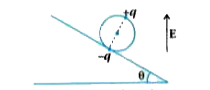 For balance of wheel, `vecF_(G) =vecF_(E)` `vecr XX vecF_(G) =vectau` `rF_(G)sintheta =pEsintheta` `rmg sintheta =pEsintheta rArr` where p = 2rq `therefore E=(mg)/(2q)` |
|
| 26. |
The resistance between points A and C in the given figure is: |
|
Answer» `3OMEGA` |
|
| 27. |
Magnetic Lorentz force cannot change the speed of a moving charge . Why? |
| Answer» SOLUTION :Since magnetic LORENTZ force ALWAYS acts perpendicular to the velocity and the magnetic field. | |
| 28. |
An alternating e.m.f. e=50sqrt2sin(100t), is connected to a capacitor C=1muF. Then the reading shown by the a.c ammeter connected in the circuit is: |
|
Answer» 2.5MA |
|
| 29. |
A bar magnet of length 10 cm and pole strength 2 Am is making an angle 60^(@) with a uniform field of induction 50T. Find the couple acting on it. |
|
Answer» Solution :Length of the bar magnet , 2l=10cm = 0.1 m pole strength , m =2Am magnetic induction , B=50T Angle between the magnetic FILED and axis of the magnet ,` theta =60^(@)` `:.`Couple ACTING on the bar magnet,` tau = MB sin theta ` `implies tau = (2 l xx m)B sin theta = ( 0.1 xx 2 ) 50 sin 60^(@)` `= 0.2 xx 50 xx (sqrt(3))/(2) = 6.66 N-m` |
|
| 30. |
There are two parallel rings R_(1) and R_(2) placed co-axially and a bar magnet whose length is kept along the axis of rings is moved as shown in figure. |
|
Answer» Rings will attract each other |
|
| 31. |
Which of the following wavelengths falls in X-rays region? |
|
Answer» `1 overset(*)A` |
|
| 32. |
A body is projected vertically upwards from the surface of a planet of radius R with a velocity equal to half the escape velocityfor that planet. The maximum height attained by the body is : |
|
Answer» Solution :K.E. = change in gravitational potential energy. `(1)/(m) ((V_(e))/(2))^(2)=(GMM)/(R+H)+(GMm)/(R )` `(1)/(2) m ((sqrt(2GM//R))/(2))^(2)=(-GMm)/(R+h)+(GMm)/(R )` Thus gives `h=(R )/(3)` Correct CHOICE is (b). |
|
| 33. |
Find integrals of given functions int(1/5 - 2/(x^3) + 2x)dx |
|
Answer» |
|
| 34. |
Choose the wron statement |
|
Answer» in isotropic medium, a ray of light is perpendicular to the wavefront |
|
| 35. |
The speed of light c, acceleration due to gravity g and pressure p are taken as fundamental units, the dimensions of gravitational constant G are : |
|
Answer» `c^(0)GP^(-3)` `M^(-1)L^(3)T^(-2)=[L^(1)T^(-1)]^(x)[L^(1)T^(-2)]^(y)[ML^(-1)T^(-2)]^(z)` `=M^(z)L^(x+y-z)T^(-x-2y-2z)` Then`z=-1,x+y+1=3,-x-2(y+z)=-z` or`-x-2y+2=-2` `-(x+y)-y=-4` `-2-y=-4` or `y=2` `x=0` `:.G=c^(0)g^(2)p^(-1)` Hence CORRECT choice is `(c )`. |
|
| 36. |
In a double slit experiment, l_(o) is the intensity of the central bright fringe obtained with monochromatic light of lambda = 6000 A^(@). Determine the intensity at a distance of 4.8xx10^(-5) m from the central maximum if the separation between the slits is 0.25 cm and the distance between the screen and the double slit is 1.20 m. |
|
Answer» SOLUTION :From the principle of superposition the resultant intensity l = `l_(1) + l_(2) + 2sqrt(l_(1)l_(2))cos delta`, where `delta` = phase difference =`(2pi)/lambda xx` path difference. At the central fringe, `delta` = 0, thus `l_(o) = l_(1)+l_(2)+2l_(1) = 4l_(1)` At a DISTANCE x from the central bright fringe, the path difference = `(xd)/D` and the corresponding Phase difference. `delta = (2pi)/lambda (xd)/D` . Hence, the resultant intensity at the assigned POSITION will be l=`l_(1)+l_(2)=2 sqrt(l_(1)l_(2)) cos delta = l_(0)/4 + l_(0)/4 + (2 l_(0))/4 cos delta` = `1/4 [1+1+2cos delta] = l_(0)/2 [1+ cos delta = l_(0) cos^(2) (delta/2)]` hence , `delta/2 = 1/2 (2pi)/lambda (xd)/D = pi/6` Thus l=`l_(0)/2 xx (sqrt(3)/2)^(2) = (3l_(0))/4 = 0.75 l_(0)` |
|
| 37. |
A block of mass 2 kg rests on a rough inclined plane making an angle of 30^0 with the horizontal. If mu_s = 0.6, The frictional force on the block is |
|
Answer» 9.8 N |
|
| 38. |
A large number of pendulums with identical bobs (mass m) but varying lengths are suspended from a thick thread. Another pendulum of a heavier bob (mass M) is also suspended from the same thred as shown. This pendulum with the heavier bob is used as a 'driver' to drive the other pendulums called as 'driven' pendulums. Assume that the amplitude of the driver is maintained constant (by some suitable mechanism). Let the frequency of the driver be f_(0) It is observed that |
|
Answer» all the pendulums EXCEPT ONE are at rest |
|
| 39. |
In an alternating current circuit consisting of elements in series, the current increases on increasing the frequency of supply. Which of the following elements are likely to constitute the circuit ? |
|
Answer» Only resistor. For a capacitive circuit, `X_C=1/(2pivC)` When the frequency increases `X_C` decreases and For a R-C circuit, `Z=sqrt(R^2+(1/(OMEGAC))^2)=sqrt(R^2+(1/(2pivC))^2)` when frequency increases X decreases. Because, circuit only with resistance if the resistance does not CHANGES and frequency changes current does not changes. Moreover,circuit with inductor as the frequency increases its reactance increases and hence current decreases but not increases. |
|
| 40. |
Show how to generalize Ampere's circuital law to include the term due to displacement current? |
|
Answer» Solution :According to Ampere's circuital law, `underset(s)( oint )vec(B)cdot vec(dl)= mu_(0)` As ther current flows across the area bounded by loop `S_(1)`,so `underset(s_(2))(oint )vec(B)cdot vec(dl)= mu_(0)`. But the area bounded by `S_(2)` lies in the REGION between the plates capacitor where no current flows across it. `underset(s_(2))(oint) vec(B)cdot vec(dl) =0.` Consider that loops enclosing S1 & S2 are infinitesimally close to each other. then `underset(s_(1))(oint )vec(B)cdot vec(dl)= underset(s_(2))(oint )vec(B)cdot vec(dl)` This equation is INCONSISTENT with equation (2) & (3). to remove this maxwell said that a CHANGING electric field (during charging ) between the capacitor plates MUST induce a magnetic field which in turn must be associated with current `I_(d)`. `I_(d) = epsilon_(0)((d phi_(E))/(dt))[ (d phi_(E))/(dt) " change in electric flux"]` The total current must be `I = I_("conduction ") + I_("displacement")` `I_(c )= epsilon_(0) (d phi_(E))/(dt)` Hence the generalised from of Ampere's circuital law is `oint vec(B)cdot vec(dl)= mu_(0) [ I_(C ) + epsilon_(0) (d phi_(E))/(dt) ]` |
|
| 41. |
Three photo diodes D_(1), D_(2)and D_(3)are made of semiconductors having band gaps of 2.5 eV, 2eV and 3eV respectively. Which of them will not be able to detect light of wavelength 600 nm? |
|
Answer» |
|
| 42. |
100 mA current gives a full scale deflection in a galvanometer of 2Omega resistance .The resistance connected with the galvanometer to convert it into a voltmeter to measure 5V is: |
|
Answer» `98Omega` |
|
| 43. |
Can we use a.c. of frequency 15(ps) for lighting purpose ? |
| Answer» Solution :Yes, because the FLUCTUATIONS in current will be so rapid (30 TIMES per SECOND ) that the bulb will appear glowing continuously due to PERSISTANCE of vision . | |
| 44. |
Which one of the following is the unit of electric field? |
|
Answer» Coulomb |
|
| 45. |
Calculate the excess pressure inside the bubble in the above problem 37. |
| Answer» SOLUTION :146 N `m^(-2)` | |
| 46. |
A mass M, attached to a horizontal spring, executes S.H.M. with aplitude A_(1). When the mass M passes through its mean position then a smaller mass m is placed over it and both of them move together with amplitude A_(2). The ratio of ((A_(1))/(A_(1))) is : |
|
Answer» `(M+m)/(M)` `Mv_(1)=(M+m)v_(2)` `MA_(1)sqrt((K)/(M))=(M+m)A_(2)sqrt((K)/(m+M))` `A_(1)sqrt(M)=A_(2)sqrt(M+m)` `:.""(A_(1))/(A_(2))=sqrt((m+M)/(M))` Correct CHOICE : ( c ). |
|
| 47. |
E,m,L and G denote energy, mass, angular momentum and gravititional constant respectively, the quantity(E.L)/(m^(5)G^(2)) has the dimensions of : |
|
Answer» angle `X=([ML^(2)T^(-2)]xx[ML^(2)T^(-1)]^(2))/(M^(5)xx[M^(-1)L^(3)T^(-2)]^(2))` `=[M^(0)L^(0)T^(0)]=` dimensionless `:.(a)`is the correct CHOICE. |
|
| 48. |
State two applications of radio waves. |
| Answer» Solution :(i) In RADIO & TELE communication systems.(II) In radio astronomy. | |
| 49. |
For a given surface the Gauss.s Law is stated as oint E.ds= 0. From this we can conclude that: |
|
Answer» E is necessarily ZERO on the surface |
|
| 50. |
A car moving with a speed of 50 km/h, can be stopped by brakes after atleast 6 m. If the same car is moving at a speed of 100 km/h, the minimum stopping distance is |
|
Answer» 12m Final speed `NU=0` Using equation of motion `nu^(2)-u^(2)=2as` `a=-(u^(2))/(2s)=-(1)/(2)((500)/(36))^(2)xx(1)/(2)=-16m//s^(2)` If `u = 100 km//h=2xx(500)/(36) ` m/s = 27.78 m/s `s= (u^(2))/(2A)= ((27.78)^(2))/(2xx16) = 24m.` |
|


