

Saved Bookmarks
This section includes 7 InterviewSolutions, each offering curated multiple-choice questions to sharpen your Current Affairs knowledge and support exam preparation. Choose a topic below to get started.
| 1. |
एक कार 200m की दूरी चलती है। यह प्रथम आधी दूरी को चाल 60km/h से तथा शेष आधी दूरी को चाल v से तय करतीहै। यदि औसत चाल 40km/h , तब v का मान होगा |
|
Answer» 30 km/h |
|
| 2. |
In the integral int(dx)/(2ax-x^(2))^(1//2)=ansin^(-1)((x)/(a)-1), the value of n should be ( by dimensions ): |
|
Answer» `1` Hence `(c )` is correct. |
|
| 3. |
A body in motion along a straight line. From position time graph Calculate it'sTime of rest of the body |
| Answer» SOLUTION :(III) Body GOES away from origin during regions OA and BC total time `(10+5)` sec = 15 seconds. | |
| 4. |
Figure represents a graph of kinetic energy (K) of photoelectrons (in eV ) and frequency (v) for a metal used as cathode in photoelectric experiment. The work function of metal is |
|
Answer» 1 eV |
|
| 5. |
In a zener diode |
|
Answer» <P>both p- and n-side are very lightly doped. |
|
| 6. |
As shown in the figure , a parallel beam of light incidents on the upper part of a prism of angle 1.8^(@) and material pf refractive index 1.5 . The light emerging out from the prism falls on a convature 40 cm. This distance of the point from the principal axis of the mirror where the light rays are focussed after reflection from the mirror is |
|
Answer» 4.76 cm `=0.9^(@) xx (pi)/(180^@)` radian This beam from prism is also parallel and is converged at point in focal PLANE by concave mirror . 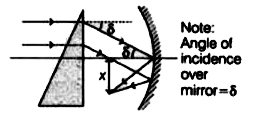 Distance `x = F xx delta= (R)/(2) xx delta = (20)/(2) xx 0.9 ^(@) xx (pi)/(180^@)` =0.157 cm = 1.57 mm |
|
| 7. |
The de Broglie wavelength of an electron in the nth Bohr orbit is related to the radius R of the orbit as: |
|
Answer» `nlambda=nR` `lambda=h/(MV)=(2pir)/N rArr 2pir=nlambda` |
|
| 8. |
In each question, there .is a table having 3 columns and 4 rows. Based on the table, there are 3 questions. Eac!h question bas 4 options (a), (b), (c) and (d), ONLY ONE of these four options is correct. In the given table, Column I shows different laws in electromagnetic theory, Column II shows the related physica l quantities and Column III shows the equations related to the different laws. {:("Column I" , "Column II" , "Column II"),((I)" ""Gauss's law (i)", " ""Magnetism"" "(J),oint vecB.dvecs=mu_(0)epsilon_(0)(dphi_(E))/(dt)+mu_(0)(dq)/(dt)),((II)"Ampere's law" ,(ii) "Current " ,(K)" "ointvecB.dvecA=0),((III) "Gauss's law " (iii),"Induction " ""(L),ointvecE.dvecs=(dphi_(B))/(dt)),((IV) "Faraday's "(iv),"Electricity" (M),ointvecE.dvecA=(q)/(epsilon)):} In which law currents or changing electric fi elds(E's) make circulating magnetic fields (B's)? |
| Answer» Answer :A | |
| 9. |
Check that the ratio ke2/G memp is dimensionless. Look up a Table of Physical Constants and determine the value of this ratio. What does the ratio signify? |
|
Answer» Solution :The given ratio is `(KE^(2))/(Gm_(e) m_(p))` Where, G = Gravitational constant Its unit is `N m^(2) kg^(−2)`. `m_(e)` and `m_(p)` = Masses of electron and proton. Their unit is kg. e = ELECTRIC charge. Its unit is C. k = Aconstant `=(1)/(4piepsilon_(0))` `epsilon_(0)` =Permittivity of free space Its unit is `N m^(2) C^(−2)`. Therefore, unit of thegiven ratio `(ke^(2))/(Gm_(e)m_(p))=([NM^(2) C^(-2)][C^(-2)])/([Nm^(2) kg^(-2)][kg][kg])` `"" =M^(0)L^(0) T^(0)` Hence, the given ratio is dimensionless. `e = 1.6 × 10^(−19) C` `G = 6.67 × 10^(−11) N m_(2) kg^(-2)` `me = 9.1 × 10^(−31) kg` `mp = 1.66 × 10^(−27) kg` Hence, the numerical value of the given ratio is . `(ke^(2))/(Gm_(e)m_(p)) = (9 xx 10^(9)xx(1.6 xx 10^(-19))^(2))/(6.67 xx 10^(-11) xx 9.1 xx 10^(-3)xx 1.67 xx 10^(-22))~~2.3 xx 10^(39)` This is the ratio of electric force to the gravitational force between a proton and an electron, keeping distance between them constant. |
|
| 10. |
Proportion of diffraction by slit ....... |
|
Answer» is directly PROPORTIONAL to |
|
| 11. |
Two identical loops, one of copper and another of constanton, are removed from a magnetic field within the same time interval. In which loop the induced current be greater ? |
| Answer» SOLUTION :Induced emf in both the LOOPS is same but induced current is more in COPPER loop because resistance of copper loop is LESSER than that of constanton loop. | |
| 12. |
A pulley is connected to the ceiling of an elevator by a massless rod. Two masses are connected as shown in figure. There is sufficient friction in the pulley axis. The acceleration of block w.r.t. earth is |
|
Answer» `(4G)/(7)` (upward) |
|
| 13. |
The function of the male sex accessory duct is |
|
Answer» STORAGE of sperms |
|
| 14. |
Two waves of intensities 1 and 41 superpose, then the maximum and minimum intensities are ...... and ...... respectively. |
|
Answer» 5I,3I `=I+4I+2 sqrt((I)(4I))XX1` `=5I=2xx2I` `=9I` `I_(min)=I_(1)+I_(2)+2 sqrt(I_(1)I_(2)) cos pi` `=I+4I+2 sqrt((I)(4I)) (-I)` `=5I-4I=1` |
|
| 15. |
In each question, there .is a table having 3 columns and 4 rows. Based on the table, there are 3 questions. Eac!h question bas 4 options (a), (b), (c) and (d), ONLY ONE of these four options is correct. In the given table, Column I shows different laws in electromagnetic theory, Column II shows the related physica l quantities and Column III shows the equations related to the different laws. {:("Column I" , "Column II" , "Column II"),((I)" ""Gauss's law", (i) "Magnetism"""(J),oint vecB.dvecs=mu_(0)epsilon_(0)(dphi_(E))/(dt)+mu_(0)(dq)/(dt)),((II)"Ampere's law" ,(ii) "Current " ""(K)," "ointvecB.dvecA=0),((III) "Gauss's law " ,(iii)"Induction " ""(L),ointvecE.dvecs=(dphi_(B))/(dt)),((IV) "Faraday's ",(iv)"Electricity" ""(M),ointvecE.dvecA=(q)/(epsilon)):} In which law does the charge create diverging electric fields? |
|
Answer» (I) (IV) (M) |
|
| 16. |
In each question, there .is a table having 3 columns and 4 rows. Based on the table, there are 3 questions. Eac!h question bas 4 options (a), (b), (c) and (d), ONLY ONE of these four options is correct. In the given table, Column I shows different laws in electromagnetic theory, Column II shows the related physica l quantities and Column III shows the equations related to the different laws. {:("Column I" , "Column II" , "Column II"),((I)" ""Gauss's law (i)", " ""Magnetism"" "(J),oint vecB.dvecs=mu_(0)epsilon_(0)(dphi_(E))/(dt)+mu_(0)(dq)/(dt)),((II)"Ampere's law" ,(ii) "Current " ,(K)" "ointvecB.dvecA=0),((III) "Gauss's law " (iii),"Induction " ""(L),ointvecE.dvecs=(dphi_(B))/(dt)),((IV) "Faraday's "(iv),"Electricity" (M),ointvecE.dvecA=(q)/(epsilon)):} Jn which law there are no magnetic monopoles invo lved? |
|
Answer» (1) (ii) (J) |
|
| 17. |
The ground state energy of hydrogen atom is-13.6 eV. What are the kinetic and potential energies of the electron in this state? |
|
Answer» Solution :The ground state energy of HYDROGEN atom is `-13.6 EV i.e., E= - 13.6 eV`. `THEREFORE `Kinetic energy of hydrogen in this state` K = - E + 13.6 V `. and potential energy of hydrogen in this state `U = 2E = 2xx (-13.6) eV = -27.2 eV` |
|
| 18. |
A mass m is raised from the surface of earth to a point which is at a height nR from the surface of earth. Change in potential energyis : |
|
Answer» nmgR `=(GMm)/(R )-(GMm)/(R(n+1))=(GMm)/(R ) [1-(1)/(n+1)]` `=(GMm)/(R )[(n+1-1)/(n+1)]=(gR^(2)m)/(R )[(n)/(n+1)]` `=(n)/(n+1)mgR` So the correct choice is (c ). |
|
| 20. |
By using light of wavelength 5200 A, two points separated by a distance of 0.12 m can just be resolved by a microscope. What will be the limit of resolution, if light of wavelength 6500 A is used ? |
|
Answer» 0.10 mm |
|
| 21. |
A silver wire has resistivity rho=1.62xx10^-8 Omegam and cross-sectional area 10.0mm^2. The current in the wire is uniform and changing at the rate of 4000A//s, when the current is 200A. (a) What is the magnitude of the electric field in the wire when the current in the wire is 200A? (b) What is the displacement current in the wire at that time (c) What is the ration of the magnitude of the magnetic field due to the displacement current to that due to the current at a distance r from the wire? |
|
Answer» Solution :Here, `rho=1.62xx10^-8Omegam`, `A=10.0xx10^-6m^2=10^-5m^2`. `(DI)/(dt)=4000As^-1, I=200A`. (a) Magnitude of the electric field in the wire when the CURRENT in the wire is 200A, is `E=rhoJ=rhol/A=((1.62xx10^-8)xx200)/(10^-5)` `=0.324Vm^-1` (b) The displacement current is `I_D=in_0 (dphi_E)/(dt)=in_0d/(dt)(EA)` `in_0A (dE)/(dt)=in_0Ad/(dt) ((rhol)/A)` `=in_0Axxrho/A((dI)/(dt)) =in_0rho(dl)/(dt)` `=(8.85xx10^-12)x(1.62xx10^-8)xx4000` `=5.74xx10^-6A` (C) Ratio of magnetic fields is `(B("DUE to" I_d))/(B("due to" I))=(mu_0 I_D//2pir)/(mu_0I//2pir)` `=(I_D)/I=(5.7f4xx10^-16)/200=2.87xx10^-18` |
|
| 22. |
A freely falling body, falling from a tower of heighth covers a distance h/2 in the last second of its motion The height of the tower is 10 ms^(-2)): |
|
Answer» 58 m `x_(nth) u+(1)/(2) a(2n-1)implies(H)/(2)=0+(1)/(2)g(2n-1)` `implies h=g(2n-1)` Also `h=ut+(1)/(2)gn^(2) implies h=0+(1)/(2) gn^(2)` `:. (1)/(2)gn^(2)=g(2n-1) implies (1)/(2)n^(2)-2n +1=0` `n^(2) -4n+2=0 implies n+(4pmsqrt(16-4xx1xx2))/(2xx1)` Now `h=(1)/(2) gn^(2)=(1)/(2)xx10xx(3.414)^(2)=58 m` |
|
| 23. |
A convex lens can be fixed at two different positions between a burning candle and a screen so as to form sharp image of candle on the screen. If I_(1) and I_(2) be the size of the images respectively for the two positions of lens then the true size of the candle is given by |
|
Answer» `(I_(1))/(I_(2))` |
|
| 24. |
Resistances of three resistors are in the proportion connected in parallel, their effective resistance is 6 Omega. Then connect on if these resistance are connect in series so equivalent resistance will be ....... |
|
Answer» `36 Omega` SUPPOSE RESISTANCE is R. `therefore`We get three resistance R : 2R : 3R. equivalent resistance on connecting these three resistance in parallel, `(1)/(6) = (1)/(R) + (1)/(2R) + (1)/(3R) = (6 + 3 + 2)/(6R) = (11)/(6R)` `therefore(6R)/(6) = 11 ` `therefore R = 11 Omega` Now each resistance `11 Omega, 22 Omega , 33 Omega` `therefore ` Equivalent resistance in series connection `R_(S) = 11 + 22 + 33 therefore R_(S) = 66 Omega` |
|
| 25. |
An iron gains kinetic energy due to the force of attraction by a magnet . What is the source of this kinetic energy ? |
| Answer» Solution :When an iron nail kept in a magnetic field , it gains some magnetic POTENTIAL energy . In this CASE , that potential energyis the source of kinetic energy of the nail . When the nail moves towards the MAGNET due to the FORCE of attraction , the potential energy of the nail decreases it is CONVERTED into the said kinetic energy . | |
| 26. |
Find capacitance between the inner and outer curved conductor surfaces (Neglect fringing) (In 2 = 0.694) |
|
Answer» `10/3` PF |
|
| 27. |
A double slit apparatus is immersed in a liquid of refractive index 1.33. It has slit separation of 1mm and distance between the plane of slit and screen 1.33m. The slits are illuminated by a parallel beam of light whose wavelength in air is 6300A^(0). One of the slits of the apparatus is covered by a thin glass sheet of refractive index 1.53. Find the smallest thickness of the sheet to bring the adjacent minima on the axis. |
|
Answer» <P> Solution :Now as the distance of a minima from adjacent maxima is `(BETA."/"2)`, so according to given problem, SHIFT`y_(0)= (D)/(d) (mu_(R ) -1)t= (beta.)/(2)""" with "mu_(r )= (mu_p)/(mu_M)` `(D)/(d)[(mu_p)/(mu_M)-1]t= (D lambda)/(2mu_(M)d)""i.e., t= (lambda)/(2(mu_(p)-mu_(M)))` So, `t= (6300xx 10^(-10))/(2(1.53-1.33))= 1.75 mu m`. |
|
| 28. |
A double slit apparatus is immersed in a liquid of refractive index 1.33. It has slit separation of 1mm and distance between the plane of slit and screen 1.33m. The slits are illuminated by a parallel beam of light whose wavelength in air is 6300A^(0). Calculate the fringe width. |
|
Answer» SOLUTION :As FRINGE width `BETA= (D lambda"/"d)` and by presence of medium the WAVELENGTH becomes `(lambda"/"mu)`, so the fringe width in liquid will be `beta.= (D lambda)/(mu d)= (1.33xx 6300xx 10^(-10))/(1.33xx 1 xx 10^(-3))= 0.63mm`. |
|
| 29. |
यदि कोई वस्तु एक उत्तल लेंस के सामने 2f दूरी पर रखी है तो लेंस से उसके प्रतिबिम्ब की दूरी होगी |
|
Answer» f |
|
| 30. |
In the previous question, the height attained by the rocket before deceleration is : |
| Answer» ANSWER :B | |
| 31. |
A barometer tube of length 0.99m reads 0.76m The volume of air measured at atmospheric pressure to be introduced into space to cause of length of mercury column to drop to 0.57m is (the cross section of the barometer tube is 0.1cm^(2))? |
|
Answer» `10.5cc` 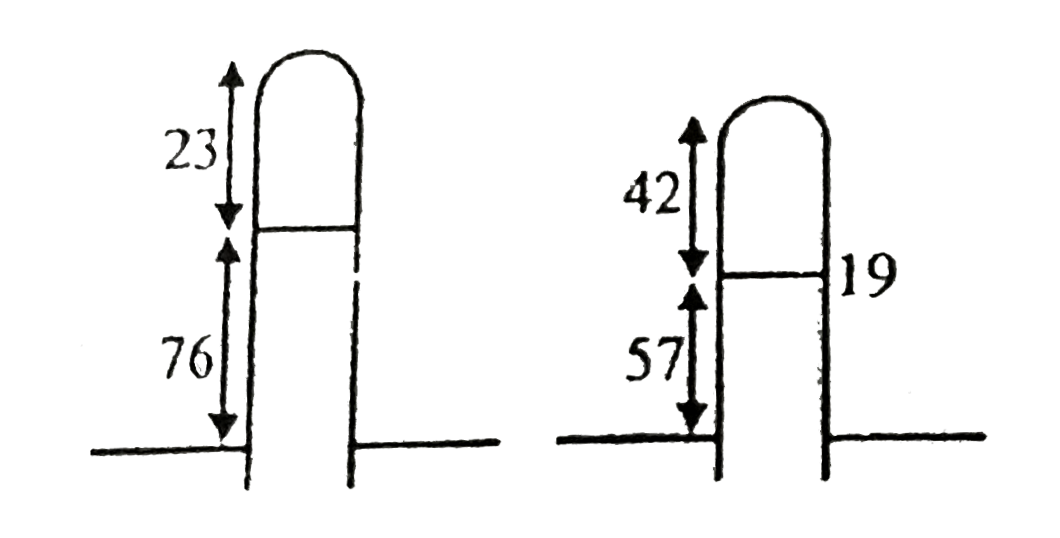 `10xx42 = 76xxL` `10.5cmxx1cm^(2) = 10.5` |
|
| 32. |
Two bodies whose masses are in the ratio 2:1 are dropped simultaneously at two placesA and B where the accelerations due to gravity are g_(A) and g_(B) respectively.If they reach the ground simultneously ,the ratio of the heights from which they are dropped is |
|
Answer» `g_(A):g_(B)` |
|
| 33. |
An ideal gas is taken from state A to state B following three different paths as shown in P-V diagram. Which one of the following is true ? |
|
Answer» work done is maximum along AB = minimum along ADB |
|
| 34. |
A zener diode is fabricated by heavily doping both p- and -sides of the junction. Explain why ? Breifly explain the use of zener diode as a d.c. voltage regulator with the help of a circuit diagram. |
|
Answer» Solution :Zener diode is icated by heavily doping both p- andn- sides of the p-n JUNCTION. As a result, the depletion region formed is very thin, even less than `10^(6)` m, and consequently the electric field at the junction is extremely HIGH (of the order of `5 XX 10^(6)` V/m or even more) even for a small reverse bias voltage of about 5 V and breakdown voltage has a low value of about 5 V. A zener diode is used to GET a constant d.c. voltage from the unregulated filtered output of a full-wave rectifier. The circuit diagram is shown in . The unregulated d.c. voltage is connected to zener diode through a series resistance `R_(s)`, . Of course zener diode is connected in reverse bias arrangement. Output voltage is obtained across load resistor `R_(L)` which is joined in parallel to zener diode . If the zener voltage increases, the current through `R_(s)` and zener diode also increases. This increase the voltage drop across `R_(s)` but voltage drop across zener diode (or load `R_(I)`) remains constant. This is because in the breakdown region, zener voltage remains constant even though the current through the zener diode changes. Again if the input d.c. voltage decreases, current through `R_(s)` and zener diode decreases. The voltage drop across `R_(s)` decreases but voltage drop across zener diode (or load `R_(I)`) remains practically constant. Thus, any increase/decrease in the input voltage `V_(i)` results in an increase/decrease of the voltage drop across `R_(s)` without any change in voltage across the zener diode. Hence, the zener diode acts as a voltage regulator, in which the output d.c. voltage is constant at the zener (breakdown) voltage `V_(z)` of the zener diode. 
|
|
| 35. |
What should we never do? |
|
Answer» Never THINK ill of others |
|
| 36. |
In stationary waves the distance between a node and nearest antinodes is equal to: |
|
Answer» `LAMDA` |
|
| 37. |
Velocity vectors of three masses 2 kg, 1 kg and 3 kg are vecv_1=(hati-2hatj+hatk)m/s, vecv_2=(2hati+2hatj-hatk)m/sand vecv_3 respectively. If velocity vector of center of mass of the system is zero then value of vecv_3 will be |
|
Answer» `(FRAC{2hati+2hatj-hatk}{3})` m/s |
|
| 38. |
A 40 omega resistance is connected to a 200 sqrt2 V, 50 Hz main supply. The peak value of the current flowing in the circuit is : |
|
Answer» 5 A |
|
| 39. |
In Young.s double silt experiment the y co-ordinates of central maxima and 10th maxima are 2cm and 5 cm respectively. When theapparatus is immersed in a liquid of refractive index 1.5 the corresponding y co-ordinates will be : |
| Answer» Solution :Fringe WIDTH `beta propto LAMBDA`. Therefore, and hence `beta` will decrease `1.5` times when immersed in liquid. The DISTANCE between central maximum and 10TH maxima is 3 cm in vacuum. When immersed in liquid it will reduce to `(3)/(1.5)= 2cm`. Position of central maxima will not change while 10th maxima will be obtained at y= 4CM. | |
| 40. |
A mass m hangs with the help of a string wrapped around a pulley on a frictionless bearing. The pulley has mass m and radius R. Assuming pulley to be a perfect uniform circular disc, the acceleration of the mass m if the string does not slip on the pulley, is |
|
Answer» g `((1)/(2)mR^(2)+mR^(2))alpha=mg.R` `THEREFORE (3)/(2)mR^(2)alpha=mgR` `therefore alphaR=((2)/(3))g` `therefore` Acceleration .a. of the mass m is `((2)/(3))g`. |
|
| 41. |
A rubber ball is dropped from a height of 5 m on a planet where the acceleration due to gravity is not known. On bouncing it rises to 1.8 m. The ball loses its velocity on bouncing by a factor of: |
|
Answer» `(16)/(25)` Then `(v_2)/(v_1)=sqrt((2gph2)/(2gph1))=sqrt((1.8)/(5))=sqrt((9)/(25))=(3)/(5)` Now `(v_1-v_2)/(v_1)=1-(v_2)/(v_1)=1-sqrt((18)/(50))=13//5=2//5` |
|
| 42. |
In a hydrogen like atom electron make transition from an energy level with quantun number n to another with quantum numbe (n-1). If ngtgt1, the frequency of radiatioi emitted is proportional to ..... |
|
Answer» `(1)/(n^(3))` `(f_(ik))/(c)=R((1)/((n-1)^(2))-(1)/(n^(2)))""[:.c=lamda_(ik)f_(ik)]` `=R[(1)/(n^(2)(1-(1)/(n))^(2))-(1)/(n^(2))]` `R=[(1)/(n^(2)){(1-(1)/(n))^(-2)-1}]` `=R[(1)/(n^(2)){1+(2)/(n)-1}]` First two TERMS of binomial EXPANSION. `R=[(2)/(n^(3))]` `f_(ik)=(2Rc)/(n^(3))` `:.f_(ik)PROP(1)/(n^(3))""` [2 Rc is constant] `:.FPROP(1)/(n^(3))` |
|
| 43. |
What is crime against humanity? |
|
Answer» CHILD Slavery |
|
| 44. |
Two charges 2muC and -2muC are placed at points A and B 6cm apart. a. Identify an equipotential surface of the given system. (b) What is the directionof the electric field at every point on this surface? |
Answer» SOLUTION :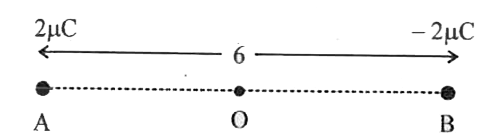 a. A surface CONTAINING equatorial LINE and PERPENDICULAR line. b.Towards the side of -ve CHARGE, parallel to axis. |
|
| 45. |
In Young's double slit experiment parallel monochromatic light is incident on both the slits at an angle as shown in the figure. To obtain the central maxima at on the screen we can |
|
Answer» place a thin glass sheet of appropriate thickness in front of slit `S_(1)`. |
|
| 46. |
When the speed of electrons increases, then the value of its specific charge |
|
Answer» Increases |
|
| 47. |
The gap between the plates of a plane capacitor is filled with an isotropic insulator whose di-electric constant varies in the direction perpendicular to the plates according to the law K=K_1 [1+sin (pi )/( d) X]where d is the separation, between the plates & K_1 is a constant. The area of the plates is S. Determine the capacitance of the capacitor. |
|
Answer» |
|
| 48. |
What is magnetic Lorentz force ? |
| Answer» SOLUTION :The force experienced by a CHARGED particle, when MOVING inside magnetic field is called magnetic lorentz foce, GIVEN by `oversettoF=q(oversettoVxxoversettoB)` and magnetic is given by `F_m=Bqvsintheta` | |
| 49. |
The fig. below is the distribution of charges. The flux of electric field due to these charges through the surface is : |
|
Answer» `(3Q)/in_0` |
|
| 50. |
A voltmeter of resistance 1000Omegacan read upto 150volt when a resistance of 9000 Omega is connected in series with it.The voltage range of galvanometer is : |
|
Answer» 1.5V |
|
