

Saved Bookmarks
This section includes 7 InterviewSolutions, each offering curated multiple-choice questions to sharpen your Current Affairs knowledge and support exam preparation. Choose a topic below to get started.
| 1. |
If light passes near a massive object, the gravitational interation causes abending of the ray. This can be thought of as heappening due to a change in the effective refrative index of the medium given by n(r) =1 +2 GM//rc^2 where r is thedistance of the point of consideration from the centre of the mass of the massive body, G is the universal gravitational constant, M the mass of the body and c the speed of light in vacuum. Considering a spherical object find the deviation of the ray form the original path as it graxes the object. |
Answer» Solution : `rArr` As shown in the figure , when light ray passes tangentially to the surface of central massive body of mass M and radius R , suppose it gets deviated by amount `d theta` within distacen dr. `rArr` Now, applying Snell.s law at the point where light ray is made incident on the concentric spherical suface at distance, r, FROMTHE centre of central massive body we GET , `n sin theta = (n + dn) sin ( theta + d theta)` `thereforen sin theta = (n + dn) (sin theta cos d theta + cos theta sin d theta)` `therefore n sin theta = n sin theta cos ( d theta) + n cos (d theta) + n cos theta sin (d theta) + (dn) sin theta cos (d theta) + (dn) cos theta sin (d theta)` `rArr` Since ` dtheta` is extremely small, we can take `sin (d theta ) = (d theta)` and taking`cos (theta) = ` `n sin theta =n sin theta + n cos theta (d theta)+ (dh) sin theta + (dn ) cos theta (d theta)` `therefore 0 = n cos theta( because (dn)(cos theta) (dtheta ` is negligible) `therefore - (dn) sin theta = n cos theta (d theta)` ` therefore - ((dn)/(dr)) sin theta = n cos theta ((d theta)/(dr))` `therefore - ((dn)/(dr)) tan theta = n ((d theta)/(dr))`.....(1) `rArr` From the statement , `n = 1 + (2GM)/(rc^2)` `therefore (dn)/(dr) = 0 + (2GM)/(c^2) (-(1)/(r^2)) [ because (d)/(dr)(1/r)= - (1)/(r^2)]` `therefore (dn)/(dr) = 0 + (2GM)/(r^2c^2)` ......(2) `rArr` From equation (1) and (2) , `(2GM)/(r^2c^2) tan theta = (1 + (2GM)/(rc^2))(d theta)/(dr)` `rArr` Here inside the backet on R.H.S `(2GM)/(rc^2) lt lt lt lt 1` and so neglecing it, `(2 GM)/(r^2 c^2) tan theta = (d theta)/(dr)` `therefored theta = (2GM)/(c^2) ((tan theta)/(r^2))dr ....... (3)` `rArr`From the figure `r^2= x^2 + R^2` .......(4) `therefore 2r dr = 2x dx+ 0` `therefore r dr = x dx rArr dr = (xdx)/(r)` ......(5) `rArr` From EQUATIONS (3) and (5), `d theta = (2GM)/(c^2) (tan theta)/(r^3)x dx ......(7)` `rArr` Here, `r^2 = x^2 + R^2` `therefore (r^2)^(3//2) = (x^2 + R^2)^(3//2)` `therefore r^3 = (x^2 +R^2)^(3//2)` ......(8) `rArr` From equaitons (6),(7) and (8), `d theta = (2GM)/(c^2) (R)/(x^2 + R^2)^(3//2)dx .....(9)` `rArr` Nowsuppose, `x = R tan theta phi` `therefore dx = R sec^2 phi d phi` .......(11) `rArr` Now, `(x^2 + R^2)^(3//2) = (R^2 tan^2 phi + R^(2))^(3//2)` `= (R^2 sec^2 phi )^(3//2)` ` = R^3 sec^3 phi` ........(12) `rArr` From equaitons (9),(11),(12), `d theta = (2GM)/(Rc^2) cos phi " d " phi`.......(13) `rArr` From equation (10), if ` x= - oo " then " phi = - (pi)/(2)` rad `x = + oo` then `phi = l (pi)/(2)` rad `rArr` Also when ` x = - oo, theta = 0` `x= + oo, theta - theta_0` Taking intergration on both the SIDES of eqation (13), `int_(0)^(theta0) d theta = (2GM)/(Rc^2) int_(-pi/2)^(+pi/2) cos theta " d "theta` `therefore theta_0 = (2GM)/(Rc^2){sin phi}_(-pi/2)^(+pi/2)` ` = (2GM)/(Rc^2){sin (pi/2) - sin (- pi/2)}` `thereforetheta_0 = (4GM)/(Rc^2)` `rArr` Above equation gives required result. |
|
| 2. |
Obtain the relation between incidence angle, emergence angle, prism angle and deviation angle for refraction through prism |
Answer» Solution :In figure the cross-section perpendicular to the rectangular surface of a PRISM made up of a transparent medium is shown. A ray of monochromatic light is incident at point Q on the AB surface of the prism. According to Snell.s Law, it is refracted and travels along path QR. It experiences deviation `delta_1`, at point Q. Ray QR is incident on surface AC at point R and suffering deviation `delta_2`, due to refraction emerges in the direction RS. If the incident ray PQ is extended it advances in QE direction. When the emergent ray RS is extended backwards it meets PE in D. Incidence angle : Angle made by incident ray at a point on surface with normal is called incidence angle. `anglePQK = i` Refracted angle : Angle made by refracted ray at a point on surface with normal is called refracted angle. `angleRQL = r_1`, and `angleQRL = r_2` EMERGENCE angle : Angle made by emergent ray with normal of surface is called emergence angle. `angle`TRS = e Angle of Deviation : “Angle between incident ray and emergent ray is called angle of deviation `(delta)`”. `angle epsilon DS =delta` In the figure in `squareAQLR,` `angleAQL = 90^@` and `angleARL= 90^@`are right angle. `therefore angleA+angleQLR=180^@` ... (1) Now, in `triangleQLR` `r_1+r_2+angleQLR=180^@` ...(2) From EQUATION (1) and (2), `r_1+r_2+angleQLR=angleA+angleQLR=180^@` `therefore r_1+r_2=angleA` ... (3) From the geometry of the figure angle of deviation `delta` is the EXTERIOR angle for `angleDQR i.e. angleEDS = angleDOR` `therefore angleEDS=angleDQR+angleDRQ` `therefore delta=delta_1+delta_2` but, `angleDQR = angleDQL – angleRQL ` `delta_1=i-r_1`[`because angle PQK=angleDQL=i]` and,`angleDRQ=angleDRL-angleQRL` `delta_2=e-r_2` `delta=i-r_1+e-r_2` `delta=i+e-(r_1+r_2)` `thereforedelta=i+e-A` [`because` equation (3)] `thereforei+e=A+delta` This equation gives the RELATION between angle of deviation, angle of incident, angle of emergence and angle of prism. From above equation we say that angle of deviation depends on the angle of incidence. |
|
| 3. |
When one atom of ""_(92)U^(235)undergoes fission, 200 MeV energy is released. Calculate the amount of energy released using 0.5 grams of it. |
|
Answer» |
|
| 4. |
If accelerating potential increases from 20 kV to 80 kV in an electron microscope, its resolving power R would change to : |
|
Answer» Solution :(c ) `R prop (a)/(lambda) prop (1)/(lambda)` `THEREFORE lambda=(h)/(sqrt(2m_(e)V))prop(1)/(sqrt(V))` `therefore R. = 2R` |
|
| 5. |
The thermistors are usually made of |
|
Answer» Metals with low TEMPERATURE coefficient of RESISTIVITY |
|
| 6. |
A particle is projected vertically with velocity vecu.The velocity of the particle when it returns back to the point of throw is |
| Answer» Answer :B | |
| 7. |
What is the main function of a soft iron core used in a moving coil galvanometer? |
|
Answer» Solution :(i) This makes the MAGNETIC field radial. In such a magnetic field the plane of the coil is always parallel to the direction of magnetic field. Due to it, the galvanometer scale BECOMES linear. (ii) This increases the strength of magnetic field due to the CROWDING of the magnetic lines of force through the soft iron core, which in TURN increases the sensitiveness of the galvanometer. |
|
| 8. |
the magnetic field shown in the figure consist of the two magnetic fields. If v is the velocity just required for a charge particles of mass m and charge q to pass through the magnetic field. Particle is projected with velocity 'v' then how much time does such a charge spend in the magntic filed- |
|
Answer» `(PIM)/(2qB)` 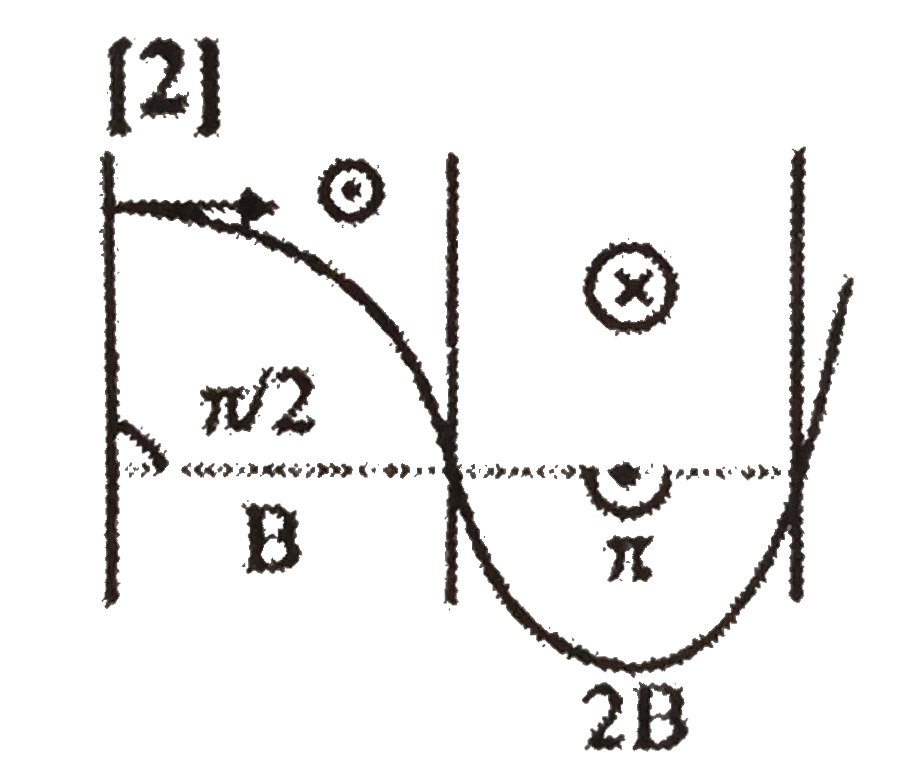 TIME `= (pim)/(2qB) + (pim)/(2qB) = (pim)/(qB)` |
|
| 9. |
The counting rate observed from a radioactive source at t=0 second was 1600 counts per second and t =8 seconds it was 100 counts per second. The counting rate observed as counts per second t=6 seconds will be |
|
Answer» 250 |
|
| 10. |
The sound waves after being converted into electrical waves, are not transmitted as such because |
|
Answer» they TRAVEL with the speed of sound |
|
| 11. |
Consider a zener diode with the breakdown voltage 6.2V.Write any one application of zener diode |
| Answer» SOLUTION :VOLTAGE REGULATOR | |
| 12. |
A current of 2 A is flowing through a cjrcular coil of radius 10 cm containing 100 turns. Find the magnetic flux density at the centre of the coil. |
|
Answer» Solution :Given i = 2A , r =10 cm ` = 10 xx 10^(-2) m , N = 100` Flux DENSITY at the centre of .N. turn COIL is given by, `B = N (mu_0i)/(2R) = 100 xx (2pi xx 10^7 xx 2)/(10 xx 10^(-2))` `= 1.26 xx 10^(-3) Wb//m^2` |
|
| 13. |
An artificial satellite with a metal surface is orbiting the earth in equatorial plane. Why no current is induced due to earth's magnetism? |
| Answer» SOLUTION :This is because there is no CHANGE of magneticflux LINKED with the SATELLITE. | |
| 15. |
A beam of light falls on a glass plate (mu=3//2) of thickness 6.0 cm at an angle of 60^(@). Find the deflection of the beam on passing throug the plate. (incm). |
|
Answer» |
|
| 16. |
A stone is released from an aeroplane which is rising with upward acceleration 5 m s^(-2). Here g = 10 m s^(-1)The seconds after the release , the saparation between stone and aeroplane will be |
| Answer» ANSWER :C | |
| 17. |
The collector supply voltage is 6 V and the voltage drop across a resistor of 600 Omega in the collector circuit is 0.6 V , in a transistor connected in common emitter mode . If the current gain is 20 , the base current is |
|
Answer» 0.25 mA |
|
| 18. |
___ of an intrinsic semiconductor increases with increase in temperature but its ____ decreases with increase in temperature. |
| Answer» SOLUTION :ELECTRICAL CONDUCTIVITY, RESISTIVITY | |
| 19. |
What would be the radius of second orbit of He^(+) ions? |
|
Answer» `1.058 Å` For `He^(+) ion, n = 2, Z = 2` `THEREFORE r_(2) = (4)/(2)xx0.529 Å = 1.058 Å` |
|
| 20. |
The voltage across a resistance R is determined using a voltmeter connected to its ends. What relative error will be made if the readings of the voltmeter are taken as the voltage applied before it was switched on ? The current intensity in the circuit is constant. |
|
Answer» `(R )/(R_(0))` |
|
| 21. |
A (current vs time) graph of the current passing through a solenoid is shown in figure. For which time is the back electromotive force (epsilon) a maximum. If the back emf at t = 3s is e, find the back emf at 1 = 7 s, 15 s and 40 s. OA, AB and BC are straight line segments. |
|
Answer» Solution :When rate of change of flux is maximum then induced emf is also t = 10 sec maximum. In graph at t = 5 sec. to slope is maximum, hence rate of change of flux is also maximum and induced emf will also be maximum. For t=0 s to t=5 s , slope `(dI)/(dt)=1/5As^(-1)` Back emf `epsilon=(-LDI)/(dt)` So for t=0 to t=5s (At t=3 s also) Back emf=E=`-L(1/5)=(-L)/5` `therefore e=(-L)/5` ...(1) (i)For 5s `LT t lt 10 s` slope `(dI)/(dt)=(-3)/5 As^(-1)` Back emf for t=5 s to t=10 s, (At t=7s as well) `e_1=(-LdI)/(dt)=-L((-3)/5)` `-3((-L)/5)` `e_1=-3s [ because e=(-L)/5]` (ii) For 10s to `t lt 30` s slope `(dI)/(dt)=2/20=1/10 As^(-1)` Back emf at t=15 s is , `e_2=-L xx (dI)/(dt)` `-LXX(+1/10)` `=(-L)/10=1/2 e [ because e=(-L)/5]` (iii)At `t ge 30s` , slope =0 , So, at t=40 s back emf `e_3=0` Thus at t=7 s induced emf `e_1=-3e` at t=15 s induced emf `e_2=e/2` at t=40 s induced emf `e_3=0` |
|
| 22. |
The light of wavelength 600 nm is incident normally on a slit of width 3 mm. Calculate the linear width of central maximum on a screen kept m awy from the slit. |
|
Answer» |
|
| 23. |
The mass of a nucleus ._(Z)^(A)X is less that the sum of the masses of (A-Z) number of neutrons and Z number of protons in the nucleus.The energy equivalent to the corresponding mass difference is known as the binding energy of the nucleus. A heavy nucleus of mass M can break into two light nuclei of masses m_(1) and m_(2) only if (m_(1)+m_(2)) lt M. Also two light nuclei of masses m_(3) and m_(4) can undergo complete fusion and form a heavy nucleus of mass M'. only if (m_(3)+m_(4)) gt M'. The masses of some neutral atoms are given in the table below: |{:(._(1)^(1)H ,1.007825u , ._(1)^(2)H,2.014102u,._(1)^(3)H,3.016050u,._(2)^(4)He,4.002603u),(._(3)^(6)Li,6.015123u,._(3)^(7)Li,7.016004u,._(30)^(70)Zn,69.925325u, ._(34)^(82)Se,81.916709u),(._(64)^(152)Gd,151.91980u,._(82)^(206)Pb,205.974455u,._(83)^(209)Bi,208.980388u,._(84)^(210)Po,209.982876u):}| The correct statement is: |
|
Answer» The nucleus `._(3)^(6)Li` can emit an alpha particle `Deltam=][M_(Li)-M_(He)-M_(H^(3))]` `=[6.01513-4.002603-3.016050]` `= -1.003523u` `Delta m` is NEGATIVE so reaction is not possible. (B) `84^(Po^(210))rarr83^(Bi^(209))+1^(P^(1))` `Delta m` is negative so reaction is not possible. (c ) `1^(H^(2))rarr2^(He^(4))+3^(Li^(6))` `Deltam` is Positive so reaction is possible. (D) `30^(Zn^(70))+2^(Se^(82))rarr64^(Gd^(152))` `Deltam` is Positive so reaction is not possible. |
|
| 24. |
The electron emitted in beta- radiation originates from |
|
Answer» electrons PRESENT inside the nucleus |
|
| 25. |
A metal cube of each side 0.05 m long emits 0.6 kcal in 80 second. The emissive power of its surface is |
|
Answer» `0.5 kcal/m^2 SEC` |
|
| 26. |
If charge q_1 and q_2 lies inside and outside respectively of a closed surface S. Let E be the electric field at any point on S andϕ be the electric flux over S. Select the incorrect option. |
|
Answer» If `q_1` = 0 and `q_2 ≠0`,then E=0 but `ϕ ≠ 0` |
|
| 27. |
Where the weight of a man is more ? at the surface of the earth or at it’s centre ? |
|
Answer» Solution :The value of G at a depth`R//2`from the surface of the EARTH is`g'=g[g-(d/R] g'=g[1-(R/2R)=g/2` The WEIGHT of the body=mg'=100/2=50N`the earth is`g'=g[1-d/R]g'=g[1-R/(2R)]=R/2`The weight of the body `=mg'100/2=50N` |
|
| 28. |
(a) Calculate the potential at a point P due to a charge of 4 xx 10^(-7) Clocated 9 cm away. (b) Hence obtain the work done in bringing a charge of2 xx 10^(-9) Cfrom infinity to the point P. Does the answer depend on the path along which the charge is brought ? |
|
Answer» Solution :(a) ` V = (1)/(4PI epsi_0) Q/R = 9 xx 10^9 Nm^2 C^(-2) xx (4 xx 10^(-7))/(0.09 m)` ` = 4 xx 10^4 V` (b) ` W = qV = 2 xx 10^(-9) C xx 4xx 10^4 V` `= 8 xx 10^(-5) J` No, work done will be path independent. Any arbitrary infinitesimal path can be resolved into TWO perpendicular displacements : ONE along and another perpendicular to r. The work done corresponding to the later will be zero. |
|
| 29. |
Mini's mother asked her to go inside because |
|
Answer» the WEATHER was windy. |
|
| 30. |
The spectral line for a given element in light received from a distance satr is shifted towards longer wavelength by 0.32 % . What is velocity of star is C = 3 xx 10^(8) m/s |
|
Answer» `9.6 XX 10^(4)` m/s Recession SPEED of star is `U_(s) = C(Delta lambda)/(lambda) ` `U_(s) = 3 xx 10^(8) ((0.32)/(100) ) ` `U_(s) = 9.6 xx 10^(5) ms^(-1)`. Hence the correct choice is (d) . |
|
| 32. |
The percengate error in the second reading is |
|
Answer» 0.11 |
|
| 33. |
A satellite is placed in a circular orbit about Earth with radius equal to half the radius of the moon· s orbit. Period of rotation of the satellite is n times that of the lunar month (lunar month is the period of revolution of the. moon). The value of n is |
|
Answer» `2^(-3//2)` |
|
| 34. |
A plano-convex lens of refractive index 1.5 and radius of curvature 30 cm is silvered at the curved surface, Now this lens has been used to form the image of an object. At what distance from this lens an object be placed in order to have a real image of the size of the object : |
Answer» Solution :(d) to get real image of size of object, the object must be placed at centre of curvature of EQUIVALENT MIRROR formed due to silvering.  `(1)/(F) = (1)/(f_(1)) + (1)/(f_(m))` and `(1)/(f_(1)) = ((1)/(oo)-(1)/(30))=(1)/(60)` But `f_(m) = 15 cm` then `(1)/(F) = (1)/(15) + (2)/(60) = (1)/(10)` F = 10 cm, So distance of object = 2F = 20 |
|
| 35. |
A very long uniformly charged cylinder (radius R) has a surface charge density sigma . A very long uniformly charged line charge( linear charge density lambda) is placed along the cylinder axis. If electric field intensity vector outside the cylinder is zero then : |
|
Answer» `lambda=Rsigma` |
|
| 36. |
En electron - positron pair is produced when a gamma - ray photon of energy 2.36MeV passes close to a heavy nucleus. Find the kinetic energy carried by each particle produced , as well as its total energy. |
|
Answer» Solution :The REACTION is represented by `GAMMA rarr (""_(-1)e^(0))+(""_(+)e^(0)),` so that `E=m_(0).C^(2)+K.E.` (electron) `+m_(0)c^2+` K.E. (positron) `2.36 MEV = 2m_(0) .c^2+K.E` (electron) + K.E (positron) ` = 1.02MeV + K.E (e^(-))+K.E(e^(+))` `:. ` Kinetic energy of electron or position `KE (e^(-))=K.E(e^(+))=1/2(2.36 - 1.02)MeV` , K.E . carried each = 0.67 MeV (motional energy) Total energy shared by each particle is obviously `m_(0).c^(2)+K.E = 0.51 MeV + 0.67 MeV` = 1.18 MeV |
|
| 37. |
Which one of the following is not transducer? |
|
Answer» LOUDSPEAKER |
|
| 38. |
The diameter of the eye-ball of a normal eye is about 2.5 cm . The power of the eye lens varies from |
| Answer» Answer :d | |
| 39. |
A : It is impossible to see an object as small as an atom regardless of the quality of light used by microscope. R : In order ..see.. an object, wave length of light in the microscope must be comparable to the size of object. |
|
Answer» Both A and R are TRUE and R is the correct explanation of A |
|
| 40. |
The speed of sound in agas at N.T.P. is 300 ms^(-1). If the pressure increases 4 times without change in temperature, the velocity of sound will be |
|
Answer» 150 `ms^(-1)` |
|
| 41. |
It is possible to exert an pressure on an objectby shining a beam of light from a small lampfilament. Why? |
| Answer» Solution :ELECTROMAGNETIC WAVE transport momentum and deliver it to a BODY(Radiation PRESSURE) | |
| 42. |
Foran oblique projection find the ratio of solpe at any instantto theinitial slope if , x R denotehorizontal distanceand horizontal range . |
| Answer» SOLUTION :`(1-(2X)/(R))` | |
| 43. |
In an experiment with a capacitor, the charge which was stored is measured for different values of changing p.d. The results are tabulated as follows: a. Plot a graph with charge on Y - axis and p.d. on X axis. Using the graph, calculate the capacitance of the capacitor. |
Answer» SOLUTION :a. 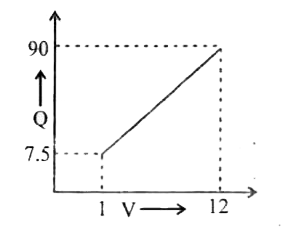 B. `C=Q/V=7.5muF` |
|
| 44. |
Which part of electromagnetic spectrum is absorbed from sunlight by ozone layer? |
| Answer» Solution :Ultraviolet ray PART of ELECTROMAGNETIC spectrum from SUNLIGHT is absorbed by OZONE LAYER. | |
| 45. |
A vessel containing 1 mole of O_(2) gas (molar mass 32) at a temperature T. The pressure of the gas is P. An identical vessel containing one mole of He gas (molar mass 4) at temperature 2 T has a pressure of : |
|
Answer» P/8 `thereforeP_(1)V=n_(1)RT_(1)` and `P_(2)V=n_(2)RT_(2)`. `THEREFORE(P_(2))/(P_(1))=(n_(2))/(n_(1)).(T_(2))/(T_(1))rArrP_(2)=Pxx1xx2=2P` `therefore` CORRECT CHOICE is (b). |
|
| 46. |
Five resistor each having value of 4 Omega are connected with ideal battery and ammeter as shown in figure. Find reading of ammeter. |
Answer» Solution :When 4 resistances each of VALUE`4 Omega` are connected in parallel equivalent resistance would be `(R)/(N) = (4)/(4) = 1 Omega`. Hence , above circuit can be redrawn as FOLLOWS :  Currne in the ammneter in above CLOSED loop is , `I= (epsilon )/(R_(eq))= (2)/(4 + 1 ) = (2)/(5) = 0.4 ` A  Equivalent resictance of pair of resistors,` = (4 xx 4)/(4 + 4 ) =(16)/(8) =2 Omega` Equivalent resistance of circuit , `R = (2 xx 2 )/(2 + 2 ) + 4 ` =1 + 4 = 5 `Omega` `therefore ` Current in AMMETER I ` = (epsilon)/(R)` `I =(2)/(3)` I = 0.4 A |
|
| 47. |
Water has the specific heat 4,186kJ/kg*""^(@)C, a boiling point of 100^(@)C, and a heat of vaporisation of 2,260kJ/kg. a sealed beaker contains 100g of water that's initially at 20^(@)C. If the water absorbs 100 kJ of heat, what will its final temperature be? |
|
Answer» `100^(@)C` `Q=mcDeltaT=(0.1kg)(4.186kJ//kg*""^(@)C)(100^(@)C-20^(@)C)=33kJ` Once the water REACHES `100^(@)C` any ADDITIONAL heat will be absorbed and begin the transformation to steam. to completely VAPORIZE the sample requires. `Q=mL=(0.1kg)(2260kJ//kg)=226kJ`. SINCE the `20^(@)C` water absorbed only 100 kJ of heat, enough heat was provided to bring the water to boiling, but enough to completely vaporize it (at which point, the absorption of more heat would begin to increase the temperature of the steam). thus, the water will reach and remain at `100^(@)C`. |
|
| 48. |
The fundamental frequency of a sonometer wire carrying a block of mass 1 kg and density 1.8 is 260. When the block is completely immersed in a liquid of density 1.2 then what will be its new frequency ? |
| Answer» Answer :B | |
| 49. |
An airplane flying at a distance of 10 km from a radio transmitter receives a signal of intensity 28 muW//m^(2) . What is the amplitude of the (a) electric and (b) magnetic component of the signal at the airplane ? ( c) If the transmitter radiates uniformly over a hemisphere what is the transmission power ? |
| Answer» SOLUTION :(a) `0.15 V//m , (b) 0.48 ` nT , ( c) 18 KW | |
| 50. |
A point charge +10mu C is at a distance 5 cm directly above the centre of a square of side 10 cm, as shown in figure. What is the magnitude of the electric flux through the square? (Hint: Think of the square as one face of a cube with edge 10cm) |
|
Answer» Solution :`phi=1/epsi_(0) Q=(1 xx 10 xx 10^(-6))/(8.85 xx 10^(-12)) =1.13 xx 10^(6) NM^(2) C^(-1)` Flux through the square `=(1.13 xx 10^(6))/(6) =1.88 xx 10^(5)Nm^(2) C^(-1)` |
|