

Saved Bookmarks
This section includes 7 InterviewSolutions, each offering curated multiple-choice questions to sharpen your Current Affairs knowledge and support exam preparation. Choose a topic below to get started.
| 1. |
A 0.50 gm ball carries a charge of magnitude 10 muC. It is suspended by a string in a downard electric field of intensity 300 N/C. If the charge on the ball is positive, then the tension in the string is multiplies of 10^(-3) N is : (g = 10 ms^(2)) |
|
Answer» |
|
| 2. |
A proton and an alpha-particle have the same de-Broglie wavelength. Determine the ratio of (i) their accelerating potentials (ii) their speeds. |
|
Answer» <P> Solution :As PER QUESTION `lamda_(p)=lamda_(alpha)` but `lamda=(h)/(sqrt(2qmV))=(h)/(mv)`(i) `THEREFORE (h)/(sqrt(2em_(p)V_(p)))=(h)/(sqrt(2(2e)(4m_(p))V_(alpha)))implies 2em_(p)V_(p)=16em_(p)V_(alpha)implies(V_(p))/(V_(alpha))=(8)/(1)` (ii) Again `lamda=(h)/(m_(p)v_(p))=(h)/(4m_(p)v_(alpha))implies m_(p)v_(p)=4m_(p)v_(alpha)implies(v_(p))/(v_(alpha))=4/1`. |
|
| 3. |
In an LC circuit, resistance of the circuit is negligible. If time period of oscillation is T then : (iii) at what time is the total energy shared equally between the inductor and capacitor. |
| Answer» SOLUTION :(III) `t= (T)/(8), (3T)/(8),(5T)/(8),….........` | |
| 4. |
A convex lens with focal length 15 cm forms an image with magnification 3. Determine the position of object and image if image obtained is erect in nature. |
| Answer» SOLUTION :`-10CM, -30CM` | |
| 5. |
The dispersive powers of crown and flint glasses are 0.03 and 0.05 respectively. The difference in refractive indices for blue and red colour is 0.015 for angles of the two prisms for a deviation of 2^(@) without dispersion. |
|
Answer» `mu_(b) - mu_( r) = 0.015` `omega = 0.03` for flint glass : `mu'_(b) - mu'_(r ) = 0.022` `omega' = 0.05` Net deviation `= (mu - 1)A + (mu' - 1)A' = 2^(@)` `= (A(mu_(b) - mu_(r ))(mu - 1))/((mu_(b) - mu_( r))) + (A'(mu' - 1)(mu'_(b) - mu'_(r )))/((mu'_(b) - mu'_( r)))` `= (A(mu_(b) - mu_(r )))/(omega) + (A'(mu'_(b) - mu'_(r )))/(omega')` `= (A xx 0.015)/(0.03) + (A' xx 0.022)/(0.05)` `2^(@) = (1)/(2) A + (11)/(25)A'` For no dispersion, `(mu_(b) - mu_(r ))_(A) + (mu'_(b) - mu'_(r ))A' = 0` `A(0.015) + A'(0.022) = 0` `A = -(22)/(15)A'` Put in (i) `(1)/(2)(-(22)/(15)A') + (11)/(25)A' = 2` `- (44)/(150)A' = 2, A' = (-300)/(44) = - 6.82^(@)` From (ii),`A = -(22)/(15) xx ((-300)/(44)) = 10^(@)` NEGATIVE sign of `A'` IMPLIES that TWO prisms must be placed in opposition. |
|
| 6. |
Draw graphs showing variation of photoelectric current with applied voltage for three incident radiations of equal frequency and different intensities. Mark the graph for the radiation of higher intensity. |
|
Answer» Solution :Graphs have been shown in FIGURE. Here `I_(3)gtI_(2)gtI_(1)`. 
|
|
| 7. |
Inertial frame S' moves at a speed of 0.65c with respect to frame S (Fig. 36-11). Further, x=x'=0 at t=t'=0. Two events are recorded. In frame S, event 1 occurs at the origin at t = 0 and event 2 occurs on the x axis at x = 3.0 km at t = 4.0 mus. According to observer S', what is the time of (a) event 1 and (b) event 2? (c ) Do the two observers see the same sequence or the reverse? |
|
Answer» |
|
| 8. |
A charge q is released with a velocity 1 xx 10^(6) m/s from a large distance from a fixed positive charge Q. What is the closest distance of approach? The mass of the charge q is m. |
|
Answer» |
|
| 9. |
यदि एक व्यक्ति 10 मीटर उत्तर की ओर तथा 20 मीटर पूर्व की ओर जाता है, तब उसका विस्थापन होता है |
|
Answer» 22.5 m |
|
| 10. |
A step down transformer converts a voltage of 2200 V into 220 V in the transmission line. Number of turns in primary coil is 5000. Efficiency of transformer is 90% and its output power is 8kW. Calculate (i) number of turns in secondary coil (ii) input power. |
|
Answer» SOLUTION :`"Efficiency "eta=("Output POWER")/("Input power")` `"or Input power"=("Output power")/(eta)=(8)/(90//100)=8.9kW` `"Again "(N_(s))/(N_(p))=(E_(s))/(E_(p)) or N_(s)=(E_(s))/(E_(p))xxN_(p)` `"Here "N_(p)=5000,E_(s)=220V, E_(p)=2200V` `therefore N_(s)="500 turns"` |
|
| 11. |
Assertion (A) : In a series LCR a.c. circuit resonance can take place when inductive and capacitive reactances are equal. Reason (R) : Sharpness of resonance increases if resistance presence in LCR resonance circuit is reduced. |
|
Answer» If both assertion and reason are true and the reason is the CORRECT explanation of the assertion. |
|
| 12. |
Ten 50 W bulbs are operated on an average for 10 hours a day. Find the energy consumed in kWH in one month of 30 days. |
|
Answer» Solution :Electrical energy CONSUMED by Ten 50 W bulbs at the rate of 10 hours a day for 30 DAYS = TOTAL wattage `xx` hours of USE `xx 30` `=(10xx50) xx 10 xx 30 ` watt- hours `=(10xx50 xx 10 xx 30)/(1000) kWh = 150` kWh |
|
| 13. |
A copper wire of length 1m and radius 1mm is joined in series with an iron wire of length 2m through the wires. The ratio of current densities in the copper and iron wires is |
|
Answer» 18:1 |
|
| 14. |
A body is thrown vertically upward from a point 'A' 125 m above the ground. It goes up to a maximum height of 250 m above the ground and passes through 'A'on its downward journey. The velocity of the body when it is at a height of 70 m above the ground is (g = 10ms^(-2)) |
|
Answer» `50 MS^(-1)` |
|
| 15. |
The width of the diffraction band varies |
|
Answer» inversely as the wavelength |
|
| 16. |
X-rays are known as to be electromagnetic radiation. Therefore the X-ray photon has |
|
Answer» ELECTRIC CHARGE but no MAGNETIC MOMENT |
|
| 17. |
A beam of unpolarised light is incident on a tourmaline crystal C_(1). The intensity of the emergent lightis I_(0) and I_(0) and it is incident on another tourmaline crystal C_(2) . It is found that no light emerges from C_(2) .If now C_(1) is rotated through 45^(@) towards C_(2) the intensity of the light emerging from C_(2) is |
|
Answer» ZERO |
|
| 18. |
The is an arrangement of pulleys as shown in figure. All the pulley are massless and frcitionless and the strings used are inextensible. Each of these springs have a spring constant k. We define the stiffness of the assembly k_(1) as the force required to be applied at point A for its unit displacement. What will he the most probable value of k_(1) for n =3 |
|
Answer» 64k/21 |
|
| 19. |
Derive equation of radioactivity using laws of radioactive decay. Define half life period. |
|
Answer» Laws of Radioactive disintegration 1. Radioactivity is spontaneous process which does not depend upon external factors. During disintegration either `alpha` or `beta`-particle is emitted. Both are never emitted simultaneously. 3. Emission of `alpha`-particle decreases atomic number by two and mass number by 4. 4. Emission of `beta`-particle increases atomic number by one but mass number remains the same. 5. Emission of `gamma`-ray does not change atomic or mass number. 6. The number of atoms disintegrated per second is directly proportional to the number of radioactive atoms actually present at that instant. This law is called radioactive DECAY law. i.e. `-(dN)/(dt) prop N` or `-(dN)/(dt)= lambda N`,...(i) where `lambda` is a constant called disintegration constant and depends upon the nature of the radioactive substance. Now from (i) , we have `(1)/(N) dN = - lambda dt` or `int 1/N dN = lambda int dt` or `log_(e)N=lambda t +C`,...(ii) where C is constant of integration. To determine its value. Let `N=N_(0)` INITIALLY, i.e. when `t=0, N=N_(0)` `log_(e)=N=0+C` Substituting the value of C in (ii) , we have `log_(e)N=-lambda t + log_(e)N_(0)` or `log_(e)N-log_(e)N_(0)=-lambda t` or `log_(e). (N_(0))/(N)= -lambdat` or `(N)/(N_(0))=e^(-lambda t)` or `N=N_(0)e^(-lambda t)` which is the required equation. Disintegrationconstant `(lambda)` is defined as the time after which the number of radioactive atoms reduce to 1/e times the ORIGINAL number of atoms. Half life period (T) is the time during which the number of atoms of a radioactive material reduces to half of the original number . |
|
| 20. |
Suppose that the lower half of the concave mirror's reflecting surface is covered with an opaque(non-reflective ) material. What effect will the have on the image of an object placed in front of the mirror ? |
Answer» Solution :Don.t think the image is only half of the object. RAYS from differentpoints of object, objeyed by laws of reflection, are REFLECTED and the image of whole object is produced, the rear end BC being perpendicular to principal axis,image is formed at the same plane and is almost of same SIZE. the rays from off axis points after reflection produce distorted image by APERTURE effect. 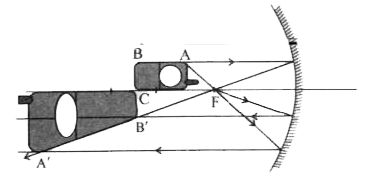
|
|
| 21. |
In a Young's double slit interference experiment the fringe pattern is observed on a screen placed at a distance D from the slits. The slits are separated by a distance d and are illuminated by monochromatic light of wavelength lamda . Find the distance from the central point where the intensity falls to (a) half the maximum, (b) one fourth of the maximum. |
| Answer» SOLUTION :`(D LAMDA)/(4D) ,(B) (D lamda)/(3D)` | |
| 22. |
एकांक समय मे वेग मे परिवर्तन कहलाता है |
|
Answer» त्वरण |
|
| 23. |
A block ispushed up a rough inclined plane of 45^(@) with a velocity u. The block rises up and then comes down sliding to have a velocity u/2 at the bottom. The coefficient of sliding friction between block and the plane is |
|
Answer» 0.5 |
|
| 24. |
A particle of mass m is attached to three identical massless springs of spring constant k as shown in the m 135 figure. The time period of vertical oscillation of the particle is |
|
Answer» `2pi sqrt(m/k)` The TOTAL restoring force on the mass m along AO, is  `F =F_(A) + F_(B) cos 45^(@) + F_(C ) cos 45^(@)` `F = -ky -ky. cos 45^(@) -ky. cos 45^(@)` `F =-[ky + ky. cos 45^(@) + ky. cos45^(@)] = -[ky + 2ky. cos 45^(@)]` `=-[ky + 2ky cos^(2) 45^(@)]=-[ky + ky]` `F =-2ky`........(i) Comparing (i) with, `F = -k_(eq)y`, we get `k_(eq) = 2k` The time PERIOD of vertical oscillations of the particle is, `T = 2pi sqrt(m/k_(eq)) = 2pi sqrt(m/(2k))` |
|
| 25. |
The field lines always emerge from |
|
Answer» NEGATIVE charge |
|
| 26. |
A plane mirror is fixed at the bottom of a tank containing water. A small object is kept at a height of24 cm from the bottom and is viewed from a point vertically above it. The distance between the object and the image in the mirror as appears to the person is : |
|
Answer» 48cm |
|
| 27. |
The is an arrangement of pulleys as shown in figure. All the pulley are massless and frcitionless and the strings used are inextensible. Each of these springs have a spring constant k. We define the stiffness of the assembly k_(1) as the force required to be applied at point A for its unit displacement. Find k_(1) for n=2 |
|
Answer» 2k |
|
| 28. |
The is an arrangement of pulleys as shown in figure. All the pulley are massless and frcitionless and the strings used are inextensible. Each of these springs have a spring constant k. We define the stiffness of the assembly k_(1) as the force required to be applied at point A for its unit displacement. Find k_(1) for n = 1 |
|
Answer» k |
|
| 29. |
A sonometer wire under tension of 64N vibrating in its fundamental mode is in resonance with a vibrating tuning fork. The vibrating portion of that sonometer wire has a length of 10cm and a mass of 1 gm. The vibrating tuning fork is now moved away from the vibrating wire with a constant speed and an observer standing near sonometer hears one beat per second. The speed with which the tuning fork is moved is 752 xx 10^(-y) (speed of sound in air is 300 m/s). Then y |
|
Answer» |
|
| 30. |
As shown in figure, a plano-convex lens of focal length 20 cm is silvered at its plane surface and it is made reflecting, then find new focal length of system. |
|
Answer» 20 cm For first refraction from curved surface `therefore(1)/(f_1)`then reflection from SILVERED plane surface `therefore(1)/(F_M)`and then second refraction from curved surface `therefore(1)/(f_1)` where `f_1`= FOCAL length of plano convex lens = 20 cm `F_m `= focal length of plane mirror =`infty` Now, equivalent focal length, F can be obtained as follows. `1/F=(1)/(f_1)`[Plano convex lens] `+(1)/(F_M)` [Plane mirror] `+(1)/(f_1)`[Plano covex lens] `1/F=(2)/(f_1)+(1)/(f_m)=(2)/(20)+(1)/(infty)=(1)/(10)` `therefore`F=10 cm [Note that here `f_1` is positive. If it was concave `f_1` would be negative] |
|
| 31. |
In an adiabatic change, the pressue and temperature of a monoatomic gas are related as P prop T^(-c), where c equals: |
|
Answer» <P>`(2)/(5)` `P alpha T^(-(gamma)/(1-gamma))` THUS, `C=+(gamma)/(1-gamma)=+((5)/(3))/(1-(5)/(3))=((5)/(3))/((-2)/(3))=(-5)/(2)`. `therefore` CORRECT CHOICE is (a). |
|
| 32. |
An particle of energy 5 MeV is scattered through 180° by gold nucleus. The distance of closest approach is of the order of |
|
Answer» `10^(-16)cm` `D= 455 xx 10^(-16) = 455 xx 10^(-14) cm= 4.55 xx 10^(-12) cm ~~ 10^(-12)cm` |
|
| 33. |
A sprayerworks on the principle of |
|
Answer» Newton |
|
| 34. |
Twelvecapacitors, each having capacitors, C, are joined to from a cube as shown. Find the equivalent capacitance between the ends of (a) Digitonal i.e., between A and B. (b) Face diagonal i.e., between A and C. (c) side of cube i.e., between A and D. |
Answer» SOLUTION :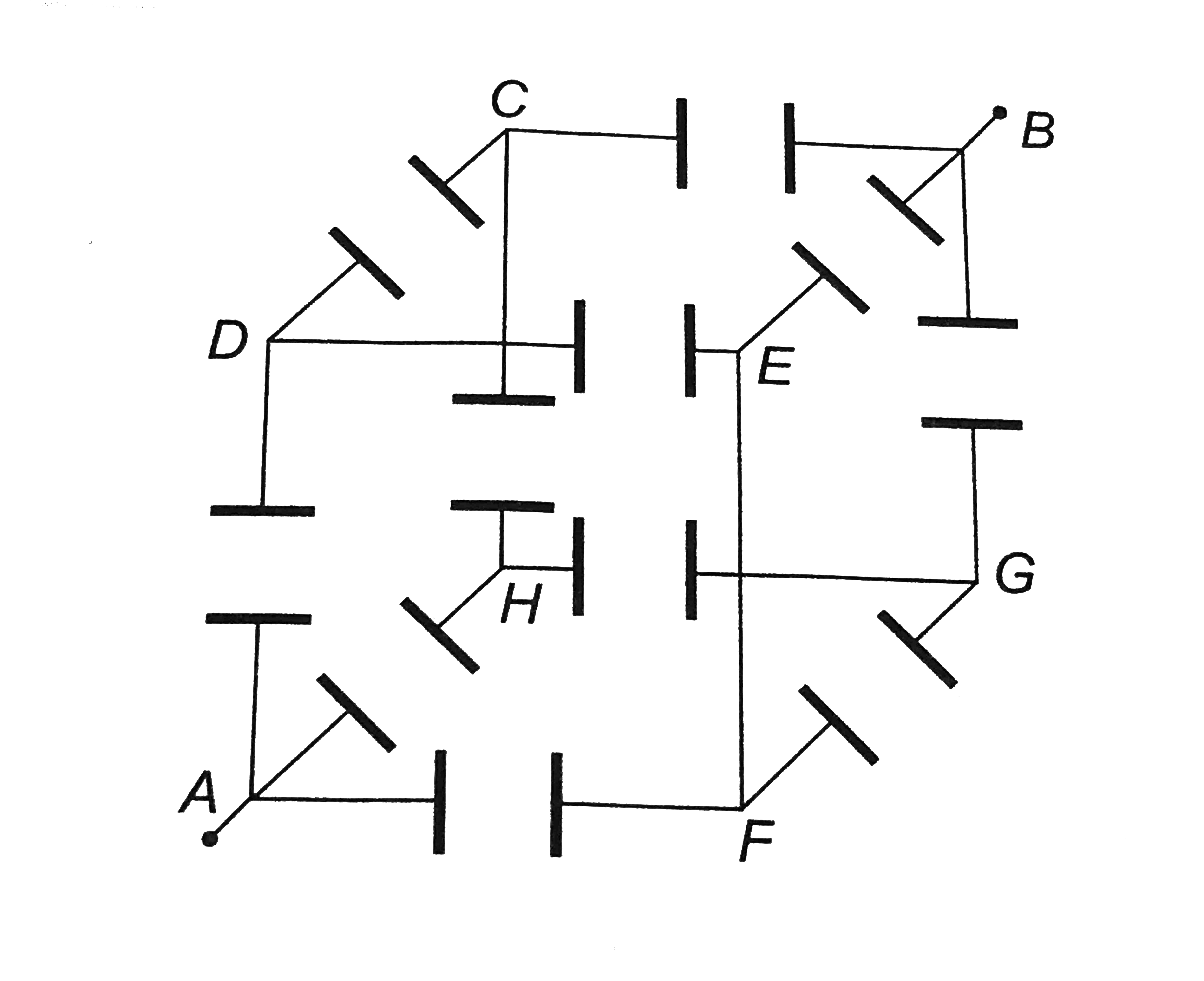 (a) `{:(,D,H,F,C,E,G),(A,1,1,1,2,2,2),(B,2,2,2,1,1,1):}` `(D,H,F),(C,E,G)` are at same POTENTIAL, redraw the diagram. 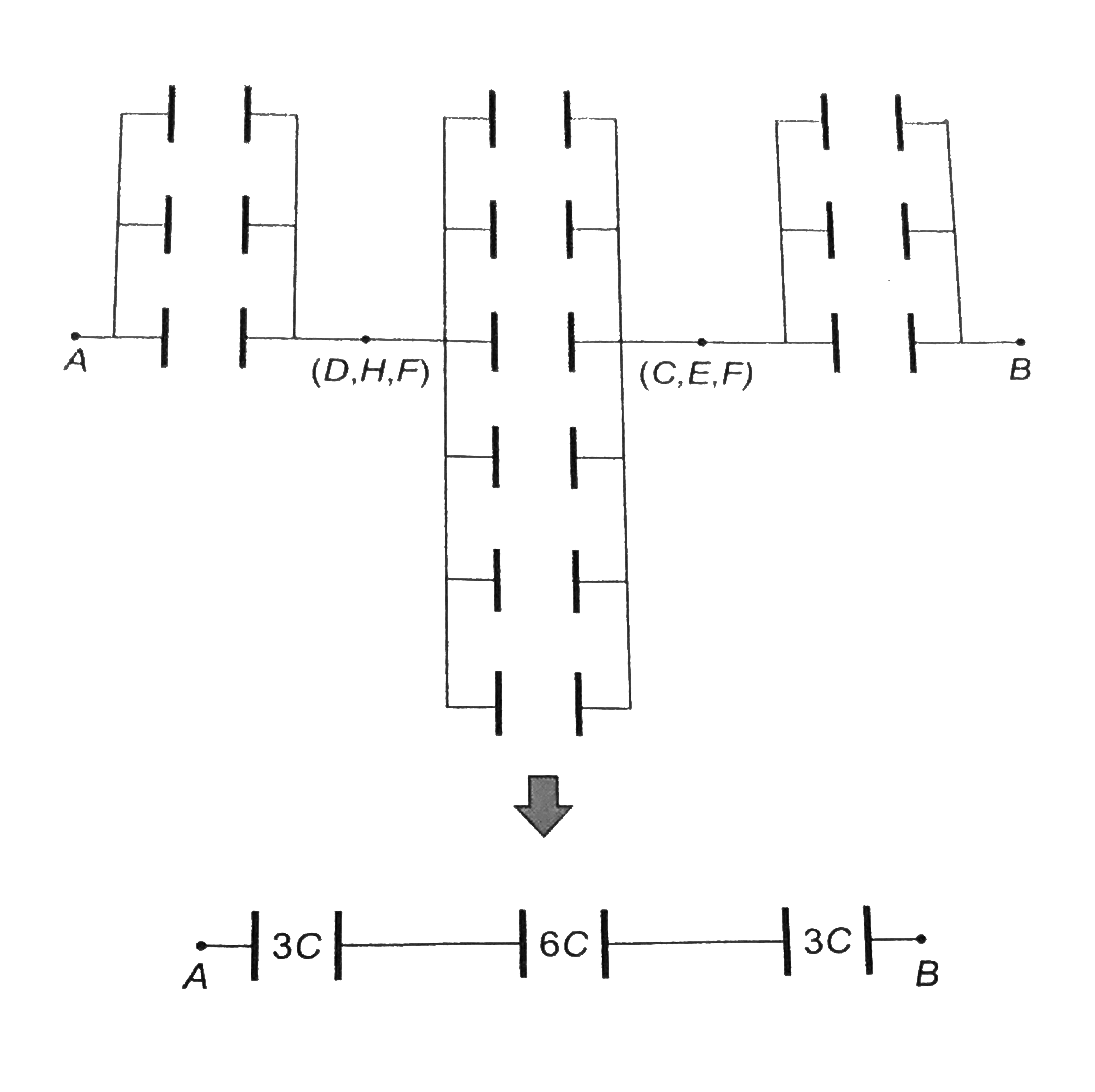 (b) 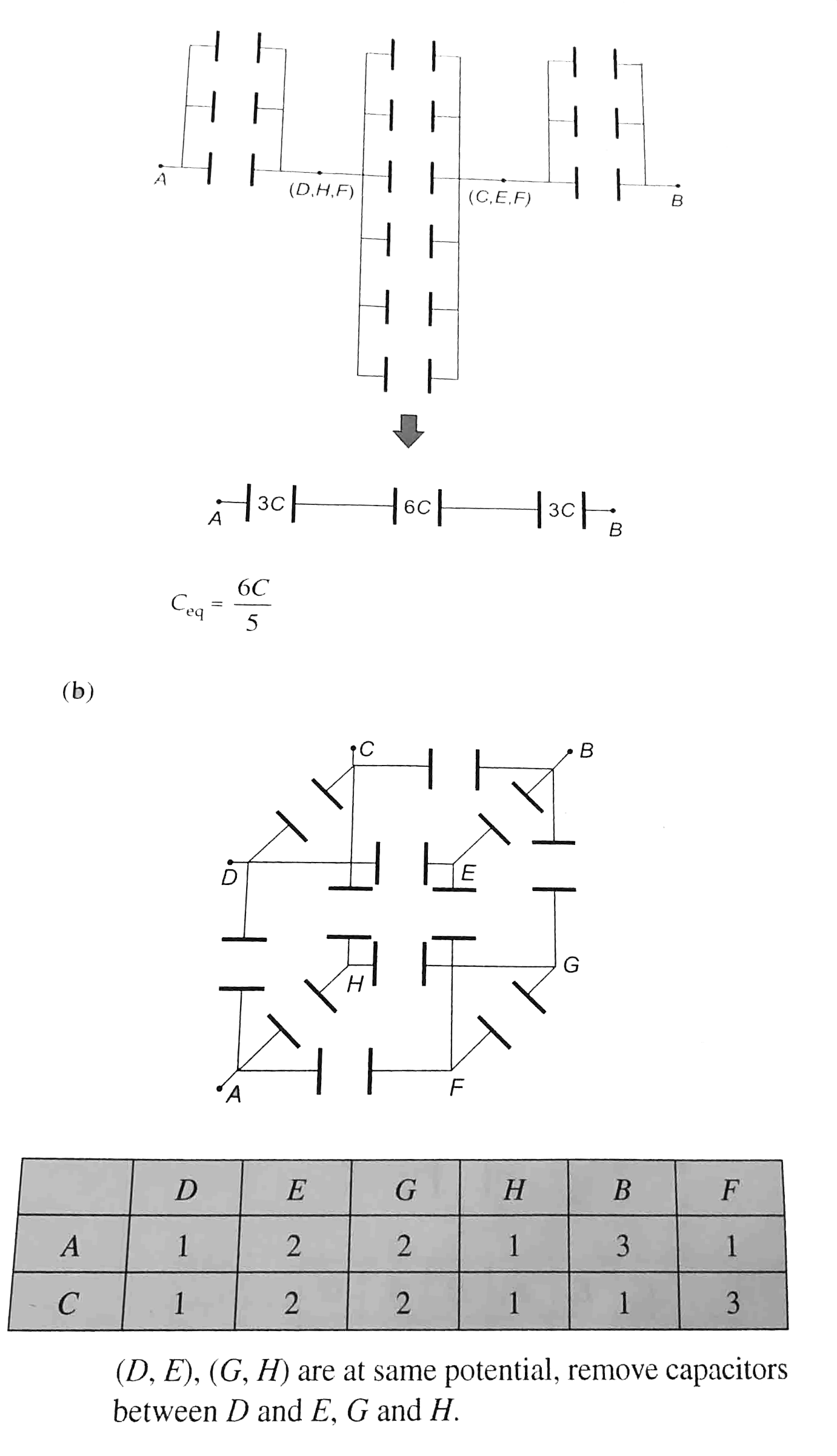 `{:(,D,E,G,H,B,F),(A,1,2,2,1,3,1),(C,1,2,2,1,1,3):}` `(D,E),(G,H)` are at same potential, REMOVE capacitors betweem `D` and `E,G` and `H`. 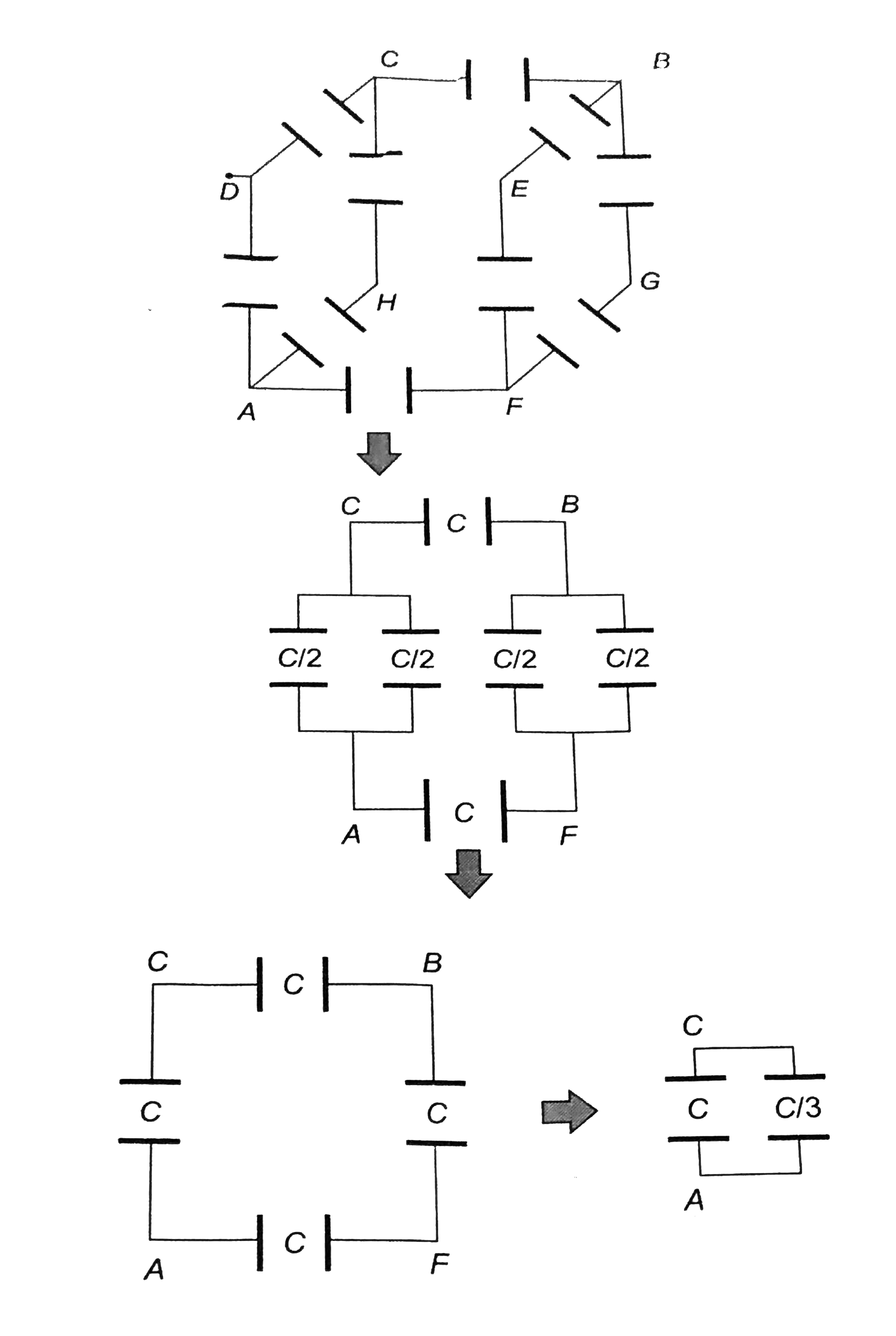 (c) `{:(,C,E,F,H,B,G),(A,2,2,1,1,3,2),(D,1,1,2,2,2,3):}` `(C,E),(F,H)` are at same potential, redraw the diagram. 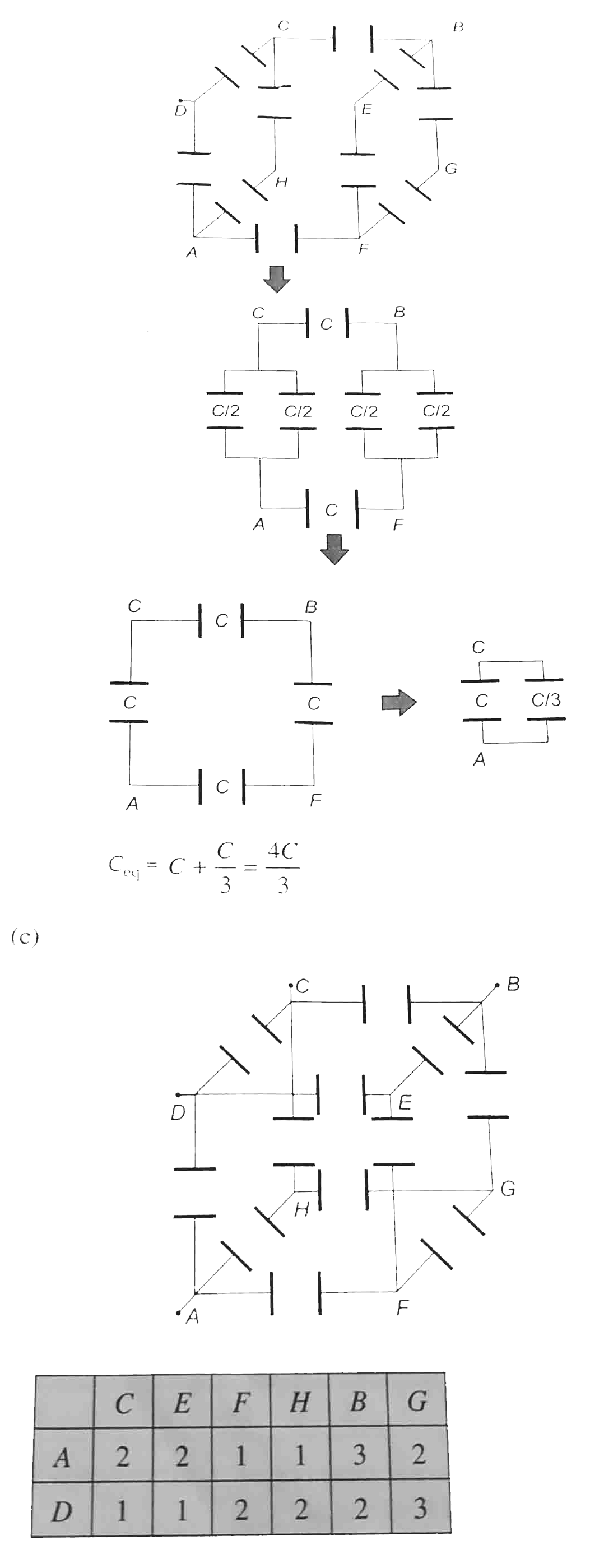 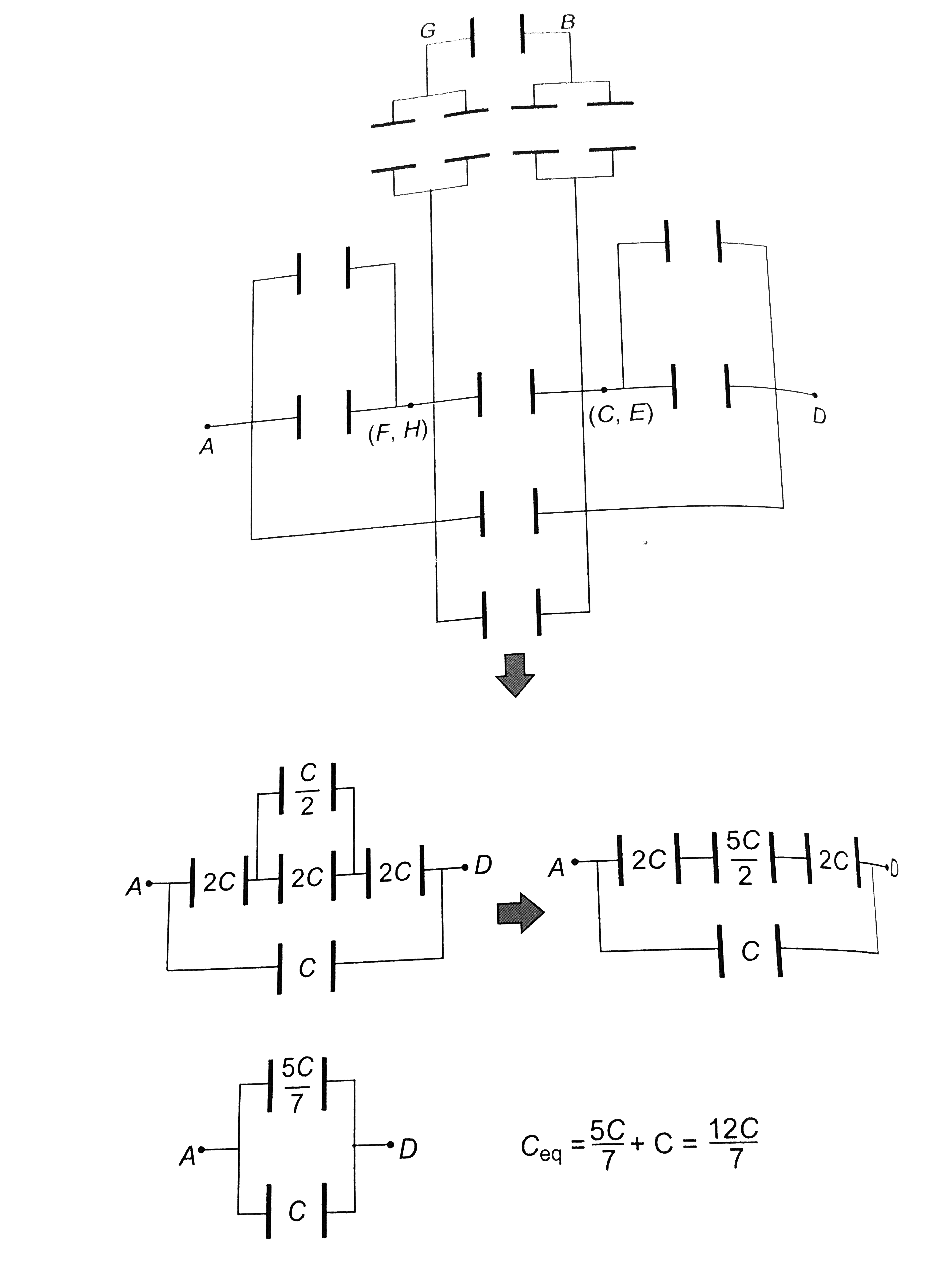 `C_(eq)=(5C)/(7)+C=(12C)/(7)` |
|
| 35. |
Find the half life of uranium, given that 3.23 xx 10^(-7)gm of radium is found per gm of uranium in old minerals. The atomic weight of uranium and radium are 238 and 226 and half life of radium is 1600 years : |
|
Answer» `4.70 xx 10^(7)"years"` `lambda_(1)N_(1)=lambda_(2)N_(2)` `lambda_(U)N_(U)=lambda_(R) lambda_(R)` or `N_(U)/T_(U)=N_(R)/T_(R) or T_(U)=T_(R) (N_(U)/N_(R)) ........(1)` Now, `N_(U) =(6.023 xx 10^(23))/(238)` `and N_(R)=(6.023 xx 10^(23))/(226) xx 3.23 xx 10^(-7)` `N_(U)/N_(R)=(226)/(238 xx 3.23 xx 10^(-7)) =2.94 xx 10^(6)` From EQNS (1) and (2) `T_U=1600 xx 2.94 xx 10^(6)=4.70 xx 10^(9)"years"` |
|
| 36. |
A vessel is filled with two mutually immiscible liquids of refractive indices mu^(1) and mu^(2). The depths of the two liquids are d_(1) and d_(2) respectively. There is a mark at the bottom of the vessel. Show that the apparent depth of the mark when viewed normally is given by ((d_(1))/(mu_(1))+(d_(2))/(mu_(2))). |
|
Answer» Solution :The image of p is formed at Q due of refraction at the surface of SEPARATION B of the 1st and 2ND liquid. Another final image due to refraction in air from the second liquid is formed at R. For the first refraction, `(mu_1)/(mu_(2)) = (BP)/(BQ)` `or, "" BQ = (mu_(2))/(mu_(1)).BP` `(mu_(1))/(mu_2)d_(1)` For the second refraction, `(mu_(2))/(1) = (AQ)/(AR)` `or, "" AR = (AQ)/(AR) = (1)/(mu_(2)) (AB + BQ)` `or, "" AR = (1)/(mu_(2))(d_(2) + (mu_(2))/(mu_(1))d_(1)) = (d_(2))/(mu_(2)) + (d_(1))/(mu_(1))` `therefore` APPARENT depth of the mark P when viewed NORMALLY `= AR = (d_(1))/(mu_(1)) + (d_(2))/(mu_(2))` 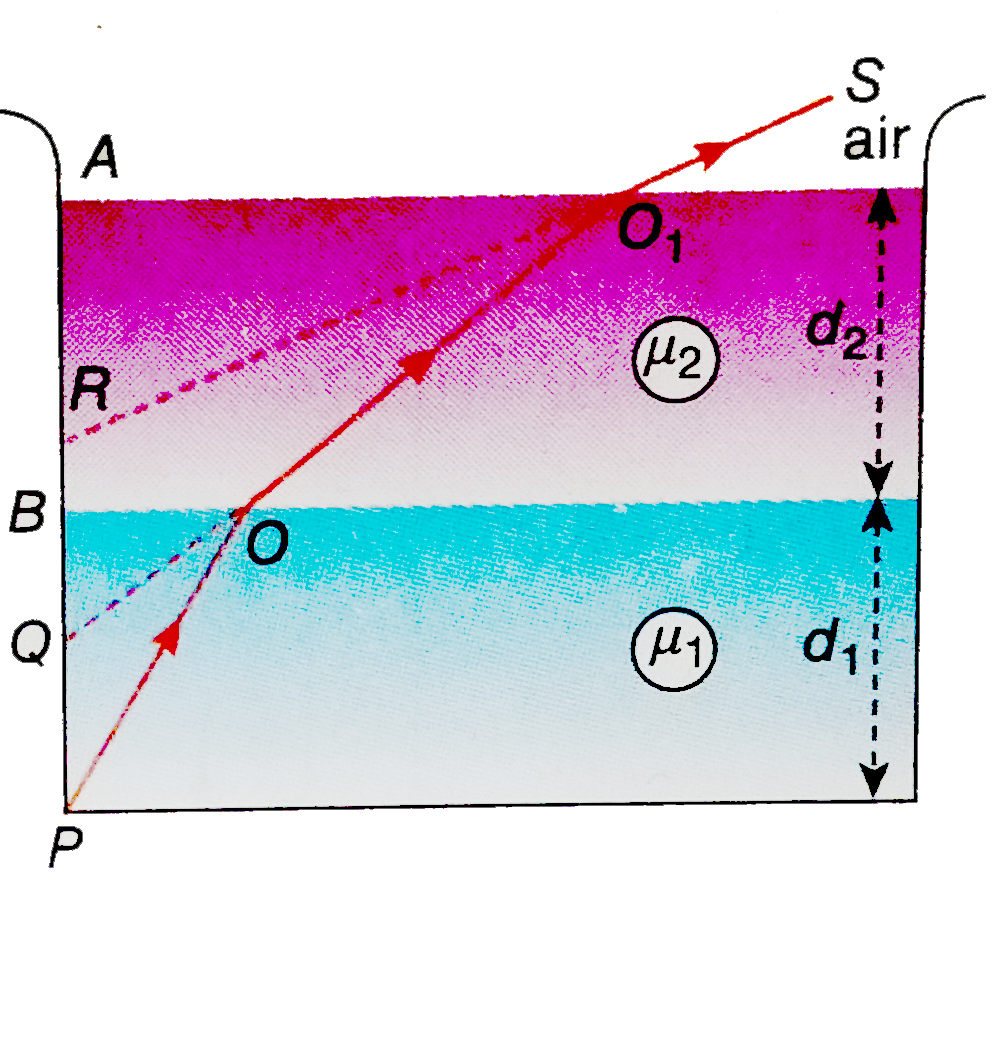
|
|
| 37. |
Which of the following energy-time graphs represents damped harmonic oscillator. |
|
Answer»
`E=(1)/(2)kA^(2)e^(-bt//m)""…(i)` where the symbols have their usual MEANINGS. Equation (i) shows AMPLITUDE of the damped harmonic oscillator decreases exponentially with time. Hence, option ( c ) REPRESENTS the correct graph. correct choice is c. |
|
| 38. |
Calculate the distance of an object of height h from a concave mirror of radius 20 cm to obtain a real image of magnification 2. Find the location of image also. |
|
Answer» Solution :`R=-20 CM and M = - 2` FOCAL LENGTH `f = R/2 = -10 cm` Magnification M `-v/u=-2` (GIVEN) `:. U = 2u` Using mirror formula `1/u+1/u=1/(f)rArr1/(2u)+1/u=-1/10` `rArr3/(2u)=1/10rArrmu=-15 cm ` `:. v = 2 xx(-15)=-30cm` |
|
| 39. |
When a resistance of 10Omega is connected in series with the unknown resistance R the balancing length is found to be 50cm . When 10 Omega is removed the balancing length is shifted to 40 cm. What will be the value of unknown resistance R? |
|
Answer» SOLUTION :LET `R^1` be the resistance in the box Then (R+10)=`R^1xx50/50=R^1`………(1) R=`R^1xx40/60=0.667R^1`……2 from (1) and (2) R=0.667(R+10) R=20`Omega` |
|
| 40. |
When light is polarised by reflection from a transparent surface. a) reflection and refracted rays are mutually perpendicular b) both reflected and refracted rays are plane polarised c) refraction ray is partially polarised d) the R.I., of transparent surface is equal to tangent of Brewster.s angle |
|
Answer» only a and C are true |
|
| 41. |
Nuclear energy is released in fission because binding energy per nucleon is |
|
Answer» GREATER for FISSION FRAGMENTS than for parent nucleus |
|
| 42. |
Self-inductance of a long solenoid of length l, area A and total number of turns N with a core material of relative magnetic permeability, mu_(0) is_____. |
|
Answer» |
|
| 43. |
Lencho wrote a Letter to God and said |
|
Answer» He and His family will go hungry |
|
| 44. |
Explain why ( or how ) : (a) in a sound wave, a displacement node is a pressure antinode and vice versa, (b) bats can ascertain distances, directions,nature and sizes of the obstacles without any "eyes". (c ) a violine note and sitar note may have the samefrequency,yet we can distinguish between the two notes. (d) Soils can support both longitudinal and transverse waves, but only longitudinal waves can propagate in gases and (e ) The shape ofa pulse gets distorted during during propagation in a dispersivemedium. |
|
Answer» Solution :(a) Node (N ) is a pointwherethe amplitude of oscillation is 0. ( and pressure is maximum ) Antinode ( A) is a point where the amplitude of osciallation is maximum ( and pressureis MIN). These nodes & antinodes do not coincide with pressure nodes & antinodes. Infact , N coincides with pressure antinode and A coincides with pressure node,as is clear from the definitions. (b)Bats EMIT ultrasonic wave of large frequencies, when these waves are reflected from the obstacles in their path, they give them the idea about the distance, direction , size & nature of the osbtacle. (c )Thoughthe violin note and sitar note have the same frequency, yet the over tones produced and their reactivestrengths are different in the two notes that is WHYWE can distinguish BETWEENTHE two notes. (d)This is because solids have both, the elasticity of volume and elasticity of SHAPE where asgases haveonly the volume elasticity. (e ) A sound pulseis a combination of waves of different wavelenths. As waves of different wavelengths travelsin a dispersemedium with different velocities,therefore the shape of the pulsegets distorted. |
|
| 45. |
When is the tension maximum in a thread of a simple pendulum performing S.H.M. |
| Answer» SOLUTION :In a VERTICAL POSITION. | |
| 46. |
An example of a non ohmic device is |
|
Answer» SOLUTION :A device for Which I-V graph is non-linear Example: Any .one. of the following: DIODE, TRANSISTOR, Discharge lamps, Vaccum TUBES, THERMISTOR, Voltameter. |
|
| 47. |
There is a small air bubble inside a glass sphere (mu = 1.5) of radius 5 cm. The bubble is 7.5 cm below the surface of the glass. The sphere is placed inside water (mu=4/3) such that the top surface of glass is 10 cm below the surface of water. The bubble is viewed normally from air. Find the apparent depth on the bubble. |
|
Answer» 15 CM below the SURFACE of WATER |
|
| 48. |
A boy with a mass of 35 kg and a sled with a mass of 6.5 kg are on the frictionless ice of a frozen lake, 12 m apart but connected by a rope of negligible mass. The boy exerts a horizontal 4.2 N force on the rope. What are the acceleration magnitudes of (a) the sled and (b) the boy ? ( c ) How far from the boy's initial position do they meet ? |
| Answer» SOLUTION :(a) `0.65" m"//"s"^(2),` (B) `0.12" m"//"s"^(2),` ( C ) 1.9 m | |
| 49. |
You are given two concentric charged conducting spheres of radii R_(1) and R_(2) such that R_(1) gt R_(2) ,having charges Q_(1) and Q_(2) respectively and uniformly distributed over its surface. Calculate E and V at three points A, B , C whose distances from the centre are r_(A), r_(B) and r_(c)respectively as shown in figure. |
|
Answer» Solution :At point A , the point A is outside both the spheres so for the purpose of calculation of E and V we have to consider both `Q_(1) and Q_(2)` to be CONCENTRATED at the centre. So, E ` ((Q_(1) + Q_(2)))/(4 pi epsilon_(0).r_(A)^(2)) and V = ((Q_(1) + Q_(2)))/(4 pi epsilon_(0).r_(A))` At point B : For ELECTRIC field calculation note that the point B is inside the outer sphere so there will be no contribution of `Q_(1)` in the electric field at B. But for `Q_(2)` charges, the point B is outside so we have t assume `Q_(2)` to be at the centre and distance of B will be taken to be `r_(B)` So, `e at B = (Q_(2))/(4 pi epsilon_(0)r_(B)^(2))` Now, for potential, remember that a single charge will never give zero contribution to potential at finite pionts. So `Q_(1)` as well as `Q_(2)` will contribute to potential at B. Noe talk about the contribution of `Q_(1)` at point B you can SEE that the point B is inside the large sphere of `Q_(1) `so `Q_(1)` will OFFER its surface potential`(Q_(1))/(4 pi epsilon_(0)R_(1)` at all its inside points. but what about the potential contribution of `Q_(2)` at point B! for `Q_(2)` the point B is outside the sphere so, we'll assume as if `Q_(2)` is concentrated at the centre and the distance taken will be `r_(B)`. so the contribution of `Q_(2)` in potential will be `(Q_(2))/(4 pi epsilon_(0)r_(B))` Hence the total potential at B = `(Q_(1))/(4 pi epsilon_(0)R_(1)) + (Q_(2))/(4 pi epsilon_(0)r_(B))` At point C : For electric field note that to both `Q_(1) and Q_(2)` . the point c is inside. So, the net contribution in the electric field will be zero, i.e E at C = zero. infact, at all the point inside the smaller sphere, the electric field will be zero, whate about potential at C! For both the spheres the point C is inside so both `Q_(1) and Q_(2)` will offer their respective surface potential. since surface potential of `Q_(1)` is `(Q_(1))/(4 pi epsilon_(0)R_(1))` and that of `Q_(2)` is `(Q_(2))/(4 pi epsilon_(0)R_(2))` , hence the potential at C will be `(Q_(1))/(4 pi epsilon_(0)R_(1)) + (Q_(2))/(4 pi epsilon_(0)R_(2))` In fact at all the points inside the inner sphere the potential will be constant and will be equal to the potential at C. |
|
| 50. |
A lamp post is fixed at point(0,0,5m). A man is moving with constant velocity 6 m/s along a line y=sqrt3x. Height of man is 2m and initially the man is at origin. The velocity of edge of his shadow along the line of motion of man is |
|
Answer» `8hati+6hatj` |
|


