Saved Bookmarks
This section includes 7 InterviewSolutions, each offering curated multiple-choice questions to sharpen your Current Affairs knowledge and support exam preparation. Choose a topic below to get started.
| 1. |
An electric bulb designed to draw P_(0) power at V_(0) voltage. If the voltage is V, it draws P power . Then . |
|
Answer» `P = (V_(0))/(V) P_(0)` |
|
| 2. |
An inverted image can be seen in a convex mirror |
|
Answer» under no circumstances |
|
| 3. |
How many elecrons do pass through a lamp in 1 minute if the current is 300 mA ? |
|
Answer» 3000 |
|
| 4. |
Who is the writer of the story "A Friend Who Came from the sky"? |
|
Answer» ANISTON Jupiter |
|
| 5. |
An uncharged body if kept in contact for some time with a charged body gets repelled. Why? |
| Answer» Solution :When charged body is in CONTACT with a body for SOMETIME, the charge is SHARED by both of them, DUE to the force of repulsion between the like charge, the body is repelled. | |
| 6. |
This question contain Statement-1 and Statement-2. Of the four choices given after the statements, choose the one that best describes the two statements. Statement-1: For a mass M kept at centre of a cube of side 'a', the flux of gravitational field passing through its sides 4piGM. and Statement-2: If the direction of a field due to a point source is radial and its dependence on the distance 'r' from the source is given as (1)/(r^(2)), its flux through a closed surface depends only on the strength of the source enclosed by the surface and not on the size or shape of the surface. |
|
Answer» Statement-1 is false, Statement-2 is true. So the correct CHOICE is B. |
|
| 7. |
Two wires of equal length, one of copper and other of manganin have the same resistance, which wire is thicker ? |
|
Answer» SOLUTION :`rho_crho/A_c=rho_ml/A_m` or `rho_cA_m/A_c=rho_m/rho_c` SINCE `rho_cltrho_m,A_mgtA_c`. Hence MANGANIN wire will be thicker. |
|
| 8. |
AgBr shows.......defect |
|
Answer» FRENKEL Defect |
|
| 9. |
A tuning fork A gives 4 beats per sec with a tuning fork B of frequency 120 Hz . When B is filed slightly beats disappear . Frequency od A Is |
|
Answer» 116 Hz. |
|
| 10. |
What is Curie temperatue ? What happens above curie temperature ? |
|
Answer» SOLUTION :When the temperature of a ferromagnetic SUBSTANCE in INCREASED the COUPLING between yarious atomic magnets in each domain becomes loose. The coupling breaks BEYOND a certain temprature. At this temperature domain structure collapses. This temperature is called curie temperature, Above the curietemperature, ferromagnetic substances becomes paramagnetic substances. |
|
| 11. |
Predict the direction of induced current in a metal ring when the ring is moved towards a straight conductor with constant speed v. The conductor is carrying current I in the direction shown in Fig. 6.13. |
|
Answer» |
|
| 12. |
How does focal length of lens change when red light incident on it is replaced by violet light? |
| Answer» SOLUTION :DECREASES | |
| 13. |
A graph of stopping potential of a photo sensitive metal with the frequency of incident radiation is plotted. What does the slope of this curve represent? |
Answer» Solution :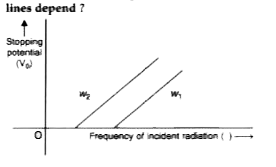 (i) Slope is DETERMINED by H and e. (or slope is independent of the METAL used.) (ii) Work FUNCTION of the metal. |
|
| 14. |
Suppose a body spends its mechanical energy to overcome friction. will it be a reversible process ? |
| Answer» Solution :When a body spends its mechanical energy to OVERCOME friction in moving from one position to another, the energy is dissipated as heat. Now if the body is allowed to go round its REVERSE path, the previously SPEND energy is not recovered, of COURCE, further energy is spend in reverse path. HENCE the process is not reversible | |
| 15. |
Distinguish between 'sky waves' and 'space waves' modes of propagation in communication system. (a) Why is sky wave mode propagation restricted to frequencies upto 40 MHz? (b) Give two examples where space wave mode of propagation is used. |
|
Answer» Solution :Sky wave: Television `to 1710 kHz " to " 40MHz` 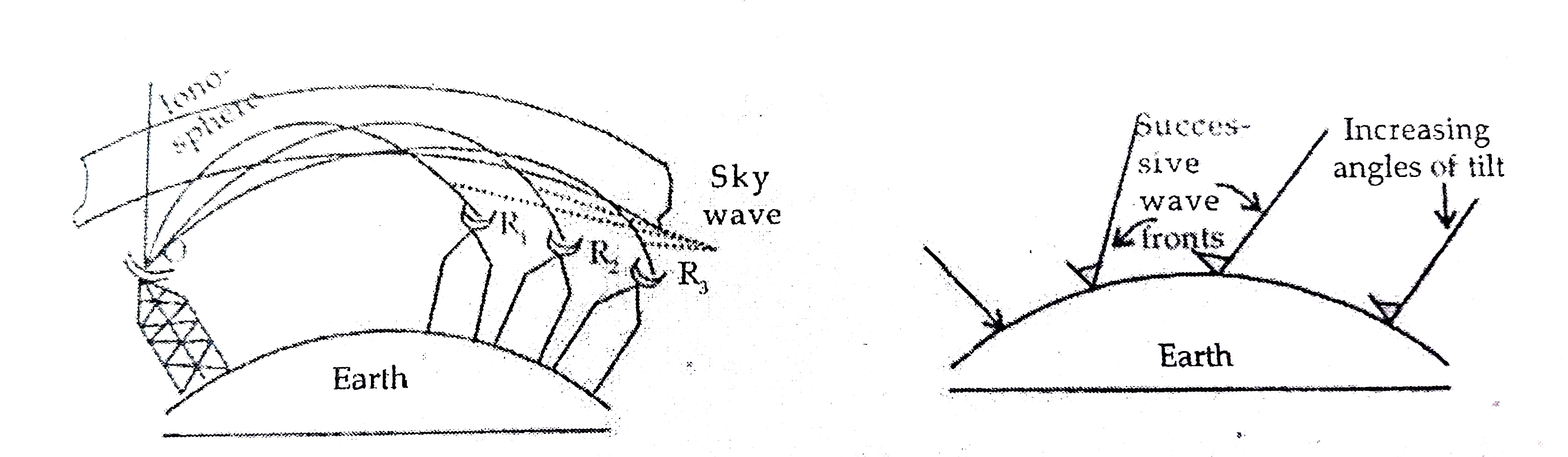 SPACE wave: SATELLITE communication `to `upto 1710 KHz. Direction of propagation `to ` (a) For FREQUENCIES about 40 MHz, space wave propagation is being used as the ionosphere will not reflect the signals and groundtransmissionis not possible. In space wave, thetransmitter and receiver must beon the line of sight TOGETHER. In this propagation, the UPLINK and downlink frequencies are kept different to avoid the mixing up of signals. (b) (i) Line of sight communication, (ii) Satellite communication. |
|
| 16. |
A cube is constructed by connecting 12 wires of equal resistance as shown in figure. The equivalent resistance between the points A and B shown in the figure is..... . The resistance of each wire is of r Omega. A and B are the midpoints of the sides PQ and VU respectively. |
Answer» SOLUTION :NOTE that with reference to the line joining A and B, the pairs AP and UB, AQ and VB, PW and RU, QT and SV, WV and QR are symmetric branches. Hence, current flowing through each of this symmetric pair must be same. e.g. if the current flowing through PW is `(1)/(4)` , the same current (i.e. `(I)/(4) ` ) will flow through RU. With this consideration the proportional currents through the various circuit branches are as assigned their values in figure Points W and T being symmetric about A are at the same potential, so no current will flow through WT and SIMILARLY ALSO through SR. Applying Kirchoff.s second rule to the closed loop APWVBNMA, taking r as the resistance of each wire. ` - (1)/(2) ((r)/(2))- (I)/(4) r - (I)/(4) r - (I)/(2)((r)/(2)) = - epsilon` `therefore " IR " = epsilon "" ` .... (2) Comparing equations (1) and (2), r.= r 
|
|
| 17. |
A body of mass 2 kg rests on a rough inclined plane making an angle of 30^(@) with the horizontal. The coefficient of static friction between the block and the plane is 0.7. The frictional force on the block is : |
|
Answer» 9.8 N `=0.7xx2xx9.8xx(sqrt3)/(2)\=11.88N`  Downward force responsible for MOTION `=mg sin 30^(@) = 2 xx 9.8 xx(1)/(2)=9,8N` Since mg sin is less than `F_(f)` the block does not move. THUS force of friction = force down the INCLINED plane `:. F_(f)=9.8 N` Hence correct choice is (a). |
|
| 18. |
A p-n-p transistor is used in common-emitter mode in an amplifier circuit. A change of 40 mu A in the base current brings a change of 2 mA in collector current and 0.04 V in base-emitter voltage. Find the : (i) input resistance (R_("in")) and (ii) the base current amplification factor (beta ). If a load of 6k Omegais used, then also find the voltage gain of the amplifier. |
|
Answer» Solution :Given `DeltaI_B = 40mu A= 40 xx 10^(-6) A ` `DeltaI_C= 2mA= 2 xx 10^(-3) A ` ` Delta V_(BE )= 0.04` volt `R_L= 6 k OMEGA= 6 xx 10^2 Omega ` (i) Input Resistance, `R_("in") = (Delta V_(BE ))/( Delta I_(B )) = ( 0.04 ) /( 40 xx 10^(-6)) = 10^3 Omega1 k Omega ` (ii) Current AMPLIFICATION factor, ` beta= (DeltaI_C )/(Delta I_B) = ( 2 xx 10^(-3))/( 40 xx 10^(-6)) = 50` (iii) VOLTAGE gain in common-emitter CONFIGURATION. ` A_u = beta(R_L)/(R_("imp"))=50 xx(6 xx 10^3)/( 1 xx 10^3 ) = 300` |
|
| 19. |
A stoneis projected from the pont ofa groundin sucha direction so as to hita birdon the top of a telegraph post of heighth and thenattain the maximum height 2h abovethe ground. If at theinstnatof projection , the brid were to fly away horizontally witha unifrom speed , find the ratio between the horizontalvelcoities ofthebird and the stone, if stone still hits the bird while descending . |
| Answer» Solution :`(v)/( U COS THETA) = (2)/(sqrt(2) + 1)` | |
| 20. |
The speed of a wave in a medium is 760 m/s. If 3600 waves are passing through a point in the medium in 2 minutes, then its wavelength is: |
|
Answer» 13.8 m |
|
| 21. |
Assume that the decomposition of HNO_(3) can be represented by the following equation 4NHO_(3)(g)hArr4NO_(2)(g)+2H_(2)O(g)+O_(2)(g) and the reaction approaches equilibrium partial pressure of HNO_(3) is 2 atm. Calculate K_(e) in ((mol)/L)^(3) at 400K : (Use : R = 0.08 atm-L/mol-K) |
|
Answer» 4 `because P_(NO_(2))=4P_(O_(2))and P_(H_(2)O)=2P_(O_(2))` `THEREFORE P_("total")=P_(HNO_(3))+7PO_(2)` `rArr30-2=P_(O_(2))xx7` `rArr28/7=4` `K_(p)=(P_(NO_(2))^(4)cdotP_(H_(2)O)cdotPO_(2))/P_(HNO_(3))^(4)` `=((4xx4)^(4)xx(2xx4)^(2)xx4)/(2^(4))=2^(20)` `K_(p)=K_(e)(RT)^(Deltan_(g))=K_(c)(0.08xx400)^(3)` `rArrK_(c)=2^(20)/(32)^(3)=32` |
|
| 22. |
In a wire of circular cross-section with radius 'r' free electrons travel with a drift velocity v, when a current I flows through the wire. The current in another wire of half the radius and of the same material when the drift velocity is 2v |
|
Answer» 2I |
|
| 23. |
In a Young's double slit experiment, d=0.5 mm andD = 100 cm. It is found that 9^(th) bright fringe is at a distance of 7.5 mm from the second dark fringe of fringe pattern. The wavelength of light used is (in Å) |
|
Answer» `2500/7` where n=0,1,2,3,… For dark fringes , `x=((2n-1)lambdaD)/(2d)` where n=1,2,3,… As PER question `(9lambdaD)/d-(3lambdaD)/(2d)=7.5xx10^(-3)m` or `(15lambdaD)/(2d)=7.5xx10^(-3)` m `LAMBDA=(2xx7.5xx10^(-3) m xxd)/(15D)` Substituting the given values , we GET `lambda=(2xx7.5xx10^(-3) m xx 0.5xx10^(-3) m )/(15xx1 m)` = 5000 Å |
|
| 25. |
A rope stretched between two fixed points can support transverse standinng waves. What is the ratio of the sixth harmonic frequency to the third harmonic frequency? |
|
Answer» `1/2` `(f_(6))/(f_(3))=(6f_(1))/(3f_(1))=2`. |
|
| 26. |
White light is passed through a prism of angle 5^@. If the refractive indices for red and blue colours are 1.641 and 1.659 respectively, calculate the angle of dispersion between them. |
|
Answer» Solution :As forsmallangleof prism` delta= ( mu -1) A ,` ` delta _h=( 1.659-1)XX 5^0 = 3.2295 ^0 and ` ` delta_r= (1.641-1) xx 5^@= 3.205^@ ` so ` theta = delta _b -delta _r= 3.2 295 ^0 - 3.205^@= 0.090 ^@` |
|
| 27. |
For the arrangement shown in figure, the spring is inilially compressed by 3cm. When the spring is released the block collides with the wall and rebounds to compress the spring again. If the time starts at the instant when spring is released, find the minimum time after which the block becomes stationary. |
Answer» Solution :If collision is elastic then In the case of spring - mass system, since the time period is INDEPENDENT of the amplitude of oscillation THEREFORE. 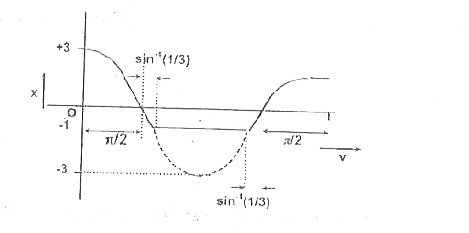 `T = (T_(0))/(2pi) [PI + 2 sin^(-1) ((1)/(3))]` `T = sqrt((m)/(k)) [pi + 2sin^(-1) ((1)/(3))]` Case- II if collision is inelasticFrom t = 0 to before collsion let time is `t_(1)` `t_(1) = (T_(0))/(4) + (T_(0))/(2pi) sin^(-1) ((1)/(3))` After collision the amplitude will changed to `sqrt5` therefore if the time is `t_(2)` before coming rest instantaneously then `t_(2) = (T_(0))/(4) + (T_(0))/(2pi) sin^(-1) ((1)/(sqrt5))` Total time taken `T = t_(1) + t_(2)` `T = sqrt((m)/(k)) [pi + sin^(-1) ((1)/(3)) + sin^(-1) ((1)/(sqrt5))]` |
|
| 28. |
A wave pulse starts propagating in +x-direction along a non-uniform wire of length L witdt mass per unit length given mu=m_(0)+alpha x and under tension of TN. Find the time taken by the pulse to travel from the lighter end (x = 0) to the heavier end. |
|
Answer» SOLUTION :VELOCITY oftransverse wave in a STRING. `v = (dx)/(dt) = sqrt(T/m) = sqrt(T/(m_0 + alphax))` `:. sqrt(m_0 + alphax) dx= sqrtT dt` Integrating within proper limits, `int_0^L sqrt(m_0 + alpha x) dx = sqrtT int_0^t dt` `RARR [(2(m_0 + alphax)^(3//2))/(3alpha)]_0^L = sqrtTt` `:. t = 2/(3 alpha sqrtT) [(m_0 + alphaL)^(3//2) -m_0^(3//2)]` |
|
| 29. |
What is the relationship between the half-life and mean life of a radioactive substance ? |
| Answer» SOLUTION :Half-LIFE` = 0.693 XX` MEAN life i.e., `T_(1/2) = 0.693tau` | |
| 30. |
Name two physical quantities which are imparted by an em wave to a surface on which it falls. |
| Answer» SOLUTION :ENERGY and PRESSURE | |
| 31. |
Laser light of wavelength 630 nm incident on a pair of slits produces an interference pattern in which the bright fringes are separated by 8.1 mm. a second light produces an interference pattern in which the fringes are separated by 7.2 mm. calculated the wavelength of the second light. |
|
Answer» Solution :From RELATION `beta=(lamdaD)/(d)`, we find that, other factors remaining UNCHANGED `(beta.)/(beta)=(lamda.)/(lamda)` In present PROBLEM `beta=8.1`MM, `beta.=7.2mm and lamda=630mm` `THEREFORE lamda.=(beta.)/(beta)*lamda=(7.2mm)/(8.1mm)xx630nm=560nm` |
|
| 32. |
A parallel beam of light strikes the first surface of a glass sphere of R.I 1.5 and radius of curvature 0.10 m. Find the positionof the final image. |
|
Answer» <P> SOLUTION :`u=OO``n_(g)=1.5` `n_(a)=1` `r=0.10m` (i) for I surface using the FORMULA `(n_(0))/(-u)+(n_(1))/(v)=(n_(0)-n_(1))/(r)` `(1)/(oo) +(1.5)/(v)=(1.5-1)/(0.10)=5` `thereforev=(1.5)/(5)=0.3m`from `p_(1)` The IMAGE will serve as a virtual object for II surface. Distance of I. from `P_(2)=(0.3-0.2)=0.10m` `therefore (1.5)/(-0.10)+(1)/(v)=(1.5-1)/(0.10)=5` `(1)/(v) - =5+15=20` or`v=(1)/(20)=0.05m ` from `P_(2)` `therefore ` The final image will be at 0.05 m from `P_(2)`. |
|
| 33. |
A : A famous painting was painted by not using brush strokes in the usual manner, but rather a myriad of small colour dots. The colour you see it any given place on the painting, changes as you move away. R : The angular separation of adjacent dots changes with the distance between themin the painting. |
|
Answer» Both A and R are true and R is the correct EXPLANATION of A |
|
| 34. |
A phase difference of pi between two waves reaching a point is equal to path difference : |
|
Answer» `(LAMBDA)/2` |
|
| 35. |
प्रायद्वीपीय नदियों के संबंध में इनमें से कौन सा कथन सही है? |
|
Answer» प्रायद्वीपीय नदियां हिमालय की नदियों की तुलना में लंबी होती है |
|
| 36. |
Common aberration of a lens are |
|
Answer» Chromaticaberration and SPHERICAL ABERRATION |
|
| 37. |
हिमालय की नदियों से संबंधित इनमें से कौन सा कथन सही नहीं है? |
|
Answer» हिमालय की नदियां बारहमासी होती है |
|
| 38. |
If M is the magnetci moment, and d is the distance of the point from the centre of the magnet, then the force in Tan B position is given by |
|
Answer» `B_(H) TANTHETA` |
|
| 39. |
A block moving on an inclined plane making an angle 45^(@) with the horizontal and the coefficient of friction is mu the force required to just push it up the inclined plane is three times the force required to just prevent it from sliding down. If we defineN=10 mu N then N is |
| Answer» | |
| 40. |
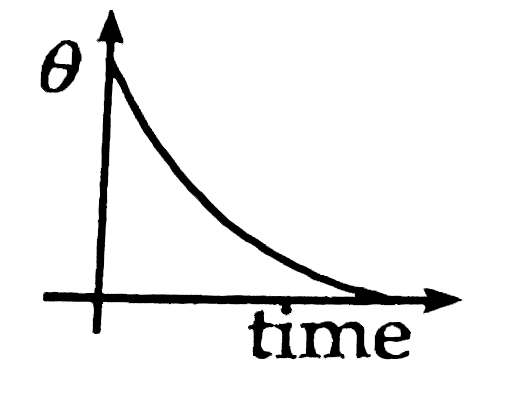
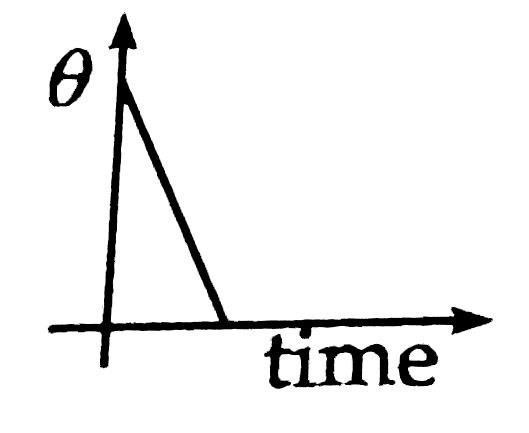
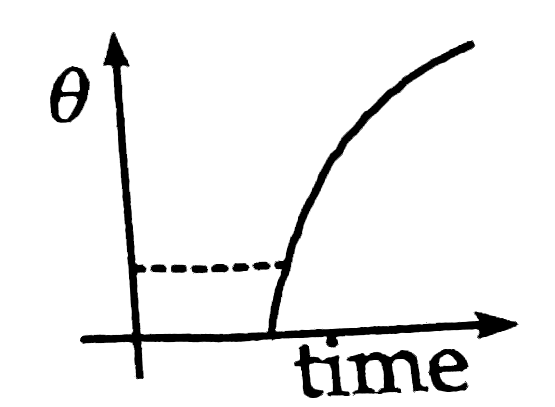
If the temperature of the body theta and time of cooling 't' and room temperature of the surrounding theta_(0). The cooling curve is |
|
Answer»
|
|
| 41. |
The current carrying wire and the rod AB are in the same plane. The rod moves parallel to the wire with a velocity v. Which one of the following statements is true about induced e.m.f. in the rod? |
|
Answer» End `A` will be at lower potential with respect to `B` |
|
| 42. |
The charges of an electric dipole are respectively 32xx10^(-7) coulomband -32xx10^(-7) coulomb are separated by a distance of10 cm . Find the field at a point situated at a distance of 8 cm fromeach charge. |
Answer» Solution :Suppose `E_(1)` is the FIELD due to `+32xx10^(-7)` COULOMB charge and `E_(2)` is the field due to the `-32xx10^(-7)` coulomb charge at C, then  `E_(1)=(1)/(4piepsilon_(0))(q_(1))/(r^(2))` `=(9XX10^(9)xx32xx10^(-7))/((0.8)^(2))` `=4.5xx10^(6)N//C` . Along CP and `E_(2)=(9xx10^(9)xx32xx10^(-7))/((.08)^(2))` `=4.5xx10^(6)N//C`.Along CQ But from `Delta.s` PCR and CAB `(CR)/(AB)=(CP)/(CA)` or `(E)/(0.1)=(4.5xx10^(6))/(.08)` or , `E=(0.10xx4.5xx10^(6))/(.08)` `=5.625xx10^(6)` `E=5.625xx10^(6)("newton")/("coulomb")` |
|
| 43. |
Assertion: The electric field due to a discrete charge configuration is not defined at the locations of the discrete charges Reason:For a surface charge distribution, electric field is discontinuous acorss the surface. |
|
Answer» Both ASSERTION and REASON are TRUE and Reason is the correct explanation of Assertion |
|
| 44. |
A small quantity of solution containing Na24 radio nuclide (half-life = 15 hour) of activity 1.0 microcurie is injected into the blood of a person. A sample of the blood of volume 1 cm^(3)taken after 5 hours shows an activity of 296 disintegrations per minute. Determine the total volume of the blood in the body of the person. Assume that the radioactive solution mixes uniformly in the blood of the person. (1 curie = 3.7 xx 10^(10)disintegration per second) |
|
Answer» |
|
| 45. |
A U-tube open from both ends, contain two arms, arm-1 and arm-2 each of having equal cross-section and height of each arm is 1m. Water of density rho_(w) and an unknown liquid of density rho is fliied as shown A tuning fork of frequency 300 Hz is vibrated on arm-1, then air column vibrated is fundamental tone. If the same tuning fork is vibrated on arm-2, then air column vibrates in 1st overtone V_("sound") = 300 m//sec , g = 10//sec^(2), density of water rho_(w) = 10^(3)kg//m^(2), atmospheric pressure = 10^(2) Pa) Nelect the effect of surface tension and end correction : Npw we use a tuning fork of frequency 302 Hz, instead of 300 Hz, with how much velocity should we move the tuning fork, so that resonance is created with the air column in any arm ? |
|
Answer» 2 m/sec, towards the TUBE `f'=f_(0)((V-V_(0))/(V-V_(s)))RARR 300=302 ((300-0)/(300-(-V)))` `V=2 m//sec` away from the tube. |
|
| 46. |
The electron beam in the device shown in Fig. 28.7a is deflected upwards by a transverse magnetic field. The field is effective along a length l= 20 mm, the distance of the deflection system from the screen being L =175 mm. The magnetic induction is 10^(-3)T, the anode voltage is 500 V. Find the deflection of the electron beam on the screen. |
|
Answer» As is evident from the FIGURE, GD=GE+EB, or `d=L tan alpha +R (1-cos alpha)=L tan alpha+l (1-cos alpha)/(sin alpha)=L tan alpha+l tan ""pi/2` Knowing the parameters of the device one may easily calculate the displacement sought. 
|
|
| 47. |
A U-tube open from both ends, contain two arms, arm-1 and arm-2 each of having equal cross-section and height of each arm is 1m. Water of density rho_(w) and an unknown liquid of density rho is fliied as shown A tuning fork of frequency 300 Hz is vibrated on arm-1, then air column vibrated is fundamental tone. If the same tuning fork is vibrated on arm-2, then air column vibrates in 1st overtone V_("sound") = 300 m//sec , g = 10//sec^(2), density of water rho_(w) = 10^(3)kg//m^(2), atmospheric pressure = 10^(2) Pa) Nelect the effect of surface tension and end correction : Density of the unknown liquid (rho) is : |
|
Answer» `2 rho_(W)` 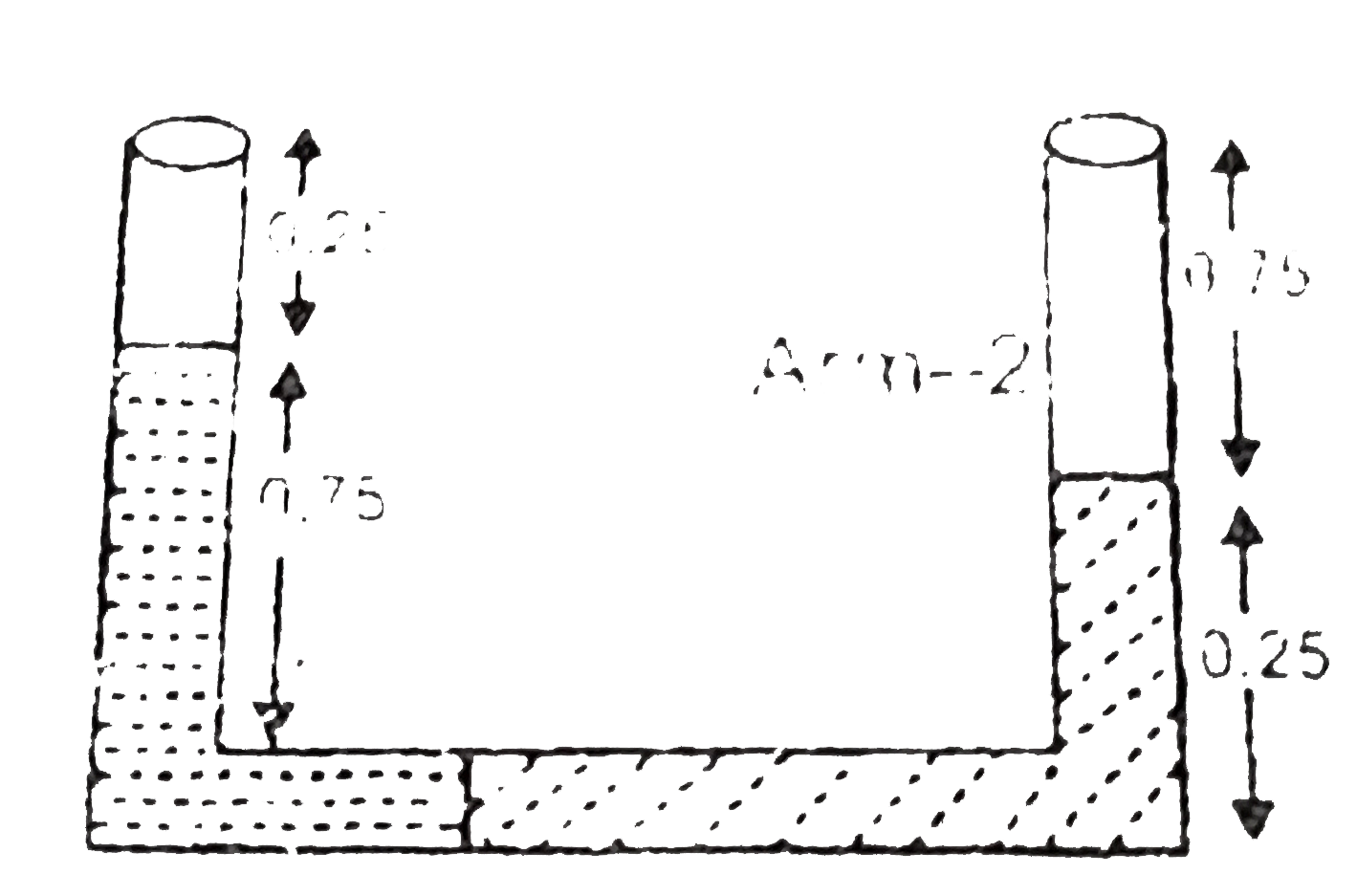 For resonance with ARM -1 `f_(0)=(V)/(4l_(1))rArr l_(1)=0.25m` For resonance , with arm-2 `f_(0)=(3v)/(4l_(2))rArr l_(2)=0.75 m` `rho_(0)+rho_(w)G(0.75)=rho_(0)+rhog(0.25)rArr rho = 3 rho_(w)`. |
|
| 48. |
A projectile is thrown at an angle of15^@ with horizontal and range is 1.5 m. What it's range when projected at 45^@ |
|
Answer» 1.5km |
|
| 49. |
If a function g={(1,1),(2,3),(3,5),(4,7)} is describeby g(x)=alphax+beta,values of alpha and beta. |
|
Answer» 2, -1 |
|
| 50. |
A potentiometer wire of length L and a resistance r are connected in series with a battery of e.m.f. E and a resistance r_(1). An unknown e.m.f. E_(o) is balanced at a length l of the potentiometer wire. The e.m.f. E will be given by |
|
Answer» `(LE_(o)r)/((r+r_(1))l)` |
|