

Saved Bookmarks
This section includes 7 InterviewSolutions, each offering curated multiple-choice questions to sharpen your Current Affairs knowledge and support exam preparation. Choose a topic below to get started.
| 1. |
Why can’t Beinkensopp attend his P.E class ? |
|
Answer» Because he didn’t have his kit |
|
| 2. |
In the given reaction _zX^Ato_(z+1)Y^Ato_(z-1)K^(A-4)to_(z-1)K^(A-4)radioactive radiations are emitted in the sequence |
|
Answer» `ALPHA,BETA,GAMMA` |
|
| 3. |
A variable frequency ac source is connected to a capacitor. How will the displacement current change with decrease in frequency ? |
|
Answer» Solution :Capacitive reactance is INVERSELY proportional to conduction current, `THEREFORE C_(c )prop (1)/(I_(c ))` and `X_(c )=(1)/(2pi vc)` `therefore X_(c )prop(1)/(f)`and`I_(c )=(V)/(X_(c ))` When frequency decreases `X_(c )` will increase and conduction current also decreases. HENCE conduction current is equal DISPLACEMENT current. |
|
| 4. |
(A) : It is necessary to use satellites for long distance T.V tranmission (R) : The television signals are low frequency signals |
|
Answer» Both 'A' and 'R' are TRUE and 'R' is the correct EXPLANATION of 'A'. |
|
| 5. |
Describe briefly, with the help of a circuit diagram, how apotentiometer is used to determine the internal resistance of a cell . |
|
Answer» |
|
| 6. |
Which ion falls at position 2 ? |
|
Answer» A |
|
| 7. |
Figure 6.20 shows a metal rod PQ resting on the smooth rails AB and positioned between the poles of a permanent magnet. The rails, the rod, and the magnetic field are in three mutual perpendicular directions. A galvanometer G connects the rails through a switch K. Length of the rod = 15 cm, B = 0.50 T, resistance of the closed loop containing the rod = 9.0 mOmega. Assume the field to be uniform. (a) Suppose K is open and the rod is moved with a speed of 12 cm s^(-1) in the direction shown. Give the polarity and magnitude of the induced emf. (b) Is there an excess charge built up at the ends of the rods when K is open? What if K is closed? (c) With K open and the rod moving uniformly, there is no net force on the electrons in the rod PQ even though they do experience magnetic force due to the motion of the rod. Explain. (d) What is the retarding force on the rod when K is closed? (e) How much power is required (by an external agent) to keep the rod moving at the same speed (=12 cm s^(-1)) when K is closed? How much power is required when K is open? (f ) How much power is dissipated as heat in the closed circuit? What is the source of this power? (g) What is the induced emf in the moving rod if the magnetic field is parallel to the rails instead of being perpendicular? |
|
Answer» Solution :`|epsi|= vBl= 0.12xx0.50xx0.15= 9.0 mV,` P positive end and Q negative end. (b) Yes. When K is closed, the excess charge is MAINTAINED by the continuous flow of current. (c) Magnetic force is cancelled by the electric force set-up due to the excess charge of opposite signs at the ends of the rod. (d) Retarding force = `IBL` `(9mV)/(9m Omega) xx 0.5 T xx 0.15 m` `= 75 xx 10^(-3) N ` (e) Power expended by an external agent against the above retarding force to keep the rod moving uniformly at 12 cm `s^(-1)` `=7.5xx10^(-3) xx 12 xx 10^(-12) = 9.0 xx 10^(-3) W` When K is OPEN , no power is expended (f) `I^2 R = 1 xx 1 xx 9 xx 10^(-3) = 9.0 xx 10^(-3) W` The source of this power is the power provided by the external agent as CALCULATED above. (g) Zero, motion of the rod does not cut across the field lines. [Note:length of PQ has been considered above to be EQUAL to the spacing between the rails.] |
|
| 8. |
Einstein's equation for photoelectric effect is E_("max") = hf - W_(0), where h = Planck's constant= 6.625 xx 10^(-34) J.s, f = frequency of light incident on metal surface, W_(0)= work function of metal and E_("max")= maximum kinetic energy of the emitted photoelectrons. It is evident that if the frequency f is less than a minimum value f_(0) or if the wavelength lamda is greater than a maximum value lamda_(0), the value of E_("max") would be negative, which is impossible. Thus for a particular metal surface f_(0) is the threshold frequency and lamda_(0) is the threshold wavelength for photoelectric emssion to take place. Again if the collector plate is ketp at a negative potential with respect to the emitter plate, the velocity of the photoelectrons would decrease. The minimum potential for which the velocity of the speediest electron becoes zero, is known as the stopping potential, the photoelectric effect stops for a potential lower than this. [velocity of light = 3xx 10^(8) m.s^(-1), mass of an electron m = 9.1 xx 10^(-31) kg, charge of an electron, e = 1.6 xx 10^(-19)C Ultraviolet of wavelength 1800 Å is incident on the metal surface. The maximum velocity of the emitted photoelectron (in m.s^(-1)) is |
|
Answer» `8.5 xx 10^(5)` |
|
| 9. |
(A) : An ammeter is connected in series in the circuit. (R) : An ammeter is a high resistance galvanometer. |
|
Answer» Both 'A' and 'R' are true and 'R' is the CORRECT EXPLANATION of 'A'. |
|
| 10. |
In thepreviousproblem , Calculatethe amplitudeof oscillating magneticfieldifamplitudeof electricfieldis 30 V m^(-1) |
| Answer» SOLUTION :`10 XX 10^(-8) T` | |
| 11. |
What is capacitance ? Give its SI units . |
|
Answer» |
|
| 12. |
In Young.s double slit experiment the point source placed slightly off the central axis as shown in figure .The plane of slits (S_(p)S_(2)) and screen are separated by a distanceof 2m . The separation between the slits is 10 mm . The positionof the slitabove the axis is I mm . If the wavelength lambda = 4000 A^(0) in the above arrangement The optical path difference between the two waves arriving at P is |
|
Answer» `0.8` MM |
|
| 13. |
Einstein's equation for photoelectric effect is E_("max") = hf - W_(0), where h = Planck's constant= 6.625 xx 10^(-34) J.s, f = frequency of light incident on metal surface, W_(0)= work function of metal and E_("max")= maximum kinetic energy of the emitted photoelectrons. It is evident that if the frequency f is less than a minimum value f_(0) or if the wavelength lamda is greater than a maximum value lamda_(0), the value of E_("max") would be negative, which is impossible. Thus for a particular metal surface f_(0) is the threshold frequency and lamda_(0) is the threshold wavelength for photoelectric emssion to take place. Again if the collector plate is ketp at a negative potential with respect to the emitter plate, the velocity of the photoelectrons would decrease. The minimum potential for which the velocity of the speediest electron becoes zero, is known as the stopping potential, the photoelectric effect stops for a potential lower than this. [velocity of light = 3xx 10^(8) m.s^(-1), mass of an electron m = 9.1 xx 10^(-31) kg, charge of an electron, e = 1.6 xx 10^(-19)C The stopping potential in case of incident ultravilet ray of wavelength 1800 Å (in V) is |
|
Answer» `2.7` |
|
| 14. |
In Young.s double slit experiment the point source placed slightly off the central axis as shown in figure .The plane of slits (S_(p)S_(2)) and screen are separated by a distanceof 2m . The separation between the slits is 10 mm . The positionof the slitabove the axis is I mm . If the wavelength lambda = 4000 A^(0) in the above arrangement(##AKS_TRG_AO_PHY_XII_V02_C_C04_E03_032_Q01.png" width="80%"> |
|
Answer» `0.035` MM |
|
| 15. |
Which of the following is not an electromagneticwave? |
|
Answer» X-RAYS |
|
| 16. |
Figure shows the variation of frequency of a characteristic X -ray and atomic number. |
|
Answer» The characteristic `X`-ray is `K_(alpha)` `v=0` at `z=b`. From graph `v=0` at `z=1` `:.b=1 :.K_(alpha)` ii. For `K_(alpha), sqrt(v)=sqrt((3RC)/4)(z-1)` Photon energy `=hv=3/4 HRC. 100^(3)=3/4xx13.6xx100^(2)=102keV` |
|
| 17. |
Describe the structure of nucleus with a suitable diagram. |
|
Answer» Solution :Nuclear reactor: • Nuclear reactor is a system in which the nuclear fission takes place in a self-sustained controlled manner and the energy produced is used either for research purpose or for power generation. • The main parts of a nuclear reactor are fuel, moderator and control rods. In addition to this, there is a cooling system which is connected with power generation set up. Fuel: • The fuel is fissionable material, usually URANIUM or plutonium. Naturally occurring uranium contains only 0.7% of `underset(92)overset(235)"U`and 99.3% are only `underset(92)overset(238)"U`. So the `underset(92)overset(238)"U`must be enriched such that it contains at least 2 to 4% of `underset(92)overset(235)"U`. • In addition to this, a neutron source is required to initiate the chain reaction for the FIRST time. A mixture of beryllium with plutonium or polonium is used as the neutron source. During fission of `underset(92)overset(235)"U`, only fast neutrons are emitted but the probability of initiating fission by it in another nucleus is very low. Therefore, slow neutrons are preferred for sustained nuclear reactions. Moderators: • The moderator is a material used to convert fast neutrons into slow neutrons. Usually the moderators are chosen in such a way that it must be very light nucleus having mass comparable to that of neutrons. Hence, these light nuclei undergo collision with fast neutrons and the speed of the neutron is reduced • Most of the reactors use water, heavy water (D,O) and graphite as moderators. The blocks of uranium stacked together with blocks of graphite (the moderator) to form a large pile. 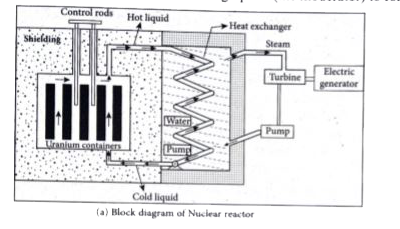 Control rods: • The control rods are used to adjust the reaction rate. During each fission, on an average 2.5 neutrons are emitted and in order to have the controlled chain reactions, only one neutron is allowed to cause another fission and the REMAINING neutrons are absorbed by the control rods. • Usually cadmium or boron acts as control rod material and these rods are inserted into the uranium blocks. Depending on the insertion depth of control rod into the uranium, the average number of neutrons produced per fission is set to be equal to one or greater than one. • If the average number of neutrons produced per fission is equal to one, then reactor is said to be in critical state. In fact, all the nuclear reactors are maintained in critical state by SUITABLE adjustment of control rods. If it is greater than one, then reactor is said to be in super-critical and it may explode sooner or may cause massive destruction. Shielding: • For a protection against harmful radiations, the nuclear reactor is surrounded by a concrete wall of thickness of about 2 to 2.5 m. Cooling system: • The cooling system removes the heat GENERATED in the reactor core. Ordinary water, heavy water and liquid sodium are used as coolant since they have very high specific heat capacity and have large boiling point under high pressure. • This coolant passes through the fuel block and carries away the heat to the steam generator through heat exchanger. The steam runs the turbines which produces electricity in power reactors. |
|
| 18. |
In Young.s double slit experiment the point source placed slightly off the central axis as shown in figure .The plane of slits (S_(p)S_(2)) and screen are separated by a distanceof 2m . The separation between the slits is 10 mm . The positionof the slitabove the axis is I mm . If the wavelength lambda = 4000 A^(0) in the above arrangement(##AKS_TRG_AO_PHY_XII_V02_C_C04_E03_031_Q01.png" width="80%"> If centralmaximum is to occur of rays from one of the slits to the point .P. ( t - thickness of film ) |
|
Answer» <P>`S_(1) `to P such that `[SS_(1) +S_(1)P(mu-1)t]-[SS_(2)+S_(2)P]=0` |
|
| 19. |
A beam of monochromatic radiation is incident on a photosensitive surface. Answer the following with reasons. Does the K.E. of the emitted electrons depend upon the intensity of incident radiation ? |
| Answer» SOLUTION :No, the KINETIC ENERGY of a photoelectron DEPENDS on the energy of each INCIDENT photon and not on the number of photons or intensity of high. | |
| 20. |
A beam of monochromatic radiation is incident on a photosensitive surface. Answer the following with reasons. On what factors does the number of emitted photoelectrons depend? |
| Answer» Solution :No, of PHOTOELECTRONS EMITTED DEPENDS on the INTENSITY of incident light. | |
| 21. |
A thin uniform rod of mass m and length l is free to rotate about its upper end. When it is at rest, it receives an impulse J at its lowest point, normal to its length. Immediately after impact, |
|
Answer» the angular MOMENTUM of the rod is Jl |
|
| 22. |
He is the second Indian winner of the- |
| Answer» Answer :A | |
| 23. |
Whena drya cell is connectedacrossa bulband the circuitis switched on , then thebrightness of bulbgoes ondecreasing . Explain. |
Answer» Solution : If theemf ofcell is `epsi`and its internal resistanceis r, then currentthroughthe bulb of RESISTANCER is `l= (epsi)/(R + r)` . EMF of thecell `epsi= V_(+) + V_(-)` is thedifferenceof chemicalpotentialsof electrodes,whichis constantfor a givecell ANDIS independent of timeof use . Internalresistanceof the cellis inverselyproportionalto charge density). Withpassageof timeof use, iondensityin theelectrolyte (as resistivelyis inverselyproportionalto charge density ). With passageof timeof use ,ion densitygoes ondecreasingso internalresistancer of cellgoes onincreasing . THUS,the currentl through the bulbgoes ondecreasing . |
|
| 24. |
If the object is at (50/7)cm and the image produced is at distinct vision. What is the magnification in this case ? |
| Answer» Solution :LINEAR magnification = `(V)/(u ) = (-25)/(((-50)/(7)) ) = 3.5 ` | |
| 25. |
A cell of emf 2.0 V and internal resistance 0.1 Omega is connected with a resistance of 3.9Omega. The voltage across the cell terminals will be |
|
Answer» 0.50 V |
|
| 26. |
The minimum distance between the object and its real image for a concave mirror is |
|
Answer» f |
|
| 27. |
Angular momentum of electron in the stationary orbit is integral multiple of _____. |
| Answer» SOLUTION :`H/(2PI)` | |
| 28. |
A spaceship is moving away from Earth at speed 0.333c. A source on the rear of the ship light at wave length 450 nm according to someone on the ship. What (a) wavelength and (b) color (blue, green, yellow, or red) are detected by someone on Earth watching the ship? |
|
Answer» |
|
| 29. |
Is electrostatic potential necessarily zero at a point where electric field is zero ? Illustrate your answer. |
| Answer» Solution :No, it is not necessary. As an example electric field INSIDE a hollow charged spherical SHELL is zero but POTENTIAL at the POINT is same as that on the SURFACE of shell. | |
| 30. |
Find the ratio of de-Broglie wavelengths associated with two electrons accelerated through 25V and 36V. |
|
Answer» Solution :As de-Broglie wavelength of electron `LAMDA=(h)/(sqrt(2emV))`, HENCE, `(lamda_(1))/(lamda_(2))=sqrt((V_(2))/(V_(1)))=sqrt((36)/(25))=(6)/(5)`. |
|
| 31. |
Image is formed for the short sighted person at |
|
Answer» Retina |
|
| 32. |
(A) : A choke coil is used instead of a resistor in fluorescent tubes with ac mains. (R) : A choke coil reduces voltage across tube without wasting power, whereas a resistor would waste power as heat. |
|
Answer» Both 'A' and 'R' are TRUE and 'R' is the correct explanation of 'A'. |
|
| 33. |
Mention the contribution of Indian physicist J.C. Bose in the production of electromagnetic waves. |
| Answer» Solution :J.C. BOSE was the first scientist to produce and observe ELECTROMAGNETIC WAVES of wavelengths as short as upto 5 mm. | |
| 34. |
Ionization potential of hydrogen atom is 13.6 eV. Hydrogen atoms in the ground state are excited by monochromatic radiation of photon energy 12.1 eV. According to Bohr's theory, the spectral lines emitted by hydrogen will be ...... |
|
Answer» three first excited state energy `=-(13.6)/(4)=-3.4eV` second excited state energy is `=-(13.6)/(9)=-1.5eV` The DIFFERENCE between the energy of ground state and second excited state = 13.6-1.5= 12.1 eV So electron can jump in third orbit. `:.` Since possible transition are `1 to 2, 1 to 3,2 to 3`, so three LINE can obtained 
|
|
| 35. |
Uniform magnetic field B=10T is acting in a region of length L=2m as shown. A squre loop of side (L)/(2) enters in it with constant acceleration alpha=1m//s^(2). Resistance per unit length of the square frame is 1Omega//m. At, t=1s |
|
Answer» INDUCED CURRENT in the square frame is clockwise |
|
| 36. |
For scattering by an .inverse square. field (such as that produced by a charged nucleus in Rutherford.s model), the relation between impact parameter b and the scattering angle theta is given by, b=(Ze^(2)cot theta//2)/(4pi epsilon_(0)((1)/(2)mv^(2))) For a given energy of the projectile, does the scattering angle increase or decrease with dec rease in impact parameter ? |
|
Answer» Solution :Given relation: `b=(Ze^(2)COT theta//2)/(4PI epsilon_(0)((1)/(2)MV^(2)))` For a given energy `(mv^(2)//2)` of the projectile, the decrease in the VALUE of impact parameter means a decrease in the value of `cot theta//2` and HENCE an increase in the value of scattering angle `theta`. |
|
| 37. |
To obtain a p-typ6 germanium semiconductor, it must be doped with : |
|
Answer»
|
|
| 38. |
In YDSE interference pattern produced by two identical slits, the intensity at the site of the central maximum is 1. The intensity at the same spot when either of two slits is closed is |
|
Answer» I/2 |
|
| 39. |
Pick out the correct meaning listed below to define 'average income': |
|
Answer» AVERAGE INCOME of the country means the total income of the country. 2. |
|
| 40. |
For scattering by an .inverse square. field (such as that produced by a charged nucleus in Rutherford.s model), the relation between impact parameter b and the scattering angle theta is given by, b=(Ze^(2)cot theta//2)/(4pi epsilon_(0)((1)/(2)mv^(2))) Why is it that the mass of the nucleus does not enter the formula above but its charge does ? |
|
Answer» Solution :Given relation: `b=(Ze^(2)cot theta//2)/(4pi epsilon_(0)((1)/(2)mv^(2)))` The scattering of `alpha`-particles takes PLACE due to charge on the nucleus. If Z = 0, `theta=0^(@)` (from the given formula) Mass of nucleus does not APPEAR in the expression for b because the RECOIL of the nucleus is being ignored i.e., the nucleus is assumed to be at rest during its interaction with the `alpha`-particle. |
|
| 41. |
A clock with a metallic pendulum at 15°C runs faster by 5 sec each day and at 30°C, runs slow by 10 sec. The coefficient of linear expansion of the metal is nxx10^(-6)//^(@)Cwhere the value of n in nearest integer is ___. |
|
Answer» We get , `(dt)/(T)=(1)/(2)alphadt` Loss or gain per day `=dT=(1)/(2)adtxx86400` SINCE `T=86400s` for each day , At `15^(@)C,5=(1)/(2)ALPHA(t-15)xx86400,"At "30^(@)C,10=(1)/(2)alpha(30-t)xx86400` `therefore(30-t)/(t-15)=2rArr3t=60^(@)C,T=20^(@)C` `thereforealpha=(10)/((t-15)xx86400)=(10)/(5xx86400)=0.0000023=2.3xx10^(-6)//^(@)C=2` |
|
| 42. |
The value of principal quantum number "n" for which electron in Bohr orbit of hydrogen has maximum linear speed is: |
| Answer» Answer :A | |
| 43. |
The figure shows a schematic diagram showing the arrangement of Youngs'sDouble Slit Experiment Choose the correct statement (s) related to the wavelength of light used |
|
Answer» LARGER the wavelength of light larger the fringe width |
|
| 44. |
A hollow metal sphere of radius R is uniformly charged. The electric field due to the sphere at a distance r from the centre |
|
Answer» increases as r increases for r LT R and for r gt R 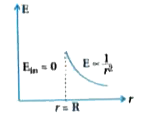
|
|
| 45. |
Explain the underlying principle of working of a parallel plate capacitor . If two similar plates , each of area A , having surface charge densities +sigma and -sigma are separated by a distance 'd' in air , write expression for : the potential difference between the plates. |
|
Answer» Solution :For UNDERLYING principle of working of a parallel plate capacitor . If two similar plates , each of area A , have surface charge densities `+sigma` and `-sigma` and are separated by a DISTANCE d in AIR , then potential difference between the plates `V_(1) - V_(2) = Ed = (sigma)/(in_(0)) d` |
|
| 46. |
A hollow insulated brass sphere is positively charged. The electric potential inside the sphere is |
|
Answer» zero |
|
| 47. |
A tank having cross-section 'A' is filled with water upto height h_(1). What will be the time taken by water to come out of a hole of cross-section 'a' at the bottom to decrease the level from h_(1) to h_(2)· |
|
Answer» A. a . `sqrt(2g).(h_(1) -h_(2))` `=pirh^(2)dg,` `A(-(du)/(dt))=av=asqrt(2gh)` or `(dh)/(dt)=-a/A(2gh)^(1//2)` `(h_(2))/(h_(1))(dh)/((h)^(1//2))=a/Asqrt(2g)_(0)^(t)dt` or `-2[sqrth]_(h_(1))^(h_(2))=a/Asqrt(2gt)` `thereforet=2[sqrt(h_(1))-sqrt(h_(2))]A/axx1/(sqrt(2g))` `=A/asqrt(2/g)[sqrt(h_(1))-sqrt(h_(2))]` `therefore` Correct choice is (b). |
|
| 48. |
Explain the underlying principle of working of a parallel plate capacitor . If two similar plates , each of area A , having surface charge densities +sigma and -sigma are separated by a distance 'd' in air , write expression for : the capacitance of the capacitor so formed . |
|
Answer» Solution :For underlying principle of working of a PARALLEL plate capacitor . If TWO similar plates , each of area A , have surface charge densities `+SIGMA` and `-sigma` and are separated by a distance d in air , then capacitance of the capacitor so FORMED `C = (O)/(V_(1) - V_(2)) = (sigma A)/((sigma)/(in_(0)) d) = (in_(0) A)/(d)` |
|
| 49. |
The resistances of the four arms P,Q,R and S in a Wheatstone's bridge are 10 ohm, 30 ohm, 30 ohm and 90 ohm, respectively. The e.m.f. and internal resistance of the cell are 7 volt and 5 ohm respectively. If the galvanometer resistance is 50 ohm, the current drawn from the cell will be |
|
Answer» 1.0 A |
|