

Saved Bookmarks
This section includes 7 InterviewSolutions, each offering curated multiple-choice questions to sharpen your Current Affairs knowledge and support exam preparation. Choose a topic below to get started.
| 1. |
Explain the underlying principle of working of a parallel plate capacitor . If two similar plates , each of area A , having surface charge densities +sigma and -sigma are separated by a distance 'd' in air , write expression for : the electric field at points between the plates . |
|
Answer» SOLUTION :For underlying principle of working of a parallel plate capacitor . If TWO similar PLATES , each of area A , have surface charge densities `+sigma` and `-sigma` and are SEPARATED by a distance d in air , then the electric field at any point between the plates `VECE = vecE_(1) + vecE_(2) = (sigma)/(2 in_(0)) + (sigma)/(2 in_(0)) = (sigma)/(in_(0))` towards plate 2. |
|
| 2. |
Find the number of images formed when two plane mirrors are placed at E right angle to each other & locate the images by drawing ray diagram. |
|
Answer» Solution :Number of IMAGES `N= ((2PI)/THETA -1 )`, where `theta` is the angle between the mirrors. 4-1=3 
|
|
| 3. |
Which of the following radiations alpha,beta and gamma are : (ii) easily absorbed by matter |
| Answer» SOLUTION :`ALPHA`- PARTICLE. | |
| 4. |
An inductor of 5 H inductance carries a E steady current of 2A. How can a 50 V self-induced emf be made to appear in the inductor ? |
|
Answer» Solution : L =5H, |e| = 50V Let us produce the required EMF by REDUCING current to zero. Now , `|e| = L (dI)/(DT) " or " dt = (LdI)/(|e|) = (5 xx 2)/(50) s ` ` = 10/50 s = 1/5= 0.2 s` ? So, the desired emf can be produced by reducing the given current to zero in 0.2 second. |
|
| 5. |
Let B_P and B_Q be the magnetic field produced by wire P and Q which are placed symmetrically in a rectangular loop ABCD. Current in wire P is directed I inward and in Q is 2I outward. If int_A^B vecB_Q.dvecl=2mu_0T-m int_D^B vecB_P.dvecl=-2mu_0T-m int_A^B vecB_P.dvecl=-mu_0T-m Then find I. |
|
Answer» <P> `QtoAB, CD,DA,BC` GIVEN `int_A^B vecB_Q.dvecl=2mu_0T-m` `int_D^B vecB_P.dvecl=-2mu_0T-m` `int_A^B vecB_P.dvecl=-mu_0T-m` we know `int vecB_(n et). Dvecl=mu_0(2I-I)=mu_0I` Using superpostion taking wire P only `intvecB_P.dvecl=-mu_0I and int vecB_Q.dvecl=mu_0 2I` `int_A^B vecB_Pdvecl+int_B^C vecB_Pdvecl+int_A^D vecB_Pdvecl+int_D^A vecB_Pdvecl=-mu_0I` From symmetry it is clear `int_B^C vecB_Pdvecl=int_D^A vecB_Pdvecl` As `int_A^B vecB_Qdvecl=2mu_0I` Hence, `int_B^C vecB_Pdvecl=-mu_0I` Also, `int_D^A vecB_Q dvecl=-2mu_0I` Then, `int_A^D vecB_Q dvecl=4 mu_0I=int vecB_Qdvecl` `int_A^B vecB_P dvecl=-mu_0I IMPLIES int_D^C vecB_Q dvecl=2mu_0I` `int vecB_("net") dvecl=int vecB_Pdvecl+int vecB_Q dvecl=mu_0I` `=[-mu_0I-mu_0I-2mu_0I-2mu_0I]` `+[2mu_0I+2mu_0I+4mu_0I+4mu_0I]` `=-6mu_0I+12mu_0I=mu_0(6I)` Hence, `I=6A`. |
|
| 6. |
(a) Draw the energy level diagram showing the emission of beta-particles followed by gamma-rays by a " "_(27)^(60)Co nucleus. (b) Plot the distribution of kinetic energy of beta-particles and state why the energy spectrum is continuous. |
|
Answer» Solution :(a) Energy level diagram SHOWING emission of `beta`-particle followed by `gamma`-rays by a `" "_(27)^(60)Co` NUCLEUS is s (b) DISTRIBUTION curve of K.E. of `beta`-particles is shown in Fig.13.11.  Energy spectrum of `beta`-particles is continuous because during emission of `beta^(-)`-particles an antineutrino (and during emission of `beta^(+)`-particle a neutrino) particle is also emitted. THUS, the energy RELEASED is shared by `beta`-particle and antineutrino (or neutrino) particle randomly. As a result, energy spectrum of `beta^(-)`-particles is continuous. |
|
| 7. |
Many of the diagrams given in figure show magnetic field lines (thick lines in the figure ) wrongly. Point out what is wrong with them . Some of them may describe electrostatic field lines correctly. Point out which ones. |
|
Answer» Solution :a. Wrong Magnetic field lines can never emanate from , as shown in figure . Over any closed surface , the net flux of B must always be ZERO., i.e. ., pictorially as many field lines should seem to enter the surface as the number of lines leaving it . The field lines shown , in fact , represent ELECTRIC field of a long positively charged wire. The correct magnetic field lines are circling the straight conductor. b. Wrong Magnetic field lines (like electric field lines ) can never cross each other, because otherwise the direction of field at the point of intersection in ambiguous . There is further error in the figure Magnetostatic field lines can never form closed loops around empty space. A closed loop of static magnetic field line must enclose a region across which a current is passing . By contrast , electrostatic field lines can never form closed loops, neither in empty space, nor when the loop ENCLOSES charges . c. Right Magnetic lines ae completely confined within a toroid Noting wrong in field lines forming closed loops, since each encloses across which a current passes . For clarity of figure , only a few field lines within the toroid have been shown . Actually, the entire region enclosed by the windings contains magnetic field. d. WrongField lines due to a solenoid at its ends and outside cannot be so completely straight and confined , such a thing violates Ampere.s law. The lines should CURVE out at both ends, and meet eventually to form closed loops. e. Right There are field lines out side and inside a bar MAGNET .Note carefully the direction of field lines inside . Not all field lines emanate out of a north pole (or converge into a south pole) . Around both the N-pole , and the net flux of the field is zero. f. Wrong These field lines cannot possibly represent a magnetic field . Look at the upper region All the field lines seem to emanate out of the shaded plate . The net flux through a surface surrounding the shaded plate is not zero. This is impossible for a magnetic field . The given field lines , in fact, show the electrostatic field lines around a positively charged upper plate and a negatively charged lower plate. g. Wrong Magnetic field lines between two pole pieces be precisely straight at the ends. Some fringing of lines is inevitable . Otherwise, Ampere .s law is violated. This is also true for electric field lines. |
|
| 8. |
Determine V_(0), I_(d1) and I_(d2) for the given network. Where D_(1) and D_(2) are made of silicon. |
|
Answer» SOLUTION :`V_(0) = V_(si) = 0.7 V` `I_(1) =(10 - 0.7)/(0.33 xx 10^(3))` `=28.18 mA` `THEREFORE I_(d1) = I_(D2) = (28.18)/2` `=14.09` mA |
|
| 9. |
A converging lens forms a five fold magnified image of an object. The screen is moved towards the object by a distance d=0.5 m, and the lens is shifted so that the image has the same size as the object. Find the power of lens and the initial distance between the object and the screen. |
|
Answer» image and object are of equal size. Hence, `|v|=|u|`. From the two figures,  `6x=2y+d` or `6x-2y=0.5`……(i)` Using the lens formula for both the cases, `(1)/(5X)-1/-x=1/f` or `6/(5x)=1/f`......(ii) `1/y-1/(-y)=1/f` or `2/y=1/f`......(iii) SOLVING these three equations, we GET `x=0.1875 m and f=0.15625 m` Therefore, initial distance between the object and the screen `=6x=1.125 m` Power of the lens, `P=1/f` `=1/0.15625=6.4D` |
|
| 10. |
IfL is the angularmomentum of a satellite revolvingaroundearthis a circularorbitof radiusr withspeed v , then |
|
Answer» `L PROP V` |
|
| 11. |
For scattering by an .inverse square. field (such as that produced by a charged nucleus in Rutherford.s model), the relation between impact parameter b and the scattering angle theta is given by, b=(Ze^(2)cot theta//2)/(4pi epsilon_(0)((1)/(2)mv^(2))) For a given imapct parameter b, does the angle of deflection increase or decrease with increase in energy ? |
|
Answer» SOLUTION :Given relation: `b=(Ze^(2)cot theta//2)/(4pi epsilon_(0)((1)/(2)mv^(2)))` For given b, `(Ze^(2)cot theta//2)/(4pi epsilon_(0)((1)/(2)mv^(2)))`= constant As the energy `(mv^(2)//2)` increases, the value of `cot theta//2` increases. THEREFORE, the value of scattering ANGLE `theta` decreases as expected. |
|
| 12. |
Two monochromatic light waves of amplitude 3A and 2A interfering at a point have a phase difference of 60^(@). The intensity at that point will be proportional to |
|
Answer» `5 A^(2)` ` I = 9A^(2) + 4A^(2) + 2 xx 3A xx 2A xx 1/2` `I = 19A^(2)`. |
|
| 13. |
For scattering by an .inverse square. field (such as that produced by a charged nucleus in Rutherford.s model), the relation between impact parameter b and the scattering angle theta is given by, b=(Ze^(2)cot theta//2)/(4pi epsilon_(0)((1)/(2)mv^(2))) What is the scattering angle for b = 0? |
|
Answer» Solution :GIVEN relation: `b=(Ze^(2)cot theta//2)/(4pi epsilon_(0)((1)/(2)mv^(2)))` For b = 0, `0=(Ze^(2)cot theta//2)/(4pi epsilon_(0)((1)/(2)mv^(2)))` or `cot""(theta)/(2)=0 :. (theta)/(2)=90^(@)` or `theta=180^(@)` Thus the scattering angle is `180^(@)` when impact PARAMETER is zero. |
|
| 14. |
Draw a schematic diagram showing the (i) ground wave, (ii) sky wave and(iii) space wave propagation modes for EM waves. Write the frequency range for each of the following: (i) Standard AM broadcast (ii) Television (iii) Satellite communication |
Answer» SOLUTION : (i) STANDARD AM Broadcast540-1600 kHz (ii) Television 54-890 MHZ (iii) SATELLITE COMMUNICATION 5.925 - 6425 GHz UPLINK 3.7-4.2 GHz Down link |
|
| 15. |
A particle of mass m moves on the x-axis as follows: It starts from rest at r= 0 from the pointr=0, and come to rest at 1 at the point x = 1. The velocity changes lincarly with time. No other information is available about its motion at intermediate times [ 0 lt t lt 1] . If alpha denotes the instantaneous acceleration of the particle , then |
|
Answer» `alpha` cannot remain positive for all t in the interval 0 to 1 S= Area under velocity -time graph `V_("MAX")=(1)/(2)xxV_("max")xxt_(2)`  `IMPLIES V_("max") =(2x)/(t_(2))=2 m//s` `:. alpha =(V_("max"-4))/(t_(2)/(2))=(2-0)/((1)/(2))=4 m//s^(2)` `:.`In some post or points `|alpha| gt 4`. |
|
| 16. |
A radioactive sample has an activity of 4xx10^7 Ci. Express its activity in .becqueral. and .rutherford.. |
|
Answer» Solution :SINCE 1 Ci = `3.7xx10^10` DECAYS PER second. activity = `4xx10^7` Ci. `=4xx10^7xx3.7xx10^10` Bq `=1.48xx10^18` Bq Since, `1xx10^6` decay per second = 1Rd Activity =`1.48xx10^18` Bq `=(1.48xx10^18)/(1xx10^6)` Rd =`1.48xx10^12` Rd. |
|
| 17. |
A Young' s double slit experiment uses a monochromatic source.The shape of interference fringes is : |
|
Answer» parabola |
|
| 18. |
For scattering by an .inverse square. field (such as that produced by a charged nucleus in Rutherford.s model), the relation between impact parameter b and the scattering angle theta is given by, b=(Ze^(2)cot theta//2)/(4pi epsilon_(0)((1)/(2)mv^(2))) What is the impact parameter at which the scattering angle is 90^(@) for Z = 79 and initial energy equal to 10MeV ? |
|
Answer» Solution :Given relation: `b=(ZE^(2)cot theta//2)/(4pi epsilon_(0)((1)/(2)mv^(2)))` `theta=90^(@),Z=79,e=1.6xx10^(-19)C` Now `E=(1)/(2)mv^(2)=10MeV` `=10xx10^(6)xx1.6xx10^(-19)J=1.6xx10^(-12)J` `:.b=(9xx10^(9)xx79xx(1.6xx10^(-19))^(2)cot 45^(@))/(1.6xx10^(-12))` `=1.1xx10^(-14)m` |
|
| 19. |
Draw a circuit diagram to obtain the characteristics of a n-p-n transistor in common base configuration . Give shape of input and output characteristic curves. |
Answer» Solution :`(i)` Common base characteristics. The CIRCUIT diagram for common base n-p-n transistor is shown in fig. (a). The INPUT is applied across the emitter and base and OUTPUT is taken across collector and base. Here base is common to both the input and output circuits. The most important characteristics of common base connections are input characteristic and output characteristic.  Input characteristics (or emitter characteristics) A graph showing the relationship between the emitter base VOLTAGE `(V_(eb))` and the emitter current `(I_(e))` at constant collector base voltage is called input characteristics of emitter characteristics of the transistor. To obtain input characteristics, the emitter base circuit is forward baised by emitter to base voltage `V_(eb)` and collector base circuit is reverse biased by collector to base voltage `V_(eb)`. The collector voltage `V_(cb)` is kept constant at a suitable value. The emitter voltage `V_(eb)` is VARIED in small steps and the emitter current `I_(e)` is noted corresponding to each value of the emitter voltage. A curve is then plotted between `V_(eb)` and `I_(e)` for a given value of `V`. This is one characterisitic. Similar characteristic curves can be drawn for different fixed values of `V_(cb)` as shown in fig. (b).  `(ii)` Output characteristic (or collector characteristics). A graph showing the relationship between the collector base voltage `(V_(cb)` and collector current at constant emitter current `(I_(e))` is called the collector characteristic or the output characteristic of the transistor. To obtain ouput characteristics the emitter current `I_(e)` is kept constant at a suitable value. The collector voltage `V_(cb)` is varied in small steps and the collector current `I_(c)` is noted corresponding to each value of the emitter current. A curve is then plotted between `V_(cb)` and `I_(c)` for a given value `I_(e)`. This is one characteristic. Similar characteristic curves can be drawn for different fixed values of `I_(c)` as shown in fig (c) . 
|
|
| 20. |
A battery is connected to an ideal solenoid and a light bulb in parallel (As shown in the following figure). When the switch is opened, the light bulb |
|
Answer» REMAINS off |
|
| 21. |
The waves having peridioc changes in electric and magmetic fields are called ? |
| Answer» SOLUTION :Elaectromagnetic WAVES | |
| 22. |
Which of the following is correct representation of liquid-vapour phase diagram for mixture ofHNO_(30 and H_(2)O ? |
|
Answer»
|
|
| 23. |
(A): Gamma rays are more energetic than X-rays (R) : Gamma rays are of nuclear origin but X-rays are produced due to sudden deceleration of high energy electron while falling on a metal of high atomic number |
|
Answer» Both 'A' and 'R' are TRUE and 'R' is the CORRECT EXPLANATION of 'A'. |
|
| 24. |
How does the resolving power of a telescope chande when the aperature of the objective is increased ? |
| Answer» SOLUTION :RP of a TELESCOPE = `D/(1.22 LAMBDA`) | |
| 25. |
A resistor of 50 Omega, an inductor of (20//pi)H and a capacitor of (5//pi) mu F are connected in series to a voltage source 230 V, 50 Hz. Find the impedance of the circuit. |
|
Answer» |
|
| 26. |
Give the sign of the work done by the external agency in moving a small negative charge from B and A. |
| Answer» Solution :In moving a small negative charge from B to A WORK has to be done by the EXTERNAL AGENCY. It is POSITIVE. | |
| 27. |
What should be the minimum value of refractive indexof a prism of refractive angle A, so that there is no emergent ray irrespective of angle of incidence? |
|
Answer» sin`A/2` From Snell.s law at face AB, we have 1sini=nsin`r_1`…(II) `A=r_1+r_2=r_1+C`…(iii) From eqn. (ii) N is minimum when `r_1` is maximum , i.e., `r_1=C`. In this CASE `i=90^@` From eqn. (iii) , A=2C or C=A/2 From eqn. (ii), sin C=`1/n`, sin`A/2=1/n` `therefore` n=cosec`A/2` 
|
|
| 28. |
Four identical plates each of area a are separated by a distance d. The connection is shown below . What is the capacitance between P and Q? |
|
Answer» `2aepsilon_(0)//d` `thereforeC_(p)=(2epsilon_(0)a)/(d)`. |
|
| 29. |
A point charge q is located between two mutually perpendicular conducting half-planes. Its distance from each half-plane is equal to l. Find the modulus of the vector of the force acting on the charge. |
|
Answer» |
|
| 30. |
For an LCR circuit, the power transferred from the driving source to the driven oscillator is P=I^2Zcosphi _____ |
|
Answer» Here, the POWER factor cos `PHI gt 0 , P gt 0` where I=current , Z=impedance , cos `phi`=power factor but cos `phi=R/2` where R `gt` 0 and HENCE `Z gt 0` `therefore cos phi gt 0` |
|
| 31. |
A large flat metal surface has uniform charge density + sigma . An electron of mass m and charge e leaves the surface at point A with speed y, and return to it at point B. The maximum value of AB is |
|
Answer» `( V m in_0)/( SIGMA E)` |
|
| 32. |
Figures of merit of two galvanometers of resistance 100Omega and 50Omega, are 10^(-8) A/div and 2 xx 10^(-5)A/div respectively. In which case the voltage sensitivity is more ? |
|
Answer» more in CASE I |
|
| 33. |
Answer the following questions, which help you understand the difference between Thomson's model and Rutherford's model better. Is the average angle of deflection of alph - particles by a thin gold foil predicted by Thomson's model much less, about the same, or much greater than that predicted by Rutherford's model? |
| Answer» SOLUTION :About the same this is because we are TALKING of AVERAGE ANGLE of DEFLECTION. | |
| 34. |
Answer the following questions, which help you understand the difference between Thomson's model and Rutherford's model better. Keeping other factors fixed, it is found experimentally that for small thickness t, the number of alpha- particles scattered at moderate angles is proportional to t. What clue does this linear dependence on t provide ? |
| Answer» Solution :This suggests that scattering is PREDOMINANTLY due to a single collision increases with the NUMBER of target atoms which increases LINEARLY with the THICKNESS of the foil. | |
| 35. |
StateBrewster's Law Thevalue ofBrewsteranglefor atransparentmedium is differentfor lightof differentcolours . Give reason. |
|
Answer» Solution :Brewster’s Law: When UNPOLARISED light is incident on the surface SEPARATING two media at polarising angle, the REFLECTED light gets completely polarised only when the reflected light and the refracted light are PERPENDICULAR to each other. Now, refractive index of DENSER (second) medium with respect to rarer (first) medium is given by `mu=tani_p`where `i_p`= polarising angle. Since refractive index is different for different colour (wavelengths), Brewter’s angle is different for different colours. |
|
| 36. |
Obtain the equation of the bandwidth for an L-C-R series AC circuit and deduce the equation of Q factor. |
|
Answer» SOLUTION :When `omega_(1) = omega_(1) + Delta omega`, the amplitude of current is`I_(m) = ( I_(max))/( sqrt(2))` hence amplitude of current at `omega_(1)`, `I_(m) = ( V_(m))/( Z) = ( V_(m))/( sqrt( R^(2)) + ( omega_(0) L - ( 1)/( omega_(0)C))^(2))` `(I_(m)^(max))/(sqrt(2)) = ( V_(m))/( R sqrt( 2))` or `sqrt( R^(2) + ( omega_(1) L - ( 1)/( omega_(1) C ))^(2)) = Rsqrt(2)` `:. R^(2) + ( omega_(1) L - (1)/( omega_(1) C ))^(2) = 2R^(2)` `:. ( omega_(1) L - ( 1)/( omega_(1) C ))^(2) = R^(2)` `:. omega_(1) L - ( 1)/( omega_(1) C ) = R` but puttting `omega_(1) = omega_(0) + Delta omega` `( omega _(0)+ Delta omega) L - ( 1)/(( omega _(0)+ Delta omega)C ) = R ` `:. omega_(0) L + Delta omega L - ( 1)/( omega_(0) C + Delta omega C ) = R ` `:. omega_(0) L ( 1+ ( Delta omega )/( omega_(0))) - ( 1)/( omega_(0) C ( 1+ ( Delta omega)/( omega_(0)))) = R ` `:. omega_(0) L ( 1+ ( Delta omega )/( omega_(0))) - ( omega _(0) L)/((1+ (Deltaomega)/omega_(0)))= R` where `omega_(0) C = ( 1)/( omega_(0) L )` `:. omega _(0) L ( 1+ ( Delta omega)/( omega_(0))) - omega_(0) L ( 1+ ( Delta omega)/( omega_(0)))^(-1)` SINCE `( Delta omega )/( omega_(0)) lt lt 1 ( 1+ ( Delta omega )/( omega_(0)))^(-1) = ( 1- ( Delta omega )/( omega ))` `:. omega_(0) L ( 1 + (Delta omega ) /( omega_(0))) - omega_(0) L ( 1 - ( Delta omega)/( omega_(0)))` `:. omega_(0) L[ 1+ ( Delta omega )/( omega_(0)) - 1+ ( Delta omega ) /( omega_(0))]` `:. omega _(0) L xx ( 2 Delta omega )/( omega _(0)) = R :. Delta omega = ( R )/( 2L )` |
|
| 37. |
Three series A.C. circuits (i) RC (ii) RL and (iii) LC (where values of L and C are such that X_L = X_C) are connected turn by turn with a given A.C. source with angular frequency omega. If power consumed in these circuits are respectively P_1, P_2 and P_3then ....... |
|
Answer» `P_1 gt P_2 gt P_3` (where `phi_1` is such that `tan phi_1=(|-X_C|)/R`) ….(1) `P_2=V^2/sqrt(R^2+X_L^2)cosphi_2` (Where `phi_2` is such that `tan phi_2 =X_L/2` ) …..(2) `rArr P_1=P_2` (`because X_L = X_C` and cos`phi_1=cosphi_2` because `X_L=X_C`) ....(3) `P_3=V^2/(|X_L-X_C|)cos (pi/2)=0`....(4) From (3) and (4) , `P_1=P_2 gt P_3` |
|
| 38. |
(A) : A.C. is more dangerous than D.C for human body. (R): Frequency of A.C. is dangerous for human body. |
|
Answer» Both 'A' and 'R' are true and 'R' is the CORRECT explanation of 'A'. |
|
| 39. |
A coil perpendicular to a uniform magnetic field is rotated by 180. What is the change in the flux through it? |
| Answer» SOLUTION :The FLUX BECOMES DOUBLE. | |
| 40. |
Indicate the magnetic axis and magnetic length for a permanent horse - shoe (U - shaped ) magnet . |
Answer» Solution :In FIG . , the straight line CD passes through the two poles of the HORSE - SHOE MAGNET . So , CD is the magnetic axis . The line segment AB INDICATES the least distance between the two poles , N and S . So , the length of AB is the magnetic length . 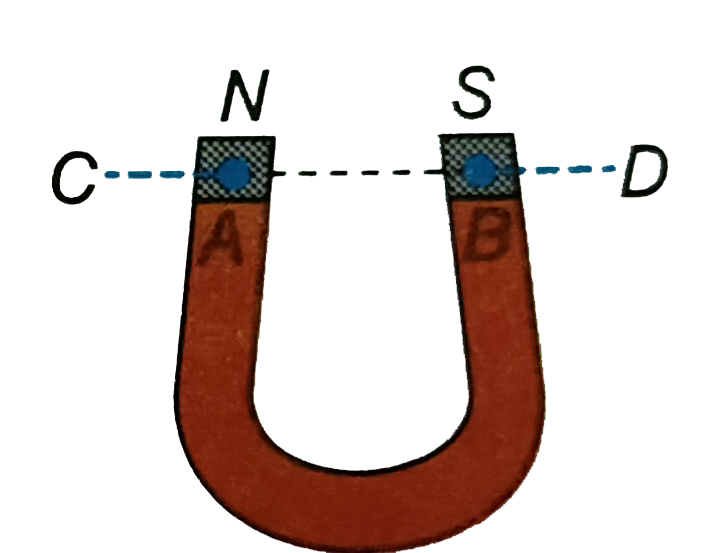
|
|
| 41. |
The charge q flowing in a conductor of uniform cross section, varies with time as q=alphat-batat^(2). Then, the current |
|
Answer» DECREASES linearly with time |
|
| 42. |
K.E. of free electron doubles, its de-broglie wavelength changes by a factor : |
|
Answer» `(1)/(sqrt(2))` `lambda. prop (1)/( sqrt(2E))` `:. (lambda.)/(lambda)=(1)/(sqrt(2)) rArr lambda.=(lambda)/(sqrt(2))` |
|
| 43. |
For which of the following fields, Gauss'a law is valid- |
|
Answer» fields following SQUARE INVERSE LAW |
|
| 44. |
State and explain ohm's law |
|
Answer» SOLUTION :Ohm.s law: The law states that , at the coonstnat TEMPERATURES, the steady current FLOWING through a conductor is DIRECTLY proporational to the potential difference between the two ends of the conductor. `{:(i.e."," , I alpha V), ( or , I = 1/R V ), ( therefore , V = IR ), ( or , R = V /I):}` Resistance of a conductor is DEFINED as the rqatio of potential defference across the conductor to the current following through. it THe unit of resistance is ohm `(Omega)` |
|
| 45. |
A cylinder contains 0.3 moles of N_(2), 0.1 mole of O_(2) and 0.1 mole of helium. If the total pressure is one atm, what is the partial pressure of oxygen in mm Hg:- |
|
Answer» 450 =0.5 `Po_(2)=(0.1)/(0.5)xx760=(1)/(5)xx760` `=150mm HG` |
|
| 46. |
Magnetic susceptibility of a diamagnetic substance is _____ by temperature. |
| Answer» SOLUTION :not AFFECTED | |
| 47. |
Findoutthewavelengthof theelectron orbiting in thegroundstateof hydrogenatom . |
|
Answer» SOLUTION :As perquantum concept, for a stable ntheorbitof HYDROGEN atomthe total length oforbital path (i.e., the circumferenceof the orbit) is equal to n times the de - BROGLIE wavelenghtof electron. Thus , `2 pi rn = n lambda_("electron")` For an electron orbitingin the ground stateof hydrogenatom , n =1 . HENCE , we have ` 2 pi r_(1) = lambda_("electron")` |
|
| 48. |
Prove that an inductor offers easy path to dc and a resistive path to ac |
| Answer» SOLUTION :INDUCTIVE reactance `X_L=Lomega` For dc `omega=0, lomega=0` for AC `omega=0 So `X_L=Lomega` has finite value | |
| 49. |
(A) : Magnetic force is always perpendicular to the magnetic field (R) : Electric force is along the direction of electric field. |
|
Answer» Both 'A' and 'R' are TRUE and 'R' is the CORRECT explanation of 'A'. |
|
| 50. |
A conducting frame is placed in a horizontal plane as shown in the figure. The two sides are parallel and separated by a distance of 0.25 m. A massless conducting rod can slide without friction on the frame. The total resistance of the circuit is 40 Omega. The rod is connected to a 0.2 kg mass by a massless cord which passes over a massless and frictionless pulley. A uniform magnetic field of 2T points vertically upward. The voltage of the bettery is 100 V. Find the constant velocity in m//s with which the rod and mass eventually move. |
|
Answer» :.W = GRAVITATIONAL force `=mg=i//B` [i=INDUCED current in the circuit] `:. I = (0.2xx10)/(2xx0.25)=4A` To produce 4A current in the bar, induced emf varepsilon in the circuit is `(100+varepsilon)/40 = 4 varepsilon=60V` We know, `varepsilon=BlV RIGHTARROW V=varepsilon/(Bl)=60/(2xx0.25)=120m//s` |
|


