Saved Bookmarks
This section includes 7 InterviewSolutions, each offering curated multiple-choice questions to sharpen your Current Affairs knowledge and support exam preparation. Choose a topic below to get started.
| 2. |
Find the magnitude of the electric field at a point 4 cm away from a line charge of density 2 xx 10^(-6) C/m |
|
Answer» `9 XX 10^(9) N//C` |
|
| 3. |
A post of height 4 m is dipped straight in a pond. 1 m of the post remains above the water of the pond. If the rays of the sun are inclined at an angle of 45^(@) to the surface of water what will be the length of the shadow of the post at the bottom of the pond? Refractive index of water mu = (4)/(3). |
|
Answer» Solution :When the vessel is EMPTY, a light ray from the point A enters the telescope T following the straight path AO [Fig. 2.55]. When the vessel is filled with the liquid, aray of light from the point B moves along BO and after refraction in air enters the telescope. Let h be the height of the vessel. `"Here" angleBOC = i and angleAOC = r` According to the FIGURE, `(sini)/(sinr) = (1)/(mu) or, mu = (sinr)/(sini)` `or, "" 1.5 = ((AC)/(AO))/((BC)/(BO)) = (AC)/(AO) xx (BO)/(BC) = (AC)/(BC) xx (BO)/(AO)` `or, "" 1.5 = (10)/(5) xx (sqrt(BC^(2) + CO^(2)))/(sqrt(AC^(2) + CO^(2))) = 2 xx (sqrt(25 + h^(2)))/(sqrt(100 + h^(2)))` `or, " " 2.25 = (4(25 + h^(2)))/(100 + h^(2))` `or, "" h = 8.45 cm` 
|
|
| 4. |
Sensitivity of potentiometer |
|
Answer» INCREASES with increase of LENGTH of the wire |
|
| 5. |
Three discs A, B and C having radii 2m, 4 m and 6 m respectively are coated with carbon black on their outer surfaces. The wavelengths corresponding to maximum intensity are 300 nm, 400 nm and 500 nm respectively. The power radiated by them are Q_(A),Q_(B) and Q_(C) respectively : |
|
Answer» `Q_(A)` is maximum Since `lamda_(m)T="Const"`. `:.Qprop(A)/(lamda_(m)^(4))` or `Qprop(r^(2))/(lamda_(m)^(4))`. `:.Q_(!):Q_(B):Q_(C)=(2^(2))/(3^(4)):(4^(2))/(3^(4)):(6^(4))/(5^(4))` `=(4)/(81):(1)/(16):(36)/(625)` THUS `Q_(B)` is maximum. Correct choice is (c). |
|
| 6. |
A closely wound solenoid of 1000 tuins and area of Cross-section 2.0 xx 10^(-4) in- carries a current of 2.0 A. It is placed with its horizontal axis al 30^(@) with the direction of a uniform horizontal magnetie field of 0.16 T as shown in the figure. What is the magnitude of the restoring torque produced by the lield on the solenoid! |
|
Answer» 0.016 Nm `M = nIA = 1000xx2xx2xx10^(-4)` `therefore M= 0.4 m^(2)` The direction of M is along the axis of the solenoid i.e., in the direction PQ. It makes an angle of `30^(@)` with the direction of the field. A restorings torqua `TAU` act on the solenoid, to bring the axis of the solenoid N-S direction. The magnitude of torqua, `tau = MB sintheta` `= 0.4 xx0.16 XX sin30^(@) =0.064 xx 1//2 =0.032 Nm` |
|
| 7. |
द्विघात बहुपद 4x^2 +4x+1 के शून्यक alpha ,betaहो तो alpha+beta-alphabeta का मान होगा - |
| Answer» ANSWER :D | |
| 8. |
""_(87)^(221)Ra undergoes radioactive decay with half life 4 days. What is the probablity that a nucleus undergoes decay in two half-lives: |
|
Answer» 1 `=1-e^((-LN 2)/(T).2T)=1-e^(-2 ln 2)` `=1-1/4=3/4` |
|
| 9. |
In a sonometer wire, the tension is maintained by suspending a 50.7kg mass from the free end of the wire. The suspended mass has a volume of 0.0075cm^3. The fundamental frequency, of vibration of the wire is 260Hz. If the suspended mass is completely submerged in water, the fundamental frequency will 40y Hz. Find y |
|
Answer» |
|
| 10. |
STATEMENT-1: In characteristic X-rays, K_(alpha) X-rays are of smaller wavelengththan K_(beta) X-rays for the same element. STATEMENT-2: Characteristics X-rays are produced by transitions of orbital electrons in the target atom. |
|
Answer» Statement-1 is TRUE , Statement-2 is True, Statement-2 is a CORRECT EXPLANATION for Statement-1. |
|
| 11. |
The half-lives of radioisotypes P^32 and P^33 are 14 days and 25 days respectively. These radioisotopes are mixed in the ratio of 4:1 of their atoms. It the initial activity of the mixed sample is 3.0 mCi, find the activity of the mixed isotopes after 60 years. |
|
Answer» `lambda_2=(1n2)/(T_2)` `R_(01)+R_0=8mCi` (GIVEN) `:.` `lambda_1(4N_0)+lambda_2(N_C)=8mCi` From here we can FIND number after `t=60 yr` `R=R_1+R_2` `=(4lambda_1N_0)E^(-lambda_1t)+(lambda_2N_0)e^(-lambda_2t)` |
|
| 12. |
Consider the following sequence of reactions. The intermediate products (X) and (Y) are respectively - |
|
Answer»
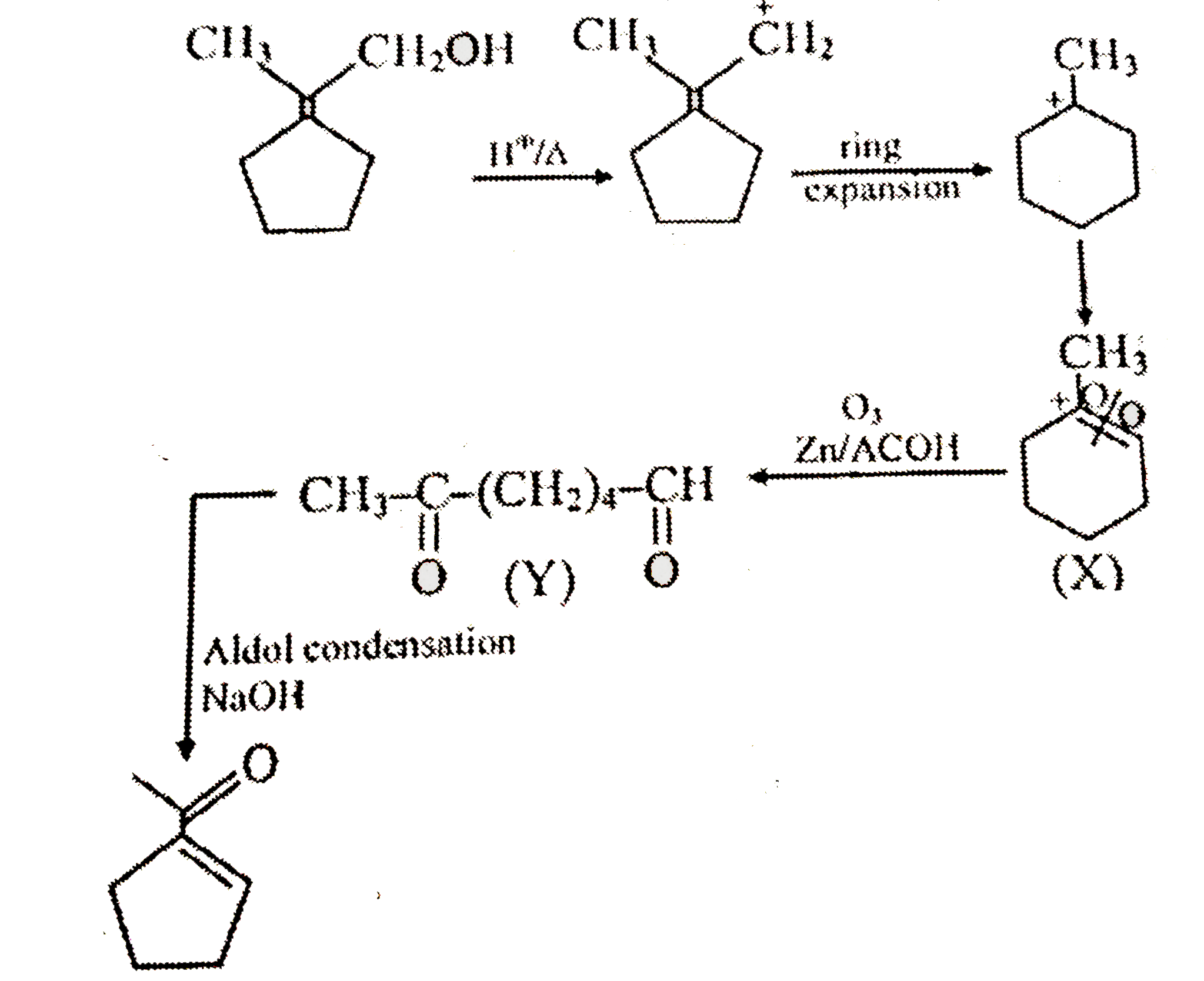
|
|
| 13. |
A body starts from rest and acquires a velocity V in time T. The work done on the body in time t will be proportional to |
|
Answer» `V/Text` |
|
| 14. |
Find magneitc field at O |
|
Answer» `(5mu_(0)itheta)/(24pir)` |
|
| 15. |
Atomic weight of boron is 10.81 and it has two isotopes _5B^10 to _5B^11 in nature would be : |
|
Answer» `19:81` |
|
| 16. |
Does the critical angle depend on the wavelength of light? |
| Answer» SOLUTION :Yes. Critical angle C is given by C=`SIN^(-1)`1/n and depends on wavelength. | |
| 17. |
In case of linearly polarised light, the magnitude of the electric field vector ....... |
|
Answer» does not CHANGE with TIME. |
|
| 18. |
Apparatus is set up to propagate e.m. waves in the x-direction, having wavelength of 6 mm. An electric field of magnitude 33V m^(-1) is applied in y-direction. The suitable equation for magnetic field (as function of x and t) is : |
|
Answer» `B_(Z)=1.1 XX 10^(-7) sin pi(t- x // c)` `B_(z)=B_(0)sin omega(t-x // c)` `=1.1 xx 10^(-7) sin pi 10^(11) (t-x // c)` |
|
| 19. |
Deduce Ohm's law using the concept of drift velocity. |
|
Answer» SOLUTION :We know that the drift velocity is given by `v_(d)=(I)/(N eA)`. . . (i) Also `v_(d)=(eEtau)/(m)`. . (II) From eqs. (i) and (ii), `(eEtau)/(m)=(I)/(n eA)` or `(E)/(I)=(m)/(n e^(2)Atau)` or `(V)/(lI)=(m)/(n e^(2)Atau)` or `(V)/(I)=(ml)/(n e^(2)A tau)` or `(V)/(I)=(ml)/(n e^(2)A tau)=R` (constant) or `V=IR`. |
|
| 20. |
A capacitor of 2 muF is charged to a potential of 4V using a battery, and then the battery is disconnected and the changed capacior is connected to an uncjharged caspacitor of 4 muF capacitance. When the equilibrium is established the total energy stored in the capacitors is |
|
Answer» `16 muJ` `U_(F)=1/2(C_(1)+C_(2))V^(2)` |
|
| 21. |
A storage battery of emf 0.8 V and internal resistance 0.5 Omega is being charged by a 120 V do supply using a series resistor of 15.5 Omega. What is the terminal voltage of the battery during charging? What is the purpose of having a series resistor in the charging circuit? |
|
Answer» 11.5 V |
|
| 22. |
A light ray passes through a prism of angle A in a position of minimum deviation. Obtain and expression for (a) the angle of incidence in terms of the angle of the prism and the angle of minimum deviation (b) the angle of refraction in terms of the refractive index of the prism. |
|
Answer» Solution :In the quadrilateral AQNR `angleA+angleQNR=180^(@)" ………………………..(1)"` From `Delta^("le")` QNR, `r_(1)+r_(2)+angleQNR=180^(@)"………………………..(2)"` `r_(1)+r_(2)=A"………………………………(3)"` `"Total DEVIATION " delta=(i-r_(1))+(e-r_(2))` `delta=i+e-A"....................(4)"` (a) At minimum deviatoin position `delta=D_(m), i=e and r_(1)=r_(2)=r` `THEREFORE"From eq (4), "D_(m)=2i-A` `i=(A+D_(m))/(2)"......................(5)"` (B) From eq (3), `r+r=A` `r=A//2"..........................(6)"` Refractive index of HTE prism `MU=(sini)/(sinr)" ............................(7)"` `sin r=(sini)/(mu), r=sin^(-1)((sini)/(mu))` `mu=(sin((A+D_(m))/(2)))/(sinA//2)".........................(8)"` 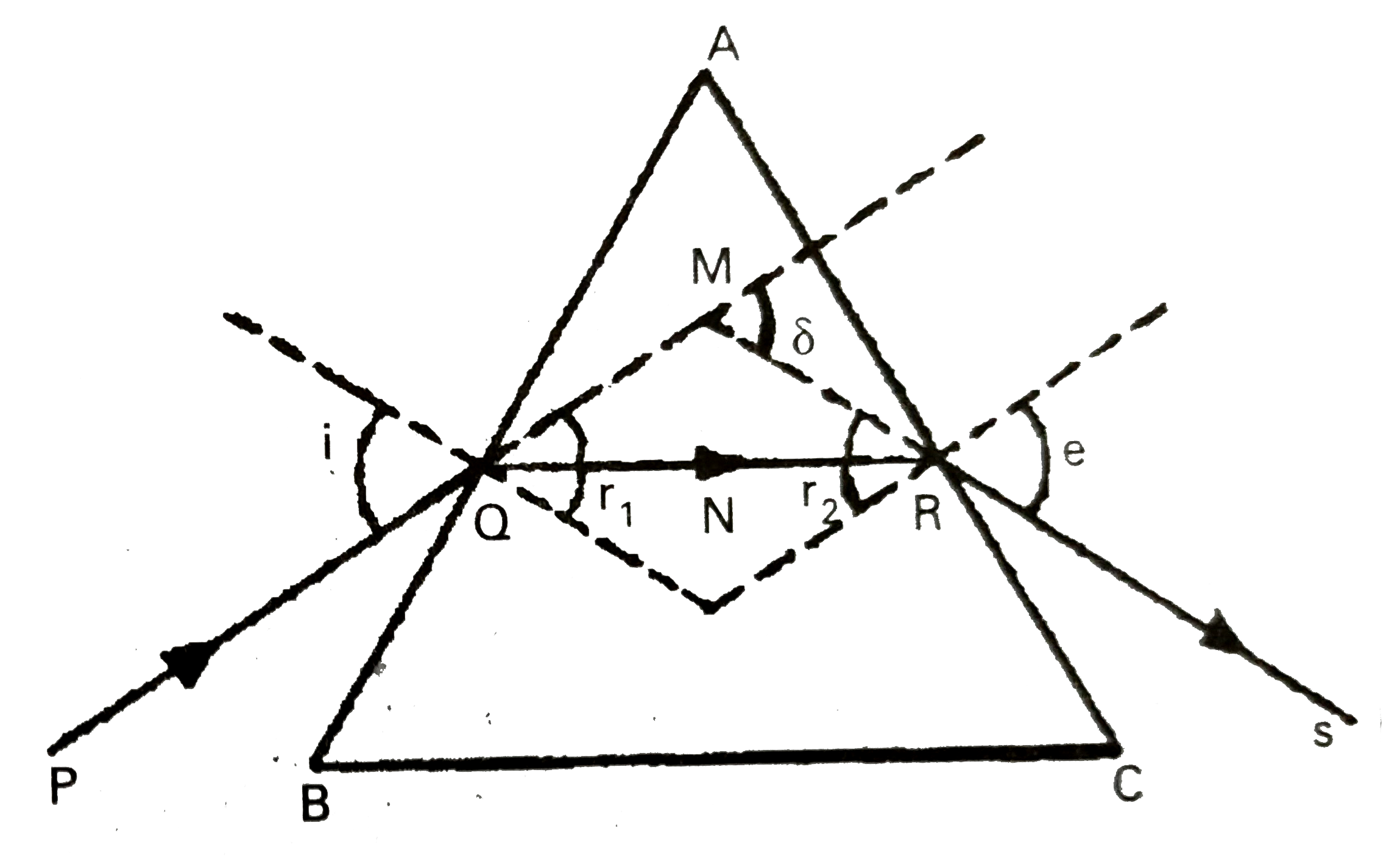
|
|
| 23. |
Two identical capacitors with identical dielectric slabs in between them are connected in series as shown in. Now, the slab of one capacitor is pulled out slowly with the help of an external force F at steady state as shown. Mark the correct statement(s). . |
|
Answer» During the spring the process, charge (positive) flows from b to a. `U_(i)+W_("ext")=U_(f)+"work done on battery"+DeltaH` As dielectric slab is attracted by the plates of capcitors, to pull it out, F has to perform some work, i.e. `W_("ext")(F)gt0`. |
|
| 24. |
The standard free energy change free energy for the following reaction is -210 KJ. What is the standard cell potential ? 2H_(2)O_(2)(aq)rarr2H_(2)O(l)+O_(2)(g) |
|
Answer» `+0.752` `-210xx1000=-2xx96500xxE_("cell")^(@)` `-E_("cell")^(@)=1.09V` |
|
| 25. |
Four metallic plates rearranged as shown in the figure. If the distance between each plate then capacitance of the given system between points A and B is (Given d lt lt A ) |
|
Answer» `(epsilon_0A)/d` |
|
| 26. |
Light of wavelength 6000A^(0) is incident on a single slit. The first minimum of the diffraction pattern is obtained at 4 mm from the centre. The screen is at a distance of 2m from the slit. The slit width will be |
|
Answer» `0.3 MM` |
|
| 27. |
The radius of nucleus is R=R_(0)A^(1//3)where A is the mass number of the atom. What are the dimensions of R_(0) ? |
|
Answer» `[M^(0)L^(0)T^(-1)]` `R_(0)=(R)/(A^(1//3))=(L^(1))/([M^(0)L^(0)T^(0)]^(1//3))` `=[M^(0)L^(1)T^(0)]` Hence CORRECT CHOICE is `(b)`. |
|
| 28. |
A slit whose width is 5.0 cm is irradiated with microwaves of wavelength 2 cm. The angular spread of the central maximum ? (Assume that the incidence is along the normal to the plane of the slit) is |
|
Answer» `2 SIN^(-1)(2//5)` |
|
| 29. |
It is necessary to use satellites for long distance TV transmission, why? |
| Answer» SOLUTION :TV signals being of high frequency are not reflected by ionosphere. Also, ground wave TRANSMISSION is POSSIBLE only upto a limited range. That is why satellites are used for LONG distance TV transmission. | |
| 30. |
Extraneous chagres are uniformly distributed with space density rho gt 0 overa ball of radiusR made of uniformistropis dielectric with permittivity epsilon. Find : (a) magnitudeof the electric field strength as a function of distance r fromthe centreof the ball, drawteh approixmateplots E(r) adn varphi (r ), (b) the space and surface densitiesof the boundcharges. |
|
Answer» SOLUTION :`di v vec(D) = (1)/(r^(2)) (del)/(del r) D_(r ) = rho` `r^(2) D_(r ) = rho (r^(3))/(3) + A D, = (1)/(3) rho r + (A)/(r^(2)), r LT R` `A = 0` as `D_(r ) = oo` at `r = 0`, THUS, `E_( r) = (rho r)/(3 epsilon epsilon_(0))` For`r gt R, D_( r) = (B)/(r^(2))` By continuity of `D`, at`r = R , B =(rho R^(3))/(3)` so, `E_(r ) = (rho R^(3))/(3 epsilon_(0) r^(2)) , r gt R` `varphi = (rho R^(3))/(3 epsilon r), r gt R` and `varphi = (rho r^(2))/(6 epsilon epsilon_(0)) + C, r lt R` `C = + (rho R^2)/(3 epsilon_(0)) + (rho R^(2))/(6 epsilon epsilon_(0))`, by continuity of `varphi`. See answer sheet for graphs of `E ( r)` and `varphi (r )` (b) `rho' = d ivvec(P) = (1)/(r^(2)) (del)/(del r) {(r^(3))/(3) rho (1 - (1)/(epsilon))} = - (rho (epsilon - 1))/(epsilon)` `sigma' = P_(1r) - P_(2r) = P_(1r) = (1)/(3) rho R(1 - (1)/(epsilon))` |
|
| 31. |
A piston of cross-sectional area 100 cm^(2) is used in a hydraulic press to exert a force of 107 dyne on the water. The cross-sectional area of the other piston which supports a truck of mass 2000 kg is : |
|
Answer» `9.8xx10^(2)CM^(2)` Let A be the CROSS sectional area of the other piston. Then the pressure on this piston =`(2000xx1000xx980)/A` SINCE the two pressures are EQUAL. `therefore(2000xx1000xx980)/A=10^(5)` or `A=19600cm^(2)=1.96xx10^(4)cm^(2)` Correct choice is (d). |
|
| 32. |
The aperture of the human eye is 2 mm. if the mean wavelength of light is 500 nm, then the limit of resolution of the eye is approximately equal to : |
|
Answer» 1' |
|
| 34. |
If the output of the OR gate is connected to both inputs of the NAND gate, then this combination acts as a ………. |
|
Answer» OR gate  which is the equation of NOR gate. SECOND method: `y=BAR(y.*y.)` `=bar((A+B)*(A+B))=bar(A+B)` which is the BOOLEAN equation of NOR gate. |
|
| 35. |
…. Lamp is used in physiotherapy treatement. |
| Answer» Answer :A | |
| 36. |
A uniform rod of mass m and length L is hinged at one end and free to rotate in the horizontal plane. All the surface are smooth. A particle of same mass m collides with the rod with a speed V_(0). The coefficient of restitution for the collision is e=(1)/(2). If hinge reaction during the collision is zero then the value of x is : |
|
Answer» No such value of X is possible |
|
| 37. |
When a capacitor discharges through a resistance R, the time constant is tau and the maximum current in the circuit is i_(0) |
|
Answer» The initial charge on the capacitor was `i_(0)TAU` |
|
| 38. |
What is magnetic induction. |
| Answer» Solution :It is at a POINT inside the matter , is the NUMBER of LINES of force crossing per UNIT AREA at that point. | |
| 39. |
The acceleration of a particle starting from rest varies with time according to the relation a=-sw^2 sin wt The displacement of the particle at time 't' will be |
|
Answer» s sinwt |
|
| 40. |
In a biprism experiment using sodium light lambda = 6000 Å an interference pattern is obtained in which 20 fringes occupy 2 cm. On replacing sodium light by another source of wavelength lambda_(2) without making any other change 30 fringes occupy 2.7 cm on the screen. What is the value of lambda_(2) ? |
|
Answer» |
|
| 41. |
An athlete of mass 60 kg skips at the rate of 20 steps per minute through an average height of 25 cm. The power developed is |
|
Answer» 98 W |
|
| 42. |
In a large building, there are 15 bulbs of 40W, 5 bulbs of 100W, 5 fans of 80W and 1 heater of 1 kW are connected. The voltage of electric mains is 220V. The minimum capacity of the main fuse of the building will be ………………. . |
| Answer» ANSWER :D | |
| 43. |
The graph show a hypothetical graph of gas molecules. N is the total number of molecules. Find the value of a. |
|
Answer» `(1)/(3)` AREA = `intydx=int(1)/(N)(dN)/(dv)dv=(1)/(N)intdN=(N)/(N)=1""...(i)` Area under the curve = `(1)/(2)(2a)+2a=3a""…(II)` `therefore` from (i) and (ii), `3a=1impliesa=(1)/(3)` |
|
| 44. |
Explain different modes of propagation of radio waves? |
| Answer» Solution :There are THREE modes of propagation of radio WAVES, NAMELY, GROUND wave propagation, sky and space wave COMMUNICATION. | |
| 45. |
The electric potential decreases uniformly from 120 V to 80 V as one moves on the X-axis from x = -1 cm to x = + 1 cm. The electirc field at the origin |
|
Answer» MUST be EQUAL to 20 V/cm |
|
| 46. |
Four particles, each of mass M and equidistant from each other, move along a circle of radius R under the action of their mutual gravitational attraction. The speed of each particle is: |
|
Answer» `(1)/(2) sqrt((GM)/(R )(1+2sqrt(2)))`  `=(GM^(2))/((2R)^(2))+(GM^(2))/((R sqrt(2))^(2))cos45^(@)+(GM^(2))/((R sqrt(2))^(2))cos45^(@)` `=(GM^(2))/(R^(2))[(1)/(4 )+(1)/(sqrt(2))]` This force will be equal to centripetal force so `(Mu^(2))/(R )=(GM^(2))/(R^(2))[(1+2sqrt(2))/(4)]` `u=sqrt((GM)/(4R)[1+2sqrt(2)])=(1)/(2)sqrt((GM)/(R )[2sqrt(2)+1])` So correct choice is (a). |
|
| 47. |
A Gaussian surface in the cylinder of cross-section pia^(2) and length L is immersed in a uniform electric field E with the cylinder axis parallel to the field. The flux phi of the electric field through the closed surface is |
| Answer» Answer :D | |
| 48. |
Two convex lenses of same focal length but of aperture A_(1) and (A_(2) lt A_(1)) , are used as the objective lenses in two astronomical telescopes having identical eyepieces. What is the ratio of their resolving power? Which telescope will you prefer and why ? Give reason. |
|
Answer» SOLUTION :RATIO of resolving power ` = ( A_(1))/( A_(2))` TELESCOPE of aperture `A_(1)` is preferred Reason `:` HIGHER resolving power `//` More light gathering power. |
|
| 49. |
A metallic ring of radius r with a uniform metallic spoke of negligible mass and length r is rotated about its axis with angular velocity omega in a perpendicular uniform magnetic field B as shown in Fig. 3.163. The central end of the spoke is connected to the rim of the wheel through a resistor R as shown. The resistor does not rotate, its one end is always at the center of the ring and the other end is always in as shown is needed to maintain constant angular velocity of the wheel. F is equal to (the ring and the spoke has zero resistance) |
|
Answer» (a) `(B^(2)omegar^(2))/(8R)` 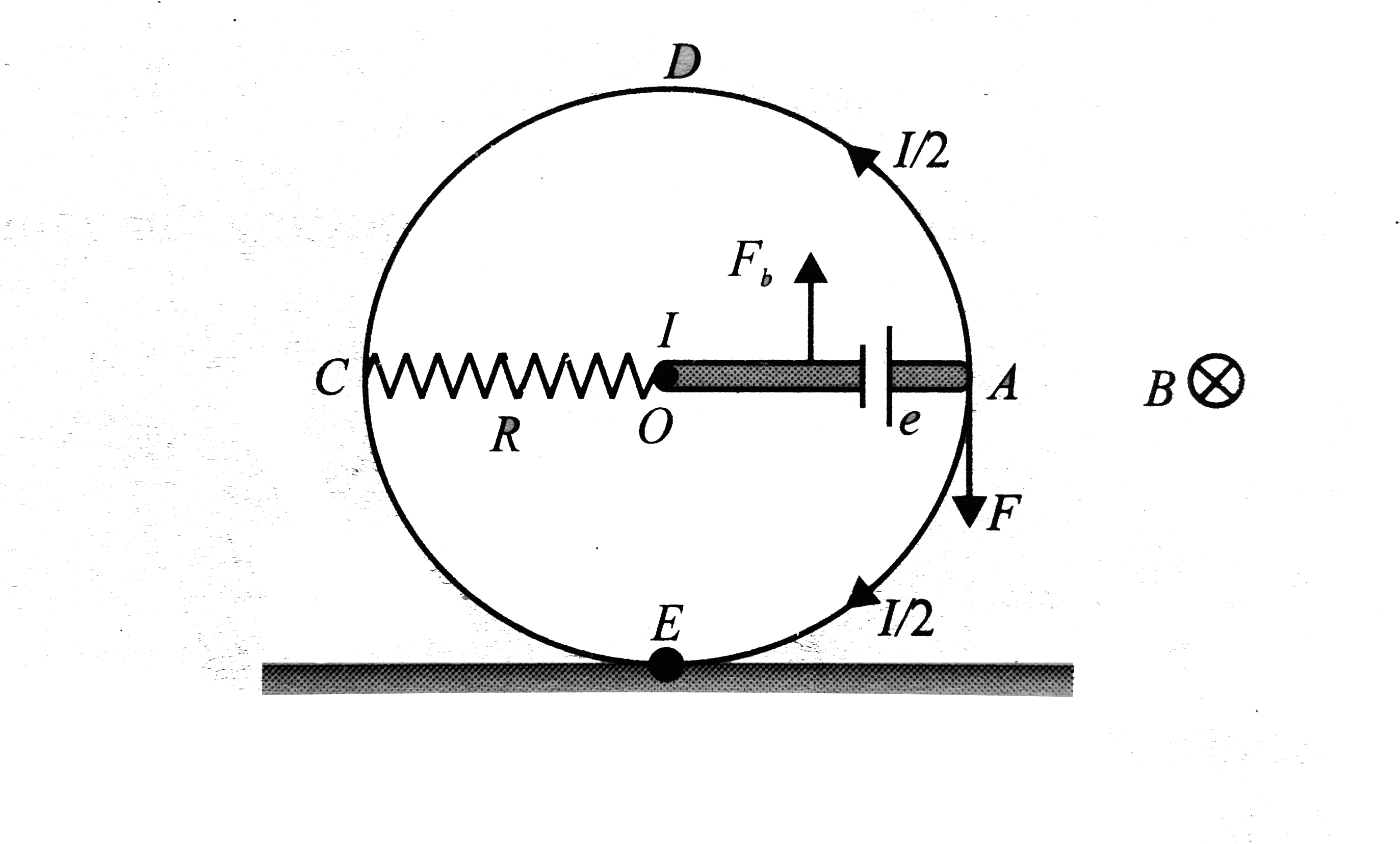 `e = (1)/(2)Bomegar^(2), I = (e)/(R ) = (Bomegar^(2))/(2R)` There will be no induced emf SEPARATELY in parts `ADC`or `AEC`. `F_(b) = IrB = (B^(2)omegar^(3))/(4R)` balancing torque about `E`: `FR = F_(b)r//2` RARR `F = (F_(b))/(2) = (B^(2)omegar^(3))/(4R)` |
|
| 50. |
What is the word in the poem for "knowledge'? |
|
Answer» Sunlight |
|