

Saved Bookmarks
This section includes 7 InterviewSolutions, each offering curated multiple-choice questions to sharpen your Current Affairs knowledge and support exam preparation. Choose a topic below to get started.
| 1. |
जर्मेनियम उदाहरण है एक |
|
Answer» आन्तरिक (INTRINSIC ) अर्दधचालक का |
|
| 2. |
Name the part of electromagnetic spectrum whose wavelength lies in the range of 10^(-10) m. Give its one use. |
| Answer» SOLUTION :X-Rays , APPLICATIONS :In MEDICINAL applications. | |
| 3. |
At a place on earth the horizontal component of earth's magnetic field is 73.2 % times then its vertical component. The angle of dip at this place is ..... |
|
Answer» `30^@` `THEREFORE tan phi = (B_v)/(1.732 B_v)""[because B_h = 1.732B_V]` `= (1)/(1.732) = (1)/(SQRT3) therefore tan phi = 30^@`. |
|
| 4. |
A light of intensity 16 mW and energy of each photon 10 eV incident on a metal plate of work function 5 eV and area 10^(-4)m^(2) then find the maximum kinetic energy of emitted electrons and the number of photoelectrons emitted per second if photon efficiency is 10%. |
|
Answer» 5 EV, `10^(11)` |
|
| 5. |
A pendulum is formed by pivoting a long thin rod of length L and mass m about a point P on the rod which is a distance d above the centre of the rod as shown. The time period of this pendulum when d = L/2 will be |
|
Answer» `2pi SQRT((2l)/(3g))` |
|
| 6. |
Determine the conductivity and resistivity of pure germanium at 300K assuming that at this temperature the concentration of germanium is 2.5xx10^(13)cm^(-3). The electron and hole mobilities are 3600cm^(2)V^(-1)s^(-1) and 1700cm^(2)V^(-1)s^(-1) respectively. |
|
Answer» |
|
| 7. |
लीनियस ने अपनी किताब .......(1753) में पोधों की 5900 जातियों और अपनी किताब.......... (1758) में जन्तुओं की 4326 जातियों का वर्णन किया है। |
|
Answer» फिलोस्फीका बोटेनिका, जेनेरा प्लान्टरम |
|
| 8. |
A body travels 200cm in the first two second and 220cm in the next four second what will be the velocity at the end of the seventh second from the start ? |
|
Answer» `5cm/s` |
|
| 9. |
A potentiometer wire has length 4m and resistance 8Omega. The resistance that must be connected in serires with the wire and an accumulator of emf 2V, so as to get a potential gradient 1mV per cm on the wire is: |
|
Answer» `40Omega` |
|
| 10. |
Here we calculate on instantaneous work - that is, the rate at which work is being done at any given instant rather than averaged over a time interval. Figure 8-34 shows constant forces vec(F)_(1) and vec(F)_(2) acting onabox as the box slides rightward across a frictionless floor. Force vec(F)_(1) is horizontal , with magnitude 2.0 N, force vec(F)_(2) is angled upward by 60^(@) to the floor and has magnitude 4.0 N. The speed v of the box at a certain instant is 3.0 m/s. What is the power due to each force acting on the box at that instant, and what is the net power? Is the net power changing at that instant? |
|
Answer» Solution :KEY IDEAS We want an instantaneous power, not an average power over a time period. Also, we KNOW the box.s velocity (rather than the work done on it). Calculation: We use Eq. 8-87 for each force, For force `vec(F)_(1)` at angle `phi_(1)=180^(@)` to velocity `vec(v)` , we have `P_(1) = F_(1) v cos phi_(1) = (2.0N)(3.0 m//s) cos 180^(@)` ` = -6.0` W. This negative result tells us that force `vec(F)_(1)` is TRANSFERRING energy from the box at the rate of 6.0 J/s. For force `vec(F)_(2)`, at angle `phi_(2)=60^(@)` to velocity `vec(v)`, we have `P_(2)= F_(2) v cos phi_(2)=(4.0 N) (3.0 m//s) cos 60^(@)` `= 6.0 W`.  Figure 8-34 Two forces `vec(F)_(1)` and `vec(F)_(2)` act on a box that slides reightward across a frictionless floor. The velocity of the box is `vec(v)`. This positive result tells us that force `vec(F)_(2)` is transferring energy to the box at the rate of 6.0 J/s. The net power is the sum of theindividual powers ( complete with their algebraic SIGNS): ` P_("net")=P_(1)+P_(2)` ` = -60 W + 6.0 W = 0`, Which tells us that the net rate of transfer of energy to or fromthe box is zero. Thus, the kinetic energy `(K=1//2 mv^(2))` of the box is not changing, and so the speed of the box will remain at 3.0 m//s. With neither the forces `vec(F)_(1)` and `vec(F)_(2)` nor HTE velocity `vec(v)` changing , We see from Eq. 8-88 that `P_(1)` and `P_(2)` are constant and thus So is `P_("net")`. |
|
| 11. |
The emitter of transistor is doped heaviest because |
|
Answer» ACTS as a supplier of CHARGE CARRIES |
|
| 12. |
Find the strength of the magnetic field required to deflect an electron beam of energy 1//16 MeV into a circular path of radius 5 cm. Given m=9xx10^(-31) kg and e=1.6xx10^(-19)C. |
|
Answer» |
|
| 13. |
(A): The conductivity of an electrolyte is low as compared to a metal at room tempe rature. (R): The number density of free ions in electrolyte is much smaller compared to number density of free electrons in metals. Further, ions drift much more slowly, being heavier. |
|
Answer» Both 'A' and 'R' are true and 'R' is the correct EXPLANATION of 'A' |
|
| 14. |
In Q. No. 92, immediately after impact, |
|
Answer» the velocity of 'A+P` with RESPECT of C is u/6, to the right |
|
| 15. |
If the resistance of upper half of a rigid loop is twice that of the lower half the magnitude of magnetic induction at the centre is equal to |
|
Answer» ZERO |
|
| 16. |
A metallic conductor at 10^(@)C connected in the left gap of Meter Bridge given balancing length 40cm. When the conductor is at 60^(@)C, the balancing point shifts by__cm, (temperature coefficient of resistance of the material of the wire is (1//220)//^(@)C) |
|
Answer» 4.8 |
|
| 17. |
Convex lens having focal length 25 cm and concave lens having focal length 30 cm are kept in contact, such that they have the same principal axis. Focal length of this combination is .......... |
|
Answer» 1.5 cm `=(1)/(25)-(1)/(30)(because`For CONCAVE `f_2` is negative) `thereforef=(-(30)(25))/(-30+25)=(-750)/(-5)=150` cm 
|
|
| 18. |
An electromagnetic wave of wavelength lamda is incident on a photosensitive surface of negligible work function. If the photoelectrons emitted from this surface have the de-Broglie wavelength lamda_(1), prove that lamda=((2mc)/(h))lamda_(1)^(2). |
|
Answer» Solution :As per Einstein.s PHOTOELECTRIC equation, we know that `(hc)/(lamda)-phi_(0)=K` If WORK function `phi_(0)` is negligible, then `(hc)/(lamda)=K` where K is the maximum vlaue of KINETIC energy of ejected photoelectrons If de-Broglie WAVELENGTH of ejected photoelectrons be `lamda_(1)`, then `lamda_(1)=(h)/(p)=(h)/(SQRT(2mK))implies K=(h^(2))/(2mlamda_(1)^(2))` Comparing two expressions for K, we have `(hc)/(lamda)=(h^(2))/(2mlamda_(1)^(2))implies lamda=((2mc)/(h))lamda_(1)^(2)`. |
|
| 19. |
When electron revolves around nucleus in a circular orbit, its orbital magnetic moment is ______ |
|
Answer» `vecmu_(L)=(E/(2m_(e)))VECL` |
|
| 21. |
The angular velocity of a rotating disk increases from 2 rad/s to 5 rad/s in 0.5s. What's the disk's average angular acceleration? |
|
Answer» SOLUTION :By DEFINITION `OVERLINE(a)=(Deltaomega)/(DELTAT)=((5-2)rad//s)/(0.5s)=6rad//s^(2)`. |
|
| 23. |
Obtain Gauss's law from Coulomb's law. |
|
Answer» SOLUTION :Coulombian force acting between charges Q +q is, `F = 1/(4PI epsilon_(0)).(Qq)/r^(2)` `F/Q =q/(4pi epsilon_(0).r^(2))` But, `F/Q =vecE` [Force acting on Q charge placed in ELECTRIC FIELD of q means intensity of electric field E] `THEREFORE E = 1/(4pi epsilon_(0)).q/r^(2)` `therefore E xx 4pir^(2) =q/epsilon_(0)` `therefore intEds = q/epsilon_(0)`, where `4pir^(2) = ds` As E and ds are vectors. `intvecE.vec(ds) =q/epsilon_(0)`. This is Gauss.s law. |
|
| 24. |
Statement I : In N - type semiconductor , the free electron concentration approximately equals the density of donor atoms . Statement II : In a forward biased P - N - region is proportional to the change Q of the injected minority carrier holes. |
|
Answer» Statement I is TRUE , statement II is false. |
|
| 25. |
The wavelength of light in vacuum is 5000Å. When it travels normally through diamond of thickness 1.0mm find the number of waves of light in 1.0mm of diamond. (Refractive index of diamond = 2.417) |
|
Answer» 4834 WAVES |
|
| 26. |
If the kinetic energy of a particle is increased four times, then the percentage decrease in its De-Broglie wavelength will be |
|
Answer» 1 |
|
| 27. |
A block of mass 5 kg is placed on a rough horizontal plane. The coefficient of static and kinetic friction between the block and surface is 0.5 and 0.3 respectively. A force of 100 N is appliedat an angle of 30^(@) from the horizontal as shown in the figure. The acceleration of the block will be [g=10m//s^(2)] |
|
Answer» `(10-sqrt(3)) sqrt(3)m//s^(2)` |
|
| 28. |
In most mammals, the testes are located in scrotal sac for |
|
Answer» more SPACE to VISCERAL organs |
|
| 29. |
In the figure below, the capacitance of each capacitor is 3 muF. The effective capacitance between points A and B is |
| Answer» Answer :D | |
| 30. |
The highest-filled value of energy in the highest band is called_____. |
|
Answer» |
|
| 31. |
Draw a labelled circuit diagram of n - p - n germanium transistor in common emitter configuration. Explainbriegfly , how this transistor is used as a voltage amplifier. |
|
Answer» Solution :Transistor as an amplifier is based on the principle that a weak input signal given to a base region produces an amplified out signal in the collector region. The input voltage signal`V_("i")` is connected between base and emitter through a capacitor `C_(1)` which filters d .cvoltage `V_(BB)` from going towards a . c input source . The output is taken from the collector resistance `R_(c)`. The capacitor `c_(2)` filters the dc voltage `V_( c c)` from the output signal `V_(0)`. Applying kirchhoff 's second law on input loop `V_(BB)=V_(BE)+I_(B)R_(B)`. . . (i) Applying Kirchhoff 's second law on output loop `V_(C C)=V_(CE)+I_(C)R_(C)` . . . (ii) From equation (i) ,`V_(BB)+V_("i")=V_(BE)+(I_(B)+DeltaI_(B))R_(B)` . . . (iii) Subtracting (i) from (iii) ,`V_("i")=DeltaI_(B)R_(B)rArrDeltaI_(B)=(V_("i"))/(R_(B))` 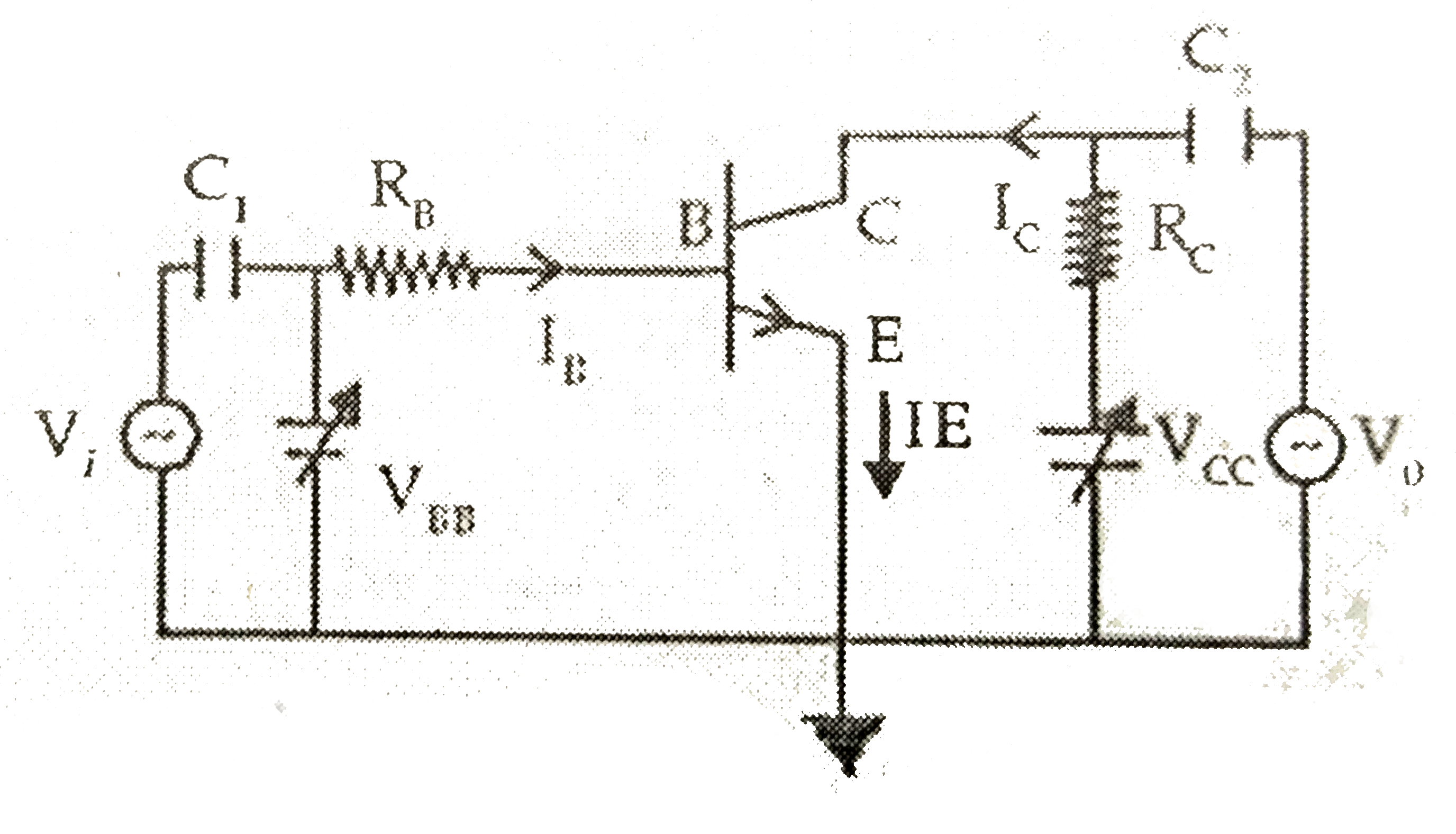 CHANGE in collector current`DeltaI_(c)=beta_(AC)=DeltaI_(B)=(beta_(ac)*V_("i"))/(R_(B))` . . . (iv) Where ,`beta_(ac)=(DeltaI_(c))/(DeltaI_(B))=(I_(c))/(I_(B))` From (ii) and (iv) ,Voltage gain`AV=(V_(0))/(V_("i"))=-beta_(ac)(R_(c))/(R_(B))` 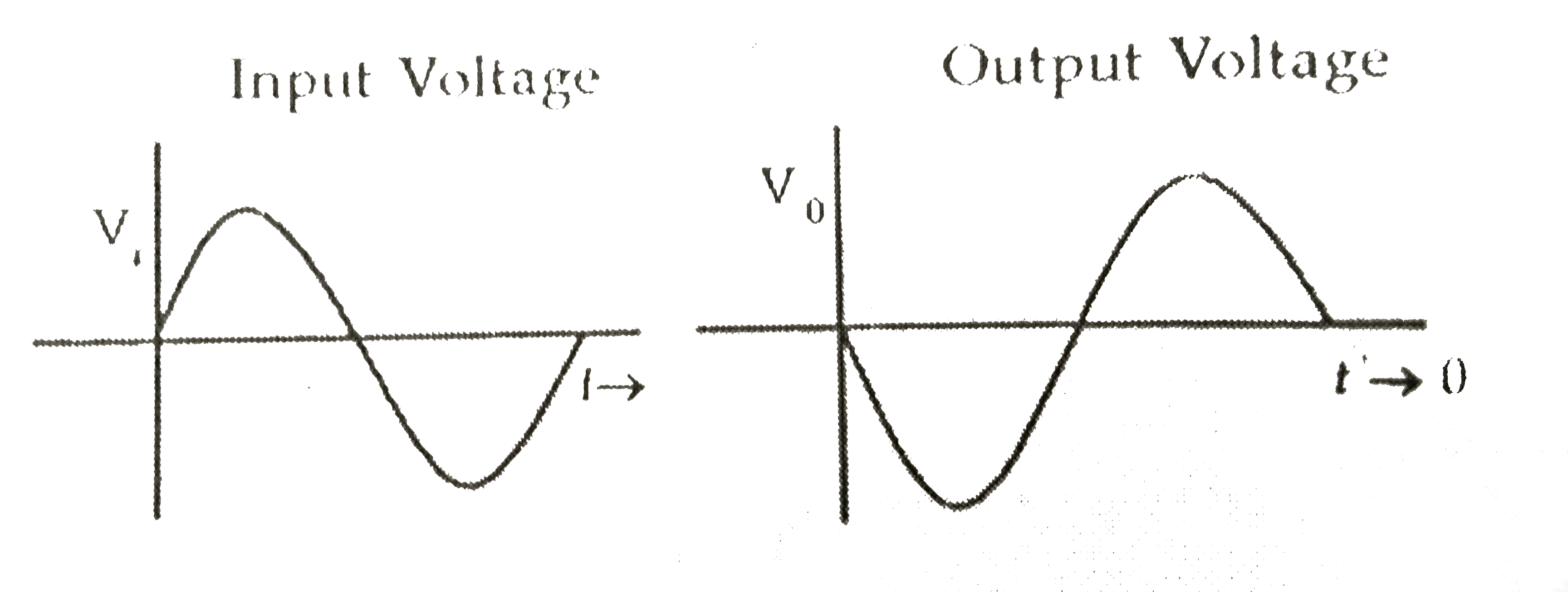 Negative sign SHOWS that input and output signals differin phase by `pi` radian (out of phase). |
|
| 32. |
Zener diode acts as a/an |
|
Answer» OSCILLATOR |
|
| 33. |
Discuss the phenomenon of resonance in a LCR series a.c. circuit. |
|
Answer» Solution :We know that when an alternating voltage V=`V_(m) SIN omega t`is applied to a LCR series circuit, the current in the circuit is given by: `I = V_(m)/sqrt(R^(2) + X_(L) - X_(C))^(2).sin(omegat-phi) = V_(m)/Z sin(omega t-phi)` where impedance, `Z = sqrt(R^(2) + (X_(L)-X_(C))^(2))` and phase angle `phi = tan^(-1) (X_(L)-X_(C))/R` If it so happens that `X_(L) = X_(C)`then Z=R= minimum and `phi = tan^(-1)(0)= 0^(@)`i.e., the current will have a maximum VALUE given by I = and will be in same phase as that of applied voltage. Such a situation is called the phenomenon of electrical resonance. For electrical resonance, the necessary CONDITION is: `X_(L) = X_(C)` or `L omega_(0) = 1/(C omega_(0))` Obviously as L and C are fixed for a circuit, resonance occurs for a PARTICULAR frequency known as "resonant frequency". `v_(0)`(or resonant ANGULAR frequency `omega_(0)` ) given by: `Lomega_(0) = 1/(C omega_(0))` which leads us to `omega_(0) = 1/sqrt(LC)` `rArr v_(0)=1/(C omega_(0)) =1/(2pi sqrt(LC))` |
|
| 34. |
Two wires carrying |
|
Answer» Parallel CURRENT repel each other |
|
| 35. |
A particle moves in X-Y plane under the action of forces F such that the values of linear momentum ‘p’ at any time is p_(x) =2 cos t and p_(y) = 2 sin t. The angle betweenvec(F) and vec(p) at the time t will be : |
|
Answer» <P>0° Now `vec(F)=(dvecp)/(t)=-2sinthati+2costhatj`. The angle will be `costheta=(vec(F).vec(p))/(Fp)` `costheta=(-4sintcost + 4sintcost)/(Fxxp)` `theta=90^@` |
|
| 36. |
At a neutral point in a combined magnetic field |
|
Answer» Resultant MAGNETIC FIELD is zero |
|
| 37. |
The initial magnetization curve of technically pure iron is shown in Fig. 29.9a. Making use of the graph find the magnetic permeabilities of this material at magnetic fields strength of: 50 N/m: 75 A/m, 100 A/m: 200 Alm: 500 A/m: 1000 N/m, 1500 A/m. Plot the graph of the dependence of the magnetic permeabilily on the magnetic field. Making use of the graph estimate the field at which the magnetic permeability is at its maximum (mu_("mex")), and the approximate value of the latter. |
Answer» Solution :From the graph 29.92a we COMPILE the table  The graph for `MU` is given in FIG. 29.9. 
|
|
| 38. |
The primary functions of |
| Answer» Solution :The ELECTRIC field and the magnetic field in the CYCLOTRON in a cyclotron the purpose of the `vec(E)` field is the energize the BEAM and the purpose of the `vec(B)` field is to bring the charged particle again and again into the `vec(E)` field. | |
| 39. |
A capacitor allows alternating current to flow through itself but does not allow flow of direct current. |
|
Answer» Hence, for d.c. It offers an INFINITE reactance. |
|
| 40. |
Statement I : The air film in Newton's rings apparatus is replaced by an oil film. The radii of the rings, decreases. Statement II : A slit of width 'a' is illuminated by white light. The first minima for red light (lambda = 6500 Å) will fall at theta = 30^(@) when value of a is 1.3 micron. |
|
Answer» Statement I is TRUE, statement II is false. (ANGLE between analyser and polariser). So the angle that analyser makes with beam in `90^(@) - 30^(@) = 60^(@)`. |
|
| 41. |
Two satellites of masses in the ratio of 1:16 are put in the same orbit round the sun. The ratio of their periods of revolution is : |
|
Answer» `1:4` Thus correct CHOICE is (C ). |
|
| 42. |
The angular velocity of a fly wheel increases 0 to 40 rad/s, in 8 secs. What is it's total angular displacement in this time ? |
|
Answer» SOLUTION :`W=w_@ + ALPHAT therefore40=0+alphaxx8 thereforealpha=5(RAD)/s^2` `and THETA = w_@t+1/2 alphat^2=1/2xx5xx64=160 rad.` |
|
| 43. |
The displacemeent of a particle is given at time t by x = A sin(-2omega t) + B sin^(2)omegat. Then, |
|
Answer» the motion of the particle is SHM with an amplitude of `sqrt(A^(2) + B^(2)/4)` `-A sin 2omega t + B/2 (1- cos2 omega t)` `=(-A sin 2omegat + B/2 COS 2omegat) + B/2` This motion represents SHM with an amplitude `sqrt(A^(2) + (B^(2)//4))`, and mean position of B/2. |
|
| 44. |
Find the value of colour coded resistance shown is fig |
|
Answer» `520+- 10 % ` |
|
| 45. |
(a) Explain, giving reasons, the basic difference in converting a galvanometer into (i) a voltmeter and (ii) an ammeter. (b) Two long straight parallel conductors carrying steady currents I_1 and I_2 are separeted by a distance 'd' . Explain briefly, with the help of a suitable diagram, how the magnetic field due to one conductor acts on the other. Hence, deduce the expression for the force acting between the two conductors. Mention the nature of this force. |
|
Answer» Solution :(a) (i) A galvanometer can be used as a VOLTMETER can be used as a voltmeter to measure the voltage across agiven section of an electric circuit. For this, it must be connected in a parallel with that section. Moreover, it must draw a very small CURRENT otherwise the voltage MEASUREMENT may disturb the original set up by a large amount. To ensure this, a large RESISTANCE R is connected is series with the galvanometer. If galvanometer has a resistance `R_G` and given full scale deflection for a current `I_g` then to convert it into a voltmeter of range 0 - V, we connect a resistance R in series so that `V = I_g (R_G + R) implies R = V/(I_g) - R_G` (ii) A galvanometer cannot be used as an ammeter to measure large currents because it is a very sensitive device giving full scale deflection for a small current `I_g` of the order of few microampere. Moreover, for MEASURING current the galvanometer should be connected in series. As galvanometer has large resistance, its joining in series affects the value of current in the circuit. To overcome these difficuilties , we attach a small shunt resistance `r_s` in parallel with the galvanometer coil. If we want to convert a galvanometer into an ammeter of range 0 - I, then value of shunt resistance `r_s = (R_G cdot I_g)/(I - I_g)` As net resistance of ammeter is extermely small, its presence in series does not affect the circuit current. |
|
| 46. |
The terminology of different parts of the electromagnetic spectrum is given in the text. Use the formula E = hv (for energy of a quantum of radiation: photon) and obtain the photon energy in units of eV for different parts of the electromagnetic spectrum. In what way are the different scales of photon energies that you obtain related to the sources of electromagnetic radiation ? |
|
Answer» Solution :ENERGY ofa photon of FREQUENCY v is givenby E=hvjoules`=(hv)/(1.6xx10^(-19))`ev Where `h=6.6xx10^(-34)` J. The energy of photon ofdifferentparts ofelectromagnetic spectrum in joules and eV are shown in table below, along with their SOURCES of origin. 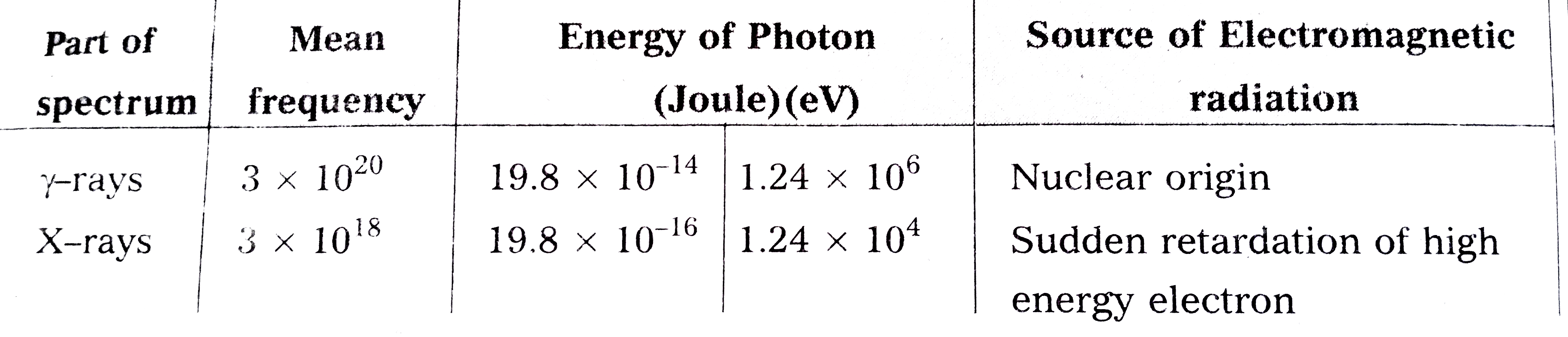 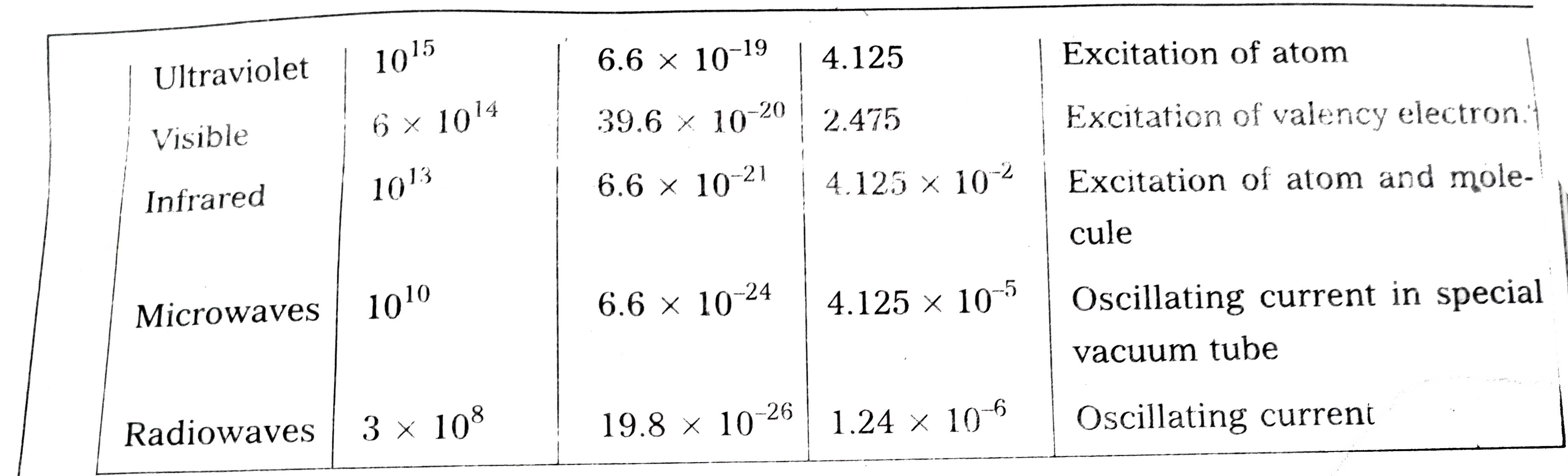
|
|
| 47. |
एक आवृतबीजी में 400 परागकणों को उत्पन्न करने के लिए कितने अर्द्धसूत्री विभाजन आवश्यक होंगे ? |
|
Answer» 400 |
|
| 48. |
Sudden fall of atmospheric pressure by a large amount of indicate |
| Answer» Answer :A | |
| 49. |
The specific heat capacity of a metal at low temperature (T) is given as : C_(p) (kJK^(-1)kg^(-1))=32 ((T)/(400))^(3) A 100 gram vessel of this metal is to be cooled from 20K to 4K by a special refrigerator operating at room temperature (27^(@)C). The amount of work required to cool the vessel is: |
|
Answer» greater than 0.148 k Correct choice : (d). |
|
| 50. |
An electric bulb marked 40 W and 200 V is used in a circuit of supply voltage 100 V. Now its power is .... . |
|
Answer» <P>10 W P = `(V^(2))/(R) ` , where R is CONSTANT (bulb is same ) P `prop V^(2)` `THEREFORE (P_(2))/(P_(1)) = ((V_(2))/(V_(1)))^(2)` `therefore P_(2) = P_(1) xx ((V_(2))/(V_(1)))^(2)` = ` 40 xx ((100)/(200))^(2) = 40 xx (1)/(4) = 10` W |
|