

Saved Bookmarks
This section includes 7 InterviewSolutions, each offering curated multiple-choice questions to sharpen your Current Affairs knowledge and support exam preparation. Choose a topic below to get started.
| 1. |
Light with wavelength 0.50 mm falls on a slit of width 10 mm and at an angle theta_(0) = 30^(@) to its normal.Then angular position of first minima located on right side of the central Fraunhoffer's diffraction will be at : |
|
Answer» `33.4 ^(@)` At right of central DIFFRACTION `sin theta_(1) = sin theta_(0) + (lambda)/(d) = 33.37^(@)` |
|
| 2. |
A simple pendulum consists of a small sphere of mass m suspended by a thread of length l. The sphere carries a charge q. The pendulum Is placed in a uniform electric fleld of strength E directed vertically upwards.With what perlod will the pendulum oscillate if the electrostatic force acting on the sphere is less than the gravitational force? |
|
Answer» Solution :Let the pendulum be at an angle of `theta` with the vertical. Net force acting on the bob =mg-qE Torque experienced by the bob about the POINT of suspension, `tau=-(mg-qE)lsintheta` (where, the negative sign indicates that the torque experienced is restoring torque) As the AMPLITUDE of oscillation is small, 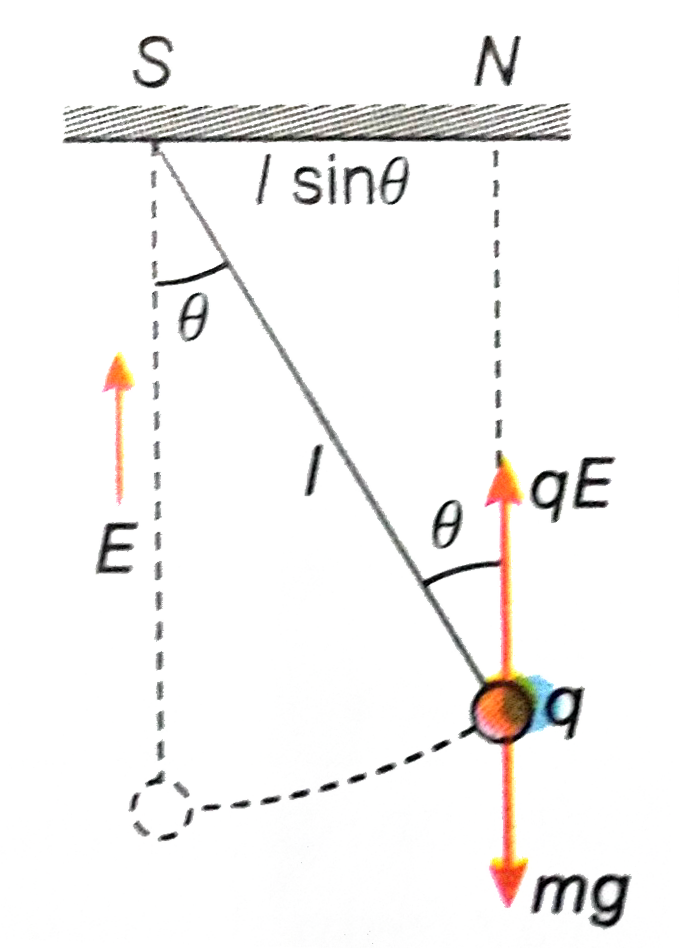 `sintheta~~theta` Then, `tau=-(mg-qE)ltheta` again, `tau=` moment of inertia (l) `XX` angular acceleration `(ALPHA)` `thereforealpha=(tau)/I=(-(mg-qE)ltheta)/I=(-(mg-qE)ltheta)/(ml^(2))[becauseI=ml^(2)]` `=((-(g-(qE)/m)theta)/l` `thereforealphaprop-theta[because((g-(qE)/m))/l=`constant`]` `therefore` The pendulum executes an SHM. `therefore` Time period of the pendulum, `T=2pisqrt(("angular DISPLACEMENT")/("angular acceleration"))=2pisqrt((theta)/(alpha))` `thereforeT=2pisqrt(l/(g-(qE)/m))` |
|
| 3. |
A body of mass 'm' falls from height 'h' on the ground. If 'e' be the coefficient of restitution between the body and the ground, find (i) the velocity with which it rises after the n^("th") collision with the ground (ii) The height upto which it rises after the n^("th") collision. |
|
Answer» Solution :(i) Let the velocity with which the BODY falls of the ground is `u_(1),` then `u_(1)=sqrt(2gh)` The velocity with which the body rebounds after collision is `v_(1)`, then velocity of separation `=e xx "velocity of approach"` `or vec(v_(1))=-evec(u_(1)) or v_(1)=eu_(1)"(Negative SIGN indicates upward direction)"` After rising to maximum height, the body will hit the ground with speed `v_(1)=eu_(1)`. Hence the speed with which the body will RISE will be `v_(2)=ev_(1)=e^(2)u_(1)` Similarly, `v_(3)=ev_(2)=e^(3)u_(1)` Proceeding similarly, the speed with which the body will rise after `n^("th")` collision is `v_(n)=e^(n)u_(1)` (ii) The K.E. of the body just before hitting the ground first TIME is `K=(1)/(2)mu_(1)^(2)=mgh` If `h_(1)` be the height upto which the body rises after first collision then `mgh_(1)=(1)/(2)mv_(1)^(2)=(1)/(2)m(eu_(1))^(2)=e^(2).(1)/(2) m u_(1)^(2)=e^(2).mgh` `"or"h_(1)=e^(2)h` `"or"h_(2)=e^(2)h_(1)` `"or"h_(2)=e^(4)h` Similarly, `""h_(n)=e^(2N)h` |
|
| 4. |
Which impurity is doped in Si to form N-type semiconductor ? |
|
Answer» Al |
|
| 5. |
What is an intrinsic semiconductor ? |
| Answer» SOLUTION :A pure semiconductor, in whlch no impurity has been added, (i.e., no DOPING has been done), is CALLED an INTRINSIC semi-conductor. | |
| 6. |
In a junction transistor the emitter region is heavily doped since emitter has to supply to the base Zener diode acts as a ……… . |
|
Answer» minority CARRIER |
|
| 7. |
An object is placed at 20cm from a convex mirror of focal length 10 cm. The image formed by a mirror is |
|
Answer» REAL and at 20CM from the mirror |
|
| 8. |
Match the appropriate Column I with Column II. {:("Column I","Column II"),("(A) Same dimension of mass","(P) electric charge"),("(B) Negative dimension of mass","(Q) electric potential"),("(C) Zero dimension of mass","(R) electric capacity"),("(D) Dimension of length is"pm"D", "(S) energy density"):} |
|
Answer» <P> |
|
| 9. |
A spherical conductor of radius 12 cm has a charge of 1.6 xx 10 ^(7)C distributed uniformly on its surface. What is the electric field inside the sphere (ii) just outside the sphere ©At a point 18 cm from the centre of the sphere? |
|
Answer» Solution :Here ` q= 1.6 xx 10^(-7)C and R = 12 cm =0.12 ` Electric field at any point insidethe sphere E=0 (ii) Here ` q= 1.6 xx 10^(-7)C and R = 12 cm =0.12 ` Electric field at a point just outside the sphere ` "" E= ( q )/( 4 pi in _0. R^(2))=( 1.6 xx 10^(-7) xx 9 xx 10^(9))/( (0.12)^(2))= 10 ^(5)NC ^(-1) ` (c) Here ` q= 1.6 xx 10^(-7)C and R = 12 cm =0.12 ` Electric field at any point18 cm from the CENTRE of sphere (i.e. r= 18 cm =0.18 m) ` E = ( q)/( 4 pi in _0. r^(2)) =( 1.6 xx 10 ^(-7) xx 9 xx 10 ^(9))/( (0.18)^(2))= 4.44 xx 10 ^(4) N C^(-1) ` |
|
| 10. |
Doppler's effect is sound in addition of relative velocity between source and observer, also depends while source and abserver or both are moving. Doppler effect in light depend only on the relative velocity of source and observed. The reason of this is |
|
Answer» EINSTEIN mass-energy relation |
|
| 11. |
A planet in a distant solar system is 10 times more massive than the earth and its radius is 10 times smaller. Given that the escape velocity from the earth is 11 km s^(-1), the escape velocity from the surface of the planet would be : |
|
Answer» `1.1km s^(-1)` `therefore (V_(e))_(2)=10xx11=110km//s` So CORRECT choice is (c )`. |
|
| 12. |
1 mg redium has 2.68xx10^18 atoms. Its half life is 1620 years. How many radium atoms will disintegrate from 1 mg of pure radium in 3240 years ? |
|
Answer» `2.01xx10^9` As `N/N_0=m/m_0=(1/2)^n` Mass of radium left after 2 half lives is `m=m_0(1/2)^n = 1XX(1/2)^2 =1/4` = 0.25 MG Mass of radium DISINTEGRATED =1-0.25 =0.75 mg Number of radium atoms disintegrated = 0.75x 2.68 x `10^18=2.01xx10^18` |
|
| 13. |
A thin wire ring of radius r has an electric charge q. What is the tension of the wire if a point charge q_0 is placed at the ring's centre? |
|
Answer» |
|
| 14. |
Advantages of optical fibres are |
|
Answer» HIGH BANDWIDTH and EM interference |
|
| 15. |
A very large non-conducting plane carrying charge Q uniformly distributed over it is placed in a medium with resistively rho and permittivity epsilon. The plane leaks charge through the surrounding medium and the charge becomes 1/n times the initial value after a time t=6rho epsilon ln(2) elapses. Find the integer value n. (Neglect the end effects). |
|
Answer» `I=jA=Q/(2rho epsilon)IMPLIES(DQ)/(dt)=-q/(2rho epsilon)` ltbRgt `impliesq=Qd^(-(t/(2rho epsilon)))` or `q=Q/8` at `t=5 rho epsilon ln(2)` |
|
| 16. |
The angle between two vectors vec A =vec B is theta. The resultant of vec A and vec B making an angle theta/2 with vec A. Then |
|
Answer» A = B |
|
| 17. |
Two opposite and equal charges 4 xx 10^(-8) coulomb when placed 2 xx 10^(-2)cm away, from a dipole. If this dipole is placed in an external electric field 4 xx 10^8 newton/ coulomb, the value of maximum torque and the work done in rotating it through 180^@ will be |
|
Answer» `64 xx 10^(-4) Nm and 64 xx 10^(-4) J` |
|
| 18. |
The weight of a man in a lift moving upwards is 608 N while the weight of the same man in the lift moving downwards with the same acceleration is 368 N. His normal weight in newton is : |
|
Answer» 488 SOLVING `a=2.4ms^(-2)` and `m=49.8kg`. The real weight `=49.8xx9.8=488N` THUS correct choice is (a). |
|
| 21. |
Two bulbs of 220 V and 100 W are firs connected in series and then in parallel with a supply of 220 V. Total power in buth the cases will be ........ |
|
Answer» 50 W, 100 W Power in series combination of resistances `P_(s)= (P_(1) xx P_(2))/(P_(1) + P_(2))` but `P_(1)= P_(2)` = 100W `THEREFORE P_(S) = (100 xx 100)/(100 + 100)` 50 W Power in parallel combination, `P_(p) = P_(1) + p_(2)` but `P_(1) = P_(2) ` = 100 W `P_(p) = 100 + 100 ` = 200 W |
|
| 22. |
If B.E. of satellite of mass 1000 kg is 10^6J, then B.E. of another satellite of mass 10^4kg at the same height from the earth will be - |
|
Answer» `a)8xx10^8J,-4xx10^8J` |
|
| 23. |
How does speed of electron vary with change in quantum number in hydrogen atom? |
| Answer» Solution :`v_(1) : v_(2) : v_(3) , v_(4) = 1 : (1)/(2) : (1)/(3) : (1)/(4)…….(i.e., v_(n) prop (1)/(n))`. | |
| 24. |
The shortest wavelength in the Lyman series of hydrogen spectrum is 912 Å corresponding to a photon energy of 13.6 eV. The shortest wavelength in the Balmer series is about |
|
Answer» 3648Å `rArr (lambda_("min"))_(B)=4 xx (lambda_("min"))_(L)=4 xx 912=3648Å` |
|
| 25. |
Two polaroids are oriented with their transmission axes making an angle of 30^(@) with each other. What fraction of incident un polarized light is transmitted? |
|
Answer» Solution :If unpolarized light is passed through a polaroid `P_1`, its intensity will become half. So `I_(1)= (1)/(2)I_(0)` with vibrations PARALLEL to the axis of `P_1`. Now this light will PASS through the second polarized `P_2` (Analyser) WHOSE axis is inclined at an ANGLE of `30^(@)` to the axis of `P_1` and hence vibrations of `I_1`. So in accordance with Malus law, the intensity of light emerging from `P_2` will be `I_(2)= I_(1) cos^(2) 30^(@)= ((1)/(2)I_(0))((SQRT(3))/(2))^(2)= (3)/(8)I_(0)` So the fractional transmitted light `(I_2)/(I_0)=(3)/(8)=37.5%`. |
|
| 26. |
The kinetic friction is always (A) Less than staticfriction (B) Greater thanrolling friction |
|
Answer» Both A and B are TRUE |
|
| 27. |
Explain the following giving reasons : (i) When monochromatic light is incident on a surface separating two media, the reflected and refracted light both have the same frequency as the incident frequency. (ii) When ligjt travels from a rarer to a denser medium, the speed decreases. Does this decrease in speed imply a reduction in the energy carried by the wave ? (iii) In the wave picture of light, intensity of light is determined by the square of the amplitude of the wave. What determines the intensity in the photon picture of light ? |
|
Answer» Solution :`(i)` Frequencyis INTRINSIC property of a wave, which does not change when it goes from one medium to other. Only WAVELENGTHS and speed of the wave changes. `(ii)` No. Because energy is `E=hv` and `v` remains same. `(iii)` Number of PHOTONS striking PER unit area per unit time. |
|
| 28. |
A satellite orbiting certain planet has apogee R_(1) and perigee equal to R_(2), then find the minimum kinetic energy that should be given to the satellite to enable it to escape the planate. |
|
Answer» Solution :`2A=R_(1)+R_2` `a=(R_1+R_2)/(2)` `tau.epsi=-(GMM)/(2a)` `k.epsi."should be given "=|tau.epsi.|` `=("Gmm")/(2a)` `=("Gmm")/(2(R_(1)+R_(2))` |
|
| 29. |
The electric polarization P is given by_____. |
|
Answer» |
|
| 30. |
A person can see objects lying between 50 cm and 100 cm. What power of lens will he use for reading a book ? (Distance of L.D.V. is 25 cm) : |
|
Answer» <P>`+ 2D` `therefore (1)/(F) = (1)/(25) - (1)/(50) or f = 50 cm, P = (100)/(50) = + 2D`. |
|
| 32. |
In a forward punch in karate, the fist begins at rest at the waist and is brought rapidly forward until the arm is fully extended. The speed v (t) of the fist is given inFig. 2-22 for someone skilled in karate. The vertical scaling is set by v_(s)=8.0 m//s. How far has the fist moved at (a) time t=50 ms and (b) when the speed of the fist is maximum ? |
|
Answer» |
|
| 33. |
A plane electromagnetic wave travelling along X - direction has electric field of amplitude 300 Vm^(-1), directed along the Y - axis (a) What is the intensity of the wave ? (b) If the wave falls on a perfectly absorbing sheet of area 3.0 m^(2), at what rate is the momentum delivered to the sheet and what is the radiation pressure exerted on the sheet ? [epsilon_(0)=8.854xx10^(-12)C^(2)N^(-1)m^(-2), c=3xx10^(8)ms^(-1)] |
|
Answer» Solution :For electromagnetic wave propagation in X - direction, `vec(E )_(0)=300 hat(J)V//m` `epsilon_(0)=8.85xx10^(-12)C^(2)//Nm^(2)` `c=3xx10^(8)m//s` (a) Intensity of wave `I=epsilon_(0)c E_(rms)^(2)` `=(epsilon_(0)c E_(0)^(2))/(2)` `=(8.854xx3xx300xx300xx10^(-12)xx10^(8))/(2)` `=119.529 W//m^(2)` (B)Radiation pressure exerted on the sheet `P=("energy (U)")/(c )=(IA)/(c )=(IA)/(c ) ""` (Area `A=3m^(2)`) `=(119.529xx3)/(3xx10^(8))=1.195xx10^(-6)N` Radiation pressure `=("force")/("area")=("momentum"XX"time")/("area")` `therefore` Pressure `P=(1.19xx10^(-6))/(3)=3.98xx10^(-7)Pa` |
|
| 34. |
What is Airy's discs? |
|
Answer» Solution :(i) Similar to a rectangular SLIT, when a circular aperture or opening (like a lens or the iris of our eye) forms an image of a POINT object, the image formed will not be a point buta diffraction pattern of concentric CIRCLES that BECOMES fainter while moving away from the center as shown in Figure. These are known as Airy's discs. `a sin theta = 1.22 lamda`  (ii) Here, the numerical value 1.22 comes for central maximum formed by circular APERTURES. For small angles, `sin theta = theta` `a theta = 1.22 lamda` Rewriting further, `theta = (1.22 lamda)/(a) " and " (r_0)/(f) = (1.22 lamda) / (a)` ` r_0 = (1.22 lamda f)/( a) ` |
|
| 35. |
संख्या 1365 को किस संख्या से विभाजित किया जाये कि भागफल 31 तथा शेषफल 32 आये ? |
|
Answer» 53 |
|
| 36. |
A charged 30 mu F capacitor is connected to a 27 mH inductor. What is the angular frequency of free oscillations of the circuit ? |
| Answer» SOLUTION :`1.1xx10^(3)s^(-1)` | |
| 37. |
White coherent light (400 nm-700 nm) is sent through the slits of a Young's double slit experiment (as shown in the figure). The separation between the slits is 1 mm and the screen is 100 cm away from the slits. There is a hole in the screen at a point 1.5 mm away (along the width of the fringes) from the central line. (a) For which wavelength (s) there will be minima at that point ? (b) which wavelength (s) will have a maximum intensity? |
|
Answer» For minima (a) `y=(n+(1)/(2))beta.=(n+(1)/(2))(lambdaD)/(d)` `rArr lambda=(1.5xx10^(-3)xx1xx10^(-3))/(1xx(n+(1)/(2))) =(1.5xx10^(-6))/(n+(1)/(2))` `n=1, lambda=(2)/(3)xx1.5xx10^(-6)=1000 nm` `n=2, lambda=(2)/(5)xx1.5xx10^(-6)= 600 nm` `n=3, lambda=(2)/(7)xx1.5xx10^(-6)=428 nm` Putting integral values of `'n'` `n=1 , lambda=1000 nm` `n=2, lambda=600 nm`. `n=3, lambda=428 nm` So only `lambda=428 nm and lambdad=6000 nm,` will have minima at the hole. Hence they will be ABSENT in the LIGHT coming out. (b) `1.5 mm = n beta`. `1.5 mm = n((lambdaD)/(d))` `rArr lambda=(1.5xx10^(-3)xx1xx10^(-3))/(nxx100xx10^(2))` for `n=1.lambda = 1500 nm`. for `n =2.lambda = 750 nm`. for `n=3. lambda=500 nm`. Hence only `lambda=500 nm` will have maximum intensity. |
|
| 38. |
Explain electrical energy when an ac current passes through a resistor. |
Answer» Solution :It is seen from the graph that in A.C. circuit voltage and current varies with sine curve and obtained positive and negative values CORRESPONDS to it.  Thus, the sum of the instantaneous current values over one complete CYCLE is zero and the average current is zero. The fact that the average current is zero, however does not mean that the average power consumed is zero and that there is no dissipation of electrical energy. Joule heating is given by `I^(2) Rt` and depends on `I^(2)` which is always positive whether I is positive or negative and not on I. The instantaneous power dissipated in the resistor is, `P = I^(2) R` `= I_(m)^(2) R sin ^(2) Omega t ``[ :. I = I _(m) sin omega t ]` The average value of `bar(p) ` over a cycle is, `lt P gt = lt I^(2) R gt ` `= I_(m)^(2)lt R sin^(2) omega t gt = I_(2)^(2) R lt sin^(2) omega t gt ` here the bar over a `bar(p)` denotes its average value and `lt gt` denotes average of the quantity INSIDE the bracket. `:. P = I_(m) ^(2)R lt sin^(2) omega tgt [ :. I_(m)^(2)` and R is constant ] Using the TRIGONOMETRIC, `lt sin^(2) omega tgt = ( 1)/(2) (1- cos 2 omega t )` `= ( (1)/(2)- (1)/(2) cos omega t )` but `lt cos 2 omega t gt =0`, so, `lt sin^(2) omega t gt = ( 1)/(2)` `:. P = ( 1)/( 2) I_(m)^(2) R ` `lt cos 2 omegat gt = ( 1)/( T) int_(0)^(T )cos 2 omega t dt = (1)/( T ) [ ( sin 2 omega t )/( 2 omega ) ]_(0)^(T)` ` = ( 1)/( 2omega T ) [ sin 2 omega T - 0 ] = ( 1)/( 2 omega T ) ` `[ SIN2 pi - 0 ] =0` |
|
| 39. |
Which of the followings can excite a hydrogen atom in ground state? (i) A photon having 11 eV energy (ii) A neutron having 11 eV kinetic energy (iii) An electron having 11 eV kinetic energyGive reasons for your answer. |
|
Answer» |
|
| 40. |
A 2 kg block slides on a horizontal floor with a speed of 4 m/s. It strikes an uncompressed spring, and compresses it till the block is motionless. The kinetic friction force is 15 N and spring constant is 10,000 N/m. The spring compresses by : |
|
Answer» 2.5 cm `:.1/2mv^2=1/2kx^2+F_kxxx` `1/2xx2xx(4)^2=1/2xx10,000x^2+15 x` `32=10,000x^2+30 x` `:.10,000x^2+30 x-32=0` or `x=(-30pmsqrt(900+4xx10,000xx32))/(20,000)` =`(-30pm1132)/(20,000)=(1102)/(20,000)xx100 cm` implies 5.5 cm |
|
| 41. |
The Kinetic energy acquired by a mass m after travelling a fixed distance from rest under the action of a constant force is directy proportional to |
|
Answer» `SQRT m` |
|
| 42. |
State the underlying principle of working of a moving coil galvonometer. Write two reasons why a galvometer cannot be used as such to measure current in a given circuit. Name any two factors on which the current sensitivity of a galvonometer depends. |
|
Answer» Solution :A galvonometer cannot be USED as such to measure current directly in ampere in a given circuit due to following two REASONS: (i) Galvonometer is a very sensitive device and gives a full scale deflection for a current of the order of few microampere. (ii) For measuring current, the galvonometer is to be connected in SEIRES. As the galvonometer has a large resistance, it will change the value of the current in the circuit. The current sensitivity of a galvonometer is defined as the deflection per unit current. Thus, Current sensitivity, `= (phi)/I = (NAB)/(k)` From this relation it is clear that the current sensitivity depends on (i) the strength of radial MAGNETIC field, and (ii) the TORSIONAL constant of suspension/spring. |
|
| 43. |
Calculate the potential difference between the points A and B, and between the points B and C of figure in steady state |
| Answer» SOLUTION :`25 V, 75 V` | |
| 44. |
The de Broglie wavelength of a particle of kinetic energy K is lambda . What would be the wavelength of the particle, if it's kinetic energy were K/4. |
|
Answer» SOLUTION :de Broglie wavelength of a particle of mass m and KINETIC ENERGY K is |
|
| 45. |
Light of two different frequencies whose photons have energies 1 eV and 2.5 eV respectively, successively illuminate a metallic surface whose work function is 0.5 eV. Ratio of maximum speeds of emitted electrons will be |
|
Answer» `1: 1` `K_(1)= 1-0.5= 0.5eV` `K_(2)= 2.5- 0.5 = 2eV` `((1)/(2) mV_(1)^(2))/((1)/(2) mV_(2)^(2))= (0.5)/(2) RARR (V_(1)^(2))/(V_(2)^(2)) = (1)/(4) rArr (V_(1))/(V_(2))= (1)/(2)` |
|
| 46. |
Answer the following : (a) The top fo the atmosphere is at about 400 kv withrespect to the surface of earth, the field is about100 Vm^(-1). Why then do we not get an electricshock, as we step out of out house into the open ? (Assume the house to be a steel cageso that there is no fieldinside). (b) A man fixes outsidehis house one eveninga two meter high insulating slab carryingon its top, a large aluminium sheet of area 1 m^(2). Will he get an electricshock if he touches the metalsheet next morning ? (c) The discharging currentin the atmosphere due tothe smallconducity of air is knownto be 1800 A onan averageoverthe globe. Why then does the atomspherenot dischargeitself completyin duecourse and becomeelectrically neutral ? In other words, what keeps the atmosphere charged ? (d) What are teh formsof energyinto whichthe electrical energy fo the atmosphere is dissipated during a lighting ? |
|
Answer» Solution :(a) Since our body and the surface of earth, both are conducting, therefore, our body and the ground form an equipotential surface. As we step out intothe openfrom our HOUSE , the orignalequipotentialsurfaces of open air CHARGE, keepingour body and the ground at the same potential. That is whywe donot get anelectric shock. (b) Yes, the man will get the shock. This is because the steady dischargingcurrent of the atmostphere charegs up the aluminium sheet graduallyadn raises its voltageto an extent dependingon the CAPACITANCE of the condenser formedby thealuminium sheet, the ground and the insulating SLAB. (c) The atomosphere is beingchargedcontinously be thunderstoms and lightingall overthe globe. It is also dischargingdue to the small conductivity of air. The twoopposing process, on an average,are in equilibrium. Therefore the atmosphere keeps charged. (d) During a lighting the electrical energy of the atmosphereis dissipated in the form of light HEAT and sound. |
|
| 47. |
The equation for the displacement of a stretched string is given by y = 4sin 2pi [t/0.02 - x/100] where y and x are in cm and t in sec. Determine the (a) direction in which wave is propagating (b) amplitude (c) time period (d) frequency (e) angular frequency (t) wavelength (g) propagation constant (h) velocity ofwave (i) phase constant and (j) the maximum particle velocity. |
|
Answer» Solution :Comparing the GIVEN, equation with the general wave equation : `y = A sin (omegat - Kx = phi)`, i.e., `y = A sin 2pi [t/T-x/lambda+phi]` we find that : (a) As there is negative sign between t and x TENNS, the wave is propagating along positive x-axis. (b) The amplitude of the wave A= 4 cm = 0.04m. (c) The time period ofthe wave T= 0.02 s = (1150) s. (d) The frequency of the wave f = (1 /T) =50Hz. (e) Angularfrequency ofthe wave `OMEGA =2pi f= 100 pi " red"//s` (t) The wave length of the wave `lambda =100cm = 1m` . (g) The propagation CONSTANT. (= wave vector = angular wave number `=(2pi//lambda) =2pi "red/m".` (h) The velocity of wave `v = flambda =50 xx 1 =50 m//s` . (i) The phase constant. i.e., initial phase `phi = 0`. (j) The maximum particle velocity `(V_(Pa))_(max) =A omega = 0.04 xx 100pi = 4pim//s` |
|
| 48. |
In the circuit shown, when the key k is pressed at time t =0, which of the following statements about current I in the resistor AB is true |
|
Answer» ` I = 2mA ` at all t |
|
| 49. |
A particle of mass m is moved from A to B as show in figure. Then potential energy of the the particle |
|
Answer» will continuously increases |
|
| 50. |
Apparatus is set up to propagate e.m. waves in the x-direction, having wavelength of 6 mm. An electric field of magnitude 33V m^(-1) is applied in y-direction. The suitable equation of electric vector of electric field (as function of x and t) is : |
|
Answer» `E_(y)= 33 cos pi(t-(x)/(c))` `OMEGA=2pi v=(2pi c)/(lambda)=pi xx 10^(11) "rad" // s` Max. magnetic field, `B_(0)=(E_(0))/(c)=(33)/(3 xx 10^(8))=11 xx 10^(-8) T` `:. E_(0)=33 xx 10^(11)` Equation of electric field alpng y-axis in e.m. wave is `E_(y)=E_(0) sin omega(t-(x)/(c))=33 sin pi 10^(11) (t- x // c)` |
|