

Saved Bookmarks
This section includes InterviewSolutions, each offering curated multiple-choice questions to sharpen your knowledge and support exam preparation. Choose a topic below to get started.
| 38551. |
The layers of atmosphere are heated through |
|
Answer» Concatenation |
|
| 38552. |
The slope of a line in the standard (x,y) coordinate plane is 4. What is the slope of a line perpendicular to that line ? |
| Answer» Solution :The MELTING point of ICE DECREASES with pressure. | |
| 38553. |
A lift carries a person with a weighting machine in it, up and then down with the same constant acceleration. The weights recorded by the machine in the two cases are in the ratio 5:3. The acceleation of the lift is |
|
Answer» ` 12.45ms^(-2)` |
|
| 38554. |
The angular momentum of a body changes by 60 kg m^(2)s^(-1) ,when its angular velocity changges from 10 rads^(-1) rad s^(-1) .Find the cange in its kinetic energy of rotation. |
|
Answer» Solution :`omega_(1)=10 rd s^(-1) ,omega_(2)=30 rad s^(-1),Delta L=60 kgm^(2)s^(-1)`=change in angular momentum change in angular VELOCITY `=Deltaomega=omega_(2)omega_(1)=30-10=20 rads^(-1)` `I=(DELTAL)/(Deltaomega)=3kgm^(2),L_(1)Iomega_(1)=30 kg^(2)s^(-1),L_(2)=Iomega_(2)=90 kg m^(2)s^(-1)` Chanhe in K.E.=`(1)/(2)(L_(1)+L_(2))Deltaomega=(1)/(2)(30+90)xx20=1200J` |
|
| 38555. |
A flat rigid body is moving in x – y plane on a table. The plane of the body lies in the x – y plane. At an instant it was found that some of the velocity components of its three particles A, B and C were V_(Ax) = 4 m//s, V_(Bx) = 3 m//s and V_(cy) = - 2 m//s, respectively. At the instant the three particles A, B and C were located at (0,0) (3,4) , (4,3) (all in meter ) respectively in a co-ordinate system attached to the table. (a) Find the velocity of A, B and C(b) Find the angular velocity of the body. |
|
Answer» (b) `omega = (1)/(4)` rad/s |
|
| 38556. |
A capillary tube of radius 'r' and height h_(1) is connected to a broad tube as shown in fig. The broad tube is gradually filled with drops water falling at equal intervals. Plot the changes in the levels of the water in both tubes with time and changes in the difference between these levels. Calculate the maximum water level in the broad-tube and maximum difference in levels. The surface tension of water is alpha. |
|
Answer» |
|
| 38557. |
If |vecP+vecQ|=|vecP|-|vecQ|, the the angle between the vectors vecPandvecQ |
|
Answer» <P>`0^(@)` `P^(2)+Q^(2)+2PQcostheta=P^(2)+Q^(2)-2PQ` `costheta=-1""theta=180^(@)` |
|
| 38558. |
The escape velocity for a planet is V_e. A particle starts from rest at a large distance from the planet, reaches the planet only under gravitational attraction, and passes through a smooth tunnel through its centre. Its speed at the centre of the planet will be: |
|
Answer» `v_(e)` |
|
| 38559. |
(A) : The spin angular velocity of a star is greatly enhanced when it collapse under gravitiational pull and become a neuton star.(R ) : According to law of conservation of angular momentum there is increase in angular velocity of collapsing star. |
|
Answer» Both (A) and (R ) are true and (R ) is the CORRECT EXPLANATION of (A) |
|
| 38560. |
A 9 kg mass and4kg mass are moving with equal kinetic energies. T he ratio of their momentum is |
| Answer» Solution :Given that K.E. are equal `THEREFORE p_(1)^(2)/(2m_(1))=p_(2)^(2)/(2m^(2)) therefore p_(1)/p_(2)=sqrt(m_(1)/m_(2))=sqrt(9/4)=3/2` | |
| 38561. |
A ground to ground projectile is at point A at t=T/3 is at point B at t=(5T)/6 and reaches the ground at t=T.The difference in heights between points A andB is (gT^(2))/(6x). Find value of x |
|
Answer» |
|
| 38562. |
Statement - 1 : It takes more fuel for a spacecraft to travel from the earth to moon than for the return trip. Statement - 2 : Potential energy of spacecraft at moon's surface is greater than at earth surface. |
|
Answer» Statement -1 is true, statement-2 is true and statement -2 is CORRECT EXPLANATION for statement -1. |
|
| 38563. |
Gravitational field intensity increases at height from surface of Earth. |
|
Answer» |
|
| 38564. |
A level controller is shown in the figure it contains of a thin circular plug of diameter 10 cm and a cyclindrical plug of diameter 20 cm tied together with a light rigid rod of length 10 cm. The plug fits in smoothly in a dram hole at the bottom of the tank which opens into atmosphere. As water fills up and the level reaches height h, the plug opens. Find h. Determine the level of water in the tank when the plug closes again. The float has a mass 3kg and the plug may be assumed as massless. |
|
Answer» |
|
| 38565. |
A fork of frequency 256 is held over a tube and the resonance is obtained when the coloumns are 32 cm and 100 cm long.Find the end correction. |
| Answer» SOLUTION :348 `m(s)^-1`,2 CM | |
| 38566. |
A person is running at his maximum speed of 4 m//sto catch a train . When he is 6m from the door of the compartment the train strts to leave the station at a constant acceleration of 1 m//s^(2) . Find how long it takes him to catch up the train |
|
Answer» |
|
| 38567. |
A ball moving with a velocity of 6 m/s strikes an identical stationary ball. After collisions each ball moves at an angle of 30^(@)with the original line of motion. What are the speeds of the balls after the collision? |
Answer» Solution : APPLYING the law of conservation of momentum perpendicular to the initial LINE of motion: `0 = mv _(1) sin 30^(@) - mv _(2) sin 30^(@) or v _(1) =v _(2) …(i)` HENCE speed of both will be same after collision. Now ALONG the line of motion: `mv = mv _(1) cos 30^(@) + mv _(2) cos 30^(@).....(ii)` Putting EQUATION (i) in equation (ii) `mv = 2 mv _(1) cos 30^(@) (or) v _(1) = (v)/(sqrt3) = (6)/(sqrt3) = 2 sqrt3 m//s` |
|
| 38568. |
In a children's park, using the park ride the visitors can be made to rotate in a vertical circle. At the top of the circle a rider has an effective weight of magnitude 1000 N. If his actual weight is 500 N (i) What is his effective weight at the bottom of the cricle ? (ii) What is the effective weight when the rider is halfway to the centre of the circle ? |
| Answer» Solution :`W_("top") = mromega^(2) - MG = 1000, mromega^(2) = 1000 + 500 = 1500 N, W_("bottom") = mromega^(2) + mg= 1500 + 500 = 2000 N`. Weight at half way = `mromega^(2) + mg cos theta = 1500 + 500 XX cos 45^(@) = 1586 N` | |
| 38569. |
Number of significant digits in 332005............ |
|
Answer» 1 |
|
| 38570. |
A student was asked a question why are there summer and winter for us? He replied as since Earth is orbiting in an elliptical orbit. When the Earth is very far away from the Sun(aphelion) there will be winter, when the Earth is nearer to the Sun(perihelion) there will be winter. Is this answer correct? If not, what is the correct explanation for the occurrence of summer and winter? |
|
Answer» Solution :The ANSWER is not correct. The SEASONS in the Earth arise due to the ROTATION of Earth AROUND the Sun with the `23.5^(@)` tilt. |
|
| 38571. |
(I)Gravitational force is attractive. (II) Gravitational potential energy is a Scalar quantity? Which one is correct statement? |
|
Answer» I only |
|
| 38572. |
A body a starts from rest with an acceleration a_(1) . After 2s, another body B starts from rest with an accelerationa_(2). If they travel equal distances in the 5^(th)second after the start of A then, the ratio a_(1) :a_(2)is equal to : |
|
Answer» ` 9 : 7` `S_(5^(th))(A) = S_(3^(th))(B)` `0 + (a_(1))/(2) [(2 xx5)=1] = 0 +(a_(2))/(2) [ (2xx3) - 1]` `(a_(1)xx9)/(2) = (a_(2) xx5)/(2)` `:. (a_(1))/(a_(2)) = (5)/(9)` `a_(1) :a_(2) = 5:9` |
|
| 38573. |
An object initially at rest explodes into three fragments A,B and C. The momentum of A is P and that of B is sqrt3 P perpendicular to A. the momentum of C will be |
|
Answer» `(1+SQRT3)`P in a DIRECTION MAKING `120^@` with that of A |
|
| 38574. |
A physical quantity is represented by X=M^aL^bT^(-c). If the percentage error in the measurement of M, L and T are 2 alpha % , beta% , 3 gamma% , respectively then maximum percentage error in X is |
|
Answer» `(a ALPHA +b BETA - c gamma)%` |
|
| 38575. |
At two points on a horizontal tube of varying cross section carrying water, the radii are 1cm and 0.4cm. The pressure difference between these points is 4.9cm of water. How much liquid flows through the tube per second? |
|
Answer» 100c.c, per sec where `rho` is the density of liquid, V its velocity, P its pressure and SUBSCRIPTS 1 and 2 refer to two points. Also `A_(1)v_(1) = A_(2) v_(2)` by equation of continuity ...(II) `P_(1) - P_(2) = rho g xx 4.9` ...(III) From (i) and (iii), we get `v_(2)^(2) - v_(1)^(2) = (2 (P_(1) -P_(2)))/(rho) = (2rho g xx 4.9)/(rho)= (2g) xx 4.9 = 2 xx 980 xx 4.9` or `v_(2)^(2) - v_(1)^(2) = 98^(2) CM^(2)//sec^(2)` ...(iv) Using (ii), `(v_(1))/(v_(2)) = (A_(2))/(A_(1)) = (pi xx 0.4^(2))/(pi xx 1^(2)) = 0.16` Substituting `v_(1) = 0.16 xx v_(2)` in (iv), we get `v_(2)^(2) [1-0.16^(2)] = 98^(2) or v_(2) = sqrt((98^(2))/(0.9744))` Quantity of water flowing `=A_(1)v_(1) = A_(2) v_(2) = pi xx 0.4^(2) xx sqrt((98^(2))/(0.9744)) = 50cc`. per sec |
|
| 38576. |
Select the strongest force from the following list: |
|
Answer» ELECTROMAGNETIC force |
|
| 38577. |
A wire of length 'l' meters, made of a material or specific gravity 8 is floating horizontally on the surface of water. If it is not wet by water, the maximum diameter of the wire (in millimeters) up to which it can continue to float is (surface tension of water is T = 70 xx 10^(-3) Nm^(-1) ) |
|
Answer» `1.5` |
|
| 38578. |
Escape velocity for earth surface is 11 km/s. If the radius of any planet is two times the radius of the earth but average density is same that of earth, then the escape velocity at the planet will be ........ |
|
Answer» 22 km/s `v_e PROP R ` (If `RHO ` is CONSTANT ) |
|
| 38579. |
Can you go fast enough to have red light appear green ? lambda ("red") = 6200 Å and lambda ("green") = 5400 Å. |
|
Answer» |
|
| 38580. |
A body is placed on a rough inclined plane of inclination theta. As the angle theta to 90^(@) the contact force between the block and the plane |
|
Answer» REMAINS constant |
|
| 38581. |
Which one of the following equations of motion represent simple harmonic motion? Where k, k_(0), k_(1) and a are positive. |
|
Answer» ACCELERATION `= -k(x+a)` From acceleration in SHM `a= -kX`. where `X= x+a` |
|
| 38582. |
The refractive indices of violet and red light are 1.54 and 1.52 respectively. If the angle of prism is 10^@ then the angular dispersion is |
|
Answer» 0.02 |
|
| 38583. |
(A): The adiabatic exponent [gamma=C_(P)/C_(V)] of amonoatomic gas (R ): The molecules of monoactomic gas more degrees of freedom |
|
Answer» Both (A) and(R ) are TRUE and (R ) is the CORRECT EXPLANATION of (A) |
|
| 38584. |
A glass capillary tube of inner diameter 0.28 mm is lowered vertically into water in a vessel. The pressure to be applied on the water in the capillary tube so that water level in the tube is same as that in the vessel (in Nm^-2) is Surface tension of water = 0.07 Nm^-1 Atmospheric pressure = 10^5 Nm^-2 |
| Answer» Answer :D | |
| 38585. |
A lighter body collides head-on and elastically with heavier body at rest then after collision |
|
Answer» Lighter body comes to rest, then heavier body BEGINS to move with INITIAL VELOCITY of lighter body |
|
| 38586. |
AB is an iron wire, CD is a copper wire of same length and same cross-section as AB. The rod BD is 80cm long. A load of 2kgwt is suspended from the rod. At what distance x, should the load be suspended from the point B for the rod to remains in horizotal position. |
|
Answer» Solution :`Y_(CU)=11.8xx10^(10)(N)/(m^(2)), Y_(Fe)=19.6xx0^(10)(N)/(m^(2))` The rod will remain horizontal if elongation of both the wires is same `e_(1)=e_(2)` `(T_(1)L)/(pir^(2)Y_(1))=(T_(2)gL)/(pir^(2)Y_(2)) RARR(T_(1))/(Y_(1))=(T_(2))/(Y_(2))=(T_(1))/(T_(2))=(Y_(1))/(Y_(1))=(11.8xx10^(10))/(19.6xx10^(10))=(59)/(98)` `T_(2)=T_(1)(80-x),(98)/(59)x=80- x rArr 98x=59xx80-59x` `157x=59xx80, x=(59xx80)/(157) rArr x= 30 cm` |
|
| 38587. |
A cylinder is sandwiched between two planks. Two constant horizontal forces F and 2F are applied on the planks as shown Masses of planks and cylinder are indicated in the figure Radius of the cylinder is as shown. Then |
|
Answer» then the ACCELERATION of the centre of mass of cylinder is `(F)/(35M)` |
|
| 38588. |
What is the escape velocity from the surface of a black hole ? |
| Answer» SOLUTION :EQUAL to VELOCITY of LIGHT. | |
| 38589. |
Determine the centre of gravity of plane lamina by pivoting method. |
|
Answer» Solution :We can DETERMINE the centre of gravity of a uniform lamina of even an IRREGULAR shape by pivoting it at VARIOUS points by trial and error. The lamina remains horizontal when pivoted at a point. The net gravitatioinal force acts at the point. It is the centre of gravity as shown in the figure. When a body is supported at the centre of gravity, the sum of the torques acting on all the point MASSES of the rigid body becomes ZERO. in addition the weight is compensated by the normal reaction force exerted by the pivot. The body is in static equuilibriu. Hence it remains horizontal. 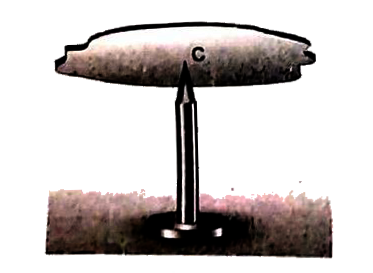
|
|
| 38590. |
Four particles of masses 1 kg, 2 kg, 3 kg and 4 kg are placed at the four vertices A, B, C and Dof the square of side 1 m. Find the position of centre of mass of the particles. |
Answer» Solution :Assuming A as the ORIGIN, AB as x-axis and AD as y-axis we have  Co-ordinates of their CM are `x_(CM)=(m_(1)x_(1)+m_(2)x_(2)+m_(3)x_(3)+m_(4)x_(4))/(m_(1)+m_(2)+m_(3)+m_(4))` `=(1(0)+2(1)+3(1)+4(0))/(1+2+3+4)=0.7m` `:.` Co-ordinates of centre of mass `(x_(CM),y_(CM))=(0.5m.0.7m)` |
|
| 38591. |
Find the point at which the gravitational force acting on any mass is zero due to the earth and the moon system. (such a point is called neutral point). The mass of the moon and the distance between the earth and the moon is 3,85,000 km. |
Answer» Solution : Let `m_(1)` and `m_(2)` be the masses of the EARTH and the moon separated by a distance d. Consider an object of mass m at a point P, which is at a distance X from `m_(1)`. The force due to mass `m_(1)` on the mass m is `F_(1) = (GM m_(1))/(X^(2))` TOWARDS `m_(1)` and The force due to mass `m_(2)` on the mass m is `F_(2) = (Gm m_(2))/((d-x)^(2))` towards `m_(2)` If the RESULTANT force on the mass .m. is to be zero, `F_(1)` must be equal to `F_(2)` in magnitude and they are oppositely DIRECTE `(Gm m_(1))/(x^(2)) = (Gm m_(2))/((d-x)^(2)) rarr x = 38,500 km` from moon here `m_(1) = M` mass of the moon, `m_(2) = 81M`, mass of the earth |
|
| 38592. |
You may have seen in a circus a motorcyclist driving in vertical loops inside a ‘death- well’ (a hollow spherical chamber with holes, so the spectators can watch from outside). Explain clearly why the motorcyclist does not drop down when he is at the uppermost point, with no support from below.What is the minimum speed required at the uppermost position to perform a vertical loop if the radius of the chamber is 25 m ? |
|
Answer» Solution :At the uppermost point `N + mg = (mv^2)/( R)`, where N is the normal force (downwards) on the MOTORCYCLIST by the ceiling of the chamber.The minimum POSSIBLE speed at the uppermost point CORRESPONDS to N = 0. `i.e. v_("min") = sqrt(R_g) = sqrt(25 xx 10) = 16 ms^(-1)` |
|
| 38593. |
On complete combustion a litre of petrol gives off heat equivalent to3 xx 10^(7) J. In a test drive, a car weighing 1200 kg including the mass of driver, runs 15 km per litre while moving with a uniform speed on a straight track. Assuming that friction offered by the road surface and air to be uniform. calculate the force of friction acting on the car during the test drive. if the efficiency of the car engine were 0.5. |
|
Answer» Solution :Petrol gives energy in the form of heat of comblustion . Thus , by question , `E_("input") = 3xx10^(7) J ` ` eta = 0.5` ` :. E = 0.5 XX 3xx10^(7) J - 1.5 xx10^(7) J ` Total DISTANCE travelled(d) = 15 km= `15 xx10^(3) ` m If f is the force of friction , then ` E = fxxd ""( :. "energy is utilised in working against friction")` `1.5 xx10^(7) = f xx 15 xx10^(3)` `f = (1.5 xx10^(7))/(15xx10^(3)) = 10^(3) N ` `f = 1000` N |
|
| 38594. |
A particle performs simple harmonic motion with amplitude A. Its speed is trebled at the instant that it is at a distance (2A)/(3) from equilibrium position. The new amplitude of the motion is : |
| Answer» Answer :A | |
| 38595. |
1 Pa = …… "dyne"//cm^(2). |
|
Answer» |
|
| 38596. |
Which one of the following plots represent the variation of gravitational field on a particle with distance r due to a thin spherical shell of radius R? (r is measured from the centre of the spherical shell) |
|
Answer»
 `implies` Gravitational field INTENSITY at DISTANCE R from the centre of spherical shell of radius R `I= (GM)/r^2 ` (If `r GT R` ) At the surface of shellr = R `:. F = (GM)/R^2` For INSIDE the shell ` r lt R` F=0 |
|
| 38597. |
Consider the statement (A) and (B) andidentify the correct answer. A: First law of thermodynamics specifies thecondition underwhich a body can use itsheat energy to produce the work. B: Second law of thermodynamics states thatheat always flows from hot body to cold body by itself |
|
Answer» Both (A) and (B are TRUE |
|
| 38598. |
A metal rope of density 6000"kgm"^(-3) has breaking stress 9.8 xx 10^(8) Nm^(-2). This rope is used to measure the depth of the sea. Then the depth of the sea that can be measured without breaking is ----- |
|
Answer» `10 XX 10^(3)` m |
|
| 38599. |
An ideal gas is taken along a process P proptoV where P and V are the pressure and volume at any instant. Determine how the pressure depend on the temperature T and how the temperature T depend on volume ? |
|
Answer» <P> |
|
| 38600. |
A rod AB of length / is such that its linear density (mass per unit length) mu varies as mu=a/(b-x)where x is the distance of the section from end A (and b > I). Determine the distance of the centre of mass of the rod from end A. |
|
Answer» |
|


