

Saved Bookmarks
This section includes 7 InterviewSolutions, each offering curated multiple-choice questions to sharpen your Current Affairs knowledge and support exam preparation. Choose a topic below to get started.
| 1. |
Which of the following is not an illustration of newton 's third law |
|
Answer» flightof a jet plane |
|
| 2. |
A thin square steel plate with each side equal to 10 cm is heated by a blacksmith. The rate of radiated energy by the heated plate is 1134 W. The temperature of the hot steel plate is (Stefans constant sigma=5.67xx10^(-8)"watt"m^(-2)k^(-4), emissivity of the plate = 1) |
|
Answer» 1000 K |
|
| 3. |
Increase in temperature of a gas filled in a container would lead to: |
|
Answer» decrease in INTERMOLECULAR distance `:.` Kinetic energy `PROP T` `:.` By INCREASING temperature, kinetic energy INCREASES. |
|
| 4. |
A spherically symmetric non-rotating body of radius R has varying volume density given by rho = rho_(0)r where rho_(0) is a positive constant and r is distance from centre. For this situation mark the correct statement (s ) with respect to gravitational field intensity. |
|
Answer» It is definitely zero at CENTRE |
|
| 5. |
A U- tube contains water and methlated spiritseparated by mercury . Themercury columns in the two arms are in level with 10.0 cmof spirit in the other. What is the specific grvity of spirit ? |
|
Answer» <P> SOLUTION : Pressure at A and B are equal . `thereforeP_(1)=P_(2)` `thereforeh_(1)rho_(1)g=h_(2)rho_(2)g` `thereforerho_(2)=(h_(1)rho_(1))/(h_(2))` `=(10xx1)/(12.5)` `=0.8gcm^(-3)` Relative DENSITY of spirit `=("Density of spirit")/("Density of water")` `=(0.8)/(1)=0.8` |
|
| 6. |
A force of 100 N gives a mass m_1, an acceleration of 10 ms-2 and of 20 ms^(-2) to a mass m_2. What acceleration must be given to it if both the masses are tied together? |
|
Answer» Solution :Suppose, a = ACCELERATION produced if `m_1` and `m_2`are TIED together, F = 100 N Let `a_1` and `a_2`be the acceleration produced in `m_1` and `m_2` , respectively. ` therefore a_1 = 10 ms6(-2) , a _2 = 20 ms^(-2) ` (GIVEN ) agian ` m_1 = (F)/(a_1) " and " m_2 = (F)/(a_3)` ` rArrm_1 = 100/10 = 10kg` `m_2 = 100/20 = 5kg ` ` m_1 + m_2 = 10 + 5 = 15` so `a = (F)/(m_1 + m_2) =100/15 = 20/3 = 6.67 ms^(-2)` |
|
| 7. |
The resultant of two forces cannot exceed |
|
Answer» AVERAGE of the forces |
|
| 8. |
The internal energy of gas is increased in _____ |
| Answer» SOLUTION :ADIABATIC COMPRESSION. | |
| 9. |
Mark correct statements. |
|
Answer» Two PARTICLES thrown with same speed from the same point at the same instant but at different angles cannot collide in mid air. |
|
| 10. |
An object is thrown vertically upward with a non - zero velocity. If gravity is turned off at the instant the object reaches the maximum height, what happens ? |
|
Answer» the object continues to MOVE in a STRAIGHT line |
|
| 11. |
Two bodieseach of mass M are kept at a fixed distance of reparation 2L. A particle of mass m si projected from midpoint of line joining of their centres perpendicular to the line. The minimum initial velocity of mass m to escape the gravitational field of the two bodies is |
|
Answer» `Asqrt((GM)/(L ))` |
|
| 12. |
A bullet ofmass m hits a wooden block of mass M, suspended by a string of length l, and gets embedded in it. If the velocity of the bullet is v, find theangular displacement of the block. |
Answer» Solution :Let the VELOCITY of the block -bullet system after impact be V and the angular displacement be `theta` [Fig.1.48].  From the lawof conservation of momentum, `mv=(M+m)V or, V=(mv)/(M+m)` Kineticenergy of the block -bullet system at position A `=1/2 (M+m)V^2` `=1/2 (M+m)xx(m^2v^2)/((M+m)^2)` =`(m^2v^2)/(2(M+m))` Potential energy of the system at B `=(M+m)g*AC` `=(M+m)g[OA-OC]` `=(M+m)g(l-lcos theta)=(M+m)gl(1-COS theta)` From the law of conservation of energy, `1/2 (m^2v^2)/(M+m) =(M+m)gl(1- cos theta)` or, `1- cos theta =1/2 (m^2v^2)/((M+m)^2gl)` `or, 2 sin ^2"" theta/2=1/2 ((mv)/(M+m))^2xx1/(gl)` `or, sin "" theta/2 =(mv)/(2(M+m)SQRT(gl)) or, theta/2=sin ^(-1) [(mv)/(2(M+m)sqrt(gl))]` ` therefore theta =2sin ^(-1) [(mv)/(2(M+m)sqrt(gl))]`. |
|
| 13. |
An artificial satellite is revolving around a planet of mass M and radius R in a circularorbit of radius r. From Kepler's third law about the period of a satellite around a common central body, square of the period of revolution T is proportional to the cube of the radius of the orbit r. Show using dimensional analysis that T=(k)/(R) sqrt((r^(3))/(g)) where k is dimensionless RV g constant and g is acceleration due to gravity. |
|
Answer» Solution :According to Kepler.s third law `T^(2) prop r^(2) rArr T prop r^((3)/(2))` We know that T is a function of R and G, Let `T prop r^((3)/(2)) R^(a)g^(b)` `:.T=kr^((3)/(2))R^(a)g^(b) ""...(i)` where K is a DIMENSIONLESS constant of proportionality. Substituting the dimensions of each term in equ. (i) we get `[M^(0)L^(0)T]=[L]^((3)/(2))[L]^(a)+[LT^(-2)]^(b)` `=[L^(a+b+(3)/(2))T^(-2b)]` By comparing the powers `a+2b+(3)/(2)=0 ""...(II)` `=-2b=1 rArr b=-(1)/(2) ""...(iii)` USING equ. (ii) `a-(1)/(2)+(3)/(2)=0 rArr a=-1` By substituting the values of a and b in equ (i) `T=kr^((3)/(2))R^(-1)g^((1)/(2))` `:.T=(k)/(R) sqrt((r^(3))/(g))` |
|
| 14. |
A pump on the ground floor of a building can pump up water to fill a tank of volume 30 m^3in 15 min. If the tank is 40 m above the ground, how much electric power is consumed by the pump. The efficiency of the pump is 30% |
|
Answer» `(30)/(100)xxp=(vpgh)/t` `p=43.6KW` |
|
| 15. |
In a cyclic process, work done by the system is |
|
Answer» zero `DELTA Q = Delta U + Delta W` Since in a cyclic process the system returns to its ORIGINAL state, so `Delta U = 0. :. Delta Q = Delta W` |
|
| 16. |
A flywheel initially rotating at 120 rpm retards and its angular speed reduces to 10 rpm. If the retardation in uniform and time taken is 1.5 s, then calculate the numberr of rotations made before coming to a soap. |
|
Answer» Solution :Given `omega_r=10rpm=120xx2xx3.142//60=12.568rads` t=1.5s USING `PROP=(omega_r-omega_i)/t=(1.043-12.5689)/(1.5)` i.e `prop=-7.683rads^(-2)` Applying `theta=omega_1t+1/2propt^2` We GET `theta=12.568xx1.5+1/2(-7.683)xx(1.5)^2` i.e `theta=18.852-8.643` `theta=18.852-8.643` `theta=10.209rad` NUMBER of rotations=`(10.209_/(2pi)=(10.209)/(2xx3.142)=1.62` |
|
| 17. |
A mass of 0.1kg is rotated in a verticla circle using a string of length 1m. When the string makes an angle 30^(@) with the vertical, the speed of the mass is 2 ms^(-1). The radial acceleration of the mass at that instant is |
|
Answer» `4MS^(-2)` |
|
| 18. |
A car of mass 1000 kg is moving with a speed of 40 ms^(-1) on a circular path of radius 400m. If its speed is increasing at the rate of 3ms^(-2) the toal force acting on the car is |
| Answer» ANSWER :C | |
| 19. |
A metal piece of mass 120 g is stretched to form a plane rectangular sheet of area of cross section 0.54 m^(2). If length and breadth of this sheet are in the ratio 1 : 6, find its moment of inertia about an axis passing through its centre and perpendicular to its plane. |
|
Answer» Solution :Mass M = 120 g = `120xx10^(-3)kg` area `= lb =0.54 m^(2)` `(L)/(b)=(1)/(6), "" therefore l=(b)/(6)` `lb=0.54 , "" (b)/(6).b=0.54` `b^(2)=0.54xx6 rArr b = sqrt(3.24)=1.8 m`. SIMILARLY `l = (0.54)/(18)=0.3m`. MOMENT of Inertia `I=(M(l^(2)+b^(2)))/(12)=(120xx10^(-3)[(0.3)^(2)+(1.8)^(2)])/(12)` `I=33.3xx10^(-3)kg m^(2)`. |
|
| 20. |
A mass is whirled in a circular path with angular momeentum L. If the length of string and angular velocity both are doubled the new angular momentum is |
|
Answer» L |
|
| 21. |
Three vectors each of magnitude A act A act at a point simultaeously such that angle between any two vectors is 60^(@). Find the magnitude of the resultant? |
|
Answer» |
|
| 22. |
Choose the correct statement (s) of the following |
|
Answer» FORCE acting on a PARTICLE for equal time INTERVALS can produce the same change in MOMEMTUM but DIFFERENT change in kinetic energy |
|
| 23. |
A particle of mass 1 kg is thrown vertically upward with speed 100 m/s. After 5 sec it explodes into two parts. One part of mass 400 g comes back with speed 25 m/s, what is the speed of the other part just after explosion ? (g=10 m//s^(2)) |
|
Answer» 600 m/s UPWARD |
|
| 24. |
The intensity of a sound wave 20 m away from the sound source is 3n W//m^(2). Find the intensity of the wave 32 m away from the source, if the half -thickness for sound of this frequency is 120 m. |
|
Answer» |
|
| 25. |
In the above given problem if the lower thread is pulled with a jerk , what happens ? |
| Answer» SOLUTION :When the LOWER threadCD is pulled with a JERK , the thread CD itself break . Because PULL on thread CD is not TRANSMITTED to the thread AB instantly. | |
| 26. |
The figure shows elliptical orbit of a planet 'M' about the Sun 'S', the shaded area SCD is twice the shaded area SAB. If t_(1) is the time for the planet to move from C and D and t_(2) is the time to move from A to B then. |
|
Answer» Solution :ACCORDINGTO Kepler.slaw LAWOF areas `(DeltaA)/(Deltat) ` = constant `DeltaA prop Deltat` `(DeltaA_(SCD))/(DeltaA_(SAB)) = (t_(1))/(t_(2))` `(2A)/A = (t_(1))/(t_(2))` ` :. "" t_(1) = 2t_(2)` 
|
|
| 28. |
The rms velocity of a gas molecule of mass m at a given temperature is proportional to |
|
Answer» `m^0` |
|
| 29. |
In gravity - free space, a particle is in contact with the inner surface of a hollow vertical cylinder and moves in horizontal circular path along the surface. There is some friction between the particle and the surface. The retardation of the particle is |
|
Answer» ZERO |
|
| 30. |
The solar radiation spectrumreveals that the intensitycorrespondingto a wavelength of 4750 A^(@) is maximum . Estimatethe surfacetemperature of the sun (Given Wien's constant = 2.89xx 10^(-3) m-k). |
|
Answer» Solution :From Wien.s displacementlaw, the temperatureT ofa body CORRESPONDING to MAXIMUM intensitywave length `lambda_(m)` is givenby `T = (b)/(lambda_(m)) thereforeT = (2.89 xx 10^(-3) m - K)/(4750 xx 10^(-10)m) =6084 K` This temperaturecorrespondsto thechromsphere(SURFACE ) of the SUN. |
|
| 31. |
A fluid flowing out of a small hole in a vessel results in a backward thrust on the vessel |
| Answer» Solution :The reason of this is CONSERVATION of momentum . The liquid flowing from HOLE has momentum in forward and the same momentum is GAINED by vessel in backward. | |
| 32. |
A satellite is orbiting the carth close to its surface. A particle is to be projected from the satellite to just escape from the earth. The escape speed from the earth is upsilon_eIts speed with respect to the satellite |
|
Answer» will be LESS than `upsilon_e` |
|
| 33. |
Under isothermal conditions two soap bubbles of radii a and b coalesce to form a single bubble ofradius c. If external pressure is P_e, the surface tension of soap solution is equal to : |
|
Answer» `( P_O ( a^(3) + B^(3) -c^(3) ) )/( 4 ( a^(2) + b^(2) + c^(2) )` |
|
| 34. |
An aeroplane flying horizontally at an altitude of 490 m with a speed of 180 kmph drops a bomb. The horizontal distance at which it hits the ground is |
|
Answer» 500 m |
|
| 35. |
Three point masses are at the corners of an equilateral triangle of side a. Their separations do not change when the system rotates about the centre of the triangle. For this, the time period of rotation must be proportional to (a)a^(3//2) , (b)a ,(c) m , (d)m^(-1//2) |
|
Answer» only a & C are true |
|
| 36. |
The balades of a windmill sweep out a circle of area A. If the wind flows at a velocity v perpendicular to the circle, then the kinetic energy of the air is |
|
Answer» `(1)/(2) A rho vt` |
|
| 37. |
Figure shows a wire of length 2L and crosssectional area A, stretched horizontally between two clamps. When an object of mass M is suspended from the mid point of the wire, the downward displacement of the young's modulus of the material of the wire is x. Shown that M = (YA x ^(3))/(gL ^(3))(where theta is small) |
Answer» SOLUTION :Here tensile stress `sigma _(N) = (F _(a))/( A.)` 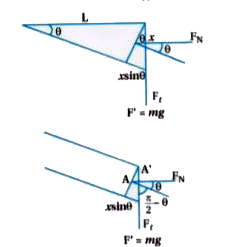 From figure `A =A. COS theta and F _(n) = F cos theta ` `therefore ` tensile stress `sigma _(n ) = (F cos ^(2) theta )/( A) [ because A. = (A)/(cos theta )]""...(1)` Increase in length of wire `Delta L = x SIN theta` `therefore` Longitudinal strain `= (Delta L )/(L) = (x sin theta)/(L) ""...(2)` Young modulus `Y = ("tensile stress")/("longitudinal strain ")` `=( sigma _(n))/( ( Delta L )/( L )) =(F cos ^(2) theta. L )/( A. x sin theta) ` `therefore Y = (FL )/(AX ) . cot theta . cos theta` Since `theta` is small. `cot theta = theta = cos theta=(L)/(x)` `therefore Y = (FL ^(3))/( Ax ^(3))= ( Mg L ^(3))/( Ax ^(3)) ` `therefore M = (YA x ^(3))/(gL^(3))` |
|
| 38. |
A spherical shell of copper is completely filled with a liquid at a temperature t°C. The bulk modules of the liquid is K and coefficient of volume expansion is gamma. If the temperature of the liquid and the shell is increased by Delta T, then the outward pressure Delta p on the shell that results from the temperature increase is given by ( alpha is the coefficient of linear expansion of the material of the shell): |
|
Answer» `K ( GAMMA-3 ALPHA ) DELTA T` |
|
| 39. |
A spring having a spring constant 1200Mn^(-1) is mounted on a horizontal table. A mass of 3 kg is attached to the free end of the spring. The mass is then pulled sideways to a distance of 0.02 m and released. Determine (i) frequency of oscillations (ii) maximum acceleration of the mass and (iii) the maximum speed of the mass. |
Answer» Solution :Given, `K=1200Nm^(-1), m=3kg, y=0.02 m` 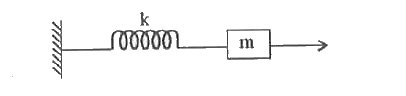 (i) Frequency of oscillation, `F=(1)/(2pi)sqrt((k)/(m))` i.e. `f=((1)/(2xx3.142))sqrt((1200)/(3))=(10)/(3.142)=((10)/(PI))Hz` (ii) maximum acceleration of the mass, `a_("max")=-omega^(2)y` where `omega=(2pi)/(T)=2pif` `"i.e."omega=2pixx(10)/(pi)` hence `a_("max")=-20xx20xx0.02` `a_("max")=8ms^(-2)` (III) maximum speed of the mass, `v_("max")=omegaA=2xx0.02 =0.4ms^(-1)`. |
|
| 40. |
A body falls from 80 m. Its time of descent is [g = 10 ms^(-2)] |
|
Answer» 3s |
|
| 41. |
In the above question 55 tangential acceleration of the bead just after it is released is ? |
|
Answer» `G/2` |
|
| 42. |
When a capillary tube is dipped in water vertically water rises to a height of 10 mm. The tube is now tilted and makes an angle 60^(@) with vertical. Now length of water column in tube is |
| Answer» Answer :C | |
| 43. |
A metal bob is suspended from a coiled spring. When set into vertical vibrations on the earth. It oscillates up and down with frequency f. If the same experiment is carried out in a satellite circling the Earth the frequency of vibration will be…………… |
|
Answer» f |
|
| 44. |
Which of the following conversions is incorrect? |
|
Answer» 1 curie `=3.7xx10^(10)g^(-1)` |
|
| 45. |
Obtain the expression of moment of inertia and define it. What are the factors on which moment of inertia depends? Write its unit and dimensional formula. |
|
Answer» Solution :When a BODY rotating about a fixed axis, each particle of the body moves in a circle with linear velocity `v_(i)=r_(i)omega`, where `i=1,2,…,n` The kinetic ENERGY of motion of this particle is `K_(i)=(1)/(2)m_(i)v_(i)^(2)` `=(1)/(2)m_(i)r_(i)^(2)omega^(2) [because v_(i)=r_(i)omega]` where every particle has mass `m_(i)` and distance from axis is `r_(i)` and `i=1,2,...,n` are no. of particles `omega` is constant for all particle. `therefore K=(1)/(2)omega^(2)underset(i=1)overset(n)summ_(i)r_(i)^(2)` Where K is the total energy of all particles. Here `underset(i=1)overset(n)summ_(i)r_(i)^(2)=I` is known as moment of inertia. If `m_(1),m_(2),...,m_(n)` are the masses of the particles of a rigid body and `r_(1),r_(2),...,r_(n)` are their perpendicular distance from a given axis, then the SUM `m_(1)r_(1)^(2)+m_(2)r_(2)^(2)+....+m_(n)r_(n)^(2)` is calle the moment of inertia of the body corresponding to the given axis. Thus, `therefore I=m_(1)r_(1)^(2)+m_(2)r_(2)^(2)+....m_(n)r_(n)^(2)` `=underset(i=1)overset(n)summ_(i)r_(i)^(2)` Defination of moment of inertia : The sum of the TERMS obtained by multiplying the masses of individual particles of a rigid body with the square of their respective perpendicular distance form a specified axis is called the moment of inertia of that body w.r.t. the SELECTED axis. Moment of inertia depends upon position and orientation of the axis of rotation, shape, size of the body and distribution of mass of the body about the axis of the rotation. Moment of inertia is independent from the magnitude of angular velocity. Which the characteristics of motion of rigid body. Mass is a inertia for linear velocity and moment of inertia is a inertia for rotational motion. Equation of linear motion are `vecp=mvecv and vecF=mveca`, corresponding these equation, equation in rotational motion are `vecL=Ivecomega and vectau=Ivecalpha`. The role of mass in linear motion is similar to the role of moment of inertia in rotational motion. SI unit of moment of inertia is kg `m^(2)` or `Js^(2)` and dimensional formula is `[M^(1)L^(2)T^(0)]`. |
|
| 46. |
A car makes a displacement of 100 m towards east and then 200 m towards north. Find the magnitude and direction of the resultant. |
|
Answer» `223.7m, tan^(-1)(2), N` of E |
|
| 47. |
Two particle of masses 4 kg and 8 kg kept at x = -2m and x =4 m respectively. Then the net force acting on a third particle of mass 1 kg kept at origin in newton is |
| Answer» ANSWER :C | |
| 48. |
Consider the following statements A and B given below and identify the correct answer. (A) Vectors hat(i)+3hat(j)+5hat(k) and 2hat(i)+6hat(j)+10hat(k) are parallel (B) hat(i)+hat(j)+hat(k) represents a unit vector |
|
Answer» Both A and B FALSE |
|
| 49. |
Inside a hollow conducting sphere of charge Q, the electric intensity (E) is zero. But, the potential (V) is not zero. How should be the potential inside the charged conducting sphere to satify the condition that E is zero inside? |
| Answer» SOLUTION :The potential shouldbe the sameevergy whereinsidethe sphere so that `(DV)/(DR) = 0` . | |
| 50. |
A lead bullet of mass 10 g travelling at 300 m/s strikes against a block of wood and comes to rest. Assuming 50% of heat is absorbed by the bullet, find the increase in its temperature. (Specific heat of lead = 150 J Kg^(-1)k^(-1)) |
|
Answer» SOLUTION :Loss in K.E. = Heat energy `1/2xx 1/2xx 10/(1000) xx (300)^(2) = 10/(1000) xx 150 xx DELTATHETA` `implies` rise in TEMPERATURE `Deltatheta = 150^(0)C` |
|