

Saved Bookmarks
This section includes 7 InterviewSolutions, each offering curated multiple-choice questions to sharpen your Current Affairs knowledge and support exam preparation. Choose a topic below to get started.
| 1. |
Rain is fallinf vertically with a speed of 35 m s^(-1). A women rides a bicycle with a speed of 12ms ^(-1) in east to west dicrection . Whatis the direction in which she should hold her umbrella ? |
Answer» Solution :In Fig . 4.16 `v_(r )` represents the velocity of rain and `v_(b)` , the velocity of the bicycle , the women is riding . Boththese velocities are with RESPECT to the GROUND . Sincethe woman is riding a bicycle , the velocity of rain as experienced by her is the velocity of rain relative to the velocity of the bicycle she is riding . That is `v_(rb) =v_(r )-v_(b)`This relative velocity vector as shown in Fig . 4.16 makes an angle `theta` with the vertical . It is GIVEN by `tantheta=(v_(b))/(v_(r))=(12)/(35)=0.343``tantheta=(v_(b))/(v_(r))=(12)/(35)=0.343` Or , `theta~=19^(@)` Therefore , the women should hold her umbrella at an angle of about `19^(@)` with the vertical towards the WEST . |
|
| 2. |
A liquid in a thermos flask is vigorously shaken. Then the temperature of the liquid |
|
Answer» Is not altered |
|
| 3. |
To melt 1gm of ice completely the amount of work to be done is |
|
Answer» 42J |
|
| 4. |
The knowledge of elasticity useful in selecting metal ropes show its use, in cranes for lifting heavy loads, when rope of steel is used (Elastic limit 30 xx 10^(7) Nm^(-2)) if load of 100000 kg is to be lifted. What should be the radius of steel rope ? What should we do to increase flexibility of such wire ? |
|
Answer» SOLUTION :The ultimate stress should not EXCEED ELASTIC limit of steel `(30 xx 10^(7) N//m^(2))` `U= (F)/(A)=(Mg)/(PIR^(2))=(10^(5)xx9.8)/(pir^(2))= 30xx10^(7)` `:. R = 3.2` cm So to lift a bad of `10^(4)` kg, crane is designed to withstand 105 kg. To impart flexibility the rope is made of large number of thin WIRES braided. |
|
| 5. |
Absence of roughness between two consecutive layers of fluid is the viscosity . |
|
Answer» |
|
| 6. |
How are vibratory motion and simple harmonic motion different? |
| Answer» Solution :Both VIBRATORY motion and simple HARMONIC motion are oscillatory motions. | |
| 7. |
The position vector of a particle in a circular motion about the origin sweeps out the equal area in equal time: |
|
Answer» its velocity remains CONSTANT |
|
| 8. |
Whatis 1 Torr pressure ? |
|
Answer» Solution :1 torr = Pressure `rhog` PRODUCED due to 1 mm COLUMN `=10^(3)XX(13.6xx10^(3))xx9.8` `=133.8N//m^(2)` |
|
| 9. |
The dimensional formula for the magnetic field is |
|
Answer» `[MT^(-2)A^(-1)]` `= ([MLT^(-2)])/([M][L])= [MT^(-2)A^(-1)]` |
|
| 10. |
Theangula speed of a fly-wheel making 120 revolutions /minute is : |
|
Answer» `4pirads^(-1)` ANGULAR SPEED of flywheel=`(120xx2pi)/(60)(rad)/(s)impliesomega=4pirads^(-1)` |
|
| 11. |
The ratio of energy required to accelerated a car from rest to 20ms^(-1) to the energy needed to acceelerate from 20ms^(-1) to 40ms^(-1) is |
|
Answer» `1:1` |
|
| 12. |
A body of mass .m. is rotating in a vertical circle of radius .r. with critical speed at the highest point.The differencein its K.E. at the top and bottom is |
|
Answer» 2mgr |
|
| 13. |
Two smooth spheres. A and B. having equal radii, lie on a horizontal table. A is of mass m and B is of mass 3m. The spheres are projected towards each other with velocity vector 5hati+2hatj and 2hati-hatj, respectively, and when they collide the lige joining their centres is parallel to the vector hati. If the coefficient of restitution between A and B is 1//3, find the velocities after impact and the loss in kinetic energy caused by the collision. Find also the magnitude of the impulses that act at the instant of impact. |
Answer» Solution :The velocity component of `A` and `B` perpendicular to the line connecting centres are unchaned by the impact. It is because no FORCE acts on `A` and `B` in a direction perpendicular to the line connecting the centre 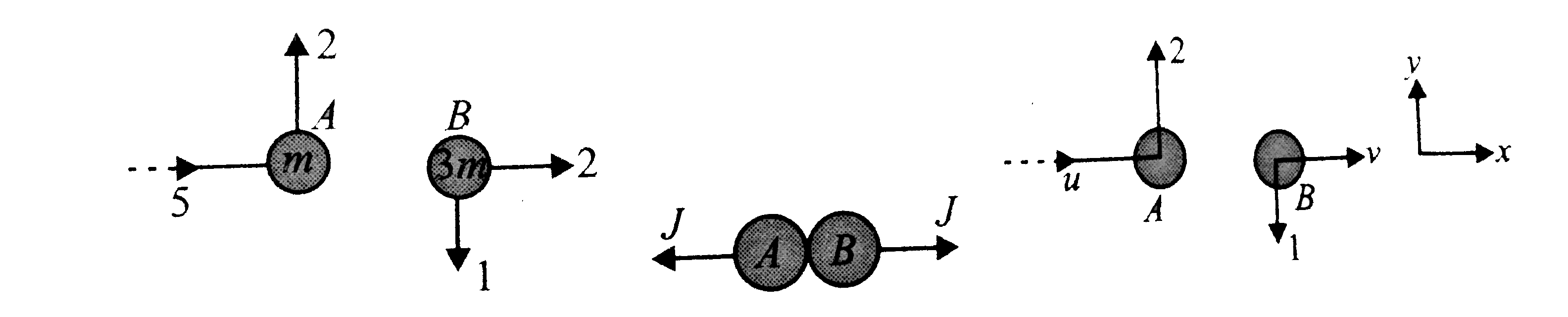 Applying conservation of inear momentum nd the law of restitution we have in `x` direction `5m+(3m)(2)="mu"+3MV`............i `and 1/3(5-2)=v-u`.........ii Solving these EQUATIONS, we have `u=2` and `v=3` The velocities of `A` and`B` after the impact are `2hati+2hatj` and `3hati-hatj` respectively. Before the kinetic ENERGY of `A` is `1/2m(5^(2)+2^(2))=29m//2` and of `B` is `1/2(3m)(2^(2)+1^(2))=15m//2` After the impact the kinetic energy of `A` is `1/2m(2^(2)+2^(2))=4m` and that of `B` is `1/2(3m)(3^(2)+1^(2))=15m` Therefore, the loss in `KE` at impact is `29/2m+15/2m-4m-15m=3m` To find the value of `J` we CONSIDER the change in momemtum along `hati` for one sphere only. For sphere `B, J=3m(3-2)` or `J=3m,` |
|
| 14. |
Explain why food does not cook speedily at high altitudes. |
| Answer» Solution :At HIGHER altitude water BOILS below 100°C. So the SUBSTANCEIS being cooked in wateracquires a temperature below 100°C.Hence it TAKES longer TIME to be cooked. | |
| 15. |
P is a point at a distance r from the centre of solid sphere of radius a. The gravitational potential at P is V. IF V is plotted as a function of r, which is the correct curve ? |
|
Answer»
|
|
| 16. |
No physicist has ever seen an atom. Yet all physicist believe in the existence of atoms. An intelligent but superstitions man advances this analogy to argue that ghosts exist even though no one has seen one. How will you refuse his argument? |
| Answer» Solution :All the experiments in MODERN physics SUPPORT sight of atom. But so FAR no EXPERIMENTAL evidence for ghosts, we do not have any computer WORKING with the help of ghosts. | |
| 17. |
A force of 100 dyne acts on a mass of 5 grams for 10 sec . Find the velocity produced ? |
|
Answer» Solution : `a= (F) /(m) = (100)/(5)= 20cm//s^(2)` `v= U+ at IMPLIES v= 0 + 20xx10=200`cm/sec |
|
| 18. |
An ideal gas of volume 1 litre and at a pressure 8 atm undergoes an adiabatic expansion until its pressure drops to 1 atm and volume increase to 4 liters. Calculate the work done in the process (y = 1.5). |
| Answer» Solution :`W = ( 1hgamma -1) (P _(1) V _(1) - P _(2) V _(2))= (1//15 -1) (8 XX 1.103 xx 10 ^(5) xx 10 ^(-3) - 1. 013 xx 10 ^(5) xx 4 xx 10 ^(-3)) = 810 J ` | |
| 19. |
How can you say that friction is a non - conservative force ? |
| Answer» Solution :Because the WORKDONE against FRICTION is any closed path is NEVER ZERO . | |
| 20. |
Object are exposed to the X-rays in a dark room. They will appear |
|
Answer» invisible |
|
| 21. |
Little more for rolling body : |
|
Answer» Solution :Velocity of body rolling without sliding from a slope of height h and reaching at the bottom is, `v^(2)=(2gh)/([1+k^(2)//R^(2)])""....(1)` LET d be the length of the inclined PLANE. Suppose the object starting from the position of rest, travel a DISTANCE d over inclined plane with linear acceleration a and reaches the bottom `therefore v^(2)=2ad [because v_(0)=0]` but `d=(h)/(sintheta)` `therefore v^(2)=(2ah)/(sintheta)"".....(2)` comparing equations (1) and (2) `a=(gsintheta)/([1+(k^(2))/(R^(2))])""......(3)` a is directly parallel to the slope. Its magnitude should be equal to `gsintheta`, which is the component of g parallel to the inclined plane `therefore` Decrease in the acceleration `a.=gsintheta-{(gsintheta)/([1+k^(2)//R^(2)])}` `a.=gsintheta-{1-(1)/(1+(k^(2))/(R^(2)))}` `=gsintheta{1-(R^(2))/(R^(2)+k^(2))}` `=gsintheta{(k^(2))/(k^(2)+R^(2))}""......(4)` Thus decrease in the acceleration is due to the frictional force acting on the rolling body. The work done against the force of FRICTION results into the kinetic energy of rotational motion. Therefore even in the presence of friction the law of conservation of mechanical energy can be used. `therefore` Friction force `F=ma.` `therefore` Friction force `F=mgsintheta{(k^(2))/(k^(2)+R^(2))}....(5)` |
|
| 22. |
Two blocks of masses 2 kg and 5 kg are at rest on ground. The masses are connected by a string passing over a frictionless pulley which is under the influence of a constant upward force F = 50 N. Find the accelerations of 5 kg and 2 kg masses. |
|
Answer» SOLUTION :The masses will be lifted if the tension in the string is greater than the gravitational pull on masses. Weight of 5 kg mass `= 5xx10 = 50 N` and that of  2 kg mass `= 2xx10=20 N`. From free BODY diagram `50-2T = 0` or T = 25 N (`because` pulley is massless) Tension in each string = 25 N. 2 kg weight will be lifted. But 5 kg weight can not be lifted ACCELERATION of 2 kg weight : `rArr 25-20 = 2a`or `a=(5)/(2)=2.5 ms^(-2)` as the 5kg mass does not lifted, so its acceleration is zero. |
|
| 23. |
Discuss the center of mass of two point masses with pictorial representation. |
|
Answer» Solution :With the equations for center of mass, let us find the center of mass of two point MASSES `m_(1) and m_(2)`, which are at POSITIONS, and x, respectively on the X-axis. For this case, we can express the position of center of mass in the FOLLOWING three ways based on the choice of the coordinate system. (i)When the masses are on positive X-axis: The origin is taken arbitrarily so that the masses `m_(1) and m_(2)` are at positions `x_(1) and x_(2)` on the positive X-axis as shown in figure (a). The center of mass will also be on the positive X-axis at `X_(CM)` as given by the equation. `x_(CM)=(m_(1)x_(1)+m_(2)x_(2))/(m_(1)+m_(2))` (ii)When the origin coincides with any one of the masses: The calculation COULD be minimised if the origin of the coordinate system is made to coincide with any one of the masses as shown in figure (b). When the origin coincides with the point mass `m_(1)` its position `x_(1)` is zero, (i.e.` x _(1)= 0)`. Then, `x_(CM)=(m_(1)(0)+m_(2)x_(2))/(m_(1)+m_(2))` The equation further simplifies as `x_(CM)=(m_(2)x_(2))/(m_(1)+m_(2))` (iii) When the origin coincides with the center of mass it self: If the origin of the coordinate system is made to coincide with the center of mass, then, `X_(CM)=0`and the mass `m_(1)` is found to be on the negative X-axis as shown in figure (c). Hence, its position `X_(1)` is negative, (IE, `-x_(1))` `0=(m_(1)(-x_(1))+m_(2)x_(2))/(m_(1)+m_(2))` `0=m_(2)(-x_(1))+m_(2)x_(2)` `m_(1)x_(1)=m_(2)x_(2)` The equation given above is known as principle of moments.  Center of mass of two point masses determined by shifting the origin |
|
| 24. |
An SHM is give by y=5["sin"(3pit)+sqrt(3)"cos"(3pit)]. What is the amplitude of the motion of y in metre ? |
|
Answer» 10 `y=5["SIN"3pit+SQRT(3)"COS"3pit]` or `y=5xx2[(1)/(2)"sin"3pit+(sqrt(3))/(2)"cos"3pit]` or `y=10["sin"3pit"cos"(PI)/(3)+"cos"3pit"sin"(pi)/(3)]` or `y=10"sin"(3pit+(pi)/(3))` |
|
| 25. |
A bomb of mass 60 kg moving uniformly with a velocity of 10m/s explodes spontaneously into two fragments of 40 kg and 20 kg. If the velocity of the larger fragments is zero, then calculate the velocity of the smaller fragement. |
|
Answer» `40m//s` `therefore 60(10)=20v_(1)+40(0)` `therefore 600=20v_(1)` `therefore v_(1)=30m//s` |
|
| 26. |
In the above problem, what will be the work performed by the engine? |
|
Answer» |
|
| 27. |
One kg of a diatomic gas is at a pressure of 8 xx 10^4 N//m^2 . The density of the gas is 4kg/m^3 . What isthe energy of the gas due to its thermal motion? |
|
Answer» `3 XX 10^(4)` J |
|
| 28. |
The mass and radius of the earth are M_1, R_1and those for the moon are M_2, R_2respectively. The distance between their centers is d with that velocity should an object of mass m be thrown away from the mid-point of the line joining them so that it escapes to infinity ? |
|
Answer» SOLUTION :`implies`The distance between earth and moon is d. SINCE body is in between the line joining between earth and moon isHence, its distance from earth or moon is `d//2` . `implies` Total ENERGY of body having stationary mass m at distance `d//2`due to earth. POTENTIAL energy `U_(1) = -(GM_(1) m)/(d//2) ""....(1)` `implies` Total energy of body having stationary mass m at distance d/2 due to moon Potential energy `U_(2) = - (GM_(2)m)/(d//2) ""...(2)` `:.` Binding energy of body of mass m at the centre of earth, ` = (2Gm)/d [M_(1) +M_(2)]` `implies` Suppose, a body escape to infinity at velocity `v_e.`hence escape energy, `=1/2 mv_(E)^(2) ""...(3)` `:. 1/2 mv_e^2 =(2Gm)/d [M_(1)+M_(2)]` `:. v_(e)= sqrt((4G)/d(M_(1+M_2)))` |
|
| 29. |
Assuming that earth as an spherical body, for second's pendulum. {:("Column - I","Column - II"),("A) At pole ","P) " T > 2s),("B) On a satelite", "Q)" T < 2s),("C) At mountain", "R)" T= 2s),("D) At centre of earth", "S) " T = 0),(,"T)" T > oo):} |
|
Answer» |
|
| 30. |
A rocket is fired upwards vertically with a net acceleration of 4m/s""^2 and initial velocity zero. After 5 seconds its fuel is finished and it decelerates with g. At the highest point its velocity becomes zero. There after it accelerates downwards with acceleration g and return back to ground. i) Plot velociry - time graph for complete journey ii) Displacement-time graph for the complete journey: ("Take g =10 m/s"^2) |
|
Answer» Solution :Stage 1 : To find velocity of rocket after 5 seconds `V_(A)=0+at_(OA) =(4)(5)=20ms^(-1)` Stage II: To find further time of ascent after 5 seconds. `0=20-gt_(AB)""t_(AB)=(20)/(10)=2"seconds"` Here, the total VERTICAL displacement of stage (i) and stage (ii) is `="area of OAB"=1/2 (7) (20)=70m`  Stage -III: If `t_(BC)` is time TAKEN of DESCENT then `70=1/2 (10) t_(BC)^(2) ` `t_(BC)=sqrt(14)-3.7s` |
|
| 31. |
Which one of the following equations of motion represents simple harmonic motion? |
|
Answer» ACCELERATION `=-k_(0)X+k_(1)x^(2)` |
|
| 32. |
Is there any increase in temperature when a wire breaks? |
| Answer» Solution :YES. Since the STRAIN ENERGY is CONVERTED into heat energy. | |
| 33. |
The weight of an object is more at the poles than at the equator. At which of these places we can get more sugar for the same weight ? State the reason for your answer. |
| Answer» Solution : If we are USING common balance to measure sugar we will get same quantity of sugar both at EQUATOR and atpoles, whereas if we are using SPRING balance to weigh sugar, then we will get less quantity of sugar at pole because value of ‘g‘ at POLES is larger. Value of ‘g. at equator is less. So we will get more quantity at sugar at equator.Note that the weight = MG is the same of both places. | |
| 34. |
Assertion In summers, a metallic scale will read more than the actual. Reason In summers, length of methallic scale will increase. |
|
Answer» If both ASSERTION and Reason are CORRECT and Reason is the correct EXPLANATION of Assertion. |
|
| 35. |
A body of mass 300 Kg is moved through 10m along a smooth inclined plane of angle 30°. The work done in moving is (jouls) (g=9.8m//s^2) |
|
Answer» 4900 |
|
| 36. |
A ball dropped from the 9th story of a multi - storeyed building reaches the ground in 3 second. In the first second of its free fall, it passes through n storeys, where nis equal to (Take g=10ms^(-2)) |
|
Answer» SOLUTION :`9Y=(1)/(2)xx10xx3xx3ory=5m` Again, `nxx5=(1)/(2)xx10xx1xx1=5 or n=1` |
|
| 37. |
The correct order in which the dimensions of ''time'' decreases in the following physical quantities is (A) Stefan's constant(B) Coeffecient of volume expansion(C ) Work(D) Velocity gradient |
|
Answer» D, B, C, A |
|
| 38. |
A bus covers 3 equal distances. The first is covered with speed 10 km/h, second with speed 20 km/h and third with 60 km/h, then find its average speed in km/h. |
|
Answer» 9 Time taken to cover `1 ^(STH)` part, `t _(1) = (d)/(10)` Time taken to cover `2^(nd)` pard, `t _(2) = (d)/(20)` Time taken to cover `3^(rd)` part, `t _(3) =(d )/(30)` Total time taken, `t =(3d)/(lt V gt )` `therefore t = t _(1) + t _(2) + t _(3)` `(3d)/(lt v gt) = (d)/(10) + (d)/(20) + (d)/(60)` `therefore(3)/(lt v gt) = (6 + 3 +1)/(60)` `therefore (3)/(lt v gt) = (10)/(60)` `therefore lt v gt = (3 xx 60)/(10)` `therefore lt v gt = (180)/(10)` `therefore lt v gt = 18 km//h` |
|
| 39. |
Can we derive the kinematic relations V= u+ at , S = ut = 1/2 at^2 and V^2 = u^2 +2as. Explain the reason for your answer. |
| Answer» Solution :No . On left HAND SIDE there is only one PHYSICAL quantity, but on the right hand side there are more than one QUANTITIES. | |
| 40. |
The thickness of icein a lakeis 5cmand the atmospherictermperature is -10^(@)C. Calculatethe timerequriedfor the thickness of iceto growto 7cm . Thermalconductivity ofice= 4 xx 10^(-3) cal//cm s-""^(@)C, densityof ice= 0.92g//cm^(3) and latentheat of fusion for ice=80 cal/g. |
|
Answer» Solution :Using `Delta = (RHO L)/(2KT) (x_(2)^(2) - x_(1)^(2))` wehavethe requiredtime `Delta t` as . `Delta t =(92 xx 10^(-2) g//cm^(3))/(2 xx 4xx 10^(-3) "cal/cm"-s-""^(@)C) xx (80 cal//gm)/(10^(@)C) xx (7^(2) - 5^(2))cm^(2)` ` = (92 xx 80 xx 24)/(8) s = 22080 s = 6.13` HR |
|
| 41. |
A simple pendilum is swinging in a vertical plane. The ratio of its potential energies when it is making angles 30^(@) and 60^(@) with thevertical is, |
|
Answer» `1 : (2 - sqrt(3))` |
|
| 42. |
A 500kg boat has an initial speed of 10ms^(-1)as it passes under a bridge. At that instant a 50 kg man jumps straight down into the boat from the bridge. The speed of the boat after the man and boat attain a common speed is |
|
Answer» `100/11 MS^(-1)` |
|
| 43. |
There are three distinct modes of heat transfer. The main mode of transmission of heat by which the sun heats the surface of the earth is: |
|
Answer» Conduction |
|
| 44. |
A point object is placed at a distance of 30cm from a convex mirror of focal length 30cm. The image will form at |
|
Answer» Infinity |
|
| 45. |
An electric kettle has 750 W-240V heater, is plugged to a 200V mains. If heat capacity of kettle is 400JK^(-1)and the initial water temperature is 20^@C The time required to boil 500 g of water is (0.8)n minutes. Find the value of .n.. |
| Answer» | |
| 46. |
Two moles of an ideal gas X occupying a volume C exerts a pressure P.The same pressure is exerted by one of another gas Y occupying a volume 2V.If the molecular weight of Y is 16 times the molecularweight of X,find the ration of the rms speeds of the molecules of X and Y. |
|
Answer» SOLUTION :`V_(rms)=SQRT((3PV)/(nM))((m)/(M)=N)` `(V_(1rms))/(V_(2rms))=sqrt((V_(1))/(V_(2))(n_(2))/(n_(1))(M_(2))/(M_(1))),(V_(1rms))/(v_(2rms))=sqrt((V)/(2V)((1)/(2))(16)/(1))` `(V_(1rms))/(V_(2rms))=2` |
|
| 47. |
The x -co- ordinatesof theparticle at time t (gt(pi)/(3B_(0)alpha))wouldbe |
|
Answer» `-(2V_(0))/(B_(0)ALPHA)` |
|
| 48. |
An air chamber of volume V has a neck area of cross section A into which a ball of mass m just fits and can move up and down without any friction. When the ball is pressed down a little and released, it executes SHM. The time period is assuming pressure, volume variations of air to be isothermal, B = bulk modulus) |
|
Answer» `2PI sqrt((Vm)/(A^(2)B))` |
|
| 49. |
Two particles A and B are shot from the same height at t=0 in opposite directions with horizontal velocities 3m/s and a m/s respectively. If they are subjected to the same vertical accelration due to gravity (g=9.8m//s^(2)), the distance between them when their velocity vectors become mutually perpendicu lar is: |
|
Answer» 1.059m |
|
| 50. |
(A) : The maximum possible error in a reading is taken as least count of the measuring instrument. (R) : Error in a measurement cannot be greater than least count of the measuring instrument. |
|
Answer» Both (A) and (R) are TRUE and (R) is the correct EXPLANATION of (A) |
|


