

Saved Bookmarks
This section includes 7 InterviewSolutions, each offering curated multiple-choice questions to sharpen your Current Affairs knowledge and support exam preparation. Choose a topic below to get started.
| 1. |
A ray of light from a denser medium strikes a rarer medium. The reflected and refracted rays make an angle of 90^@ with each other. The angles of reflection and refraction are r and t_1. The critical angle would be |
|
Answer» `SIN^-1 (TAN R)` |
|
| 2. |
A body of mass 6 kg is under a force which causes displacement in it given by s=t^(2)/4 metre where t is time. The work done by the force in 2 s is |
|
Answer» 12j |
|
| 3. |
A planet revolves around the sun in an elliptical orbit of minor and major axes x and y respectively. Then the time period of revolution if proportional to |
|
Answer» `(X+y)^(3//2)` |
|
| 4. |
Three particles of masses 1g, 2g and 3g are at distances of 1cm, 2cm and 3cm from the axis of rotation. Find i) the moment of inertia of the system and ii) the radius of gyration of the system. |
|
Answer» Solution :The MI of the system, `I=m_(1)r_(1)^(2)+m_(2)r_(2)^(2)+m_(3)r_(3)^(2)` `=1xx1^(2)+2xx2^(2)+3xx3^(2)=1+8+27=36gcm^(2)` ii) The radius of GYRATION, `k=sqrt((I)/("Total mass"))=sqrt((36)/(1+2+3))=sqrt6=2.449` cm. |
|
| 5. |
Two blocks of masses m_(1) and m_(2) are connected by an ideal sprit, of force constant k. The blocks are placed on smooth horizontal surface. A horizontal force F acts on the block m_(1). Initially spring is relaxed, both the blocks are at rest. What is maximum elongation of spring. |
|
Answer» `(2m_(1)F)/((m_(1)+m_(2))k)`  `x_(1)+x_(2)=x` ………..i `(F-m_(1)a_(cm))x_(1)+m_(2)a_(cm).x_(2)-1/2kx^(2)=0`…….ii where `a_(cm)=F/(m_(1)+m_(2))`………….iii SOLVE get answer. |
|
| 6. |
for oxygen molecule with three angstrom value find the molecular volume in fraction of actual volume |
| Answer» Solution :Here, the diameter of an OXYGEN moleculed = 3 A = 3 X 10⁻¹⁰ MTHE RADIUS of an oxygen molecule | |
| 7. |
It is easier to roll than to pull a barrel along a road. Explain. |
| Answer» SOLUTION :Because ROLLING FRICTION is LESS than SLIDING friction. | |
| 8. |
The coefficients of linear expansion of P and Q are alpha_(1) and alpha_(2)respectively. If the coefficient of cubical expansion of 'Q' is three times the coefficient of superficial expansion of P, then which of the following is true ? |
|
Answer» `alpha_(2) = 2 alpha_(1)` |
|
| 9. |
A body of mass m is attached to the spring which is elongated to 25 cm by an applied for from its equilibrium position, (a) Calculate the potential energy stored in the spring-mass system? (b) What is the work done by the spring force in this elongation? (C) Suppose the spring is compressed to the same 25 cm, calculate the potential energy stored and also the work done by the spring force during compression. (The spring constant,k=0.1Nm^(-1)). |
|
Answer» Solution :The spring constant, `k=0.1Nm^(-1)` The DISPLACEMENT`x=25cm=0.25m` (a) The potential energy STORED in the spring is GIVEN by `U=1/2Kx^(2)=1/2xx0.1xx(0.25)^(2)=0.0031J` (b) The work done `W_(s)` by the spring force `vecF_(s)` is given by, `W_(s)=underset(0)overset(x)vecF_(x)int*dvecr=underset(0)overset(x)int(-kxhati)*(dxhati)` This spring force `vecF_(s)` acts in the negative x direction while elongation acts in the POSITIVE x direction. `W_(s)=underset(0)overset(x)int(-kx)dx=-1/2kx^(2)` `w_(s)=-1/2x0.1xx(0.250^(2)=-0.003J` Note that the potential energy is defined through the work done by the agency The positive sign in the potential energy implies that the energy is reed from the agency to the OBJECT. But the work done by the receng for indicais crester is in the opposite direction to the displacement direction. (c) During compression also the potential energy stored in the object is the same `U=1/2KX^(2)=0.0031J` Work done by the restoring som force during given by `W_(s)=underset(0)overset(x)vecF_(x)int*dvecr=underset(0)overset(x)int(kxhati)*(-dxhati)` In the case of compression, the restoring spring force towards postes and displacement is along negative x direction `W_(s)=underset(0)overset(x)int(-kx)dx=-1/2kx^(2)=-0.0031J` |
|
| 10. |
The observer hears nobeats. If the frequency of the horn of the car B is 504 Hz , the frequency of the horn of the car A will be : |
|
Answer» `440.5 HZ` `(v)/(v-v_(s))XXV=(v)/(v-v_(s))xxv` `(v)/(v-15)=(504)/(v-30)` `v=(340-15)/(340-330)xx504` `=529.2 Hz`. |
|
| 11. |
A bullet fired at an angle of 30^(@) with the horizontal hits the ground 3.0kmaway . Byadjusting its angle of projection , can one hope to hit a target 5.0 km away ? Assume the muzzle speed to be fixed and neglect air resistance . |
|
Answer» |
|
| 12. |
A body of mass 5 kg moving alonga straight line is accelerated from 4ms^(-1) to 8ms^(-1) with the application of a froce of 10 N in the same direction. Then |
|
Answer» Work DONE by the force is 120 j |
|
| 13. |
A vehicle of mass M is moving on a rough horizontal road with a momentum P. If the coefficient of friction between the tyres and the road is mu, then the stopping distance is |
|
Answer» <P>`(P)/(2muMg)` |
|
| 14. |
Four particles have speeds 2, 3, 4 and 5 cm/s respectively. Their rms speed is |
|
Answer» `3.5 cm//s` |
|
| 15. |
Shows that the path of horizontal projectile is a parabola and derive an expression for (i)Time of flight (ii) Horizontal range (iii) resultant relative and any instant (iv) speed of the projectile when it hits the ground? |
|
Answer» Solution :Consider a projectile, say a ball, thrown horizontally with an initial velocity `vecu` from the top of a tower of HEIGHT h. As the ball moves, it covers a horizontal distance DUE to its uniform horizontal velocity u and a vertical downward distance because of constant acceleration due to gravity g. Thus, under the combined effect the ball moves along the path OPA. The motion is in a 2-dimensional plane. Let the ball take time t to reach the ground at point A. Then the horizontal distance travelled by the ball is x(t) = x, and the vertical distance travelled is y(t)=y.  We can apply the kinematic equations along the x direction and y direction separately. Since this is two-dimensional motion, the velocity will have both horizontal component `u_(x)` and vertical component `u_(y)`. Motion along horizontal direction: The particle has zero acceleration along direction So, the initial velocitly `u_(x)` remains constant throughout the motion. The distance travelled by the projectile at a time is GIVEN by the equation `x=u_(x)t+(1)/(2)at^(2)`. Since a=0 along x direction we have `x=u_(x)t"".......(1)` Motion along downward direction: Here `u_(y)=0` (initial velocity has no downward component), a s (we choose the +ve waxis in downward direction), and distance y at time t. `:.` From equation, `y=u_(x)t+(1)/(2)at^(2)` we, get `y=(1)/(2)at^(2)""......(2)` Substituting the value of from equation (i) in equation (ii) we have `y=(1)/(2)g""(x^(2))/(u_(z)^(2))=((g)/(2u_(x)^(2)))` `y=Kx^(2)"".......(3)` where `K=(g)/(2u_(x)^(2))` is constant. Equation (3) is the equation of a parabola. Thus, the path followed by the projectile is a parabola. 1. Time of Flight: The time taken for the projectile to complete its trajectory or time taken by the projectile to hit the ground is called time of flight. Consider the example of a tower and projectile. Let h be the height of a tower. Let T be the time taken by the projectile to hit the ground, after being thrown horizontally from the tower. We know that `s_(y)=u_(y)t+(1)/(2)at^(2)` for vertical motion. Here `s_(y)=h,t=T,u_(y)=0` (i.e., no initial vertical velocity). Then `h=(1)/(2)"gt"^(2)orT=sqrt((2h)/(g))`  Thus, the time of flight for projectile motion depends on the height of the tower, but is independent of the horizontal velocity of projection. If one ball falls vertically and another ball is projected horizontally with some velocity, both the balls will reach the bottom at the same time. This is illustrated in the figure. Horizontal range: The horizontal distance covered by the projectile from the FOOT of the tower to the point where the projectile hits the ground is called horizontal range. For horizontal motion, we have `s_(x)=u_(x)t+(1)/(2)at^(2)` Here, `s_(x)=R` (range), `u_(x)=u,a=0` (no horizontal acceleration) T is time of flight. Then horizontal range =uT. Since the time of flight `T=sqrt((2h)/(g))`,we substitute this and we get the horizontal range of the particle as `R=usqrt((2h)/(g))`. The above equation implies that the range R is directly proportional to the initial velocity u and inversely proportional to acceleration due to gravity g. 3. Resultant Velocity(Velocity of projectile at any time): At any instant 1, the projectile has velocity components along both x-axis and y-axis. The resultant of these two components gives the velocity of the projectile at that instanti, as shown in figure.  The velocity component at any TALONG horizontal (x-axis) is `v_(x)=u_(x)+a_(x)t.` Since, `u_(x)=u,a_(x)=0,` we get `v_(x)=u` The component of velocity along vertical direction (y-axis) is `v_(y)=u_(y)+a_(y)t` Since, `u_(y)=0,a_(y)=g,` we get `v_(y)="gt"` Hence the velocity of the particle at any instant is `vecv=uhati+"gt"hatj` The speed of the particle at any instant is given by `v=sqrt(v_(x)^(2)+v_(y)^(2))` `:.v=sqrt(u^(2)+g^(2)t^(2))` Speed of the projectile when it hits the ground: When the projectile hits the ground after initially thrown horizontally from the top of tower of. heighth, the time of thight is `t=sqrt((2h)/(g))` The horizontal component velocity of the projectile remains the same i.e. ` v_(x)=u`. The vertical component velocity of the projectile at time T is `v=gT=gsqrt((2h)/(g))=sqrt(2gh)` The speed of the particle when it reaches the ground is `v=sqrt(u^(2)+2gh)` |
|
| 16. |
A uniform spherical shell gradually shrinks maintaining its shape. The gravitational poential at the centre |
|
Answer» INCREASES |
|
| 17. |
The mass and radius of a planet are double that of the earth. The time period of simple pendulum on the planet, if T is the time period of simple pendulum on earth. |
|
Answer» 2T |
|
| 18. |
We know that both Moon and the sun produce our ocean tides. We also know that moon plays the greater role because it is closer. Does its closeness mean it pulls with more gravitational force than the sun on the Earth's oceans? |
| Answer» Solution :No, the gravitational pull of sun in much stronger than that of Moon, due to very LARGE mass of sun. this gravitational pull is INVERSELY proptonal to the square of the distance to the body that pulls. But it is DIFFERENCE from the pulls across the Earth's oceans which is inversely proportional to the cube of the distance. When the distance to the sun id squared, the gravitational pull due to sun is still stronger than gravitational pull due to closer Moon because of the large mass of the sun than Moon. But when the distance to the sun cubed, as is the case of TIDAL FORCES, the sun's influence on earth's oceans is less than the Moon's influence. It means distance is the key to tidal force. | |
| 19. |
Assertion :A planet moves faster , when it is closer to the sun in its orbit and vice versa . Reason : Orbital velocity in orbital of planet is constant. |
|
Answer» Both Assertion and REASON are TRUE and Reason is the correct explanation of Assertion |
|
| 20. |
Define work - energy theorem. |
|
Answer» Solution :(i) If the work done by the force on the body is positive then its kinetic energy increases. (ii) If the work done by the force on the body is negative then its kinetic energy decreases. (III) If there is no work done by the force on the body then there is no CHANGE in its kinetic energy, which means that the body has moved at constant speed provided its mass remains constant. (iv) When a PARTICLE MOVES with constant speed in a circle, there is no change in the kinetic energy of the particle. So according to work energy principle, the work done by centripetal force is zero. |
|
| 21. |
Find the value of 'g(i)' at a height of 100 km (ii) at height 6400 km from the surface of the earth. (Radius of the earth = 6400 km, g on the surface of the earth = 9.8 ms^(-2). |
|
Answer» Solution :(i) USING `g_(H) = g(1-(2h)/(R))` with h = 100 km and `R = 6400 km ""g_(h) = 9.49 m//s^(2)` (ii) using `g_(h) = (g)/((1+(h)/(R))^(2))` with `h = R g = 2.45 ms^(-2)` |
|
| 22. |
The work done by the tension in the string of a simple pendulum in one complete oscillation is equal to |
|
Answer» Zero |
|
| 23. |
A particle is fired from 'A' in the diagonal plane of building of dimension 20 m(length)x 1.5 m (breadth) x 12.5 m (height) , just clears the roof diagonally & falls on the other side of the building at B. it is observed that the particle is travelling at an angle 45^(@) with the horizontal whtn it clears tha edges P and Q of the diagonal Take g=10 m//s^(2) The angle pf projection at A will be : |
|
Answer» `30^(@)` |
|
| 24. |
Which of the following diagrams does not represent a streamline flow? |
|
Answer»
|
|
| 25. |
If the temperature of air whose relative humitity is 60% falls 20^(@) to 5^(@)C calculate the fraction of the mass of water vapour contained in the air which will condense into drops. (Saturated vapour pressure of water at 20^(@)C=17.5mm and at 5^(@)C=6.5mm) |
|
Answer» |
|
| 26. |
The ratio of the radii of gyration of a circular disc to that of circular ring, each of same mass and same radius about their axes is |
|
Answer» Solution :MOMENT of inertia of disc about the AXIS of centre `I_("disc") = (MR^2)/(2) ` (or) `K_("disc") = (R)/(SQRT2)` Moment of inertia of RING. `I_("ring") = MR^2 ` (or) `K_("ring") = R` `(K_("disc"))/(K_("ring")) = (R//sqrt2)/(R) = 1/sqrt2 impliesK_("disc") : K_("ring") = 1:sqrt2` |
|
| 27. |
When damped harmonic oscillator completes 100 oscillations , its amplitude is reduced to 1/3 of its initial value . What will be its amplitude when it completes 200 oscillations ? |
|
Answer» `1/5` |
|
| 28. |
A 10 g bullet with a horizontal velocity of 300 "m.s"^(-1) , hits a wooden block of mass 290 g. After collision, the block and the bullet move together and come to rest after travelling 15 m horizontally. What is the coefficient of friction between the block and the horizontal plane on which it is kept? |
|
Answer» |
|
| 29. |
Viscous force is somewhere like friction at it opposes the motion and is non conservation but not exactly so, because |
|
Answer» it is velocity DEPENDENT while friction not |
|
| 30. |
How much work to be done in decreasing the volume of and ideal gas by an amount of2.4 xx 10^(-4) m^3 and constant normal pressure of 1 xx 10^5 N//m^2 |
|
Answer» 28 joule |
|
| 31. |
An expression for the time period of oscillation of a simple pendulum of length 'L' at a place where acceleration due to gravity is g is T prop ((L)/(g))^((1)/(x)), then the vaslue of x is |
|
Answer» |
|
| 32. |
A rectangular frame is to be suspended symmetrically by two strings of equal length on two supports as shown in figure. It can be done in one of the following three ways, The tension in the strings will be |
|
Answer» the same in AL cases. 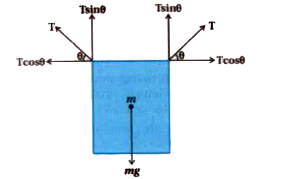 If T is the tension in the string, so vertical and horizontal components of it are as SHOWN in figure. For BALANCING vertical forces, ` 2 T SIN theta - mg =0` `therefore 2T sin theta = mg therefore T = (mg )/(2 sin theta) ""...(1)` For balancing horizontal forces, `T cos theta - T cos theta =0` In equation (1) mg is same. `therefore T prop (1)/( sin theta)` `If theta _(min) implies T max` but ` theta_(min) = 0^(@)` `therefore T_(max) prop (1)/( sin theta)` `therefore T _(max)` is infinite but `theta =0.6 ^(@)`is not given. If `theta_(max) implies T _(min)` `therefore But theta _(max) = 90^(@)` hence `T _(min) prop (1)/( sin 90^(@))` `therefore T_(min) prop 1` which is least tension. |
|
| 33. |
Define elasticity ? Give its example. |
| Answer» Solution :A body regains its original SHAPE and size after the removal of DEFORMING FORCE, it is SAID be elasticand the property is called elasticity. Example : Rubber, METALS , steet ropes. | |
| 34. |
A cylinder of mass M and radius R status failing under gravity at t=0 as shown in figure. If the mass of chord is negligible, the tention in each string is |
| Answer» Answer :A | |
| 35. |
Steel is preferred for making springs over copper because |
|
Answer» Young's MODULUS of steel is more than that of copper |
|
| 36. |
The dimensions of a wooden block are 1.1m x 2.36 m x 3.1 m. The number of significant figures in its volume should be |
|
Answer» 1 |
|
| 37. |
An elevator ascends with an upward acceleration of 0.2 m/s2. At the instanr its upward speed in 3 m/sec a loose bolt 5m high from the floor drops from the ceiling of the elevator. Find the tine maril the bolt strikes the floor and the displacement it has fallen |
|
Answer» Solution :Initial velocity of BOLT relative to the elevator =0 ACCELERATION of bolt relative to the foor of the elevator =(9.8 +0.2) =10ms`""^2` t=1 second. If s is the time of the displacement then `s=-ut+1/2 GT^(2)""s=-3(1)+1/2 (9.8) (1)^(2)` s=1.9m |
|
| 38. |
Explain Torque in vector from. |
|
Answer» Solution :(i) The torque of a FORCE about an AXIS is independent of the choice of the ORIGIN as long as it is chosen on that axis itself. (ii) Let O be the origin on the axis AB, wich is the rotational axis of a rigid body. F is the force acting at the POINT P. Now, choose another point O' anywhere on the axis. (iii) The torque of F about O' is `bar(O'P) xx vec(F) = (bar(O'O) + bar(OP)) xx vec(F)` `= (bar(O'O) xx vec(F)) + (bar(OP) xx vec(F))` (iv) As `bar(O'O) xx vec(F)` is PERPENDICULAR to `bar(O'O)`, this term will not have a component along AB. Thus, the component of `bar(O'P) xx vec(F)` is equal to that of `bar(OP) xx vec(F)` |
|
| 39. |
On observing light from three different stars P, Q and R, it was found that intensity of violet color is maximum in the spectrum of P, the intensity of green colour is maximum in the spectrum of R and the intensity of red colour is maximum in the spectrum of Q. If T_(P),T_(Q) and T_(R) are the respective absolute temperatures of P,Q and R, then it can be concluded from the above observation that : |
|
Answer» `T_(P)gtT_(R)gtT_(Q)` `:.` If `lamda_(m)` decreases, then T increase. Now from sequence .VIBGYOR.. `lamda_(m)` of violet is minimum, hence T is MAXIMUM `lamda_(m)` of red is maximum hence T is minimum `:.T_(P)gtT_(R)gtT_(Q)` |
|
| 40. |
Two identical sources of sound S_(1) and S_(2) produce intensity I_(0) at a point P equidistant from each source . (i) Determine the intensity of each at the point P. (ii) If the power of S_(1)is reduced to 64% and phase difference between the two sources is varied continuously , then determine the maximum and minimum intensities at the point P. (iii) If the power of S_(1) is reduced by 64% , then determine the maximum and minimum intensities at the point P. |
|
Answer» Solution :(i) Both the SOURCES produce maximum at the point `P`. Thus , `I_(max) = I_(0) = ( sqrt (I_(1)) + sqrt(I_(2)))^(2)` SINCE the sources are IDENTICAL , THEREFORE , `I_(1) = I_(2) = I`. ltbr. `I_(0) = 4 I or I = I_(0)//4` (ii) Now `I_(1) = 0.64 I = 0.16 I_(0)` ltbr. And `I_(2) = I = 0.25 I_(0)` `I_(max) = ( sqrt( I_(1)) + sqrt( I_(2)))^(2) = 0.81 I_(0)` `I_(min) = (sqrt( I_(1)) - sqrt(I_(2)))^(2) = 0.01 I_(0)` (iii) Now`I_(1) = ( 1 - 0.64) I_(0) = 0.36 I = 0.09 I_(0)` And`I_(2) = I = 0.25 I_(0)` `I_(max) = ( sqrt(I_(1)) + sqrt(I_(2))) ^(2) = 0.64 I_(0)` `I_(min) = ( sqrt(I_(1)) - sqrt(I_(2)))^(2) = 0.04 I_(0)` |
|
| 41. |
The refractive indices of crown glass prism for C, D and F lines are 1.527,1.530 and 1.535 respectively. Find the dispersive power of the crown glass prism. |
|
Answer» `0.01509` |
|
| 42. |
In the above problem, the maximum positive displacement x is |
| Answer» ANSWER :A | |
| 43. |
A Block of Ice |
|
Answer» Can radiate as WELL as absorb HEAT |
|
| 44. |
A body is dropped from a height of 16 m. The body strikes the ground and losses 25% of its velocity. The body rebounds to a height of |
|
Answer» 12 m |
|
| 45. |
What happens to the energy of simple harmonic oscillator if its (i) amplitude is doubled ? (ii) time period is doubled? Give relevant equations. |
|
Answer» Solution :Energy of a simple oscillator`E = 1/2 m omega^2 A^2` (i) When amplitude is DOUBLED energy of simple harmonic oscillator INCREASES by four times. (ii) if time period T is doubled then ANGULAR VELOCITY `omega` is reduced to half `omega = (2pi)/(T)` So energy of simple harmonic oscillator decreases to `1/4` of initial value. |
|
| 46. |
A uniform metre stick is placed vertically on a horizontal frictionless surface and released. As the stick is in motion, the centre of mass moves |
|
Answer» VERTICALLY up |
|
| 47. |
A solid cylinder of mass 20 kg rotates about its axis with angular speed 100 rads^(-1) . The radius of the cylinder is 0.25 m. What is the kinetic energy associated with the cylinder? What is the magnitude of angular momentum of the cylinder about its axis? |
| Answer» SOLUTION :3125J,625Js | |
| 48. |
Orbital velocity of a satellite revolving in a circular path close to the planet |
|
Answer» is directly PROPORTIONAL to the DENSITY of the planet |
|
| 49. |
A stone of mass 2kgis attached to a stringof length 1 meter the sting canwithstand maximum tension200 N what is the m maximum speed that stone can have during the whirling motion ? |
|
Answer» Solution :GIVEN: Mass of a stone = 2 kg, length of a string = 1 m Maximum tension = 200 N The force acting on a stone in the whirling motion is centripetal force. Which is provided by tension of the string. ` THEREFORE T_(max) = F_(max) = (mV^2_(max)) ` `200 = (2 xx v^2)/(1)` ` therefore v_(max)^2 = 100` ` v_(max) = 10 ms^(-1)` |
|
| 50. |
Force constant of a spring (k) is anonymous to |
| Answer» Answer :A | |


