

Saved Bookmarks
This section includes InterviewSolutions, each offering curated multiple-choice questions to sharpen your knowledge and support exam preparation. Choose a topic below to get started.
| 301. |
What is the relation between price and marginal cost at equilibrium, when price falls with the rise in output. |
|
Answer» Price = Marginal COST |
|
| 302. |
''Elasticity of demand at a common point will be more on a flatter curve than on a steeper curve''. Prove. |
Answer» Solution :In the given DIAGRAM, at point R the flatter demand CURVE `D_(1)D_(1)` is more elastic than the steeper curve DD. This is because at point R, PRICE and quantity are the same for both the curves. Now, for a given CHANGE in price, i.e., `Delta P`, the corresponding `Delta q` for the flatter curve `D_(1)D_(1)` is `Q Q_(2)` while for the steeper curve, it is `Q Q_(1), Q Q_(2)` is more than `Q Q_(1)`.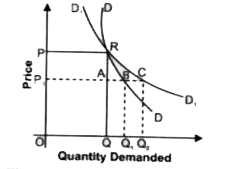 Therefore, `Q Q_(2)` divided by `PP_(1)` on the flatter curve `D_(1)D_(1)` will be more than `Q Q_(1)` divided by `PP_(1)` on the steeper curve DD, i.e., `(Q Q_(2))/(PP_(1))gt (Q Q_(1))/(P P_(1))`. Hence, elasticity of demand will be more on a flatter curve `D_(1)D_(1)`, than on a steeper curve DD. |
|
| 303. |
Define marginal utility . |
| Answer» SOLUTION :Marginal utility is the ADDITIONAL utility DERIVED from CONSUMPTION of an additional unit of a commodity. | |
| 304. |
Are the following statements true or false ? Give reasons. Direct taxes have limited reach as compared to indirect taxes. |
| Answer» Solution :TRUE . It happens because direct TAXES do not REACH all sections of the society , while indirect taxes have a wide coverage as they reach all sections of the society . | |
| 305. |
Classify the following as intermediate goods or final goods : Electricity consumption in a business. |
| Answer» SOLUTION :INTERMEDIATE GOODS | |
| 306. |
Demand for American goods will rise in India due ot appreciation fo Indian currency |
| Answer» Solution : True. APPRECIATION will MAKE domestic CURRENCY more valuable and with same AMOUNT of money, more American goods can be purchased. As a result their demand will rise. | |
| 307. |
Calculate Marginal Propensity to Consume from the following data about an economy which is in equilibrium National Income=2000 Marginal propensity to save=200 Investment expenditure 100 |
| Answer» SOLUTION :MARGINAL PROPENSITY to Consume=0.50 | |
| 308. |
Deos public debt impose a burden ? Explain. |
|
Answer» Solution :Public debt can impose a burden in the following cases : (i) When government has imposed new taxes or raised the existing tax rates to redeem the debt, (ii) When debt is to be REDEEMED through printingof new currency. In such case,it would cause inflationary trends in the economy , (iii) When public debt is taken for WAR purposes or debt is used in an UNPLANNED MANNER. Value - Problem solving |
|
| 309. |
According to classical theory there is always |
|
Answer» FULL EMPLOYMENT equilibrium |
|
| 310. |
Total Utility remains the same , whether Marginal Utility is positive or negative ". Defend or refute. |
| Answer» Solution :The GIVEN statement is refuted. When Marginal UTILITY is positive till point Q as shown in figure of QUESTION 1 then total Utility increases at a DIMINISHING rate and when Marginal Utility is negative after point Q , total Utility DECREASES. | |
| 311. |
As a result of increase in investment by Rs. 200 crore, total national income rises by Rs. 2000 crore. Find out the value of MPC and MPS. |
|
Answer» |
|
| 312. |
Differentiate between perfectly elastic and perfectly inelastic demand. |
Answer» SOLUTION :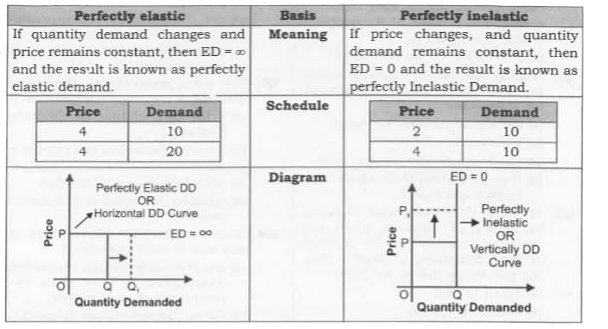
|
|
| 313. |
Define depreciation and appreciation of domestic currency. |
|
Answer» SOLUTION :DEPRECIATION of currency MEANS there is a fall in the value of domestic currency in terms of foreign currency. Appreciation of currency means there is a RISE in the value of the domestic currency in terms of foreign currency. |
|
| 314. |
An economyis inequilibriumfrom thefollowingdateaboutan econmy ,calcualate autonomousconsumption ,(set 1) (i) income =5,000 (ii)marginal propensityto save=0.2 (iii)investment expenditure=800 An economyis in equilibriumfrom th followingdateabout an economy, calculateinvestmentexpenditure :(set 2) (i) income =10,000 (ii) marginal propensityto consume =0.9 (iii) Autonomousconsumption =100 An economy is inequilibrium , from the followingdate, calculate autonomoussonsumption .(set 3) (i) income =10,000 (ii) Marginal propensity to save =0.2 (iii) investment=1,500 |
|
Answer» investmentexpenditure =900 Autonomousconsumption =500 |
|
| 315. |
What are capital goods ? |
| Answer» SOLUTION :CAPITAL GOODS are those final goods which help in further production of goods and SERVICES. | |
| 316. |
Net domestic product at factor cost is less than national income when : |
|
Answer» NET factor income from ABROAD is positive |
|
| 317. |
Does a rise in price of other goods have the same effect on demand for a commodity ? |
|
Answer» SOLUTION :NO, rise in prices of other goods doesnot have the same effect on DEMAND for a commodity. (i) IN case of rise in price of substitute goods, demand for the GIVENCOMMODITY RISES. (ii) In case of rise in price of complementary goods, demand for the given commodity FALLS. |
|
| 318. |
When the barter system was in use , a merchant had to incur cost in the absence of money. What were those costs ? |
| Answer» Solution :In barter system, a merchant had to incur TRADING cost which are nothing but costs of ENGAGING in TRADE. Its two COMPONENTS are (i) Search costwhich is cost of searching suitablepersons to exchange goods and(ii) Disutility of waiting which means cost equivalent to wastage of time period spent on finding out the REQUIRED person. | |
| 319. |
What causes an upward movement along a demand curve of a commodity? |
| Answer» SOLUTION :Rise in price of GOODS and fall in quantity demanded, i.e., CONTRACTION in demand. | |
| 320. |
How are excess and defficient demand in a three sector economy corrected? |
|
Answer» Solution :There are three sectors in a three sector economy. They are HOUSEHOLD sector, producer sector and government sector. Nature of aggreagate demand (AD) curve. AD is the sum of total consumption (C ), Investment (I) and government expenditure (G) in a three sector economy. THUS, `AD_(1)=C+I+G` In other words, `(AD_(1)(C+I+G)_(1)` LIES above `AD_(0)(C+I)` curve as the governement sector is introduced to sector economy, 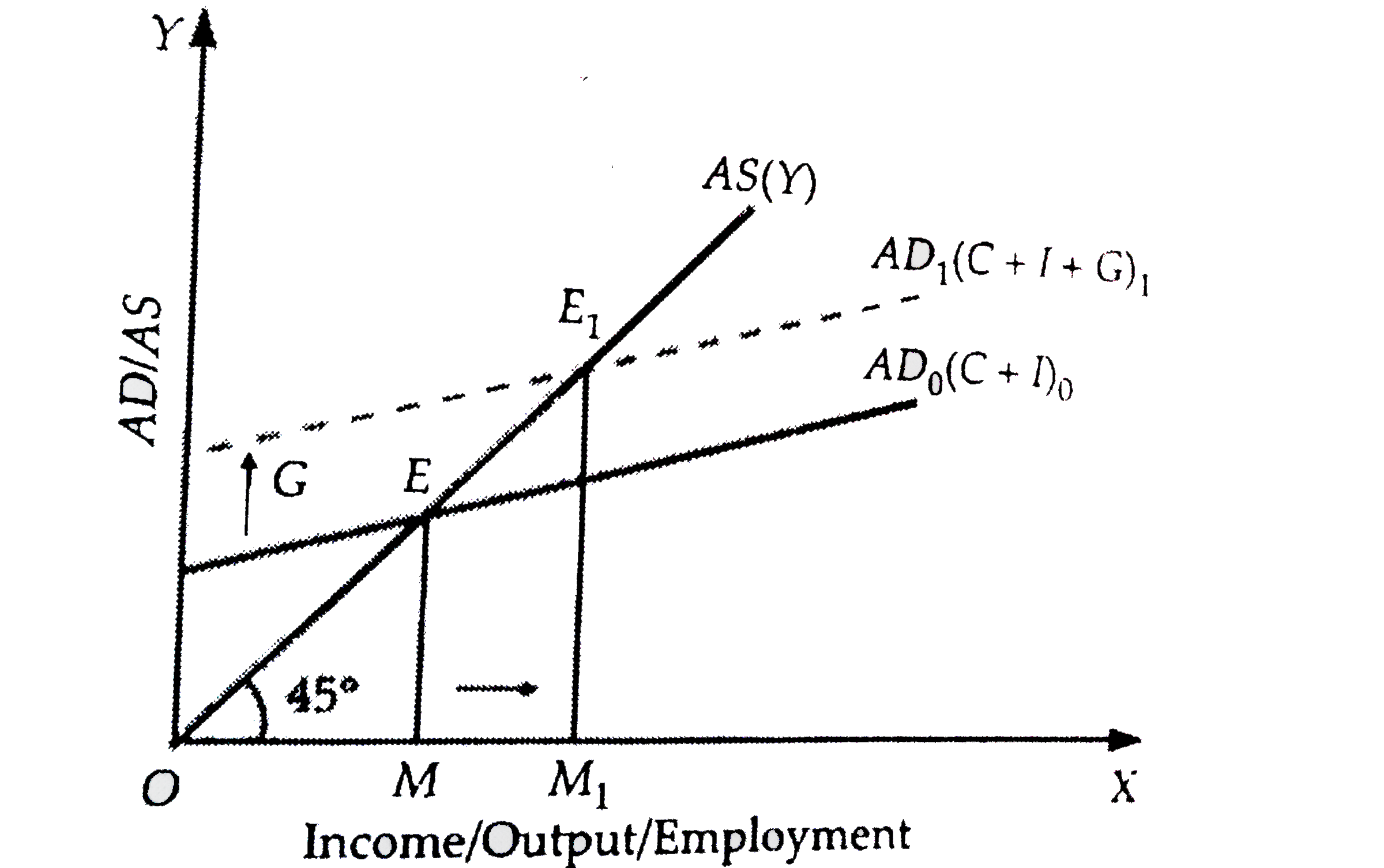 `AD_(1)` curve is parallel to `AD_(0)` curve because at every level of output, vertical DISTANCE between `AD_(1)` and `AD_(0)` is the constant amount of government expenditure (G). Figure shows the effect government expenditure on AD. It is clear from the figure that aggreagate demand rises due to inclusion of government sector in the two sector economy Change in Government Expenditure to Correct Excess Demand or Inflationary Gap Excess demand arises when actual level of aggregate demand is higher than required level of aggregate demand to maintain full employment. To correct excess demand/inflationary gap, the aggregate demand should be reduced by an amount equal to the gap Observations 1. Economy should be at full employment equilibrium at point E. 2. But actual aggregate demand (AD) is higher than required aggregate demand (AD)) causing excess demand of inflationary gap i.e. FM-EM=EF 3. 3. To correct inflationary gap or excess demand, government will use its fiscal measure by reducing expenditure. 4. Decrease in government expenditure (AG) will bring down the actual AD (AD,) to required AD (AD,). 5. The economy will come back to full employment equilibrium at point 'E' again by removing the inflationary gap or excess demand (EF).  Change in Government Expenditure to Correct Deficient Demand or Deflationary Gap 1. Economy should be at point 'E' to maintain full employment equilibriumn 2. But actual aggregate demand (AD,) is lesser than required level of aggregate demand (AD,) It creates deficient demand or deflationary gap equal to EM- FM EF 3. To correct this gap, government should use its fiscal measure by increasing expenditure. 4. Increase in government expenditure (AG) will bring up the actual `AD(AD_(2))` to required `AD(AD_(0))` 5. The economy will come back to full employment equilibrium at point 'E' again by solving 
|
|
| 321. |
What is monetary policy ? State any three instruments of monetary policy. |
| Answer» SOLUTION :Monetary policy is the policy ADOPTED by the monetary authority of a country that controls either the interest RATE PAYABLE on very short-term BORROWING or the money supply, often targeting inflation or the interest rate to ensure price stability and general trust in the currency. Central banks have three main monetary policy tools: open market operations, the discount rate, and the reserve requirement | |
| 322. |
What are demand deposits ? |
| Answer» SOLUTION :Demand deposits are those deposits which a DEPOSITOR can WITHDRAW at any GIVEN time by WRITING a cheque. | |
| 323. |
Assume that consumer's incomes and the number of sellers in the market for goods A both decrease. Based upon this information, we can conclude, with certainty, that the equilibrium |
|
Answer» PRICE will increase. |
|
| 324. |
State whether the following items constitute demand or supply demand of supply of forgin exchange (i) India going to USA for medical treatment (ii) Donation of 500 Million $ received from Microsoft (iii) Import of goods from goods from china (iv) Indian students going to Australia for MBA (v) Forign Tourists to India to visit Taj Mahal (vi) Purchase of land India in England (vii) Bought500 Pounds to sell for speculation |
| Answer» Solution :DEMAND for Foregin Exchange : (i), (III), (iv), (vi), AMD (vii). Supply of Forgin Exchange : (II), (V) | |
| 325. |
What is the difference between money and high powered money? |
| Answer» | |
| 326. |
Giving reason explain how the following shouldbe treated in estimation of national income : (i) Payment of interest by a firm to a bank (ii) Payment of interest by a bank to an individual (iii) Payment of interest by an individual to a bank |
|
Answer» Solution :(i) Payment of interest by a firm to bank is TREATED as a factor payment by the firm because the firm BORROWS MONEY for carrying out PRODUCTION and therefore included in national income (ii) Payment of interest by bank to an individual is a factor payment because bank borrows for carrying out banking services and therefore included in national income. (iii) Payment of interest by an individual to bank is not included in national income because the individual borrows for consumption and not for production |
|
| 327. |
A consumer consumes only two goods. Explain the conditions that need to be satisfied for consumer to be in equilibrium under indifference curve analysis . |
|
Answer» Solution :(i) To define consumer equilibrium, we use Interference Curve map and the budget line . Two conditions for consumer Equilibrium (a) Necessary Condition Marginal Rate of Substitution = Market Rate of Exchange `[(P_x)/(P_y)]` Or , `MRS_(x,y)=P_x//P_y` MRS ( Market Rate of Exchange ) MRE Or `MRS_(x,y) =MRE[(P_x)/P_y]` `"*" ` If `MRS_(x,y) gt MRE [(P_x)/(P_y)]` , At point T in figure It means the consumer.s willingness to pay for commodity X is higher than what makes VALUES for commodity X. So, the consumer should buy more of X and less of Y to get MRS `=P_x/P_y` 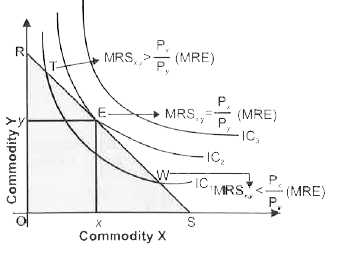 `"*"` If `MRS_(x,y) lt MRE [(P_x)/(P_y)]`, At point W in figure, It means the consumer willingness to pay for commodity X is LESSER than what market value for commodity X ,So, consumer should buy less of X and more Y to get MRS = `p_x/p_y` (B) Sufficient Condition `MRS_(x,y)` Diminishing (Convex) at a point of equilibrium i.e., when `MRS_(xy)=MRE[P_x/P_y]` (ii) The consumer will reach equilibrium when the budget line is tangential to the higher possible INDIFFERENCE Curve, i.e. ., where necessary and sufficient condition satisfy . In the above diagram , the consumer will reach equilibrium at point E where budget line RS is tangential to the higher possible `IC_2` (iii) The consumer cannot move to Indifference Curve , i.e. ., `IC _3`as this is beyond this money income. (iv) Even on `IC_2` all the other points except E are beyond his means . (v) Hence , at point E, the consumer is in equilibrium where his satisfaction maximizes, given his income and prices of goods X and Y . In equilibrium at E , the slope of Budget line = the slope of Indifference Curve. Therefore `MRS_(xy)`is equal to the ratio of the price bof two goods `[(P_x)/(P_y)]` . |
|
| 328. |
Distinguish between voluntary unemloyment and involuntary unemployment. What is the significance of this distinction ? |
|
Answer» Solution :Voluntary unemployment refers to a situation when a PERSON is unemployment because he is not willing to work at the existing wage RATE. On the other hand, Involuntary unemployment refers to an unemployment in which all those people, who are willing and able to work at the existing wage rate, do not GET work. The distinction is SIGNIFICANT to determine the total unemployment in aneconomy. Voluntary unemployment is not counted while estimating the SIZE of unemployment. While involuntary unemployment is considered while estimating the total unemployment in an economy. |
|
| 329. |
Inspite of having monopoly why the Indian Railways has not increased the fare for many years? |
|
Answer» SOLUTION :Indian Railway is a major public sector undertaking and its MAIN MOTIVE is SOCIAL welfare not the profit. Value: Social welfare |
|
| 330. |
The crops which benefitted most under green revolution were : |
|
Answer» WHEAT |
|
| 332. |
The difference between average total cost and average variable cost is constant. |
| Answer» SOLUTION :False: As we KNOW the DIFFERENCE between ATC and AVC is AFC and AFC always falls with the increase in production and can NEVER be CONSTANT. | |
| 333. |
Explain the implications of large number of buyers in a perfectly competitive market. |
|
Answer» SOLUTION :Large number of sellers - (i) The words .large number. simply states that the number of sellers is large enough to render a single seller.s share in total market supply of the product insignificant. (ii) Insignificant share means that if only one individual firm reduces or raises its own supply, the prevailing market price remains unaffected. (iii) The prevailing market price is the one which was set through the intersection of market demand and market supply forces, for which all the sellers and all the buyers together are responsible. (IV) One single seller has no option but to sell what it produces at this market determined price. This position of an individual firm in the total market is referred to as price taker. This is a UNIQUE feature of a perfectly competitive market. . Large number of buyers - (i) The words .large number. simply states that the number of buyers is large enough, that an individual buyer.s share in total market demand is insignificant, the buyers cannot influence the market price on his own by changing his demand. (ii) This makes a single buyer also a price taker. To sum up, the feature "large number" indicates INEFFECTIVENESS of a single seller or a single buyer in influencing the prevailing market price on its own, rendering him simply a price taker. |
|
| 334. |
The problems of scarcity of resources and their alternate uses arise everywhere but particularly in backward countries. For their solution non-economic considerations can be stressed. How? |
|
Answer» Solution :Central problems, what to produce?, How to produce? and for whom to produce?, can be SOLVED in poor COUNTRIES by laying more STRESS on the social aspects, e.g., public utility services may be developed, labour intensive techniques may be preferred and the distribution of national income may be made equitable. VALUE: ANALYTIC |
|
| 335. |
What is the relation between market price and average revenue of a pricetaking firm i.e. perfectly competitive firm)? |
|
Answer» Solution :The average revenue (AR) of a firm is defined as total revenue per unit of output sold. LET a firm.s output be Q and the market price be P, then TR equals `P XX Q`.HENCE, ` AR = (TR)/Q = (P xx Q)/Q = P ` In other words, for a price-taking firm, average revenue equals the market price. |
|
| 336. |
Name the ways in which budgetary deficit is financed. |
|
Answer» Solution :There are three ways by which the government can finance its budgetary deficit : (i) By Monetary EXPANSION (deficit FINANCING ) (ii) By Borrowings (III) By DISINVESTMENT . |
|
| 337. |
Define 'average propensity to consume' and 'marginal propensity to consume'. How are they calculated ? |
| Answer» Solution :APC is the ratio of CONSUMPTION to income, it is the PROPORTION of income that is consumed. It is calculated by dividing total consumption EXPENDITURE by total incomeAPC=C/YMPC is the ratio of change in consumption to change in income. It is calculated by dividing change in consumption by change in income.MPC= dC/dY | |
| 338. |
Manish buys a second hand car from a car broker fro Rs. 3,25,000. The broker receives Rs. 16,500 as commission for his services from Manish. How will this transaction affect the national income of the country ? Give reason for your answer. |
| Answer» SOLUTION :The commission of Rs. 16,500 received by broker will be added in the national income of the country as not be income of broker for his productive SERVICES to Manish. The amount paid for purchase of CAR will not be included as it is the payment for purchase of an already EXISTING object and there is no addition to current flow of goods and services. | |
| 339. |
What is ment by circular flow of income ? |
| Answer» Solution :CIRCULAR flow of income refers to CYCLE of generation of income in the production process, its distribution AMONG the factors of production and finally, its circulation from householdsto firms in the form of CONSUMPTION expenditure on goods and services produced by them. | |
| 340. |
If at a given price of the commodity there is excess demand, how will the equilibrium price be reached4? Explain with the help of a diagram. OR If equilibrium price of a good is grcater than its market price, explain all the changes that will take place in the market. Use diagram. OR Explain the changes that will take place in the market for a commodity if the prevailing market price is less than the equilibrium price. |
|
Answer» Solution :If at a given price let at `P_(1)` there is excess demand as shown in the given figure. ` (##FM_M_ECO_XII_P1_C12_E02_037_S01.png" width="80%"> In the given diagram the excess demand of AB at price `P_(1)` creates a COMPETITION among the buyers, which will increase the price from `P_(1)` to P. It can be explained in the following two cases: CASE I: UPWARD movement along the supply curve (Expansion in Supply) Due to excess demand of AB, competition among the buyers, will rise the price from `P_(1)` to P. As we know positive relationship EXIST between price and quantity SUPPLIED. So, the rise in price from `P_(1)` to `P_(1)` will rise the supply from A to E. Case II: Upward movement along the demand curve (Contraction in Demand) Due to excess demand of AB, the price rises. As we know Inverse relationship exists between price and quantity demanded. So, due to rise in price from `P_(1)` to P the quantity demanded falls from B to E. It can also be explained with the help of the schedule that follows: In the above schedule, at price 1 there is an excess demand. Due to this excess demand price will rise til we reach the equilibrium at price 3. Note: Expansion in supply and Contraction in demand has to bedone simultaneously to reach the equilibrium price. ` (##FM_M_ECO_XII_P1_C12_E02_037_S02.png" width="80%"> |
|
| 341. |
_____ refers to the difference between exports and imports of visible items |
|
Answer» Balance of PAYMENTS |
|
| 342. |
Give two examples each of capital receipts which create a liability and which does not create a liability. |
|
Answer» Solution :1. Two examples of Capital Receipts which create LIABILITY are Borrowing and Raising of funds from Public Provident Fund and Small savings deposits. (i) Borrowings are treated capital receipts because they create liability of RETURNING loans. (II) Similarly, funds raised from PPF, small saving deposits in post offices and banks are treated as capital receipts because they increase liability of the GOVERNMENT to repay these amounts to PPF holders and small savings depositors. 2. Two examples of capital receipts which reduce assets are disinvestment and recovery of loans. (i) Disinvestment by government MEANS selling a part or whole of its shares of public sector undertakings (e.g., HMT, LIC, FCI) to private enterprises. Disinvestment is treated as capital receipt because it reduces government assets. (ii) Recovery of loan is a also capital receipt as it reduces governmentassets. For instance, if the UP government, which has taken loan of Rs. 100 crore from the Central government, repays Rs. 20 crore, value of the Central Government assets of Rs. 100 crore is now reduced to Rs. 80 crore because of partial recovery of loan. |
|
| 343. |
The Government decides to give budgetary incentives to investors for making investments in backward regions . Explain these incentives and the reasons for the same . |
|
Answer» Solution :Budgetary incentives refer to CONCESSION in taxation and GRANTING subsidies to those production units which set up their unitsin economically backward areas. Taxconcessions , like lower Goods and SERVICES Tax (GST) AIM at reducing cost and thus raising profits . Subsidies aim at reducing prices of products to encourage sales and earning more profits . Thus , both aim at raising profits. |
|
| 344. |
Can AC and AVC curves touch each other? |
| Answer» Solution :No, because difference between AC and AVC is AFC and AFC can never be ZERO. | |
| 345. |
On the basis of the Table completed in Q, 4, answer the following : (i) Identify the break-even point. (ii) Locate the equilibrium level of income. (iii) Calculate MPS. (iv) Calculate APC at income level of Rs. 100 crore. (v) Calculate APS at the income level of Rs. 200 crore. |
|
Answer» |
|
| 346. |
What do you understand by Parametric shift of a line? How does a line shift when its (i) slope changes, and (ii) intercept increases? |
|
Answer» Solution :Let `C=bar(C)+b bar(Y)` be the consumption function Also, let `bar(C)=4 and b=0.5` Thus, C-4=0.5Y Given situation are: When b changes..When `bar(C )` changes. (i) When b changes : b is the slope of the consumption curve, when b INCREASES from 0.5 to 0.8, then consuption curve rotates upwards. This is called a parametric shift of a graph. It is SHOW in the figure 7.17 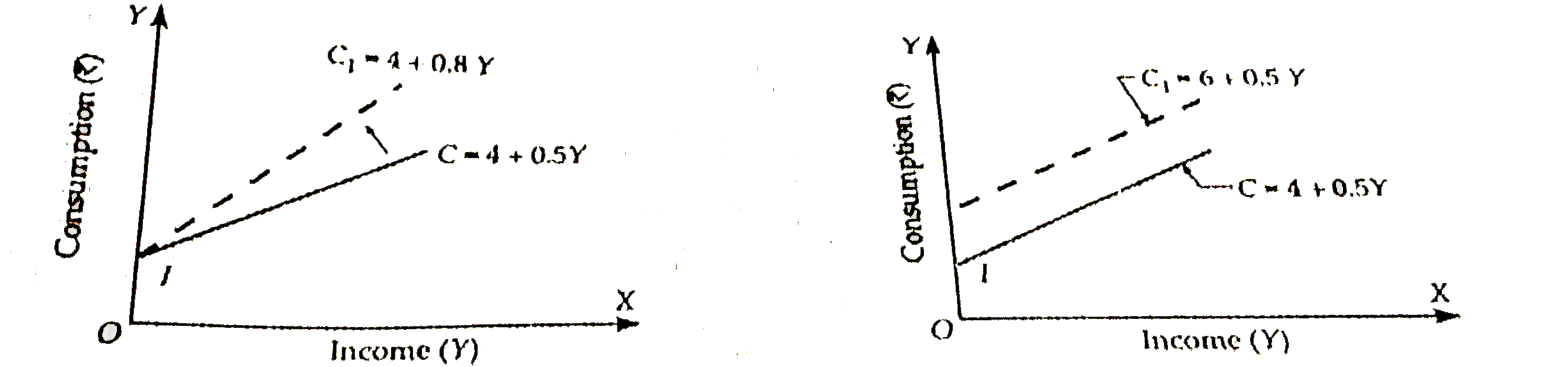 (II) When `bar(C )` changes :`bar(C )` is consumption at zero level of income. It graphically gives the intercept of the consumption curve. If increases from 4 to 6, there will be parallel upward shift in the consumption curve. It is shown in the figure 7.18 above. Observations 1. When slope changes there is parametric shift in the curve. 2. When intercept changes (AUTONOMOUS consumption) there is parallel shift in the curve. |
|
| 347. |
What does balance of payment account show? Name the two parts of the balance of payments account. |
| Answer» Solution :The balance of PAYMENTS is the RECORD of all INTERNATIONAL trade and financial transactions made by a country's residents. The balance of payments has three COMPONENTS. They are the current account, the financial account, and the CAPITAL account. | |
| 348. |
An economy is in equilibrium. From the following data about an economy calculate autonomous consumption: (i) Income=5000 (ii) Marginal Propensity to save=0.2 (iii) Investment expenditure=800 |
|
Answer» SOLUTION :Y=C+I `Y=BAR(C)+bY+I` `Y=bar(C)+bY+I` `5000=bar(C)100+0.8(5000)+800[MPS=0.2, MPC=0.8]` 5000=bar(C )+4000+800 bar(C )=5000-4800=200 |
|
| 349. |
Legal Tender money has a legal sanction behind it by the government . |
|
Answer» |
|
| 350. |
Define money. |
| Answer» Solution :MONEY is something which is generally accepted as a medium of exchange, a measure of VALUE a store of value and a standard of DEFERRED PAYMENTS | |