

Saved Bookmarks
This section includes InterviewSolutions, each offering curated multiple-choice questions to sharpen your knowledge and support exam preparation. Choose a topic below to get started.
| 251. |
What is the relationship between average propensity to consume and average propensity to save? Can the value of average propensity to save be negative ? If yes, when ? |
|
Answer» Solution :The sum of the AVERAGE Propensity to Consume (APC) and Average Propensity to SAVE (APS) is always EQUAL to unity, i.e., APC + APS = 1. It is so because the money income can EITHER be spent on consumption or it can be SAVED. Yes, APS can be negative when S is negative or when C > Y. |
|
| 252. |
What does the average fixed cost curve look like? Why does it look so? |
| Answer» Solution :The shape of AFC is downward SLOPING Rectangular hyperbola. AFC FALLS as output increases because ` AFC =(TFC)/("Output")` and TFC remains CONSTANT. So, as output increases, TFC remains constant, but AFC falls. | |
| 253. |
State factors thst can cause a rightward shift of supply curve. |
|
Answer» Solution :An INCREASE in SUPPLY means that producers now supply more at a given price level. (a) Fall in the prices of other goods. (b) Fall in the prices of remuneration of factors of production (c ) Improvement in Technology. (d) Change in objective or producer (increase the supply at the same rate ). (E) TAXATION policy of GOVERNEMENT falls. 
|
|
| 254. |
What is revenue expenditure ? |
| Answer» Solution :Revenue expenditure refers to the expenditure which NEITHER CREATES any ASSET nor causes a reduction in any liability of the GOVERNMENT . | |
| 255. |
What is the reasons for deficient demand? |
|
Answer» SOLUTION :The reason are: (i) Fall in consumption EXPENDITURE (ii) Fall in INVESTMENT expenditure (iii) Increase in imports (IV) Increase in tax RATE. |
|
| 256. |
When there is depreciation of Indian rupee in terms of US dollars, Indian imports will rise. |
| Answer» Solution :False because of INDIAN goods becoming cheaper, Indian EXPORTS will RISE. | |
| 257. |
From the following data, calculate "gross value added at factor cost". |
|
Answer» =Sales+Change in STOCK - Purchase of RAW materials+Subsidies =180+15-100+10 =Rs. 105 crores |
|
| 258. |
Appreciation of Indian currency implies strengthening of Indian rupee. However exporters do not favour appreciation of Indian currency. Why? |
|
Answer» Solution :Appreciation of domestic currency means an increase in the value of the domestic currency in terms of foreign currency. It implies that one unit of foreign currency can be EXCHANGED for less rupees for example, if PRICE of 1 $ falls from Rs 55 to Rs 50. EXPORTERS do not favour this because it would discourages exports India because with same one unit foreign currency, less goods can be PURCHASED from India. |
|
| 259. |
How will 'Reverse Reps Rate'and 'OpenMarketOperations controlexcess moneysupplly in anenconomy ? |
|
Answer» Solution :Reverse repo rate is the rate at which the central bank of a country (Reserve Bank of India in case of India) borrows money from commercial banks WITHIN the country. It is a MONETARY policy instrument which can be used to control the money supply in the country.An increase in the reverse repo rate will decrease the money supply and vice-versa, other THINGS remaining constant. An increase in reverse repo rate means that commercial banks will get more incentives to park their funds with the RBI, thereby decreasing the supply of money in the market. Open Market Operations(OMO) refers to the sale and purchase of GOVERNMENT securities in the open market by the Central Bank (RBI). By selling such securities the Central Bank soaks liquidity from the economy and by purchasing the government securities, Central Bank releases liquidity. This is an IMPORTANT method of regulating the money supply (liquidity) in the market. |
|
| 260. |
Can there be a positive level of output that a profit-maximizing firm produces in a competitive market at which market price is not equal to marginal cost? Give an explanation. |
|
Answer» SOLUTION :The profit MAXIMIZING level of output is always determined where, (i) MR=MC (ii) MC MUST be rising. In other words, where price is equal to MC. If price is not equal to MC, profit maximizing condition cannot hold. It can be explained with the help of the following two cases: Case 1: Price Greater Than MC (i) In the given figure at output level `q_(2)`, the market price is greater than MARGINAL cost. (ii) To show that q, is not a profit maximizing level of output, we have taken `q_(3)` output level, which is right of `q_(2)`. (iii) Suppose the firm increases its output level from `q_(2)` to `q_(3)`. The increase in total revenue of the firm from this output is the market price multiplied by the change in quantity (`DeltaTR`= market price `xxDeltaQ`), that is the area of rectangle `q_(2)q_(3)CB`.  (iv) On the other hand, the increase in total cost with this increase in output is the area of the region `q_(2)q_(3)XW`. (v) But, a comparison of the two area shows that the firm.s profit is higher when output level is `q_(3)` rather than `q_(2)` So, `q_(2)` is not a profit maximizing levelof output. Case 2: Price Less Than MC (i) In the given figure at output level `q_(2)`, the market price is less than marginal cost. (ii) To show that `q_(2)` is not a profit maximizing level of output, we have taken `q_(3)` output level, which is LEFT of `q_(2)`.  (iii) Suppose now, that the firm reduce its output level from `q_(2)` to `q_(3)`. The decrease in total revenue of the firm from this output is the market price multiplied by the change in quantity (`DeltaTR=` market price `xxDeltaQ` ), that is the area of rectangle `q_(2)q_(3)CB`. (iv) On the other hand, the decrease in total cost with this decrease in output is the area of the region `q_(2)q_(3)WX`. But, a comparison of the two area shows, that by reducing the output from `q_(2)` to `q_(3)`, the decrease in cost is more than the loss in revenue. So, `q_(2)` is not a profit maximizing level of output. |
|
| 261. |
Categorise the following into direct tax or indirect tax Tax Receipts . |
|
Answer» |
|
| 262. |
Which among the following are capital goods and which are consumer goods (or consumption goods ) and why ? (a) A car used as a taxi (b) Refrigerator in a hotel (c) Air-conditioner in a house |
|
Answer» (B) Refrigerator in a hotel : It is a capital good because it is used for providing services over a period of TIME to the production unit. (c) AIR- conditioner in a house : It is a CONSUMER good because it is used for satisfaction of a want by a household. |
|
| 263. |
Define perfectly elastic demand. |
| Answer» SOLUTION :If QUANTITY demand CHANGES and price remains CONSTANT, ed `= oo` and the result is known as perfectly elastic demand. | |
| 264. |
Economy always operates on PPC. |
| Answer» SOLUTION :FALSE: Economy operates on PPC only when resources are fully and efficiently utilised. If resources are not fully and efficiently utilized, economy operates at any POINT inside PPC. | |
| 265. |
Production of services for self-consumption are not included in national income. |
| Answer» Solution :TRUE. Such SERVICES are not included in national income as it is difficult to ASCERTAIN their market VALUE and they are not rendered for earning income. | |
| 266. |
Which of the following is a correct measure of primary deficit? |
|
Answer» FISCAL deficit MINUS revenue deficit |
|
| 267. |
A consumer spends Rs. 80 on a commodity when price is Rs. 1 per unit. If the price increases by Rs. 1, what would be his expenditure. PED =-0.4 ? |
|
Answer» SOLUTION :`{:("Initial Price (P) = 1","Initial Expenditure = 80","Initial Quantity (Q) "=("Exp.")/("Price")=80),("NEW Price "(P_(1))=2,"New Expenditure = ?","New Quantity "(Q_(1))=?),(Delta P=1,,Delta Q=?):}` `PED =(Delta Q)/(Delta P)xx(P)/(Q) "or" -0.4=(Delta Q)/(1)xx(1)/(80)` `-32=Delta Q` As New Price is increasing from 1 to 2, quantity demanded must decrease by `Delta Q`. New Quantity = Initial Quantity `+Delta Q=80+(-32)=48` At Price = 2, Quantity demanded = 48. The Expenditure at this Price `= P xx Q=2xx48=96` |
|
| 268. |
What is a lega tender? What is fiat money? |
| Answer» | |
| 269. |
According to Keynes, the equillibrium, level of income is always determined corresponding to full employment level. |
| Answer» Solution :The equilibrium LEVEL may be DETERMINED at a level less than, more than or equal to level of FULL EMPLOYMENT | |
| 270. |
Government raises its expenditure on producing public goods. Which economic value does it reflect ? Explain. |
| Answer» SOLUTION :Increased expenditure by government on public goods LIKE DEFENCE, maintaining law and ORDER etc. increases their availability to the people of the country. For example, more expenditure on maintaining law and order raises the sense of security among the POEPLE. Any such expenditure raises welfare of the people. | |
| 271. |
What do you mean by complements? Give examples of two goods which are complements of each other. |
Answer» Solution :(i) Complementary goods are those which are useless in the absence of other goods and which are demanded jointly.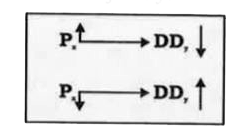 (ii) There would ALWAYS exist an inverse relationship between price of complementary goods and demand for GIVEN COMMODITY. (iii) It MEANS, with a rise in price complementary goods, the demand for given commodity falls and vice versa. (iv) For example pen and refills, tea and sugar are COMPLEMENTS to each other. |
|
| 272. |
What is a legal tender? What is fiat money? |
| Answer» Solution :LEGAL tender MONEY refers to money which can be legally used to make payment of debts of debts or other obligation. Flat money is defined as the money which is under that FIAT or ORDER the government to act as money,i.e. under law, it must be ACCEPTED for all debts. | |
| 273. |
There are large number of sellers in a perfectly competitive market. Explain the significance of this feature. |
|
Answer» Solution :Large NUMBER of sellers - (i)The words .large number. simply states that the number of sellers is large enough to render a single seller.s share in total MARKET supply of the product insignificant. (ii) Insignificant share means that if only one individual firm reduces or raises its own supply, the PREVAILING market price remains unaffected (iii) The prevailing market price is the one which was SET through the intersection of market demand and market supply forces, for which all the sellers and all the buyers together are responsible. (iv) One single seller has no option but to sell what it produces at this market determined price. This position of an individual firm in the total market is REFERRED to as price taker. This is a unique feature of a perfectly competitive market. |
|
| 274. |
According to recent to recent media reports: USA has accused China of currency devaluation to promote in exports'. In the light of the given media report comment., how exports can be promoted through the Currency devaluation? (b) What is meant by Curreny Account Deficit(CAD) and Current Account Surplus (CAS)? State theri significance |
|
Answer» Solution :(a) USA has a valid point argumentasdevaluationof currency encourages exports of a country. As exported goods become cheaper in theinternationalmarket givingacompetitive edge for the goods of domestic country (China).Devaluation of thevalueof domesticcurrencypromotesthe exportsof the countryandmayadverselyimpact theproductionand SALE of importingcountry (USA). (b) Current Account Deficits (CAD) is a situationthat ARISES whenthereceiptson currentaccountare less than the payments on current account. In simple words, Current Account Deficit (CAD) arises when the VALUE of exports of good send services,is lessthanthe value ofimports of goodand services.CurrentAccordingsurplus (CAS) arises whenthe value ofexportsof goodand servicesis more thanthe value of imports of goods andservices.CAD signifiesthat thenation is a BORROWER from restoftheworld, whereas, CAS signifiesthat the nation is a lender to the rest oftheworld. |
|
| 275. |
Calculate equilibrium level of income from the following: |
| Answer» SOLUTION :Equivilbriumlevel of income=16000 | |
| 276. |
A Consumer consumes only two goods X and Y and is in equilibrium . Price of good X falls . Show that it will lead to rise in demand for good X. |
|
Answer» Solution :As, we know CONDITIONS for consumer equilibrium is , Necessary Condition Marginal utility of last rupee spent on each commodity is same . SUPPOSE there are two commodities, X and Y respectively. So , for commodity X, the condition is, Marginal Utility of Money = PRICE of X Or `(" Marginal in UTIL Product in Util " [MU_x])/( "Marginal Utility of One Rupee " [MU_R])` = Price of X or `(MU_x)/(P_x) = MU_R "".....(1)` Similarly, for commodity Y , the condition is, `(MU_y)/P_y=MU_R ""....(2)` Putting equation (2) in (1), we get `(MU_x)/(P_y)=(MU_y)/P_y` But as given in the question that the ratio of marginal utility to price in case of X is higher than that in case of Y, i.e., `(MU_x)/P_x gt (MU_y)/P_y` It means marginal utility from the last rupee spent on commodity X is more than marginal utility from the last rupee spent on commodity Y. So, to attain the equilibrium consumer must INCREASE the quantity of X, which decreases the `MU_x` and decreases the quantity of Y, which will increase the `MU_y` Increase in quantity of X and decrease in quantity of Y continue till `(MU_x)/P_x = (MU_y)/P_y` . |
|
| 277. |
Are the following statements true or false ? Give reasons. Indirect taxes are generally progressive in nature . |
| Answer» SOLUTION :FALSE . INDIRECT taxes are GENERALLY Proportional in nature. | |
| 278. |
Explain how 'Repo Rate' can be helpful in controlling credit creation |
| Answer» | |
| 279. |
A change from Rs. 140=2 £ "to" Rs. 60 =1 £ indicates that Rs. is |
|
Answer» Apreciating |
|
| 280. |
Are the following statements true or false ? Give reasons. Non-debt creating capital receipts give rise to debt. |
| Answer» SOLUTION :False . They do not give RISE to debt as they are not borrowings. | |
| 281. |
Explain the problem of double counting in estimating national income, with the help of an example. Also explain two alternative ways of avoiding the problem. |
| Answer» Solution :The counting of the value of COMMODITY more than once is called Double Counting. This leads to overestimation of the value of goods and services produced. Thus, the importance of avoiding double counting lies in avoiding overestimating the value of domestic productFor example, a farmer produces one ton of wheat and sells it for Rs.400 in the market to a flour mill. The flour mill sells it for Rs.600 to the baker. The baker sells to the bread shopkeeper for Rs.800. The shopkeeper sells the entire bread to the FINAL consumers for Rs.900. Thus, Value of OUTPUT = Rs.400 + Rs.600 + Rs.800 + Rs.900= Rs.2700 In fact, the value of the wheat is counted four times, the value of services of the MILLER thrice, and the value of services by the baker twice. In other words, the value of wheat and value of services of the miller and of the baker have been counted more than once. The counting of the value of commodity more than once is called Double Counting. To AVOID the problem of double counting two methods are used: (i) Final Output Method, and (ii) Value Added Method.(i) Final Output Method: According to this method, the value of intermediate goods is not considered. Only the value of final goods and services is considered. In the above example, the value of final goods, i.e., Bread is Rs.900. (ii) Value Added Method: Another method to avoid the problem of double counting is to estimate the total value added at each stage of production. In the above example, the value added at each stage of production is Rs.400 + Rs.200 + Rs.200 + Rs.100 = Rs.900 | |
| 282. |
What are capital goods ? How are they different from consumption goods ? |
| Answer» Solution :Capital goods are goods USED by one business to help another business produce CONSUMER goods. Consumer goods are used by consumers and have no future PRODUCTIVE use. Capital goods include items LIKE buildings, machinery, and tools. Examples of consumer goods include FOOD, appliances, clothing, and automobiles. | |
| 283. |
A good is an inferior good for one and at the same time a 'normal' good for another consumer. Do you agree? Explain. |
|
Answer» SOLUTION :(i) YES, the same goods can be inferior for one and normal for another one. (ii) WHETHER a good is inferior or normal is determined by the income level of a consumer. (iii) A good is normal good for the consumer having lower income, may become an inferior good FORA consumer havinghigher income. (iv) When a consumer moves to higherincome, he/she may considersome goods below their income status, and TREATS them as inferior. |
|
| 284. |
Explain the relationship between Total Product and Average Product. |
|
Answer» Solution :(i) When Total Product increases at an increasing RATE, Average Product ALSO increases. (ii) When Total Product increases at a diminishing rate, Average Product declines. (iii) Since Total Product is always POSITIVE, Average Product also REMAINS throughout positive. |
|
| 285. |
Draw a demand curve in different market situation and also compare its elasticity of demand. |
Answer» SOLUTION :
|
|
| 286. |
Define normal resident. |
| Answer» Solution :Normal RESIDENT refers to an individual or an institution whi ordinarily RESIDES in the country for a period of more than one year and whose centre of economic INTEREST ALSO LIES in that country. | |
| 287. |
What is meant by disequilibrium in BOP? |
| Answer» SOLUTION :It means either there is DEFICIT or surplus in BOP. | |
| 288. |
Categorise the following into revenue expenditure or capital expenditure Interest paid on government loans . |
|
Answer» |
|
| 289. |
Classify the following as intermediate goods or final goods : Milk purchased by households. |
| Answer» SOLUTION :FINAL GOODS | |
| 290. |
If a firm shuts down in the short run, will it have zero costs or not? Explain. |
| Answer» SOLUTION :No, the FIRM will STILL have FIXED COSTS. | |
| 291. |
_policy refers to a central bank's policy to control the supply of money in the economy. |
|
Answer» |
|
| 292. |
Describe the expenditure method of calculating gross domestic product at market price. |
| Answer» Solution :The expenditures APPROACH says GDP = consumption + investment + government EXPENDITURE + EXPORTS – imports. The income approach sums the factor incomes to the factors of PRODUCTION. The output approach is also called the “net product†or “value added†approach . | |
| 293. |
Give two examples of debt creating capital receipts. |
| Answer» Solution :NET BORROWING by GOVERNMENT at HOME, borrowing from ABROAD. | |
| 294. |
Why are exports entered as positive items in the Balance of Payments account? |
|
Answer» |
|
| 296. |
Exports of goods and services raises the ______ of foreign exchange. |
|
Answer» demand |
|
| 297. |
What are the causes for supply (inflow) of foreign exchange? |
|
Answer» SOLUTION :The CAUSES are: i) Exports of gooda and servicesii) Foreign investments iii) UNILATERAL TRANSFERS from abroadiv) Tourism etc. |
|
| 298. |
All of the following are characteristics of a monopoly except: |
|
Answer» There is a SINGLE firm. |
|
| 299. |
What will happen in an economy when planned investment is less than planned saving ? |
| Answer» Solution :When PLANNED investment is less than planned SAVING, it means that households are not consuming as much as the firms expected them to do. It will create the situation of DEFICIENT DEMAND in the ECONOMY and it will result increase in the inventory stock of unsold goods. | |
| 300. |
Under monopolistic competition, all the customers have perfect knowledge of the market conditions. |
| Answer» Solution :False: under monopolistic COMPETITION there is a large VARIETY of a single PRODUCT, so they do not GET perfect knowledge of the market conditions. | |


