

Saved Bookmarks
This section includes InterviewSolutions, each offering curated multiple-choice questions to sharpen your knowledge and support exam preparation. Choose a topic below to get started.
| 351. |
Name any three variables of microeconomics. |
| Answer» Solution :(i) Individual demand, (II) Individual SUPPLY, and (III) Individual INCOME. | |
| 352. |
As a result of fall in price of the commodity by 10% , the quantity supplied also falls by 15%. Comment on PES. |
|
Answer» Solution :ES=`("Percentage CHANGE in quantity supplied")/("Percentage change in price")` `=(15%)/(10%)=1.5` PES`=1.5` [More than UNITARY Elastic or elastic Supply] |
|
| 353. |
_______refers to minimum percentageof deposits of commerical banks to be kept with RBI |
|
Answer» SLR |
|
| 354. |
What is ideal supply of money? |
| Answer» Solution :It is that amount of money supply which keeps the aggregate demand of money or the TOTAL PURCHASING power in a STATE of balance with aggregate supply of money.It is called ideal supplye of nomey because it protects THEECONOMY from inflationaryor deflationary pressurees | |
| 355. |
Are the following entered (i) on the credit side or the debit side and (ii) in the current account or capital account in the Balance of Payments account? You must give reason for your answer. (a) Investment from abroad (b) Transfer of funds to relative abroad. |
|
Answer» Solution :(i) Investments from abroad are recoreded on the CREDIT side because these brings in FOREIGN exchange. The transaction is recorded in capital account because it increases foreign exchange liability. (ii) Transfer of funds to relatives abroad is recorded on the debit side because it leads to OUTFLOW of foreign exchange It is recorded in the CURRENT account because this does not create any foreign exchange asset |
|
| 356. |
Assume the marginal product for a particular good is constant. Describe the shape of the total product function that would accompany it. |
| Answer» Solution :The TOTAL product FUNCTION WOULD be upward SLOPING and increases at a constant rate. | |
| 357. |
How will reverse repo rate and open market operation control excess money supply in an economy? |
| Answer» | |
| 358. |
How can a deficit be financed ? |
|
Answer» Solution :A deficit MAY be FINANCED (i) by borrowing from internal sources (i.e., PUBLIC) and external sources (i.e., foreign governments, World Bank). (ii) by PRINTING new currency, i.e., monetary EXPANSION. |
|
| 359. |
Give two examples of capitalreceipts in a government budget. |
| Answer» Solution :(i) Borrowings from PUBLIC , (II) Receiptsfrom SALE of SHARES of a public SECTOR undertaking . | |
| 360. |
Explain how distribution of gross domestic product is its limitation as a measure of economic welfare. |
| Answer» Solution :Although GDP has been used widely as the indicator to measure the development level of the world economy, there are inherent limitation and weaknesses in this method that prevents its wider use in the ECONOMIC GROWTH. And it particularly reduces the EFFICIENCY of GDP in EVALUATING the economic welfare. The main limitation of GDP is that it does not reflect all the contents of the economic activities, which weakens the ROLE of GDP as the indicator of the economic welfare. | |
| 361. |
In the middle of a demand curve by geometric method, elasticity of demand is unity. |
| Answer» Solution :TRUE : At this POINT, LOWER portion of demand curve is equal to UPPER portion of demand curve. | |
| 362. |
How are following treated in the estimation of national income ? Money received from sale of second-hand goods. |
| Answer» SOLUTION :No, it will not be INCLUDED in the national income BACAUSE the sale of second-hand goods is transfer of ownership which does not add to current PRODUCTION. | |
| 363. |
From the following data about an economy, calculate the equilbrium level of income: National Income=0.5 Marginal propensity to save=300 Investment expenditure =6000 |
| Answer» SOLUTION :Equivilibrium LEVEL of income=12600 | |
| 364. |
Depreciation of fixed capital assets refers to |
|
Answer» NORMAL WEAR and TEAR |
|
| 365. |
Marginal revenue is always the price at which the last unit of a commodity is sold. |
| Answer» Solution :FALSE : Marginal revenue is never the price at which last unit of a commodity is sold. Marginal revenue is ADDITIONAL unit of OUTPUT is sold. It can be zero or NEGATIVE but price AR is never zero or negative. | |
| 366. |
Value of multiplier is 5. What is the value of MPC ? |
|
Answer» |
|
| 367. |
Explain any two drawbacks/problems of barter system How does money help in removing these drawbacks? Explain any one problem faced in the barter system. Hpow has money solved this problem? |
| Answer» | |
| 368. |
_______bank nurtures the market for govt securities in india |
|
Answer» COMMERICAL bank |
|
| 369. |
Classify the following as intermediate goods or final goods : Expenditure on research and development by a company. |
| Answer» SOLUTION :INTERMEDIATE GOODS | |
| 370. |
If price of substitute goods falls, demand for related goods will also fall ? |
|
Answer» |
|
| 371. |
Under what condition increase in demand would not make any effect on equilibrium price ? |
|
Answer» SOLUTION :Case I:when supply also increase at the same rate as the demand increases In the given diagram PRICE is measured on vertical axis and quantity demanded and supplied is measured on HORIZONTAL axis. INITIALLY, the equilibrium price is OP and equilibrium quantity is OQ. But when "demand and supply both increase at the same rate " then. (i) Equilibrium price remains constant at OP, and (ii) Equilibrium quantity rises from OQ to `OQ_(1)` Case II: When supply becomes perfectly elastic In the given diagram price is measured on vertical axis and quantity demanded and supplied is measured on horizontal axis. Initially, the equilibrium price is OP and equilibrium quantity is OQ. But when "supply becomes perfectly elastic and demand increases then, (i) Equilibrium price remains constant at OP, and (ii) Equilibrium quantity rises froma OQ to `OQ_(1)` ` (##FM_M_ECO_XII_P1_C12_E02_018_S01.png" WIDTH="80%"> ` (##FM_M_ECO_XII_P1_C12_E02_018_S02.png" width="80%"> |
|
| 372. |
Welfare of the people of a country is determined by : |
|
Answer» Nominal GDP |
|
| 373. |
A consumer spends Rs.1000 on a good price at Rs.8 per unit. When price rises by 25 percent, the consumer continues to spend same amount on the good. Calculate price elasticity of demand by percentage method. |
|
Answer» Solution :GIVEN : INITIAL Total Expenditure `(TE_(0))`=Rs.1000 Final Total Expenditure `(TE_(1))`=Rs.1000 Initial Price `(P_(0))`=Rs.8 Percentage change in price = +25% Percentage change in price = `(P_(1)-P_(0))/(P_(0))XX100` `25=(P_(1)-8)/(8)xx100` `(200)/(100)=P_(1)-8` `P_(1)=10` `{:("Price (P)","Total Expenditure (TE)=Price (P)"xx "Quantity (Q)","Quantity (Q)"=(TE)/(P)),(P_(0)=Rs.8,TE_(0)=Rs.1000,Q_(0)=125),(P_(1)=Rs.10,TE_(1)=Rs.1000,Q_(1)=100):}` Now, `E_(d)=(-)("Percentage change in quantity demanded")/("Percentage change in price")` `E_(d)=(-)((100-125)/(125)xx100)/(25)` `E_(d)=(-20)/(25)` `therefore E_(d)=0.8` Thus, the price ELASTICITY of demand is 0.8 |
|
| 374. |
Elasticity of supply is greater than one when |
|
Answer» Proportionate CHANGE in QUANTITY supplied is more than the proportionate change in PRICE |
|
| 375. |
Give the meaning of average propensity to save. What is its relation with average propensity to consume ? |
| Answer» SOLUTION :APS refers to RATIO of ABSOLUTE saving to absolute income.Relationship between APC and APS -APC+APS =1 | |
| 376. |
What is 'aggregate demand' in macroeconomics? |
| Answer» SOLUTION :Aggregate demand refers to the total VALUE of final goods and services which all the sectors of an economy are planning to buy at a GIVEN level of income during a PERIOD of an ACCOUNTING year. | |
| 377. |
Explain the outcome of the following features of a perfectly competitive market: (i)Freedom to firms to enter the industry. (ii)Freedom to the firms to leave the industry. |
|
Answer» Solution :(i) Buyers and sellers are free to ENTER or LEAVE the market at any time they like. New firms induced by large profits can enter the industry whereas losses make inefficient firms to leave the industry. (ii) The freedom of entry and exit of firms has an important implication. This ensures that no firm can earn above normal profit in the long run. Each firm EARNS just the normal profit, i.e., minimum necessary to carry on business. (iii) Suppose the existing firms are earning above normal profits, i.e. positive economic profits. Attracted by the positive profits, the new firms enter the industry. The industry.s output, i.e. market supply, goes up. The prices come down. New firms continue to enter and the prices continue to fall TILL economic profits are reduced to zero. (iv) Now suppose the existing firms are incurring losses. The firms start leaving. The industry.s output starts FALLING, prices going up, and all this continues till losses are wiped out. The remaining firms in the industry then once again earn just the normal profits. (v) Only zero economic profit in the long run is the basic outcome of a perfectly competitive market. |
|
| 378. |
whatchanges in theeconomywill takeplaceto reachthelevelof equilibriumif ADexceeds ASwhen(i)economyhasnotreachedthe fullemploymentleveland (ii) economyhasreachedthe fullemploymentlevel. |
|
Answer» Solution : (i)If ADexceedsAS , itmeansthatcinsumerandfirmstogetherwouldbe buyingmoregoodsthantheproducers wereproducingthiswouldleadto unplanneddecreasein inventoriesprodcerswouldthenincrease smploymentleadingto increasein outputand INCOME. theprocess ofincreaseinincome( andtheresultantincrease in DEMAND) willcontinueentilAD=As whereeconomy is inequilibrium . (ii)inn caseeconomyhasreachedthe fullemploymentleveland ADexceedsASatleveloffullemployment, ITINDICATES situationof EXCESS demandcreatinginflationarygap , thiswillcausea riseinpricelevelsuch INFLATIONIS alsocalleddemandpull inflationi.e.,aggregataedemandinducedriseinpricelevel. |
|
| 379. |
In an economy, the entire increase in income is spent on consumption. What will be the value of multiplier? |
|
Answer» Solution :When entire increase in income is spent on consumption, then: `DeltaC=DeltaY,i.e.MPC=1` We know: Multiplier (K)`=(1)/(1-MPC)` When MPC `=1,` then:k `=(1)/(1-1)=(1)/(0)=INFTY`(as any NUMBER DIVIDED by 0 is `infty`) |
|
| 380. |
"Flow of income is circular in a two-sector economy". Comment. |
| Answer» Solution :The given statement is defended, i.e., flow is circular in a TWO sector economy. The income received by households from firms for their FACTOR services is SPENT by them on purchase of GOODS and services produced by the firms. Thus, income is EQUAL to disposition. This flow of income continues as production is a continuous process. | |
| 381. |
The law of Demand, assuming other things to remain constant, establishes the relationship between : |
|
Answer» 1.income of the consumer and the quantity of GOODS DEMANDED by him. |
|
| 382. |
Define marginal propensity to save. |
|
Answer» Solution :Marginal propensity to save (MPS) refers to the ratio of CHANGE in saving to change in TOTAL INCOME. MPS = `("Change in Saving"(DELTAS))/("Change in income"(DeltaY))` |
|
| 383. |
A part of profits : |
|
Answer» CORPORATE tax |
|
| 384. |
What is meant by spot exchange rate? |
| Answer» SOLUTION : The rate of exchange,which prevails in the post MARKET at the TIME when foreigncurrecy is boughtand sold, is termed as sport exchangerate | |
| 385. |
Salary paid to worker is an example of |
|
Answer» TRANSFER income |
|
| 386. |
What isthe othername for 'MoneyMultiphlier ? |
|
Answer» Credit MULTIPLIER |
|
| 387. |
Explain the law of diminishing marginal utility with the help of a total utility schedule |
Answer» SOLUTION :Law of Diminishing Marginal Utility states that as a consumer CONSUMERS more and more UNITS of a commodity at succession, then the Marginal Utility DERIVED from the CONSUMPTION of each additional unit of the commodity falls.  From the above schedule, it can be observed that for two unit of consumption, marginal utility is 80. For the third unit, the marginal utility falls to 60. For the fourth unit, the marginal utility further falls to 50 and so on. Thus, as more and more units of a commodity are consumer, the marginal utility derived from the consumption of each additional unit falls. |
|
| 388. |
Identify the Objective of Government Budgetfrom the following statements : (i) Government increases taxes on liquor . (ii) Government increases its own expenditure during deflation to increase aggregate demand. (iii) Government increases taxes on super rich people . (iv) Government increases expenditure on infrastructure . |
|
Answer» SOLUTION :(i) Reallocation of Resources . (ii) Economic STABILITY . (iii) Reducing inequalities in INCOME and WEALTH . (iv) Economic Growth. |
|
| 389. |
Will monopolist firm continue to produce in the short run if a loss is incurred at the best short run level of output? |
| Answer» SOLUTION :If the MONOPOLIST FIRM incurs LOSS in the short run, it will stop production in the long run. | |
| 390. |
When is the net domestic product at market price less than the net domestic product at factor cost ? |
|
Answer» |
|
| 391. |
Why is the flow of income and product called a circular flow ? |
|
Answer» Solution :It is because (i) REAL flows and money flows flow in OPPOSITE direction. (ii) In an exchange process, the producers receive the same amount what CONSUMERS spend. (iii) Activities of production, income and expenditure keep MOVING always in a circular MANNER. |
|
| 392. |
Distinguish between revenue expenditure and capital expenditure on the basis of : (a) Asset creation(b) Recurrence(c) Period (d) Example |
Answer» SOLUTION :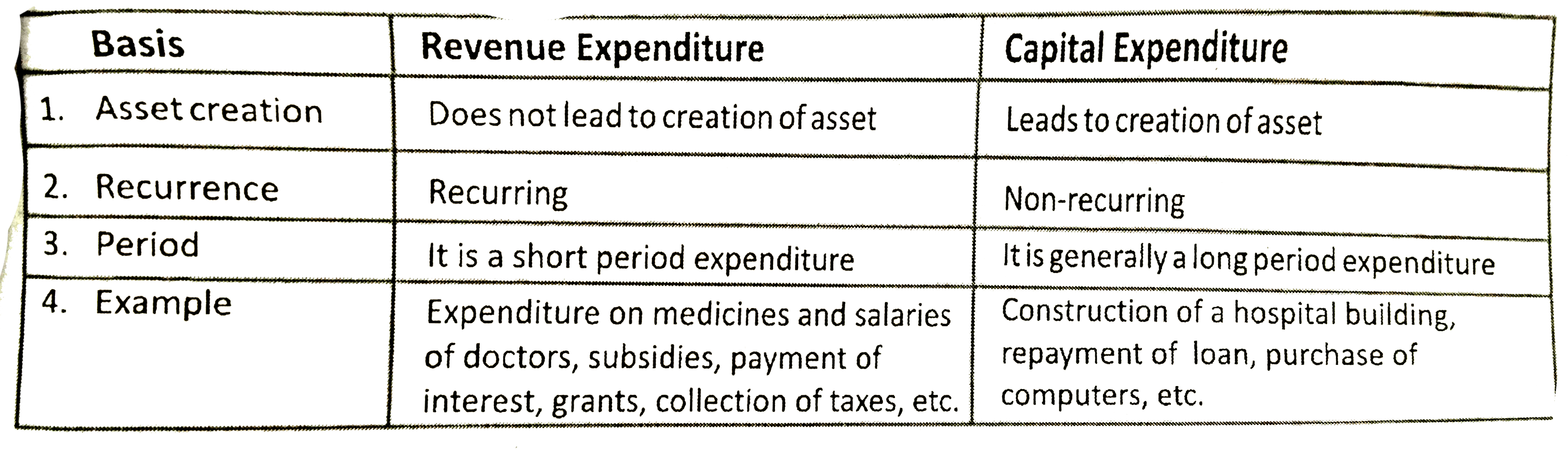
|
|
| 393. |
Repayment of loan is reflected as credit item in BOP account |
| Answer» SOLUTION :False because it is REFLECTED as DEBIT item since it leads to OUTFLOW of foreign exchange | |
| 394. |
If MPC and MPS are equal. What is the value of the multiplier? |
|
Answer» SOLUTION :We KNOW , MPC +MPS = 1 . If BOTHARE equal , it MEANS, MPS = 0.5 `"Multiplier(k)" = (1)/(MPS)= (1)/(0.5) = 2` |
|
| 395. |
Are the following statements true or false ? Give reasons. A good can be intermediary good in one case and a final good in another case. |
|
Answer» |
|
| 396. |
Name the situation under which aggregate demand is insufficient to eliminate involuntary unemployment. |
| Answer» SOLUTION :DEFICIENT DEMAND. | |
| 397. |
Explain the relationship between average propensity to consume and averagepropensity to save. Which of these can have a negative value and when ? |
| Answer» Solution :APC REFERS to RATIO of ABSOLUTE consumption to absolute incomeAPC= C/YAPS refers to ratio of absolute savings to absolute income.APS= S/YOut of these 2, APS can have NEGATIVE value when income is less than consumption. | |
| 398. |
What is the consumption function ? |
| Answer» SOLUTION :It shows the FUNCTIONAL RELATIONSHIP between the CONSUMPTION EXPENDITURE andnational income. | |
| 399. |
Suppose the price elasticity of demand for a good is -0.2. If there is a 5% increase in the price of the good, by what percentage will the demand for the good go down ? |
|
Answer» SOLUTION :`{:("% Change in% Change in"),(" Demand = ?Price = 5%"),(" Elasticity of Demand (ED) "=(-)0.2):}` Price Elasticity of Demand (ED) `=("% Change in quantity demanded")/("% Change in Price")` `(-)0.2=("quantity demanded")/(5%)` PERCENTAGE FALL in demand = 1% Demand for the PIECE of goods will fall by 1%. |
|