

Saved Bookmarks
This section includes InterviewSolutions, each offering curated multiple-choice questions to sharpen your knowledge and support exam preparation. Choose a topic below to get started.
| 1901. |
Explain consumer's equilibrium in case of a single commodity with the help of a utility schedule. |
|
Answer» Solution :(i) When purchasing a unit of a commodity a consumer compares its PRICE with the expanted utility from the utility obtained is the benefit, and the pricepayable is the cost , the consumer compares benefit and the cost. He will by the unit of commodity only if the benefit is is greater than or at latest equal to the cost. (ii) EQUILIBRIUM conditions for single commodity consumer Equilibrium . (a) Necessary Condition Marginal utility of Money = price `""...(1)` Or `(" Marginal Utility of a Product in Util " [MU_x])/("Marginal Utility of One Rupe "[MU_R]) " = Price of X"....(2)` In particular, the condition (1) saya that themarginal utility of a product in terms of Money should be equal to its price. Sometimes this is loosely stated as Marginal Utility is equal to price, i.e. ., MU = price . `"*"`If MU `gt`price `implies` As a rational consumer he willContinue to purchase an additional unit on a commodity as long as MU = price . `implies` MU `gt`Price IMPULSE benefit is greater than cost and when ever benefit is greater than cost the consumer keeps on consuming additional unit of a commodity till MU = price . `implies` It is so because according to the law of DIMINISHING marginal utility MU falls moreis purchased . As MU falls it is bound to become equal to the price at some point of purchase. `"*"` If MU `lt`Price `implies` As a rational consumer he will have to reduce the consumption of a commodity as long as MU = price . `implies MU lt`price implies when benefit is less than cost , never benefit is less than cost the dressing the additional unit of a commodity till MU = price. `implies` It is so because according to the law of diminishing marginal utility, MU rises as less units are consumed. As MU rises , it is bound to become equal to the price at some point of purchase . (b) Sufficient condition: TOTAL gain falls as more is purchased after equilibrium . it means that consumer continues to purchase so long as total gain is increasing or at least constant. (iii) It can be explained with the help of the following schedule : 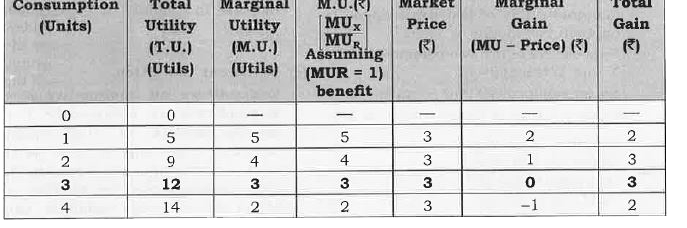 (a) Suppose , the price of commodity X in the market is Rs3 per unit .It means he has to pay Rs3 per unit for all the units he buys.Suppose, the unility obtained from the first unit is 5 utils(=Rs 5)The consumer will buy this unit because the utility of this unit is greater than the price and this process continues till Marginal utility = price as shown in the above schedule at quantity 3 . (b) Consumer will not buy the fourth unit utility of this unit is 2 unit because utility of this unit is 2 utils (= Rs 2)which is less than the price . It is not worth buying the fourth unit. The consumer will restrict his purchase to only 3 units. |
|
| 1902. |
_ refer to those deposits in which amountis deposited withbankfor a fixedperoidoftime |
|
Answer» Current Deposit |
|
| 1903. |
Name anyonestep the Government can takethroughitsbudget to reduce the gap betweenthe richand thepoor . |
| Answer» SOLUTION :Governmentcan reducethe gap BETWEENTHE RICHAND thepoorby IMPOSING taxes on therichandspending more on thewelfareof hepoor. | |
| 1904. |
Give meaning of (i) Involuntary unemployment. (ii) Full employment. (iii) Under-employment. Or Explain briefly the meaning of involuntary unemployment and full employment. |
| Answer» SOLUTION : (i) Involuntary unemployment :the condition in which VIRTUALLY all who are able and willing to WORK are EMPLOYED(ii) Full - EMPLOYMENT : the condition in which virtually all who are able and willing to work are employed | |
| 1905. |
As a result of increase in investment of Rs. 1,000 in the economy, total national income rises by Rs. 5,000. what is the value of multiplier ? |
| Answer» SOLUTION :MULTIPLIER `=(5,000)/(1,000)=(DELTA Y)/(Delta I)=5`. | |
| 1906. |
How can externalities be a limitation of using gross domestic product as an index of welfare ? |
| Answer» Solution :Increase in GROSS Domestic Product is due to increase in economic activities like industrialisation and urbanisation. With increased industrialisation, certain problems for society also increase like pollution of air, WATER and soil and deforestation.Urbanisation also results in housing problems, increase in road ACCIDENTS, ETC. On the whole, welfare DECREASES and this decrease in .welfare is ignored, while calculation of GDP. So, we can say that externalities can be a limitation of using GDP as an index of welfare. | |
| 1907. |
What is increase in supply ? Explain three causes of increase in supply. |
|
Answer» SOLUTION :An increase in supply MEANS that producers now supply more at a given price level. (a) Fall in the prices of other goods. (b) Fall in the prices of remuneration of factors of production (C ) Improvement in Technology. (d) Change in OBJECTIVE or producer (increase the supply at the same rate ). (e) Taxation policy of governement falls. 
|
|
| 1908. |
Classify the following as factor income or transfer income Taxes paid to government. |
| Answer» SOLUTION :TRANSFER INCOME | |
| 1909. |
Purchase of car by a consumer is a part of gross domestic capital formation. |
| Answer» Solution :False. It is a PART of private FINAL CONSUMPTION EXPENDITURE. | |
| 1910. |
How are following treated in the estimation of national income ? Payment of wealth tax. |
| Answer» Solution :No, it will not be included in the NATIONAL income as it is a COMPULSORY transfer payment to the government and also these are paid out of PAST saving of the TAX PAYER. | |
| 1911. |
Discuss any two differences between GDP at constant prices and GDP at current Prices. |
| Answer» Solution :TWO main differences between GDP at current prices and at CONSTANT prices are: (i) GDP at current prices are measured at current years prices, WHEREAS GDP at constant prices are measured at base years prices. (II) GDP at current prices MAY increase even if there is no flow of goods and service, whereas GDP at constant prices will only increase when there is an increase in the flow of goods and services. | |
| 1912. |
Calculate National income from the following following data : |
|
Answer» Solution :`NDP_(MP)=PFCE+GFCE+NDCF+`Net EXPORTS `=ii+iv+(vi+ix)+viii` `=300+100+(80+20)+(-40)` `=300+100+100-40` `= RS 460` crore `N NP_(FC)//`National INCOME `=NDP_(MP)+NFIA-NIT` `=NDP_(MP)+(iii)-(vii-v)` `=460+(-10)-(70-20)` `=460-10-50` `= Rs 400` crore Note : If Depreciation is not GIVEN, we use NDCF in place of GDCF and the aggregate so calculated is `NDP_(MP)`. |
|
| 1913. |
What does fiscal deficit represent ? |
| Answer» Solution :FISCAL deficit REPRESENTS the borrowing REQUIREMENTSOF the GOVERNMENT . | |
| 1914. |
Define nominal flow. |
| Answer» SOLUTION :MONEY flow REFERS to the flow of factor PAYMENTS from firms to households for their factor services and the corresponding flow of money, from households to firms, in the form ofconsumption expenditure on the purchase of goods and services produced by the firms. | |
| 1915. |
Who regulates money supply ? |
|
Answer» GOVERNMENT of India |
|
| 1916. |
Identify the following as Normal Residents of India : Indian going for medical treatment to U.S. |
| Answer» SOLUTION :NORMAL RESIDENTS. | |
| 1917. |
Why do all economies have similar central problems? |
| Answer» Solution :All economies whether DEVELOPED or developing, have similar central PROBLEM because one or more of their resources (LAND, labour, capital and ENTREPRENEURSHIP) are limited and these resources can be put to alternative uses. The wants of the economies are unlimited. Therefore all economies have to face the BASE economic problem of choice (what to produce. how to produce and for whom to produce). | |
| 1918. |
In an economy, C = 300 + 0.8 Y and I= 500 .. Calculate the following : ( i) Equilibrium level of income (ii) Consumption expenditure at equilibrium level of income. |
| Answer» SOLUTION :40003500 | |
| 1919. |
What conditions must hold if a profit maximizing firm produces positive output in a competitive market? |
Answer» Solution :The conditions must hold if a profit maximizing firm produces positive output in a competitive MARKET when price is constant under MR/MC approach is determined where (i) MR = MC (ii) MC must be rising  According to Table, both the conditions of equilibrium are satisfied at 4 units of output. MC is equal to MR and MC is rising. MC is more than MR when output is produced after 4 units of output. So, Producer.s Equilibrium will be achieved at 4 units of output. However, MR is equal to MC at 2 units of output also. But, second condition is not fulfilled here. Let us understand the determination of equilibrium with the help of a diagram:  Producer.s Equilibrium is determined at OQ level of output corresponding to point E as at this point, MC = MR and MC CURVE cuts MR curve from below. In Figure, output is shown on the horizontal axis and revenue and costs on the vertical axis. Producer.s equilibrium will be determined at OQ level of output corresponding to point E because at this, the following two conditions are met: (i) MC=MR (ii) MC curve cuts the MR curve from below. When `MR gt MC`, then producer will continue to produce as long as MR becomes equal to MC. It is so because firm will find it profitable to raise the output level. When `MRgtMC`, then producer will cut down the production as long as MR becomes equal to MC. It is so because firm will find it unprofitable to produce an extra unit. So, it starts reducing the level of output till MR = MC. |
|
| 1920. |
Are the following normal residents of Indian economy ? (i) Indians employed in the World Health Organisation located in India. (ii) An American tourist staying in India. |
|
Answer» Solution :(i) Indians EMPLOYED in WHO located in India are residents of India because their ECONOMIC interest lies in India and they live in India. (II) American tourist staying in India is not the RESIDENT of India. He is the resident of America because his economic interest lies in America and he lives in America. |
|
| 1921. |
As a result of high wage settlement in the New Yourk City due to taxi strike of several years ago, taxi owners increased taxi fares. Was this the right decision ? |
|
Answer» Solution :(i) The GIVEN decision is RIGHT or wrong depends upon the price elasticity of demand for taxi rides in New York City. (ii) The given decision is right when demand for taxi rides is price INELASTIC then price and total revenue moves in same DIRECTION. So, when taxi owners increases the taxi fares, then their total revenue rises. (iii) The given decision is INCORRECT when demand for taxi ride is price - elastic or unitary elastic. (a) It is so because when price is Elastic, then price and total revenue moves in opposite direction. So, when taxi owners increases the taxi fares, then their total revenue falls. (b) It is so because when price is unitary elastic, then price increases, and total revenue remains constant. So, when taxi owners increases the taxi fares, then their total revenue remains constant. Value : Critical thinking. |
|
| 1923. |
Define product differentiation. |
| Answer» Solution :Product differentiation refers to differentiating the PRODUCTS on the basis of brand, SIZE, colour, SHAPE, etc. | |
| 1924. |
Which one of these is a limitation of the barter exchange |
|
Answer» Lack of double coincidnece of wants |
|
| 1925. |
The most urgent problem which prompted the introduction of New Ecomin policy in 1991 was : |
|
Answer» Bad perpeformance of PUBLIC sector units |
|
| 1926. |
State law of supply |
Answer» Solution :It is based on certain assumptions. If these assumptions fulfil in the economy, Law of supply states that positive relationship exists between price of the COMMODITY and quantity supplied of that commodity.  "Other THINGS being constant (ceteris paribus), based on the price of the commodity" is called law of supply. It MEANS due to rise in price of a commodity its quantity supplied also rises and vice-versa. The assumptions are ASUNDER : (a) Price of other commodity remains constant. (b) Technology of production should not change. (c ) Cost of production remains costant. (d) Goal of the firm remains constant. (e ) Taxation policy of the government should not change. 
|
|
| 1927. |
Higher the value of MPC, more is the value of multiplier |
| Answer» Solution :Consider, K=1/1-MPCWe can clearly see that multiplier (K) is DIRECTLY RELATED to MARGINAL PROPENSITY to consume(MPC).So, higher the VALUE of MPC , more is the value of a multiplier. | |
| 1928. |
A decrease in the spending by the government reduces the income and purchasing power of the people. Do you agree with the given statements ? |
| Answer» Solution :Yes, I agree with the given statements. REDUCTION in government spending will reduce the level of aggregate demand, which will lead to FALL in the income and PURCHASING power of the people. However, the EXTENT of all in the income and purchasing power depends on the SIZE of multiplies. | |
| 1929. |
If there is an improvement in technology of producing a good, supply decreases ? |
| Answer» Solution :False : If technology of producing a good improves, the COST of production of a commodity FALLS and SHIFT the supply CURVE rightward. | |
| 1930. |
Give the meaning of autonomous consumption. |
| Answer» Solution :It refers to minimum LEVEL of CONSUMPTION, which is needed for survieval, i.e. consumption at ZERO level of NATIONAL INCOME. | |
| 1931. |
Why is the consumer in equilibrium when he buys only that combination of the two goods that is shown at the point of tangency of the budget line with an indifference curve ? Explain . |
|
Answer» Solution :(i) To define consumer equilibrium, we use INTERFERENCE Curve map and the budget line . Two conditions for consumer Equilibrium (a) Necessary Condition Marginal Rate of Substitution = Market Rate of Exchange `[(P_x)/(P_y)]` Or , `MRS_(x,y)=P_x//P_y` ( Market Rate of Exchange ) MRE Or `MRS_(x,y) =MRE[(P_x)/P_y]` `"*" ` If `MRS_(x,y) gt MRE [(P_x)/(P_y)]` , At point T in figure It means the consumer.s willingness to pay for commodity X is higher than what makes values for commodity X. So, the consumer should buy more of X and less of Y to get MRS `=P_x/P_y` 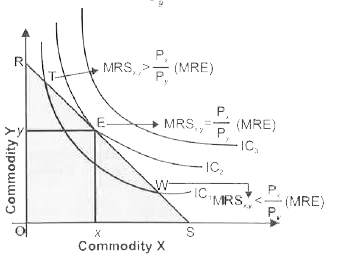 `"*"` If `MRS_(x,y) lt MRE [(P_x)/(P_y)]`, At point W in figure, It means the consumer willingness to pay for commodity X is LESSER than what market value for commodity X ,So, consumer should buy less of X and more Y to get MRS = `p_x/p_y` (b) Sufficient Condition `MRS_(x,y)` Diminishing (Convex) at a point of equilibrium i.e., when `MRS_(xy)=MRE[P_x/P_y]` (ii) The consumer will reach equilibrium when the budget line is tangential to the higher possible Indifference Curve, i.e. ., where necessary and sufficient condition satisfy . In the above diagram , the consumer will reach equilibrium at point E where budget line RS is tangential to the higher possible `IC_2` (iii) The consumer cannot MOVE to Indifference Curve , i.e. ., `IC _3`as this is beyond this money income. (iv) Even on `IC_2` all the other points except E are beyond his means . (v) Hence , at point E, the consumer is in equilibrium where his satisfaction maximizes, given his income and prices of goods X and Y . In equilibrium at E , the slope of Budget line = the slope of Indifference Curve. Therefore `MRS_(xy)`is equal to the RATIO of the price bof two goods `[(P_x)/(P_y)]` . |
|
| 1932. |
Expenditure on air -conditioners by households. |
|
Answer» |
|
| 1933. |
What is the relationship between TR, AR and MR under perfect competition? |
|
Answer» Solution :(i) In the perfect competition, a firm is a price taker. (ii) It has to sell its product at the same price as given (determined) by the industry. Consequently, price = AR = MR. (iii) Hence, a firm.s AR and MR curve will be a horizontal straight line parallel to X axis. (iv) Since price remains the same, i.e., MR is constant, therefore, TR increases at the Constant rate as increase in the output SOLD. (V) As the result of, TR curve FACING a competitive firm is positively sloped straight line. Again, because at zero output Total REVENUE is zero therefore, TR curve passes through the origin O as shown in the given figure. 
|
|
| 1934. |
Defficient Demand indicates: |
|
Answer» Under EMPLOYMENT equilibrium |
|
| 1935. |
What is meant bydepreciation of domestic currency ? |
| Answer» Solution : Currency DEPRECIATION refers to decreaes in the VALUE ofdomestic currency in TERMS of foreign courrency | |
| 1936. |
Why does an economic problem arise? |
|
Answer» Solution :Economic PROBLEM arises becauseof scarcity of RESOURCES in relation to demand for them. (i) Wants are unlimited: (a) This is a basic fact of human life. Human wants are unlimited. (b) They are not only unlimited but also grow and multiplyvery fast. (ii) Resources are limited: (a) The resources to produce goods and services to SATISFY human wants are available in limited quantities. Land, labour, capital and entrepreneurship are the basic SCARCE resources. (b) These resources are available in limited quantities in every economy, big or small, developed or underdeveloped, rich or poor. Some economies may have more or one or two resources but not all the resources. (c ) For example, Indian economy has relatively more labour but less capital and land. The U.S. economy has relatively more land but less labour. No economy in the world is comfortable in all the resources. (iii) Resources have alternative uses: (a) Generally a resource has many alternative uses. (b) A WORKER can be employed in a factory, in a school, in a government office, self employed and so on. (c ) Like this, nearly all resources have alternative uses. But the problem is that which resource should be put to which use. |
|
| 1937. |
The economy attains equilibrium at a point where the saving curve intersects the investment curve. |
|
Answer» |
|
| 1938. |
How does giving incentives for exports influence foreign echange rate ? Explain |
| Answer» SOLUTION : INCENTIVES for EXPORTS are aimed at increasing expots. Increases in exports will BRING more foreign exchange into the country. Demand for foreignexchange remaining unchanged, exchange rate is likely to fall. | |
| 1939. |
Chinese embassy in India is a part of economic territory of: |
|
Answer» CHINA |
|
| 1940. |
Mention any one factor affecting credit creation by banks. |
| Answer» SOLUTION :INITIAL CASH DEPOSITS | |
| 1941. |
State the components of money supply. |
| Answer» | |
| 1942. |
What is a price-maker firm? |
| Answer» Solution :A PRICE maker FIRM is one to fix the price itself because of its MONOPOLY POWER. | |
| 1943. |
What is the relationship between TR and Price line when price is constant ? |
Answer» SOLUTION :When price of a commodity is constant, Price =AR=MR at all LEVELS of output . Therefore, price LINE is the same as MR CURVE . Also, `TR=sumMR`. So,the area under MR curve or price line will be equal to TR. In Figure, TR at OQ level of output= `OPxxOQ=` Area under price line. 
|
|
| 1944. |
Depreciation means : |
|
Answer» Destruction of a plantin a fire accident |
|
| 1945. |
How are following treated in the estimation of domestic factor income ? Profit earned by a branch of State Bank of India in England. |
| Answer» SOLUTION :No, It will not be INCLUDED in the domestic factor income as State BANK of INDIA is located outside the domestic territory of India. | |
| 1946. |
The various combinations of goods that can be produced in any economy when it uses its available resourcesand technology efficiently are depicted by |
|
Answer» 1.Demand CURVE. |
|
| 1947. |
Suppose that the demand curve for the XYZ company slopes downward and to the right. Would you conclude that the firm is a price taker or a price maker? Give reasons. |
|
Answer» SOLUTION :(i) Since the DEMAND curve of XYZ Co. is downward sloping, it has to lower its price to sell additional units of output. (ii) But in perfect competition the demand curve is parallel to x-axis as the firm can sell any amount of the output at the same price. (III) Hence, XYZ Co. is not a price- taker but a price maker. |
|
| 1948. |
In monopoly, firm is different from industry. |
| Answer» Solution :FALSE: There is only one firm in MONOPOLY MARKET, so there EXISTS no difference between firm and INDUSTRY. | |
| 1949. |
Balance of payments is a stock concept. |
| Answer» Solution :FALSE. It is a flow CONCEPT as it is RELATED to a given period of TIME. | |
| 1950. |
What is Primary deficit ? |
| Answer» Solution :Primary deficit is the differencebetween FISCAL deficit of the current year and INTEREST payments on the previous borrowings. | |