

Saved Bookmarks
This section includes 7 InterviewSolutions, each offering curated multiple-choice questions to sharpen your Current Affairs knowledge and support exam preparation. Choose a topic below to get started.
| 1. |
[Kr]4d^(10) 5s^(2) 5p^(4) is the electronic configuration of ___________. |
| Answer» SOLUTION :TELLURIUM | |
| 2. |
Kr and fluorine gases are irradiated with SbF_(5) it forms ……………. . |
| Answer» SOLUTION :`KrF_(2).2SbF_(3)` | |
| 4. |
K_(p)andK_(c) are related by K_(p)=K_(c)(RT)^(Deltan). Under what practical condition/s, K_(p)=K_(c) ? |
|
Answer» RT = 1 |
|
| 5. |
K_p of the reaction, N_2O_4(g)hArr2NO(g) at 773K is 640 mm of Hg. If the equilibrium pressure is 160 mm of Hg, then whatpercent of N_2O_4 will be dissociated? At what pressure will its degree of dissociation be 50%? |
|
Answer» Solution :Let initial NUMBER of MOLES of `N_O_2`=1 mol and the DEGREE of dissociation of `N_2O_4` at equilibrium`=prop` `N_2O_4(g) Total number of moles at equilibrium `=1-prop-2prop=1+prop` At equilibrium `P_(N_2O_4)=((1-prop)/(1+prop))xx160` and `P_(NO_2)=((2prop)/(1+prop))xx160` `K_p=(p_(NO_2)^2)/(p_(NO_2O_4))=(4prop^2xx160)/(1-prop^2)`or`640=(4prop^2xx160)/(1-prop^2)` `:.prop=0.707` `:.` PERCENT dissociation of `N_2O_4=70.7%` Let, at a pressure of p mm Hg, the degree of dissociation of `N_2O_4` is 0.5 `:p_(N_2O_4)=((1-0.5)/(1+0.5))p=p/3mmHg` and `p_(NO_2)=((2xx0.5)/(1+0.5))p=(2p)/3 mm Hg` `K_p=(p_(NO_2)^2)/(p_(N_2O_4))=((2p)/(3)^2)/(p/3)=(4p)/3`or`(4p)/3=640` `:.` p=480 atm |
|
| 6. |
(K_(P))/(K_(C)) for the gaseous reaction – (a) 2 A + 3 B hArr2C (b) 2 AhArr 4B (c) A + B + 2ChArr4D would be respectively - |
|
Answer» `(RT)^(-3) , (RT)^(2), (RT)^(@)` |
|
| 7. |
K_p/K_c for the reaction: CO(g)+1/2O_2(g) hArr CO_2(g) is : |
|
Answer» 1 |
|
| 8. |
The ratio of K_(p)// K_(c ) for the reaction :CO(g)+(1)/(2)O_(2)(g)hArr CO_(2)(g)is: |
|
Answer» 1 |
|
| 9. |
K_(p) for the reaction PCl_(5)(g)ghArrPCl_(3)(g)+Cl_(2)(g) at 250^(@)C is 0.82. Calculate the degree of dissociation at given temperature under a total pressure of 5 atm. What will be the degree of dissociation if the equilibrium pressure is 10 atm, at same temperature. |
| Answer» ANSWER :A | |
| 10. |
K_p for the reaction: N_2O_4(g) iff 2NO_2(g)is 0.66 atm at 320 K. Calculate the degreeof dissociation of N_2O_4 at 320 K and 380 mm. Also calculate the partial pressures of N_2O_4 and NO_2at equilibrium. |
| Answer» SOLUTION :0.497, 0.332 ATM, 0.168 atm | |
| 11. |
K_pfor the reactionN_2O_4(g) = 2NO_2(g)is 0.66 at 46^@C . Calculate the per cent dissociation of N_2O_4 at 46^@Cand a total pressure of 380 mm. What are the partial pressures of N_2O_4 and NO_2at equilibrium? |
| Answer» SOLUTION :0.168 ATM, 0.332 atm | |
| 12. |
K_(p) for the reaction H_(2)(g)+(1)/(2)O_(2)(g)hArrH_(2)O(l) is 8.0 "bar"^(-3//2) at T kelvin temperature. If vapour pressure of H_(2)O is 2.0 bar at same temperature then K_(P)^(0) for the reaction 2H_(2)(g)+O_(2)(g)hArr2H_(2)O(g) is |
|
Answer» `8.0` `k_(p_(i))=8"BAR"^(-3//2)` `H_(2)O(l)hArrH_(2)O(g)` `K_(p_(2))=V.P.` of `H_(2)O=2` bar `H_(2)(g)+(1)/(2)O_(2)(g)hArrH_(2)O(g)` `K_(P)=K_(p_(i))xxk_(p_(2))` `2H_(2)(g)+O_(2)(g)hArr2H_(2)O(g)` `K_(p)=(k_(p_(1))xxK_(p_(2))^(2)` `(8xx2)^(2)"bar"^(-1)=256 "bar"^(1)` `k_(p)^(0)=256` |
|
| 13. |
K_(p)for the reaction :CO_(2)(g)+H_(2)(g) hArr CO(g)+H_(2)O(g)is found to be 16 at a given temperature. Originally equal number of moles of H_(2) andCO_(2)(g) were placed in the flask. At equilibrium, the pressure of H_(2) is 1.20 atm. What is the partial presure of CO_(2) and H_(2)O ? |
|
Answer» 1.20 ATM. each |
|
| 14. |
K_(p) for the reactionMgCO_(3_((s))) to MgO_((s)) + CO _(2_((g)))" is" 9 xx 10^(-10). CalculateDelta G^(@) for thereactionat 25^(@)C. |
|
Answer» Temperature`= T = 273+ 25 =298 K ` `Delta G^(@) = ? ` `Delta G^(@) =- 2 .303RT log_(10) K_(p)` `=-2.303x 8.314 xx 298 xx log_(10) 9 xx 10^(-10)` `=- 2.303 xx 8. 314 xx 298 xx [bar(10).9542]` `=- 2.303 xx 8.314 xx 298 xx [ - 9.0458]` `= 51683 J mol^(-1)` `=51. 683 kJ mol^(-1)` |
|
| 15. |
K_(p)for thereaction2SO_(2(g))+ O_(2(g))to2SO_(3(g))" is" 7.1 xx 10^(24)at25^(@)C . CalculateDelta G^(@)for thereactions. (R= 8. 314KJ^(-1) mol^(-1)) |
| Answer» Solution :`DELTA G^(@)=- 141.8 KJ mol^(-1)` | |
| 16. |
k_(P) for the following reaction at 700 K is 1.3xx10^(-3)atm^(-1) The K_(c) at same temperature for the reaction 2SO_(2)+O_(2)hArr2SO_(3) will be |
|
Answer» `1.1xx10^(-2)` `K_(c)=(K_(p))/((RT)^(Deltan))=(1.3xx10^(-3))/((0.0821xx700)^(-4))=7.4xx10^(-2)` |
|
| 17. |
K_(p) and K'_(p) are the equilibrium constants of the two reactions, given below 1/2N_(2(g))+3/2H_(2(g))hArrNH_(2(g))N_(2(g))+3H_(2(g))hArr2NH_(3(g)) Therefore, K_(p) and K'_(p) are related by |
|
Answer» `K_(p)=K_(p)^(2)` So, `K'_(p)=(K_(p))^(2)orK_(p)=sqrt(K'_(p))` |
|
| 18. |
K_(p)and K'_(p) are equilibrium constants of the two reactions given below :(1)/(2)N_(2)(g)+(3)/(2)H_(2)(g) hArr NH_(3)(g)N_(2)(g)+3H_(2)(g)hArr 2NH_(3)(g)Therefore K_(p) and K'_(p) are related by : |
|
Answer» `K_(p)=K'_(p)^(2)` |
|
| 19. |
Kolbe's synthesis of sodium salt of butanoic acid gives: |
|
Answer» n-hexane |
|
| 20. |
Kolbes - Schmidt reaction is used to prepare |
|
Answer» SALICYLIC acid |
|
| 21. |
Kolbe's electrolysis of potassium succinate gives CO_(2) and_____. |
| Answer» SOLUTION :ETHYLENE or ETHENE. | |
| 22. |
Kolbe-schmidt reaction is used for |
|
Answer» SALICYLIC acid |
|
| 23. |
Kolbe'ssynthesisof sodiumsaltof butaneacidgives : |
|
Answer» N- HEXANE |
|
| 24. |
Kolbe-Schmidt reaction is used for: |
|
Answer» SALICYLIC acid |
|
| 25. |
Kolbe 'seletrolyticmethodcan beapplied on : |
|
Answer» `CH_(3)COONa` |
|
| 26. |
Kohlraush's law is applied to calculate |
|
Answer» MOLAR conductance at INFINITE DILUTION of a weak electrolyte |
|
| 27. |
Kohlrausch's law is used to calculate |
|
Answer» `^^_(m)^(OO)` |
|
| 28. |
Kohlrausch's law is applied to calculate …………….. . |
|
Answer» molar conductance at infinite dilution of a weak ELECTROLYTE |
|
| 29. |
Kohlrausch's law helps to determine the degree of dissociation of a weak electrolyte at a given concentration.The molar conductivityLambda_mof .001M acetic acid is 4.95xx10^(_5)Scm^2mol^(-1).Calculate the degree of dissociation(alpha)at this concentration if limiting molar conductivitylamda_m^0for H+is 340xx10^(-5)Scm^2mol^(-1)and CH_3COO^-50.5xx10^(-5)Scm^2mol^(-1) |
|
Answer» SOLUTION :`lamda_m^0CHCOOH=4.95XX10^(-5)Scm^2mol^(-1)` `lamda_m^0CH_3COOH=lamda_m^0CH_3COO^(-)+H^+` |
|
| 30. |
Kohlrausch law states that at |
|
Answer» infinite dilution, each ion MAKES definite contribution to conductance of an electrolyte whatever be the nature of the other ion of the electrolyte `Lambda_(m)^(oo) = Lambda_(+)^(oo) + Lambda_(-)^(oo)` `Lambda_(1)^(oo) and Lambda_(-)^(oo)` are molar ionic conductance at infinite dilution,for cations and anions, respectively. |
|
| 31. |
Kohlrausch's law helps to determine the degree of dissociation of a weak electrolyte at a given concentration.State Kohlrausch's law. |
| Answer» Solution :It states that the limiting molar CONDUCTIVITY of an electroylte is the sum of limiting molar ionic CONDUCTIVITIES of ANIONS and CATIONS. | |
| 32. |
Kohlrausch law can be used to find the molar conductivity of a weak electrolyte at infinite dilution. |
|
Answer» |
|
| 33. |
Kodel polyester is formed by trans-esterification of dimethyl terephthalate with 1,4-di (hydroxymehyl) cyclohexane. Write its reaction ? |
Answer» SOLUTION :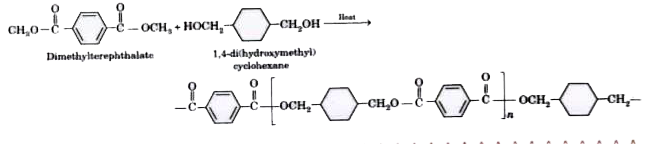
|
|
| 34. |
Kohlrausch’s law states that at |
|
Answer» finite DILUTION, each ion MAKES definite contribution to the equivalent CONDUCTANCE of an electrolyte, whatever be the NATURE of the other ion of the electrolyte. |
|
| 35. |
KOH can be used as drying agent for |
|
Answer» AMINES |
|
| 36. |
KO_2 (potassium superoxide) is used in oxygen cylinders in space and submarines because it |
|
Answer» Absorbs `CO_(2)` and increases `O_(2)` CONTENT |
|
| 37. |
KO_(2) (potassium superoxide) is used in oxygen cylinders in space and submarines because it : |
|
Answer» 1. ABSORBS `CO_(2)` and increases `O_(2)` content |
|
| 38. |
KO_2 + CO_2 to ?(gas) |
|
Answer» `H_(2)` |
|
| 39. |
KO_2 is used in oxygen cylinders in space and submarines because it |
|
Answer» ABSORBS `CO_2` and INCREASES `O_2` CONTANT |
|
| 40. |
Known trihalide of N is: |
|
Answer» `NF_3` |
|
| 41. |
Knowing the electron gain enthalpy values of O rarr O^(-) and O rarr O^(2-) as -141 and 702 kJ mol^(-1) respectively, how can you account for the formation of a large number of oxides having O^(2-) species and not O^(-) ? |
|
Answer» Solution :Consider the reaction of a divalent metal (M) with oxygen. The formation of `MO_(2)` and MO involves the following steps : `{:(M(g) overset(Delta_(i)H_(1))RARR M^(+)(g) overset(Delta_(i)H_(2))rarr M^(2+)(g) ","O(g) overset(Delta_(eg)H_(1))rarr O^(-)(g)overset(Delta_(eg)H_(2))rarr O^(2-)(g)),(M^(2+)(g)+2O^(-)(g) overset("Lattice energy")rarr M^(2+)(O^(-))_(2)(s)","M^(2+)(g) overset("Lattice energy")rarr M^(2+) O^(2-)(s)):}` If electron gain enthalpy were the only factor involved in the formation of `O^(2-)` ions, we would expect that O will prefer to form `O^(-)` rather than `O^(2-)` ions. ACTUALLY a large number of oxides have `O^(2-)` species and not `O^(-)`. This is due to the following two reasons : (i) `O^(2-)` has the stable noble GAS configuration (ii) Due to higher charge on `O^(2-)` than on `O^(-)` ions, the lattice energy released during the formation of oxides containing `O^(2-)` species in the solid state is MUCH higher than lattice energy released during the formation of oxides having `O^(-)` species. In other words, it is the higher lattice energy of formation of oxides containing `O^(2-)` species which more than compensates the higher electron gain enthalpy `(Delta_(eg)H_(2))` needed during formation of `O^(2-)` from `O^(-)` ions. Thus, formation of oxides containing `O^(2-)` species is energyetically more favourable than oxides containing `O^(-)` species. It is because of this reason that oxygen forms a larger number of oxides having `O^(2-)` species and not `O^(-)`. |
|
| 42. |
Knowing the electron gain enthalpy values for O to O^(-) and O to O^(2-)as -141 and 702 kj mol-1 respectively, how can you account for the formation of a large number of oxides having O^(2-)species and not O^(-)? |
| Answer» Solution :The VALUES of ELECTRON gain ENTHALPY suggest that formation of `O^(2-)`is endothermic. However, `O^(2-)`has most stable CONFIGURATION in `s_2 np_6`. In SOLID state, the lattice energies of the oxides having `O^(2-)`anions are very high which compensates the positive electron gain enthalpy of oxide (`O^(2-)`) formation. Thus, more oxides with `O^(2-)`ion are formed. | |
| 43. |
Knowing the electron gain enthalpy values forO to O^(-)and O to O^(2-) as- 141 and 702 kJ "mol"^(-1)respectively, how can you account for the formation of a large number of oxides having O^(2-)species and not O^(-) ? |
| Answer» SOLUTION :The second electron enthalpy of oxygen for the formation of `O^(2-)`is positive while first electron gain enthalpy of oxygen for the formation of `O^-`is negative. This means that if electron gain enthalpy is the only factor involved for the formation of divalent ions, we would expect that oxygen would prefer to form `O^-`ions rather than `O^(2-)`ions. ACTUALLY, a large number of oxides have `O^(2-)`species and not `O^-`. This is because (i) Divalent `O^(2-`) has the stable noble gas CONFIGURATION (II) In the solid state, large amount of energy KNOWN as lattice enthalpy is released to form divalent `O^(2-)`ions than monovalent `O^-` ions. It is the greater lattice enthalpy of `O^(2-)`ions which compensates for the high energy required to remove the second electron. This is responsible for greater stability of `O^(2-)`ions as compared to `O^-`ions. | |
| 44. |
Knowing the electron gain enthalpy values for O to O^(-) and O to O^(2-) as -141 and 702 kJ " mol"^(-1) respectively , how can you account for the formation of a large number of oxides having O^(2-) speciesand not O^(-) ? |
|
Answer» Solution :Consider the reaction of a divalent metal ( M) with oxygen . The formation of `M_2O and MO` involves the following steps : `M(g) overset(Delta_i, H_1)to M^(+) (g) overset(Delta_i/ H_2) to M^(2+) (g)` `Deltai H_1 and Delta_i H_2` are first and second ionisation enthalpies of the metal M . `O(g) overset(Delta_(eg) H_1) to O^(-) ( g) overset(Delta_(eg)H_2)to O^(2-)(g)` `Delta_(eg) H_1 and Delta_(eg)H_2` are first and second ELECTRON gain enthalpies `2M^(+)(g) + O^(-)(g) overset("Lattice energy")to M_2O (s)` `M^(2+)(g) + O_(2)^(-)(g) overset("Lattice energy ")to MO(s)` Although `Delta_i H_2` is much more than `Delta_i H_1 and Delta_(eg) H_2` is much higher than `Delta_(eg)H_1`, yet the lattice nenergy of formation of MO(s) due to higher charges is muchmore than that of `M_2O(s)`. In other words, formation MO is energetically more favourable than `M_2O`. It is due to this reason that oxygen forms PREFERABLY oxides having the `O^(2-)` species and not `O^(-)`. |
|
| 45. |
Knowing that the chemistry of lanthanoids (Ln) is dominated by its +3 oxidation state, which of the following statement is incorrect? |
|
Answer» The ionic sizes of LN(III) decreases in general with increasing atomic number |
|
| 46. |
Knowing that the chemicstry of lanthanoids(Ln) is dominated by its +3 oxidation state, which of the following statements is incorrect ? |
|
Answer» The ionic sizes of Ln(III) DECREASE in GENERAL with increasing atomic number. |
|
| 47. |
Knowing that the Chemistry of lanthanoids (Ln) is dominated by its+3 oxidation state, which of the following statement is incorrect? |
|
Answer» Because of the LARGE size of the Ln (III) ions the bonding in its compounds is predominantly ionic in character |
|
| 48. |
Knocking sound occurs in engine when fuel |
|
Answer» Ignites slowly |
|
| 49. |
Knowing that average kinetic energy of an ideal gas (X) is directly proportinal to absolute temperature, if T_(1)=273K, which statements describe the other curves? |
|
Answer» CURVE A is for heavier GAS but at same temperature |
|
| 50. |
KNO_(2)+AgF to AgNO_(2)darr+KF |
|
Answer» For PRECIPITATE FORMATION formation reaction |
|