Saved Bookmarks
This section includes 7 InterviewSolutions, each offering curated multiple-choice questions to sharpen your Current Affairs knowledge and support exam preparation. Choose a topic below to get started.
| 1. |
Indicate the correct answer out of the following for the below reaction. NH_(4)Cl + H_(2)O |
|
Answer» The reaction is not favoured by the ADDITION of KOH. `NH_(4)^(+) + H_(2)O |
|
| 2. |
Indicate the complex ion which shows geometrical isomerism : |
|
Answer» `[Cr(H_(2)O)_(4)Cl_(2)]^(+)` |
|
| 3. |
Indicate the colour of compound Z formed in the given reaction , C_(6)H_(5)NO_(2)overset(Fe//HCl)rarrXunderset(273k)overset(HNO_(2))rarrY overset(C_(6)H_(5)OH)rarrZ. |
Answer» Solution :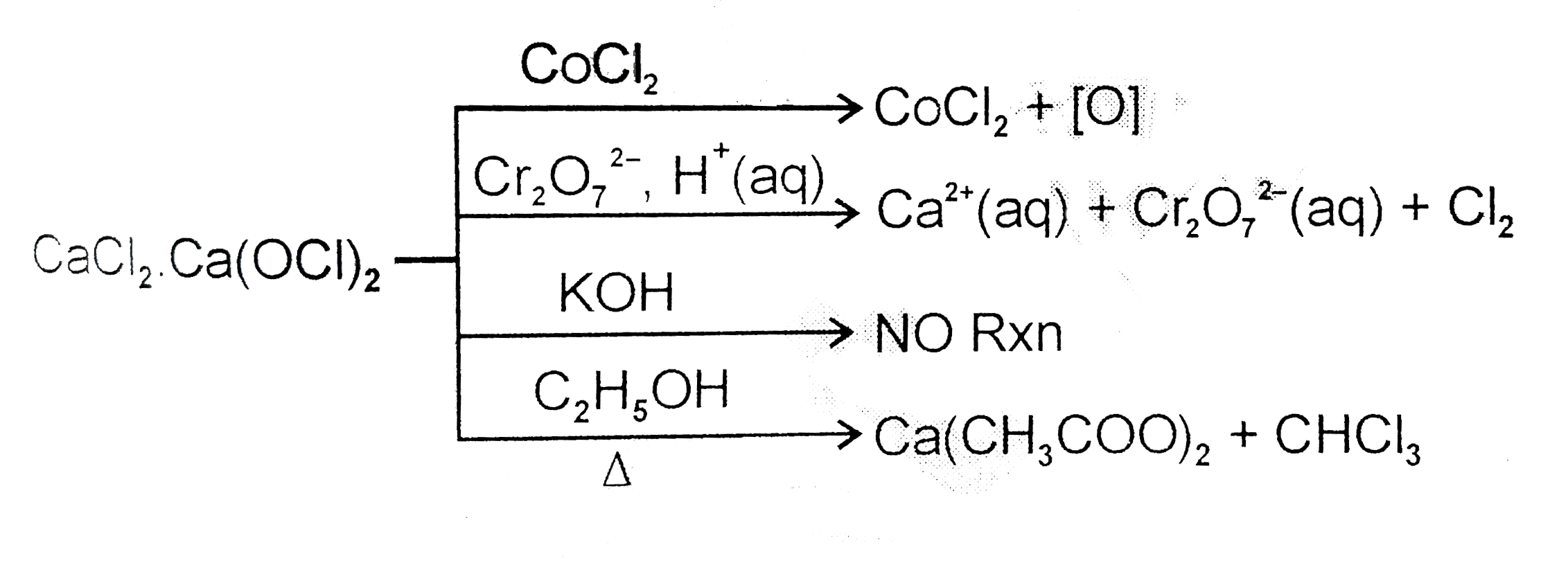
|
|
| 4. |
Indicate the complex ion which shows geometrical isomerism |
|
Answer» `[CR(H_(2)O)_(4)Cl_(2)]^(+)` |
|
| 5. |
Indicate the complex ion which shows geometrical isomerism. |
|
Answer» `[Cr(H_(2)O)_4)Cl_(2)]^(+)` |
|
| 6. |
Write basicity of H_3PO_2,H_3PO_3 and H_3PO_4 . |
|
Answer» Solution :Basicity of `H_3PO_4` IS 3 (Tribasic acid) Basicity of `H_3PO_3` is 2 (DIBASIC acid ) Basicity of`H_3PO_2` is 1 (monobasic acid) |
|
| 7. |
Indicate more stable carbocation and explain : |
|
Answer» |
|
| 8. |
Indicate in which case/cases the spontaneity of a change is favoured when |
|
Answer» `DELTAG` is +ve |
|
| 9. |
Indicate bonds which are cleaved I: In basic contions II: in acidic conditions |
|
Answer» |
|
| 10. |
Indicate a chemical reaction involvind a homogenous catalyst. |
| Answer» SOLUTION :`2SO_(2)(G)+O_(2)(g) overset(NO(g))to2SO_(3)(g)` (Lead chamber process for MANUFACTURE of sulphuric acid). | |
| 11. |
India has the world's largest deposite of thorium in the form of |
|
Answer» Rutile |
|
| 13. |
India conducted an underground nuclear test at |
|
Answer» Tarapur |
|
| 14. |
Indentigy the set of reagents/reacatns conditins (X) and (Y) in the followingset of transforamtion: CH_(3) - CH_(2) - CH_(2) Br overset((Br))(rarr) underset(Br)underset(|)underset(CH_(3)-CH-CH_(3))underset(darr (Y))("Product") |
|
Answer» `(X)` = Dilute aqueosu`NaOH, 20^(@)C` For `X`, the conditions given are: `{:(a,b,c,d),(Dil.aq.,CONC. Alcoholic,Dil.aq.,Conc. Alcoholic),(NaOH,NaOH,NaOH,NaOH),(20^@C,80^@C,20^@C,80^@):}` So conditions (a) and (c) are same and not required becuase in aq. `NAOH. SN^(2)` reaction will OCCUR to give `ROH`. [So condtions for `E2`ELIMINATION is conc. alcoholic `NaOH` at `80^(@)C` (Conditions (b) and (d) are same.)] For `Y` conditions given are: `{:(a,b,c,d),(HBr//"acetic".,HBr//"acetic",Br_(2)//CHCl_(3),Br_(2)//CHCl_(3)),("acid","acid",,),(at20^@C,at20^@C,at0^@C,at0^@):}` Conditions (c) and (d) are not required becuase they do not give the desiredproduct. Only condition for `(Y)` is `(a)` or `(b)` But for `(X)` is as in `(b)`, and conditionfor `(Y)` as in `(b)`. 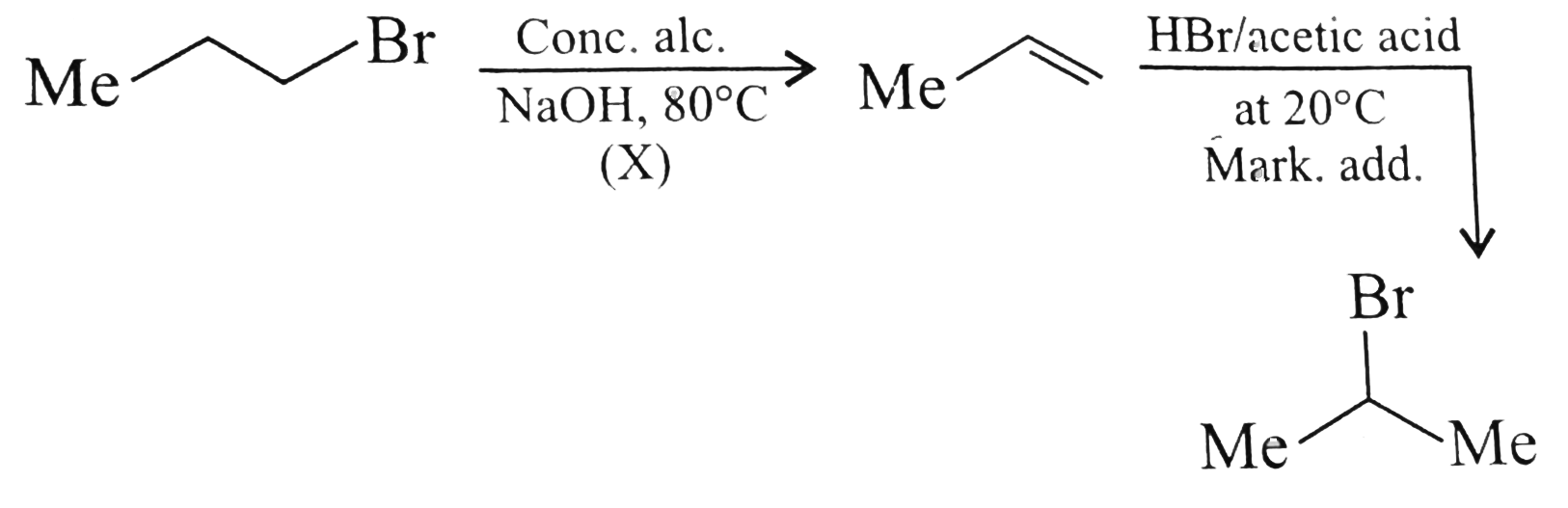
|
|
| 15. |
Indentify the true statement(s) |
|
Answer» A catalyst is chemically unchanged at the end of a REACTION |
|
| 16. |
Indentify the following ions by a simple test forming complex compound : (i)Cu^(2+)(ii)Ni^(2+)(iii)Fe^(3+)(iv)Co^(2+) |
|
Answer» Solution :(i) ` Cu^(2+) ` solution with excesses of AMMONIA solution, `NH_(4)OH` FROMS a deep BLUE coloured complex. ` underset(ap)(Cu^(2+)) + 4NH_(4)OH_(aq) to [Cu(NH_(3))_(4)]^(2+) + 4H_(2)O` (b) ` Cu^(2+)` with potassium hexacyanoferrate (II) forms red - brown PRECIPITATE which is a complex, ` Cu_(2) [Fe(CN)_(6)]` ` 2Cu^(2+) + K_(4)[Fe(CN)_(6)] to Cu_(2)[Fe(CN)_(6)]` red brown (ii) `Ni^(2+)`with dimethylgloxine (DMG) in ammonical alcoholic solution forms rosy-red precipitate of a complex. ` (##NVT_21_CHE_XII_C18_E01_001_S01.png" width="80%"> (iii) (a) ` Fe^(3+) ` with `K_(4)[Fe (CN)_(6)]`forms prussian blue compound of deep blue colour . ` Fe^(3+) + K_(4)[Fe(CN)_(6)] to overset(III""II )(K[Fe(CN)_(6))] + 3K^(+)` prussian blue (b) ` Fe^(3+) ` with ammonium thiocyanate `NH_(4)SCN` forms deep red compound . ` Fe^(3+) + 3NH_(4)SCN to underset("deep red")(Fe(SCN)_(3)) + 3NH_(4)^(+)` |
|
| 17. |
Indentify (A),(B),(C), (D) and (E) in the following shcemes and write their structure |
|
Answer» |
|
| 18. |
Indentify (A) to (E). a. 1,3- Butadience + BrCCl_(3) + "Preoxide" rarr (A) b. RCH = CH_(2) + CCl_(4) overset("Peroxide")(rarr) (B) + (C) c. 1- Octene + CHCl_(3) overset("Peroxide")(rarr) (D) 1- Octene + CbrCl_(3) overset("Peroxide")(rarr) (E) |
Answer» SOLUTION :a. This is RADICAL ADDITION which typically gives mainly the `1,4-` adduct. 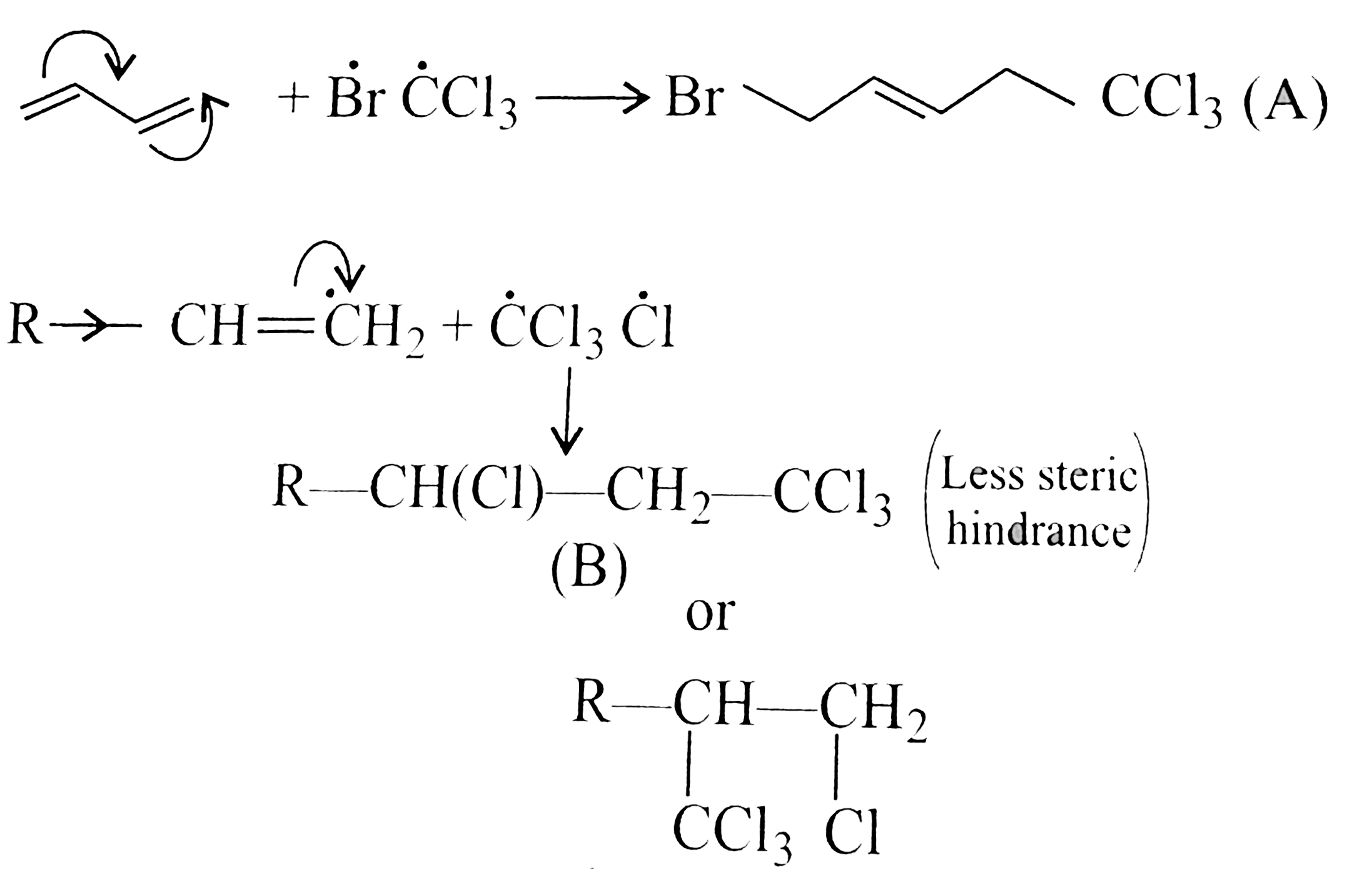 Prodouct `(C)` can be obtained by thecombinationof TWO intermedicate free radicals. `R dot(C) HCH_(2) CCl_(3) + RCH(Cl)dot(C) H_(2)` 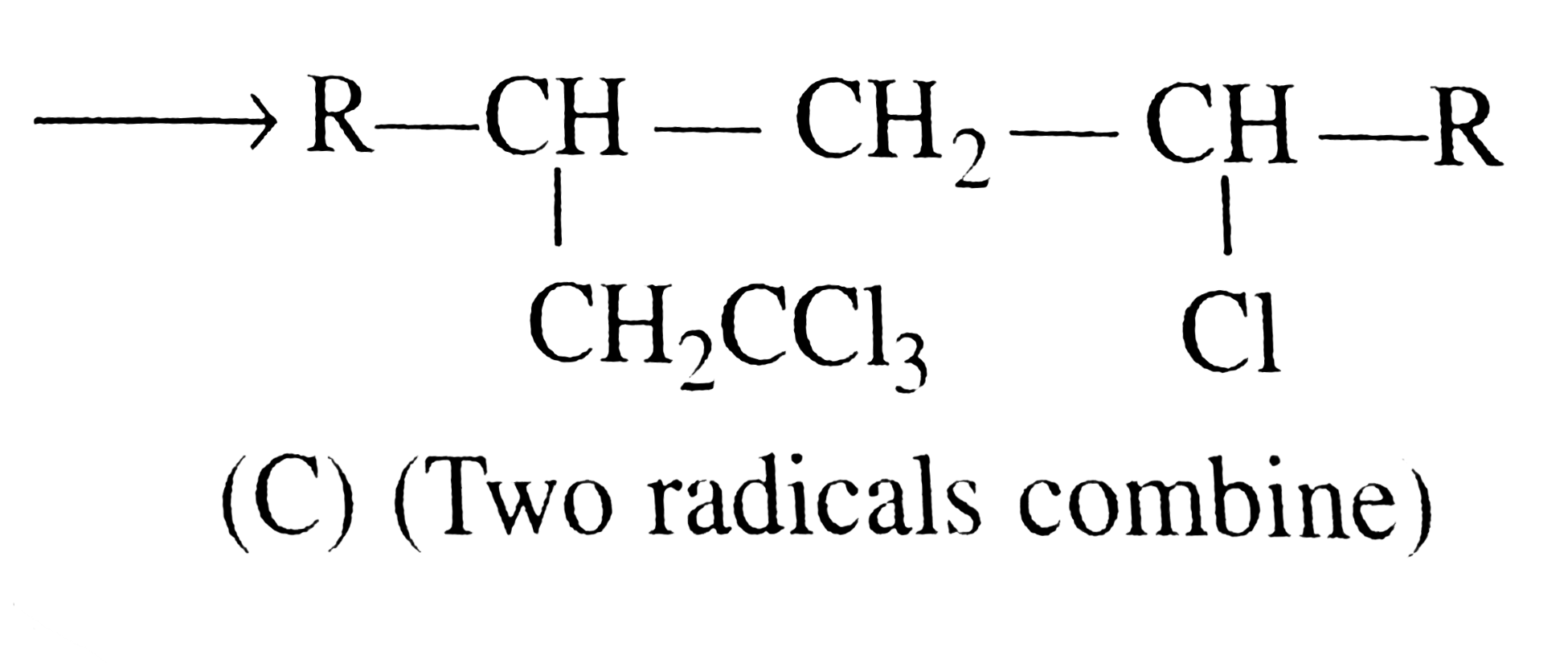 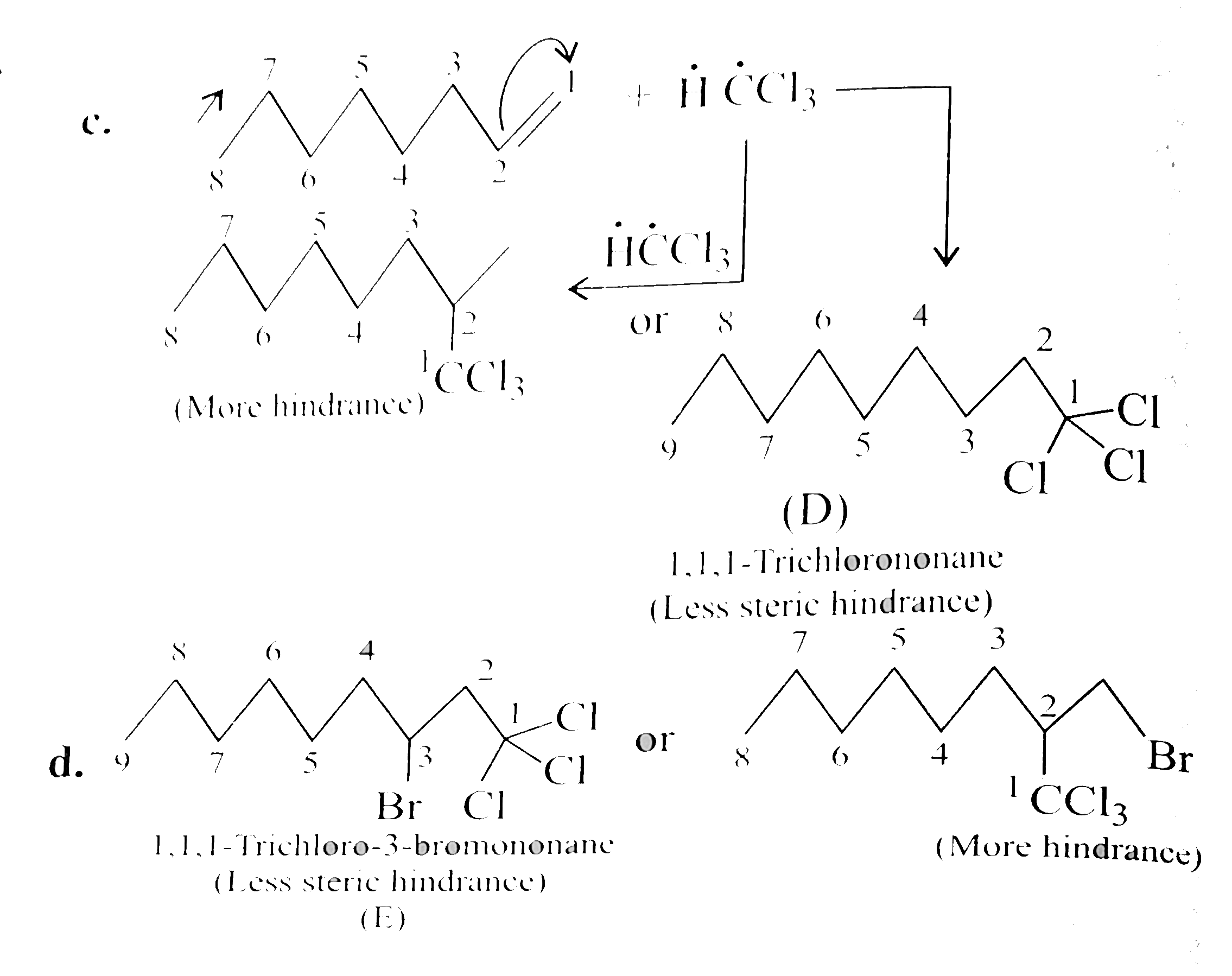 |
|
| 19. |
Increasing value of spin only magnetic moments of :- (I) [Fe(CN)_(6)]^( 4–) (II) [Fe(CN)_6]^( –3)(III) [Cr(NH_(3))_(6)] ^(3+)(IV) [Ni(H_(2)O)_(4)]^( 2+ ) |
|
Answer» I LT II lt III lt IV |
|
| 20. |
Indentifiy the incorrect statement regarding chemical equlibrium |
|
Answer» It can be attained from EITHER side |
|
| 21. |
Increasing the temperature of an aqueous solution wil case |
|
Answer» DECREASE in molality |
|
| 22. |
Increasing the temperature of an aqueous solution will cause |
|
Answer» DECREASE in molality |
|
| 23. |
Increasing the temperature of an aqueous solution will cause - |
|
Answer» DECREASE in molality |
|
| 24. |
Increasing the adsorbing power iof an adsorbent by suddividing it is called ……… of the solid adsorbent. |
| Answer» SOLUTION :ACTIVATION | |
| 25. |
Increasing order of thermal stability is : |
|
Answer» `BeCO_(3)ltMgCO_(3)ltCaCO_(3)ltK_(2)CO_(3)` |
|
| 26. |
Increasing pK_(a) values of o-, and p- cresols is |
|
Answer» <P>`o LT p lt m` |
|
| 27. |
Increasing order of strength of oxyacids of chlorine is: |
|
Answer» `HClOltHClO_2ltHClO_3ltHClO_4` |
|
| 28. |
Increasing order of stability of the +2 oxidation of the ions? |
|
Answer» `CA^(2+)LTBA^(2+)ltSr^(2+)` |
|
| 29. |
Increasing order of stability among the three main conformations (i.e, eclipse, anit, gauche) of 2-fluroethanol is |
|
Answer» ECLIPSE, GAUCHE, ANTI |
|
| 30. |
Increasing order of stability among the three main conformations of 2-Fluroethanol is : |
|
Answer» ECLIPSE, GAUCHE, ANTI |
|
| 31. |
Increasing order of stability among the three main conformation (i.e., eclipse,anti,gauche) of 2-fluoroethanol is: |
|
Answer» ECLIPSE,GAUCHE,ANTI |
|
| 32. |
Increasing order of solubility is |
|
Answer» `CaCO_(3),KHCO_(3),NaHCO_(3)` |
|
| 33. |
Increasing order of reactivity of the following alkyl halide in the Willamson's synthesis is underset(I)(CH_2=CHCH_2CI), underset(II)(CH_3CH_2CH_2Br),underset(III)((CH_(3))C CH_2Br),underset(IV)(CH_3CH_2CH_2CI) |
|
Answer» `II lt III lt IV lt I` `(CH_(3))_(3)CCH_2Br` (Neopentyl bromide, a sterically HINDERED R-X) |
|
| 34. |
Increasing order of reactivity of alkyl halide is |
|
Answer» `R-FltR-BrltR-O=I` |
|
| 35. |
Increasing order of intermolecular forces of the following polymers is |
|
Answer» NEOPRENE, PVC, NYLON -6 |
|
| 36. |
The increasing order of the rate of HCN addition of compound a-d is (i) HCHO (ii) CH_(3)COCH_(3) (iii) PhCOCH_(3) (iv) PhCOPh |
|
Answer» `IV LT ii lt iii lt i` |
|
| 37. |
Increasing order of electronegativity is |
|
Answer» <P>`BI LT P lt S lt CL` |
|
| 38. |
Increasing order of carbon-carbon bond length for the following is : {:(C_(2)H_(4),C_(2)H_(2),C_(6)H_(6),C_(2)H_(6)),((A),"(B)",(C),(D)):} |
|
Answer» `B LT C lt A lt D` |
|
| 39. |
Increasing order of basic nature of NH_(3) (I), CH_(3)NH_(2) (II) "and" C_(6)H_(5)NH_(2) (III) is |
|
Answer» `III lt I lt II` |
|
| 40. |
Increasing order of carbon-carbon bond length for the following is : (i) C_(2)H_(4) (ii) C_(2)H_(2) (iii) C_(6)H_(6) (iv) C_(2)H_(6) |
|
Answer» `BltCltAltD` `C_(2)H_(4)` (A) has 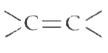 bond ,having bond length 1.34 Å. bond ,having bond length 1.34 Å. `C_(2)H_(4)` (B) has`-C-=C` - bond,having bond length 1.21 Å `C_(2)H_(6)` (D) having 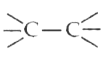 bond,having bond length 1.54 Å `THEREFORE` Increasing order of bond length is bond,having bond length 1.54 Å `THEREFORE` Increasing order of bond length is `BltAltCltD` |
|
| 41. |
Increasing order of boiling points is: |
|
Answer» `H_2O GT H_2S gt H_2Se gt H_2Te` |
|
| 42. |
Increasing order of boiling points is: 1) H_2O gt H_2S gt H_2Se gt H_2Te2) H_2O gt H_2Te gt H_2Se gt H_2S3) H_2O gt H_2Se gt H_2Te gt H_2S 4) H_2O gt H_2S gt H_2 Te gt H_2Se |
|
Answer» `H_2O GT H_2S gt H_2Se gt H_2Te` |
|
| 43. |
Increasing order of acidic character would be |
|
Answer» `CH_(3)COOH lt H_(2)SO_(4) lt H_(2)CO_(3)` |
|
| 44. |
Increasing order of acid strengths of hydrogen halides is: |
|
Answer» HF`LT`HCL`lt`HBR`lt`HI |
|
| 45. |
Increasing order of acid strength among tert butanol, isopropanol and ethanol is : |
|
Answer» Ethanol, ISOPROPANOL,tert butanol |
|
| 46. |
Increasing order of acid strength among p-methoxphenol, p-methylphenol and p-nitrophenol is |
|
Answer» <P> p-nitrophenol,p -METHOXYPHENOL,p-methylphenol |
|
| 47. |
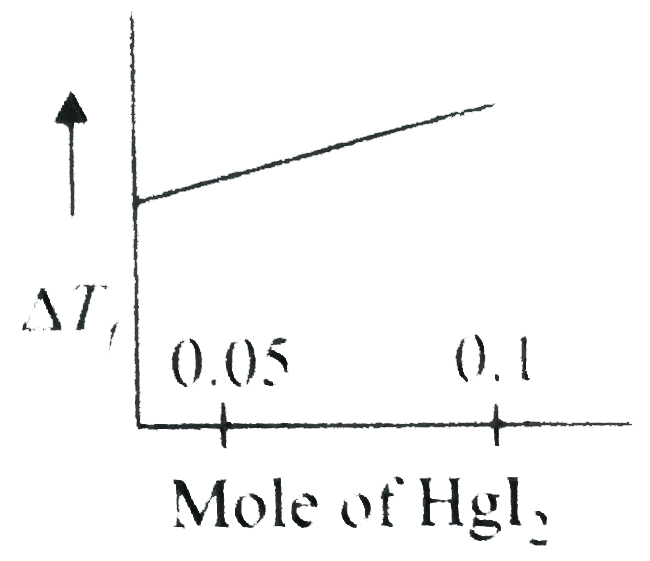
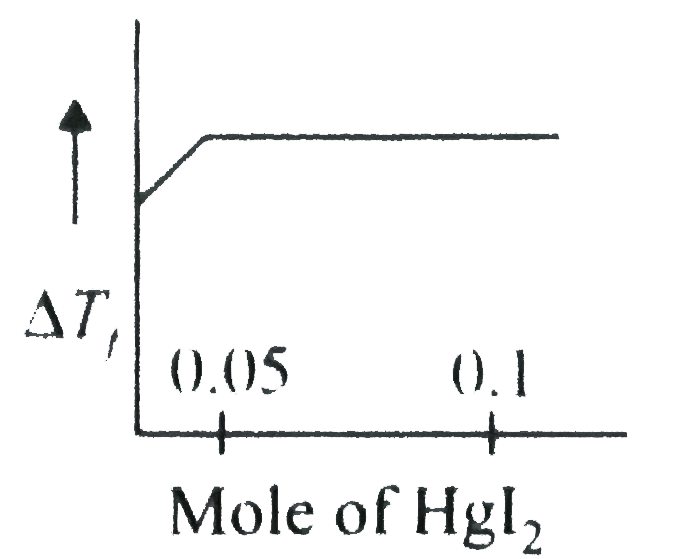
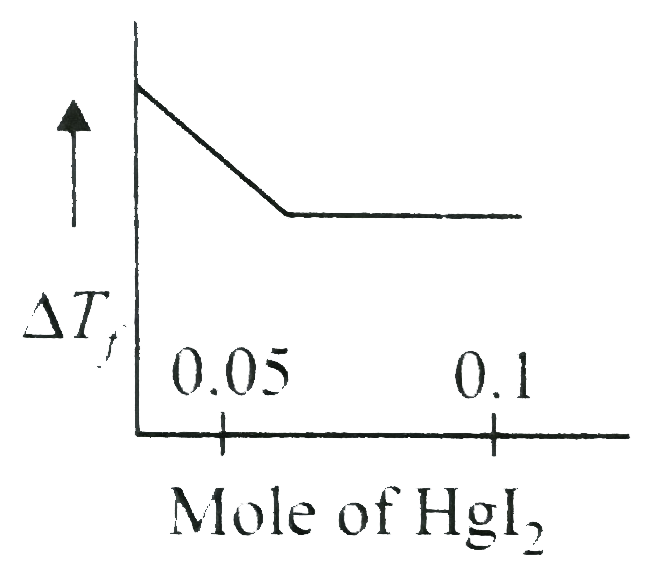
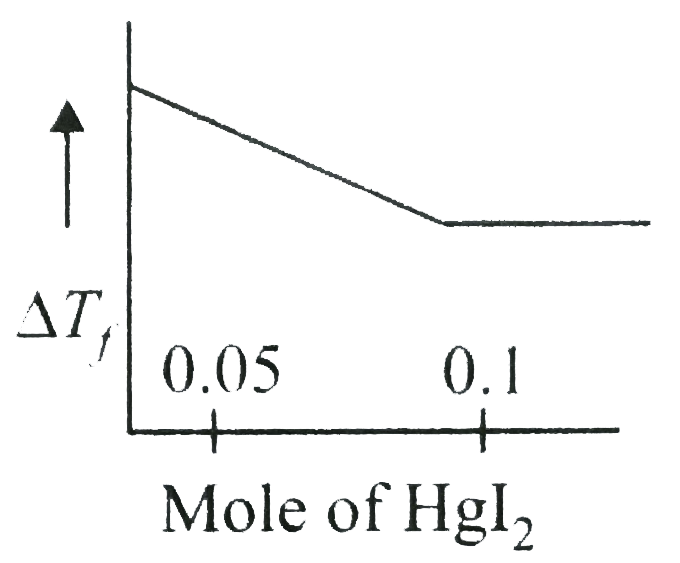
Increasing amoutn of HgI_(2)is added to 1 litre of an aqueous solution containing0.1mole of KI.Which of the following graphs does represent the variation of depression in freezing point of the resulting solution with the amount of HgI_(2)added? |
|
Answer»
|
|
| 48. |
Increasing basic properties of TiO_(2), ZrO_(2) and HfO_(2) are in order : |
|
Answer» `TiO_(2) LT ZrO_(2) lt HfO_(2)` |
|
| 49. |
Increasing amount of solid Hgl_(2) is added to 1 L of an aqueous solution containing 0.1 mol KI. Which fo the following graphs do represent the variation of freezing point of the resulting with the amount of Hgi_(2) added? |
|
Answer»
`HgI_(2)+2KitoK_(2)HgI_(4)` Mole` 0.05""0.2""0.1""0.05` `implies`0.05moles ofare REQUIRED for its complete reaction with KI. Thus, as `HgI_(2)`is being added, number of SOLUTE molecules will decrease causing `DeltaT_(f)`to decrease[Causing `T_(g)`to increase]. When whole of KI has been converted to `K_(2)HgI_(4)` , further addition of `HgI_(2)` doesn’t change the `T_(g)`since it is a sparingly soluble SALT. |
|
| 50. |
Increased blood pressure may be caused by excess secretion of : |
|
Answer» Thyroxin |
|