Saved Bookmarks
This section includes 7 InterviewSolutions, each offering curated multiple-choice questions to sharpen your Current Affairs knowledge and support exam preparation. Choose a topic below to get started.
| 1. |
In the presence of iodine catalyst, chlorine reacts with acetic acid to form |
|
Answer» `CH_(3)-OVERSET(O)overset(||)(C)-Cl` |
|
| 2. |
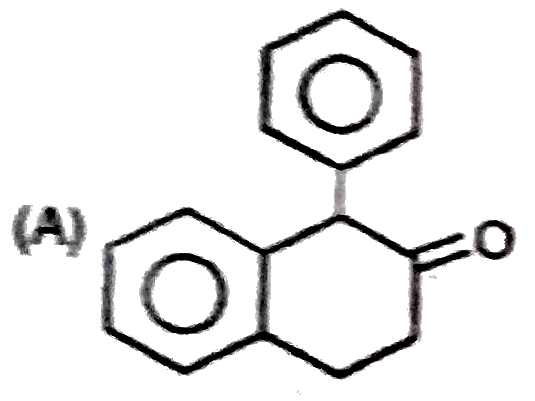
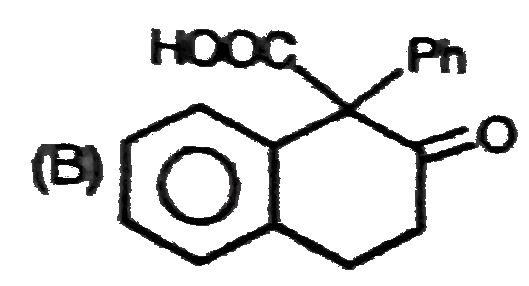
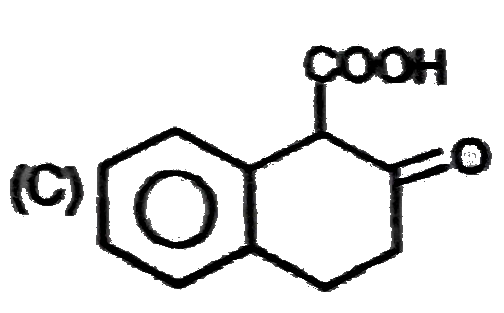
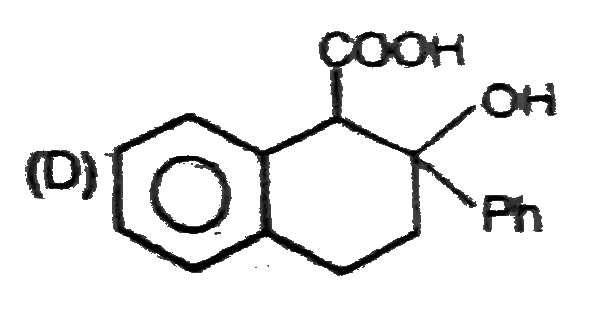
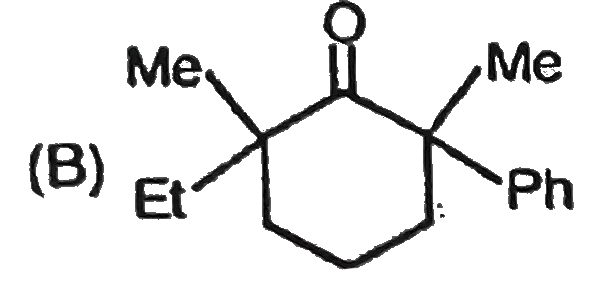
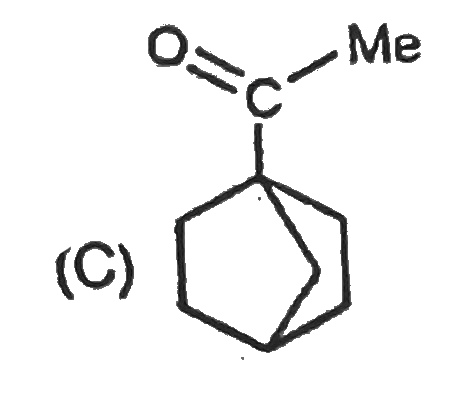
In the presence of excess base and excess halogen a methylketone is converted first into a trihalo substituted ketone and then into a carboxylic acid.After the trihalo substituted ketone is formed hydroxide ion attacks the carboxyl carbon because the trihalo methyl ion is the group more easily expelled from the tetrahedral intermediate.The conversion of a methyl ketone to a carboxylic acid is called a haloform reaction because one of the product is haloform (CHCl_3) or CHI_3 or CHBr_3. |
|
Answer»

|
|
| 3. |
In the presence of excess base and excess halogen a methylketone is converted first into a trihalo substituted ketone and then into a carboxylic acid.After the trihalo substituted ketone is formed hydroxide ion attacks the carboxyl carbon because the trihalo methyl ion is the group more easily expelled from the tetrahedral intermediate.The conversion of a methyl ketone to a carboxylic acid is called a haloform reaction because one of the product is haloform (CHCl_3) or CHI_3 or CHBr_3. Ph-undersetunderset(O)(||)C-undersetunderset(Me)(|)oversetoverset(Et)(|)C-undersetunderset(O)(||)C-CH_3undersetunderset((3)Delta)((2)H^(o+))overset((1)I_2//OH^(o+))to Product is |
|
Answer» `Ph-undersetunderset(O)(||)C-undersetunderset(ET)(|)oversetoverset(Me)(|)C-COOH` |
|
| 4. |
In the presence of enzyme sucrase, the activation energy of sucrose hydrolysis is lowered to …………………. |
|
Answer» `6.22 kJ//mol^(-1)` |
|
| 5. |
In the presence of excess base and excess halogen a methylketone is converted first into a trihalo substituted ketone and then into a carboxylic acid.After the trihalo substituted ketone is formed hydroxide ion attacks the carboxyl carbon because the trihalo methyl ion is the group more easily expelled from the tetrahedral intermediate.The conversion of a methyl ketone to a carboxylic acid is called a haloform reaction because one of the product is haloform (CHCl_3) or CHI_3 or CHBr_3. Which of the following compound show haloform reaction and racemisation in OD^(-) //D_2O |
|
Answer» `CH_3CH_2OH` If H, present on the chiral carbon, undergoes TAUTOMERISATION we will get racemic MIXTURE. |
|
| 6. |
In the presence of dry ether,formaldehyde (A) undergoes nucleophilic addition with Grignard reagent (obtained from methyl iodine and metallic magnesium ) to give compound 'B' . The compound 'B' on heating with diazomethane in the presence of fluorboric acid gives compounds 'C'. Identify compound 'B' and 'C' . |
|
Answer» Methan-1-ol, 1-methoxyethane |
|
| 7. |
In the presence of Cobalt chloride (CoCl_(2)), bleaching powder decomposes to form |
|
Answer» `CaCO_(3)` & `O_(3)` |
|
| 8. |
In the presence of Cobalt Chloride (CoCl_(2)) bleaching powder decomposes to form |
|
Answer» `CaCO_(3) & O` |
|
| 9. |
In the presence of catalyst the energy of activation is ..........and hence greater number of molecules change over to products there by increasing the rate of the reaction. |
| Answer» SOLUTION :LOWERED | |
| 10. |
In the presence of an anthraquinone derivatives as a catalyst, the aqueous solution of sodium dithionite Na_(2)S_(2)O_(4) (Fieser's solution) effectively remove oxygen and forms |
|
Answer» `Na_(2)S_(2)O_(6)` |
|
| 11. |
In the presence of an acid catalyst, two alcohol molecules will undego dehydration to give : |
|
Answer» Ester |
|
| 12. |
In the presenceof alumina as catalyst , two alcohol molecules will undergo dehydration and form |
|
Answer» ESTER |
|
| 14. |
In the presence of a dilute base C_(6)H_(5)CHO and CH_(3)CHO react together to give a product. The product is |
|
Answer» `C_(6)H_(5)CH_(3)` 
|
|
| 15. |
In the presence of a catalyst, what happens to the chemical equilibrium? |
|
Answer» Energy of activation of the forward and backward reactions is LOWERED by same amount |
|
| 16. |
In the presence of a catalyst,the heat evolved or absorbed during the reaction…….. |
|
Answer» INCREASE |
|
| 17. |
In the presence of a catalyst, the heat evolved or absorbed during the reaction …………………. . |
|
Answer» increases |
|
| 18. |
Inthepresenceof a catalyst, theheatevolvedor absorbedduringthe reaction ………. . |
|
Answer» increases |
|
| 19. |
In the presence of a catalyst, the activation energy of a reaction is lowered by 2 kcal at 27^(@)C. The rate of reaction will increase by |
|
Answer» 2 times `k_2=Ae^(-(E_(a)-2)//RT)=Ae^(-E_(a)//RT_(E^(2//RT)))` `:.""k_(2)/k_(1)=e^2//RT"orin"k_2/k_1=2/(RT)` Putting `R=2xx10^(-3)`kcal `K^(-1) mol^(-1)` and `T=300 K,`we get `log""k_2/k_1=2/(2*303xx2xx10^-3xx300)=1*4473` `:."" k_2/k_1=28"or"k_(2)=28xxk_1` |
|
| 20. |
In the preperation of CHCl_3 from ethanol and bleaching powder the latter provides: |
| Answer» Answer :C | |
| 21. |
In the preparation red phosphorous from white phosphorous |
|
Answer» `MnO_(2)` is used as catalyst |
|
| 22. |
In the preparation of sodium carbonate which of the following is used- |
|
Answer» SLAKED lime |
|
| 23. |
In the preparation of sodium carbonate (By solvay ammonia soda process) , which of the following is used |
|
Answer» SLAKED LIME |
|
| 24. |
In the preparation of sodium carbonate (Na_(2)CO_(3)),from solvay process which of the following is used : |
|
Answer» SLAKED lime |
|
| 25. |
In the preparation of red Phosphorous from within Phosphorous |
|
Answer» <P>`MnO_2` is used as catalyst |
|
| 26. |
In the preparation of Nylon -6 from chyclohexanone oxime use is made of a rearrangment reaction. This rearrangment reaction is called |
|
Answer» WOLF rearrangement |
|
| 27. |
What is the role of MnO_(2) in the preparation of O_(2) from KClO_(3) ? |
|
Answer» Activator |
|
| 28. |
In the preparation of nylon -6 polymerisation carried out in the presence of |
|
Answer» NITROGEN |
|
| 29. |
In the preparation of O_2 from KClO_3, MnO_2 acts as: |
|
Answer» Activator |
|
| 30. |
In the preparation of N-phenyl benzene sulphonamide from aniline, the reagent used is |
| Answer» Answer :D | |
| 31. |
In the preparation of KMnO_(4) pyrolusite (MnO_(2)) is first converted to potassium manganate (K_(2)MnO_(4)). In this conversion, the oxidation state off manganese changes from |
|
Answer» +1 to +3 |
|
| 32. |
In the preparation of KMnO_(4) Potassium permanganate is (K_(2)MnO_(4)) is prepared from pyrolucite (MnO_(2)). What is the change in oxidation number? |
| Answer» Answer :D | |
| 33. |
In the preparation of iodethane form ethane which of the following is uded |
|
Answer» HI and HgO |
|
| 34. |
In the preparation of HNO_(3), we get NO gas by catalytic oxidation of ammonia . The moles of No produced by the oxidation of two moles ofNH_(3) will be……… . |
|
Answer» 2 |
|
| 35. |
In the preparation of HNO_3, we get NO gas by catalytic oxidation of ammonia. The moles of NO produced by the oxidation of two moles of NH_(3) will be……………. |
|
Answer» 2 2 moles of `NH_3` will GIVE 2 moles of NO |
|
| 36. |
In the preparation of HNO_3, we get NO gas by catalytic oxidation of, ammonia. The moles of NO produced by the oxidation of two moles of NH_3 will be |
|
Answer» 2 |
|
| 37. |
In the preparation of HNO_(3), we get NO gas by catalytic oxidation of ammonia. The moles of NO produced by the oxidation of twoo moles of NH_(3) will be |
|
Answer» 2 |
|
| 38. |
In the preparation of H_(2)SO_(4) by contact process, why is SO_(3) not absorbed directly in water to form H_(2)SO_(4)? |
| Answer» Solution :Because the REACTION is highly EXOTHERMIC, ACID MIST is formed and thus, the reaction becomes difficult to handle. | |
| 39. |
In the preparation of H_(2)SO_(4) by Contact Process, why is SO_(3) not absorbed directly in water to form H_(2)SO_(4) ? |
| Answer» Solution :A DENSE FOG of `H_(2)SO_(4)` is formed which is difficult to CONDENSE. | |
| 40. |
In the preparation of HNO_(3) by Ostwald process ammonia is |
|
Answer» REDUCED |
|
| 41. |
In the preparation of H_2SO_4 by Contact Process, why is SO_(3)not absorbed directly in water to form H_2SO_4 ? |
| Answer» Solution :If `SO_3` is absorbed directly in WATER, ACID fog is FORMED with the release of large amount of heat. Also, the acid fog is very difficult to CONDENSE. | |
| 42. |
In the preparation of H_2SO_4 by contact process, why is SO_3 not absorbed directly in water to form H_2SO_4 ? |
| Answer» Solution :An ACID FOG is FORMED which is difficult to condense. | |
| 43. |
In the preparation of H_(2) SO_(4),by Constact process V _(2) O_(5) is usedas a catalyst in the reaction. |
|
Answer» `S+O_2rarrSO_2` |
|
| 44. |
In the preparation of H_2SO_4 |
|
Answer» `SO_2` is dissolved in DILUTE `H_2SO_4` |
|
| 45. |
In the preparation of H_(2)SO_(4) |
|
Answer» `SO_(2)` is DISSOLVED in `H_(2)SO_(4)` |
|
| 46. |
In the preparation of Griganrds reagent catalyst used is, |
|
Answer» `I_(2)`<BR>`Cl_(2)` |
|
| 47. |
In the preparation of glucose from sucrose, on hydrolysis with hydrochloric acid, the alcoholic medium is necessary to __________ |
|
Answer» get glucose in higher PERCENTAGE than FRUCTOSE |
|
| 48. |
In the preparation of fluorine, HF is not used because |
|
Answer» It is a liquid |
|
| 49. |
In the preparation of glucose from cane sugar, alcoholic medium is necessary jto |
|
Answer» get more YIELD of glucose |
|
| 50. |
In the preparation of ether, one of the reactant is R-X another is |
|
Answer» ALC. R-ONa |
|