

Saved Bookmarks
This section includes 7 InterviewSolutions, each offering curated multiple-choice questions to sharpen your Current Affairs knowledge and support exam preparation. Choose a topic below to get started.
| 1. |
In both 1st and VII group of the periodic table, the following property increases with increase in atomic number: |
|
Answer» 1. OXIDISING property |
|
| 2. |
In borax, the number of B - O - B links and B - OH bonds present are, respectively |
|
Answer» FIVE and four 
|
|
| 3. |
In borax the number of B-O-B links and B-OH bond present are, respectively. |
|
Answer» FIVE and FOUR 
|
|
| 4. |
In borax bead test, which of the following compound is formed |
|
Answer» Meta borateTetra borate `CuO+B_(2)O_(3)to underset(("Copper metaborate blue"))(Cu(BO_(2))_(2)` |
|
| 5. |
In Borax bead test, metal oxides react with B_(2)O_(3) and form a coloured bead. This bead contains |
|
Answer» orthoborate ion |
|
| 6. |
In Bohr series of lines of hydrogen spectrum, the third line from the red end corresponds to which one of the following inter-orbit jumps of the electron for Bohr orbit in an atom of hydrogen? |
|
Answer» `5to2` |
|
| 7. |
In Bohr' model of the hydrogen atoms the ratio between the period of revolution on an electron in the orbit n = 1 to the period of revolution of the electron in the orbit n = 2 is |
|
Answer» `1:4` |
|
| 8. |
In body drug prontosil is cinverted into |
|
Answer» sulphapyridine |
|
| 9. |
In body center crystal arrangement of solid cube, how much percentage of edges is not occupied by atoms ? |
| Answer» ANSWER :C | |
| 10. |
In B.O.D. test, oxygen plays an important role to |
|
Answer» DESTROY pollution |
|
| 11. |
In body centred cubic structure the space occupied is about |
| Answer» ANSWER :A | |
| 12. |
In blue solution of copper sulphate excess of KCNis added then solution becomes colourless due to the formation of : |
|
Answer» `[Cu(CN)_(4)]^(2-)` `Cu^(2+)+2CN^(-) to Cu(CN)_(2)darr("yellow"), 2Cu(CN)_(2)darr ("white")+(CN)_(2) darr` `CuCN darr +CN^(-) to [Cu^(I)(CN)_(4)]^(3-)` (COLOURLESS SOLUBLE complex) |
|
| 13. |
In blood, the transport of oxygen from lungs to tissues is carried out by : |
|
Answer» WHITE blood CELLS (leukocytes) |
|
| 14. |
In blast furnace, which mixture on heating gives phosphorous ? |
|
Answer» ASH of bone and COKE. |
|
| 15. |
The process of heating of steel to temperature much below redness and then slowly cooling is called: |
|
Answer» REDUCTION zone |
|
| 17. |
In blast furnace, iron oxide is reduced by |
|
Answer» hot blast of air `Fe_(3)O_(4)+COoverset(500-600^(@)C)to3FeO+CO_(2)` `FeO+COoverset(700^(@)C)toFe+co_(2)` Iron formed is called spongy iron. In the reduction reactions heat is also evolved which DECOMPOSES a PART of carbon monoxide into carbon `2COunderset(iron)overset(hot spongy)toCO_(2)+C` |
|
| 18. |
In blast furnace , the cup and cone arrangement is used : |
|
Answer» To ESCAPE the GASES during CHARGING |
|
| 20. |
In BF_(3), the B-F bond length is 1.30 A, when BF_(3) is allowed to be treated with Me_(3)N, it forms an adduct, Me_(3)NtoBF_(3), The bond length of B-F in the adduct is : |
|
Answer» GREATER than `1.30 A` |
|
| 21. |
In blackand whitephotographytheh developedfilmis fixedby washingwith "______" |
|
Answer» Hypesolution |
|
| 22. |
In Birkland and Eyde process, the temperature of electric arc is about? |
|
Answer» `1500^C` |
|
| 23. |
In big cities, air pollution is due to |
|
Answer» BURNING of FOSSIL fuels |
|
| 24. |
In between P_(4)O_(6) " and " P_(4)O_(10) Which of the following option is correct ? [State(T) for true and (F) false] (P) Both having cyclic structure. (Q)Both having same number of p pi-d pi bonds. (R ) Both having same P-O-P bond length. (S) Both having same hybridisation of P atoms. |
|
Answer» TFFT |
|
| 25. |
In between the metals A and B, both form oxide but B also form nitride, when both burns in the air. So A and B are: |
|
Answer» CS, K |
|
| 26. |
In bessemerization, the sulphide of copper is reduced by _________. |
|
Answer» REDUCTION by carbon |
|
| 28. |
In Birkeland and Eyde process, the raw material used is : |
| Answer» Answer :A | |
| 29. |
In benzylic and vinylic halides the halogen bearing carbons are |
|
Answer» both `SP^(3)` hybridised. |
|
| 30. |
In Berkeley -Hartley method, as osmosis starts , the level of a liquid in the capillary |
|
Answer» decreases |
|
| 31. |
In benzene the sp^3 orbitals of each carbon atoms constitute |
|
Answer» Two `SIGMA" and ONE " pi` bond |
|
| 32. |
In Benzene the 'C' atoms are: |
|
Answer» ` sp^3` hybridised |
|
| 33. |
In benzene molecule there are 3pi-bonds and: |
|
Answer» 10 `SIGMA`-bond |
|
| 34. |
In benzene, all the C-C bonds are of equal length because of: |
|
Answer» Isomerism |
|
| 35. |
In benzene, each carbon atom undergoes : |
|
Answer» sp HYBRIDISATION |
|
| 36. |
In benitonite (BaTiSi_(3)O_(9)) number of O atoms shared persilicate tetrahedron is … |
|
Answer» |
|
| 37. |
in Belgian process for reduction of ZnO to Z reductant is |
|
Answer» Al |
|
| 38. |
In Belgan process, for reduction of ZnO to Zn reductant is |
|
Answer» WATER gas |
|
| 39. |
In BCl_(3), the hybridisation state of Boron is : |
|
Answer» SP |
|
| 41. |
In Bayer's process before digesting the one with concentrated Sodium hydroxide it must be |
|
Answer» Dissolved in CRYOLITE |
|
| 42. |
In basic solution abovepH 6, CrO_(3)forms the tetrahedral yellow chromate ion, CrO_(4)^(2-). BetweenpH 2 and 6, HCrO_(4)^(-) and the orange red dichromatedichromate ion, Cr_(2)O_(7)^(2-), arein equilibrium. At pH values below 1, themain species is H_(2)PCrO_(4). Theequilibria are HCrO_(4)^(-) hArrCrO_(4)^(2-) + H^(+), K = 10^(-5.9) H_(2) CrO_(4) hArr HCrO_(4)^(-) + H^(+), K = 4.1 Cr_(2)O_(7)^(2-)+H_(2)O iff 2HCrO_(4)^(-),K=10^(-2.2) In addition, these are base- hydrolysis equilibria Cr_(2)O_(7)^(2-)+OH^(+) iff HCrO_(4)^(-)+CrO_(4)^(2-) HCrO_(4)^(-)+OH^(-) iff CrO_(4)^(2-) iff CrO_(4)^(2-) +H_(2)O The pH dependentequilibria are quite labile and on addition of cations that form insoluble chromates (e.g., Ba^(2+),Pb^(2+) " and " Ag^(+)), the chromates and not the dichromates are precipitated. In the redox reaction involving Cr_(2)O_(7)^(2-) and Fe^(2+) ions, the number of electrons absorbed per chromium atom is |
|
Answer» 1 |
|
| 43. |
In basic solution abovepH 6, CrO_(3)forms the tetrahedral yellow chromate ion, CrO_(4)^(2-). BetweenpH 2 and 6, HCrO_(4)^(-) and the orange red dichromatedichromate ion, Cr_(2)O_(7)^(2-), arein equilibrium. At pH values below 1, themain species is H_(2)PCrO_(4). Theequilibria are HCrO_(4)^(-) hArrCrO_(4)^(2-) + H^(+), K = 10^(-5.9) H_(2) CrO_(4) hArr HCrO_(4)^(-) + H^(+), K = 4.1 Cr_(2)O_(7)^(2-)+H_(2)O iff 2HCrO_(4)^(-),K=10^(-2.2) In addition, these are base- hydrolysis equilibria Cr_(2)O_(7)^(2-)+OH^(+) iff HCrO_(4)^(-)+CrO_(4)^(2-) HCrO_(4)^(-)+OH^(-) iff CrO_(4)^(2-) iff CrO_(4)^(2-) +H_(2)O The pH dependentequilibria are quite labile and on addition of cations that form insoluble chromates (e.g., Ba^(2+),Pb^(2+) " and " Ag^(+)), the chromates and not the dichromates are precipitated. Which of the following statement is correct ? |
|
Answer» Acid SOLUTIONS of dichromate are strong oxidants |
|
| 44. |
In basic solution abovepH 6, CrO_(3)forms the tetrahedral yellow chromate ion, CrO_(4)^(2-). BetweenpH 2 and 6, HCrO_(4)^(-) and the orange red dichromatedichromate ion, Cr_(2)O_(7)^(2-), arein equilibrium. At pH values below 1, themain species is H_(2)PCrO_(4). Theequilibria are HCrO_(4)^(-) hArrCrO_(4)^(2-) + H^(+), K = 10^(-5.9) H_(2) CrO_(4) hArr HCrO_(4)^(-) + H^(+), K = 4.1 Cr_(2)O_(7)^(2-)+H_(2)O iff 2HCrO_(4)^(-),K=10^(-2.2) In addition, these are base- hydrolysis equilibria Cr_(2)O_(7)^(2-)+OH^(+) iff HCrO_(4)^(-)+CrO_(4)^(2-) HCrO_(4)^(-)+OH^(-) iff CrO_(4)^(2-) iff CrO_(4)^(2-) +H_(2)O The pH dependentequilibria are quite labile and on addition of cations that form insoluble chromates (e.g., Ba^(2+),Pb^(2+) " and " Ag^(+)), the chromates and not the dichromates are precipitated. The equilibria, (a)Cr_(2)O_(7)^(2-) iff 2CrO_(4)^(2-) is shifted to right in |
|
Answer» An ACIDIC medium |
|
| 45. |
In Bayer's process. Al(OH)_(3) in heating gives |
|
Answer» `NaAlO_(2)` |
|
| 46. |
In basicity of aniline is weaker in comparison to that of methylamine due to |
|
Answer» hyperconjugative effect of Me group of `MeNH_(2)` |
|
| 47. |
In basic medium , CrO_(4)^(2-)oxidize S_(2)O_(3)^(2-) to form SO_(4)^(2-) and itself changes to Cr(OH)_(4)^(-) How many ml of 0.154 M CrO_(4)^(2-)are required to react with 400 ml of 0.246 MS_(2)O_(3)^(2-)? |
|
Answer» `200ML ` `:.V = 170.4 ML` |
|
| 48. |
In basic medium the amount of Ni^(2+) in a solution can be estimated with the dimethylglyoxime reagent. The correct statement (s) about the reaction and the product is (are) |
|
Answer» in ammoniacal SOLUTION `Ni^(2+)` salts give cherry RED precipitate of nickel (II) dimethylglyoximate 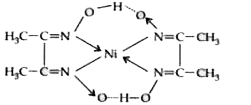
|
|
| 49. |
In basic medium the amountof Ni^(2+) in a solution can be estimated with the dimethylglyoxime reagent. The correct statemnt(s) about the reaction an the product is (are) |
|
Answer» in ammoniacal solution `Ni^(2+)` salts given cherry RED precipitate of nickel (II) dimethlglyoximate 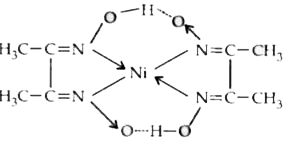
|
|