

Saved Bookmarks
This section includes 7 InterviewSolutions, each offering curated multiple-choice questions to sharpen your Current Affairs knowledge and support exam preparation. Choose a topic below to get started.
| 1. |
In Balmer series of hydrogen atom spectrum which electronic transition causes third line ? |
|
Answer» Fifth Bohr orbit to SECOND one |
|
| 2. |
In balancing the half reaction S_(2)O_(3)^(2-)toS_((s)) the number of electrons that must be added is:- |
|
Answer» 4 on the left |
|
| 3. |
In azo-couplingthe substitutionusuallyoccurs at ____positionto theactivatinggroup |
| Answer» SOLUTION :ElectrondoN/Ating GROUP | |
| 4. |
In bakelite , the rings are joined to each other through |
|
Answer» `-CH_2-` |
|
| 5. |
In (B), there is increase in conductance before (though slightly) and after the end point. This |
|
Answer» FORMATION of NaCl type SALT from STRONG acid which is HYDROLYSED releasing NaOH `NaCl+H_2O= NaOH+HCI` |
|
| 6. |
In AX_(5) type sof moleculeif 'A' undergoes sp^(3)d^(2) hybridisation, then the shape of the molecule is |
|
Answer» T- shape |
|
| 7. |
In B_2H_6 : |
|
Answer» There is a DIRECT boron-boron bond |
|
| 9. |
In auto catalysis_____acts as catalyst. |
|
Answer» reactant |
|
| 10. |
In athe extraction of copper, the copper matte is a mixture is |
|
Answer» COPPER (II) Sulphide and IRON (II) Sulphide |
|
| 11. |
In aryl halides, what is the hybridisation of carbon atom to which halogen is attached? |
| Answer» Solution :In aryl HALIDES, the hhybridisation of carbon atom to which HALOGEN is attached is `SP^(2)` | |
| 12. |
In assigning R-S configuration which among the following groups has highest priority? |
|
Answer» `-SO_(3)H` |
|
| 13. |
In Arrhenius equation , k=Ae^(E_a/(RT)) , A may not be termed as rate constant . |
|
Answer» When 100% REACTANT will CONVERT into the product |
|
| 14. |
In Arrhenius equation for a certain reaction, thevalue of A and E_a (activation energy) are 4 x 10^(13) s^(-1) and 98.6 kJ mol^(-1) respectively If the reaction is of first order, then at what temperature will its half life period be 10 minutes? [log 2 88 = 0.4594] |
|
Answer» 350.5 K |
|
| 15. |
In Arrhenius equation, If EA is positive and T_(2)gt T_(1), then ___________ |
|
Answer» `k_(1)=k_(2)` |
|
| 16. |
In Arrhenius equation for a a certain reaction , the values of A and E_a (activation energy ) are 4xx10^(13)"sec"^(-1) and 98.6"kJ mol"^(-1) respectively. If the reaction is of order , at what temperature will its half life period be 10 minutes ? |
|
Answer» Solution :ACCORDING to the Arrhenius equation, `k=Ae^(-E_a/(RT))` or `log_ek=log_eA-(E_a)/(RT)` or `2.303log_(10)k=2.303log_(10)A -E_a/(RT)` `t_(1//2)=(0.693)/k(0.693)/600` `k=(0.693)/(600)sec^(-1)(t_(1//2)=10min=600sec)` `=1.1xx10^(-3)sec^(-1)` Hence , LOG `(1.1xx10^(-3)` `=log(4xx10^(13))-(98.6xx10^3)/(2.303xx8.314xxT)` `T=310.95K` |
|
| 17. |
In Arrhenius equation K=Ae^-Ea//RT ,the quantity-E_a//RT is referred as : |
|
Answer» BOLTZMANN factor |
|
| 18. |
In aqueous solutions, the basic strength of amines decreases in the order |
|
Answer» `CH_(3)NH_(2) GT (CH_(3))_(2)NH_(2) gt (CH_(3))_(3)N` `2^(@) gt 1^(@) gt 3^(@) i.e., (CH_(3))_(2)NH gt CH_(3)NH_(2)gt (CH_(3))_(3)N` |
|
| 19. |
In Arrhenius equation |
|
Answer» The Arrhenius constant has UNITS of RATE of reaction |
|
| 20. |
In aqueous solutions H_(2) SO _(4) ionises as: H _(2) SO_(4) + H _(2) O hArr H _(2) SO _(24 ) ^(-) + H _(3) O ^(+) , K a _(1) H_(2) SO _(4) ^(-) + H_(2) O hArr SO _(4) ^(2-) + H_(3) O ^(+) , Ka _(2). The relation between Ka _(1) and Ka _(2)is |
|
Answer» `Ka_1ltKa_2` |
|
| 21. |
In aqueous solutions Eu^(2+) acts as |
|
Answer» an OXIDISING AGENT |
|
| 22. |
In aqueous solution which of the following colour is exhibited by Nici, |
| Answer» Answer :B | |
| 23. |
In aqueous solutions Cu^+ is less stable than Cu^(2+) |
|
Answer» |
|
| 24. |
In aqueous solution the ionization constants for carbonic acid are : K_(1)=4.2xx10^(-7)and K_(2)=4.8xx10^(-11) Select the correct statement for a saturated 0.034 M solution of carbonic acid. |
|
Answer» The concentration of `H^(+)` and `HCO_(3)^(-)` are approzimately EQUAL. Since `K_(1)gt gt K_(2)` Conc. of `H^(+)` and `HCO_(3)^(-)`are approximately equal. |
|
| 25. |
In aqueous solution, weak electrolytes dissociates: |
|
Answer» Completely |
|
| 26. |
In aqueous solution the ionization constant for carbonic acid are K_(1) = 4.2 xx 10^(-7) and K_(2) = 4.8 xx 10^(-11) Select the correct statement for a saturated 0.034 M solution of the carbonic acid |
|
Answer» The concentration of `H^(+)` is double that of `CO_(3)^(2-)` |
|
| 27. |
In aqueous solution the following undergoes disproportination reaction |
| Answer» Answer :D | |
| 28. |
In aqueoussolutionof anamino acid, the carboxylgroup can gain a proton and amino acidcan losea protons hydrogen bonds. |
|
Answer» |
|
| 29. |
In aqueoussolutionof amino aicds mostly existsin , |
|
Answer» `NH_(2) - CH (R) - CO OH` |
|
| 30. |
In Aqueous solution, metal ion M_(1) reacts separately with reagents Q and R in excess to give tetrahedral and square planar complexes respectively. An aqueous solution of another metal ion M_(2) always froms tetrahedral complexes with these reagents. Aqueous solution of M_(2) on reaction with reagent S gives white precipitate which dissolves in excess of S. The reactions are summarized in the scheme given ahead Reagent S is |
|
Answer» `K_(4)[Fe(CN)_(6)]` |
|
| 31. |
In Aqueous solution, metal ion M_(1) reacts separately with reagents Q and R in excess to give tetrahedral and square planar complexes respectively. An aqueous solution of another metal ion M_(2) always froms tetrahedral complexes with these reagents. Aqueous solution of M_(2) on reaction with reagent S gives white precipitate which dissolves in excess of S. The reactions are summarized in the scheme given ahead M_(1), Q and R respectively are |
|
Answer» `Zn^(2+)` , KCN and HCl  `Zn^(2+)` ion on the other hand forms tetrahedral complexes with both `CN^(-)` and `CL^(-)` ions because the ion has `d^(10)` configuration which is quite stable.  The sequence of the reaction involved is given. 
|
|
| 32. |
In aqueous solution of amino acids mostly exists in, |
|
Answer» `NH_(2)CH( R)-COOH` |
|
| 33. |
In Aqueous solution meta aluminate ion exists as |
|
Answer» NEUTRAL complex |
|
| 34. |
In aqueous solution H,_2SO_4, ionise in two steps. In first steps it produces ? |
|
Answer» `SO_(4)^(2-)` |
|
| 35. |
In aqueous solution, glucose remains as- |
|
Answer» only in OPEN chain form  The six-membered CYCLIC form is generally reffered to as the 'pyranose' form, and the five-membered cyclic form is called the 'furanose' form. Closure of the ring creates a chiral center at `C-1` resulting in TWO diastereomers (sometime called ''anomers'') the alpha `(alpha)` and beta `(beta)` forms |
|
| 36. |
In aqueous solution glucose remains as |
|
Answer» only in open CHAIN FORM 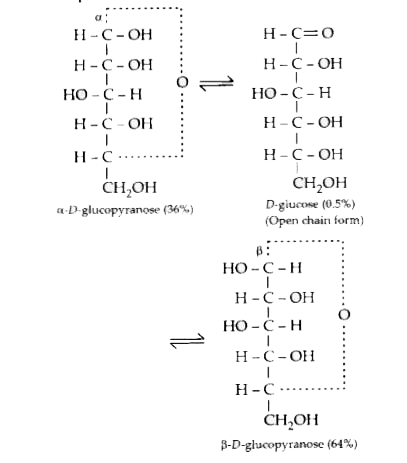
|
|
| 37. |
In aqueous solution glucose exist in how many isomeric forms. |
|
Answer» |
|
| 40. |
In aqueous solution Eu^(2+) acts as : |
|
Answer» An OXIDISING AGENT |
|
| 42. |
In aqueous solution Cd(II) exists as 6-coordinates aqua-complex. The solution on treatment with Br^(-) ion forms finally 4-coordinate Cd(II) complex with Br^(-) ions successively in four step with stepwise formation constants, logK_(1) = 1.56, log K_(2) = 0.54, log K_(3) = 0.06 and log K_(4) = 0.37. The higher value of K_(4) as compound to K_(3) is due to |
|
Answer» transformation of trigonal COMPLEX into tetrahedral complex. |
|
| 43. |
In aqueous phase basicity of amines is in order NH_(3) lt (CH_(3))_(3)N lt CH_(3)NH_(2) lt (CH_(3))_(2)NH It is due to the following facts |
|
Answer» ammonium ions in solution are stabilised not only by alkyl GROUPS but also by HYDROGEN bond DONATION to the solvent. |
|
| 44. |
In aqueous phase, most basic among the following is ________. |
|
Answer» ammonia |
|
| 45. |
In aqueous alkaline solution, two electron reduction of HO_(2)^(-) gives |
Answer» SOLUTION :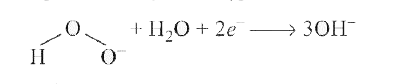
|
|
| 46. |
In aqueous medium behavior of SO_2 is similar to that of |
|
Answer» `SO_(3)` |
|
| 47. |
In aquaregia____is responsible for dissolving gold and platinum. |
| Answer» SOLUTION :NASCENT CHLORINE | |
| 48. |
In any unimolecular reaction…… |
|
Answer» only one reacting SPECIES is involved in the rate determining step |
|
| 49. |
In any unimolecular reaction ………………… . |
|
Answer» only ONE reacting SPECIES is involved in the rate determining step |
|
| 50. |
In any unimolecular reaction ___________ |
|
Answer» Only two REACTING species is involved in the rate determining STEP. |
|