Saved Bookmarks
This section includes 7 InterviewSolutions, each offering curated multiple-choice questions to sharpen your Current Affairs knowledge and support exam preparation. Choose a topic below to get started.
| 1. |
In case of an ideal gas, Joule Thomson effect is |
|
Answer» zero |
|
| 2. |
In case of alkali metals, the covalent character decreases in the order |
|
Answer» `MFgtMClgtMBrgtMI` |
|
| 3. |
In case of actinoids, the degree of complex formation decreases as : |
|
Answer» `M^(4+) GT M^(3+) gt Mo_(2)^(2+) gt MO_(2)^(+)` |
|
| 4. |
In case of a cubic system, the number of types of space lattices |
|
Answer» 3 |
|
| 5. |
In case N and S are also present along with halogen in the organic compound, the Lassaigne's solution is heated with : |
|
Answer» SODIUM hydroxide |
|
| 6. |
In Carius method of estimation of halogens, 250 mg of an organic compound gave 141 mg of AgBr. The percentageof bromine in the compound is : (Atomic mass Ag = 108, Br = 80) |
| Answer» Answer :C | |
| 7. |
In Carius method of estimation of halogens, 250mg of an organic compound gave 141mg of AgBr. The percentage of bromine in the compound is : (at mass Ag=108 , Br=80) |
|
Answer» Solution :Percentge of `Br` `=(80)/(188)xx("MASS of" AgBr)/("Wt.of compound")XX100` `=(80)/(188)xx(141)/(250)xx100=24%` |
|
| 8. |
In Carius method of estimation of halogens, 250 mg of an organic compound gave 141 mg of AgBr. The percentage of bromine in the compound is: (at mass Ag=108 , Br =80) |
|
Answer» `24` Thus`% Br = (80)/(188) xx (141)/(250) xx 100 = 24`. |
|
| 9. |
In Carius method of estimation of halogen, 250mg of an organic compound gave 141mg of AgBr. The percentage of bromine in the compound is (Ag= 108, Br= 80) |
|
Answer» 24 |
|
| 10. |
In Carius method for estimation of halogen, 0.99g of an organic compound gave 0.287g AgCl. The percentage of chlorine in the compound is |
|
Answer» `63.2` `%` of CHLORINE `=(35.5)/(143.5)xx("MASS of "AgCl)/("Mass of Compound")XX100` `=(35.5)/(143.5)xx(0.287)/(0.099)xx100=71.7%` |
|
| 11. |
In carbonyl compounds, the carbonyl group is polar as well as in sp^(2) hybridisation state. As a result, these compounds are highly reactive in nature and takepart in the addition reactions. The mechanism of these reactions is nucleophilic in nature and is catalyseed in the weakly acidic medium. The extent of nycleophilic addition is influenced by two factors. These are steric effect of the groups attached to the carbonyl carbon atom. Both tend to decrease the reactivity of these compounds in the nuclephilic addition reactions. Important properties of carbon compounds are : nucleophilic addition and acidity of alpha-hydrogen atoms. , Which factor is most useful in explaning these two ? |
|
Answer» PRESENCE of carbon-oxygen double bond. |
|
| 12. |
In carbylamine test, we heat a primary amine with a substance X and a base. The substance X is |
|
Answer» `C""Cl_(4)` |
|
| 13. |
In carbonium ion the carbon bearing the positive charge is: |
|
Answer» sp-hybridised |
|
| 14. |
In carbon monoxide carbon, oxygen bond length is 1.128Å. What is the carbon, oxygen bond length in [Fe(CO_(5)]? Why? |
| Answer» SOLUTION :`1.15Å` | |
| 15. |
In Ca(OH)_(2), solution (aqueous), the molar concentration of OH^(-) is found to be x, the solubility of Ca(OH)_(2) in moles/litre is |
|
Answer» 2x |
|
| 16. |
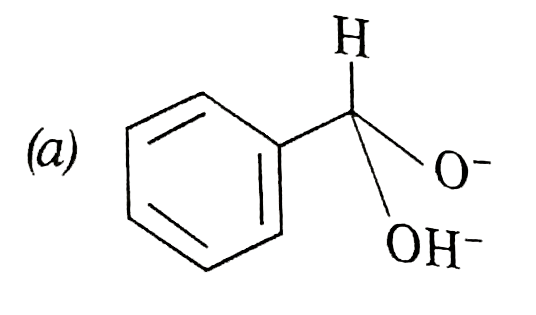
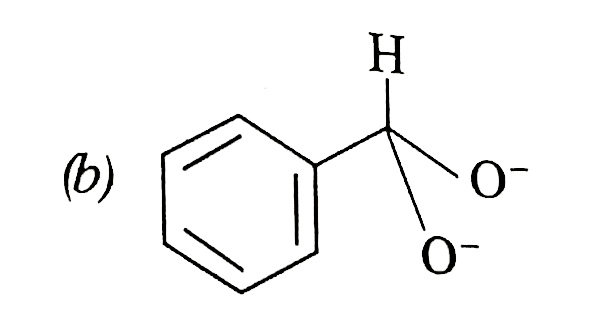
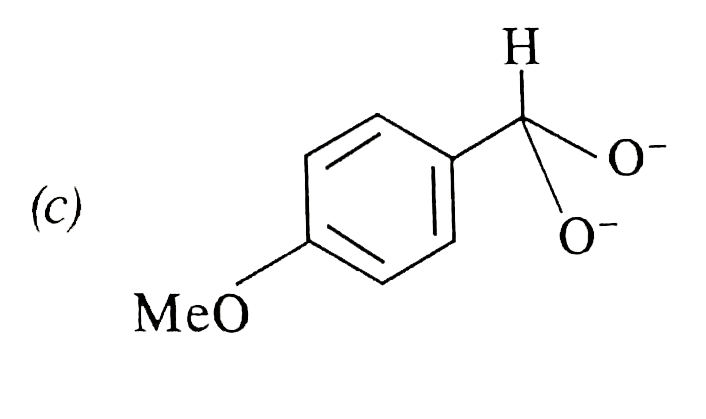
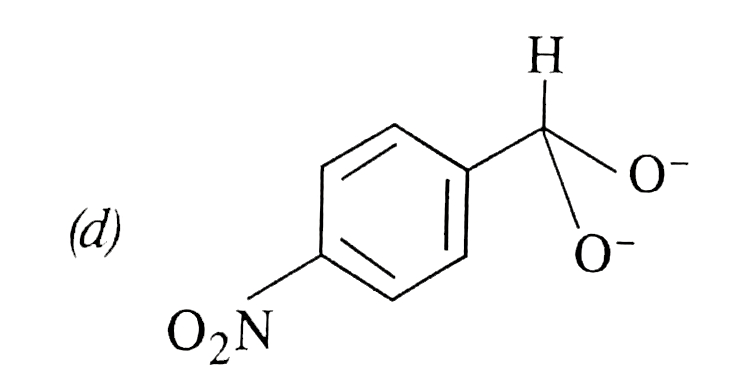
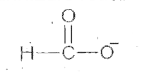
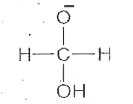
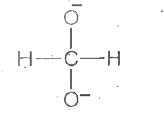
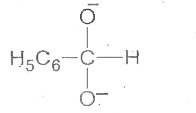
In Cannizzaro's reaction, which intermediate ion is best hydride (H^(-)) ion donor ? |
|
Answer»
|
|
| 17. |
In Cannizzaro's reaction fo formaldehyde involves an |
|
Answer» INTRAMOLECULAR SHIFT of PROTON |
|
| 18. |
In Cannizzaro's reaction, what is the rate determining step ? |
Answer» Solution :`H-overset(O)overset(||)(C)-H+bar(O)H RARR H-underset(H)underset(|)overset(bar(O))overset(|)(C)-OH`  and `H-overset(O)overset(||)(C)-OH-CH_(3)O^(-)rarrHCOO^(-)+CH_(3)OH` TRANSFER of hydride ion on to the carbonyl carbon is the rate determining STEP in the Cannizaro.s reaction. |
|
| 20. |
In Cannizaro reaction which species is best hydride donor (in conc. Alkaline medium) |
|
Answer»
|
|
| 21. |
In Cannizzaro reaction givenbelow, the slowest step is 2PhCHO overset(OH^(-))to PhCH_(2)OH + PhCO_(2)^(-) |
|
Answer» the abstraction of PROTON from the carboxylic group. |
|
| 22. |
In calcium fluoride,having the fluorite structure ,the coordination number for calcium ion Ca^(+2) and fluoride ion F^(-) are |
|
Answer» 8,4 `CA^(+2)`=8 `F^(-)=4` |
|
| 23. |
In calcium fluoride, having the flurite structure the coordination number of Ca^(2+) ion and F^(-) Ion are ……………. . |
|
Answer» 4 and 2 `CA^(2+)` IONS are in face centered CUBIC arrangement, each `Ca^(2+)` ions. Therefore coordination number of `Ca^(2+)` is 8 and of `F^(-)` is 4 |
|
| 24. |
In calcium fluoride, havingthe fluoritestructurethe coordinationnumber ofCa^(2+) ion andF^(-)lon are |
|
Answer» 4 and 2 |
|
| 25. |
In calcium fluoride, having a fluorite structure, the co-ordination numbers for calcium ion (Ca^(2+)) and fluoride ion (F^-) are : |
|
Answer» 4 and 2 |
|
| 26. |
In calcium flouride, having the flourite structure, the coordination numbers for calcium ion (Ca^(2+)) and flouride ion (F^(-)) are- |
|
Answer» 4 and 8 |
|
| 27. |
In CaF_(2), the coordination numbers of Ca^(2+) and F^(-) ions are respectively. |
|
Answer» 8,4 |
|
| 28. |
In CaF_2, the forces present are |
|
Answer» LONDON FORCES |
|
| 29. |
In C_(3)O_(2), the hybridization state of carbon is : |
| Answer» SOLUTION :`O=underset(sp)"C"=underset(sp)"C"=underset(sp)"C"=O` | |
| 30. |
In C_(60) carbon atoms from _________. |
|
Answer» HEXAGONS and octagons |
|
| 31. |
In butter, which of the following are dispersed phase and dispersion medium respectively ? |
|
Answer» SOLID and solid |
|
| 32. |
In C+ H_2O rarrCO +H_2,H_2O act as : |
| Answer» Answer :A | |
| 33. |
In butane, which of the following form has the least stable ? |
|
Answer» GAUCHE form |
|
| 36. |
In brow ring test for nitrates Fe^(2+) ion reduces NO_(3)^(-) ion to ............. Which subsequently reacts with Fe^(2+) ion to form a brown ring complex having the molecular formula ................ . |
| Answer» SOLUTION :`NO, [FE(H_(2)O)_(5)NO]^(2+)` | |
| 37. |
In brown ring Fe and NO exist as Fe^(+) and NO^(+) rather than Fe^(2+) and NO. These forms can be differentiated by |
|
Answer» Measuring the conductivity of an AQUEOUS solution of the complex |
|
| 38. |
In bromination of phenol, o-Bromophenol is minor product due to ___________. |
|
Answer» stericattraction between -OH and -BR |
|
| 39. |
In breax bead test,Which compound (s)is/are not formed? |
|
Answer» Orthoborate |
|
| 40. |
In both DNA and RNA, heterocyclic base and phosphate esters linkages are at : |
|
Answer» `C_(5)' and C_(2)`' respectively to sugar MOLECULE . |
|
| 41. |
In Both Dow's proces of Raschig's processes for the manufacture of phenol , ________ |
|
Answer» conversion of BEZENE to phenol is INVOLVED |
|
| 42. |
In both DNA and RNA , heterocyclic base and phosphate ester linkages are at |
|
Answer» `C_(5)' and C_(2)`' RESPECTIVELY of the SUGAR molecule |
|
| 43. |
In both . DNA and RNA, heterocyclic base and phosphate ester linkages are at |
|
Answer» `C_5` and `C_1` respectively of the sugar molecule  Thus, ester LINKAGES are at `C_5^1` and `C_1^1` of sugar molecules |
|
| 44. |
In both DNA and RNA, heterocyclic base and phosphate ester linkages are at- |
|
Answer» `C_5^'` and `C_1^'` respectively of the sugar molecule |
|
| 45. |
In both alkyl halides and aryl halides, the halogen (X) atom is attached directly to the carbon atom. They are expected to exhibit similar reactivity. However, aryl halides are comparatively very little reactive, particularly towards nucleophilic substitution reaction. for example, hydrolysis of ethyl chloride occurs by simply boiling with aqueous KOH. ON the other hand, the alkaline hydrolysis of chlorobenzene requires a very high temperature (623K) as well as a very high pressure. Q. Friedel Craft's reaction of bromobenzene with methyl iodide gives, |
|
Answer» o-Bromotoluene |
|
| 46. |
In both DNA and RNA , base and phosphate esterlinkage are at |
|
Answer» `C'_(5) "and" C'_(2)` RESPECTIVELY of sugar molecule |
|
| 47. |
In both ………………and ……………………. arrangements, the coordination number of each sphere is 12. |
| Answer» SOLUTION :HCP, CCP | |
| 48. |
In both alkyl halides and aryl halides, the halogen (X) atom is attached directly to the carbon atom. They are expected to exhibit similar reactivity. However, aryl halides are comparatively very little reactive, particularly towards nucleophilic substitution reaction. for example, hydrolysis of ethyl chloride occurs by simply boiling with aqueous KOH. ON the other hand, the alkaline hydrolysis of chlorobenzene requires a very high temperature (623K) as well as a very high pressure. Q. Among the following which has weakest C-X bond? |
|
Answer» Benzyl bromide |
|
| 49. |
In both alkyl halides and aryl halides, the halogen (X) atom is attached directly to the carbon atom. They are expected to exhibit similar reactivity. However, aryl halides are comparatively very little reactive, particularly towards nucleophilic substitution reaction. for example, hydrolysis of ethyl chloride occurs by simply boiling with aqueous KOH. ON the other hand, the alkaline hydrolysis of chlorobenzene requires a very high temperature (623K) as well as a very high pressure. Q. Benzene reacts with Cl_(2) in the presence of FeCl_(3) (and absence of sun light) to form: |
|
Answer» BENZYL chloride |
|
| 50. |
In both alkyl halides and aryl halides, the halogen (X) atom is attached directly to the carbon atom. They are expected to exhibit similar reactivity. However, aryl halides are comparatively very little reactive, particularly towards nucleophilic substitution reaction. for example, hydrolysis of ethyl chloride occurs by simply boiling with aqueous KOH. ON the other hand, the alkaline hydrolysis of chlorobenzene requires a very high temperature (623K) as well as a very high pressure. Q. The halide which does not give any precipitate when warmed with alcoholic AgNO_(3) solution is: |
|
Answer» chlorobenzene |
|