Saved Bookmarks
This section includes 7 InterviewSolutions, each offering curated multiple-choice questions to sharpen your Current Affairs knowledge and support exam preparation. Choose a topic below to get started.
| 1. |
In chemical behaviour, earlier members of lanthanoids are quite reactive similar to______________. |
| Answer» SOLUTION :CALCIUM | |
| 2. |
In chemical adsorption how many layers are there on adsorbent? |
|
Answer» Infinite |
|
| 3. |
In chemical adsorption, gas molecules are held to the surface by formation of chemical bond and nearly ........... is given out as heat of adsorption |
| Answer» SOLUTION :400 kJ/mole | |
| 4. |
In CHCl_(2)+OH^(-)toHCOO^(-), the intermediate (s) is/are |
|
Answer» :CC`l_(3)^(-)` |
|
| 5. |
In charging the lead accumulator battery |
|
Answer» `PbO_(2)` DISSOLVES `2PbSO_(4(s))+2H_(2)OtoPb_((s))+PbO_(2(s))` `+4H_((aq))^(+)+2SO_(4(aq))^(2-)`. |
|
| 6. |
In chain growth polymerization initiator is |
|
Answer» free RADICALS |
|
| 7. |
Between 1M CH_3COOH and0.1M CH_3COOH ,which has higher electrical conductivity? |
| Answer» Answer :A | |
| 9. |
In CH_3CH_2OH the bond which most readily undergoes heterolytic cleavage during its reaction with CH_3COOH//H_2SO_4 is : |
|
Answer» C-C |
|
| 10. |
In CH_(3)CH_(2)OH, the bond that undergoes hyteroytic cleavage most readily id : |
|
Answer» C-C |
|
| 11. |
In CH_(3)CH_(2)OH the bond that undergoes hetrolytic change most readily is |
|
Answer» C-C |
|
| 12. |
In CH_(3)CH_(2)OH, the bond that undergoes heterolytic cleavage most readily is |
|
Answer» C-C |
|
| 13. |
In CH_3CH_2OH the bond that undergoes heterolytic cleavage nost readily is: |
|
Answer» C - C |
|
| 14. |
In CH_(3)CH_(2)OH, the bond that undergoes heterolytic cleavage most readily is: |
|
Answer» `C-C` |
|
| 15. |
In CH_(3)-underset(..)(O)-CH_(3), oxygen atom has p^(3) hybridisation with two lone pair of electron. C-O-C bond angle is: |
|
Answer» `110^(@)` |
|
| 16. |
In CH_(3)-CH_(2)-CH_(2)-Br,C-Br bond is formed by the overlapping of |
|
Answer» `2sp^(3)-2p_(Z)` |
|
| 18. |
In certain matters lithium differs from other alkali metals,the main reason for this is |
|
Answer» Small SIZE of Li atom and `Li^(+)` ION |
|
| 19. |
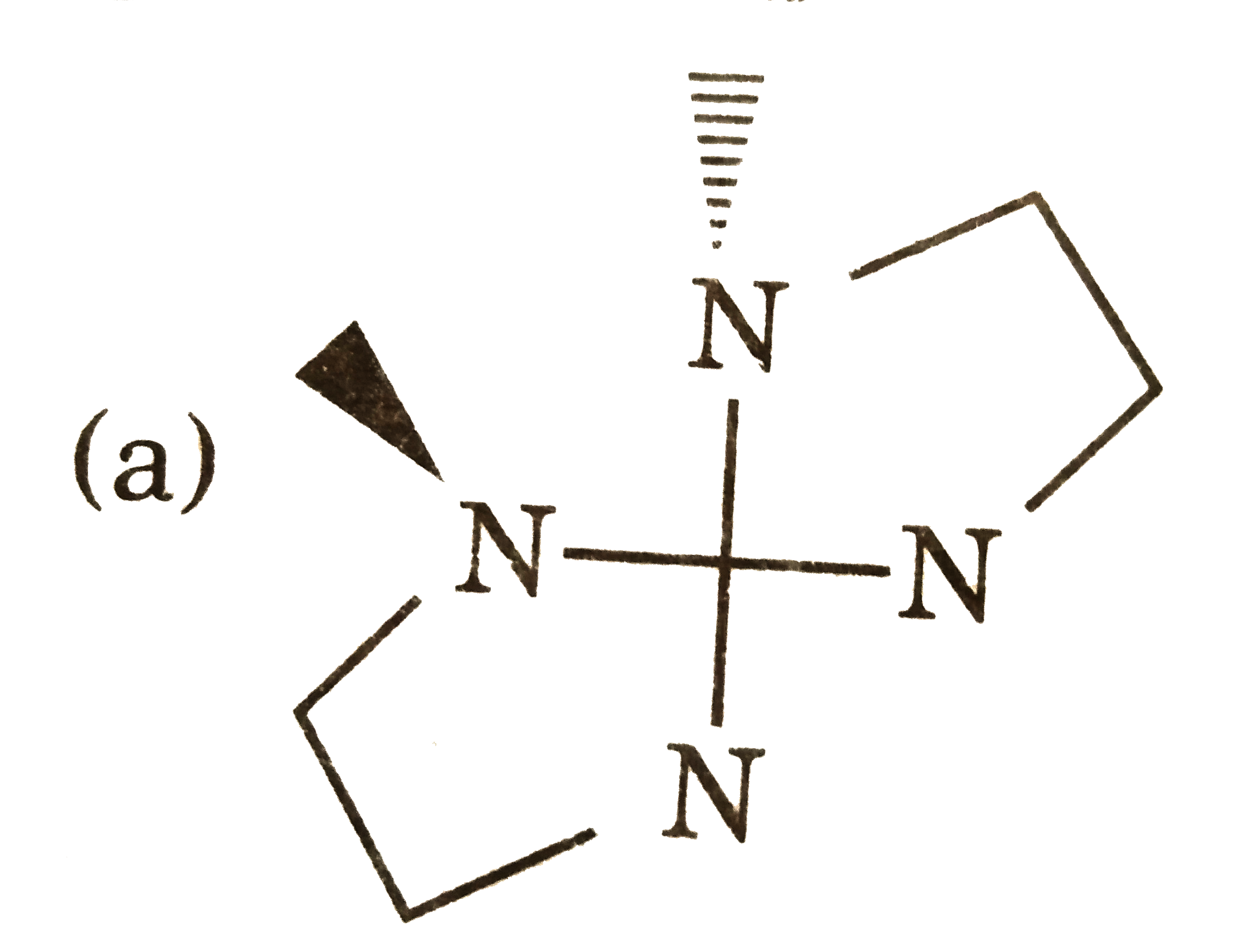
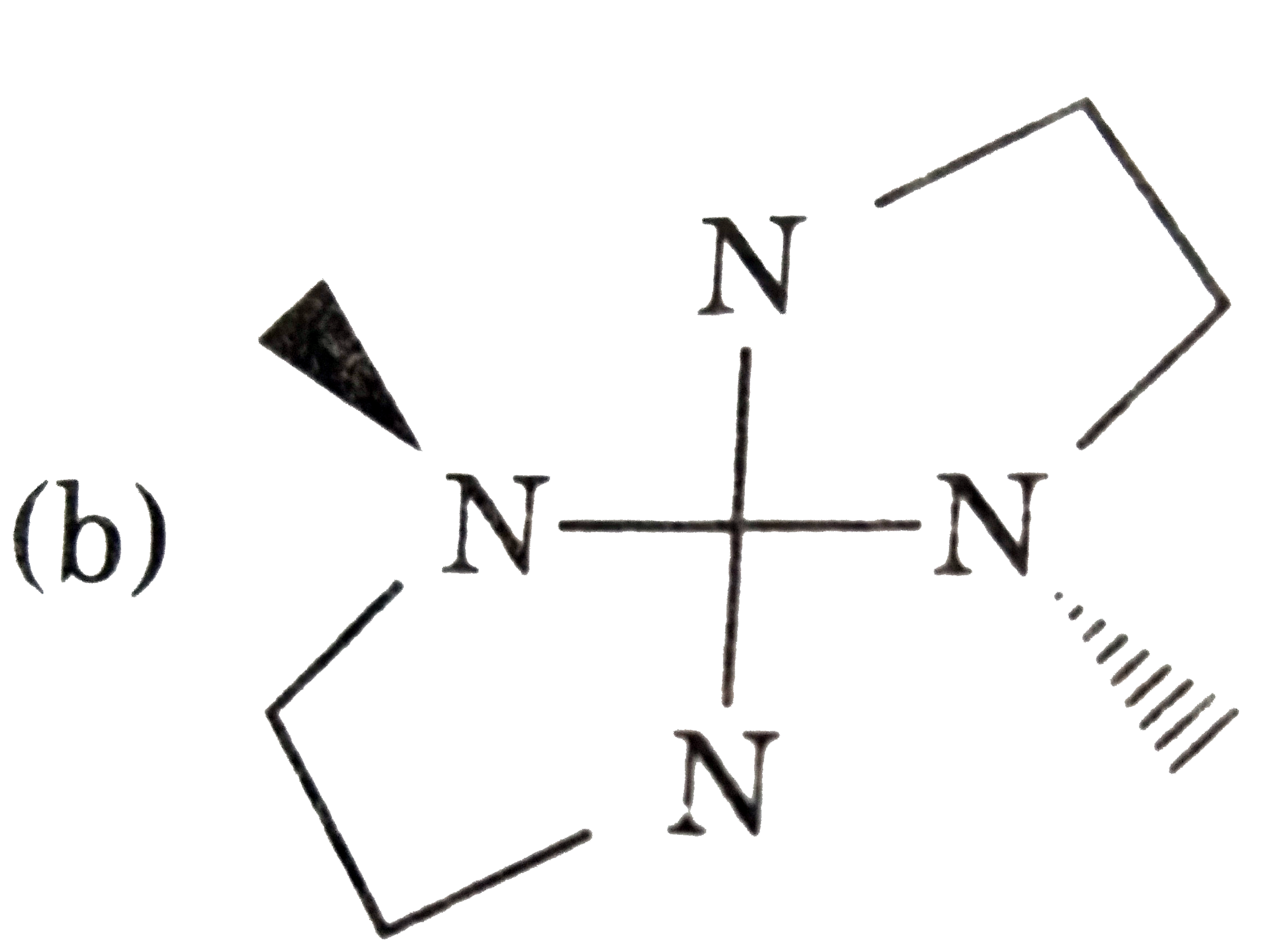
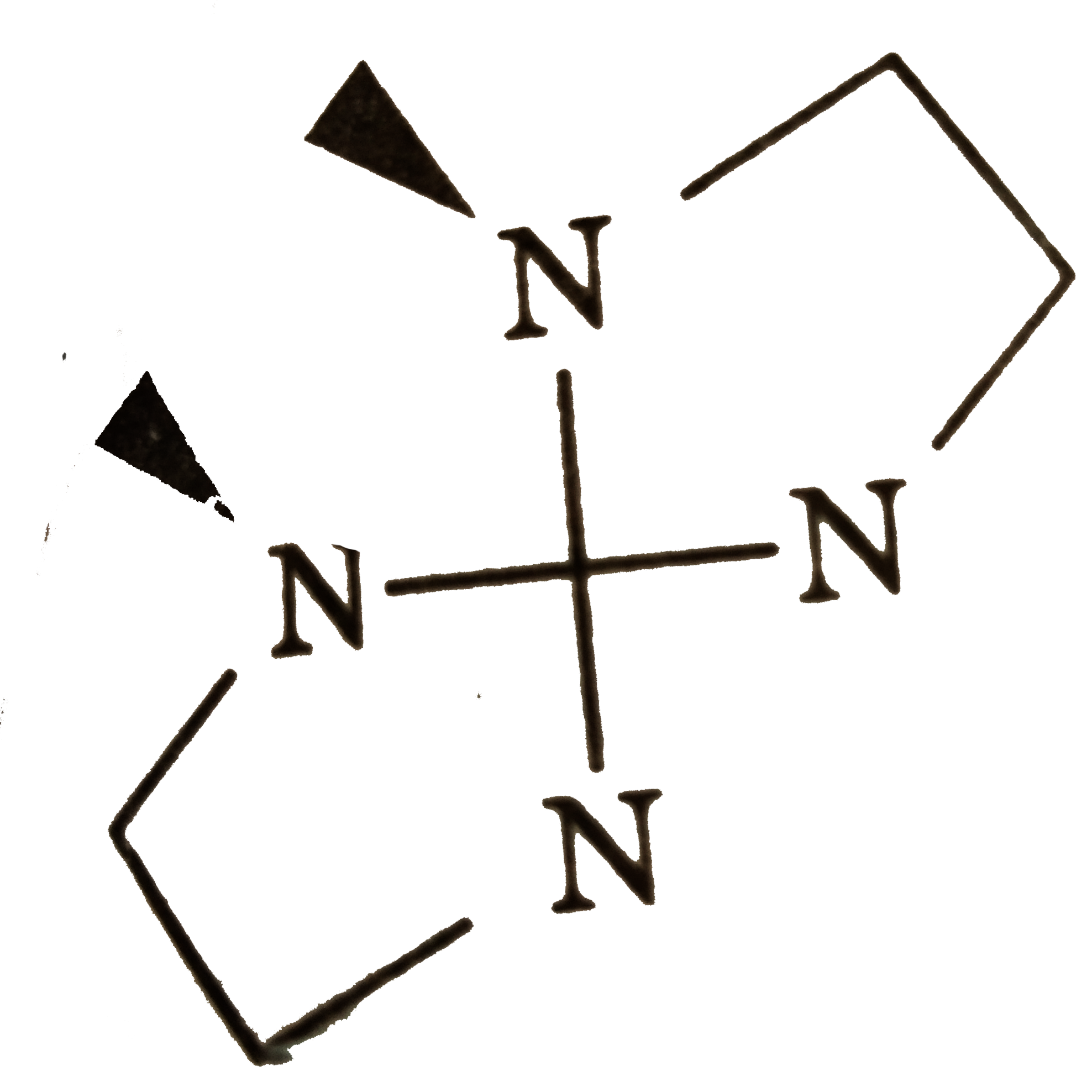
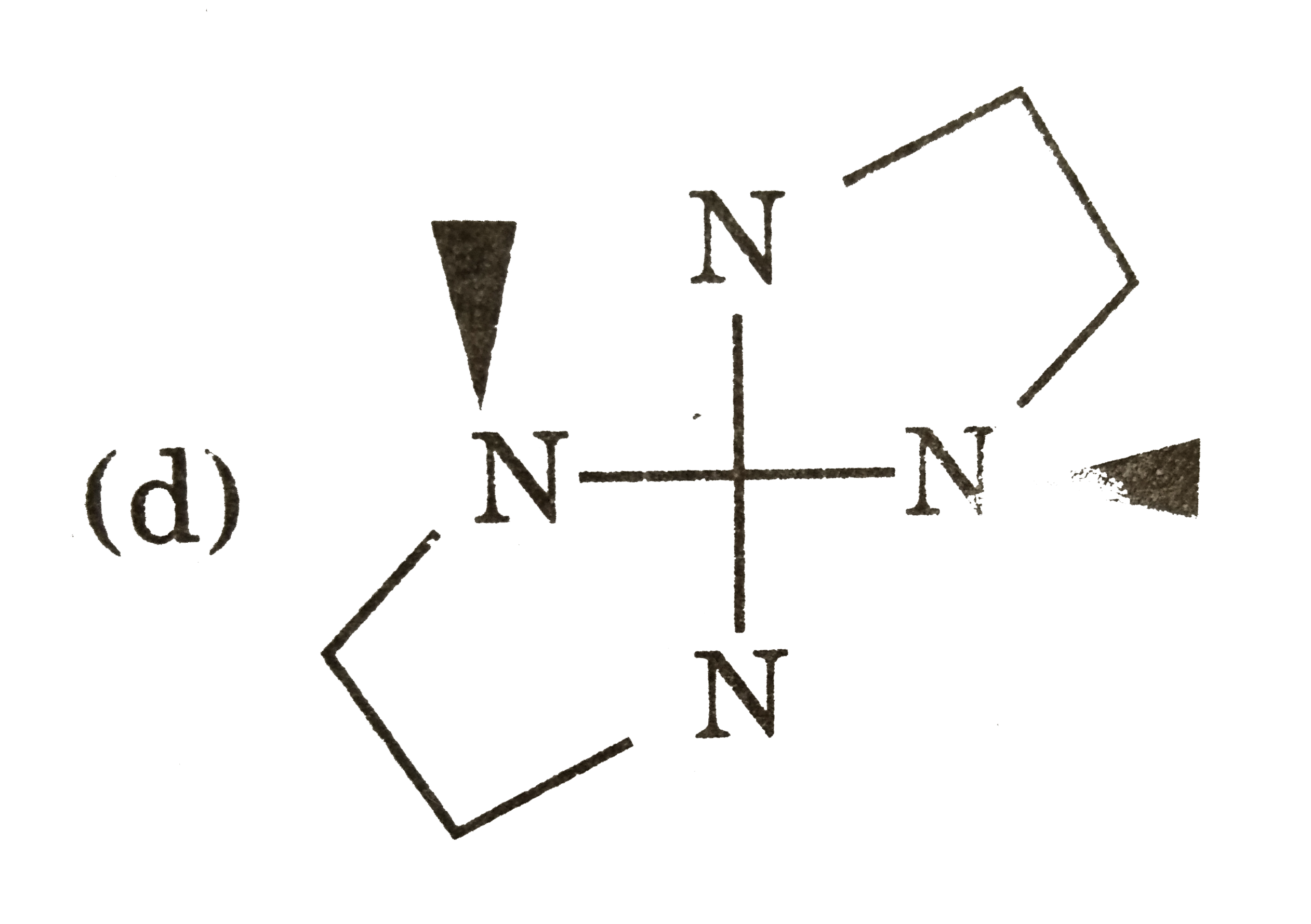
In certain cases, achiral ligands can become chiral on coordination to a metal, leading to a complex that is chiral. Usually the non-chiral ligand contains a donor that rapidly inverts as a free ligand, but that becomes locked in one configuration on co-ordination. An example is MeNHCH_(2)CH_(2)NHMe, where two N atoms become chiral centres on co-ordination to a metal atom. Consider two bidentate ligands for square planar complexes only : A A to Me-NH-CH_(2)-CH_(2)-NHMe CD to Me-NH-CH_(2)-CH_(2)-NH_(2) In the complex solution [M(CD)_(2)], identify the complex isomer which does not have any mirror planes but is nor chiral. |
|
Answer»
(C ) has PLANE of symmetry, (a) and (d) are optically active. |
|
| 20. |
In certain cases, achiral ligands can become chiral on coordination to a metal, leading to a complex that is chiral. Usually the non-chiral ligand contains a donor that rapidly inverts as a free ligand, but that becomes locked in one configuration on co-ordination. An example is MeNHCH_(2)CH_(2)NHMe, where two N atoms become chiral centres on co-ordination to a metal atom. Consider two bidentate ligands for square planar complexes only : A A to Me-NH-CH_(2)-CH_(2)-NHMe CD to Me-NH-CH_(2)-CH_(2)-NH_(2) Total number of chiral and achiral complexes obtained from M(A A)_(2) Will be respectively : |
|
Answer» 2, 1 
|
|
| 21. |
In certain cases, physisorption tansfers into chemisorption as temperature is increased. Explain with an example. |
|
Answer» |
|
| 22. |
In certain areas where coal is cheap, artificial gas is produced for household use by the 'water gas' reaction C(s) + H_2O(g) overset(600^@C)(to) H_2(g) + CO(g) Assuming that coke is 100% carbon, calculate the maximum heat obtainable at 298 K from the combustion of 1.0 kg of coke and compare this value to the maximum heat obtainable at 298 K from burning the water gas produced from 1.0 kg of coke. Heat of combustion of C, H_2 and CO are -94.1, -68.4 and -68.0 kcal/mole respectively. |
| Answer» SOLUTION :More ENERGY is obtainable from the water gas, 11366 kcal | |
| 23. |
In C Cl_4, the four valencies of carbon are directed towards the corners of a: |
|
Answer» Square |
|
| 24. |
In Castner - Kellner cell for the manufacture of NaOH( caustic soda ), Hg acts as cathode as well as anode. |
|
Answer» |
|
| 25. |
In Castner-Kellner cell for production of sodium hydroxide |
|
Answer» BRINE is electrolyzed using GRAPHITE electrods |
|
| 26. |
In Castner-Kellner cell for production of sodium hydroxide : |
|
Answer» Brine is electrolyzed with Pt electrodes |
|
| 27. |
In case of zero order reactions |
|
Answer» `t_(1//2)=2t_(1//4)` `(C_(0)-(3C_(0))/4)=K.t_(1/4)impliest_(1/4)=(C_(0))/(4K)=1/2xx(C_(0))/(2K),C_(0)-0=Kt_(alpha)impliest_(alpha)=(C_(0))/K` So `t_(3/4)=3/2xxt_(1/2),t_(1/4)=1/2xxt_(1/2),t_(1/2)=((t_(alpha))/2)` |
|
| 28. |
In case of trisubstituted benzene , if the substituents are different, then the number of isomers will be |
|
Answer» 5 |
|
| 29. |
In case of R,S configuration the group having highest priority is |
|
Answer» `-NO_(2)` |
|
| 30. |
In case of radioactive radiations : |
|
Answer» some are not deviated by electric and MAGNETIC field |
|
| 31. |
In case of PCl_(5) lone pair electrons are present |
|
Answer» s-ORBITAL 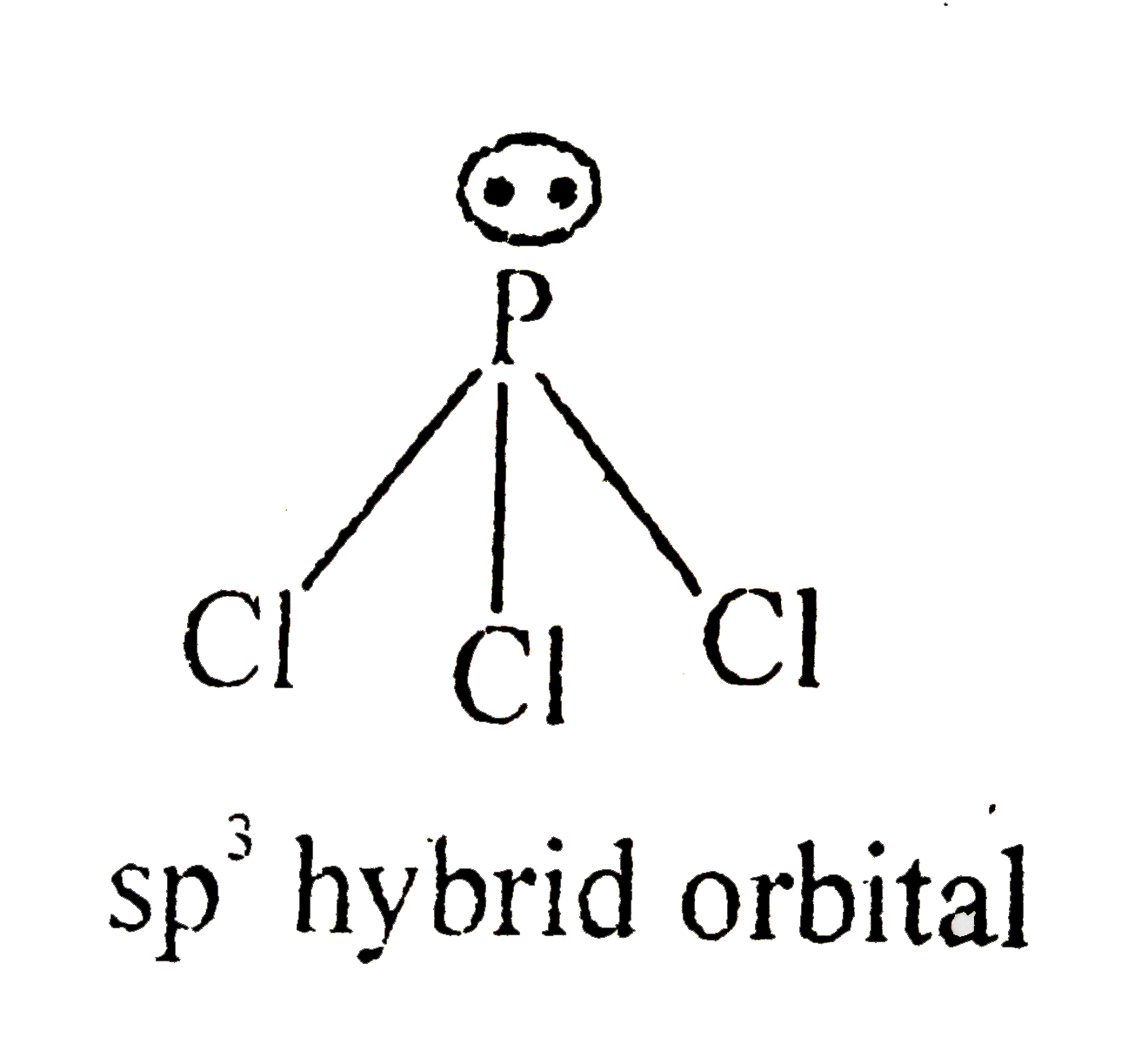 `sp^(3)` HYBRID orbital |
|
| 32. |
In case of octahedral compex, if the e_(g) orbitals (d_(x^(2) - y^(2)) " and " d_(z^(2))) are asymmetricaaly filled, their degeneracy is destroyed and the ligands approaching along +Z and -Z directions experiences different amount of repulsions than the ligands approaching along the +X, -X, +Y " and " -Y directions. As a result, the symmetrical nature of such complexes is lost and either elongation or compression along Z-axis taken place. Answer the following three questions based on the above situation. In which of the following case, no such elongation or compressions are expected ? |
|
Answer» `d^(4)` - weak LIGANDS |
|
| 33. |
In case of octahedral compex, if the e_(g) orbitals (d_(x^(2) - y^(2)) " and " d_(z^(2))) are asymmetricaaly filled, their degeneracy is destroyed and the ligands approaching along +Z and -Z directions experiences different amount of repulsions than the ligands approaching along the +X, -X, +Y " and " -Y directions. As a result, the symmetrical nature of such complexes is lost and either elongation or compression along Z-axis taken place. Answer the following three questions based on the above situation. Select the coorect statement. |
|
Answer» `[NI (CN)_(4)]^(2-)` is tetrahedral |
|
| 34. |
In case of octahedral compex, if the e_(g) orbitals (d_(x^(2) - y^(2)) " and " d_(z^(2))) are asymmetricaaly filled, their degeneracy is destroyed and the ligands approaching along +Z and -Z directions experiences different amount of repulsions than the ligands approaching along the +X, -X, +Y " and " -Y directions. As a result, the symmetrical nature of such complexes is lost and either elongation or compression along Z-axis taken place. Answer the following three questions based on the above situation. Which of the following is incorrect regarding K_(4) [Cr F_(6)] ? |
|
Answer» It has two long and FOUR short `CR-F` bonds |
|
| 35. |
In case of nitrogen, NCl_(3) is possible but not NCl_(5) while in case of phosphorous, PCl_(5) as well as PCl_(5) are possible. It is due to |
|
Answer» Availability of vacant d-orbital in P but not in N |
|
| 36. |
In case of nitrogen, NCl_(3) is possible but not NCl_(5)while in case phosphrous, PCl_(3) as well as PCl_(5) are possible. It is due to |
|
Answer» Availability of vacant d orbitals in P but not in N |
|
| 37. |
In case of nitrogen, NCl_(3) is possible but not NCI_5 gwhile in case of phosphorous, PCl_3 as well as PCI_5 IM are possible. It is due to |
|
Answer» Availability of VACANT d-orbital in P but not in N |
|
| 38. |
In case of [Mn(NH_(3))_(6)]^(2+): |
|
Answer» Relation in between `Delta_(0)" and "P " is " Delta_(0) lt P` `d_(xy)^(1)d_(yz)^(1)d_(ZX)^(1)d_(x^(2)-y^(2))d_(Z^(2))^(1)` pairing does not occur. `"Hyb"impliessp^(3)d^(2)`. |
|
| 39. |
In case of meta-attack on aniline (where -NH_(2) group is o-, p- directing) and in case of ortho-attack on nitrobenzene, resonating structures are possible. Which of them are more stable ? |
|
Answer» |
|
| 40. |
In case of hydrogen and helium the van der Waals' forces are : |
|
Answer» Strong |
|
| 41. |
In case of heteronuclear diatomics of the type AB, where A is mor electronegative than B, bonding molecular orbital resembles the character of A more that of B. The statement |
|
Answer» is false |
|
| 42. |
In case of halogen family which trend occurs as the atomic number increases |
|
Answer» Ionization radius DECREASE |
|
| 43. |
In case of group III elements, the inert pair effect is predominant in |
|
Answer» Boron |
|
| 44. |
In case of first order reactions |
|
Answer» `t_(3//4)=2t_(1//2)` `log2xx(t_(0.99))/(t_(2)^(1))=LOG10^(4),t_(0.99)=(4xxt_(1/2))/0.3010=13.289xxt_(1/2)=13.3xxt_(1/2)` |
|
| 45. |
In case of Daniel cell Zn//Zn^(2+)////Cu^(2+)//Cu which of the followings is NOT true ? |
|
Answer» ZINC ACTS as an ANODE |
|
| 46. |
In case of d-block elements |
|
Answer» OUTERMOST and penultimate SHELLS are INCOMPLETE |
|
| 47. |
In case of chemisorption, why adsorption first increases and then decreases with temperature? |
|
Answer» Solution :(i) Chemisorption involves a high activation ENERGY so it is also referred to as activated adsorption. (ii) It is found in chemisorption that it first INCREASES and then decreases with INCREASE in temperature. When adsorption is plotted, the graph first increaes and then decreases with temperature. (III) The initial increase illustrates the requirement of activation of the surface for adsorption is DUE to fact that formation of activated complex requires certain energy. But later it decreaes at high temperature is due to desorption as the kinetic energy of the adsorbate increases (exothermic nature) |
|
| 48. |
In case of condensation of polymers ? |
|
Answer» High MOLECULAR weight POLYMERS are formed all at once. |
|
| 49. |
In case of chemisorption, why adsorptionfirst increases and then decreases with temperature? |
Answer» Solution :Adsorption isotherms represents the variation of adsorption at constant temperature. When amount of adsorption is PLOTTED versus temperature at constant pressure, it is called adsorption isobar.  X is the amount of adsorbate adsorbed an "m" g of adsorbent. (i) In physical adsorption, `x/m`decreases with increases in T, But in CHEMICAL adsorption, `x/m`increases with rise in temperature and then decreases. (ii) The increase illustrates the requirement of ACTIVATION of the surface for adsorption is due to fact that FORMATION of ACTIVATED complex requires certain energy. (iii) The decrease at high temperature is due to desorption, as the kinetic energy of the adsorbate increases |
|
| 50. |
In case of chemisorption, why adsorption first increases and then decreases ? |
| Answer» SOLUTION :The initial increase is DUE to the FACT that heat supplied acts as a ACTIVATION energy. The decrease afterwards is due to the exothermic NATURE of adsorption equilibrium. | |