

Saved Bookmarks
This section includes 7 InterviewSolutions, each offering curated multiple-choice questions to sharpen your Current Affairs knowledge and support exam preparation. Choose a topic below to get started.
| 1. |
In collodial state, particle size range from :10−1000Å,20−50Å,1−10Å,1−280Å |
|
Answer» `10 - 1000 Å` |
|
| 2. |
In collision theory according to arrhenius plot, intercept is equal to |
|
Answer» `log_(10)K` |
|
| 3. |
In cold countries, ice frozen on roads and footpaths is melted by spraying salts. Explain. |
| Answer» Solution :Addition of water SOLUBLE salts like `NaCl` or `CaCl_(2)` depresses the FREEZING POINT of water hence ice melts into water. THEREFORE frozen ice can be melted and removed. | |
| 4. |
In cold countries ethylene glycol is added to water in the radiators to: |
|
Answer» BRING down the SPECIFIC HEAT of WATER |
|
| 5. |
In cold countries, ethylene glycol is added to water in the radiators to …………………. . |
|
Answer» BRING down the specific heat of WATER |
|
| 6. |
In cold countries, ethylene glycol is added to water in the radiators of cars during winters. It results in: |
|
Answer» LOWERING in BOILING point |
|
| 7. |
The number of unpaired electron in the complex ion [CoF_(6)]^(3-) is |
|
Answer» 0 |
|
| 8. |
In coagulation of a (colloidal) solution of As_2S_3, which has maximum coagulating power ? |
|
Answer» NaCl |
|
| 9. |
In CO_(2), SO_(2), SiO_(2) each central atom is covalently bonded with :- |
|
Answer» 2,2,4 OXYGEN ATOMS respectively |
|
| 10. |
In Co-ordination compound s. [Cr (en)_3 ][CrF_6] |
|
Answer» a)ligand is EN (ethylenediamine ) |
|
| 11. |
In cloud and fog the dispersion medium and dispersed phase is |
| Answer» Answer :C | |
| 12. |
In Clemmensen reduction, carbonyl compound is treated with________ |
|
Answer» ZINC AMALGAM+HCl |
|
| 13. |
In ClO_(3)^(-) ion, Cl atom undergoes : |
|
Answer» `SP^(2)` HYBRIDISATION |
|
| 14. |
In Clemmensen reduction carbonyl compound is treated with ________. |
|
Answer» ZINC amalgam + HCL |
|
| 15. |
In Clemensen's reduction, the catalyst used is |
|
Answer» Zn-Hg + conc. HCL |
|
| 16. |
In Clark's method the chemical used to remove hardness of water us |
|
Answer» `Na_2CO_3` |
|
| 17. |
In Claisen condensation , two molecules of ester get condensed in the presence of a strong base to give : |
|
Answer» ACID ANHYDRIDE |
|
| 18. |
In circus method 0.099 g organic compound gave 0.287 g AgCl. The percentage of chlorine in the compound will be |
|
Answer» `28.6` ` =(35.5)/(143.5) xx (0.287)/(0.099) xx 100 = 71.71%` |
|
| 19. |
In cis- trans isomerism, the compound generally |
|
Answer» contains a triple bond |
|
| 22. |
In chromium chloride(CrCl_(3),Cl^(-)ions have cubic close packed arragement andCr^(3+)ions are present in the octahedral holes. The fraction of the total number of holes occupied is |
|
Answer» `1//3` |
|
| 23. |
In chromite ore, the oxidation number of iron and chromium are respectively. |
|
Answer» `+ 3, + 2` Ox. STATE of `FE = + 2 , Cr=+ 3` |
|
| 24. |
In chromite ore, the oxidation number of iron and chromium are respectively ........ |
|
Answer» `+3, +2` Oxidation state of `Fe` is +2 and CR is +3. |
|
| 25. |
In chromite are , the oxidation number of iron and chromium respectively ……….. |
| Answer» Solution :CHROMITE are is `FeCr_(2)O_(4)`. | |
| 26. |
In chromatography, when the fixed phase is solid, the basis of separation is : |
|
Answer» Adsorption |
|
| 27. |
In chromatographic technique, the relative adsorption of a component in a mixture is expressed in terms of its R_(f) value . It is defined as : |
|
Answer» `("DISTANCE moved by solvent form BASE LINE ")/("Distance moved by the substance from base line")` |
|
| 28. |
In chloroethane, the carbon bearing halogen is bonded to ------ hydrogen(s). It is called --- alkyl halide |
| Answer» Answer :A | |
| 29. |
In chlorobenzene , the -CI group |
|
Answer» ACTIVATES the benzene RING more VIA resonance effect than deactivating it via inductive effect |
|
| 30. |
In the chloroethene, the carbon bearing halogen is bonded to…hydrogen(s).It is called__alkylhalide. |
| Answer» Answer :A | |
| 31. |
In chlorobenzene the Cl group |
|
Answer» activities the benzene ring more via resonane effect then deactivating it iva INDUCTIVE effect 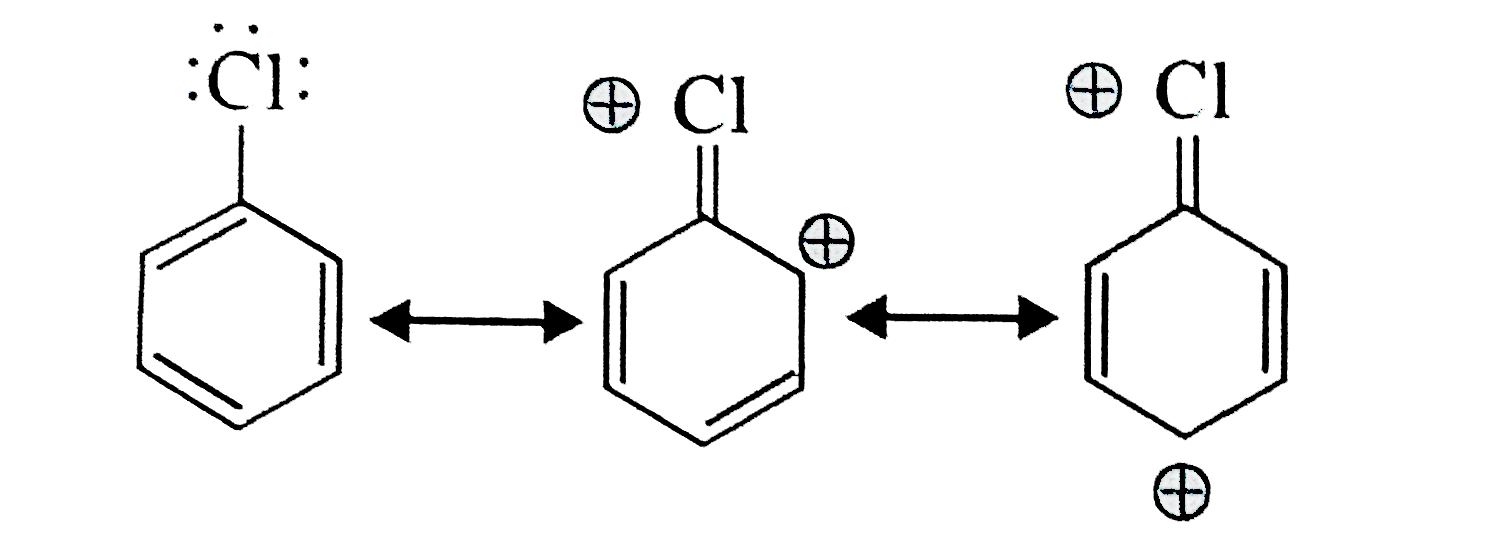 Because of high electronegativity of Cl, it ALSO exerts -I effect. So thest TWO effects balance each other. Because of high electronegativity of Cl, it ALSO exerts -I effect. So thest TWO effects balance each other.
|
|
| 32. |
In chlorobenzene solutions, the basic strength of amines increases in the order |
|
Answer» ` (C_(2)H_(5))_(3)N lt (C_(2)H_(5))_(2)NH lt C_(2)H_(5)NH_(2)` `C_(2)H_(5)NH_(2) lt (C_(2)H_(5))_(2)NHlt (C_(2)H_(5))_(3)N ` |
|
| 33. |
In chlorine gas, ratio of Cl^(35) and Cl^(37) is |
|
Answer» `1 : 3` `2x = 50 rArr x = 25 rArr " Ratio " 75 : 25 = 3 :1` |
|
| 34. |
In chlorination the relation rate of abstraction of H in 3^(@), 2^(@) "and" 1^(@)C atom respectively |
|
Answer» 5:3, 8:2 |
|
| 35. |
In chlorination roasting Tin ore is converted into its halide. In this process how many moles of chloride is required |
|
Answer» |
|
| 36. |
In chemistry, 'mole' is an essential tool for the chemical calculations. It is a basic SI unit adopted by the 14th general conference on weights and measurements in 1971. A mole contains as many elementary particles as the number of atoms present in 12g of .^(12)C. 1 mole of a gas at STP occupies 22.4 litre volume. molar volume of solids and liquids is not definite Molar mass of a substance is also called gram-atomic mass or gram molar mass. the virtual meaning of mole is plenty. heap of the collection of large numbers. 1 mole of a substance contains 6.023xx10^(23) elementary particles like atom or molecule. Atomic mass unit (amu) is the unit of atomic mass, e.g., atomic mass of single carbon is 12 amu. If Avogadro's number is1xx10^(23) mol^(-1) then the mass of one atom of oxygen would be: |
|
Answer» `(16)/(6.02)`AMU |
|
| 37. |
In chemistry, 'mole' is an essential tool for the chemical calculations. It is a basic SI unit adopted by the 14th general conference on weights and measurements in 1971. A mole contains as many elementary particles as the number of atoms present in 12g of .^(12)C. 1 mole of a gas at STP occupies 22.4 litre volume. molar volume of solids and liquids is not definite Molar mass of a substance is also called gram-atomic mass or gram molar mass. the virtual meaning of mole is plenty. heap of the collection of large numbers. 1 mole of a substance contains 6.023xx10^(23) elementary particles like atom or molecule. Atomic mass unit (amu) is the unit of atomic mass, e.g., atomic mass of single carbon is 12 amu. If N_(A) is the Avogadro's number then number of valence electrons in 4.8g of O^(2-) is: |
|
Answer» `2.4N_(A)` |
|
| 38. |
In chemistry, 'mole' is an essential tool for the chemical calculations. It is a basic SI unit adopted by the 14th general conference on weights and measurements in 1971. A mole contains as many elementary particles as the number of atoms present in 12g of .^(12)C. 1 mole of a gas at STP occupies 22.4 litre volume. molar volume of solids and liquids is not definite Molar mass of a substance is also called gram-atomic mass or gram molar mass. the virtual meaning of mole is plenty. heap of the collection of large numbers. 1 mole of a substance contains 6.023xx10^(23) elementary particles like atom or molecule. Atomic mass unit (amu) is the unit of atomic mass, e.g., atomic mass of single carbon is 12 amu. xL N_(2) gas at STP contains 3xx10^(22) molecules. the number of molecules. in x L ozone at STP will be: |
| Answer» Answer :A | |
| 39. |
In chemistry, 'mole' is an essential tool for the chemical calculations. It is a basic SI unit adopted by the 14th general conference on weights and measurements in 1971. A mole contains as many elementary particles as the number of atoms present in 12g of .^(12)C. 1 mole of a gas at STP occupies 22.4 litre volume. molar volume of solids and liquids is not definite Molar mass of a substance is also called gram-atomic mass or gram molar mass. the virtual meaning of mole is plenty. heap of the collection of large numbers. 1 mole of a substance contains 6.023xx10^(23) elementary particles like atom or molecule. Atomic mass unit (amu) is the unit of atomic mass, e.g., atomic mass of single carbon is 12 amu. How many atoms are present in 49g of H_(2)SO_(4)? |
|
Answer» `7xx6.023xx10^(23)` |
|
| 40. |
In chemistry, 'mole' is an essential tool for the chemical calculations. It is a basic SI unit adopted by the 14th general conference on weights and measurements in 1971. A mole contains as many elementary particles as the number of atoms present in 12g of .^(12)C. 1 mole of a gas at STP occupies 22.4 litre volume. molar volume of solids and liquids is not definite Molar mass of a substance is also called gram-atomic mass or gram molar mass. the virtual meaning of mole is plenty. heap of the collection of large numbers. 1 mole of a substance contains 6.023xx10^(23) elementary particles like atom or molecule. Atomic mass unit (amu) is the unit of atomic mass, e.g., atomic mass of single carbon is 12 amu. The mass of one molecule of water is approximately. |
|
Answer» 1G of butane `(C_(4)H_(10))` |
|
| 41. |
In chemistry, 'mole' is an essential tool for the chemical calculations. It is a basic SI unit adopted by the 14th general conference on weights and measurements in 1971. A mole contains as many elementary particles as the number of atoms present in 12g of .^(12)C. 1 mole of a gas at STP occupies 22.4 litre volume. molar volume of solids and liquids is not definite Molar mass of a substance is also called gram-atomic mass or gram molar mass. the virtual meaning of mole is plenty. heap of the collection of large numbers. 1 mole of a substance contains 6.023xx10^(23) elementary particles like atom or molecule. Atomic mass unit (amu) is the unit of atomic mass, e.g., atomic mass of single carbon is 12 amu. The mass of one amu is approximately. |
|
Answer» 1g of BUTANE `(C_(4)H_(10))` |
|
| 42. |
In chemistry, 'mole' is an essential tool for the chemical calculations. It is a basic SI unit adopted by the 14th general conference on weights and measurements in 1971. A mole contains as many elementary particles as the number of atoms present in 12g of .^(12)C. 1 mole of a gas at STP occupies 22.4 litre volume. molar volume of solids and liquids is not definite Molar mass of a substance is also called gram-atomic mass or gram molar mass. the virtual meaning of mole is plenty. heap of the collection of large numbers. 1 mole of a substance contains 6.023xx10^(23) elementary particles like atom or molecule. Atomic mass unit (amu) is the unit of atomic mass, e.g., atomic mass of single carbon is 12 amu. 5.6 litre of a gas at STP are found to have a mass of 22g. the molecvular mass of the gas is: |
|
Answer» 22 |
|
| 43. |
In chemical terms , what are alums used for purifying water for drinking purposes ? |
|
Answer» Hydrated chlorides Where M stands for MONOVALENT basic radicals. ALUMS have Germicide properties and thus used in PURIFICATION of water |
|
| 44. |
In chemical scale of relative mass of the isotopic mixture of oxygen atom ( O^16 , O^17 ,O^18) assumed to be equal to: |
|
Answer» 16.002 |
|
| 45. |
In chemicalreactionofamines, whichact as |
|
Answer» ELECTROPHILES |
|
| 46. |
In chemical reaction of potassium ferrocyanide and hydrogen peroxide in the presence of dil.H_2SO_4 |
|
Answer» Ferrocyanide GETS REDUCED to ferricyanide |
|
| 47. |
In chemical reaction A hArr B,the system will be know in equilibrium when |
|
Answer» A COMPLETELY changes to B |
|
| 48. |
In chemical equilibrium, the value of Delta n (number of molecules), is negative, then the relationship between K_(p) "and" K_(c) will be |
|
Answer» `K_(P)-K_(c) = 0` Since, `Delta(NG)` is -ve `Kc = Kp(RT)^(+Deltang)` |
|
| 49. |
In chemical equilibrium, the vlue of Deltan (number of molecules of products-number of molecules of reactants) is negative, then the relationship between K_(p)and K_(c) will be |
|
Answer» `K_(p)-K_(c)=0` |
|
| 50. |
In chemical analysis, the presence of a methyl ketonic group is tested with I_(2) in presence of an alkali like NaOH or KOH. In another chemical analysis, aldehyde group is tested either by Tollens' reagent (AgNO_(3)NH_(3)OH) which gives silver mirror or by Fehling's solution (CuSO_(4)+NaOH+ Roschelle salt) which gives red ppt. of copper (I) oxide. Q. Consider the following compounds: I. CH_(3)-overset(O)overset(||)(C)-CH_(2)-overset(O)overset(||)(C)-CH_(3) II. CH_(3)-overset(O)overset(||)(C)-overset(O)overset(||)(C)-CH_(3) III. CH_(3)-overset(O)overset(||)(C)-OH IV. CH_(3)-overset(O)overset(||)(C)-Cl Which will give iodoform test? |
|
Answer» Only I 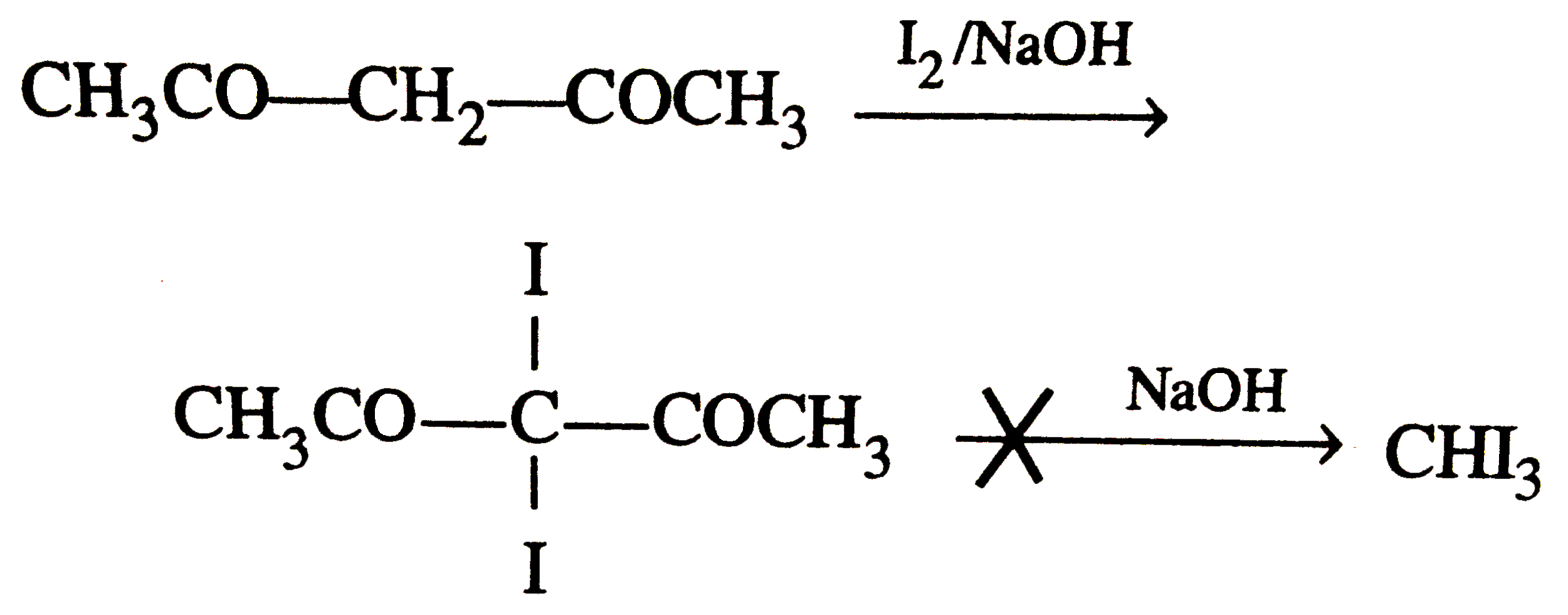 Only `CH_(3)CO-COCH_(3)` gives iodoform test. |
|