

Saved Bookmarks
This section includes 7 InterviewSolutions, each offering curated multiple-choice questions to sharpen your Current Affairs knowledge and support exam preparation. Choose a topic below to get started.
| 1. |
If in a solvent, n simple molecules of solute combine of form an associated molecule, alpha is the degree of association, then Van't Hoff factor is equal to |
|
Answer» `(1)/(1- N alpha)` Total moles after ASSOCIATION `=1-alpha+ alpha//n` Van.t Hoff factor, `i=(1-alpha+alpha//n)/(1)` |
|
| 2. |
If in 3160 years a radioactive substance becomes one fourth of the original amount . Find its half life periods. |
| Answer» SOLUTION :`t_(1//2)=1580` YEARS | |
| 3. |
If in a certain element contain one electron in sub shell of 5d-orbital, then the element is.. |
| Answer» Answer :A | |
| 4. |
If I.E. of Na, Mg and Si are respectively 496, 737 and 786 kJ "mol"^(-)The I.E. of Al in KJ "mol"^(-) is :- |
|
Answer» 575 Sequential ORDER`to underset(786)(Si ) gt underset(737) (Mg) gt underset (575)(Al) gt underset(496)(Na)` |
|
| 5. |
If I_(2) is dissolved in aqueous KI, the intense yellow species, I_(3)^(-) is formed. The structure of I_(3)^(-) ion is |
|
Answer» square PYRAMIDAL |
|
| 6. |
If (i)C+O_(2)rarrCO_(2), (ii) C+1//2O_(2)rarrCO, "(iii)"CO+1//2O_(2)rarrCO_(2), the heats of reaction are Q, -12,-10 respectively. Then Q= |
|
Answer» Solution :`C+O_(2)rarrCO_(2),Delta=q` `C+1//2O_(2)rarrCO,DeltaH=-12"....(i)"` `CO+1//2O_(2)rarrCO_(2), DeltaH=-10"....(ii)"` ADDING equation (i) and (ii) we can get `DeltaH=-12+(-10)=-22`. |
|
| 7. |
If 'I' is the intensity of absorbed light and 'C' is the concentration of AB for the photochemical process AB+hvtoAB^(**), the rate of formation of AB^(**) is directly proportional to |
|
Answer» C |
|
| 8. |
If 'I' is the intensity of absorbed light and C is the concentration of AB for the photochemical process , AB + hv to AB^(**) . The rate of formation of AB^(**) is directly proportional to |
|
Answer» C |
|
| 9. |
If hydrogen atoms (in the ground state) are passed through an homogeneous magnetic field, the beam is split into two parts.This interaction with the magnetic field shows that the atoms must have magnetic moment.However, the moment cannot be due to the orbital angular momentum since l=0. Hence one must assume existance of intrinsic angular momentum, which as the experiment shows, has only two permitted orientations. Spin of the electron produces angular momentum equal to s=sqrt(s(s+1))h/(2pi) where s=+1/2. Total spin of an atom =+n/2 or n/2 where n is the number of unpaired electron. The substance which contains species with unpaired electrons in their orbitals behave as paramagnetic substances.The paramagnetism is expected in terms of magnetic moment. The magnetic moment of an atom mu=sqrt(s(s+1))(eh)/(2pimc)=sqrt(n/2(n/2+1))(eh)/(2pimc)s=n/2 rArrmu_s=sqrt(n(n+2))B.M. n=number of unpaired electrons 1. B.M.(Bohr magneton)=(eh)/(2pimc) If magnetic moment is zero the substance is diamagnetic. Which of the following is a paramagnetic substance |
|
Answer» `MG^(2+)` |
|
| 10. |
If hydrolysis of ester is carried out inpresence of an acid , usig water containing redioactive oxygen atom, the product most likely to be radioactive is , |
|
Answer» alcohol Theradioactive OXYGEN must be in acid. This technique is known as TRACER technique. |
|
| 11. |
If hydrogen electrode dipped I 2 solution of pH=3 and pH=6 and salt bridge is connected the e.m.f. of resulting cell is |
|
Answer» 0.177V `=0.059xx(-3)=0.177V`. |
|
| 12. |
If HgI_(2) is stoichiometrically dissolved in a KI solution to get K_(2)[HgI_(4)] complex the osmotic pressure is decreased by5x% . What is x ? |
|
Answer» |
|
| 13. |
If heat of neutralisation is -13.7 k cal and H_f^(@)H_2O=-68 k cal, then enthalpy of OH^- would be: |
|
Answer» 54.3 K CAL |
|
| 14. |
If heavy water is taken as solvent of normal water while performing cannizzaro reaction, the products of the reaction are |
|
Answer» `RCOO^(-)+RCH_(2)OH` 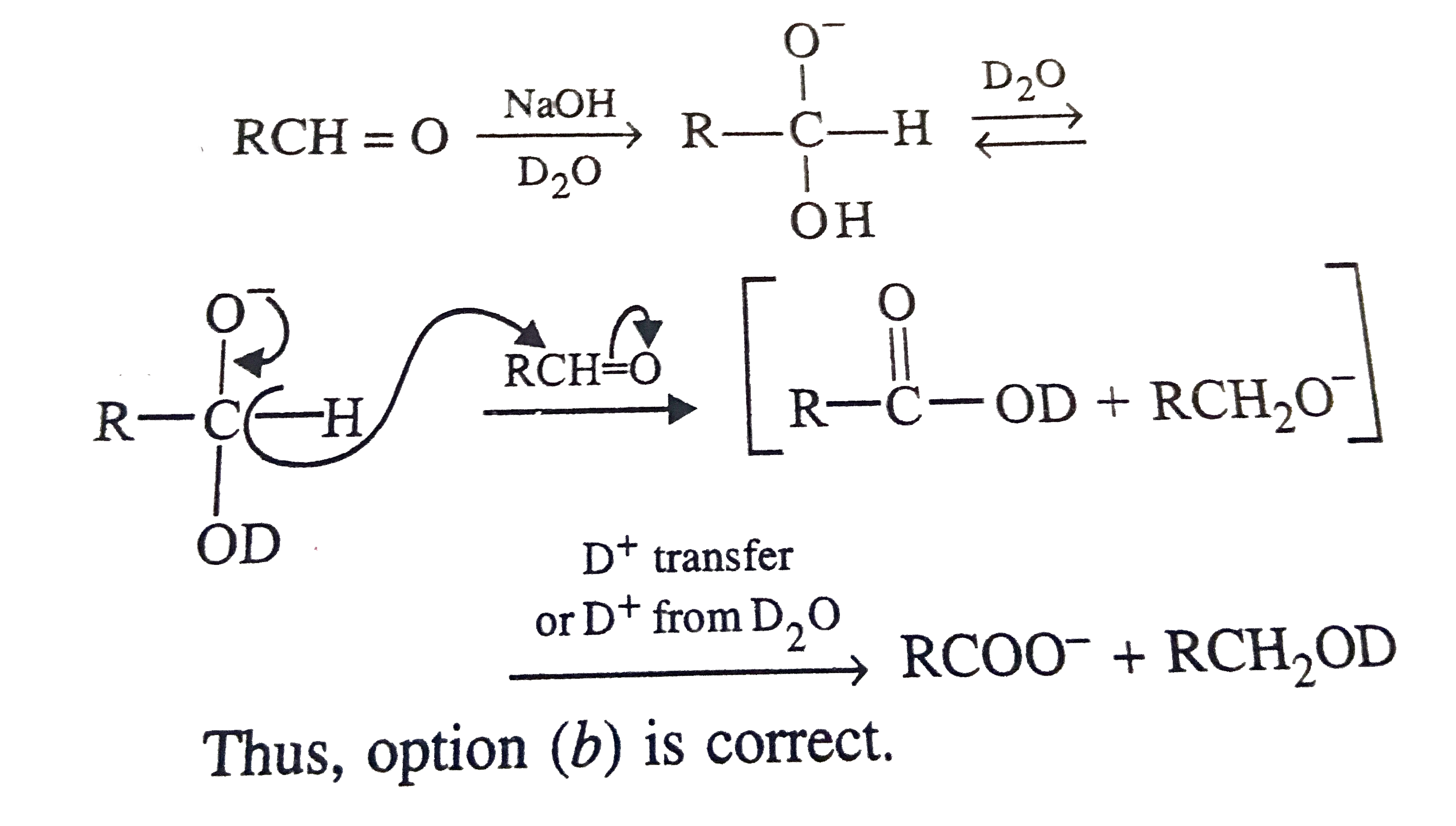 option (d) is correct. |
|
| 15. |
If helium and methane are allowed to difuse out of the container under the similar conditions of temperature and pressure, then the ratio of rate of diffusion of helium to methane is |
|
Answer» 2 |
|
| 16. |
If heat of hydrogenationof 1,3 - pentadiene and 1,4 - pentadiene are X and Y kcal respectively , heat of hydrogenation of 2,3 - pentadienewill be |
|
Answer» between X and Y Conjugated diene `gt` Isolated diene ` gt` Cummulativediene (1,3 -pentadiene ) (1,4 - pentadiene) (2,3 - pentadiene ) |
|
| 17. |
If heatof formation of C Cl_4 is 316 kcal mol^-1 the dissociation energy of C-Cl is : |
|
Answer» `79 kcal mol^-1` |
|
| 18. |
If heat of combustion of methane is -800kJ, then heat of combustion of 4 xx 10^-4kg of methane is ________ . |
| Answer» Answer :D | |
| 19. |
If He and CH_(4) are allowed to diffuse out of the container under similar conditions of temperature and pressure then the ratio of the rate of diffusion of He to CH_(4) is |
|
Answer» `2.0` |
|
| 20. |
If halfe-life of a substance is 5 yrs, then the total amount of substance left after 15 years, when initial amount is 64 grams is |
|
Answer» 16 GRAMS `:. n = (t)/(t_(1//2)) = (15)/(5) = 3` Now `N = (N_(0))/(2^(n)) = (N_(0))/(2^(3)) = (1)/(8) N_(0) = (1)/(8) XX 64 = 8` grams, |
|
| 21. |
If half lives of a radioactive element, undergoing parallel path alpha-"decay" and alpha-"decay" are 4 years and 12 years respectively, then percentage of element that remains after 12 years will be: |
|
Answer» 0.5 |
|
| 22. |
If H_(2)SO_(4) ionises as H_(2)SO_(4) + 2H_(2)O to 2H_(3)O^(+) + SO_(4)^(-2). Then total number of ions produced by 0*1 M of H_(2)SO_(4) will be |
|
Answer» `9*03xx10^(21)` `:. 0*1` M `H_(2)SO_(4)` produces ions `=0*3` mol No. of ions `=0*3xx6*02xx10^(23)=1*8xx10^(23)` |
|
| 23. |
If half-life of a certain radioactive nucleus is 1000s. the disintegration constant is |
|
Answer» `6.93 xx 10^(2) s^(-1)` |
|
| 24. |
If H_2SO_4 ionises as : H_2SO_4 + 2H_2O to 2H_3O^(+) + SO_4^(2) Then total number of ions produced by 0.3 M H_2SO_4 will be : |
|
Answer» `9.03 XX 10^21` |
|
| 25. |
If H_2S is passed through an acidified K_2Cr_2O_7solution, the colour of the solution : |
|
Answer» Will remain unchanged |
|
| 26. |
If H_(2) molecule is acting as ligand via oxidate addition : [Ir^(I)(CO)ClL_(2)] ("Vaska's complex")+H_(2) to [Ir^(III)(CO)Cl(H_(2))L_(2)],L=PPh_(3) then, choose the correct statement about the H_(2) molecule fate before and after reaction . |
|
Answer» `{:("Before","Trasition State","After"),(B.O=1,1 sigma"-DONOR,"sigma(**)-"ACCEPTOR",B.O.=0):}` 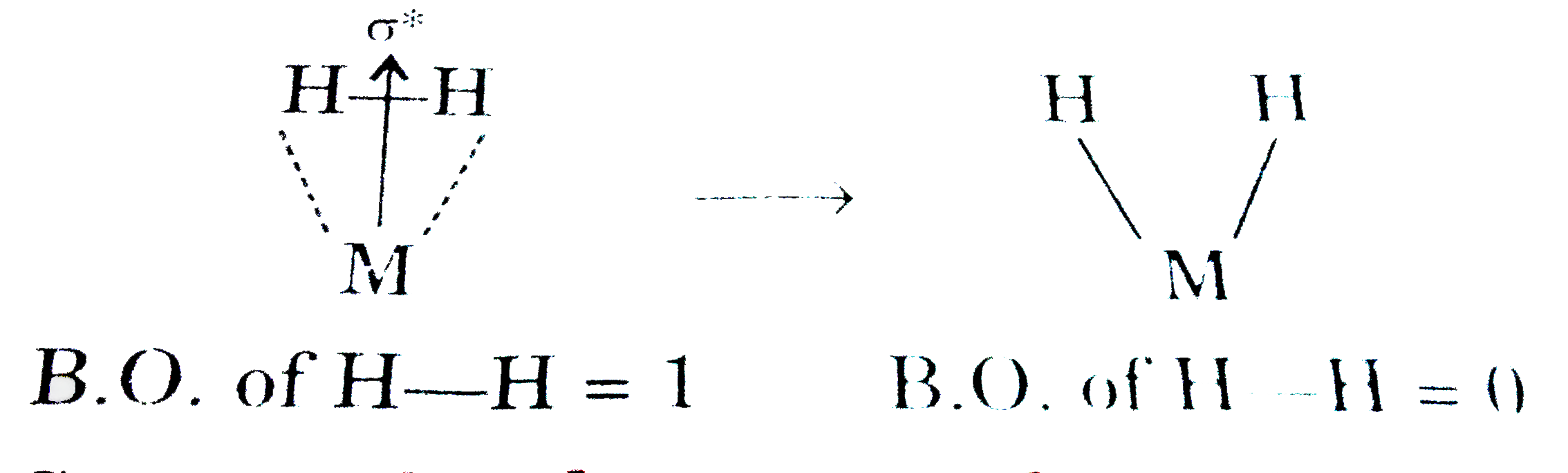
|
|
| 27. |
If H_2(g)=2H(g), triangleH=104 cal, then heat of atomisation of hydrogen is: |
|
Answer» 52 kcal |
|
| 28. |
If H_2(g)+Cl_2(g)→2HCl, ^@=-44 kcal 2Na(s)+2HCl(g→)2NaCl(s)+H_2(g), △H =-152 kcalthen, Na(s)+0.5Cl_2(g)→NaCl(s),△H =? |
|
Answer» 108 KCAL |
|
| 29. |
If {:(H_(2)+1//2O_(2)rarrH_(2)O",",,,,DeltaH= -68 kcal),(K+H_(2)OrarrKOH(aq)+1//2H_(2)",",,,,DeltaH= -48 kcal),(KOH+"water"rarrKOH(aq)",",,,,DeltaH= -14 kcal):} Find the heat of formation of KOH. Find the heat of formation of KOH. |
|
Answer» |
|
| 30. |
If H^++OHrarrH_2O+13.7 kcal then the heat of neutralisation for complete neutralisation of one mole of H_2SO_4 by a base will be: |
|
Answer» `13.7 KCAL` |
|
| 31. |
If H^(+)+OH^(-)rarrH_(2)O+13.7kcal, then the heat of neutralization for complete neutralization of one mole of H_(2)SO_(4) by base will be |
|
Answer» 13.7 KCAL |
|
| 32. |
If H is considered as the function of P and T, then which of thefollowing relations is/are corret? |
|
Answer» `DH=((dH)/(DT))_(P)dT=((dH)/(DP))_(T)dP` |
|
| 33. |
If H^(+) ion concentration of a solution is increased by 10 times its pH will be |
|
Answer» Increase by ONE `pH = log.(1)/([H^(+)])` |
|
| 34. |
If group IV the ppt of Zn(OH)_(2) dissolve in excessof NaOHdue to theformation of |
|
Answer» `Na_(2)ZnO_(2)` |
|
| 35. |
If graph log Kto(1)/(T) is plotted ,a straight line is obtained then what will be value of slope ? |
|
Answer» `(E_(a))/(2.303R)` |
|
| 36. |
If glycerene C_(3)H_(5)(OH), and methyl alcohol, CH_(3)OH are sold at the same price per kg, which would be cheaper for preparing an antifreeze solution for the radiator of an automobile ? |
|
Answer» |
|
| 37. |
If gold number of A, B, C and D are 0.005, 0.05, 0.5 and 5 respectively, then which of the following will have the greatest protective value? |
|
Answer» A |
|
| 38. |
If given are following standard electrodes potential, then find out standard potential of cell. [Zn^(+2)|Zn=-0.763V,Ag^(+)|Ag=+0.799V]. |
|
Answer» 0.562 V `=0.799-(-0.763)` `=0.799+0.763=1.562V` |
|
| 39. |
If galvanic cell is formed by standard hydrogen electrode with by E_(Cu^(2+)|Cu)^(Theta)=+0.34Vin standard condition, so what is Cu^(2+)|Cu electrode ? |
|
Answer» ANODE electrode, negative electrode `=E_(H^(+)|H_(2))^(Theta)-E_(Cu^(2+)|Cu)^(Theta)` `=0.0-(0.34)=0.34V(A)` is wrong (b) `E_(cell)^(Theta)=E_("Cathod")^(Theta)-E_("Anode")^(Theta)` `=E_(Cu^(2+)|Cu)^(Theta)-E_(H^(+)|H_(2))^(Theta)` `=0.34-0.0=0.34V` So, (B) is true. MEANS, `Cu^(2+)|Cu` Cathode (Positive) electrode and `H^(+)|H_(2)` anode. |
|
| 40. |
If formic acid, acetic acid, propanoic acid and benzoic acid is mixed with phosphorus and bromine then how many product are formed |
|
Answer» `CH_(3)-CH_(2)-COOH overset(P+Br_(2))to underset((d+l))(CH_(3)-underset(Br)underset(|)overset(**)(C)H-COOH`. |
|
| 41. |
If freezing point of 5% w/w aqueous solution of sucrose has 271 K and pure water has freezing point of 273.15 K then calculate freezing point of 5% w/w aqueous solution of glucose. |
|
Answer» |
|
| 42. |
If formic acid , acetic acid, propanic acid and benzoic acid is mixed with Phosphorus and Bromine then how many product are formed. |
Answer» 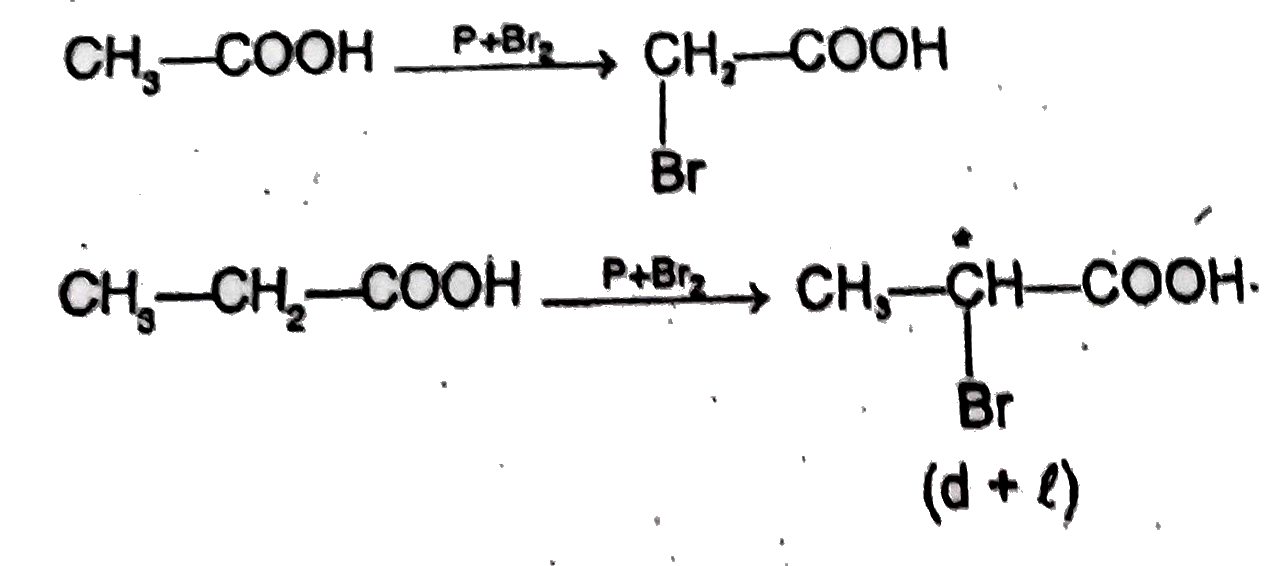
|
|
| 43. |
If formaldehyde and potassium hydroxide are heated, then we get |
|
Answer» ACETYLENE. |
|
| 44. |
If formaldehyde and KOHare heated then we get |
|
Answer» METHANE `2HCHO + KOH OVERSET(Delta) to HCOOK + CH_(3)OH`. Thus in this reaction, methyl alcohol `(CH_(3)OH)` is produced . This reaction is known as Cannizaro's reaction . |
|
| 45. |
If for the raction at 300 K, 2Mg(g)+O_(2)(g)to2MgO(s), Delta_(r)H=-1202kJ"mol"^(-1) and Delta_(r)S=-217.0JK^(-1)"mol"^(-1) The total entropy change (DeltaS)_(T) and gibbs energy change during the course of reaction (Delta_(r)G) are respectively. |
|
Answer» `3.79xx10^(3)JK^(-1)"mol"^(-1),-1136.9kJ` `=-1202-(-217xx10^(-3)xx300)=-1136.9kJ` Heat released will be ABSORBED by the SURROUNDING to increase the entropy of surroundings. `DeltaS_("surr")=+(1202xx10^(3))/300=+4.01xx10^(3)JK^(-1)"mol"^(-1)` `DeltaS_("TOTAL")=-217+4.01xx10^(3)=+3793JK^(-1)"mol"^(-1)` |
|
| 46. |
If for two gases of molecular weights M_(A) and M_(B) at temperature T_(A) and T_(B), T_(A)M_(B)=T_(B)M_(A), then which property has the same magnitude for both the gases. |
|
Answer» Density Since `(M_(B))/(T_(B))=(M_(A))/(T_(A)) therefore` at the same pressure `rho_(A) =rho_(B)` But f pressure is DIFFERENT then `rho_(A) NE rho_(B)` (ii) Pressure of the gases would be equal if their densities are equal other wise not. KE per mol `=(3)/(2)RT` `therefore` It will be different for the two gases. (iii) `V_(rms) =sqrt((3RT)/(M))," since "(T_(A))/(M_(A))=(T_(B))/(M_(B)), V_(rms)" of "A=V_(rms)" of "B` Hence, (D) is the correct answer. |
|
| 47. |
If for the half reactions Cu^(2+)+e^- to Cu^+""E^0=0.15V Cu^(2+)+2e^- to Cu""E^0=0.34V Calculate E^0 of the half cell reaction Cu^+ +e^- to Cu also predict whether Cu^+ undergoes also predict whether Cu^+ undergoes disproportionation or not |
|
Answer» |
|
| 48. |
If for two gases of molecular weight M_Aand M_B at temperature T_A and T_B,T_AM_B= T_BM_A , then which property has the same magnitude for both the gases : |
|
Answer» Density |
|
| 49. |
If for H_(2(g))+1/2S_(2(s))hArrH_(2)S_((g))and H_(2(g))+Br_(2(g))hArr2HBr_((g))The equlibrium constants are K_(1) and K_(2) respectively, the reaction Br_(2(g))+H_(2)S_((g))hArr2HBr_((g))+1/2S_(2(g)) would have equlibrium constnt |
|
Answer» `K_(1)xxK_(2)` `K_(3)=([HBr]^(2)XX[S_(2)]^(1//2))/([Br_(2)]xx[H_(2)S]),(K_(2))/(K_(1))=K_(3)` |
|
| 50. |
If H_(2)(g)=2H(g),DeltaH=104cal , then heat of atomisation of hydrogen is |
| Answer» Answer :A | |