

Saved Bookmarks
This section includes 7 InterviewSolutions, each offering curated multiple-choice questions to sharpen your Current Affairs knowledge and support exam preparation. Choose a topic below to get started.
| 1. |
If K_(sp) of MOH is 1xx10^(-10), then pH of its aqueous solution will be : |
|
Answer» 3 |
|
| 2. |
If K_(sp) for HgSO_(4) is 6.4 xx 10^(-5), then solubility of the salt is |
|
Answer» `8 XX 10^(-3)` `S = sqrt(K_(sp)) , S = sqrt(6.4 xx 10^(-5)) , S = 8 xx 10^(-3)` m/l. |
|
| 3. |
IfKlt1.0, what will be the value of DeltaG^(@) of the following |
|
Answer» `1.0` When `K LT 1.0, DeltaG^(@)=+ve`. |
|
| 4. |
If K_p< K_c and K_p=K_c then deltan are _____ and _____ respectively. |
|
Answer» |
|
| 5. |
If K_(c) is the equlibrium constant for the formation of KH_(3). the dissociation constant of ammonia under the same temperaturee will be |
|
Answer» `K_(c)` `K_(c)=([N_(2)]^(1//2)[H_(2)]^(3//2))/(NH_(3))and 1/2N_(2)+3/2H_(2)hArrNH_(3)` `K_(c)=([NH_(3)])/([N_(2)]^(1//2)[H_(2)]^(3//2))` |
|
| 6. |
If K_(f) for water is 1.86^(@)C"mol"^(-1),a 0.1 m solution of urea in water will have the freezing point of |
|
Answer» `0.186^(@)C` FREEZING point of solution `=0-0.186` `= - 0.186^(@)C` |
|
| 7. |
If K_(c) for the reaction Cu_((aq))^(2+) + Sn_((aq))^(2+) to Sn_((aq))^(4+) + Cu_((s)) at25^(@) Cis represented as y xx 10^(6) then find the value of y . (Given : E(Cu^(2+) |Cu)^(@) = 0.34 V , E_(Sn^(4+)|Sn^(2+))^(@) = 0.15V ) |
|
Answer» |
|
| 8. |
If K_(c) = 7.5 ×x 10^(-9) at 1000 k for the reaction N_(2)(g) + O_(2)(g)hArr2NO(g), what is K_(c) at 1000 K for the reaction 2NO(g)hArrN_(2)(g) + O_(2)(g) ? |
|
Answer» |
|
| 9. |
If K_Bis the Boltzmann constant then the quantity (PV//K_B T)represents the: |
|
Answer» NUMBER of molecules of the gas. `N= (PV)/(RT)` no. of molecules =` N_A = (PV)/(RT)` `=((PV)/(k_B T)), (k_B = (R)/(N_A))`= Boltzmann constant. |
|
| 10. |
If kappa is the specific conductivity of a solution with volume V containing 1 g eq of the electrolyte and wedge is the equivalent conductivity, then kappa,wedge and V are related as_____. |
| Answer» SOLUTION :`wedge=kappaxxV` | |
| 11. |
If K_(a_(1)) and K_(a_(2)) of sulphuric acid are 1xx10^(-2) and 1xx10^(-6) respectively, then concentration of sulphate ions in 0.01 M H_(2)SO_(4) solution will be : |
| Answer» Answer :A | |
| 12. |
If K_(a_1) and K_(a_2)are the ionisation constant of H_3overset+NCHRCOOH and H_2NCHRCOO^(-), respectively the pH of the solution at the isoelectric point is |
|
Answer» `PH=(pK_(a_1)+pK_(a_2))` `underset"Low pH"(H_3overset+N-undersetundersetR|CH-COOH) underset(H^+)overset(OH^-)hArr underset"Intermediate pH"(H_3overset+N-undersetundersetR|CH-COO^-) underset(H^+)overset(OH^-)hArr underset"HighpH"(H_2NundersetundersetR|CHCOO^-)` with `K_(a_1)=([H_3Noverset+CH(R)COO^(-)][H^(+) ])/([H_3overset+NCH(R)COOH])` `K_(a_2)=([H_2NCH(R)COO^(-)][H^+])/([H_3N^(+)CHRCOO^(-)])` Thus, `K_(a_1)K_(a_2)=([H_2NCH(R)COO^(-)][H^+]^2)/([H_3N^(+)CH(R)COOH])` As isoelectric point, `[H_2NCH(R)COO^(-)]=[H_3N^(+)CH(R)COOH]` Thus, `K_(a_1)K_(a_2)=[H^(+)]^2 ` or pH=`[pK_(a_1) + pK_(a_2)]^(1//2)` |
|
| 13. |
If K_(2) and K_(2)are theionizationconsatnats of H_(3)NCHRCOOH and H_(3)overset(+)(N)CHRCOO^(-) , respectively , the pH of the solutionat theisoelectric point is . |
|
Answer» `pH = pK_(1) + pK_(2)` `k_(1) =([H_(3)overset(+)NCHRCOO^(-)][H^(+)])/([H_(3) overset(+)NCHROOH]) , K_(2) = ([H_(2)NCHRCOO^(-)][H^(+)])/([H_(3) overset(+)NCHRCOO^(-)])` Thus , `K_(1)K_(2) = ([H_(2)NCHRCOO^(-)][H^(+)]^(2))/([H_(3)overset(+)NCHROOH])` At theisoelection point `[H_(2)NCR RCOO^(-)] = [H_(3)N^(+) CHRCOOH]` `k_(1)k_(2) = [H^(+)]^(2)` `2 log [H^(+)] =log K_(1) + log K_(2)` `RARR ""-2log[H^(+)] = - logK_(1)- log K_(2)` `2pH = pK_(1) + pH_(2) rArr pH= (pHk_(1) + pK_(2))//2` |
|
| 14. |
If K_a for a weak acid is 10^-5. pK_b value of its conjugate base is: |
|
Answer» 5 |
|
| 15. |
If K_(1)andK_(2)are the respective equilibrium constants for the two reactions :XeF_(6)(g)+H_(2)O(g)hArr XeOF_(4)(g)+2HF(g)XeO_(4)(g)+XeF_(6)(g)hArr XeOF_(4)(g)+XeO_(3)F_(2)(g)The equilibrium constant for the reaction :XeO_(4)(g)+2HF(g)hArr XeO_(3)F_(2)(g)+H_(2)O(g)will be : |
|
Answer» `K_(1)//K_(2)^(2)` |
|
| 16. |
If K_1 and K_2 are equiliberium constant for reactions (I) and (II) respectively for , N_2 + O_2 ⇌ 2NO….(i) 1/2 N_2 + 1/2 O_2 ⇌ NO ….(ii) then : |
|
Answer» `K_2 = K_1` |
|
| 17. |
If k_(1) and k_(2)are rate constants at temperatures T_(1) and T_(2) respectivelythen according to Arrhenius equation : |
|
Answer» `"LOG "(k_(2))/(k_(1))=(2.303R)/(E_(a))[(1)/(T_(1))-(1)/(T_(2))]` |
|
| 18. |
If K_1 & K_2 be first and second ionisation constant of H_3PO_4 and K_1 gtgt K_2 which is incorrect. |
|
Answer» `[H^(+)]=[H_(2)PO_(4)^(-)]` |
|
| 19. |
If K_1 and K_2 are the respective equiliberium constant for the two reactions XeF_6 (g) + H_2O(g) = XeOF_4 (g) + 2HF(g) XeO_4 (g) + XeF_6 (g) ⇌ XeOF_4 (g) XeO_3F_2(g) , The equiliberium constant for the reaction,XeO_4 (g) + 2HF (g) ⇌ XeO_3F_2 + H_2O (g) is : |
|
Answer» `K_1 K_2` |
|
| 20. |
If K lt 1,0, what will be the value of DeltaG^(@)? |
|
Answer» Zero |
|
| 21. |
If K is dissociation constant of H_(2)O and K_(W) is ionic product of H_(2)O then which of the following is correct:- |
| Answer» Answer :C | |
| 22. |
If it known that 1 out of every 4 collisions has appropriate orientation and activation energy is 2 Kcal, then % of effective collisions at 500 K as per collision theory will be : |
|
Answer» `25e^(-2)` |
|
| 23. |
If it safe to stir AgNO_(3) solutio with a copper spoon? Why or why not ? ltBrgt Given E_(Ag^(+)//Ag)^(@)=0.80 volt and E_(Cu^(2+)//Cu)^(@)=0.34volt. |
| Answer» Solution :The given values of REDUCTION potentials show that Cu is more reactive than `Ag`. Hence, Cu displaces Ag from `AgNO_(3)` solution, i.e., Cu REACTS with `AgNO_(3)` solution. Hence, it is not SAFE to STIR `AgNO_(3)` solution with copper spoon. | |
| 24. |
If it known that out every 5 collisions, 1 has appropriate orientation and activation energy is 4 Kcal then % of effective collisions at 1000 K as per collisions theory will be : |
|
Answer» 20 |
|
| 25. |
If it is disreed to construct the following voltaic cell to have E_(cell) = 0.0860 V, what [Cl^(-)] must be present in the cathodic half cell to achieve the desired e.m.f.? Given K_(SP) of AgCl and Agl are 1.8 xx 10^(-10) and 8.5 xx 10^(-17) respectively. Ag_((s))|Ag^(+)[Sat. Agl_((aq.))]||Ag^(+)[Sat.AgCl.xMCl^(-)|Ag_((s))] |
|
Answer» |
|
| 26. |
If it is assumed that ._(92)^(235)U decays only by emitting alpha and beta-particles, the possible product of the decay is |
|
Answer» `._(89)^(235)Ac` `DeltaA` is divisible by 4 in options (B) and (d) In option (d), `n_(alpha) =1` `:. n_(beta) = DELTA Z - 2n_(alpha) = 3 - 2 =1`, which is not possible |
|
| 27. |
If isotopic distribution of C-12 and C-14 is 98% and 2% respectively, then the number of C-14 atoms in 12 g of carbon is |
|
Answer» `1*032xx10^(22)` `=12xx2//100=0*24g` `:.` C-14 atoms in `0.24g = (0*24xx6*02xx10^(23))/(14)` `= 1*03xx10^(22)` atoms. |
|
| 28. |
If it is assumed that ""_(92)^(235)U decays only by emitting alpha-and beta-particles, the possible product of the decay is : |
|
Answer» `""_(89)^(225)AC` |
|
| 29. |
If /is the fraction of collisions withst1ffident K.E. and P is the fraction of collision::, with proper orientations of colloiding molecules then according to Arrhenius equation, rate constant of a chemical reaction is equal to |
|
Answer» `P. fe^(-E_a//RT)` `k=Ae^(-E_a//RT)"where" A= P.f` |
|
| 30. |
If internuclear axis is y then pi- bond is form by- |
|
Answer» <P>`P_(X)+P_(x)` |
|
| 31. |
If is found that the equilibrium constant increases by factor of four when the temperature is increased from 25°C to 40°C. The value of DeltaH° is |
|
Answer» 25.46 kJ |
|
| 32. |
If a is the length of unit cell .then which one is correct relationship : |
|
Answer» For SIMPLE cubic lattice, RADIUS of metal atom=a/2 |
|
| 33. |
If ionization enthalpy for hydrogen atom is 13.6 eV, then ionization enthalpy for He^+will be |
|
Answer» 54.4eV |
|
| 34. |
If interionic distance between Na^+ and F^- ions is 2.31 Å then radii of Na^+ & F^- are :- |
|
Answer» 1.95 Å & 1.36 Å |
|
| 35. |
If initial concentration is reduced to its 1//4^(th) in a zero order reaction ,the time taken for half of the reaction to complete…… |
|
Answer» REMAINS same |
|
| 36. |
If initial concentration is reduced to its 1/4 th in a zero order reaction , the time taken for half of the reaction to complete |
|
Answer» Remains same |
|
| 37. |
If initial concentration is doubled, the time for half-reaction is also doubled, the order of reaction is |
|
Answer» zero |
|
| 38. |
If increase in boiling point of 1 molal glucose solution is 2K increase in freezing point of 2 molal glucose solution is also 2K. Then state the relationship of K_(b) and K_(f). |
|
Answer» `K_(B)=1.5 K_(F)` `therefore (2)/(2)=(1xx1xx K_(b))/(1xx2xx K_(f))` `therefore K_(b)=2K_(f)` |
|
| 39. |
If in the reaction of fluorine-19 with a neutron nitrogen-16 is formed, what is the other particle given off in the reaction ? |
|
Answer» `""_(0)^(1)N` |
|
| 40. |
If in the reaction N_(2)O_(4)hArr2NO_(2),alpha is that part of N_(2)O_(4) which dissociates, then the number of moles at equilibrium will be |
|
Answer» Solution :`underset((1-alpha))underset(1)(N_(2)O_(4))hArrunderset(2alpha)underset(0)(2NO_(2))` total mole at EQULIBRIUM `=(1-alpha)+2alpha=1+alpha` |
|
| 41. |
If, in the reaction N_(2)O_(4) harr 2NO_(2) x is that part of N_(2) O_(4) which dissociates, then the number of molecules at equilibrium will be |
|
Answer» Solution :No. of moles before dissociation No. of moles after dissociation `UNDERSET(1-x)underset(1)(N_(2)O_(4)) harr underset(2x)underset(0)(2NO_(2))` Total number of moles at equilibrium`= 1-x+ 2x = 1 +x` |
|
| 42. |
If in the reaction N_2O_4⇌ 2NO_2,alpha is degree of dissociation of N_2O_4 Then the number of molecules at equiliberium will be : |
| Answer» ANSWER :D | |
| 43. |
If in the given reaction ,3I_2 + OH^- to IO_3^- + 5I^- 2 moles of iodine are taken, then the ratio of iodate and iodide ions formed in the alkaline medium is |
| Answer» Answer :A | |
| 44. |
If in the fermentation of sugar in an enzymatic solution which is initially 0.12M the concentration of the sugar is reduced to 0.06M in 10h and to 0.03M in 20h, hence order ofthe reaction is |
| Answer» Answer :B | |
| 45. |
If in the fementation of sugar in an enzymatic solution thatis 0.12m the concentration of the sugar is reduced to 0.06m in 10h and to 0.03m in 20h. What is the order of reaction |
|
Answer» SOLUTION :`1` `0.12m to 0.06m`, `50%`, CHANGE `t_(1//2)=10H` `0.12m to 0.03m`, `75%`, change `t_(3/4)=20h` Since `t_(3//4)=2xxt_(1//2)`. Hence order is `1` |
|
| 46. |
If in diamond there is a unit cell of carbon atoms as fcc and if carbon atom is sp^(3) hybridised, what fractions of voids are occupied by carbon atom? |
|
Answer» 0.25 `:.` Total available tetrahedral voidds `=2N=2xx4=8` Occupied tetrahedral VOID `=4` i.e 50% of the total. |
|
| 47. |
If in future some element is discovered in group number sisteen and in period number seven then a form a non-polar and non-planar compound with florine atom, identify the correct formula- |
|
Answer» `UohF_(2)` 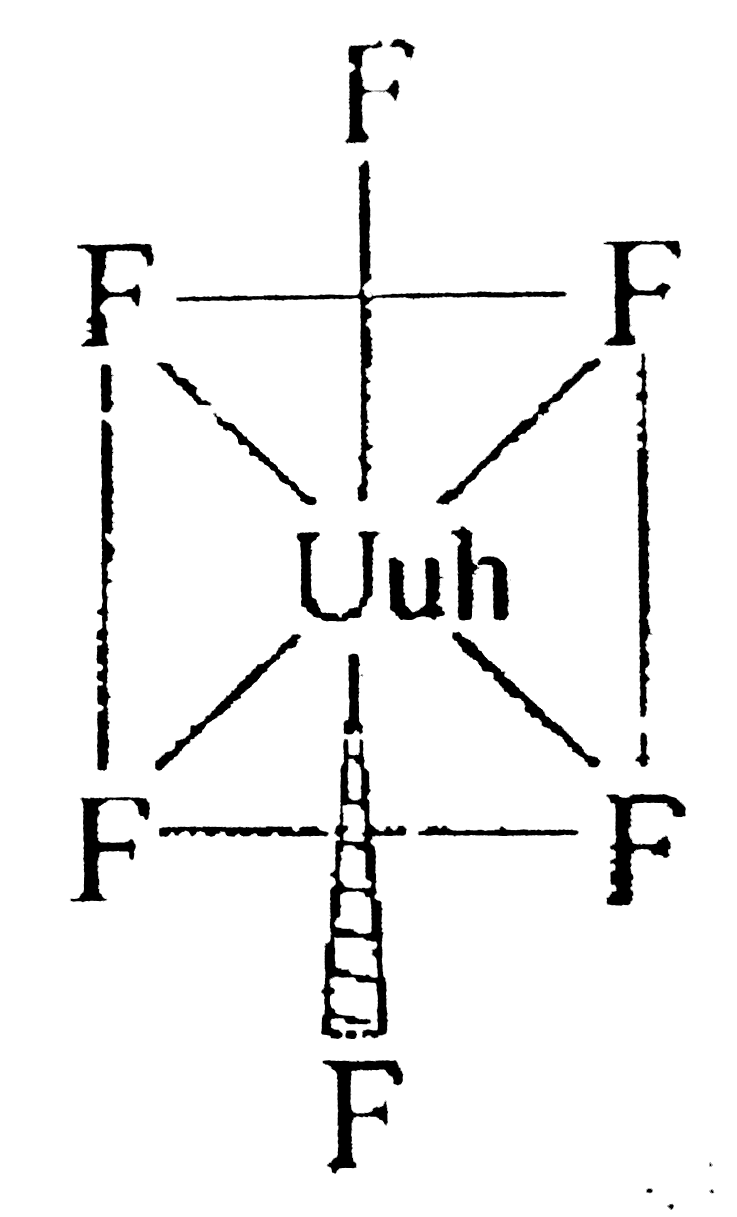 `sp^(3)d^(2)`, OCTAHEDRAL `mu=0` Non-polar and Non PLANAR |
|
| 48. |
If in diamond, there is a unit cell of carbon atoms as fcc and if carbon atom is sp^(3) hybridized, what fractions of void are occupied by carbon atom. |
|
Answer» 25 % TETRAHEDRAL |
|
| 49. |
If in a standard hydrogen electrons half cell 2H^(+) (aq) + 2e to H_(2)(g), 1 atm, on-oxidation of base hydrogen ion concentration is reduced to 10^(-3) (M), then the emf will be |
|
Answer» `+0.0591` V |
|