

Saved Bookmarks
This section includes 7 InterviewSolutions, each offering curated multiple-choice questions to sharpen your Current Affairs knowledge and support exam preparation. Choose a topic below to get started.
| 1. |
If N_(0) is the initial number of nuclie , number of nuclei remaining undecayed at the end of nth half life is : |
|
Answer» `2^(-N) N_(0)` |
|
| 2. |
If N_(0) and N are the number of radioactive particles at time t = 0 and t = t, then |
|
Answer» `LAMDA = (1)/(t) "LOG" (N_(0))/(N)` |
|
| 3. |
If N^(0) is the initial number of nuclei, number of nuclei remaining undecayed at the end of n^(th) half-life is |
|
Answer» `2^(-N) N^(0)` |
|
| 4. |
If 'n' represents total number to asymmetric carbon atoms in a compound, the possible number of optical isomers of the compound is |
|
Answer» 2n |
|
| 5. |
If 'n' is the number of ions given by 1 mole of electrolyte, the degree of dissociation 'alpha' of electrolyte is - |
|
Answer» `(i-1)/(n+1)` |
|
| 6. |
If N and S elements are present in organic compound, then during Lassaigne's test both change into |
|
Answer» `Na_(2)S " and NaCN` |
|
| 7. |
If n and l are respectively the principal and azimuthal quantum numbers, then the expression for the calculation of the total no. of electrons in any energy level is |
|
Answer» `sum_(l=0)^(l=n)2(2l+1)` `=sum_(l=0)^(l=n-1)2(2l+1)` |
|
| 8. |
If n = 3, l= 0, m = 0, then atomic number is |
|
Answer» 12 or 13 `therefore` ELECTRONIC configuration will be `1s^(2)2s^(2)2P^(6)3s^(1-2)` ATOMIC number is 11 or 12. |
|
| 9. |
If M,W and V represents molar mass of solute, mass of solute and volume of solution in litres respectively, which among following equations is true? |
|
Answer» `pi = (MWR)/(TV)` `pi V = n RT` but `n = W/M` Hence `pi V = W/M RT` or `pi = (WRT)/(MV)` |
|
| 10. |
If m_(p) is the mass of proton. m_(n) that of a neutron, M_(1) that of _(10)Ne^(20) nucleus and M_(2) that of _(20)Ca^(40) nucleus, then which of the following relations is//are not true? |
|
Answer» `M_(2) gt 2M_(1)` `M_(2) lt 2M_(1)` (Because more mass is reduced for binding more nucleons) |
|
| 11. |
If moving wih equal speed,the longest wavelength of the following matter waves is that for (an) |
| Answer» Answer :A | |
| 12. |
If molecules is pyramidal, X stereoisomers are possible for : ""C_(abed) Find the value of X. |
|
Answer» |
|
| 13. |
If molecular weight of compound is increased then sensitivity is decreased in which of the following methods |
|
Answer» Elevation in boiling point |
|
| 14. |
If molecular interaction betweentwo different liquid molecules are stronger than the molecular interactions between the pure liquid molecules, the mixture is expected to show: |
|
Answer» POSITIVE deviations |
|
| 15. |
If molecular axis is X then which of the following overlapping will form pi bond p_(z)+p_(z),p_(x)+p_(x),p_(x)+p_(y),p_(s)+p_(z),p_(y)+p_(y) |
| Answer» | |
| 16. |
If molarity = molality and density of the solution is 2gm/ml thenW_("solute"):W_("solvent") would be |
|
Answer» `1:2` Molarity =molality `("moles")/(V(sdn)(L))=("moles")/(W("SOLVENT")(kg))` `IMPLIES W_(("solvent"))` is numerically EQUAL to volume of the solution. `V_(("so In"))=(W("solution"))/(d("solution"))implies(w("solution"))/(d("solution"))=W` (solvent) `((W_("solution"))/(W_("solvent"))-d_("solution"))` As `d=2` gm/ml `impliesW_("solution")=2W_("solvent")impliesW_("solute")=W_("solvent")` |
|
| 17. |
If molar heat of vaporization is 9698 cals mol^(-1) then entropy of vaporization of water at 100^(@)C will be |
|
Answer» 20.0 CALS `MOL^(-1) k^(-1)` |
|
| 18. |
If mole fraction of the solvent in a solution decreases then: |
|
Answer» VAPOUR PRESSURE of SOLUTION increases |
|
| 19. |
IF molalityof thedilutesolutionisdoubledthe valueof molaldepressionconstant(K_(f))will be______. |
|
Answer» Dobled |
|
| 20. |
If molality of the dilute solution is doubled, the value of the molal depression constant (K_(f)) will be |
|
Answer» doubled |
|
| 21. |
If mirror image of the compouns is not superimposable on it, most appropriately it represent |
|
Answer» PAIR of OPTICAL ACTIVE isomers |
|
| 22. |
If molality of the dilute solution is doubled, the value of molal depression constant (K_f) will be |
|
Answer» unchanged |
|
| 23. |
If M_("normal") is the normal molecular mass and alpha is the degree of ionsation of K_(3)[Fe(CN)_(6)], then the abnormal molecular mass of the complex in the solution will be |
|
Answer» `M_("NORMAL")(1+2alpha)^(-1)` |
|
| 24. |
If Mg^(2+) +2e rarrMg(s), E=-2.37 V,Cu^(2+) + 2e rarrCu(s),E=+0.34V then theemf of the cell Mg|Mg^(+2)||Cu^(2+)|Cu is : |
|
Answer» `2.71V` |
|
| 25. |
If methyl group is on axial possition in product ( P-4),then what is the possition of Br-atoms on C_(1) "and"C_(2) respectively? |
|
Answer» Axial-equatrial 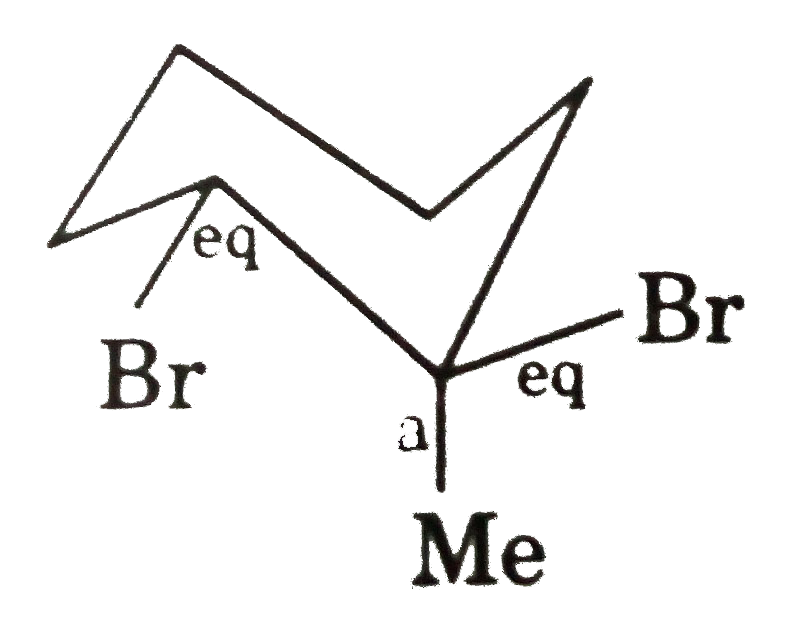
|
|
| 26. |
If methyl iodide and ethyl iodide are mixed in equal proportions, and the mixture is treated with metallic sodium in presence of dry ether, the number of possible products formed is: |
|
Answer» 2 |
|
| 27. |
If methyl bromide and ethyl bromide are mixed in equal proportion and the mixture is treated with sodium, the number of possible organic products is : |
|
Answer» 1 |
|
| 28. |
If methyl bromide and ethyl bromide are mixed iequal proportion and themixture is treated with Na metal, the number of possible organic product are |
| Answer» Solution :`3CH_(3)Br+6Na+3C_(2)H_(5)Br overset("dry ether") to C_(2)H_(6)C_(4)H_(10)+C_(3)H_(8)+6NaBr` | |
| 29. |
If metal ions of groups III are precipitated by NH_(4)Cl and NH_(4)OH without prior oxidation by conc. HNO_(3)....... is not completely precipitated. |
|
Answer» |
|
| 30. |
If methanol vapour is passed over heated copper at 300^@C, it forms formaldehyde by: |
|
Answer» Hydrogenation |
|
| 31. |
If mass % of oxygen in monovalent metal carbonate is 48% ,then find the number of atoms of metal present in 5mg of this metal carbonate sample is (N_(A) = 6.0 xx 10_(23) ) |
|
Answer» |
|
| 32. |
If matel ionsof group II are precipitate by NH_(4)CI and NH_(4)OH without prior oxidationby conconirated HNO_(3) _____is not completelyprecipitate |
|
Answer» |
|
| 33. |
If mass of neutron is assumed to half of its original value. Whereas that of proton is assumed to be twice of its original value, then the atomic mass of ._(6)^(14C will be: |
|
Answer» same Number of neutrons=8 New atomic MASS will be `=2xx6+(1)/(2)xx8=16` % Increase in mass `=(16-14)/(14)xx100=14.28%`. |
|
| 34. |
If mercury is used as cathode in the electrolysis of aqueous NaCl solution, the ions dischaged at cathode are: |
| Answer» ANSWER :B | |
| 35. |
If mass of KHC_(2)O_(4) (potassium acid oxalate) required to reduce 100 mL of 0.02 M KMnO_(4) in acidic medium is x g and to neutralise 100 mL of 0.05 M Ca(OH)_(2) is y g, then which of the following options may be correct : |
|
Answer» If x is 1 g then y is 2 g |
|
| 36. |
If magnetic moment of [MnBr_(4)]^(2-) is 5.9 BM. Predict the number of electrons? |
|
Answer» 2 `therefore 5.9=sqrt(n(n+2))` `therefore n=5`. |
|
| 37. |
If m represents mass of substance (equivalent weight E) consumed or produced when quantity Q of electricity is passed |
|
Answer» `m PROP Q` |
|
| 38. |
If m is the mass of a substance with equivalent weight E and Q is quantity of electicity passed , then |
|
Answer» `m PROP (1)/(Q)` |
|
| 39. |
If M is the element of actinoid series, the degree of complex formation decreases in the order |
|
Answer» `M^(4+) GT M^(3+) gt MO_(2)^(2+) gt MO_(2)^(+)` |
|
| 40. |
If 'M' is a monovalent metal , the order of ionic character of their halides respectively is |
|
Answer» `MFgtMClgtMBrgtMI` |
|
| 41. |
If l=length, R=resistance and A=cross sectional area, then. . . . |
|
Answer» `RPROP(l)/(A)` So, `Rprop(l)/(A)`. |
|
| 42. |
If liquids A and B form an ideal solution, |
|
Answer» the ENTROPY of mixing is zero |
|
| 43. |
If Lamda_(NaOAc)^(@)=91 and Lamda_(HCl)^(@)=496.2" S "cm^(2)mol^(-1) then what is required to find out Lamda_(HOA c)^(@) ? |
|
Answer» `Lamda_(ClCH_(2)COOH)` i.e., by KNOWING the value of `^^_(NaCl)^(@)`, we can DETERMINE `^^_(HOA C)^(@)`. |
|
| 44. |
If lamdaClCH_(2)COONa=224Ohm^(-1)cm^(2)gm" "equ^(-1),lamdaNaCl=38.2Ohm^(-1)cm^(2)" gm "equ^(-1) and lamdaHCl=203Ohm^(-1)cm^(2)" gm "equ^(-1), then what is the value of lamdaClCH_(2)COOH ? |
|
Answer» `288.5Ohm^(-1)cm^(2)" gm "EQU^(-1)` `=lamdaClCH_(2)COONa+lamdaHCl-lamdaNaCl` `=224+203-38.2` `=388.8Ohm^(-1)cm^(2)" gm "equ^(-1)`. |
|
| 45. |
If Lamda^(@)CH_(3)COONa=91" S "cm^(2)mol^(-1)," "Lamda^(@)HCl=462.2" S "cm^(2)mol^(-1), then choose correct option to determine Lamda^(@)CH_(3)COOH. |
|
Answer» `lamda^(@)CL^(-)` |
|
| 46. |
If lamda=c_(2)[(n^(2))/(n^(2)-Z^(2))] for Balmer series what is the value of C_(2)? |
|
Answer» `r/(R_(H))` `implies1/(lamda)=1/(C_(2))[1-(Z^(2))/(n^(2))]` `=(Z^(2))/(C_(2))[1/(Z^(2))-1/(n^(2))]` `:.R_(Y)=(Z^(2))/(C_(2))impliesC_(2)=4/(R_(H))` Hence a is the correct answer. |
|
| 47. |
If lambda_(0) is the threshold wavelnegth of a metal and lambda is the wavelength of the incident radiation, the maximum velocity of the ejected electron from the metal would be |
|
Answer» `[ ( 2hc)/( m )((lambda_(0) - LAMBDA)/( lambda_(0) lambda))]^(1//2)` |
|
| 48. |
IfK_(sp)of M(OH)_(3) is 1 xx 10^(-12) then 0.001 M.M^(2+) isprecipitate in a pH gt 9 |
|
Answer» `[M^(3+)][OH^(Theta)]^(3) gt K_(sp) [OH^(Theta)]^(3)gt 1 XX 10^(-9)` `[OH^(Theta)] gt 1 xx 10^(-3)` Maximum `pOH = 3` Minimum `pH = 9` Hence true. |
|
| 49. |
If lactobacillus bacteria (which converts milk to curd) multiply in milk as per the data given {:("Time(minute)",,0,,15,,45,,75),("No . of bacteria",,100,,200,,800,,3200):} 100g milk to curd requires 4xx10^(9) such bacteria. Atleast how many hours it will require to convert 1kg milk if initially 100 bacteria were mixed in it. |
|
Answer» |
|