Saved Bookmarks
This section includes 7 InterviewSolutions, each offering curated multiple-choice questions to sharpen your Current Affairs knowledge and support exam preparation. Choose a topic below to get started.
| 1. |
If for any given reaction if E_(cell)^(@) value is negative, then choose correct option for DeltaG^(@) and K. |
|
Answer» `DELTAG^(@) lt 0, K_(eq)gt1` `DeltaG^(@)=-nF" "E_(cell)^(@)` `DeltaG^(@)=+ve impliesDeltaG gt0` `DeltaG^(@)=-2.303" RT "log" "K_(eq)` `THEREFORE K_(eq) lt 1` |
|
| 2. |
If for H_2 gas,C_p -C_v=a and for O_2 gas,C_p-C_v=b,where C_p and C_v is heat capacity in cal/g-k,then select the correct relation |
|
Answer» b=8a |
|
| 3. |
If for Ag|Ag_((0.01M))^(+)||Ag_((0.1M)^(+)|Ag, cell E_(Ag^(+)|Ag)^(@)=0.80V, then . . . |
|
Answer» `E_(CELL)^(@)=0.80V` `=-0.059xx(-1.0)` `=0.059V` |
|
| 4. |
If for a thermodynamic expansion, dq=0, the increase in volume is associated with ___________ . |
|
Answer» DECREASE in PRESSURE and INCREASE in temperature |
|
| 5. |
If for a reaction Delta H is negative and Delta S is positive then the reaction is |
|
Answer» SPONTANEOUS at all temperatures |
|
| 6. |
If for a sucrose solution elevation in boiling point is 0.1^(@)C then what will be the boiling point of NaCl solution for same molal concentration |
|
Answer» `0.1^(@)C` `Delta T_(B) ptop n` For SUCROSE, `n = 1, Delta T_(b) = 0.1^(@)C` For NACL, n = 2, `Delta T_(b)=0.2^(@)C` |
|
| 7. |
What will be half life period of a nucleus if at the end of 4.2 days, N =0.798 N_(0) ? |
|
Answer» 10 days |
|
| 8. |
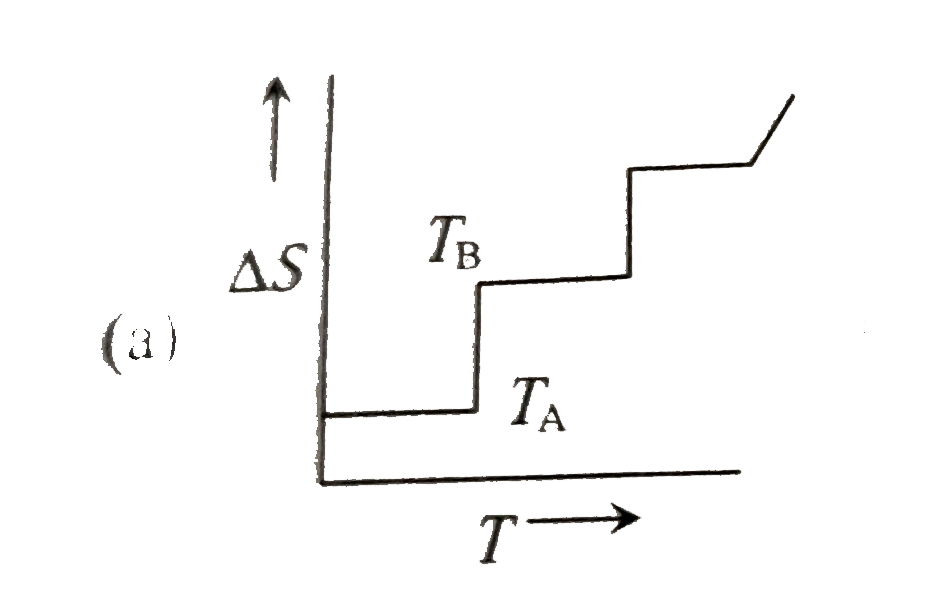
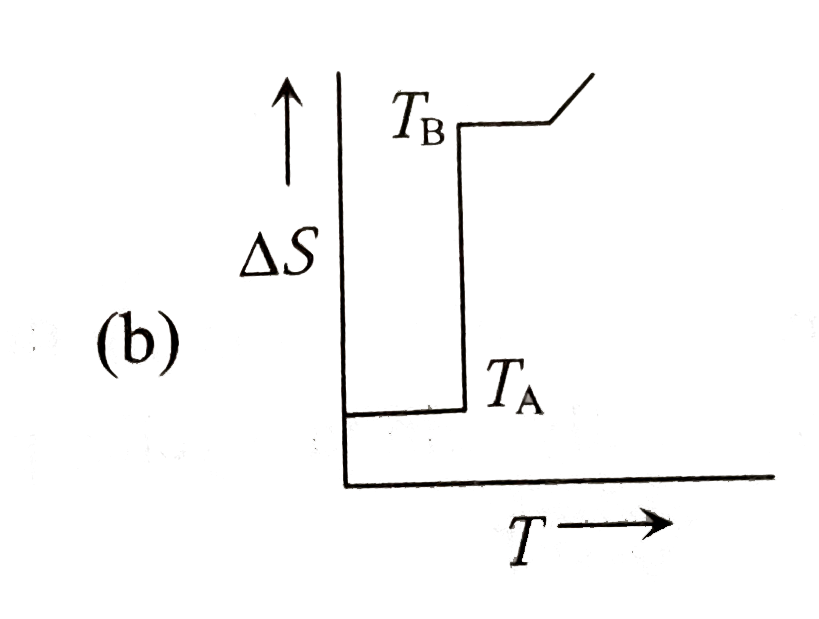
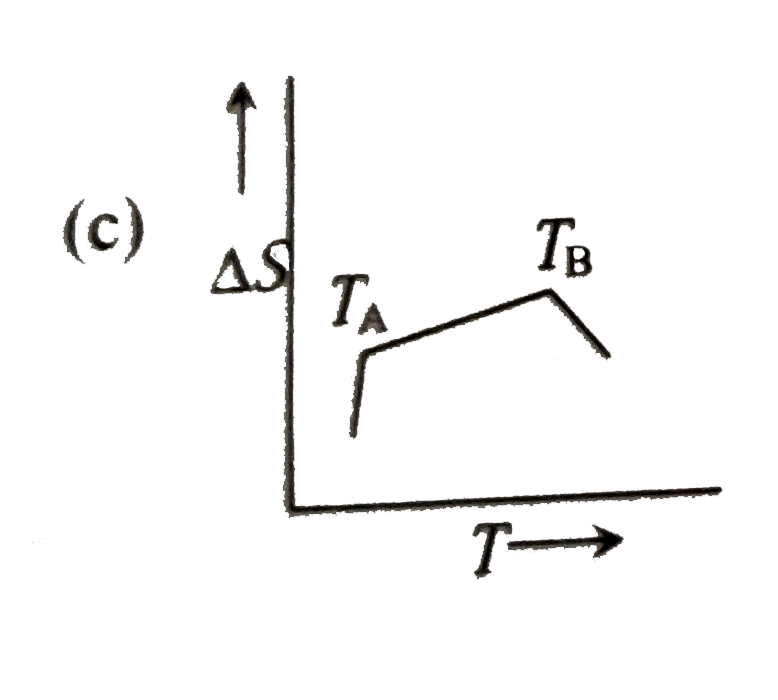
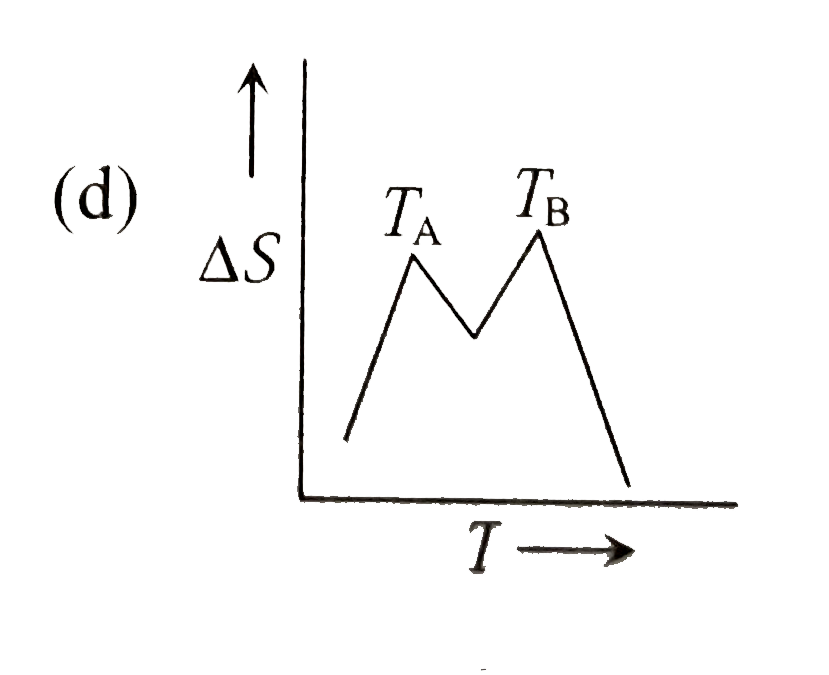
If for a given substance melting point is T_(B) and freezing point is T_(A), then correct variation shown by graph between entropy change and temperature is |
|
Answer»
|
|
| 9. |
if for a given substance , melting point is T_(B) and freezing point is T_(A)then correct variation of entropy by graph between entropy change and temperature is |
|
Answer»
|
|
| 10. |
If for a first order reaction, the values of A and E_a are 4 x 10^(13) sec^(-1) and 98.6 kJ/mol respectively, then at what temperature will its half-life period be 10 minutes? |
|
Answer» 330 K log k =log A `-(E_a)/(2.303RT)`….(1) For a FIRST order reaction,`t_(1//2)=(0.693)/(k)` `t_(1//2)`=10min=600 s `therefore k = (0.693)/(600)=1.1xx10^(-3)s^(-1)`…(2) Putting value of k from eq. (2) in eq.(1) we get, `log(1.1xx10^(-3))" "=" "log (4XX10^(13))-(98.6xx10^(3))/(2.303xx8.314xxT) `therefore` T=311.15K |
|
| 11. |
If following reaction is started with 6 gm of H_(2) and 14 gm of N_(2) then mass of NH_(3) formed will be : N_(2) (g) + 3H_(2) (g) overset(60%)rarr 2NH_(3) (g) |
|
Answer» `10.2 gm` Moles of `NH_(3)` PRODUCED `= (1)/(2) xx 2 xx 0.6 = 0.6` mole Mass of `NH_(3) = 0.6 xx 17 = 10.2 gm` |
|
| 12. |
If first order reaction (A to P ) ,"calculate"(t)/(t_(1//2))"if" (15)/(16) fraction of reactant is decayed in 't' time where t_(1//2) is half life. |
|
Answer» |
|
| 13. |
In the first order reaction, the concentration of the reactant is reduced to 12.5% in one hour. The half-life period of the reaction is: |
|
Answer» 15 min `K = 2.303/t LOG""([A]_0)/([A]) =2.303/60log"" (100)/12.5 = 0.0346 "min"^(-1)` Now t `1//2 = 0.693/K = 0.639/0.0346 = 20 min`. |
|
| 14. |
If first orbit energy of He^(+) is -54.4 eV, then the second orbit energy will be |
|
Answer» `-54.4 eV` |
|
| 15. |
If Fe|Fe^(2+)(xM)||Cu^(2+)(0.01M)|Cu has cell potential of 0.78V then x= . . . E_(Fe^(2+)//Fe)^(@)=-0.44V,E_(Cu^(2+)//Cu)^(@)=+0.34V). |
|
Answer» `xgt0.01M` `=E_(Cu^(2+)//Cu)^(@)-E_(FE^(2+)/?Fe)^(@)` `=+0.34-(-0.44)` =0.78V So `E_(cell)=E_(cell)^(@)` Hence x=0.01 M (ii) Cell reaction : `Fe_((S))+Cu^(2+)(0.01M) t Fe^(2+)(xM)+Cu_((S))` So n=2 `E_(cell)=E_(cell)^(@)-(0.0592)/(n)"log"([Fe^(2+)])/([Cu^(2+)])` `therefore 0.78=0.78-(0.0592)/(2)"log"(x)/(0.01)` `therefore logx-log(0.01)=0` `therefore logx+2=0` `therefore logx=-2` `therefore x=10^(-2)=0.01M` |
|
| 16. |
If [Fe(CO)_x]follows the Sidgwick rule of stability, what is the value of 'x'? |
|
Answer» Solution :The complex COMPOUND `[Fe(CO)_x]` following the Sidgwick rule of stability, EAN of IRON is to be equal to the atomic number of nearst inert gas 36 (Krypton). `36 = 26 - 0 + 2 xxx rArrx= 5` HENCE the value of x is 5. |
|
| 17. |
If f-block elements, the last electron enters the |
|
Answer» nf-sublevel |
|
| 18. |
If excess of Zn is added to 1.0M solution of CuSO_4, find the concentration of Cu^(2+) ions at equilibrium. The standard reduction potentials of Zn and Cu at 25^@C are 0.76 V and +0.34V. |
|
Answer» |
|
| 19. |
If extent of dissociation of both KCl and BaCl_2 of some concentrations with identical value of alpha as 0.9, what is the ratio of their van't Hoff factors? |
|
Answer» Solution :van.t Hoff FACTOR is given as , `i=(1+(n-1))/1 ALPHA` n=2 for KCL , i=1+(2-1) `alpha` = 1+ `alpha` =1+0.95 = 1.95 n=3 for `BaCl_2` , i=1+(3-1) `alpha` = 1+2 `alpha` =1+1.9=2.9 The ratio of van.t Hoff factor for KCl and `BaCl_2` =1.95 : 2.9 =1:1.51 |
|
| 20. |
If excess of halogen reacts with benzene then second halogen atom isintroduced in the ring at meta positions. Is it true or false? |
| Answer» SOLUTION :Second halogen atom is introuced in the RING at ortho and para POSITION | |
| 21. |
If excess of AgNO_(3) solution is added to 100mL of a 0.024 M solution of dichlorobis (ethylene diamine) cobalt (III) chloride, how many mol of AgCl be precipitated? |
|
Answer» 0.0012 |
|
| 22. |
If excess F_(2)(g) reacts at 0^(@)C and 1.0 atm pressure with Br_(2)(g) to give a compound BrF_(n), if 224ml of Br_(2)(g) at the same temperature and pressure produced 3.5g of BrF_(n), what is n? |
|
Answer» SOLUTION :`Br_(2)+nF_(2)rarr2BrF_(n)` `224 ML Br_(2)` at 273 K and 1 ATM `n_(Br_(2))=((1)(224)xx10^(-3))/(0.0821xx273)=0.01` mol `n_(Br)F_(n)=2n_(Br_(2))=0.02` mol `(3.5)/((80+19n))=0.2` 3.5=1.6+0.38n 1.9=0.38n `n=(1.9)/(0.38)=5` |
|
| 23. |
IF excess metallic iron is added to an N-CuSO_4 solution, calculate the approximate concentration of Cu^(2+) when equilibrium is established. |
| Answer» SOLUTION :`3 TIMES 10^-27 M` | |
| 24. |
If every quantity is expressed in SI units, then molar conductivity (wedge_(m)), conducitivy (kappa) and molarity (M) are related as____. |
| Answer» SOLUTION :`wedge_(m)=(KAPPA)/(M)` | |
| 25. |
If ethylene, carbon monoxide and water is heated at high temperature , which of the following is formed |
|
Answer» `C_4H_8O_2` |
|
| 26. |
If ethanol dissolves in water, then which of the following would be done |
|
Answer» Absorption of HEAT and CONTRACTION in volume |
|
| 27. |
If ethene molecule is present on YZ plane then nodal plane of its pi bond will lie on : |
|
Answer» XY plane |
|
| 28. |
If (eta^(5)-C_(5)H_(5))" "M(C_(2)H_(4))_(2) follows EAN rule, the central metal atom/ion would be : |
|
Answer» `Co(Z=27)` `impliesZ-1+6+2xx2=36 or 54` `implies ""Z=27or 45` |
|
| 29. |
If equlibrium constnats of reaction, N_(2)+O_(2)hArr 2NO is K_(1) and 1/2N_(2)+1/2O_(2)hArrNO is K_(2), then |
|
Answer» `K_(1)=K_(2)` `1/2N_(2)+1/2O_(2)hArrNO""...(ii)` From equation NUMBER (i) `K_(1)=([NO]^(2))/([N_(2)][O_(2)])""...(iii)` For equation number (ii) `K_(2)=([NO])/([N_(2)]^(1//2)[O_(2)]^(1//2))""...(IV)` From equation (iii) & (iv) it is clear that `K_(2)=(K_(1))^(1//2)=sqrt(K_(1)),"""Hence",K_(2)sqrt(K_(1))` |
|
| 30. |
If equlibrium constant for reaction 2ABhArrA_(2)+B_(2).is 49 then the equlibrium constant for reacton ABhArr1/2A_(2)+1/2B_(2). wll be |
|
Answer» 7 |
|
| 31. |
If equivalent conductance of 1M benzoic aid is 12.8ohm^(-1)cm^(2) and 288.42 ohm^(-1)cm^(2) respectively. Its egree of dissociation is |
|
Answer» 0.39 `=42+288.42=330.42` `ALPHA=(wedge_(m)^(@))/(wedge_(m)^(@))=(12.8)/(330.42)=3.9%` |
|
| 32. |
If equivalent conductance of 1 M benzoic acid is 12.8 ohm^(-1) cm^(2) and if the conductance of benzoic ion and H^(+) ion are 42 and 288.42 ohm^(-1) respectively, its degree of dissociation is |
|
Answer» 0.39 `=42+288.42=330.42` `alpha=(^^_( m)^(@))/(^^_( m)^(@))=(12.8)/(330.42)= 0.03 9=3.0%` |
|
| 33. |
If equilibrium constant of reaction, N_(2)+3H_(2)iff2NH_(3) is K, then K' for reaction, 2N_(2)+6H_(2)iff4NH_(3) is |
|
Answer» `K^(2)` |
|
| 34. |
If equilibrium constant K is 10^(3), the Delta G^(theta) for the reaction at 300 K is (assume R = 8.314 JK^(-1) mol^(-1)) : |
|
Answer» `- 16.582 KJ` `= -2.303 x 8 XX 300 xx log 10^(3)` `= -2.303 xx 8 xx 300 xx 3 = -16.582 kJ` |
|
| 35. |
if equal volumes of 0.1 M H_2SO_4 and 0.1 M HCl are mixed then the pH of resulting solution will be (log 15 = 1.176) |
|
Answer» 0.82 |
|
| 36. |
if equal volume of O.1 M NH_4OH and 0.1 M HCl are mixed, then the pH of resulting mixture will be [Given pK_b (NH_4 OH)= 4.75, log 5=0.7)] |
|
Answer» 8.72 |
|
| 37. |
If equal masses of oxygen and nitrogen are placed in separate containers of equal volume at the same temperature, which one of the following statements is true ?(Mol wt. N_2=28, O_2=32) |
|
Answer» <P>Both flasks contain the same number of molecules |
|
| 38. |
If E^(o)""_(Fe^(+2)//Fe) is x_(1),E^(o)""_(Fe ^(+3)//Fe)is x_(2), then E^(o) ""_(Fe^(+3)//Fe^(2+)) will be : |
|
Answer» `3x_(2) - 2x_(1)` |
|
| 39. |
If enthalpies of methane and ethane are respectively 320 and 360 calories then the bond energy of C - C bond is |
|
Answer» 80 CALORIES `E_(C-H)=(320)/(4)=80` In `C_(2)H_(6)` there is 6 implies C-H bond and 1 implies C-C bond `360=E_(C-C)+6E_(C-H)` `360=E_(C-C)+6xx80` `E_(C-C)=120 cal`. |
|
| 40. |
If enthalpy of hydrogenation of cyclohexene is [-x kJ mol^-1] and resonance energy of benzene is [-y kJ mol^-1] then the enthalpy of hydrogenation of benzene will be |
|
Answer» `[(y - 3X) KJ mol^-1]` |
|
| 41. |
If enthalpy of hydrogenation of C_(6)H_(6)(l) into C_(6)H_(12)(l) is -205 kJ & resonance energy of C_(6)H_(6)(l) -152 kJ/mol then enthalpy of hydrogenation of 1, 4-cyclohexadiene (l) is Assume DeltaH_("vap") of C_(6)H_(6)(l), C_(6)H_(8)(l), C_(6)H_(12) (l) all are equal |
|
Answer» `-535.5` kJ/mol 
|
|
| 42. |
If enthalpy of neutralisation of dil HCl and NaOH(aq) is x then enthalpy of neutralisation of dil. HI and Ba(OH)_2 (aq) is |
|
Answer» `x//2` |
|
| 43. |
if enthalpies of formatuon of C_(2)H_(4)(g),CO_(2)(g) and H_(2)O(l)at 250^(@)and 1 atm pressure be 52 ,-394 and -286 kJ mol ^(-1) respectively,the enthalpy of combustion of C_(2) H_(4)(g)will be |
|
Answer» `1412 kJ MOL ^(-1)` `DeltaH("REACTION")=[2xxDeltaH_(F)^(@)(CO_(2))+2xxDeltaH_(f)^(@)(H_(2)O)]` `[DeltaH_(f)^(@)(C_(2)H_(4))+3xxDeltaH_(f)^(@)(O_(2))]` `[2(-394)+2(286)]-[52+0]= 1412kJ mol^(-1)` |
|
| 44. |
If energies of the two photons are in the ratio 3:2, their wave lengths will be in the ratio of: |
|
Answer» Solution :`E prop 1/(LAMDA)` or `(E_(1))/(E_(2))=(lamda_(2))/(lamda_(1))=3/2` or `lamda_(1):lamda_(2)=2:3` |
|
| 45. |
If energy of activation of a reaction is 2303 joule,then whatIs the value of slope of graph log kto(1)/(T)? |
|
Answer» `-12195.12` JOULE |
|
| 46. |
If emf of standard cell during cell reaction is 0.295 V at 298 K and n=2, then what is the equilibrium constant of such reaction ? [F=96500," "R=8.314KJ^(-1)mol^(-1)] |
|
Answer» `4.0xx10^(12)` `THEREFORE logK=(2xx0.295)/(0.059)=10` `therefore K=1xx10^(10)`. |
|
| 47. |
If enthalpies of formation of C_(2)H_(4)(g), CO_(2)(g) and H_(2)O(l) at 25^(@)C and 1 atm pressure be 52, - 394 and - 286 kJ mol^(-1) respectively, the enthalpy of combustion of C_(2)H_(4)(g) will be |
|
Answer» `+1412 kJ mol^(-1)` `DeltaH_("reaction")=[2xxDeltaH_(f)^(@)(CO_(2))+2xxDeltaH_(f)^(@)(H_(2)O)]-DeltaH_(f)^(@)(C_(2)H_(4))+3xxDeltaH_(f)^(@)(O_(2))]` `=[2(-394)+2(-286)]-[52+0]=-1412 kJ`. |
|
| 48. |
If elevation in boiling point when AB is dissolved in water to make saturated solution at 25^(@)C is 2xx10^(-4) .^(@)C and K_(sp) of AB is 4xx10^(-x) then determine the value of x. (Assume alpha=1 molality = molarity) (given K_(b)=0.5K//m). |
|
Answer» |
|
| 49. |
if the elevation in boiling point of a solution of non-volatile, non-electrolytic and non-associanting solute in solvent (K_(b) =xK.kg."mol"^(-1))is y K,then the depression in freezing point of solution of same concentration would be (K_(f) )of the sovent= zk.kg"mol"^(-1)) |
|
Answer» `(Zxz)/Y` `DeltaT_(f)=Zxxm=(Zn)/x` |
|
| 50. |
If electron, hydrogen, helium and neon nuclei are all moving with the velocity of light, then the wavelengths associated with these particles are in the order |
|
Answer» electron GT hydrogen gt HELIUM gt neon |
|