

Saved Bookmarks
This section includes 7 InterviewSolutions, each offering curated multiple-choice questions to sharpen your Current Affairs knowledge and support exam preparation. Choose a topic below to get started.
| 2. |
(i) Copper metal dissolves in 1M silver nitrate solution and crystals of silver metal get deposited. (ii) Siler metal does not react with 1M zinc nitrate solution. Zinc metal dissolves in 1M copper sulphate solution and copper metal gets deposited Hence the order of decreasing strength of the three metals as reducing agents will be |
|
Answer» `cugtAggtZn` |
|
| 3. |
I. Copper is the first metal used by the human II. Aluminium is used in galvanising metals III. Aluminium is a good conductor of electricity IV. Magnets can be made from iron. |
|
Answer» Only I |
|
| 4. |
(i) Copper - Bessemer converter (ii) Iorpn- Blastfurnace (iii) chromium - Aluminothermic process (iv) Tin - Carbon reducaton (v) Zinc -Belgian process In the given data how many of them are correctly matched ? |
|
Answer» |
|
| 5. |
(i) Consider the oxidation of nitric oxide to form NO_(2) 2NO_((g))+O_(2(g)) to 2NO_(2(g)) (a) Express the rate of the reaction in terms of changes in the concentration of NO, O_(2) and NO_(2). (b) At a particular instant, when [O_(2)] is decreasing at 0.2mol L^(-1)s^(-1) at what rate is [NO_(2)] increasing at that instant? (ii) Classify the following as acid (or) base using Arrhenius concept 1. HNO_(3)"" 2.Ba(OH)_(2)""3. H_(3)PO_(4)"" 4. CH_(3)COOH |
|
Answer» Solution :(i) (a) Rate `=(-1)/(2)(d[NO])/(dt)=(d[O_(2)])/(dt)=(1)/(2)(d[NO_(2)])/(dt)` (b) `(-d[O_(2)])/(dt)=(1)/(2)(d[NO_(2)])/(dt)` `(d[NO_(2)])/(dt)=2xx((-d[O_(2)])/(dt))=2xx0.2" MOL "L^(-1)s^(-1)=0.4" mol "L^(-1)s^(-1)` (ii) 1. `HNO_(3)` : Nitric acid, dissociates to give hydrogen ions in water. `therefore HNO_(3)` is acid. 2. `Ba(OH)_(2)` : BARIUM hydroxide, dissociates to give hydroxyl ions in water. `therefore Ba(OH)_(2)` is BASE. 3. `H_(3)PO_(4)` : Orthophosphoric acid, dissociates to give hydrogen ions in water. `therefore H_(3)PO_(4) ` is acid. 4. `CH_(3)COOH` : Acetic acid, dissociates to give hydrogen ions in water. `therefore CH_(3)COOH` is acid. |
|
| 6. |
(i) Complete the following equations : (a) 2MnO_(4)^(-)+ 5SO_(3)^(2-)+6H^(+)to (b) Cr_2O_(7)^(2-)+6Fe^(2+)+14H^(+)to (ii) Based on the data, arrange Fe^(2+), Mn^(2+) and Cr^(2+) in the increasing order of stability of +2 oxdiation state . E^(@) Cr^(3+)//Cr^(2+)=-0.4V E^(@) Mn^(3+)//Mn^(2+)=01.5V E^(@) Fe^(3+)//Fe^(2+)=+08V |
|
Answer» Solution :(i)(a) `2MnO_4^(-)+5SO_(3)^(2-)+6H^(+)to 2Mn^(2+)+3H_2O+5SO_(4)^(2-)` (B) `Cr_2O_7^(2-)to 6Fe^(2+)+14H^(+)to 2Cr^(3+)+6Fe^(3+)+7H_2O` (ii) `E^(@) Cr^(3+)//Cr^(2+)=-0.4V` `E^(@) Mn^(3+)//Mn^(2+)=01.5V` `E^(@) Fe^(3+)//Fe^(2+)=+08V` INCREASING order of stability of `+2` oxidation state is : |
|
| 7. |
I. Conductance of electolyte solution increases with temperature II. Resistivity is reciprocal of molar conductivity of electrolyte. III. Cell constant has unit cm^(-1) |
|
Answer» if all the STATEMENT are correct |
|
| 8. |
(i) Complete the following equations. (a)2NaOH+Cl_(2) to (b) Cl_(2)+3I_(2) overset(934K)to(ii) Write the structure of chlorous acid [HOClO]. |
Answer» SOLUTION :
|
|
| 9. |
(i) Complete the following a. MnO_(4)^(2-)+H^(+) to ? b. C_(6)H_(5)CH_(3) underset(KMnO_(4))overset("acidified") to ? c. MnO_(4)^(-) +Fe^(2+) to ? (ii) What is linkage isomerism? Explain with an example. |
|
Answer» Solution :(i) a. `underset("ion") underset("Manganate")(3MnO_(4)^(2-))+underset("MEDIUM")underset("Acid")(4H^(+))to underset("ion")underset("Permaganate")(2MnO_(4)^(-))+underset("DIOXIDE")underset("Manganese")(MnO_(2))+2H_(2)O` b. `underset("Toluene")(C_(6)H_(5)CH_(3))underset({:(KMnO_(4)),("Oxidation"):})overset("acidified")tounderset("Benzoic acid")(C_(6)H_(5)COOH)` c. `underset("ion")underset("Permanganate")(2MnO_(4)^(-))+underset("ion")underset("FERROUS")(10Fe^(2+))+16H^(+)underset(("Oxidation"))(to)2Mn^(2+)+underset("Ferric")(10Fe^(3+))+8H_(2)O` (ii) This type of isomers arises when an ambidentate ligand is bonded to the central metal atom/ion through either of its TWO different donor atoms. For examples, `[CO(NH_(3))_(5)ONO]Cl_(2)` (Pentaammine nitrito cobalt (III) chloride) O - attached. (Red in colour). `[Co(NH_(3))_(5)NO_(2)]Cl_(2)` (Pentaammine nitro cobalt (III) chloride) N - attached (Yellow-brown in colour). |
|
| 10. |
i) Common oxidation state of actinoids is + 3 (Except thorium) ii) Maximum O.S of acitnoids is +7 (iii) Actionoids evolve H_2 with alkali's (iv) Configuration of thorium is [Rn] 5t^(0) 6d^(2) 7s^(2) Correct statements are |
| Answer» Solution :i,ii,iv, are correct | |
| 11. |
(i) CO is more stable at higher temperature. Why ? (ii) How will you prepare potash alum ? |
|
Answer» Solution :(i) In the Ellingham diagram, the formation of carbon monoxide is a straight line with NEGATIVE slope. In this case `Delta S` is positive as 2 moles of CO gas is formed by the consumption of one mole oxygen. Hence, CO is more stable at higher temperature. (ii) The alunite the alum stone is the naturally OCCURRING form and it is `K_(2) SO_(4). Al_(2) (SO_(4))_(3). 4Al(OH)_(3)`. When alum stone is treated with excess of sulphuric acid, the aluminum hydroxide is converted to aluminium sulphate. A calculated quality of potassium sulphate is added and the solution is crystallised to generate potash alum. It is purified by RECRYSTALLISATION. `K_(2)SO_(4).Al_(2)(SO_(4))_(3).4Al(OH)_(3) + 6H_(2)SO_(4) rarr K_(2)SO_(4) + Al_(2) (SO_(4))_(3) + 12 H_(2)O` `K_(2)SO_(4) + Al_(2) (SO_(4))_(3) + 24H_(2)O rarr K_(2)SO_(4).Al_(2) (SO_(4))_(3).24H_(2)O` |
|
| 12. |
(i) Cis -2- butene to trans-2-butene , Delta H_(1) (ii) Cis - 2 - butene to 1 - butene , Delta H_(2) (iii) Trans – 2 – butene is more stable than cis – 2 – butene. (iv) Enthalpy of combustion of 1 - butene, Delta H = – 649.8 kcal/mol 9 Delta H_(1) = 5 Delta H_(2) = 0 (vi)Enthalpy of combustion of trans 2 – butene, DeltaH = -647.0 kcal/mol The value of DeltaH_(1)& DeltaH_(2) in Kcal/mole are |
|
Answer» ` -1.0, 1.8` |
|
| 13. |
(i) Cis-2-buteneoverset(Br_(2))underset(C Cl_(4))(to) (ii) Trans-cyclo octeneoverset(Br_(2))underset(C Cl_(4))(to) (a) Number of organic products obtained in X. ltbr. (b) Number of organic products obtained in Y. (C)Number of possible stereoisomer of product of X. (d) Number of possible stereoisomer of product of Y. |
|
Answer» |
|
| 14. |
I) Chlorophyll is a magnesium porphyrin complex II) Mg atom forms two covalent bonds and two dative bonds in chlorophyll |
|
Answer» both are wrong |
|
| 15. |
(i) CHequivCHoverset(H_(2)O)underset(H_(2)SO_(4)//HgSO_(4))rarr[A]overset(o)rarr[B]overset(SOCl_(2))rarr[C]overset("Benzene")underset(AlCl_(3))rarr[D] (ii) C_(2)H_(5)Cloverset(KCN)rarr[A]overset(H_(2)O"/"H^(+))rarr[B]overset(NH_(3))rarr[C]overset(Heat)rarr[D] |
Answer» SOLUTION :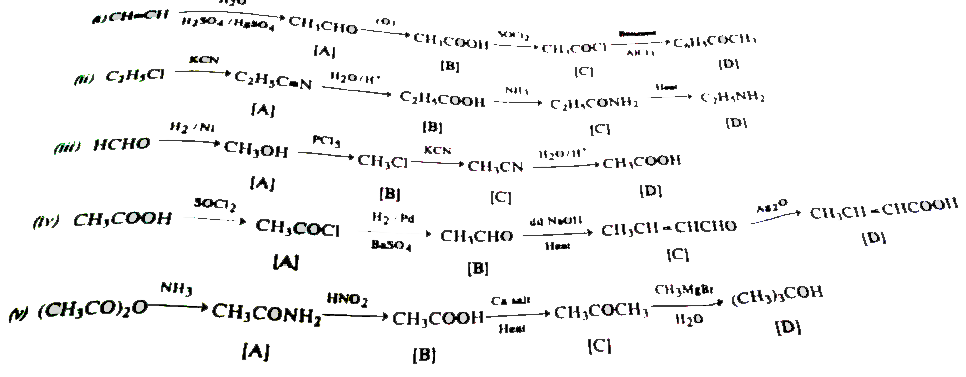 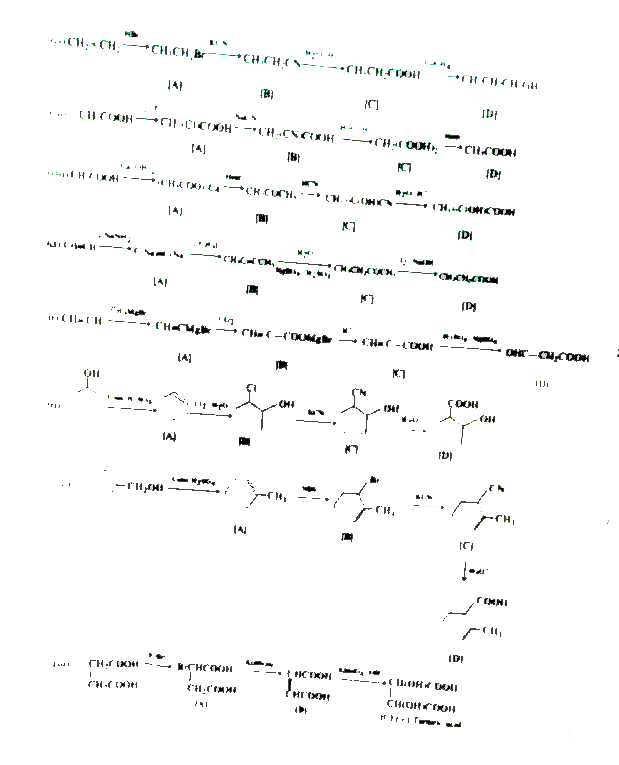
|
|
| 16. |
(i) CH_(3)CH_(2)OH+Cl_(2) overset([O])underset("Bleaching Poweder - 2HCl")rarr X overset(3Cl_(2))underset("Bleaching Poweder - 2HCl")rarr C Cl_(3)CHO(ii) C Cl_(3)CH(OH)_(2)+NaOH to Y+HCOONa+H_(2)OThe compound 'X' and 'Y' in the above two reactions are : |
|
Answer» `X=CH_(3)CHO, Y = CHCl_(3)` |
|
| 17. |
(i) CH_3CH_2 Cl overset("KOH"("aqueous"))toX (ii)underset( 170^(@) C) overset( "ConC" .H_2SO_4) to Y overset( Cl_2//H_2O ) to ZWhat is 'Z'? |
|
Answer» ETHYLENE glycolz |
|
| 18. |
(I) CH_3 OH(II) C_2H_5OH (III) CH_3CH_2CH_2OH (IV) CH_3 -CH (OH)CH_3 (V) (CH_3)_3 C- OH (VI)CH_3 CH(OH)C_2H_5 (VII) CH_3COCH_3 (VIII)C C l_3 COCH_3 (IX)CH_3 CHO(X)CH_3 -overset( O) overset(||) C - OH (XI)CH_3 -overset( O) overset(||) C- O -C_2H_5(XII)C_2 H_5-CHOWhich of the above compounds cannot undergo iodoform reaction ? |
|
Answer» `1`. Only `II,IV, VI, VII, VIII, IX` |
|
| 19. |
i) CH_(3)-CO-NH_(2)overset(Br_(2)//NaOH)rarr ii) Poverset(NaNO_(2), HCl)rarr Q What are Pand Q? Name the reaction occurring in step(i). |
|
Answer» SOLUTION :i) `CH_(3)-CO-NH_(2)OVERSET(Br_(2)//NAOH)rarr CH_(3)-NH_(2)` ii) `CH_(3)-NH_(2) overset(NaNO_(2), HCl) UNDERSET(0^(@)C)rarr CH_(3)-OH` The name of the first reaction is Hoffman.s Bromamide degradation. |
|
| 20. |
(i) CH_(2)=CH-(CH_(2))_(3)-CH_(2)-OH overset(P CC)to (ii). C_(6)H_(5)-CH=CH-CH_(2)-OH overset(PC C)to (iii). CH_(3)-overset(OH)overset(|)(C)H-CH_(2)-CH_(2)-CH_(2)-OH overset(PC C)to(A)underset((ii).Delta)overset((i).NaOH)to(B). (iv). (v). CH_(2)=CH-CH_(2)-OH overset(MnO_(2))to? (vi). (vii). CH-=C-CH=overset(CH_(3))overset(|)(C)-CH_(2)-OH underset("acetone")overset(MnO_(2))to? (viii). C_(6)H_(5)-overset(OH)overset(|)(CH)-CH_(3)underset(C Cl_(4))overset(MnO_(2))to? (ix). C_(6)H_(5)-CH=CH-CH_(2)-underset(CH_(3))underset(|)(C)H-CH_(2)-OH overset(DMSO+TsCl+NaHCO_(3))to? |
Answer» SOLUTION : . .
|
|
| 21. |
i) CH_(3)-Br+AgFrarr CH_(4)F+AgBr Name the above reaction. ii) P - dichlorobenzene has higher melting point than those of ortho and meta isomers. Give reason. |
|
Answer» SOLUTION :i) SWARTZ reaction ii) DUE to its symmetrical nature. |
|
| 22. |
(i) CH_(2)=CH-CH_(2)-CH=CH_(2) (ii) CH_(2)=CH-CH=CH-CH_(3) (iii) CH_(3)-CH=CH-CH=CH-CH_(3) The numbers of possible geometrical isomers for the above compounds are |
| Answer» Answer :D | |
| 23. |
{:("(i) Cell constant",(a)Sm^(2)mol^(-1)),("(ii) equivalent conductance",(b)Sm^(-1)),("(iii) Molar conductance",(c ) Sm^(2)g eq^(-1)),("(iv) Specific conductance",(d)m^(-1)):} |
|
Answer» `{:(A,B,C,D),(a,b,c,d):}` |
|
| 24. |
Which element of 3d series exhibits maximum oxidation state? |
|
Answer» SOLUTION :(a) `mu = sqrt(N(n+2))` `mu = sqrt(4(4 +2)) = 4.90 BM` (b) MANGANESES(or) MN. |
|
| 25. |
(i) Calculate the spin - only magnetic moment of Fe^(2+)[ Atomic number of iron =26]. (ii) Which element of 3d series exhibits maximum oxidation state ? |
|
Answer» Solution :(i) `Fe^(2+) `ATOMIC number `-26``[AR]3d^(6)4s^(2)` `MU =sqrt(n(n+2))` `n=4` `mu = sqrt(4(4+2))=sqrt24=4.89BM` (ii) Managanese . |
|
| 26. |
(i) Calculate DeltaG^(@) and log K_(c) for the following reaction at 298 K : 2Al(s)+3Cu^(2+)(aq)rarr 2Al^(3+)(aq)+3Cu(s) "Given :"E_("cell")^(@)=2.02V (ii) Using the E^(@) values of A and B, predict which is better for coating the surface of iron [E^(@)(Fe^(2+)//Fe)=-0.44V] to prevent corrosion and why? "Given : "E^(@)(A^(2+)//A)=-2.37V:E^(@)(B^(2+)//B)=-0.14V The conductivity of "0.001 mol L"^(-1) solution of CH_(3)COOH is 3.905 xx 10^(-5)" S cm"^(-1). Calculate its molar conductivity and degree of dissociation (alpha). "Given"lambda^(@)(H^(+))="349.6 S cm"^(2)"mol"^(-1) and lambda^(@)(CH_(3)COO^(-))="40.9 S cm"^(2)"mol"^(-1) What type of battery is dry cell? Write the overall reaction occurring in dry cell. |
|
Answer» Solution :`DF^(@)=-nFE_("cell")^(@)` `DG^(@)=-6xx96500xx2.02` `E_("cell")^(@)=(0.059V)/(n)logKc` `logKc=(2.02Vxx6)/(0.059V)=205.42` A because is `E^(@)` value is more negative. `^^_(m)^(@)=KAPPA xx1000//C` `=3.905xx10^(-5)xx1000//0.001` `="39.05 S cm"^(2)//"mole"` `CH_(3)COOH rarr CH_(3)COO^(-)+H^(+)` `^^^(@)CH_(3)COOH=LAMBDA^(@)CH_(3)COO^(-)+lambda^(@)H^(+)` `=349.6+40.9` `^^^(@)CH_(3)COOH="390.5 S cm"^(2)//"mol"` `=0.1` Primary cell `Zn+2NH^(+)+2MnO_(2)rarr Zn^(++)+2NH_(3)+2MnO(OH)` Primary cell `Zn+2NH^(+)+2MnO_(2)rarr Zn^(++)+2NH_(3)+2MnO(OH)` |
|
| 27. |
(i) C_(6)H_(5)CONH_(2)overset(Br_(2)//NaOH)toX+2NaBr+Na_(2)CO_(3)+2H_(2)O (ii) X+Br_(2)overset(Br_(2)//H_(2)O)toY+3HBr. Identify X,Y. |
|
Answer» SOLUTION :`XTO` ANILINE, `YTO` 2,4,6-tribromophenol. |
|
| 28. |
(I) C_6H_5N_2Cl overset( CuCl//HCl)to C_6H_5Cl+N_2(II)C_6H_5N_2Cl overset( Cu//HCl) to C_6H_5Cl+N_2+CuCl Incorrect statement among the following is |
|
Answer» Reaction 'I' is SANDMEYERS reaction |
|
| 29. |
1-butanol on heating with excess of concentradedH_2SO_4 gives : |
|
Answer» 1-butene |
|
| 30. |
I. Boric acid can be extracted from borax and colemanite. II. Boric acid is a colourful crystal. III. It is very weak monobasic acid. IV. It accepts hydroxyl ion rather than donating proton. |
|
Answer» Only I |
|
| 31. |
I both DNA and RNA, heterocyclic base and phosphate ester linkages are at |
|
Answer» C-5 and C-2 RESPECTIVELY of the SUGAR MOLECULE |
|
| 32. |
(i) Assuming the density of water to be 1g//cm^(3), calculate the volume occupied by one molecule of water. (ii) Assuming the water molecule to be spherical, calculate the diameter of the water molecule. (iii) Assuming the oxygen atom occupied half of the volume occupied by the water molecule, calculate approximately the diameter of the oxygen atom. |
|
Answer» Solution :1 mole of `H_(2)O= 18g=18cm^(3)""(because "density of "H_(2)O=1g//cm^(3))` `=6.022xx10^(23)" MOLECULES of "H_(2)O` Thus, `6.022xx10^(23)" molecules of "H_(2)O" have VOLUME"=18cm^(3)` `therefore"1 molecule of "H_(2)O" willhave volume"=(18)/(6.022xx10^(23))cm^(3)=2.989xx10^(-23)cm^(3)` (ii) As water molecule is assumed to be spherical, if R is its radius, then its volume will be `(4)/(3)piR^(3)=2.989xx10^(-23)cm^(3)"or"R^(3)=7.133xx10^(-24)"or"R=(7.133)^(1//3)xx10^(-8)=1.925xx10^(-8)cm` Take `n=(7.133)^(1//3)""therefore""logn=(1)/(3)log7.133=(1)/(3)xx0.8533=0.2844` `n="Antilog 0.2844"=1.925` `therefore"Diameter of water molecule"=2xx1.925xx10^(-8)cm=3.85xx10^(-8)cm` (iii) As oxygen atom occupied half of the volume occupied by water molecule, hence if r is the radius of oxygen atom, then `(4)/(3)pir^(3)=(1)/(2)xx2.989xx10^(-23)cm^(3)"or"r^(3)=3.566xx10^(-24)" which GIVES r"=1.528xx10^(-8)cm` `therefore"Diameter of oxygen atom"=2xx1.528xx10^(-8)cm=3.056xx10^(-8)cm.` |
|
| 33. |
(i) Assuing the reactant and product gases as ideal, show that for a gaseous reaction DeltaH=DeltaE+DeltanRT, where DeltaH and DeltaE indicate the changes of enthalpy and internal energy in the reaction. (ii) the bond energy of any diatomic molecule is defined to be the change in the internal energy for its dissociation. at 298K, O_(2)(g)to2O_(g),DeltaH=498.3kJ*mol^(-1). calculate the bond energy of O_(2) molecule R=8.314J*K^(-1)*mol^(-1). |
|
Answer» Solution :(i) (ii) GIVEN: `O_(2)(g)to2O(g),DeltaH=498.3kJ*mol^(-1)` For the above reaction, `Deltan=2-1=1` We KNOW, `DeltaH=DeltaU+DeltanRT` `THEREFORE 498.3kJ=DeltaU+1xx8.314xx10^(-3)xx298kJ` `therefore DeltaU=495.82kJ` Therefore, bond energy of `O_(2)` molecule=495.82 kJ. |
|
| 34. |
(i) Arrange the following compounds in an increasing order of basic strength : C_(6)H_(5)NH_(2), C_(6)H_(5)N(CN_(3))_(2), (C_(2)H_(5))_(2)NH and CH_(3)NH_(2) (ii) Arrange the following compounds in a decreasing order of pK_(b) values:C_(2)H_(5)NH_(2), C_(6)H_(5)NHCH_(3), (C_(2)H_(5))_(2) NH and C_(6)H_(5)NH_(2) |
|
Answer» Solution :(i) `C_(6)H_(5)NH_(2) lt C_(6)H_(5)N(CH_(3))_(2) lt CH_(3)NH_(2) lt (C_(2)H_(5))_(2)NH` (ii) `C_(6)H_(5)NH_(2) GT C_(6)H_(5)NHCH_(3) gt C_(2)H_(5)NH_(2) gt (C_(2)H_(5))_(2)NH` |
|
| 35. |
I) Aspirin is an acetyl derivative of o-hydroxy benzoic acid II) In aspirin acetyl group is substituted in the place of phenolic hydrogen |
|
Answer» Only II is correct |
|
| 36. |
(i) Arrange the following in order of their increasing boling point. H_(2)O,OH^(-),CH_(3)OH,CH_(3)O^(-) (ii) Arrange the following in order of their increasing boiling point : n-butane, ethanol, water, propane. (iii) Arrange the following in order of their increasing boiling point : n-butan, n-butanol,n-butyl chloride,isobutane. (iv) Arrange the primary, secondary and tertiary alcohols into decreasing order of reactivity towards sodium. (v) Arrange the primary, secondary and tertiary alcohols into decreasing order of acidity . (vi) Arrange the following in order of their decreasing boiling point : pentan-1-ol,2-methyl butan-2-ol,3-methyl butan-2-ol. (vii) Arrange the following in decreasing order of rate of dehydration with conc. H_(2)SO_(2) : CH_(3)CH_(2)CH(OH)CH_(2)CH_(2)CH_(3)(A) (CH_(3))_(2)C(OH)CH_(2)CH_(2)CH_(3)(B) (CH_(3))_(2)C(OH)CH(CH_(3))_(2)( C) CH_(3)CH_(2)CH(OH)CH(CH_(3))_(2)(D) CH_(3)CH_(2)CH_(2)CH_(2)CH_(2)CH_(2)CH_(2)(E ) |
|
Answer» Solution :`(i) CH_(3)OHltH_(2)OltOH^(-)ltCH_(3)O` (ii)` Propan e `ltn-`butane`lt`ETHANOL `ltH_(2)O` (iii) Isobutane`ltn`- butane`,n-` butyl chloride `ltn-` butyl ALCOHOL (iv) Primary `gt` SECONDARY `gt` tertiary (V)Primary `gt` secondary `gt `tertiary (vi) Pentan-1-ol `gt`3-methylbutan-2-ol`gt`2-methylbutan-2-ol (vii) `(C )gt(B) gt(D) gt (A) gt(E )` |
|
| 37. |
I. Anisotropy is the property which depends on the direction of measurement. II. Structural units of an ionic crystals are cations and anions. III. Amorphous solids are anisotropic in nature. IV. Crystalline solids have an orderly arrangements. |
|
Answer» Only I |
|
| 38. |
[I] and [II] are : |
|
Answer» ENANTIOMERS 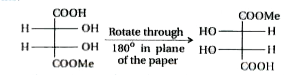
|
|
| 39. |
i) An organic compound, C_(4)H_(6), on ozonolysis gives formaldehyde and glycol. What is this compound? ii) C_(4)H_(6) can represent various structures, Identify: a) Which reacts with ammoniacal AgNO_(3), b) Which does not react with ammoniacal AgNO_(3) but by hot aklkaline KMnO_(4) gives CH_(3)COOH, c) Which decolourises Br_(2) water and by catalyst hydrogenation (using 1 mol) and subsequent reaction with alkaline KMnO_(4) gives CH_(3)COOH and d) Which by ozonolysis using O_(3)//H_(2)O gives succinic acid. |
|
Answer» SOLUTION :i) The formula suggests that either the compound is an alkyne or an alkadiene. The products of ozonolysis SUGGEST that the compound is alkadiene. It may have the FOLLOWING structures. `H_(2)C=CH-CH=CH_(2)`(A) (Buta-1.3-diene) `CH_(3)-CH=C=CH_(2)`(Buta-1,2-diene) (B) FORMALDEHYDE and glyocol can be obtained from (A). Hence, the compound is buta,1,3-diene. ii) a) `C_(4)H_(6)` reacts with ammonicial `AgNO_(3)`, so it is a terminal alkyne `(-C-=C-H)`. For EXMAPLE, `CH_(3)CH_(2)-C-=CH`(But-1-yne) b) `C_(4)H_(6) overset(KMnO_(4) alk)underset(Delta)to(CH_(3)COOH` Hence, it is `CH_(3)-C-=CH_(3)` (But-2-yne) 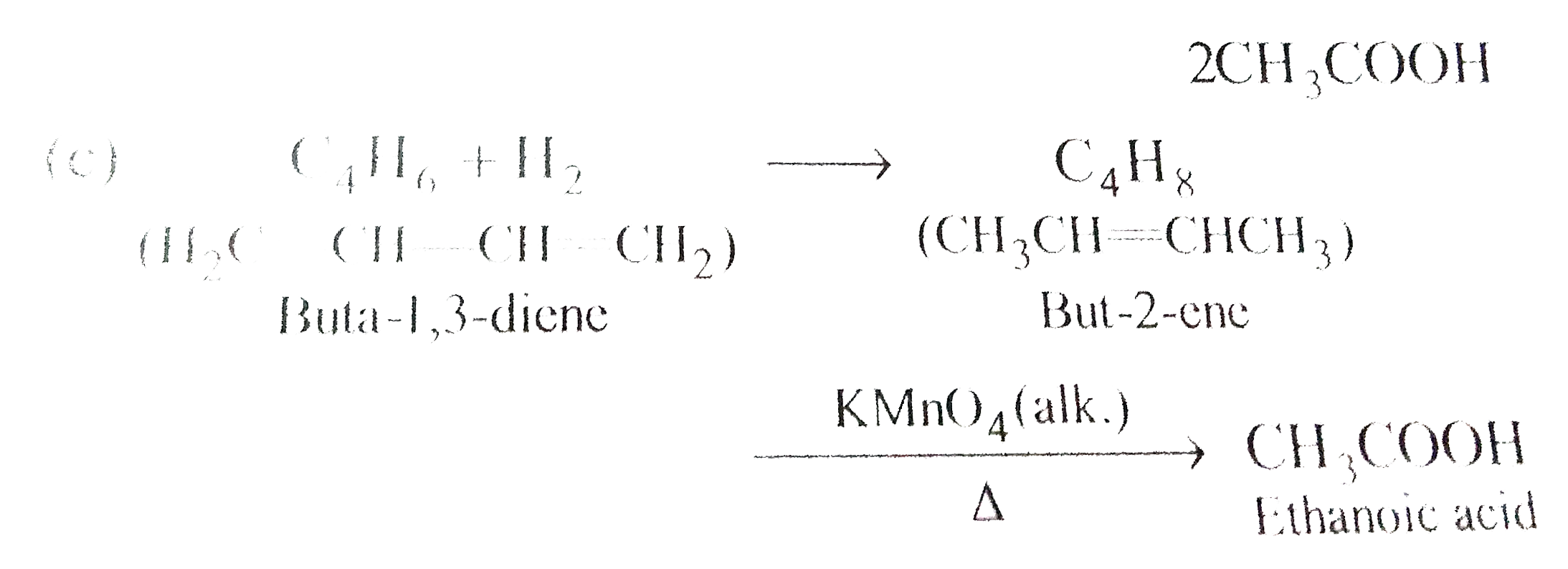 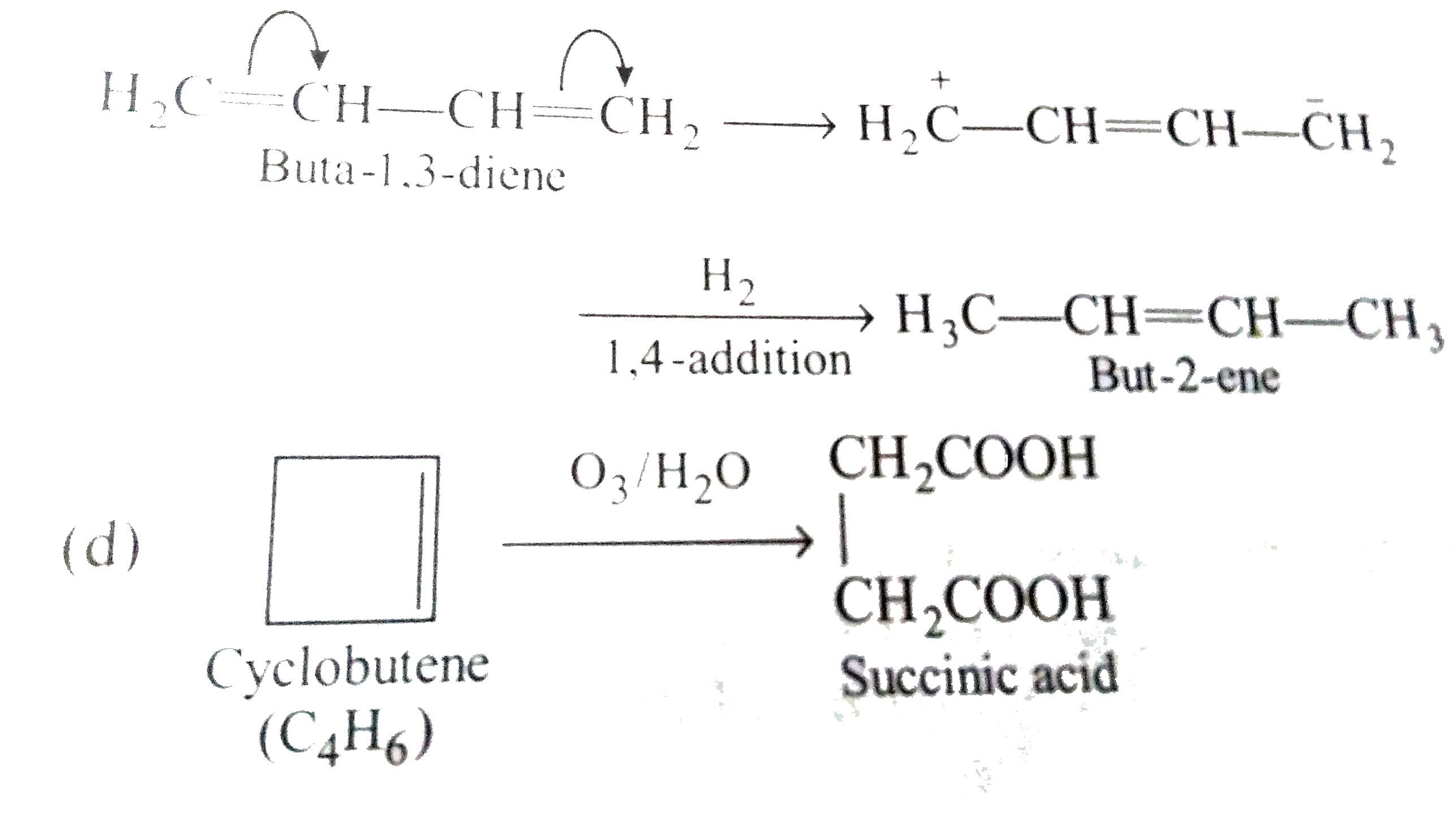
|
|
| 40. |
(i) An inorganic iodide (A) on heating with a solution of KOH gives a gas (B) and the solution of a compound (C). (ii) The gas (B) on ignition in air gives a compound (D) and water. (iii) Copper sulphate is finally reduced to the metal on passing (B) through its solution. (iv) A precipitate of compound (E) is formed on reaction of (C) with copper sulphate solution. Identify (A) to (E) and give chemical equations for reactions at steps (i) to (iv). |
|
Answer» SOLUTION :(a) Since the gas (B) reduces copper sulphate solution finally to copper metal, therefore, it must be a good reducing agent. Further since the gas (B) along with a solution of compound (C) are obtained when the inorganic iodide (A) is heated whith a solution of KOH, therefore, gas (B) must be phosphonium iodide `(PH_(4)I)`. (b) Since the gas (B) on ignition in air gives a compound (D) and water, therefore, compound (D) must be phosphorus pentoxide `(P_(2)O_(5))`. (c) Since compound (C), i.e., KI on treatment with `CuSO_(4)` solution gives a precipitate of compound (E), therefore, compound (E) must be cuprous iodide `(Cu_(2)I_(2))`. (d) The chemical equations for the REACTIONS at steps (i) to (iv) are as follows : (i) `underset((A))(PH_(4)I)+KOH overset(Delta)rarr underset((B))(PH_(3)) + underset((C))(KI)+H_(2)O` (ii) `underset((B))(2PH_(3))+4O_(2) rarr underset((D))(P_(2)O_(5)) + 3 H_(2)O` (iii) `3 CuSO_(4) + underset((B))(2PH_(3)) rarr underset("Copper phosphide")(Cu_(3)P_(2))+2H_(2)SO_(4)` `Cu_(3)P_(2)+3CuSO_(4) + 6H_(2)O rarr 6 Cu darr + I_(2) + 2 K_(2)SO_(4)` (iv) `2CuSO_(4) + 4KI rarr underset((E))(Cu_(2)I_(2)) darr + I_(2) + 2K_(2)SO_(4)` Thus, inorganic compound (A) is `PH_(4)I`, gas (B) is `PH_(3)`, compound (C) is KI, compound (D) is `P_(2)O_(5_` and compound (E) is `Cu_(2)I_(2)`. |
|
| 41. |
(i) An olefin was treated with ozone and the resulting peoduct on reduction (reductive ozonolysis) gave 2-pentanone and acetaldehyde. What is the structure of olefin? Write the reaction. (ii) How many gems of Br_2 will react with 5 gm of (a) Pent-1-ene, (b) Pent-1-yne, (c) Pentanes |
Answer» SOLUTION :
|
|
| 42. |
(i) An inorganic iodide (A) on heating with a solution of KOH gives a gas (B) and the solution of a compound( C). (ii) The gas (B) on ignition in air gives a compound (D) and water. (iii) Copper sulphate forms a black precipitate on passing (B) through its solution. (iv) A precepitate of compound (E) is formed on reaction of (C) with copper sulphate solution. Identify (A) to (E) and give chemical equations for reactions at steps (i) to (iv). |
|
Answer» Solution :GAS (B) when passed through copper sulphate solution reduces the latter to copper metal, this indicates that the gas (B) is phosphine `(PH_(3))`. Thus the inorganic iodide must be phosphonium iodide `(PH_(4)l)`. The various reactions can be written as below: (i) `PH_(4)l + KOH to UNDERSET(B)(PH_(3)) + underset(C)(Kl) + H_(2)O` (ii) `underset("B")(2PH_(3)) + 4O_(2) to underset("D")(P_(2)O_(5)) + 3H_(2)O` (iii) `3CuSO_(4) + 2PH_(3) to Cu_(2)P_(2) + 3H_(2)SO_(4)` (IV) `2CuSO_(4) + 4Kl to Cu_(2)I_(2) darr + 2K_(2)SO_(4) + I_(2)` |
|
| 43. |
(i) An aqueous solution of a compound A is acidic towards litmus and A sublimes at about 300^(@)C (ii)A solution of A, on treatment with an excess of NH_(4)SCN, gives a red compound, and on treatment with a solution of K_(4)[Fe(CN)_(6)], gives a blue compound. (iii) The solid A, on being heated with an excess of K_(2)Cr_(2)O_(7) in the presence of concentrated H_(2)SO_(4), evolves deep red vapours of D. (iv) On passing the vapours of D into a solution of NaOH and then adding the solution of acetic acid and lead acetate, a yellow precipitate of a compound E is obtained. Q. Can compound A be prepared in the anhydrous form by strongly heating its hydrated crystals? |
|
Answer» No, because the WATER molecules are very stongly bound in the hydrated crystals |
|
| 44. |
(i) An aqueous solution of a compound A is acidic towards litmus and A is sublimed at about 300^(@) C. (ii) A on treatment withh an excess of NH_(4)SCN gives a red coloured B and on treatment with a solution of K_(4)[Fe(CN)_(6)] gives a red coloured compound B and on treatment withh a solution of K_(4)[Fe(CN)_(6)] gives a blue coloured compound C. (iii) A on heating with excess of K_(2)Cr_(2)O_(7) in presence of concentrated H_(2)SO_(4) evolves deep red vapours of D. (iv) On passing the vapours of D into a solution of NaOH and then adding the solutions of acetic acid and lead acetate, a yellow precipitate of compound E is obtained. Identify A to E and give chemical equations for the reactions at steps (ii) to (iv). |
|
Answer» Solution :(i) `PeCl_(3) overset("hydrolysis")underset("by" H_(2)O) to underset("ACETIC")underset("acidic")(Fe(OH)_(3) + 3HCl)` (ii) `4FeCl_(3) + 3NH_(4)SCN to Fe(SCN)_(3) + 3NH_(4)Cl` FERRIC THIOCYANATE (B) (red colour) `4FeCl_(3) + underset("Ferrioferro cyanide blue colour C")(3K_(4)[Fe(CN_(4))] to Fe_(4)[Fe(C CN)_(6)] + 12 kCL` (iii) `2FeCl_(3) + K_(2)Cr_(2)O_(7) + 3H_(2)SO_(4) to underset("Chromyl chloride (red) (D)")(Fe_(2)(SO_(4))_(3) + 2KCl + 2CrO_(2)Cl_(2) uarr + 3H_(2)O` (iv) `Cr_(2)O_(2)Cl_(2) + 2NaOH to Na_(2)CrO_(4) + 2HCl` `underset("Lead chromate")(Na_(2)CrO_(4)) + (CH_(3)COO)_(2)Pb to PbCrCO_(4)darr + 2CH_(3)COONa` |
|
| 45. |
(i) An aromatic compound 'A' on treatment with aqueous ammonia and heating forms compound 'B' which on heating with Br_(2) and KOH forms a compound 'C' of molecular formula C_(6)H_(7)N. Write the structures and IUPAC names of compound A, B and C. (ii) Lactose act as reducing sugar. Justify this statement. |
|
Answer» Solution :(i) Step-1: To find out the structure of compounds .B. and .C.. 1. Since compound .C. with molecular formula `C_(6)H_(7)N` is formed from compound .B. on TREATMENT with `Br_(2)+KOH` (i.e., Hoffmann bromamide reaction). THEREFORE, compound .B. must be an amide and .C.must be an amine. The only amine having the molecular formula `C_(6)H_(7)N` is `C_(6)H_(5)NH_(2)` (i.e., aniline or benzenamine). 2. Since .C. is aniline, therefore, the amide from which it is formed must be benzamide `(C_(6)H_(5)CONH_(2))`. Thus, compound .B. is benzamide: The chemical equation showing the conversion of .B. to .C. is `""underset(underset((M.F.=C_(7)H_(7)NO))("Benzamide (B)"))(C_(6)H_(5)CONH_(2)) underset(("Hoffmann bormamide reaction"))overset(Br_(2)//KOH)(rarr) underset(underset((M.F.=C_(6)H_(7)N))("Benzenamine (C)"))(C_(6)H_(5)NH_(2))` Step-2: To find out the structure of compound .A.. Since compound .B. is formed from compound .A. by treatment with AQUEOUS ammonia and heating. Therefore, compound .A. must be benzoic acid or benzenecarboxylic acid. `""underset(underset("or Benzoic acid (A)")("Benzenecarboxylic acid"))(C_(6)H_(5)COOH) underset((ii)Delta)overset((i)Aq.NH_(2))(rarr) underset("Benzamide(B)")(C_(6)H_(5)CONH_(2))` (ii) `*` Lactose is a disaccharide and contains ONE galactose unit and one glucose unit. `*` In lactose, the `beta-D` galactose and `beta-D` glucose are linked by `beta-1,4-` glycosidic BOND. `*` The aldehyde carbon is not involved in the glycosidic bond hence it retains its reducing property and is called a reducing sugar. |
|
| 46. |
{:("(i) ammonia","(a) suffocating odour"),((ii)SO_(2),"(b) Rotten fish smell"),((iii)PH_(3),"(c ) Greenish yellow gas"),((iv) Cl_(2),"(d ) pungent smelling gas"):} |
| Answer» SOLUTION :(i) d (II) a (III) B (IV) c | |
| 47. |
(i) Ammonia is good complexing agent. Explain. (ii) PCI exists as [PCl_6]^(-)[PCl_4]^+but PBr_5exists as [PBr_4]^(+)[Br]^(-). Explain. (iii) Cl_5is known but PIs is not known. Why? (iv) Suggest a method for the laboratory preparation of DCI. Write a balanced equation for the reaction. (v) H_3PO_3is diprotic acid. Explain. |
|
Answer» Solution :(i) Ammonia is a good complexing AGENT because of the presence of lone pair of electrons on nitrogen. This lone pair can easily be donated to electron deficient compounds forming complexes. For example, it reacts with `Cu^(2+)`ion to form a deep blue complex. `Cu^(2+) (aq) + NH_3(aq) to underset("complex (deep blue)")([Cu(NH_3)_4]^(2+) )` On the other hand, `PBr_5`splits up into stable tetrahedral structure as : `[PBr_5] iff [PBr_4]^(+) [Br]^(-)` This SPLITTING is different from `PCl_5`because Br atoms are large and six atoms of Br cannot be easily accommodated around smaller P atom. (iii) Due to small size of Cl atom, five Cl atoms can be accommodated around P atom. But I is of large size and therefore, five I atoms cannot be accommodated around P atom. As a result, P-I bonds are weak and prefer to form`PI_3`rather than `PI_5` (iv) Hydrolysis of `PCl_5`with HEAVY water `(D_2O)`gives DCI `underset("heavy water ")(PCl_5 + D_2O) to POCl_3 + 2DCl` (v) `H_3PO_3`has THREE H atoms and therefore, it is expected to be tribasic. However, in its structure, two hydrogen atoms are JOINED through oxygen atoms and are ionisable. The third H atom is linked to P and is non-ionisable. 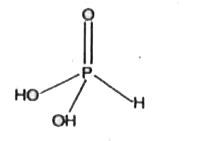 |
|
| 48. |
I. Aluminium chloride is obtained by heating a mixture of alumina and coke in a current of chlorine II. Anhydrous aluminium chloride is a hygroscopic substance. III. Anhydrous aluminium chloride is a colourless substance. IV. Aluminium chloride is a lewis base |
|
Answer» I, II & III |
|
| 49. |
I . Alloys areformedby blendinga metal II.Alloysare formedby blendinga non- metal III. Alloyshavehighmeltingpoints . IV.Alloyshave lowmetingpoints . |
|
Answer» I andII only |
|
| 50. |
(i) Alkyl iodides develop colouration on long standing particularly in light. Explain. |
|
Answer» |
|