

Saved Bookmarks
This section includes 7 InterviewSolutions, each offering curated multiple-choice questions to sharpen your Current Affairs knowledge and support exam preparation. Choose a topic below to get started.
| 1. |
(i) Acetylation of aniline reduces its activation effect. (ii) CH_(3)NH_(2) is more basic than C_(6)H_(5)NH_(2). (iii) Although -NH_(2) is olp directing group, yet aniline on nitration gives a significant amount of m-nitroaniline. |
Answer» Solution :(i) Acetylation of aniline reduces its activation effect.  The lone pair of electrons on nitrogen which is responsible for the activation effect is no longer available on nitrogen due to electron attracting effect of carbonyl group as shown above. (ii)  The electron pair on nitrogen in aniline takes part in RESONANCE and is not available on N. It decreases the basicity of aniline. On the otherhand, due to INDUCTIVE effect of methyl group `CH_(3) rarr NH_(2)`, methyl amine is more basic than aniline. (III) In strongly acidic medium, aniline form anilinium ion, which is m-directing. Therefore, we get a significant amount of m-nitroaniline. |
|
| 2. |
i) AgCl_((S)) + e^(-)to Ag_((S)) + Cl_((aq))^(-) E^(@) = 0.22 V . ii) Ag_((aq)) e^(-) to Ag_((S)) , E^(@) = - 0.8 V then SRP for the reaction is AgCl_((S)) to Ag_((aq))^(+) + Cl_((aq))^(-)is |
|
Answer» 1.20 V `Ag_((aq))^(+) + e^(-) to Ag_((S)) E^(@) = -0.8 ` V `THEREFORE` HENCE for the overall REACTION `AgCl_((S)) to Ag_((aq))^(+) + Cl_((aq))^(-) ` is = `0.22- 0.80 = -0.58` V |
|
| 3. |
(i) Account for the following : 1. Primary amines (R-NH_(2)) have higher boiling point than tertiary amines (R_(3)N). 2. Aniline does not undergo Friedel-Crafts reaction. 3. (CH_(3))_(2)NH is more basic than (CH_(3))_(3)N in an aqueous solution. (ii) Name two fat soluble vitamins, their sources and the diseases caused due to their deficiency in diet. |
|
Answer» Solution :1. Due to maximum intermolecular hydrogen bonding in primary amines (due to presence of more number of H-atmos), primary have higher BOILING point in comparison to tertiary amines. 2. Aniline does not undergo Friedel-Crafts reaction due to acid-base reaction. Aniline and a Lewis Acid / Protic Acid, which is used in Friedel-crafts reaction. 3. In `(CH_(3))_(3)N` there is maximum steric HINDRANCE and least SOLVATION but in `(CH_(3))_(2)NH` the solvation is more group, di-methyl amine is still a stronger base than TRIMETHYL amine. (ii) 
|
|
| 4. |
(i) A yellow precipiate of the compound A is formed on passing H_(2)S through a neutral solution of the salt B. (ii) The compound A is soluble in hot dilute HNO_(3) but insoluble in yellow ammonium sulhpide. (iii) The The solution of B, on treatment with a small quantitity of NH_(3), gives a white precipitate soluble in an excess of the reagent, forming a compound C. (iv). The solution of B gives a white precipitate with a small concentration of KCN. the precipitate is soluble in an excess of the reagent, forming a compound D. (v) the solution of D, on treatment with H_(2)S, gives A. (vi) The solution of B in dilute HCl, on treatment with a solution of BaCl_(2), gives a white precipitate of the compound E, which is almost insoluble in concentrated HNO_(3). Q. Which of the following are the white precipitate and the soluble substance formed by the excess of the KCN reagent. respectively, in (iv) ? |
|
Answer» `As(CN)_(3) and[As(CN)_(6)]^(2-)` |
|
| 5. |
(i) A yellow precipiate of the compound A is formed on passing H_(2)S through a neutral solution of the salt B. (ii) The compound A is soluble in hot dilute HNO_(3) but insoluble in yellow ammonium sulhpide. (iii) The The solution of B, on treatment with a small quantitity of NH_(3), gives a white precipitate soluble in an excess of the reagent, forming a compound C. (iv). The solution of B gives a white precipitate with a small concentration of KCN. the precipitate is soluble in an excess of the reagent, forming a compound D. (v) the solution of D, on treatment with H_(2)S, gives A. (vi) The solution of B in dilute HCl, on treatment with a solution of BaCl_(2), gives a white precipitate of the compound E, which is almost insoluble in concentrated HNO_(3). Q. Which of the following are the white precipitate and the soluble substance formed by the excess of the NaOH reagent, respectively? |
|
Answer» `AsOCl and AsO_(3)^(3-)` |
|
| 6. |
(i) A yellow precipiate of the compound A is formed on passing H_(2)S through a neutral solution of the salt B. (ii) The compound A is soluble in hot dilute HNO_(3) but insoluble in yellow ammonium sulhpide. (iii) The The solution of B, on treatment with a small quantitity of NH_(3), gives a white precipitate soluble in an excess of the reagent, forming a compound C. (iv). The solution of B gives a white precipitate with a small concentration of KCN. the precipitate is soluble in an excess of the reagent, forming a compound D. (v) the solution of D, on treatment with H_(2)S, gives A. (vi) The solution of B in dilute HCl, on treatment with a solution of BaCl_(2), gives a white precipitate of the compound E, which is almost insoluble in concentrated HNO_(3). Q. Which of the following anions is present in B? |
|
Answer» `SO_(4)^(2-)` |
|
| 7. |
i) According to the equation Cu^(2+)+2e^(-)rarrCu, how many moles of copper are deposited when 965C of electricity is passed through a solution of Cu^(2+) ions? (1F=96500 C). |
| Answer» SOLUTION :i) 0.005 MOL of COPPER are DEPOSITED on the ELECTRODE. | |
| 8. |
(i)aA+bB hArr cC+dD : K_(1)(ii)ncC+ndD hArr naA+nbB : K_(2) K_(1)andK_(2)are releated as : |
|
Answer» `K_(2)=(N)/(K_(1))` |
|
| 9. |
(i) A yellow precipiate of the compound A is formed on passing H_(2)S through a neutral solution of the salt B. (ii) The compound A is soluble in hot dilute HNO_(3) but insoluble in yellow ammonium sulhpide. (iii) The The solution of B, on treatment with a small quantitity of NH_(3), gives a white precipitate soluble in an excess of the reagent, forming a compound C. (iv). The solution of B gives a white precipitate with a small concentration of KCN. the precipitate is soluble in an excess of the reagent, forming a compound D. (v) the solution of D, on treatment with H_(2)S, gives A. (vi) The solution of B in dilute HCl, on treatment with a solution of BaCl_(2), gives a white precipitate of the compound E, which is almost insoluble in concentrated HNO_(3). Q. Which of the following is the cation present in B? |
|
Answer» `As^(3+)` 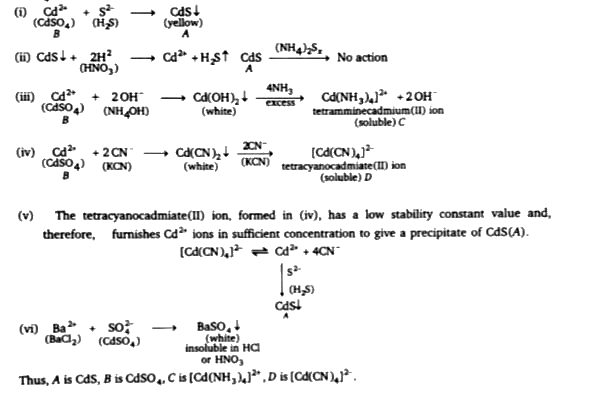
|
|
| 10. |
(i) A white solid mixture of two salts containing a common cations in insoluble in water. It dissolves in dilute HCl producing some gases (with effervescence) that turn an acidified dichromate solution gren. After the gases are passed through the acidified dichromate solution, the emerging gas turns baryta water milky. (ii) On treatment with dilute HNO_(3), the white solid gives a solution which does not directly give a precipitate with a BaCl_(2) solution but gives a white precipitate when warmed with H_(2)O_(2) and then treated with a BaCl_(2) solution. (iii) The solution of the mixture in dilute HCl, when treated with NH_(4)Cl,NH_(4)OH andan Na_(2)HPO_(4) solution, gives a white precipitate. Q. The white precipitate obtained in (iii) consists of: |
|
Answer» `Ba_(3)(PO_(4))_(2)` |
|
| 11. |
(i) A white solid mixture of two salts containing a common cations in insoluble in water. It dissolves in dilute HCl producing some gases (with effervescence) that turn an acidified dichromate solution gren. After the gases are passed through the acidified dichromate solution, the emerging gas turns baryta water milky. (ii) On treatment with dilute HNO_(3), the white solid gives a solution which does not directly give a precipitate with a BaCl_(2) solution but gives a white precipitate when warmed with H_(2)O_(2) and then treated with a BaCl_(2) solution. (iii) The solution of the mixture in dilute HCl, when treated with NH_(4)Cl,NH_(4)OH andan Na_(2)HPO_(4) solution, gives a white precipitate. Q. The white precipitate obtained in (ii) indicates the presence of a: |
|
Answer» carbonate |
|
| 12. |
(i) A white solid A, on being strongly heated, leaves a residue which is yellow while hot and whitewhen cold ii) The solid A, insoluble in water, dissolves in dilute HCI to give a solution B and a gas which does not affect acidified dichromate paper but turns baryta water milky. iii) When H_(2)S is passed through the solution B, a white precipitate C is obtained iv) The precipitate C dissolves in dilute HCI to give a solution which, when treated with an NaOH solution, gives a white precipitate. The final precipitate dissolves in an excess of NaoH form a solution D. This alkaline solution, on acidification with acetic acid followed by treatment with H_(2)S, gives the precipitate C. Given that the formation of the precipitate C from the solution D involves the reaction [M(OH)_(4)]^(2-)+4H^(+) to underset(underset(MS darr)(darr H_(2)S))(M^(2+))+4H_(2)O M is |
|
Answer» Zn |
|
| 13. |
(i) A white solid mixture of two salts containing a common cations in insoluble in water. It dissolves in dilute HCl producing some gases (with effervescence) that turn an acidified dichromate solution gren. After the gases are passed through the acidified dichromate solution, the emerging gas turns baryta water milky. (ii) On treatment with dilute HNO_(3), the white solid gives a solution which does not directly give a precipitate with a BaCl_(2) solution but gives a white precipitate when warmed with H_(2)O_(2) and then treated with a BaCl_(2) solution. (iii) The solution of the mixture in dilute HCl, when treated with NH_(4)Cl,NH_(4)OH andan Na_(2)HPO_(4) solution, gives a white precipitate. Q. The gases evolved in (i) are: |
|
Answer» `CO_(2) and HCl` |
|
| 14. |
(i) A white solid A, on being strongly heated, leaves a residue which is yellow while hot and white when cold ii) The solid A, insoluble in water, dissolves in dilute HCI to give a solution B and a gas which does not affect acidified dichromate paper but turns baryta water milky. iii) When H_(2)S is passed through the solution B, a white precipitate C is obtained iv) The precipitate C dissolves in dilute HCI to give a solution which, when treated with an NaOH solution, gives a white precipitate. The final precipitate dissolves in an excess of NaoH form a solution D. This alkaline solution, on acidification with acetic acid followed by treatment with H_(2)S, gives the precipitate C. The salt A is a |
|
Answer» sulphite |
|
| 15. |
(i) A sample of MnSO_(4).4H_(2)Ois strongly heated in air . The residue is Mn_(3)O_(4) (ii) The residue is dissolved in 100 mL of 0.1N FeSO_(4)containing dilute H_(2)SO_(4) (iii) The solution reacts completely with 50 mL of KMnO_(4) solution . (iv) 25 mL of the KMnO_(4) solutionused in step(ii) requires 30 mL of 0.1 N FeSO_(4) solution for complete reaction . |
|
Answer» Solution :m.e of 25 ML of `KMnO_(4)`solution = m.e of 30 mL of 0.1 N `FeSO_(4)` solution ` = 0.1 xx 30 = 3` ` :. ` m.e of 50 mL of `KMnO_(4)`solution = `2 xx 3 = 6` ` :. ` m.e of `FeSO_(4)`(remained which did not react with `Mn_(3)O_(4)`) = 6 Now , m.eof total `FeSO_(4)`solution = `0.1 xx 100 = 10 ` `:. ` m.eof `Mn_(3)O_(4) = 4` ` :. ` eq. of `Mn_(3)O_(4) = 4/1000` From the redoxreaction `{:(Mn_(3)O_(4)+Fe^(2+)to,3Mn^(2+)+Fe^(3+)),(+8,+6):}` Equivalent wt. of `Mn_(3)O_(4) = (" mol .wt")/(" change in ON PER mole") ` `= 229/2= 114.50` ` :." wt . of " Mn_(3)O_(4) = " equivalent " xx " eq.wt"` ` = 4/1000 xx 114.5 = 0.458 g ` As given in the problem`Mn_(3)O_(4)` is obtained by heating `MnSO_(4).4H_(2)O ` `MnSO_(4) . 4H_(2)O overset( DELTA) toMn_(3)O_(4)` or `(" wt . of " MnSO_(4).4H_(2)O)/(" mol.wt.of "MnSO_(4).4H_(2)O) = (3xx 0.458)/229` ` :. " wt . of " MnSO_(4) .4H_(2)O = (3xx 0.458 )/229 xx 223 ` ` = 1.338 g ` |
|
| 16. |
(i) A sample of a gas initially at 27^(@) C is compressed from 40 litres to 4 litres adiabatically and reversibly. Calculate the final temperature (C_(v) =5) cal/mole. (ii) Calculate the maximum work done in expanding 16 gm of oxygen at 300 K and occupying, a volume of 5 dm^(3) isothermally until the volume becomes 25 dm^(3). (iii) 10 gm of argon gas is compressed isothermally and reversibly at a temperature of 27^(@) C from 10 litre to 5 litre. Calculate q, w.DeltaE and DeltaH for this process.(R = 2.6 kcal/K). |
|
Answer» Solution :(i) 753.6 K (II) `(-2.01 xx 10^(3))`J (iii) `w=-103.635 cal, DELTAE =0, q=103.635` cal |
|
| 17. |
(i) A salt solution on treatment with neutral FeCl_3 gives a brown coloured solutioheating the solution a brown coloured ppt is obtained. When the solution is inwith Kl solution, a straw yellow.coloured ppt, is obtained. Identify the salt (ii)W on passing HS though a salt solution a brown ppt, is obtained. On adding wate an acidic solution of the salt, turbidity was observed. Identify the cation in the salt |
|
Answer» Solution :(i) The given SALT is COPPER acetate `3CH_3COO^(-)+FeCl_3to(Ch_3COO)_3Fe+#Cl^(-)` `(Ch_3COO)_3Fe+2H_2Ooverset(Delta)to (CH_3COO)Fe(OH)_(2)+2CH_3COOH` `Hence the acid RADICAL present in the salt is acetate radical. `2CU^(2+)+4kltoCu_(2)l_2+4k^(+)+l_2` (ii) The formation of a brown precipiatewith `H_2S` indicate `Bi^(3+)` or `Sn^2+` `2Bi^(3+)+3H_2StoBiS_3+6H^+` `BiCl_3+H_2Oto BiOCl+2HCl` |
|
| 18. |
(i) A salt solution gives a yellow ppt. with BaCl_2 which is soluble in dil. HCL. On adding acid to the salt solution, it becomes orange in colour. Identify the acid radical. (ii) On treating the salt with dil HCI, a colourless gas turning brown on exposure to air was evolved. On adding FeSO_4, solution, the salt solution gives a brown colour Identify the acid radical present in the salt |
|
Answer» Solution :(i) The acid radical must be chromate. `CrO_(4)^(2-)+Ba^(2+)to BaCrO_4darr` `underset(yellow)(CrO_(4)^(2-))+H hArrHCO_(4)^(-)HARR underset(Orange)(Cr_2O_(7)^(2-)+H_2O` (ii)The acid radical must be nitrite `NO_(2)^(-)H^(+)to HNO_2` `2HNO_2toH_2O+underset("COLOURLESS")(2NO)+O` `2NO+O_2to 2NO_(2)` ` |
|
| 19. |
(i) A primary alkyl halide (A), C_(4)H_(9)Br reacted with hot alcoholic KOH to give compound (B). Compound (B) reacted with HBr to give (C), which is an isomer of (A). When (A) was reacted with sodium metal, it gave a compound (D), C_(8)H_(18) which was different than the compound when n-butyl bromide was reacted with sodium. Give the structural formula of (A) and write equations of all the reactions. (ii) Iodoform gives a precipitate with AgNO_(3) on heating while CHCl_(3) does not. ? Why ? |
|
Answer» <BR> Answer :`A : implies CH_(3) - OVERSET(CH_(3))overset(|)(CH) - CH_(2) Br` |
|
| 20. |
(i) A first order reaction takes 8 hours for 90% completion. Calculate the time required for 80% completion . (log 5 = 0 .6989, log 10 =1 ) |
|
Answer» Solution :For a first ORDER reaction, `K=(2.303)/tlog(([A_0])/([A]))""..........(1)` Let `[A_0]=100M ` When `t=t_(90%),[A]=10M` (GIVEN that `t_(90%)=8`hours) `t = t = _(80%),[A]=20M` `t_(80%)=(2.303)/(t_(90%))log(100/10)` `k=(2.303)/(8"hours")log10` `k=(2.303)/(8 "hours")(1)` Substitute the value of k in equation (2) `t_(80%)=(2.303)/(2.303//8"hours")log (5)` `t_(80%)=2.303//8"hours"xx0.6989` `t_(80%)=5.59` hours |
|
| 21. |
(i) A compound (A) is obtained by boiling aqueous sodium sulphite with sulphur. (ii) Compound (A) is used to titrate iodine in volumetric analysis. (iii) It dissolves AgBr to give (B) and NaBr on addition of excess of (A) to the mixture a complex salt (C) is obtained. (iv) (A) is used in photography for fixing films and prints. Photographic emulsions are made of AgNO_(3). AgCl and AgBr. (v) When a solution (A) is added to CuSO_(4) in cold, the blue solution becomes step-wise brownish green, yellowish green and finally yellow. (vi) If (A) is added to acidic, CuSO_(4), Cu_(2)S is precipitated and if the solution is boiled, CuS is precipitated. What are (A), (B) and (C) ? |
|
Answer» SOLUTION :A `=Na_(2)S_(2)O_(3)` `B=Ag_(2)S_(2)O_(3)` C `=NAS[Ag_(3)(S_(2)O_(3))_(4)]` |
|
| 22. |
(i) A blackminerals(A) on treatment with dilute sodium cyanidersolutionin presence of air gives a clearsolution of (B)and (C).(ii) The solution of (B)on reactionwithzincgievsprecipitate of a metal(D).(iii) (D) is dissolvedin dilute HNO_(3)and theresulting solutiongives a white preipitate(E)with dilute HCl.(iv) (E) On fusion with sodium carbonate gives(D) . (v) (E) Dissloves in aqueoussolutionof ammonia givinga colourless solution of (F)Identify compounds (A) to (F) and giveschemialequationsfor reactions insteps (i) to(iv) . |
|
Answer» |
|
| 23. |
(i) A blackmineral(A) on treatment with dilutesodiumcyanidesolutionin present ofairgivesa clearsolutionof (B) and(C ).(ii) The solutionof (B) on reactionwithzinc givesprecipitate ofametal (D).Identify (A) and (D) andexplainthereactionsofsteps(i) and(ii). |
|
Answer» Solution :(i) Silver isextanctedfrom its oresbythecyanideprocess. Sincethegivenmineral (A)isblack, itformation ofacomplex, sodiumdicyanoargentate(B). ` ""underset ("A(Black)") +4 NaCNtounderset ("SOD.dicyanorgentate (B)") (2 Na [AG(CN)_2] +Na_2S ` `Na_2 S `THUS formed islargelyoxidisedto` Na_2 SO_ 4`bytheexcess air. `4 Na_2S + 2 H_ 2O+5 O_ 2(air ) tounderset ("Sodium sulphate(C)") (2Na_2SO_4) +4NaOH+2 S` Thus, B is sod. dicyanoargentate and C is sodium sulphate. (ii) Whenthe solutionof B istreated withzinddust, silverbeingless electropositive then zincgetsprecipitated `2 Na [Ag (CN)_2]+ZntoNa_2[ Zn (CN)_4 ] +underset("(D)") ( 2Ag) downarrow ` |
|
| 24. |
(i) A black coloured compound (B) is formed on passing hydrogen sulphide through the solution of a compound (A) in NH_(4)OH. (ii) (B) on treatment with hydrochloric acid and potassium chlorate gives (A). (iii) (A) on treatment with potassium cyanide gives a buff coloured precipitate which dissolves in excess of this reagent forming a compound (C). (iv) The compound (C) is changed into a compound (D) when its aqueous solution is boiled: (v) The solution of (A) was treated with excess of sodium bicarbonate and then with bromine water. On cooling and shaking for some time, a green colour of compound (E) is formed. No change is observed on heating. Identify (A) to (E) and give chemical equations for the reactions at steps (l) to (iv) |
|
Answer» Solution :The FORMATION of black coloured compound (B) by passing `H_(2)S` through the alkaline solution of the compound indicate that this asalt of the group TV TMCats (`CO^(2+)` or `Ni^(2+)`). However, the given reactions ESPECIALLY, reaction (ili), indicates that compound (A) is a cobalt salt `(CoCl_(2))` which explains all the given reactions. (i) `UNDERSET((A))(CoCl_(2))+2NH_(4)OH+H_(2)Stounderset((B))(CoS)+2NH_(4)Cl+2H_(2)O` (ii) `CoS+2HCl+underset((from KClO_(3)))([O])toCoCl_(2)+H_(2)S` `2KlCO_(3)to2Kcl+3O_(2)` (iii) `CoCl_(2)+2KCNtoCo(CN)_(2)darr+2Kcl` `Co(CN)_(2)+4KCNtoK_(4)[Co(CN)_(6)]` (iv) `2K_(4)[Co(CN)_(6)]+[O]+H_(2)Oto2K_(3)[Co(CN)_(6)]+2KOH` (v) `CoCl_(2)+6NaHCO_(3)toNa_(4)[Co(CO_(3))_(3)]+2NaCl+3CO_(2)+3H_(2)O` `2Na_(4)[Co(CO_(3))_(3)]+2NaHCO_(3)+Oto2Na_(3)[Co(CO_(3))_(3)]+2Na_(2)CO_(3)+H_(2)O` |
|
| 25. |
(i) 1.51 g of NaCl was dissolved in 500g of water and the elveation in boiling point observed to be 0.0514^(@)C. Calculate the van't . Hoff factor K_(b) for water 0.514 K kg/mol. (ii) 1.1 g of CopCl_(2) 6NH_(3) (mot wt. =267) was dissolved at 100 g"of" H_(2)O. The freezing point of solution is0.29^(@)C. How many moles of solute particies exist in solution for eac mol of soluta introduced ? K_(f) for H_(2)O=1.86^(2) Cm^(-1) (iii) 2g of bezoic acid dissolved in 25g of C_(6)H_(5)^(-). shows a deptession in freezing pont equal to 1.62K. Molal depression constant of benzene is 4.9K mol/kg . What is the percentage association of acid if it dimenzes in solution. |
|
Answer» SOLUTION :(i) `1.937` (II) `~~_(^^)` `(III) 99.2%` |
|
| 26. |
I-131 is used for the statement of |
|
Answer» THYROID disorders |
|
| 27. |
(i) 1 gm of Mg is bumt in a closed vessel which contains 0.5 g of O_(2). (a) Which reactant is left excess. (b) Find the mass of excess reactant. (ii) A mixture of KBr, NaBr weighing 0.56 gm was treated with aquaeous solution of Ag^(+) and the bromide ion was recovered as 0.97 gm of pure AgBr. What was the weight of KBr in the sample ? |
|
Answer» Solution :(i) `{:(2Mg ,+,O_(2),to,2MgO),(2xx24,,2xx16,,2XX(24+16)),(=48 gm,,32gm,,=80 gm):}` 48 gm of Mg require oxygen ` = 32/48 = 0.66` gm But only `0.5`g of oxygen is available . Hence `O_(2)` is limiting reagent and a part of magnesium wil not burn. (b) 32 g of `O_(2)` react with magnesium 48 gm ` :.0.5` gm `O_(2)` will react with magnesium ` = 48/32 xx 0.5 = 0.75` gm Hence mass of magnesium LEFT ` = (1 -0.75) = 0.25 `g (ii) `{:(KBr,+,NaBr,+,"Ag"^(+),to,AgBr),(a gm ,,(0.56 -a)gm,,,,0.97 gm):}` Applying POAC for Br atoms. Moles of Br in KBr `+` Moles of Br in NaBr = Moles of Br AgBr or ` 1 xx " Moles of " KBr + 1 xx " Moles of " NaBr = 1 xx " Moles of " AgBr` `rArr a/119 + ((0.58 -a))/103 = (0.97)/188(M_("KBr") = 199 , M_("NaBr") = 103 , M_("AgBr") = 183 )` ` :. a = 0.2125` gm Percentage of KBr in the sample ` = (0.2125)/(0.56) xx 100 = 37 .9 %` |
|
| 28. |
(i) 1,2-dichlorocyclopropane = w (II) 1,3-dimethyl-cyclobutane = x (iii) 2-bromo-3-chlorobutane = y (iv) 1,3-dimethyl cyclohexane = z Calculate total number of stereoisomer of the above compounds. Sum of w+c+y+z =…….. |
Answer» 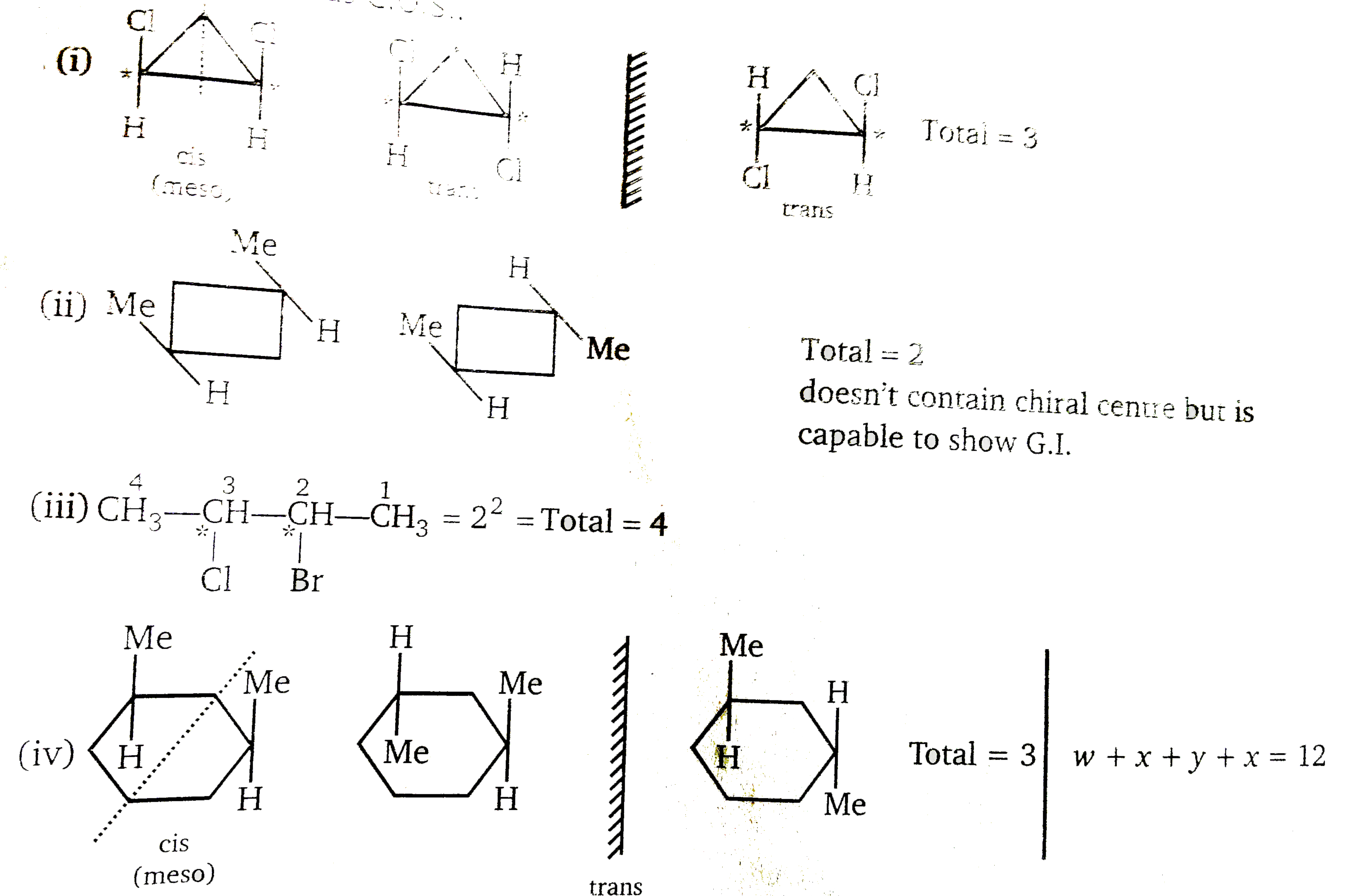 TOTAL = 2 doesn't contain CHIRAL CENTRE but is CAPABLE to show G.I. |
|
| 29. |
(I) 1,-dihydroxy benzene (II) 1,3-dihydroxylbenzene (III) 1,4-dihydroxy benzene (IV) Hydroxyl benzene The increasing order ofboiling point of above mentioned alcohols is |
|
Answer» <P>` I lt II lt III lt IV` 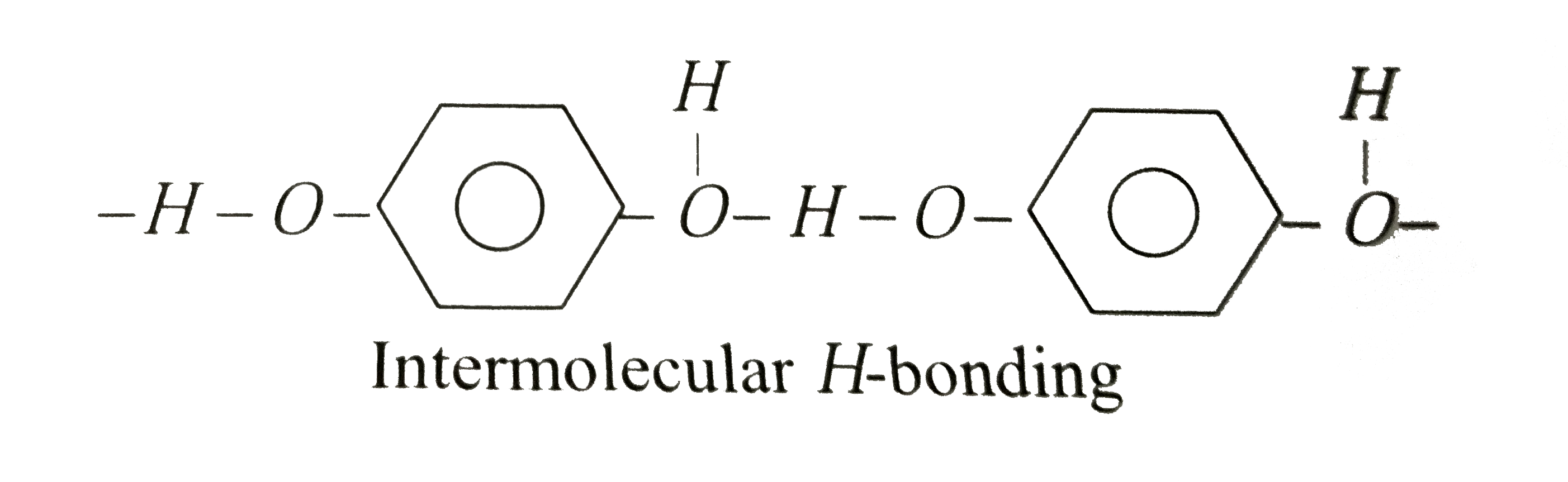 Order of H-bonding in o, m and p-isomers of a compound is given below. intermolecular H-bonding`o lt m lt p` -isomers IntramolecularH-bonding `o gt m gt p`-isomers HYDROXY benzene do not form a chain of H-bondingHence, intermolecular H-bond is stronger then intramolecular H-bond , so the stability of 1,4-dihyroxy benzene is highest . Hence, its boiling point is highest . The increasing order of the boiling points of the given compounds is `IV lt I lt II lt III` |
|
| 30. |
Hypothetical reaction A_(2)+B_(2) to 2AB, follows the mechanism as given below: A_(2)hArrA+A (fast reaction) A+B_(2) toAB+B (slow reaction) A+B to AB (fast reaction) Give the rate law and oder of reaction |
|
Answer» SOLUTION :Slowest step is rate determining Rate `=k[A][B_(2)]`…….`(1)` Here `[A]` should be determined as `K_(c )=([A][A])/([A_(2)])=([A]^(2))/([A]_(2))` `[A]=K_(c )^(1//2)[A_(2)]^((1)/(2))` From EQ. `(1)`, Rate `=k.K_(c )^(1//2)[A_(2)]^((1)/(2))[B_(2)]` `=K[A_(2)]^((1)/(2))[B_(2)]` `[K=k.K_(c )^(1//2)]` Order `=1+(1)/(2)=(3)/(2)` |
|
| 31. |
Hypophosphorous acid is |
|
Answer» <P>a triprotic ACID |
|
| 32. |
Hypohalous acids (HO-Hal) in presence of strong acid also become a very powerful halogenating agent. Explain, how? |
Answer» Solution : This halonium ION reacts with BENZENE in the same WAY as SHOWN above in the MECHANISM. |
|
| 34. |
Hypochlorite is a strong oxidant and bleaching agent. Why? |
|
Answer» Solution :HYPOCHLORITE, `OCl^(-)` is formed in the ground state of oxygen. `OCl^(-)` BOND is a single bond. `OCl^(-)` has no tendency to form pi bond and ALSO it is not stabilised by resonance. It is less STABLE and provides nascent oxygen by decomposition. `OCl^(-)rarr Cl^(-)+(O)` Hence, `OCl^(-)` hypochlorite is good OXIDANT and powerful bleaching agent. |
|
| 35. |
Hypo is used in photography for: |
|
Answer» Fixing |
|
| 36. |
Hypo is used in photography to: |
|
Answer» REDUCE AGBR grains to metallic Ag |
|
| 37. |
Hypo is used in: |
|
Answer» Iodimetric titrations |
|
| 38. |
Hypo is chemically |
|
Answer» `Na_2S_2O_3. 2H_2O` |
|
| 39. |
Hypo is a salt of the oxyacid |
|
Answer» thiosulphuric AICD |
|
| 40. |
Hypo is not used in |
|
Answer» bleaching industry |
|
| 41. |
Hypo gives (a) ____ppt. with AgNO_(3) which changes to (b) ____. |
|
Answer» |
|
| 42. |
Hypo acts as a fixing agent. The correct statements are |
|
Answer» It GIVES collodial SULPHUR as a precipitate |
|
| 43. |
Hyperglycemia refers to |
|
Answer» HIGH BLOOD SUGAR LEVEL |
|
| 44. |
Hyperconjugation effect is also known as |
|
Answer» Baker-Nathan effect |
|
| 45. |
Hypercojugation effect is also known as |
|
Answer» Baker-Nathan effect |
|
| 46. |
Hyper conjugation is: |
|
Answer» `sigma-PI` conjugation |
|
| 47. |
Hydrozoic acid HN_3is a weak acid which hydrolyses in water according toHN_3 + H_2O = H_3O^(+)+ N_3^(-)pK_a (HN_3) = 4.72(i) Calculate [H_3O^+] , [HN_3], [N_3^-] and [OH^-]in 0.1 M acid solution.(ii) Calculae pH of the acid |
|
Answer» Solution :`(i) 1.4 xx 10^(-3) M, 0.1M, 1.4 xx 10^(-3)M, 7.2 xx 10^(-12) M ` (ii) 2.86 |
|
| 48. |
Hydrołysis of sucrose is known as …………………………….. reaction. |
|
Answer» HYDRATION |
|
| 49. |
Hydroxylamine reduce iron (III) according to the equation : 2NH_(2)OH + 4 Fe^(3+) rarr N_(2)O(g)uarr + H_(2)O + 4Fe^(2+) + 4H^(+)Iron (II) thus produced is estimated by titration with a standard permanganate solution. The reaction isMnO_(4)^(-) + 5 Fe^(2+) + 8H^(+) rarr Mn^(2+) + 5Fe^(3+) + 4H_(2)O A 10 mL sample of hydroxylamine solution was diluted to 1 litre. 50 mL of this diluted solution was boiled with an excess of iron (III) solution. The resulting solution required 12 mL of 0.02 M KMnO_(4) solution for complete oxidation of iron (II). Calculate the weight of hydroxylamine in one litre of the original solution |
|
Answer» Solution :Given : `2 NH_(2)OH + 4 Fe^(3+) RARR N_(2)O + H_(2)O + 4Fe^(2+) + 4 H^(+)`........ (i) and `MnO_(4)^(-) + 5 Fe^(2+) + 8H^(+) rarr Mn^(2+) + 5 Fe^(3+) + 4 H_(2)O`........ (ii) `10 NH_(2)OH + 4 MnO_(4)^(-) + 12 H^(+) rarr 5 H_(2)O + 21H_(2)O + 4 Mn^(2+)` [On multiplying (i) by 5 and (ii) by 4 and then adding the resulting equations] Molecular weight of `NH_(2)OH`= 33Thus 4000 ml of 1 M `MnO_(4)^(-)` would react with `NH_(2)OH = 330 g` 12 ml of 0.02 M `MnO_(4)` would react with `NH_(2)OH = 330 XX 0.02 xx 12 / 4000 g` Amount of `NH_(2)OH`present in 1000 ml of DILUTED solution = `330 xx 0.02 xx 12 xx 1000 / (4000 xx 50) g` Since 10 ml of sample of hydroxylamine is diluted to one litre Amount of hydroxyl amine in one litre of original solution = `330 xx 0.02 xx 12 xx 1000 / (4000 xx 50) xx 1000/10 g = 39.6 g` |
|
| 50. |
Hydroxylamine reduced iron (+3) according to eq. 2NH_2OH + 4Fe^(+ + +) toN_2O(g) + H_2O + 4Fe^(+ +)+ 4H^(+). Iron (+2) thus produced is estimated by titration with a standard solution of permagnate. The reaction is MnO_4^(–) + 5Fe^(+ +) + 8H^(+)toMn^(2+)+ 5Fe^(+ + + )+ 4H_2O. A 10 ml solution of hydroxylamine solution was diluted to 1 litre 50 ml of this solution was boiled with an excess of iron (+3) solution. The resulting solution required 10 ml of 0.02 M KMnO_4 solution for complete oxidation or iron (+2). Calculate the weight of hydroxylamine in one litre of the original solution. |
|
Answer» |
|