

Saved Bookmarks
This section includes 7 InterviewSolutions, each offering curated multiple-choice questions to sharpen your Current Affairs knowledge and support exam preparation. Choose a topic below to get started.
| 1. |
(i) Gas (A) is more soluble in water than Gas (B) at the same temperature. Which one of thetwo gases will have the higher value of K_H(Henry's constant) and why ?(ii) In non-ideal solution, what type of deviation shows the formation of maximum boilingazeotropes ? |
|
Answer» Solution : (i) Gas B will have a HIGHER value of `K_H` `p = K_H x ` Thus higher the value of x(solubility), lower the value of `K_H`. B which has lower solubility will have higher value of `K_H` (ii) The solutions that show large NEGATIVE deviation from Raoult.s law form MAXIMUM boilingazeotrope at a SPECIFIC CONCENTRATION. |
|
| 2. |
(i) For the complex [Fe(CN)_(6)]^(3-), write the hybridisation type, magnetic character and spin nature of the complex (Atomic no. of Fe = 26). (ii) Draw one of the geometrical isomers of the complex [Pt(en)_(2)Cl_(2)]^(2+) which is optically active. |
| Answer» SOLUTION :SIMILAR to `[CoCl_(2)(EN)_(2)]^(+)` | |
| 3. |
I. Froth flotation is used to concentrate sulphide ores. II. Magnetic separation is applicable for ferromegnatic ores. III Roasing method used to convert sulphide ores to oxides. IV. Magnetic separation is used to concentrate heavy oxide ores. |
| Answer» Answer :D | |
| 4. |
(i) For a weak electrolyte molar conductance in dilute solution increases sharply as its concentration in solution is decreased. Give reason. (ii) Write overall cell reaction for lead storage battery when the battery is being charged. |
|
Answer» Solution :(i) Weak electrolytes have lower degree of dissociation at higher concentration. For such electrolytes the sharp increase in molar conductance with dilution is DUE to increase in the degree of dissociation. The number of ions in TOTAL volume of the solution that CONTAINS 1 MOLE of the electrolyte increases. This is why for weak electrolytes, the molar conductance increases with dilution. (ii) Lead STORAGE battery when it is being charged: `2PbSO_(4) (s) + 2H_(2)O (l) to Pb(s) + PbO_(2)(s) + 2H_(2)SO_(4)(aq)` |
|
| 5. |
I . Firsttransitionmetalscandiumexhibits + 3oxidation state . II. Mnhas 3 differentoxidation states . III. No ofoxidationstatedecreaseswiththe noof electrons . IV. No ofoxidationstateincreasesas theno . of pairedelectronsincreases. |
|
Answer» I , III ANDIV Only |
|
| 6. |
I) Fluorine reacts with cold , dilute alkalies liberating O_(2) gas. II) Chlorine reacts with hot ,conc . Alkalies to form chlorides and chlorates . III) Bromine reacts with cold ,dil .alkali to form bromide and hypobromite The correct combination is |
|
Answer» Only I & II are correct |
|
| 7. |
(I)FeCr_2 O_4 + NaOH + air to (A) + Fe_2O_3 (II) (A) + (B) to NaCr_2O_7 (III)Na_2Cr_2O_7 + X overset(Delta)(to) Cr_2O_3 (IV)Cr_2O_3 + Y overset(Delta ) (to)Cr High temperature (gt1000^@C)electrolytic reduction is necessary for isolating : |
|
Answer» Al |
|
| 8. |
(i) [Fe(CN)_(6)]^(4-) and [Fe(H_(2)O)_(6)]^(2+)are of differet colours in dilute solution. Why?(ii) A complex is prepared by mixig CoCl_(3) and NH_(3) in the molar ratio of 1: 2.0.1 M solution of this complex was foind to be freeze at -0.372^(@) C. What is the formula of the complex ? K_(f)= 1.86^(@)C/M |
|
Answer» Solution :(i) In both the cases Fe is in +2 state, it has 4 UNPAIRED electrons but `CN^(-)` and `H_(2)O` has different crystal field splitting energy. (ii) `DeltaT_(f)=i.K_(f)m`i= 2 means complex dissociate into TWO ions. Hence the formula is `[Co(NH_(3))_4(Cl_2)]Cl` |
|
| 9. |
I faraday of electricity will liberate 1 g atom of the metal from the solution of : |
|
Answer» `NACI` |
|
| 10. |
(i) Explain zone refiningprocess with an example using the Ellingham diagram. (ii) Explain Auto reduction. |
|
Answer» |
|
| 11. |
(i) Explain why an alkylamine is more basic than ammonia. (ii) How would you convert (a) aniline to nitrobenzene, ""(b) aniline to iodobenzene ? |
|
Answer» Solution :(i) `R to NH_(2) ""H-underset(underset(H)(|))(ddot(N))-H` The basic character of alkylamine and ammonia is due to the presence of a lone pair of electrons on N. Alkyl group has `+I` inductive effect. It INCREASES the electron density on nitrogen. Therefore, alkylamine is more basic than ammonia. (II) (a) ANILINE to nitrobenzene :  This can be ACHIEVED as under :  (b) Aniline to iodobenzene : This can be achieved as under : 
|
|
| 12. |
(i) Explain the test for sulphate (or) sulphuric acid. (ii) What happens when sulphuric acid reacts with oxalic acid? |
|
Answer» Solution :(i) Dilute solution of sulphuric acid or aqueous solution of sulphates gives white precipitate with barium chloride solution. It can also be detected using lead ACETATE solution. Here a white precipitate of lead sulphate is OBTAINED. `BaCl_(2)+H_(2)SO_(4)rarr underset("(White precipitate)")underset("Barium sulphate")(BaSO_(4)darr)+2HCl` `(CH_(3)COO)_(2)Pb+H_(2)SO_(4)rarr underset("(White precipitate)")underset("Lead sulphate")(PbSO_(4)darr)+2CH_(3)COOH` (ii) Sulphuric acid reacts with oxalic acid to give `CO and CO_(2)` `underset("(Oxalic acid)")((COOH)_(2))+H_(2)SO_(4)rarr CO+CO_(2)+H_(2)SO_(4).H_(2)O` |
|
| 13. |
(i) Explain the role of carbon monoxide in the purification of nickel? (ii) Describe the structure of diborane. |
|
Answer» SOLUTION :(i) During the purification of Nickel by Mond.s process, carbon monoxide (CO) is used to CONVERT impure nickel to nickel carbonyl. Nickel carbonyl is an unstable compound. Heating to higher temperature decomposes it to give pure nickel. (ii) In diborane two `BH_(2)` units are linked by two bridged hydrogens. Therefore, it has eight B-H bonds. However, diborane has only 12 valance electrons and are not sufficient to FORM normal covalent bonds. The four terminal B-H bonds are normal covalent bonds (two centre - two electron bond or 2c-2e bond). The remaining four electrons have to used for the bridged bonds. i.e. two three centred B-H-B bonds utilise two electrons each. HENCE, these bonds are three centre- two electron bonds. The bridging hydrogen atoms are in a plane as SHOWN in the figure. In diborne, the boron is `sp^(3)` hybridised. Three of the four `sp^(3)` hybridised orbitals contains single electron and the fourth orbital is empty. Two of the half filled hybridised orbitals of each boron overlap with the two hydrogens to form four terminal 2c-2e bonds, leaving one empty and one half filled hybridised orbitals on each boron. The three centre - two electron bonds, B-H-B bond formation involves overlapping the half filled hybridised orbital of one boron, the empty hybridised orbital of the other boron and the half filled 1 s orbital of hydrogen. 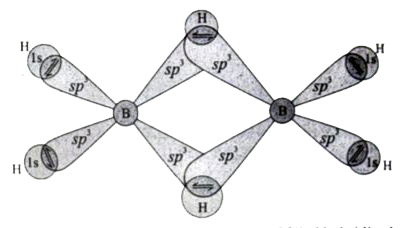
|
|
| 14. |
(i) Explain the mechanism of enzyme action? (ii) Which chemical is responsible for the antiseptic properties of dettol? |
|
Answer» Solution :(i) `*` Enzymes are bio catalysts that catalyse a specific bio chemical reaction. They generally activate the reaction by REDUCING the activation energy by stabilising the transition state. `*` In a typical reaction, enzyme E binds with the substrate molecule leversity to produce an enzyme - substrate complex. During this stage the substrate is converted into product and the enzyme becomes free and is READY to bind to ANOTHER substrate molecule. `* underset("Enzyme")(E)+underset("Substrate")(S) rarr underset("Enzyme-substrate complex")([ES])` `*" "[ES] rarr underset(("Product"))(P)+underset(("Enzyme"))(E)` (ii) (a) Chloroxylenol and (b) Terpineol are the chemicals responsible for the antiseptic PROPERTIES of dettol. But among these two, chloroxylenol plays more important role. Chloroxylenol is an antiseptic and disinfectant which is used for skin disinfection and cleaning surgical instruments. |
|
| 15. |
(i) Explain the observations from the Ellingham diagram. (ii) Write a short note on anamolous properties of the first element of p-block. |
|
Answer» Solution :(i) 1. For most of the metal oxide formation, the slope is positive. It can be explained as follows. Oxygen gas is consumed during the formation of metal oxides which results in the decrease in RANDOMNESS. Hence, `DeltaS` becomes negative and it makes the term, `TDeltaS` positive in the straight line equation. 2. The graph for the formation of carbon monoxide is a straight line with negative slope. In this case `DeltaS` is positive as 2 moles of CO gas is formed by the consumption of one mole of oxygen gas. It indicates that CO is more stable at higher temperature. 3. As the temperature increases, generally `DeltaG` value for the formation of the metaloxide become less negative and becomes zero at a particular temmperature. Below this temperature, `DeltaG` is negative and the oxide is stable and above this temperature`DeltaG` is positive. This general trend suggests that metal oxides become less stable at higher temperature and their decomposition becomes easier. 4. There is a sudden change in the slope at a particulartemperature for some metal oxides like MgO, HgO. This is due to the phase transition (melting or evaporation). (ii) In p-block elements the first member of each group differs from the other elements of the corresponding group. The following FACTORS are responsible for this anomalous behaviour. Small size of the first member. High ionisation enthalpy and high ELECTRONEGATIVITY. Absence of d-orbitals in their VALANCE shell. The first member of the group-13, boron is a metalloid while others are reactive metals. Moreover, boron shows diagonal RELATIONSHIP with silicon of group 14. The oxides of boron and silicon are similar in their acidic nature. |
|
| 16. |
(i) Explain O_2is gas and sulphur is solid.(ii) Give the reaction of O_3with (a) PbS (b) Acidified FeSO_4and (c ) Hg. |
|
Answer» SOLUTION :(i) Oxygen atom has small size. It can form multiple bonds and exists as `O_2`molecule. `O_2`molecules are HELD together by weak van der Waals. forces of attraction. ` THEREFORE ` it has low b.pt. and is GAS at ROOM temperature. S atom has large size, it forms single bonds and exists as `S_8`molecules. In these `S_8`molecules the magnitude of van der Waals. forces of attraction is large . it has high m.pt. and is solid at room temperature.  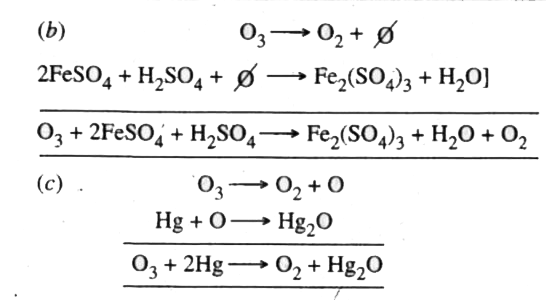
|
|
| 17. |
i) Explain S_(N)2 mechanism taking an example of chloromethane. ii) Write the general equation for the reaction of primary alcohol with SOCl_(2). |
Answer» Solution : The reaction in which rate of the reaction depends on the CONCENTRATION of both `R-x&` nuclophile. `therefore` Rate `alpha(RX)^(1)"(Nuc)"^(1)` `"order "=2` ii) `2R-OH+SOCl_(2)rarr 2R-Cl+2HCl+SO_(2)UARR` |
|
| 18. |
(i) Explain how goldore isleached by cyanideprocess (ii)Explainthe classification of Inosilicates |
|
Answer» Solution :(a) (i) (i) Gold is usually FOUND in nativestate (ii) The leachingprocess is intendedto concentrate the goldmetal. ` 4Au_(s) + 8 NaCN_(aq)^(-) + 2H_(2)O_(aq) + O_(2(g)) to 4 Na [ Au(CN)_(2)]_(aq)^(-) + 4NaOH_(aq)^(-)` ` 2NA[Au(CN)_(2)]+ ZN to Na_(2) [ Zn(CN)_(4)] + 2Au darr` (iii) In this reaction, Zn actsas a reducingagent , (ii) Inosilicates : Silicateswhich contain'n'number of silicateunits likedby sharingtwo or moreoxygenatomsare called inosilicates Examples :They are further classifiedas chainsilicates and doublechainsilicates |
|
| 19. |
(i) Explain Intermediatecompound formation theory (ii) Writeshortnoteson ultra filtration |
|
Answer» Solution :(I) The intermediatecompound formation theory : A catalyst actsby providinga new pathwith lowenergyof activation . In homogeneouscatalysedreactions a catalyst maycombine with one or more reactantto forman intermediatewhich reats withother reactant or decomposeto giveproducts and the catalyst is regenerated . Consider the reactions : ` A + B to AB ` A + C ` to`AC ( intermediate ) C is thecatalyst ` AC + B to AB + C` Activation energies for THEREACTIONS (2) and (3) areloweredcomparedto THATOF (1) . Hencethe formation anddecompositionof the intermediateaccelerate rate of the reaction . Examples : The mechaismof Fridealcraftsreaction is givenbelow : `C_(6) H_(6) + CH_(3)CIoverset("anhydrous")overset(AlCI_(3))toC_6H_(5)CH_(3) + HCI` The action of catalyst is explained as follows ` CH_(3)CI + AICI_(3) to[CH_(3)]^(+) [AICI_(4)]^(-)` It is an intermediate ` C_(6)H_(6)+ [CH_(3)^(+)] [AICI_(4)]^(-) to C_(6)H_(5)CH_(3) + AICI_(3) + HCI` (ii) Ultrafiltration (i) The pores of ordinary filterpaperspermit the passageof colloidalsolutions (ii) In ultrafiltrations , the membranes are made by usingcolloidion cellophane or visiking (iii) Whena colloidalsolution is filtered usingsucha filter, colloidalparticlesare separatedon thefilter and theimpuritiesare removedas washings. (iv) The processis QUICKENED by APPLICATION of pressure. (v) THe separation of sol particlesfromelectrolyte by filteration through an ultrafilter is called ultrafilitration . |
|
| 20. |
(i) Explain[Fe(CN)_(6)]^(3-) is paramagnetic ,usingCrystalfieldtheory (ii) Whatis schottkydetect ? |
Answer» Solution : (II) schottkydefectarisesdue tothe missingof EQUAL number of cations and anionsfromthe crystallattice. (i) Thiseffect does not change the stoichiometryof the crystal. (ii) Ionicsolids in whichthe cation and anion are of almostof similarsizeshow schottky defect , Ex : NACL (III) Presence of largenumber of schottky defects in a crystal, lowersits density 
|
|
| 21. |
(i) Explain about the hydrolysis of salt of strong base and weak acid. Derive the value of K_(h) for that reaction. (ii) Identify the Lewis acid and the Lewis base in the following reactions. (1) CaO + CO_(2) rarr CaCO_(3) (2) |
|
Answer» Solution :(i) 1. Coordination number : The number of nearest neighbours that surrounding a particle in a crystal is called the coordination number of that particle. 2. In aqueous solution, `CH_(3)COONa` is completely dissociated as follows. `CH_(3) COONa_((aq)) rarr CH_(3)COO_((aq))^(-) + Na_((aq))^(+)` 3. `CH_(3)COO^(-)` is a conjugate base of the weak acid `CH_(3)COOH` and it has a tendency to react with `H^(+)` from water to produce unionised acid. But there is no such tendency for `Na^(+)` to react with `OH^(-)` 4. `CH_(3) COO_((aq))^(-) + H_(2)O_((l)) harr CH_(3) COOH_((aq)) + OH_((aq))^(-)` and therefore `[OH^(-)] gt [H^(+)]`, in such cases, the solution is basic due to the HYDROLYSIS and pH is greater than 7. 5. Relationship between equilibrium CONSTANT, hydrolysis constant and the dissociation constant of acid is derived as follows : `K_(h) = ([CH_(3)COOH][OH^(-)])/([CH_(3)COO^(-)][H_(2)O])` `K_(h) = ([CH_(3)COOH][OH^(-)])/([CH_(3)COO^(-)])""...(1)` `CH_(3)COOH_((aq)) harr CH_(3) COO_((aq))^(-) + H_((aq))^(+)` `K_(h) = ([CH_(3)COO^(-)][H^(+)])/([CH_(3)COOH])""...(2)` Equation `(1) xx (2)` `K_(h) .K_(a) = [H^(+)] [OH^(-)]` `[H^(+)] [OH^(-)] = K_(w)` `therefore""K_(h) . K_(a) = K_(w)` `K_(h)` valuein terms of degree of hydrolysis (h) and the concentration of salt (c) for the equilibrium can be obtained as in the case of Ostwald.s dilution law `K_(h) = h^(2) C and [OH^(-)] = sqrt(K_(h).c)`. (ii) 1. `CaO + CO_(2) rarr CaCO_(3)` (a) CaO - Lewis base , All metals oxides are Lewis bases (b) `CO_(2)`-Lewis acid , `CO_(2)` contains a polar DOUBLE bond. 2. 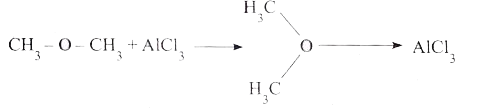 (a) `CH_(3) - O - CH_(3)`-Lewis base , Electron rich SPECIES (b) `AlCl_(3)`-Lewis acid , `AlCl_(3)` is electron deficient molecule. |
|
| 22. |
(i) Experiment shows that Nickel oxide has the formula N i_(0.98)O_(1.00). What fraction of Nickel exists as of N i^(2+) and N i^(3+) ions? (ii) Why do solids have adefinite volume ? |
|
Answer» |
|
| 23. |
(i) Estimate the average S.F bond energy in SF_(6). The standard heat of formation values of SF_(6)(g),S(g) and F(g) are -1100, 275 and 80 kJ "mol"^(-1) respectively. (ii) The heat liberated on complete combustion of 7.8 g benzene is 327 kJ. This heat has been measured at constant volume and at 27^(@) C. Calculate heat of combustion of benzene at constant pressure at 27^(@) C, (R = 8.3 J"mol"^(-1) K^(-1)) |
|
Answer» SOLUTION :(i) `309.17` (II) `-3273.735` KJ |
|
| 24. |
(i) Ether bottle should not be kept open. Why ? (ii) Draw the structures and write the IUPAC nameof the following compounds. 1. Benzyl alcohol2. Allyl alcohol3. Cyclohexyl alcohol |
|
Answer» |
|
| 25. |
I. Ellingham diagram helps to select a suitable reducing agent II. Magnesite is calcinated to obtain magnesia III. Calcination is a process of cooling substances. IV. Sulphur dioxide is harmful to the environment. |
|
Answer» I, II & IV |
|
| 26. |
(i) Draw the strucutres of all isomeric alcohols of molecular formula C_(5)H_(12)O and give their IUPAC names. (ii) Classify the isomers of alcohols in Question as primary, secondary and tertiary alcohols. |
|
Answer» Solution :Eight isomers are possible as GIVEN below. Indication of primary, secondary or TERTIARY is given in the bracket each. `{:((1)underset("Pentan -1 - ol "(1^(@)))(CH_(3)CH_(2)CH_(2)CH_(2)CH_(2)OH),(2)underset("Pentan -2 - ol "(2^(@)))(CH_(3)CH_(2)CH_(2)-OVERSET(OH)overset("|")"CH"-CH_(3))),((3)underset("Pentan -3 - ol "(2^(@)))(CH_(3)CH_(2)-overset(OH)overset("|")"CH"-CH_(2)CH_(3)),(4)underset("2-Methylbutan-1-ol "(1^(@)))(CH_(3)CH_(2)-overset(CH_(3))overset("|")"CH"-CH_(2)OH)),((5)underset("3-Methylbutan-1-(ol "(1^(@)))(CH_(3)-overset(CH_(3))overset("|")"CH"-CH_(2)CH_(2)-OH),(6)underset("2-Methylbutan-2-ol "(3^(@)))(CH_(3)-overset(CH_(3))overset("|")underset(OH)underset("|")"C "-CH_(2)CH_(3))),((7)underset("2, 2 - Dimethylpropan-1- ol "(1^(@)))(CH_(3)-overset(CH_(3))overset("|")underset(CH_(3))underset("|")"C "-CH_(2)OH),(8)underset("3-Methylbutan-2-ol "(2^(@)))(CH_(3)-overset(CH_(3))overset("|")"CH"-overset(OH)overset("|")"CH"-CH_(3))):}` |
|
| 27. |
I. E_(a)=20kJ"mol"^(-1)""DeltaH=-60kj"mol"^(-1) II. E_(a)=30kj"mol"^(-1)""DeltaH=-20kj"mol"^(-1) III. E_(a)=60kj"mol"^(-1)""DeltaH=+25kj"mol"^(-1) If all the three reaction have same frequency factor then fastest and slowest reaction are |
|
Answer» III is FASTEST, I is slowest |
|
| 28. |
(i) Draw the structures of all isomeric alcohols of molecular formula C_(5)H_(12)O annd give their IUPAC names. (ii) Classify the isomers of alcohols in questions 1 (i) as primary, secondary ad tertiary alcohols. |
|
Answer» Solution :Eight isomers are POSSIBLE. These are: (a) `underset("Pentan-1-ol "(1^(@)))(CH_(3)CH_(2)CH_(2)CH_(2)CH_(2)OH)` (B) `underset("Pentan-2-ol "(2^(@)))(CH_(3)CH_(2)CH_(2)-overset(OH)overset(|)(C)H-CH_(3))` (c) `underset("Pentan-3-ol "(2^(@)))(CH_(3)CH_(2)-overset(OH)overset(|)(C)H-CH_(2)CH_(3))` (d) `underset("2-Methylbutan-1-ol "(1^(@)))(CH_(3)CH_(2)-overset(CH_(3))overset(|)(C)H-CH_(2)OH)` (e) `underset("3-Methylbutan-1-ol "(1^(@)))(CH_(3)-overset(CH_(3))overset(|)(C)H-CH_(2)CH_(2)-OH)` (F) `underset("2-Methylbutan-2-ol "(3^(@)))(CH_(3)-underset(OH)underset(|)overset(CH_(3))overset(|)(C)-CH_(2)CH_(3))` (g) `underset("2,2-Dimethylpropan-1-ol "(1^(@)))(CH_(3)-underset(CH_(3))underset(|)overset(CH_(3))overset(|)(C)-CH_(2)OH)` (h) `underset("3-Methylbutan-2-ol "(2^(@)))(CH_(3)-overset(CH_(3))overset(|)(C)H-overset(OH)overset(|)(C)H-CH_(3))` |
|
| 29. |
(i) Draw the structures of all isomeric alcohols of molecular formula C_(5)H_(12)O and give their IUPAC names. (ii) Classify the isomers of alcohols in question (3) (i) as primary, secondary and tertiary alcohols. |
|
Answer» Solution :(i) `UNDERSET(1^(@))(underset("Pentan-1-ol")(CH_(3)CH_(2)CH_(2)CH_(2)OH))` (II) `underset(2^(@))(underset("Pentan-2-ol")(CH_(3)CH_(2)CH_(2)- overset(OH)overset(|)CHCH_(3))` (III) `underset(2^(@))(underset("Pentan-3-ol")(CH_(3)CH_(2)overset(OH)overset(|)CH-CH_(2)CH_(3))` (iv) `underset(1^(@))(underset("2-Methylbutane-1-ol")(CH_(3)CH_(2)overset(CH_(3))overset(|)CHCH_(2)OH))` (v) `underset(1^(@))(underset("2-Methylbutan-1-ol)(CH_(3)overset(CH_(3))overset(|)CHCH_(2)CH_(2)OH))` `underset(3^(@))(underset("2-Methylbutan-2-ol")(CH_(3)- underset(OH)underset(|)overset(CH_(3))overset(|)C- CH_(2)CH_(3))` `underset(1^(@))(underset("2,2-Dimethylpropan-1-ol")(CH_(3)- underset(CH_(3))underset(|)overset(CH_(3))overset(|)C- CH_(2)OH))` `underset(2^(@))(underset("3-Methylbutan")(CH_(3)- overset(CH_(3))overset(|)CH- overset(OH)overset(|)CH-CH_(3))` |
|
| 30. |
(i) Draw the pyranose structure of glucose. (ii) What type of linkage is present in proteins? (iii) Give one example each for water-soluble vitamins and fat-soluble vitamins. |
Answer» Solution :(i) Pyranose structure of GLUCOSE.  (ii) Linkage in PROTEIN: The amino acids in protein are linked by peptide linkage i.e., - CO - NH - linkage. (iii) Water SOLUBLE vitamin is vitamin B or vitamin C. Fat soluble vitamin is vitamin A. |
|
| 31. |
(i) Draw the geometrical isomers of the complex [Pt(NH_(3))_(2)Cl_(2)]. (ii) On the basis of crystal field theory, write the electronic configuration of d^(4) ion if Delta_(0)ltP. (iii) Write the hybridisation and magnetic behaviour of the complex Ni(CO)_(4) (At. no. of Ni = 28). |
| Answer» SOLUTION :(i) `t_(2G)^(3) e_(g)^(1)` | |
| 32. |
(i) Draw all possible stereo isomers of a complex Ca[Co(NH_(3))Cl(Ox)_(2)] (ii) What is Bragg'sequation ? |
Answer» Solution :(i) Possible STEREO isomers of a complex `Ca[Co(NH_(3))Cl(Ox)_(2)]` 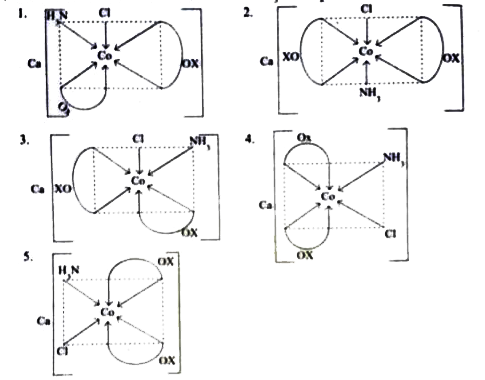 1. X-raydiffraction analysis is the most POWERFUL tool for the determination of crystal structure. 2. The interplanardistance (d) between two successive planes of atoms can be calculated using the following equation form the X-ray diffraction data `2d sin theta=n lambda`. The equation is known as Bragg.s equation Where `lambda` = WAVELENGTH of X-ray,d = Interplanardistance `theta` = The angle of diffractionn = order of reflection By knowing the values of `theta,lambda` and n. we can CALCULATE the value of d `d=(n lambda)/(2sin theta)` Using these values, the edge of the unit cell can be calculated. |
|
| 33. |
(i) Draw a neat labelled diagram of blast furnace used for the extraction of iron and mention different zones. (ii) What is the role of coke and lime stone during the extraction of cast iron? |
Answer» SOLUTION :(i) 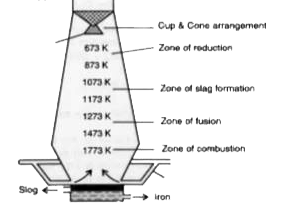 Diagram and labelling Combustion zone implies 1773 K or `1500^(@)C` Fusion zone implies 1473 K - 1573 K or `1200^(@)C-1300^(@)C` Slag zone implies 1073 K - 1273 k or `900^(@)C-1000^(@)C` Reduction zone 873 K implies `600^(@)C` (ii) Coke implies Fuel or REDUCING agent Lime STONE implies Flux |
|
| 34. |
(i) Discuss the ortho and pyro silicates. (ii) Compare lanthanides and actinides. |
|
Answer» Solution :(i) Ortho silicates : The simplest silicates which contain discrete `[SiO_(4)]^(4-)` TETRAHEDRAL units are CALLED ortho silicates or neso silicates. EXAMPLES : Phenacite `- Be_(2)SiO_(4) (Be^(2+)` ions are tetrahedrally surrounded by `O^(2-)` ions), Olivine - `(Fe//Mg)_(2) SiO_(4) (Fe^(2+) and Mg^(2+)` cations are octahedrally surrounded by `O^(2-)` ions.) Pyro silicates : Silicates which contain `[Si_(2)O_(7)]^(6-)` ions are called pyro silicates (or) Soro silicates. They are formed by joining two `[SiO_(4)]^(4-)` tetrahedral units by sharing one oxygen ATOM at one CORNER. (one oxygen is removed while joining). Example: Thortveitite `-Se_(2) Si_(2)O_(7)`. 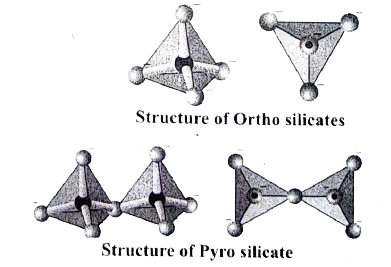 (ii) 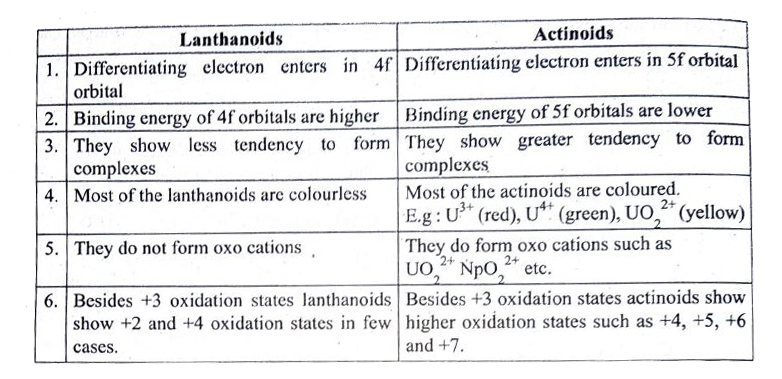
|
|
| 35. |
(i) Discuss the nature of bonding in metal carbonyls.(ii) Draw figure to show the splitting of d-orbitals in an octahedral crystal field and write electronic configuration of Mn^(2+) ion when: (a) p gt Delta_(@) (b) Delta_(@) gt p |
|
Answer» Solution :The metal carbon bond in metal carbonyls possess bith `sigma and pi` CHARACTER. The M-C `simga` bond if FORMED by the `M leftarrowC = O `while M-C `pi` bond if formed by the donation of a pair of electron from filled d-orbital of metal to aibinding `pi*` orbital of CO. (ii) 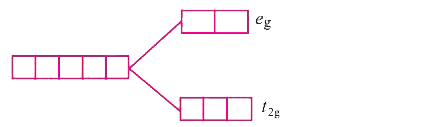 (a) `t_(2g) ^(3)e_(g)^(2)` (B) `t_(2g) ^(5)e_(g)^(0)` |
|
| 36. |
(i) Determine Delta_(f)H^(@) (NO, g) at 25^(@)C. Using the following information Delta_(f)H^(@) (CO_(2), g)= -393.5 kJ/mol {:(2NO(g)+O_(2)(g) rarr 2NO_(2)(g)(g),,,Delta_(r)H^(@)=-114.0" kJ/mol"),(2CO(g)+O_(2)(g) rarr 2CO_(2)(g),,,Delta_(r)H^(@)=-566.0" kJ/mol"),(4CO(g)+2NO_(2)(g) rarr4CO_(2)(g),+,N_(2)(g), Delta_(r)H^(@)=-1198.4" kJ/mol"):} (ii) Calculate the equilibrium pressure (in Pascal) for the conversion of grapgite to diamond at 25^(@)C. The densities of graphite and diamond may be taken to be 2.20 and 3.40 g/cc respectively independent of pressure. Given : DeltaG^(@) (C("graphite") rarr C ("diamond"))=2900 J/mol. |
|
Answer» Solution :`{:(2CO(g)+O_(2)(g) rarr 2CO_(2)(g),""Delta_(R)H^(@)=-566.0" kJ/mol"),(NO_(2)(g) rarr NO(g) +1//2O_(2)(g),""Delta_(r)H^(@)=114//2" kJ/mol"),(2CO_(2)(g)+1//2N_(2)(g) rarr 2CO(g) +NO_(2)(g) ," "Delta_(r)H^(@)=1198.4//2" kJ/mol"),(bar(1/2 N_(2)(g)+1/2 O_(2)(g) rarr NO(g),""Delta_(f)H^(@) (NO, g)=90.2" kJ/mol")):}` (ii) `DeltaG_(2)-DeltaG_(1)=DeltaV [P_(2)-P_(1)]` `DeltaV=12xx[1/3.4-1/2.2]xx10^(-6) m^(3) mol^(-1)` `DeltaV=-14.4/(3.4xx2.2)xx10^(-6)rArr -1.925xx10^(-6) m^(3) mol^(-1)` Let `P_(2)` is equilibrium pressure , `DeltaG_(2)=0, P_(2)=1" bar"=10^(5) Pa` `0-DeltaG_(1)=-1.925xx10^(-6) [P_(2)-1]` `2900=1.925xx10^(-6) [P_(2)-P_(1)]` `P_(2)=2900/(1.925xx10^(-6))+P_(1)` `rArr 1506.5xx10^(6)+10^(5)` `P_(2)=1.50xx10^(9) Pa` |
|
| 37. |
(i) Describe the preparation of acetic acid from acetylene.(ii) How can the following be obtained from acetic acid: (a) Acetone (b) Acetaldehyde? (iii) In what way can acetic acid be distinguished from acetone? (iv) Why carboxylic acid do not give the characteristic reactions of a carbonyl group? |
Answer» Solution : (iii) Add `I_2`and NaOH, Acetone will GIVE yellow precipitate of iodoform WHEREAS acetic acid does not react to give any yellow precipitate.(or) Add SODIUM bicarbonate solution, Acetone will not react, but acetic acid will give brisk effervescence due to the evolution of `CO_2` . (IV) Carboxylic acid does not give the characteristic reactions of CARBONYL group due to resonance effect by the virtue of which it does not have free ( >C=O)carbonyl group. |
|
| 38. |
(a) (i) Describlea methodfor refiningnickel. (ii)Whygroup18elementsare calledinertgases ?Writethe generalelectronicconfigurationof group18 elements. (b) (i) Givethe usesof helium. (ii) Ni(II) compounds are morestablethan Pt(II) compound.Givereason. |
|
Answer» Solution :(i) Theimpure nickelis heatedin a streamof carbon monoxideat around350 k.The nickelreactswith thecoto fromhiglyvolaticnickel tetracarbony. The solid impuritiesare leftbehind. `Ni(s)+4CO (G) to Ni (CO)_(4) (g)` Onheating the nickeltetracarbonyl around 460 k the complexdecomposesto givepuremetal . (ii)the elementsof group-18havecompletyfilleds and porbitalhencetheyare morestableand haveleastreactivity.Thereforegroup -18elementsare calledinertgases. (b)(i) Usesof helium 1. Heliumand oxygenmixtureis usedby diversin placeof AIR oxygenmixture . This preventsthepainfuldangerousconditioncalledbends. 2.Heliumis usedto provideinertatmosphere inelectricweldingof metals 3. Heliumhas lowestboilingpointhenceusedin cryogenic . 4. If is muchlessdenserthan airandhenceusedforfillingairballons. (ii) Theionisationenthalpyvaluescan beusedto predicthe themodymicstabilityoftheircompound . For Nickel .` Le_(1)+ LE_(2)= 737+ 1753` Sincethe energyrequiredto from`Ni^(2+)` is lessthan that `Pr^(2+)` Ni (II)compoundsare thermodynamicallymore stablethantP (ii)compounds. |
|
| 39. |
(i) Describe theelectrolysisof molten NaCl using inert electrodes. (ii) What are thevalues of A and B in Debye Huckel and Onsagar equation ? |
|
Answer» |
|
| 40. |
(i) Derive Henderson- Hasselbalchequation (ii) Whatis kohlraush's law ? |
|
Answer» Solution :(i) The concentration of hydronium ion in an acidic buffersolution dependson the ratioof the concentrationof the weakacidto the concentration of itsconjugatebasepresentin the solutioni.e, ` [ H_(3)O^(+)] = K_(a)([" ACID"]_(aq))/(["base"]_(aq))` (i) The weakacidis dissociatedonlyto small extent . Moreover dueto commonion effect,the dissociationis further SUPPRESSED and hencethe equilibriumconcentrationof the acidis nearly equal to the initialconcentration of the unionisedacid.Similarly the concentrationof the conjugatebaseis nearlyequalto the initial concentration of the addedsalt. ` [H_(3)O^(+) K_(a)] ("[ acid"])/("[salt"])` (ii) Here[ acid ] and [salt] represent the initial concentration of the acidand salt,respecitvelyusedto preparethe buffersolution Takinglogarithm on both sidesof theequation ` log [ H_(3)O^(+)] = log K_(a) + log ("[acid]")/("[salt]")` reverse the sign on bothsides ` - log [ H_(3)O^(+)]= - log[ H_(3)O^(+)] = - log K_(a) - log (" [ acid]")/("[salt]")` We knowthat ` pH = - log[ H_(3)O^(+)] and pK_(a) = - log K_(a)` ` RightarrowpH = pK_(a) - log ("[ acid"])/("[salt]")` ` RightarrowpH = pK_(a) + log(" [ salt]")/("[acid]")` Similarly fora basicbuffer, ` pOH =pK_(a) + log("[ salt]")/("[ base"]))` (ii) Kohlraush's LAW : At infinite dilution , THWE limitingmolarconductivityof anelectrolyte is equalto the sam e of thelimitingmolarconductivites of itsconstituent ions. |
|
| 41. |
(i) Define specific and molar conductivity and give relation between them. (ii) Calculate molar conductance of acetic acid at infinite dilution (^^_(m)^(@)). If molar conductance at infinite dilution ofNaCl, HCl and CH_(3)COONa are 126.4, 426.1 and 91.0ohm^(-1)cm^(2)mol^(-1) respectively. |
|
Answer» Solution :(i) Specific conductivity. It is the conductance of loc solution of the ELECTROLYTE. It is DENOTED by K. MOLAR conductivity. It is the conducting power of all the ions present in a solution containing 1 mole of the electrolyte. It is denoted by `^^_(m)` `^^_(m)=(kxx1000)/("Molarity")` (ii) `^^_(m)^(@)(CH_(3)COOH)=^^_(m)^(@)(CH_(3)COONa)+^^_(m)^(@)(HCL)-^^_(m)^(oo)(NaCl)` `=91+426.1-126.4` `=390.7omh^(-1)cm^(2)mol^(-1)` |
|
| 42. |
(i) Define TFM value. (ii) Differentiate thermoplastic and thermosetting. |
|
Answer» Solution :(i) 1. The quality of a soap is described in TERMS of total fatty matter (TFM value). It is defined as the total amount of fatty matter that can be separated from a sample after spliting with mineral acids. Higher the TFM value in the soap, better is its quality. 2. As per BIS STANDARDS, Grade I soaps should have 76% minimum TFM value (ii) Difference between thermoplastic and thermosetting : `{:("No.","Thermoplastic","Thermosetting"),(i.,"They do not soften on heating and harden on ","They do not soften on heating and they"),(,"cooling, and they can be remoulded.","cannot be remoulded."),(ii.,"They consists of linear long chain polymers","The consist of three DIMENSIONAL network structure"),(,"and LOW molecular weights polymers.","and high molecular weight polymers."),(iii.,"All the polymer chains are held together by","All the polymer chains are linked"),(,"weak Vanderwaals forces.","by strong covalent."),(iv.,"They are weak, soft and LESS brittle","They are strong, hard and more brittle."),(v.,"They are formed by addition","They are formed by condensation"),(,"Polymerisation.","polymerisation."),(vi.,"They are soluble in organic solvents.","They are insoluble in organic solvents."),(vii.,"Example : PVC, polythene, polystrene etc.","Example : Bakelite, melamine etc."):}` |
|
| 43. |
(i) Deficiency of which vitamin causes night-blindness ? (ii) Name the base that is found in nucleotide of RNA only. (iii) Glucose on reaction with HI gives n-hexane. What does it suggest about the structure of glucose ? |
|
Answer» SOLUTION :(i) Deficiency of vitamin A causes night-blindness. (ii) Uracil is found in RNA only. (iii) This REACTION shows that glucose has a straight CHAIN of six carbon atoms. |
|
| 44. |
(i) Deficiency of which vitamin causes rickets? (ii) Give an example each of fibrousprotein and globular proteins. (ii) Writethe productformed on reaction of D - glucosewith Br_(2)water . |
|
Answer» Solution :(i) Vitamin D . (ii) Fibrous PROTEIN : Kertain myosin . Globular protein : Insulin , albumins ,(or any otherany one EXAMPLE of each TYPE). (iii) Gluconic ACID or `underset(CH_(2)OH)underset(|)underset((CHOH)_(4))underset(|)(COOH` |
|
| 45. |
(i) Deficiency of whichvitamin causesscurvy ?(ii) Whattypeof linkange is responsiblefor the formation ofproteins ? (iii) Writethe product fromed whenglucoseis treated with HI. |
|
Answer» SOLUTION :(i)Vitamin C . (ii) Peptide linkage . (iii) n - HEXANE or its STRUCTURE . |
|
| 46. |
(i) Deficiency of whichvitamin cause night blindness ? (ii) Namethe base that is found in nucleotide of RNA only. (iii) Glucoseon reactionwith HI gives n - haxane . Whatdoes it suggest aboutthe structure of glucose ? |
|
Answer» Solution :(i) VITAMIN A. (II) URACIL. (iii) It SUGGEST that six carbon atoms are in straightchain/`CHO- (CHOCH)_(4) - CH_(2)OH`. |
|
| 47. |
(i) [CuCl_(4)]^(2-) exists while [CuI_(4)]^(2-) doesnot exist why ? (ii) Using crystal field theory, explainthe colour of the coordination compound. |
|
Answer» |
|
| 48. |
(i) Cu+2HCltoCuCl_(2)+H_(2(g)),[E_(Zn^(2+)//Zn)^(o)=-0.76V] (ii) Zn+2HCltoZnCl_(2)+H_(2(g)),[E_(Zn^(2+)//Zn)^(o)=-0.76V] (iii) Ag+HCltoAgCl+(1)/(2)H_(2(g)),[E_(Ag^(+)//Ag)^(o)=+0.80V] which of the above reactions is feasible |
|
Answer» (ii) |
|