

Saved Bookmarks
This section includes 7 InterviewSolutions, each offering curated multiple-choice questions to sharpen your Current Affairs knowledge and support exam preparation. Choose a topic below to get started.
| 1. |
(i) KI+H_(2)O+O_(3)rarrA+B+O_(2) (A turns moist starch paper blue, B turns red litmus blue) (ii) A(dry)+O_(3)rarrX+O_(2) What is true about X in the above sequence of reactions? |
|
Answer» It is a monobasic acid |
|
| 2. |
(I) K_(3)[Co(CN)_(6)]+[Cr(NH_(3))_(6)]Cl_(3)overset("acetone ")tox+3KCldarrK_(3)[Cr(CN)_(6)]+[Co(NH_(3))_(6)]Cloverset("Acetone")toy+3KCldarr the solution was filted x and y are obtained after evoporation of the solvent from the filtrate. when y is sent through anion exchange resn , then the complex eluted is |
|
Answer» `[Co(NH_(3))_(6)]^(3+)` |
|
| 3. |
(I) K_(3)[Co(CN)_(6)]+[Cr(NH_(3))_(6)]Cl_(3)overset("acetone ")tox+3KCldarrK_(3)[Cr(CN)_(6)]+[Co(NH_(3))_(6)]Cloverset("Acetone")toy+3KCldarr the solution was filted x and y are obtained after evoporation of the solvent from the filtrate. when x is sent through cation exxhange resin the complex comingout in solution is |
|
Answer» `[CO(NH_(3))_(6)]^(3+)` |
|
| 4. |
(i) Ionic conductance at infinite dilution of Al^(3+)and SO_4^(2-) are 189 and 160 mho cm^2 "equity "^(-1). Calculate the equivalent and molar conductance of the electrolyte Al_2(SO_4)_3 at infinite dilution . (ii) Suggest a way to determine lamda_m^@ value of water . (b) (i) Why does bleeding stop by rubbing moist alum. (ii) How is glycerol reacts with fuming nitric acid ? (or) How would you convert glycerol into nitroglycerine ? |
|
Answer» Solution :(i) Molar conductance `(^^^_m^@)_(Al_2(SO_4)_3)=2(lamda_m^@)_(Al^(3+))+3(lamda_m^@)_(SO_4^(2-))` `=(2xx189)+(3xx160)=378+480=858 mho " cm"^2"mol"^(-1)` 2. Equivalent conductance `(lamda_(oo))_(Al_2(SO_4)_3)=1/3(lamda_oo)_(Al^(3+))+1/2(lamda_oo)_(SO_4^(2-))` `=189/3+160/2 = 63+80=143 "mho cm"^2 ("G equiv")^(-1)` (ii) `lamda_m^@(H_2O)=lamda_(H^+)^@+lamda_(OH)^@-` We FIND out `lamda_m^@(HCL), lamda_m^@(NAOH)and lamda_m^@(NaCl)` Then `lamda_m^@(H_2O), lamda_m^@(HCl)+ lamda_m^@(NaOH)lamda_m^@(NaCl)` |
|
| 5. |
I. Ionic solids conduct electricity, because the ions are fixed in their lattice positions. II. Hydrogen bonded molecular solids are soft solids under room temperature. III. Dipole-dipole interactions are found in polar molecular solids IV. X-ray diffraction analysis is used for the determination of crystal structure. |
| Answer» Answer :A | |
| 6. |
(i) Illustrate the following reactions : (a) Hoffmann bromamide degradation reaction. (b) Coupling reaction. (ii) Write a chemical test to distinguish between aniline and methylamine. |
|
Answer» Solution :(i) Reactions for the reactions are given as under : (a) HOFFMANN bromamide degradation reaction : `R-overset(overset(O)(||))(C)-NH_(2)+Br_(2)+4NaOH rarr R-NH_(2)+Na_(2)CO_(3)+2NaBr+2H_(2)O` Hoffmann bromamide degradation reaction is used to convert an amide into amine. (b) Coupling reaction : This reaction takes PLACE between benzene DIAZONIUM chloride and phenol as under :  (ii) Chemical test to distinguish between aniline and METHYLAMINE : Aniline gives dye test while methylamine does not give this test. Aniline solution is treated with a solution of `NaNO_(2)` and HCl. It is cooled to `5^(@)C` and treated with a solution of phenol. An orange dye is obtained. METHYL amine does not give this test. |
|
| 7. |
I, II, III are three isothem respectively at T_(1), T_(2) & T_(3) temperatures will be in order |
|
Answer» `T_(1)=T_(2)=T_(3)` |
|
| 8. |
(i) If P_(A)^(@) and X_(A) (i) lt X_(B) (i)then X_(A) (iii) will increases or decreases as dompared to x_(2). (i) (a) 10 cc of a liquid A were mixed with 10 cc of liquid B. the volume of the resuting solution was foudn to be 19.8 c. What do you conclude? (b) Two liquids X and Y are mixed to the resulting solution is dound to be cooler. What do you conclude ? |
|
Answer» Solution :(i) increase (II) (a) the solution shows a NEGATIVE deviation from Faoult.s LAW. (B) the solution shows a POSITIVE deviation from Raoult.s law. |
|
| 9. |
(i). (ii). CH_(2)=CH-CH_(2)-overset(OH)overset(|)(C)H-CH_(3)overset("Aluminium tert butoxide")to (iii). . |
Answer» SOLUTION : . .
|
|
| 10. |
I, II and III respectively are |
|
Answer» paracetamol, ASPIRIN and IBUPROFEN |
|
| 11. |
(i) Identify A,B,C and D CH_(3)-NO_(2) overset(LiAlH_(4))rarr A overset(2CH_(3)CH_(2)Br)rarrB overset(H_(2)SO_(4))rarrC (ii) How would you get iodo benzene from benzene diazonium chloride. |
|
Answer» |
|
| 12. |
(i) Identify A to F: CH_3COCH_3overset((i)Mg-Hg//"dry ether")underset((ii) dil.HCl)toC |
Answer» SOLUTION :
|
|
| 13. |
(i) Identify A to F: (CH_3COO)_2Caoverset(/_\)toAoverset(NH_2NH_2//HCl)underset(CH_3COONa///_\)toB |
| Answer» SOLUTION :`Aimplies(CH_3)_2CO(B)CH_3CH_2CH_3` | |
| 14. |
(i) Identify A to F: CH_3CNoverset(LiAlH_4)toD |
| Answer» SOLUTION :`DimpliesCH_3-CH_2-NH_2` | |
| 15. |
(i) Identify A to F: CH_3CHOoverset(aq.KCN)toEoverset(H_3O^+)toF |
| Answer» SOLUTION :`(33CHY_CHE_ORG_XII_P2_MQP_E03_044_S01.png" WIDTH="80%"> | |
| 16. |
i) Identifiy 'A' and 'B' in the following equations. CH_(3)-CH=CH_(2) overset(H_(2)O//H^(+))rarr A overset(CrO_(3))rarr B ii) What is Lucas reagent? |
|
Answer» SOLUTION :i) `A=CH_(3)-underset(OH)underset(|)(CH)-CH_(3)` `B=CH_(3)-underset(O)underset(||)C-CH_(3)` II) Mixture of conc. `HCL` and ANH. `ZnCl_(2)` |
|
| 17. |
(i) Hydrogen fluoride is a weaker acid than hydrogen chloride in aqueous solution. Or Which is a stronger acid in aqueous solution, HF or HCI ? (ii) In aqueous solution, HI is a stronger acid than HCI ? (iii) F atom is more electronegative than I atom, yet HF has lower acid strength than HI. Explain. |
|
Answer» Solution :(i) Because of smaller size of F as compared to Cl, the BOND dissociation energy of H-F bond is much higher than that of H-Cl bond. As a result, in aqueous solution, H-Cl bond can break more easilyto form `H^(+)` ion than H-F bond. Thus, HYDROGEN fluoride is a weaker ACID than hydrogen CHLORIDE in aqueous solution. (ii) Due to smaller size of Cl as compared to I, bond dissociation energy of H-Cl bond is much higher than that of H-I bond. As a result, in aqueous solution, H-I bond breaks more easily to release `H^(+)` ion than H-Cl bond. Thus, HI is a stronger acid than HCl in aqueous solution. (iii) F atom being smaller in size than I atom, the bond dissociation energy of H-F is very high as compared to that of H-I bond. Consequently, H-I bond breaks more easily to release `H^(+)` ion than H-F bond and thus HI is a stronger acid than HF. |
|
| 18. |
(i) How would you calculate the solubility of sparingly soluble salt using Kohlrausch's law ? (ii) Formic acid act as reducing agent. Prove this statement. |
|
Answer» Solution :(i) Substances like `AgCl, PbSO_(4)` are sparingly soluble in water. The solubility product can be determined using conductivity experimentss. 2. Let us consier AgCl as an example `AgCl_((s)) harr Ag^(+) + Cl^(-)` `K_(SP) = [Ag^(+)] [Cl^(-)]` 3. Let the concentration of `[Ag^(+)]` be .C. mol `L^(-1)` If `[Ag^(+)]` = C, then `[Cl^(-)]` is also equal to C mol `L^(-1)` `therefore K_(sp) = C.C` `K_(sp) = C^(2)` 4. The relationship between molar CONDUCTANCE and equivalent conductance is `A_(@) = (K xx 10^(-3))/(C(mol L^(-1)))(or) C = (K xx 10^(-3))/(A^(@))` Substitute the concentration value in the relation `K_(sp) = C^(2)` `K_(sp) = [(K xx 10^(-3))/(A^(@))]^(2)` (ii) 1. FORMIC acid contains both an aldehyde as WELL as an acid group. Hence, like other aldehydes, formic acid can easily be oxidised and therefore acts as a strong reducing agent. 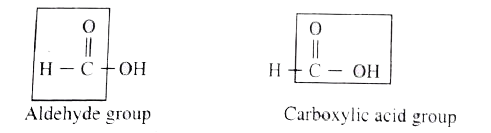 2. Formic acid reduces Tollen.s REAGENT (ammonical silver nitrate solution) to metallic silver. `HCOO^(-) + underset(("Tollen.s reagent"))(2 Ag^(+) + 3OH^(-)) rarr underset(("Silver mirror"))(2Ag + CO_(3)^(2-)) + 2H_(2)O` 3. Formic acid reduces Fehling.s solution. It reduces blue coloured cupric ions to red coloured cuprous ions. `HCOO^(-) + underset(("Blue"))underset(("Fehlings solution"))(2Cu^(2+) + 5OH^(-)) rarr underset("Red precipitate")(Cu_(2)O darr) + CO_(3)^(2-) + 3H_(2)O` |
|
| 19. |
(i) How will you purify metals by using iodine ? (ii) Boron does not react directly with hydrogen. Suggest one method to prepare diborane from BF_(3). |
|
Answer» Solution :(i) This method is based on thethermal decomposition of metal compounds which lead to the formation of pure metals. Titanium and zirconium can be purified using this method. For example, the impure titanium metal is heated in an evacuated vessel with iodine at a temperature of 550 K to form the volatille titanium tetra-iodide. `(Til_(4))`. The impurities are left behind, as they do not react with iodine. `Ti_((s))+2l_(2(s))toTil_(4)("vapour")` The volatile titanium TETRAIODIDE vapur ispassed over a tungsten filament ata temperature around 1800 K. The titanium tetraiodide is decomposed and pure titanium isdeposited on the filament. The iodine is reused. `Til_(4)("vapour")to Ti_((s))+2I_(2(s))` (ii) BORON does not react directly with hydrogen. However it forms a variety of hydrides called boranes. Treatment of gaseous boron trifluoride with SODIUM hydridearound 450 K gives diborane. `underset(("Borontrifluoride"))(2BF_(3))+6NaHoverset(450" K")to underset(("Diborane"))(B_(2)H_(6))+6NaF` |
|
| 20. |
(i) How will you prepare (a) acetic anhydride and (b) acetyl chloride from CH_(3)COOH ? Write the equation involved in each case. |
Answer» Solution :(a) 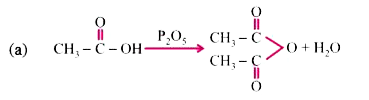 (b) `CH_(3)-overset(O)overset(||) ( C) -OH +PCI_(3)to CH_(3)COCI+POCI_(3)+HCI`. |
|
| 21. |
(i) How will you prepare: (a) Acetic anhydride and (b) Acetyl chloride from acetic acid? . Write the reactions involved in each case. (ii) Why is the boiling point of an acid anhydride higher than the acid from which it is derived? |
Answer» Solution :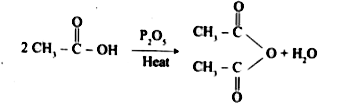 (b) `CH_3- oversetunderset(||)(O)(C ) -OH + PCI_5 to CH_5COCl + POCl_3 + HCL` (II) Acid anhydrides are bigger SIZED molecules than the corresponding acids, therefore have more surface AREA, more van der Waals. forces of attraction and hence higher boiling points. |
|
| 22. |
(i) How will you convert the following: a. Propanone to propan -2-ol b. Ethanal to 2-hydroxy propanoic acid c.Toluence to benzoic acid (ii) Distinguish the following pairs of compounds: a. Pentan-2-one and pentan-3-one b. Ethanal and propanal |
|
Answer» SOLUTION :(i) a. `underset("Propanone")(CH_(3)-overset(O)overset(||)(C)-CH_(3))underset("REDUCTION")overset(LiAlH_(4))(to)underset("Propan-2-ol")(CH_(3)-overset(OH)overset(|)(CH)-CH_(3))` 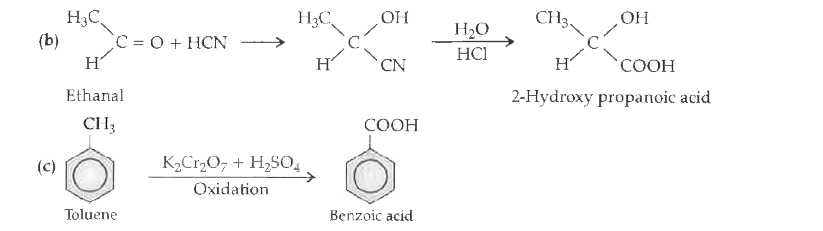 (ii) a. Pentane -2-one GIVES yellow ppt of iodoform in Idoform TEST, while pentane-3-one does not give it. `CH_(3)CH_(2)CH_(2)-overset(O)overset(||)(C)-CH_(3)+3NaOHtoCH_(3)CH_(2)CH_(2)COONa+underset("Yellow ppt")(CHI_(3))darr+2NaOH` b. Ethanal will give iodoform test, while propaal will not give it. |
|
| 23. |
(i) How will you convert nitrobenzene into 1) 1,3,5 - trinitrobenzene2)o and p - nitrophenol (ii) Differentiate between Globular and fibrous proteins. |
Answer» Solution :(i) 1. CONVERSION of nitrobenzene into 1,3,5 - trinitrobenzene: 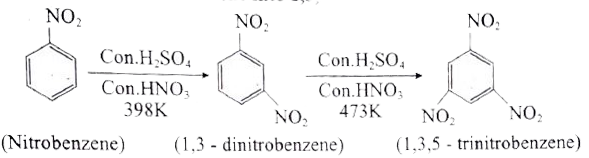 2. Conversion of nitrobenzene into o and p- nitrophenol: Nitrobenzene heated with SOLID KOH at 340 K gives a LOW yield of a mixture of O-and P-nitrophenols. 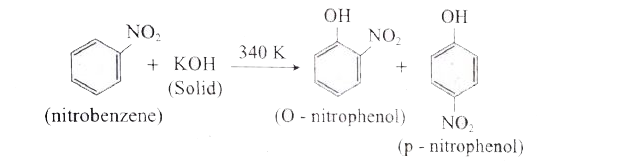 (ii) Difference between Globular and fibrous proteins. 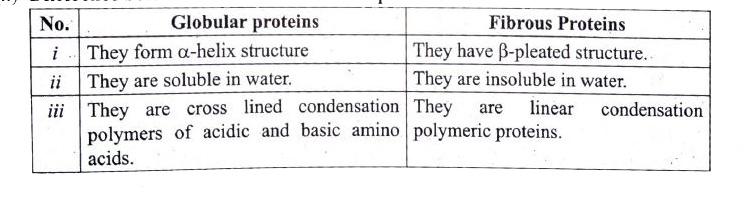
|
|
| 24. |
(i) How many grams of H_(2)S are contained in 0.40 mole of H_(2)S? (ii) How many gram atoms of H and S are contained in 0.40 mole of H_(2)S? (iii) How many molecules of H_(2)S are contained in 0.40 mole of H_(2)S? (iv) How many atoms of H and S are contained in 0.40 mole of H_(2)S? |
|
Answer» Solution :(i) 13.6 g (II) 0.8 g atoms of H and 0.4 g atoms of S (iii) `2.4088xx10^(23)` MOLECULES (IV) `4.8176xx10^(23)` atoms of H and `2.4088xx10^(23)` atoms of S |
|
| 25. |
(i) How is bleaching powder prepared ? (ii) What happens when benzene reacts with chlorine ? |
|
Answer» Solution :(i) Bleaching POWDER is prepared by PASSING chlorine gas through dry slaked lime (Calcium HYDROXIDE) `Ca(OH)_(2) + Cl_(2) to underset("(Bleaching powder)") (CaOCl_(2)) + H_(2) O` (ii) Benzene reacts withchlorine in the PRESENCE of ferric chloride to give chlorobenzene . `underset("(Benzene)")(C_(6) H_(6)) + Cl_(2) overset(FeCl_(3)) (to) underset("Chlorobenzene")(C_(6) H_(5) Cl) + HCL` |
|
| 26. |
(i) How is bleaching power prepared? (ii) What happens when benzene reacts with chlorine? |
|
Answer» Solution :(i) Bleaching power is PREPARED by passing chlorine gas through dry slaked lime (Calcium hydroxide). `CA(OH)_(2)+Cl_(2)RARR underset("(Bleaching power)")(CaOCl_(2)+H_(2)O)` (ii) Benzene reacts with chlorine in the presence of ferric CHLORIDE to give chlorobenzene. `underset("(Benzene)")(C_(6)H_(6))+Cl_(2)overset(FeCl_(3))rarr underset("(Chlorobenzene)")(C_(6)H_(5)Cl)+HCl` |
|
| 27. |
(i) How is chlorine prepared by using MnO_(2)? |
|
Answer» Solution :(i) CHLORINE is OBTAINED by heating `MnO_(2)` with CONC. HCI. `MnO_(2)+4HCl to MnCI_(2) +CI_(2) + 2H_(2)O` (ii) `NH_(2) +Cl_(2)(excess)toNCI_(3) +3HCl ` |
|
| 28. |
(i) HF is liquid while HCl is gas, why? (ii) Give the increasing order of acidic strength and reducing character of HF, HCI, HBr, and HI. Give reasons. |
Answer» Solution : (i) In HF, there are intermolecular H-bonds. .. it has high b. pt. and is liquid at ROOM temperatures.  In HCl, there are weak VAN der Waals. forces of attractions. ` therefore ` There are weak van der Waals. forces of attraction, . it has low b.pt. and is gas at room temperature. (II) The increasing order of ACIDIC strength is :HF |
|
| 29. |
{:("(i) Helium","(a) flash bulbs"),("(ii) Neon","(b) radioactive"),("(iii) Krypion","(c ) air balloons"),("(iv) Radon","(d) Brilliant red glow"):} |
| Answer» SOLUTION :(i) C (ii) d (III) a (IV) b | |
| 30. |
{:("(i) Helium ","(a) flash bubls"),("(ii) Neon","(b) radioactive"),("(iii) Krypion","(c ) air balloons"),("(iv) Radon","(d) Brilliant red glow"):} |
| Answer» SOLUTION :(i) c (II) d (III) a (IV) b | |
| 31. |
underset((I))(HCHO): underset((II))(CH_3CHO):underset((III ))(C CI_3 CHO ), underset((IV ))(CH_3 COCH_3) : underset((V ))(C CI_3 COCH_3) ,underset((VI))(C_6H_5 CHO) Which of the above compounds undergo aldol condensation |
|
Answer» Only II, III, IV and VI |
|
| 32. |
(i) HC -= CH to CH_(2) (COOH)_(2) (a) CH_(3) Broverset("Mg // Ethe") tounderset(H_(1)O)overset(CO_(2))to (B) (ii) Why can'twegetanhydrous formicacidby fractionaldistillation of fatty acids ? |
Answer» Solution :(i)(a) 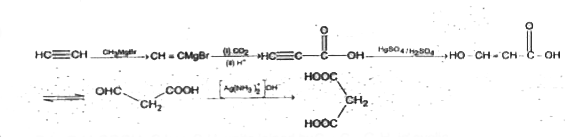 (b)B is `C_(3)H_(5)COOH` C has`C_(3)H_(5)`unitsjoinedby C = C, `C_(3)H_(5)`is cyclic(otherwiseit hasalso beenozonised ).  (ii)Boilingpointsof formicacid `(100.3^(@) C)`and water`(100^(@)C)`arealmostequal. |
|
| 33. |
(I) H_(2)S_(2)O_(5) (II) H_(2)SO_(5) (III) H_(2)S_(2)O_(6) Increasing order of number of pi-bonds in above compounds |
|
Answer» `I lt II lt III` `H_(2)SO_(5):HO-underset(O)underset(||)overset(O)overset(||)S-O-O-H" "`No. of `pi` bond = 2 `H_(2)S_(2)O_(6): HO-underset(O)underset(||)overset(O)overset(||)S-underset(O)underset(||)overset(O)overset(||)S-OH""`No. of `pi` bond = 4 |
|
| 34. |
{:("(i) Haber's process",(a) HNO_(3)),("(ii) Deacon's process",(b)" Ammonia"),("(iii) Contact process","(c ) Chlorine"),("(iv) Ostwald's process",(d) H_(2)SO_(4)):} |
| Answer» SOLUTION :(i) (b) (II) C (iii) d (IV) a | |
| 35. |
I. H_(2)S reduces acidified KMnO_(4) to MnSO_(4) II. H_(2)S reduces acidified K_(2)Cr_(2)O_(7) to red colour Cr_(2)(SO_(4))_(3) III. H_(2)S reduces nitric acid to NO_(2) IV. H_(2)S oxidises ferrous sulphate to ferric sulphate Then the correct statement(s) is/are: |
|
Answer» only I |
|
| 36. |
(i) H_(2)O_(2)+O_(3) rarr H_(2)O+2O_(2) (ii) H_(2)O_(2)+Ag_(2)O rarr 2 Ag +H_(2)O+O_(2) Role of hydrogen peroxide in the above reactions is respectively |
|
Answer» Reducing in (i) and (II) (ii) 
|
|
| 37. |
I. Graphene is an allotropic from of carbon II. CO is a strong reducing agent III. CO is a poisonous gas. IV. CO is used as a propellent |
|
Answer» I, II & III |
|
| 38. |
(i) Give two examples of macromolecules that are chosen as drug targets. (ii) What are antiseptics ? Give an example. (iii) Why is the use of aspartame limited to cold foods and soft drinks ? |
|
Answer» SOLUTION :(i) PROTEINS and carbohydrates. (II) Antiseptics are chemicals which either kill or prevent the growth of micro-organisms. Antiseptics are applied on living tissues such as wounds, cuts, ulcers and diseased skin SURFACES. Furacin and soframycin are examples of antiseptics. (iii) Use of aspartame is limited to cold foods and soft DRINKS because it is unstable at cooking temperatures. |
|
| 39. |
(i) Give three differences, between EMF andPotential difference. Calculate the electrode potential of a copper electrode dipped in 0.1 M CuSO_(4) solution at 25^(@)C. |
|
Answer» Solution :GIVEN that `E_(Cu^(2+)//Cu)^(@)=+0.34V` (i) 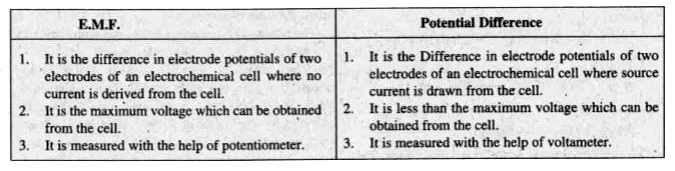 (II) `Cu^(2+)(aq)+2etoCu(s)` Nernst EQUATIONIS `E_(Cu)=E_(Cu)^(@)+(0.0591)/(2)log""[Cu^(2+)]` `=0.34+(0.0591)/(2)log(0.1)` `=0.34+(0.0591)/(2)log10^(-1)` `=0.34+(0.0591)/(2)(-1)` `=0.34-(0.0591)/(2)` `=0.34-0.0295` `E_(Cu)=0.3105V` |
|
| 40. |
(i) Give two examples of macromolecules that arechosen as drug targets. (ii) Wha are antiseptics? Give an example. (iii) Why is the use of aspartame limited to cold foods and soft drinks ? |
|
Answer» SOLUTION :(i) CARBOHYDRATES, lipids, proteins, enzymes, NUCLEIC acids (any two). (ii) Antiseptics are the chemical SUBSTANCES which are used to kill or prevent the growth of microbes, e.g., Dettol/lodoform/Boric acid/phenol (or any other correct example). (iii) Because it is unstable at cooking temperature. |
|
| 41. |
(i) Give the uses of argon. (ii) Discuss the Commercialmethod to prepare Nitric acid.[OR] How will you prepare nitric acid by Ostwald'sprocess ? |
|
Answer» |
|
| 42. |
(i) Give the mechanism for the reaction of acetyl chloride with ethyl alcohol. (ii) Give the mechanism for the Hofmann bromamide reaction. (iii) Give the mechanism of estrification (iv) Give the mechanism of basic hydrolysis of an ester. or Give the mechanism of saponification. (v) Give the mechanism of acid hydrolysis of an ester. |
Answer» SOLUTION :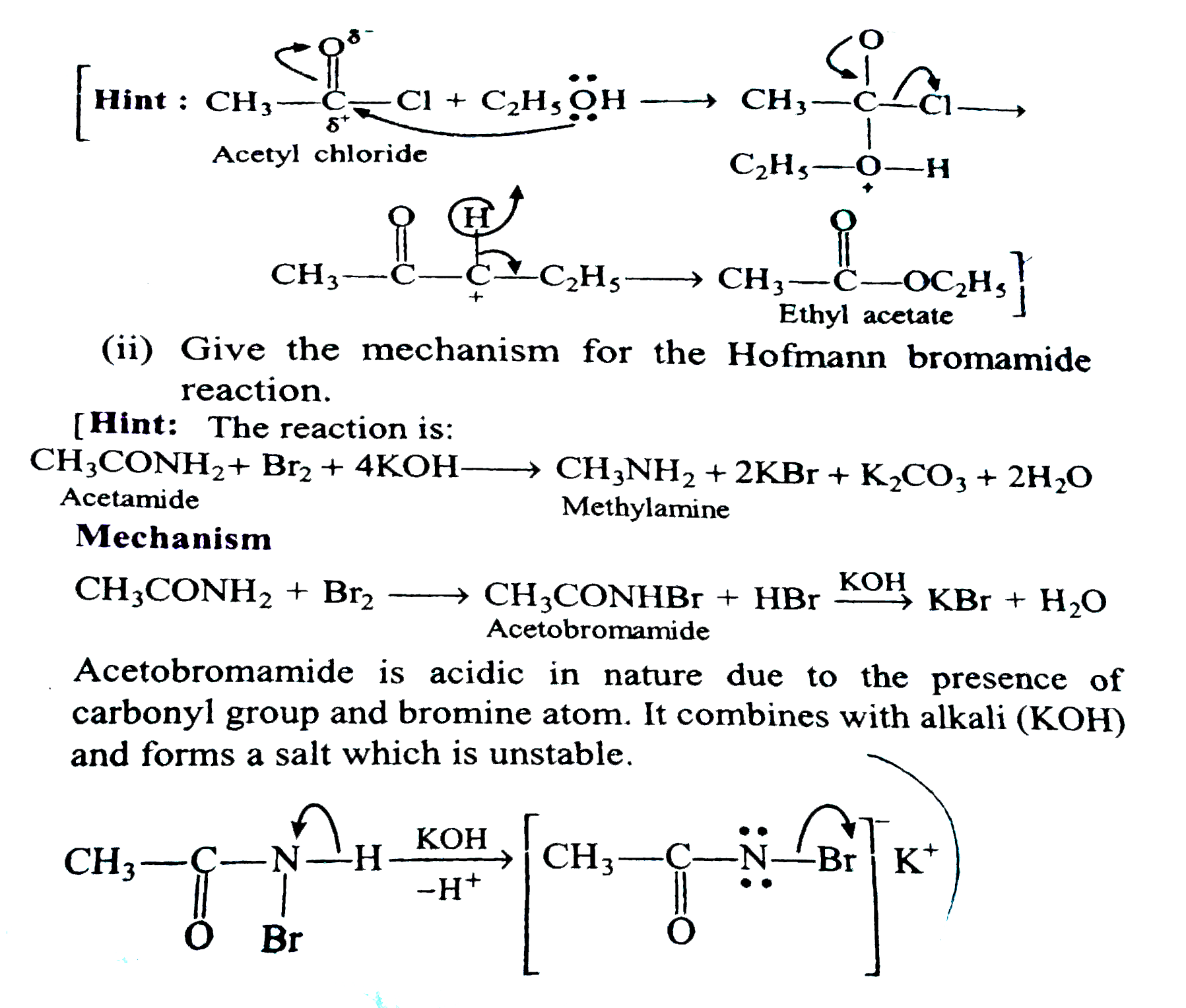 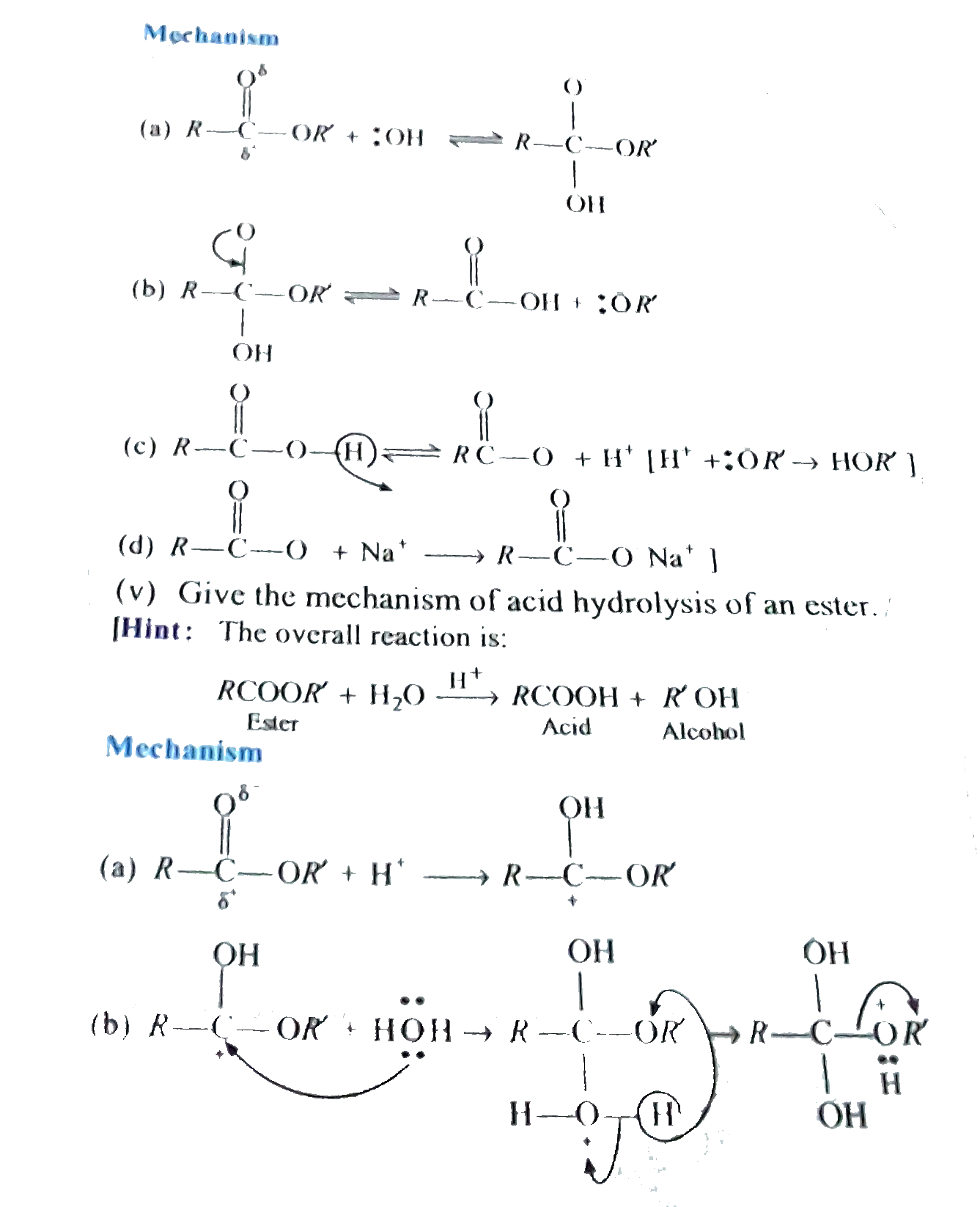 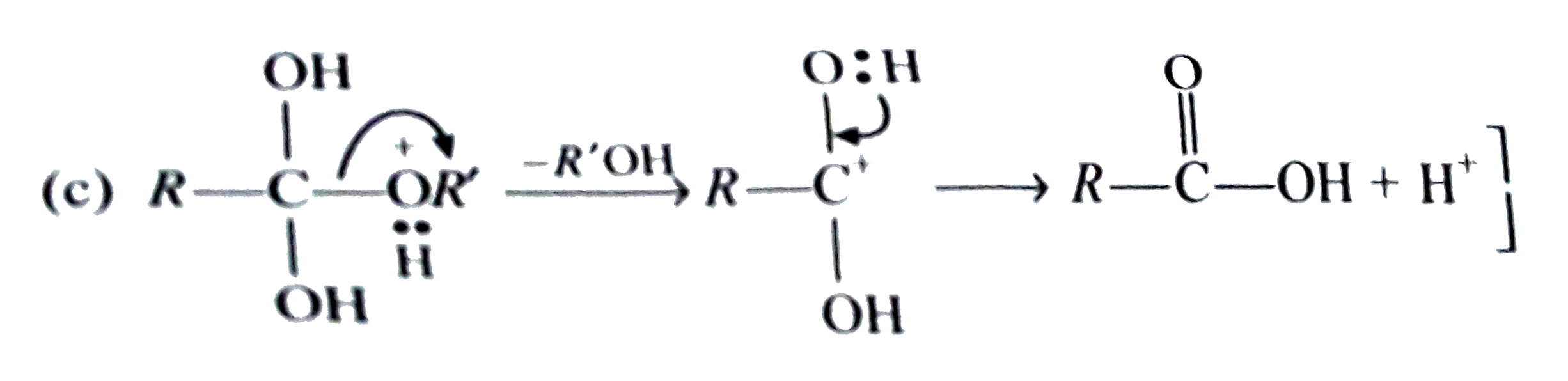
|
|
| 43. |
i) Give the IUPAC name of the product formed when tertiary butyl alcohol is passed over copper heated to 573 K. ii) Arrange the following in the increasing order of acidity and justify the same: (CH_(3))_(3)COH, CH_(3)OH, (CH_(3))_(2)CHOH |
|
Answer» Solution :i) Tertiary alcohols undergo delıydration to form corresponding alkene when passed over heated CU or Ag catalyst at 573 K `underset("t - butyl alcohol")(CH_(3)-overset(CH_(3))overset("|")underset(CH_(3))underset("|")"C "-OH)overset("Cu or Ag")rarrunderset("2 - methyl propene")(CH_(3)-overset(CH_(3))overset("|")"C "=CH_(2)+H_(2)O)` IUPAC name of the product formed is 2 methyl propene ii) `(CH_(3))_(3)C-OH lt (CH_(3))_(2) CH-OH lt CH_(3)OH` As the NUMBER of `CH_(3)` groups INCREASES, polarity of `O-H` bond decreases. |
|
| 44. |
(i) Give the possible reason for the relative reactivities when iodide ions in acetone solution reacts with MeBr, EtBr, iso-prBr and t-BuBr under condition where only the S_(N)2 mechanism operates. The relative reactivities were found to be 10,000: 65:0.50:0,0:039. (ii) In an S_(N)2) reaction there relative reactivities are not observed in S_(N)1 condition. |
|
Answer» Solution :In an `S_(N)2` reaction there are five groups attached to the carbon ATOM at which reaction occurs (transition state). Thus, there is crowding in the transition state, and bulkier the groups, the greater will be the compression energy and consequently the reaction will be hindered sterically. Thus from MeBr to t-BuBr the NUMBER of METHYL groups on the central carbon atom increases the steric retardation, therefore relative reactivities are observed. (II) In `S_(N)1` reaction, the INTERMEDIATE state does not contain more than four groups on the central atom, and hence one would expect steric hindrance to be less important in `S_(N)1`. If, however, the molecule contains bulky groups then by ionizing. The molecule can relieve the steric strains. Since the carbonium ion produced is flat (trigonal hybridization) and so there will be steric acceleration. |
|
| 45. |
(i) Give the balanced equation for the reaction between chlorine with cold NaOH. (ii) Nitrogen exists as diatomic molecule and Phosphrus as P_(4). Why ? |
|
Answer» Solution :(i) `Cl_(2) + H_(2) O rarr HCl + HOCl` `HCl + NAOH rarr NaCl + H_(2)O` `HOCl + NaOH rarr NAOCL + H_(2)O` Overall reaction, `Cl_(2) + underset(("cold"))(2NaOH) rarr underset(("Sodium hypochlorite"))(NaOCl) + underset(("Sodium chloride"))(NaCl + H_(2)O)` CHLORINE reacts with cold NaOH to give sodium chloride and sodium hypochlorite. (ii) Nitrogen has a trple bond between its two atoms because of its small size and high electronegativity. Phosphorus `P_(4)` has single bond, that is why it is tetra-atomic. |
|
| 46. |
(i) Give reasons : (a) HCHO is more reactive than CH_3-CHO towards addition of HCN . (b) pKa of O_2N-CH_2-COOH is lower than that of CH_3-COOH. (c) Alpha hydrogen of aldehydes and ketones is acidic in nature. (ii) Give simple chemical tests to distinguish between the following pairs of compounds : (a) Ethanal and Propanal (b) Pentan-2 one and Pentan-3-one |
|
Answer» Solution :(i)(a) In ethanl , the `(+)` ve charge on the CARBONYL carbon is lowerd by high `+I` effect of two alkyl groups in COMPARISON to methanol in which 2 hydrogens are present . Further increase in the no. of alkyl groups also increases the steric hindrance making it less reactive. Thus, in general, HCHO is more reactive than `CH_3CHO` towards ADDITION of nucleophile HCN. (b) `NO_2` is withdrawing group, which disperse the negative charge on carbonlate ion (decreases ELECTRON DENSITY) stabilize the carboxylate anion and thus, increases the acidity of carboxylic acid. Greater the acidic character, lower will be the pKa value. Hence, `O_2N-CH_2COOH` is having lower value of pKa than `CH_3COOH`. (c) `alpha`-hydrogen of aldehyde and ketone is attached to carbonyl carbon. After removal of `alpha`-Hydrogen, conjugated base so obtained is resonance Hence `alpha-H` in aldehyde and ketone is acidic in nature. (ii) `overset(|)underset(Theta)underset (..)(C)-overset(..)overset(O: )ChArr-overset(|)C=overset(-)overset( :O: )overset(|)(C)-` (ii) (a) Ethanal `(CH_2CHO)` and propanal `(CH_3CH_2CHO)` `CH_3CHO+l_(2)+NaOHoverset("Iodoform")underset("Reaction")to`no reaction (NO yellow ppt) (b) Penton -2-one pentan-3-one `underset("Penton-2-one")(C-C-C-overset(O)overset(||)C-C+l_2)+NaOHoverset("Iodoform")underset("Reaction")tounderset("Yellow ppt")(CHI_3)+CH_3CH_2CH_2-COONa+Nal+H_2O` `C-C-C-overset(O)overset(||)underset("Penton-2-one")(C-C+l_2+NaOH)overset("Iodoform")underset("Reaction")tounderset("No Yellow ppt")("No reaction")` |
|
| 47. |
(i) Give one structural difference between amylose and amylopectin. (ii) Name the protein and its shape present in oxygen carrier in human body. (iii) Name two fat storing tissues in human body. |
|
Answer» Solution :(i) Amylose and amylopectin are the constituents of STARCH. Amylose is a long unbranched CHAIN polymer of `alpha`-D(+) glucose. Amylopectin is a branched chain polymer of `alpha`-D-glucose. (ii) The protein present in oxygen carrier in human body is globular protein. Its shape is spherical. (iii) TWO fat STORING tissues in human body are liver and adipose tissue. |
|
| 48. |
(i) Give correct order of boiling point of hydride of group 17. (ii) Fluorine exhibits only -1 oxidation state whereas other halogens show +1, +3, +5 and +7 oxidation state also Explain. |
|
Answer» (ii) Fluorine being the most electronegativeelementcannot have positive OXIDATION STATE. Other halogens have d-orbitals,therefore can expand their octet. |
|
| 49. |
Give an example of a narcotic analgesic. |
| Answer» SOLUTION :i) Morphine/codeine is an EXAMPLE of a NARCOTIC ANALGESIC | |
| 50. |
I. Gas molecules move randomly without exerting reasonable forces on one another. II. Covalent solids are held together by weak vander waals forces. III. Molecules are held together by strong force of attraction. IV. Covalent solids are good thermal and electrical conductors. |
| Answer» Answer :D | |