

Saved Bookmarks
This section includes 7 InterviewSolutions, each offering curated multiple-choice questions to sharpen your Current Affairs knowledge and support exam preparation. Choose a topic below to get started.
| 1. |
I the electrochemical cell H_(2(g))1atm|H^(+)(1M)||Cu^(2+)(1M)|Cu_((s)) Which one of the following statements is true:- |
|
Answer» `H_(2)` is CATHODE, Cu is ANODE Cu is cathode because reduction takes place. |
|
| 2. |
I. The boron occurs mostly as borates. II. Boron does not react directly with hydrogen. III. The simplest borane is triborane. IV. Boron combines with halogen to form boron trihalides. |
|
Answer» Only I |
|
| 3. |
(i) tert-Butylamine cannot be prepared by the action of NH_(3) on tert-butyl bromide. Explain why? (ii) Suggest a convenient method for the preparation of tert-butylamine. |
Answer» Solution :(i) tert-Butyl bromide being a `3^(@)` alkyl halide on treatment with a base (i.e., `NH_(3)`) prefers to undergo elimination RATHER than substitution. THEREFORE, the product is isobutylene rather than tert-butylamine.  (ii) `1^(@)` amines containing tert-alkyl groups can be prepared by ACTION of SUITABLE Grignard reagents on O-metthylhydroxylamine. for EXAMPLE. 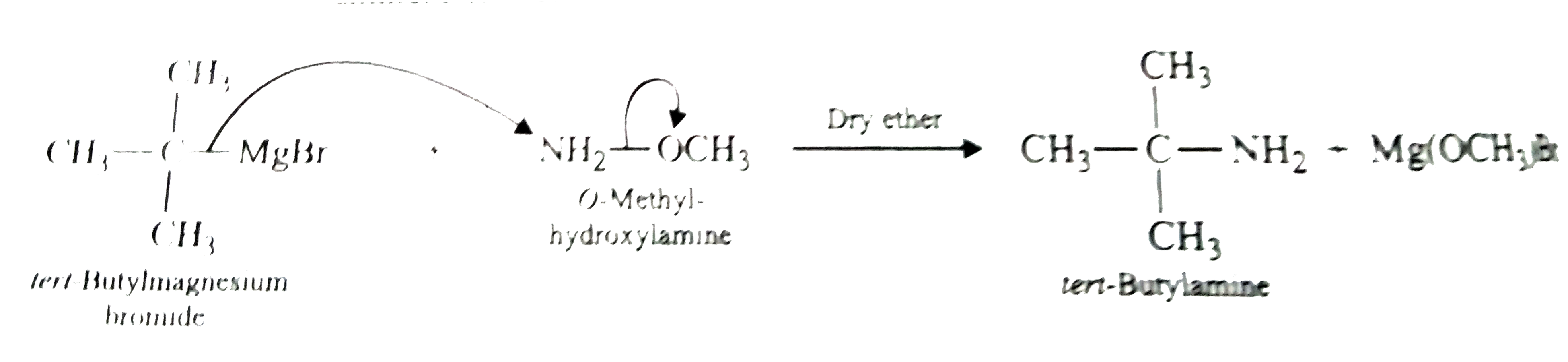
|
|
| 4. |
I. Synthesies the anti-oxidant food preservatives: a. b. II. Complete the following reactions: a. b. c.n mol of (C) + n mol of (F) rarr (G) (polymer) d. overset (PhOH) underset ((A)) + overset (3CH_(2)) underset ((B))=O overset (H^(o+)) rarr (C) overset (H_(2)//Ni) underset (Delta, pressure) rarr (D) e. |
Answer» SOLUTION :I. a. 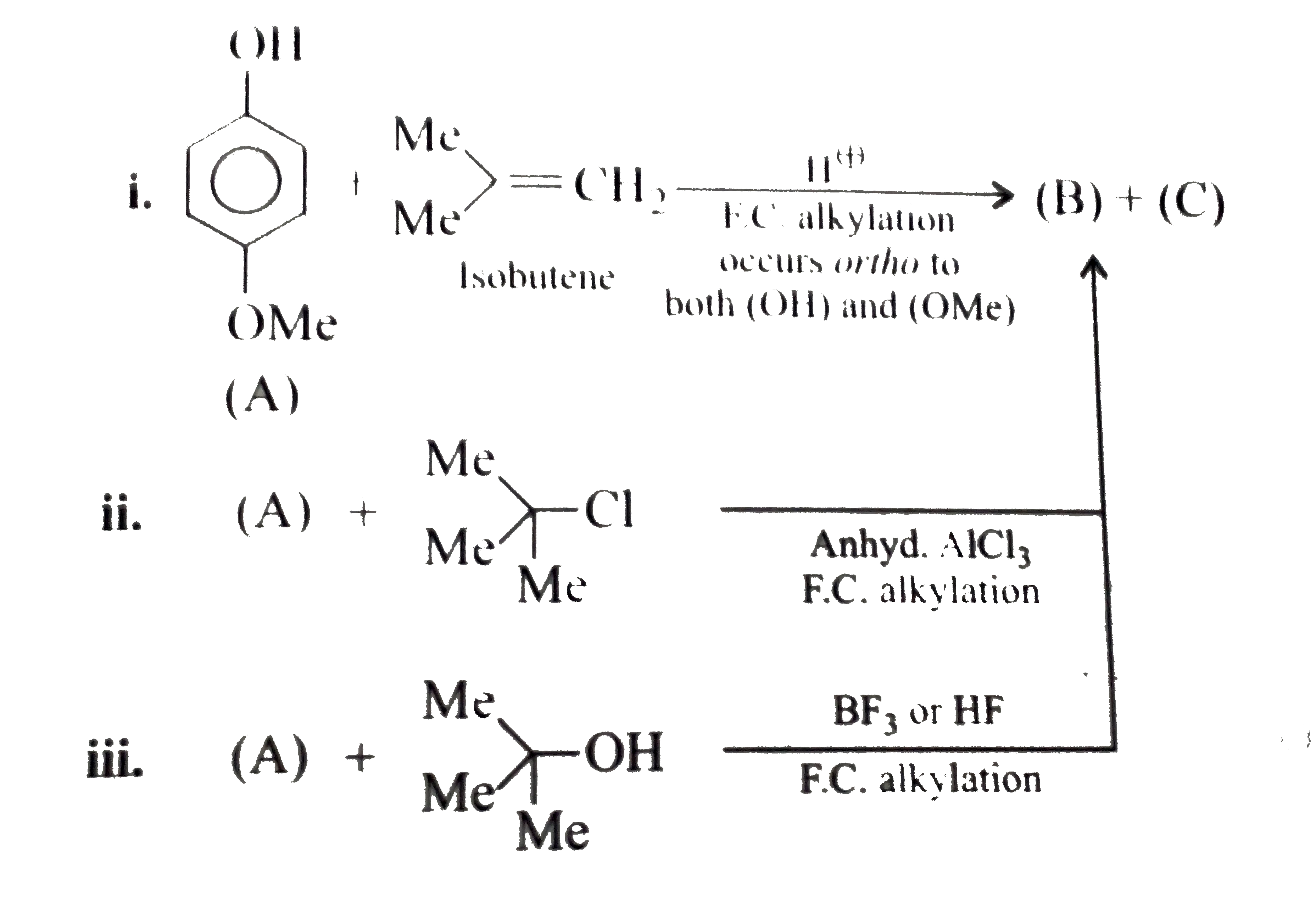 B. 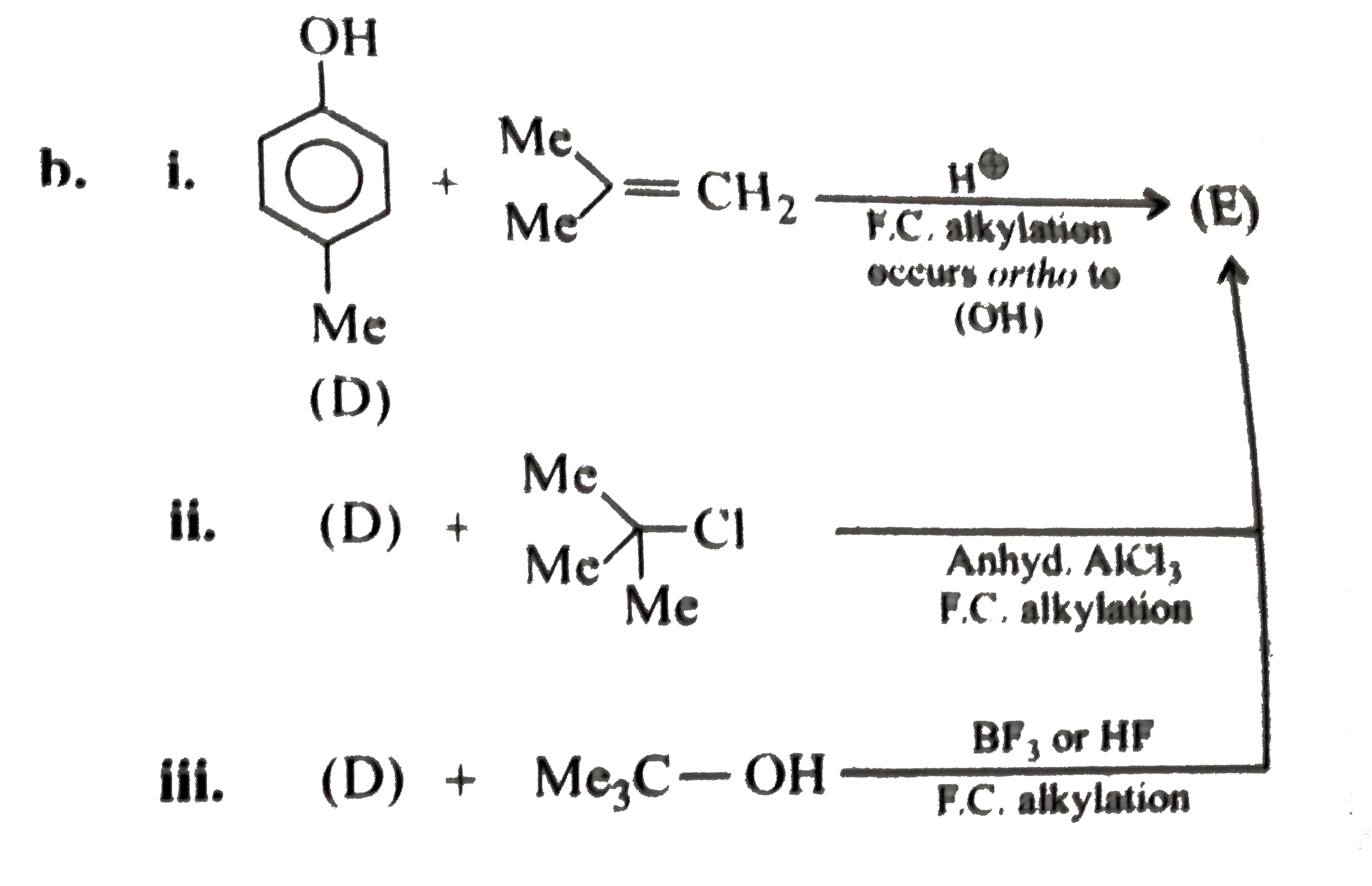 II. a. 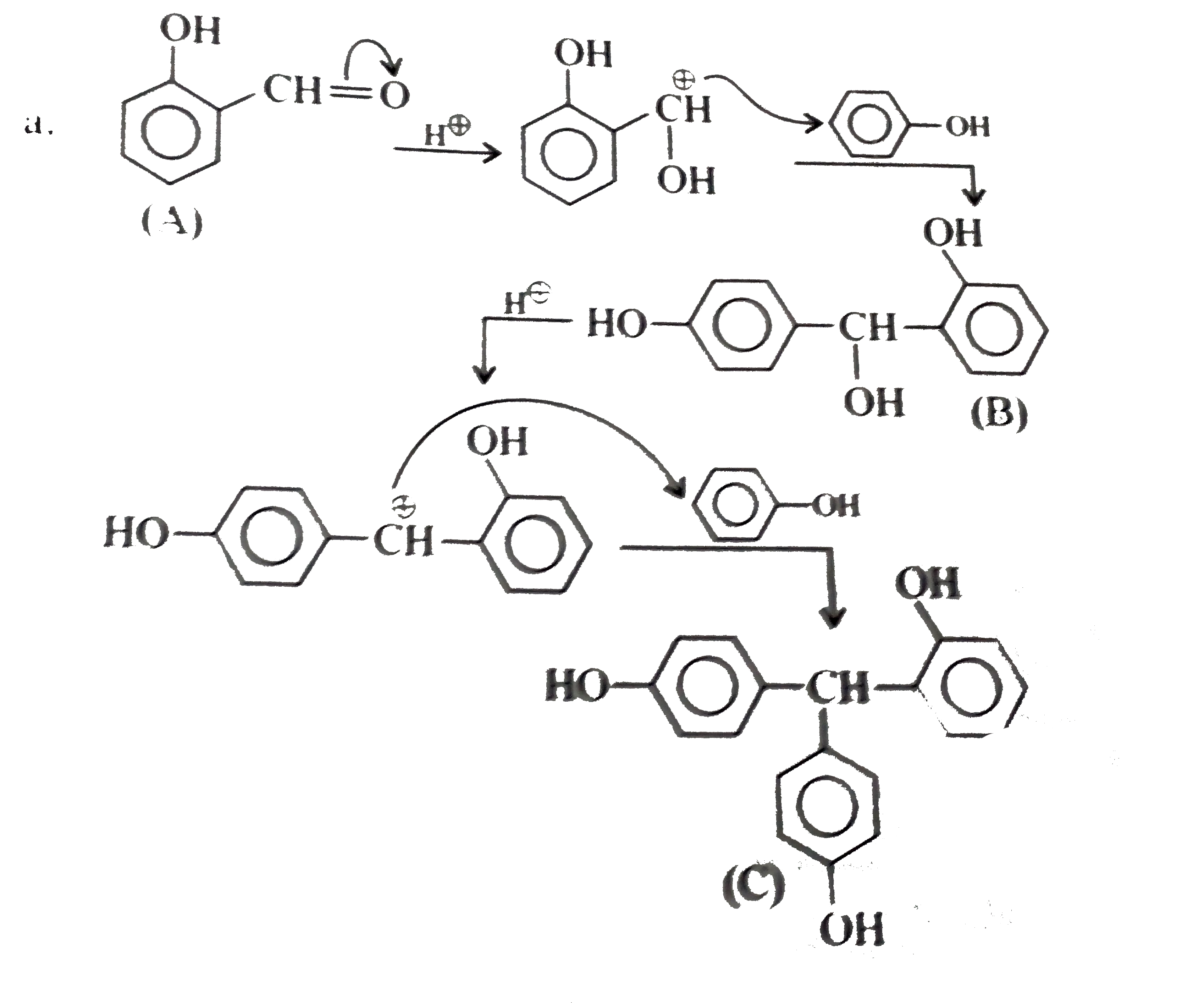 b. 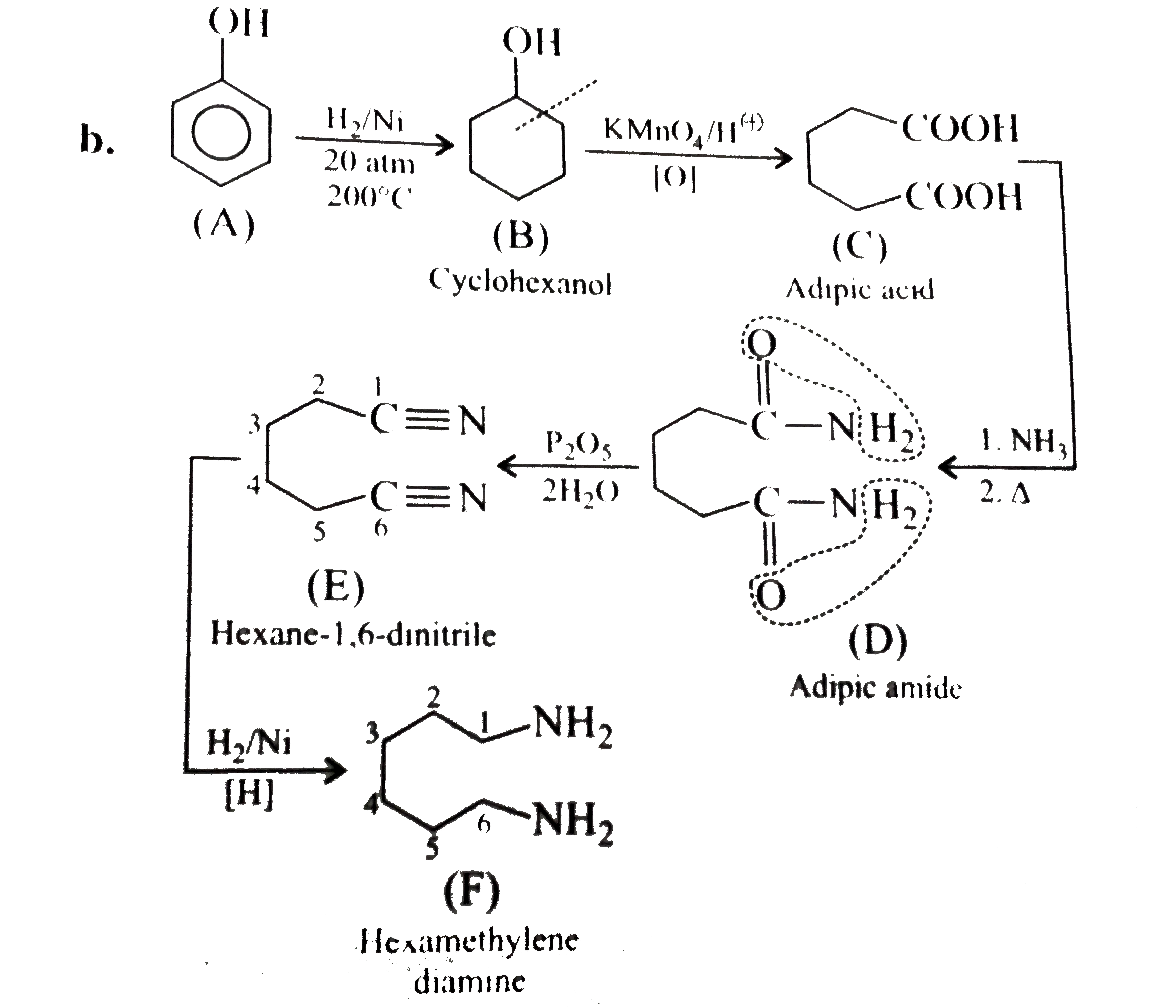 C.  d. 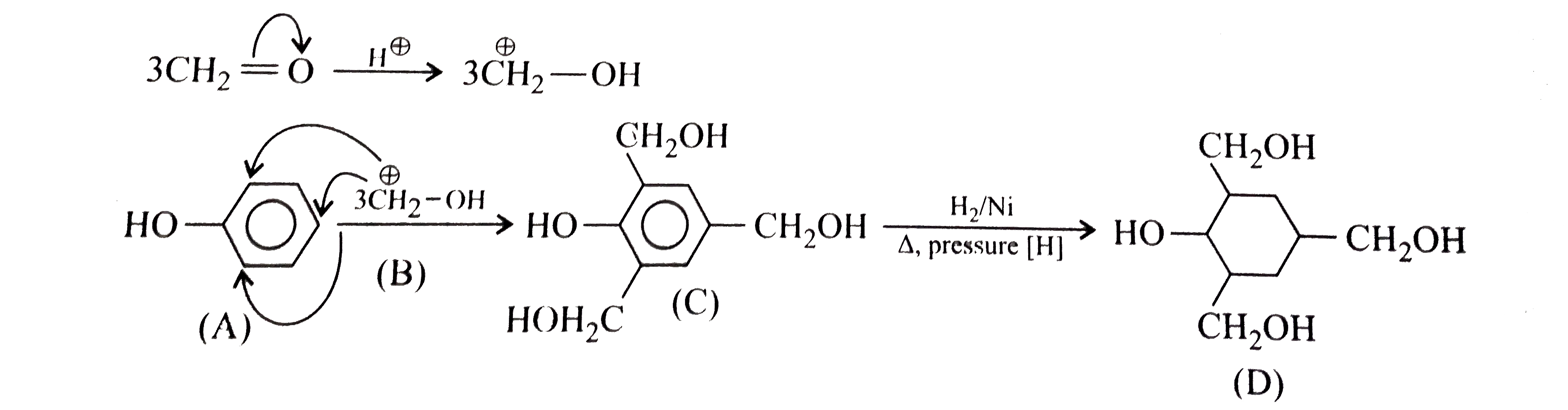 E. 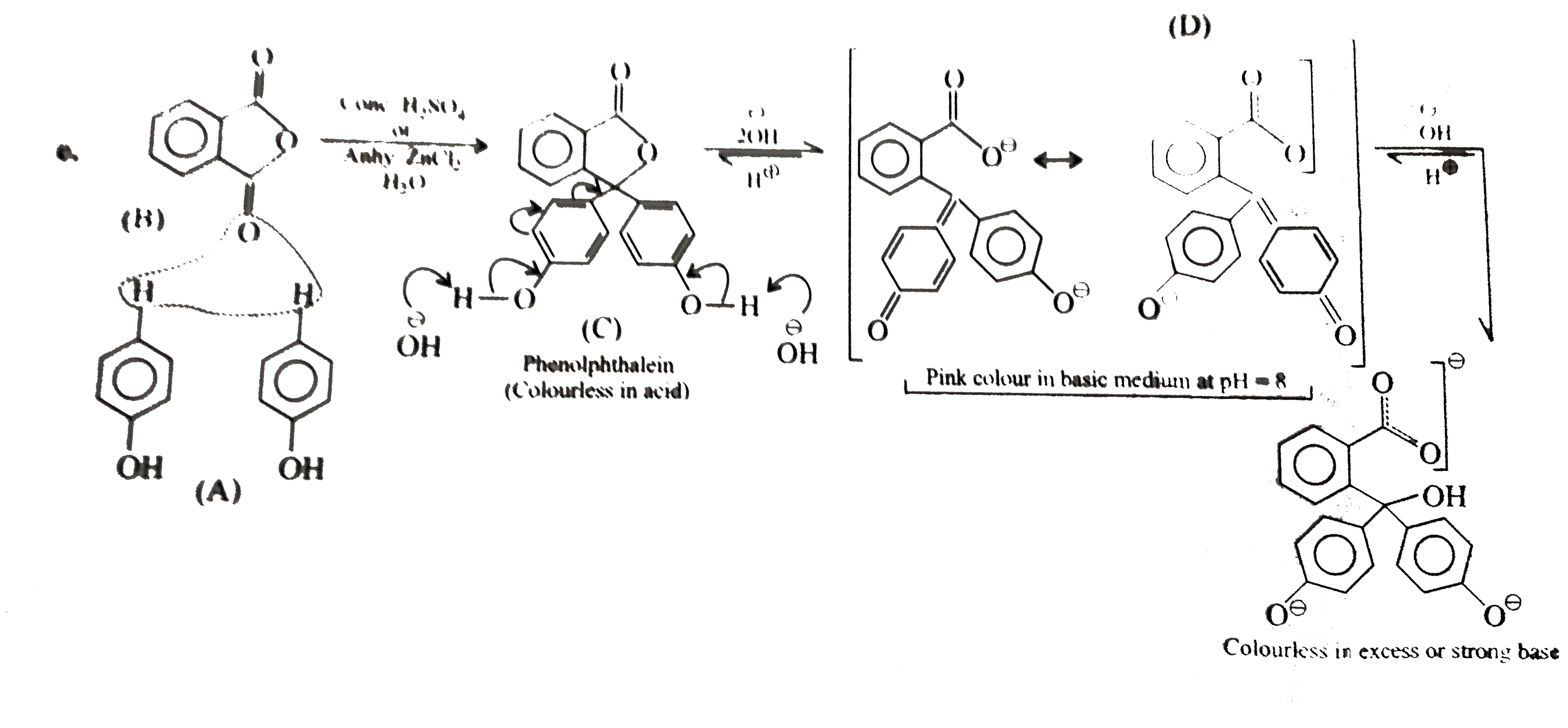
|
|
| 5. |
I : Tertiary amines do not form intermolecular hydrogen bonds II : All amines form H-bonds with water III : Amines are higher boiling than alcohols and carboxylic acids of comparable molecularweights |
|
Answer» I & II are wrong, III is RIGHT |
|
| 6. |
(i) State which compound has a faster rate of reaction with HCI. (ii) In the following pairs of halogen compounds which compound undergoes fasterS_(N^(1)) reaction ? (iii) Inthe following pairs of halogen compounds which compound undergoes faster S_(N^(2)) reaction with .^(-)OH ? (f) CH_(3) Br " or " CH_(3) I (g) (CH_(3))_(3) C-CI " or " CH_(3) CI |
Answer» SOLUTION :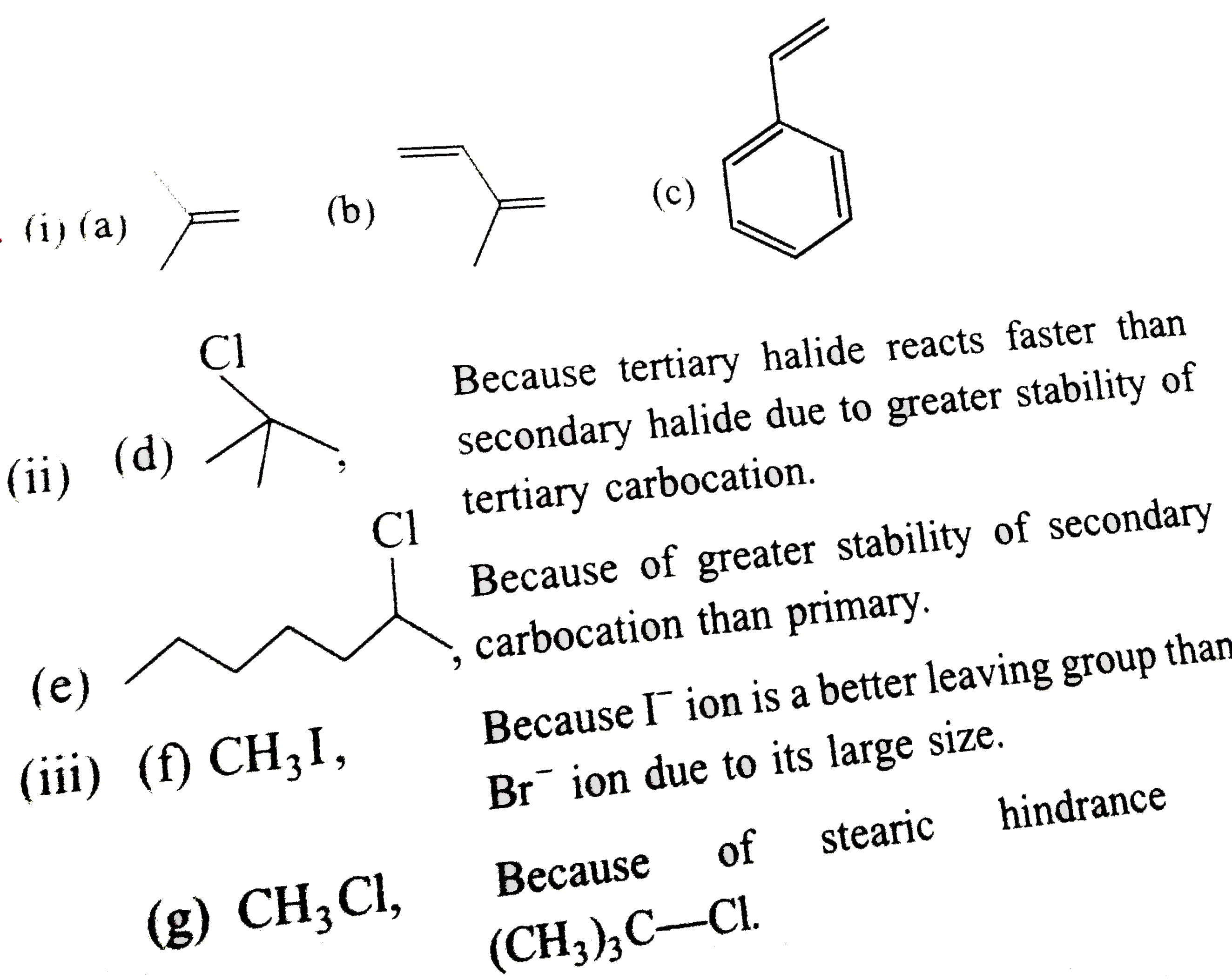
|
|
| 7. |
(i) State the relationship amongst cell constant of a cell, resistance of the solution in the cell and conductivity of the solution. How is molar conductivity of a solution related to conductivity of its solution ? (ii) A voltaic cell is set up at 25 °C with the following half cell, Al//Al^(3+) (0.001 M) and Ni//Ni^(2+) (0.50 M) Calcualte the cell voltage: [E_(ni^(2+)//Ni)^(@) =-0.25 V, E_(Al^(+)//Al)^(@) = -1.66 V] |
|
Answer» Solution : (i) Relation between CELL CONSTANT of a cell, resistance of the solution in the cell and conductivity of the solution is GIVEN by: `k =G/R` where K - Conductivity of the solution G* = Cell constant R = Resistance of the solution Relation between molar conductivity and conductivity is given by `Lambda_(m) = (1000 K)/C` where `Lambda_(m)` = Molar conductivity C = No. of moles (II) Electrode potentials for `Al^(3+)//Al` and `Ni^(2+)//Ni` electrodes are first calculated using Nernst equation : `E_(Ni^(2+)//Ni) =E_(Ni^(2+)//Ni)^(@) -0.0591/n log 1/0.50` `=-0.25 -0.0591/2 log 2` `=-0.25 -0.0089 =-0.2589` V `E_(Al^(3+)//Al)^(@) =E_(Al^(3+)//A)^(@) -0.0591/3 log 1/0.001` `=-1.66 V - 0.0591/3 log 1/0.001` `=-1.66 V - 0.0591/3 xx 3 = -1.7191` `E_("cell") =E_(Ni^(2+)//Ni) - E_(Al^(3+)//Al)` `=-0.2589 V -(-1.7191 V) = 1.4602 V` |
|
| 8. |
(i) State the first law of thermodynamics. As ideal gas of volume 6.0 L was made to expand at constant temperature and pressure of 2 atm by supplying heat. If the final volume of the gas was 12.0L, calculate the work done and the heat supplied in joule in the process. [1L*atm=101.3]. (ii) At 0^(@)C H_(2)O(s)hArrH_(2)O(g),DeltaH=51885J*mol^(-1) H_(2)O(l)hArrH_(2)O(g),DeltaH=45860J*mol^(-1) Calculate the change in entropy for the process, H_(2)O(s)toH_(2)O(l) at 0^(@)C. |
|
Answer» SOLUTION :(i) We know, `w=-P_(ex)(V_(2)-V_(1))` `therefore w=-2(12-6)L*atm=-12L*atm=-1215.6J` As the PROCESS is ISOTHERMAL and the system is an ideal GAS, `DeltaU=0` for this process according to the 1st law of thermodynamics, `DeltaU=q+w` `therefore 0=q-1215.6 or, q=+1215.6J` (ii) |
|
| 9. |
(i) Solutions of two electrolytes 'A' and 'B' are diluted. The limiting molar conductivity of 'B' increases 1.5 times while that of 'A' increases 25 times. Which of the two is a strong electrolyte ? Justify your answer. (ii) The products of electrolysis of aqueous NaCl at the respective electrodes are : Cathode: H_(2) Anode : Cl_(2)and not O_(2) . Explain. |
|
Answer» SOLUTION :(i) B is a strong electrolyte. A strong electrolyte is already dissociated into ions, but there are interionic forces of attraction. On dilution, these forces are overcome and the ions become free to move. So there is greater increase in MOLAR conductivity on dilution. (ii) WATER should get oxidised in preference to `Cl^(-)` , but DUE to OVERVOLTAGE or overpotential, `Cl^(-)`is oxidised in preference to water. |
|
| 10. |
i) State Henry's law. ii) Soda water bottles are sealed under high pressure. Give reason. |
|
Answer» SOLUTION :i) PARTIAL pressure of the gas in vapour phase is proportional to mole fraction of gas insolution at constant temperature. II) To increase the solubility of `CO_(2)`. |
|
| 11. |
(i) Sn + H_(2)O overset(Delta)(rarr) (ii) C_(s) + H_(2)O(g) overset(473 - 1273 K)(rarr) (iii) 2NaBH_(4) + I_(2) to (iv) 3B_(2)H_(6) + 6 NH_(3) overset(Delta)(rarr) Number of reactions in which H_(2(g)) is one of the product |
|
Answer» 1 |
|
| 12. |
(i) Sodium salt of an acid (A) is formed on boiling white phosphorus with NaOH solution. (ii) On passing chlorine through phosphorus kept fused under water, another acid (B) is formed. (iii) Phosphorus on treatment with concentrated HNO_(3) given an acid (C) which is also formed by the action of dilute H_(2)SO_(4) on powdered phosphorite rock. (iv) (A) on treatment with a solution of HgCl_(2) first gives a white precipitate of compound (D) and then a grey precipitate of (E). Identify (A) to (E) and write balanced chemical equation for the reactions at steps (i) to (iv) |
|
Answer» (i) `P_(4) + 3NaOH + 3H_(2)O rarr 3NaH_(2)PO_(2)` (sodium hypophosphite) `+ PH_(3)` Thus acid (A) is `H_(3)PO_(2)` i.e., hypophosphorus acid. (ii) `2P + 3Cl_(2) + 6H_(2)O rarr 2H_(3) PO_(3)` (phosporic acid) `+6HCl` Thus, acid (B) is `H_(3)PO_(3)` (III)`P_(4) + 20 HNO_(2) rarr 4H_(3) PO_(4) (C) + 20NO_(2) + 4H_(2)O` `P_(4) + 10H_(2)SO_(4) rarr 4H_(3)PO_(4) (C) ("phosporic acid") + 10 SO_(2) + 4H_(2)O` Thus, acid (C) is `H_(3)PO_(4)` (IV) `H_(3)PO_(2) + 2H_(2)O rarr H_(3)PO_(4) + 4H` `HgCl_(2) + 2H rarr Hg_(2) Cl_(2) (D) ("WHITE") + 2HCl , Hg_(2)Cl_(2) + 2H rarr 2Hg (E) ("grey") + 2HCl` |
|
| 13. |
{:("(i) Resistance","(a) Ohm m "),("(ii) Resistivity",(b) Sm^(-1)),("(iii) Conductance",(c )Ohm),("(iv) Specific conductance","(d) S"):} |
|
Answer» `{:(A,B,C,D),(a,b,c,d):}` |
|
| 14. |
(i) Reactions with low activation energy are fast, while those of high energy of activation are slow. (ii) The reaction rate almost doubles for each 10^(@)C rise in temperature although frequency does not change appreciably. (iii) Calculate the rate constant for the reaction having the activation energy 39.3kcal mol^(-1) (iv) Calculate the factor by which the rate of reaction is increased for a temperature rise of 10^(@)C from 25^(@)C to 35^(@)C. The energy of activation is 35kcal mol^(-1). Given , E_(a)=35xx10^(3)calmol^(-1) R=1.987cal, T_(2)=308K, T_(1)=298K |
|
Answer» SOLUTION :`(i)` Rate depends on rate constant and rate constant `=Ae^(-Ea//RT)`. Thus, if `E_(a)` is small, rate constant will have HIGHER value and thereby rate of reaction is more for low `E_(a)` value reactions. `(ii)` The reaction rate increase due to increase in energy of molecules which enables them to cross over the THRESHOLD energy barrier as well as an increase in collision rate. `(iii)` GIVEN , `A=1.11xx10^(11)sec^(-1)`, `R=1.987cal` `E_(a)=39.3xx10^(3)calmol^(-1)` `T=573K` `:. k=Ae^(-Ea//RT)` or `log_(10)k=log_(10)A-(E_(a)//2.303RT)` or `log_(10)k=log_(10)1.11xx10^(11)-(39.3xx10^(3))/(2.303xx1.987xx573)` `:.k=1.14xx10^(-4)sec^(-1)` `(iv) :.2.303log_(10).(k_(2))/(k_(1))=(35xx10^(3))/(1.987)[(308-298)/(308xx298)]` or `(k_(2)//k_(1))=6.812` or `k_(2)=6.812xxk_(1)` `:.r_(2)=6.812xxr_(1)` `(:. r_(2)//r_(1)=k_(2)//k_(1))` |
|
| 15. |
(I) R-COClunderset("Boiling xylene")overset(Pd//BaSO_(4))rarrR-CHO (II) R-CNunderset(HOH)overset(SnCl//HCl)rarrR-CHO Reaction (I) and (II) are ....... and ....... respectively. |
|
Answer» Oxo-PROCESS, Wacker's process |
|
| 16. |
I_ 2 readily dissolve in KI solution giving |
|
Answer» `I^-` |
|
| 17. |
I-propanol and 2-propanol can be best distinguished by : |
|
Answer» Oxidation with ALKALINE `KMnO_4` followed by reaction with fehling solution |
|
| 18. |
I. Potassium dichromate ore isconcentrated by gravityseparation. II. Concentratesulphuricacidis usedtoconvertsodiumchromateintosodiumdichromate. III. Potassiumdichromateemitstoxicchromiumfumesuponcooling . IV . It isused in quantiativeanalysisfor thhe estimation of ironcompounds adn iodides . |
|
Answer» I , II and IV only |
|
| 19. |
Select correct statements from the following: I. Potash alum is a white crystalline solid. II. It is soluble in water. III. It is used as a styptic agent IV. The aqueous solution is base. |
| Answer» Answer :D | |
| 20. |
(i) P("hydrocarbon")underset(H_(2)O)overset(O_(3)//Zn)rarr , , +CH_(2) = O, (ii) Q(C_(6)H_(10))underset(H_(2)O)overset(O_(3)//Zn)rarrHexane- 1,6-dial Write the structure of P and Q. |
|
Answer» |
|
| 21. |
(i) P+Cl_(2)overset(Delta)toQ (ii). Q+H_(2)OtoR+HCl (iii). BN+H_(2)OtoR+NH_(3)uarr (iv). Q=LiAlH_(4)toS+LiCl+AlCl_(3) (v). S+H_(2)OtoR+H_(2)uarr (vi). S+NaHtoT (P,Q,R,S, and T do not represents their chemical symbols) Q. Compound T is used as a/an: |
|
Answer» Oxidising agent `S=B_(2)H_(6),T=NaBH_(4)` |
|
| 22. |
(i) P+Cl_(2)overset(Delta)toQ (ii). Q+H_(2)OtoR+HCl (iii). BN+H_(2)OtoR+NH_(3)uarr (iv). Q=LiAlH_(4)toS+LiCl+AlCl_(3) (v). S+H_(2)OtoR+H_(2)uarr (vi). S+NaHtoT (P,Q,R,S, and T do not represents their chemical symbols) Q. Compound Q has: (i). zero dipole mament (ii) A planar trigonal structure (III) An electron deficient compound (IV) A Lewis base Choose the correct code: |
|
Answer» I,IV |
|
| 23. |
1-phenyl ethanol can be prepared from benzaldehyde by the action of: |
|
Answer» `CH_3Br` |
|
| 24. |
(i) P+C("carbon")+Cl_(2) to Q+CO uaarr (ii) Q+H_(2)O to R+HCl (iii) BN+H_(2)O to R+NH_(3) uarr (iv) Q+LiAlH_(4) to S+LiCl+AlCl_(3) (v) S+H_(2) to R+H_(2) uarr (vi) S+NaH to T (P,Q,R,S annd T do not represent their chemical symbols) Q. Compound S is: (I) an odd e^(-) compound (II) (2c-3e^(-)) compound (III) a electron deficient compound (IV) a sp^(2) hybridized compound Choose the correct code: |
|
Answer» III `(ii) underset((Q))(BCL_(3))+3H_(2)OtoH_(3)BO_(3)+3HCL` (iii) `BN+3H_(2)Otounderset((R))(H_(3)BO_(3))+NH_(3)` (iv) `underset ((Q))(4BCl_(3))+3LiAlH_(4)tounderset((S))(2B_(2)H_(6))+3LiCl+3AlCl_(3)` (v) `underset((S))(B_(2)H_(6))+6H_(2)Otounderset((R))(2H_(3)BO_(3))+6H_(2)uarr` (vi) `underset((S))(B_(2)H_(6))+2NaHtounderset((T))(2NaBH_(4))` |
|
| 25. |
(i) P+C("carbon")+Cl_(2) to Q+CO uaarr (ii) Q+H_(2)O to R+HCl (iii) BN+H_(2)O to R+NH_(3) uarr (iv) Q+LiAlH_(4) to S+LiCl+AlCl_(3) (v) S+H_(2) to R+H_(2) uarr (vi) S+NaH to T (P,Q,R,S annd T do not represent their chemical symbols) Q. Compound T is used as a/an: |
| Answer» Solution :`N//A` | |
| 26. |
I. Ores are associated with non-metallic impurities II. Ores are associated with rocky materials. III. Removal of impurities is known as concentration of ore. IV. Ellingham diagram shows the stability of different metal oxides. |
| Answer» Answer :A | |
| 27. |
{:("(i) Nitrogen sesquoxide",(a) H_(2)N_(2)O_(2)),("(ii) Nitrous oxide",(b) H_(4)N_(2)O_(4)),("(iii) Hyponitrous acid",(c )N_(2)O),("(iv) Hydronitrous acid",(d)N_(2)O_(3)):} |
| Answer» SOLUTION :(i) d (ii) C (III) a (iv) B | |
| 28. |
{:("(i) Nitric acid","(a) Purification of bone black"),("(ii) HCl","(b) Photography"),("(iii) White (yellow) phosphorous","(c ) Rotten fish smell"),("(iv) Phosphine","(d) Phosphorescence"):} |
| Answer» Solution :(i) B (II) a (III) d (IV) C | |
| 29. |
(i) Ni^(2+) is identified using alcoholic solution of dimethyl glyoxime. Write the structural formula for the rosy red precipitate of a complex formed in the reaction. Cu^(+), Zn^(2+), Sc^(3+), Ti^(4+) are colourless. Prove this statement. |
|
Answer» Solution :(i) `Ni^(2+)` ions present in Nickel chloride solution is estimated accurately for forminng an INSOLUBLE COMPLEX called `[Ni(DMG)_(2)]` Nickel ion reacts with alcoholic solution of DMG in the presence of ammonical MEDIUM, to give ROSY red precipitate of `[Ni(DMG)_(2)]` complex. 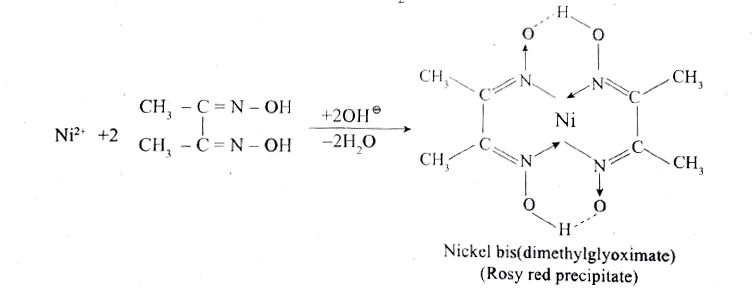 (ii) 1. `Cu^(+), Zn^(2+)"have d"^(10)` configuration and `Sc^(3+), Ti^(4+) "have d"^(1)` configuration. 2. d-d transitionn is not POSSIBLE in the above complexes. So they are colourless. |
|
| 30. |
I. Nitric acid is used in the preparation of aquaregia. II. Salts of nitric acid are used in photography. III. About 50% of earth atmosphere contains dinitrogen gas. IV. CO_(2) is the principle gas of atmosphere. |
|
Answer» I and II only |
|
| 31. |
(i) namethe transitionmetal (a ) Whichis usedin themanufacture of sulphuricacid. ( d )thatis usedin Haber'sprocess . (c )Thathave lightsensitivepropertiesand actas valuablesourcein photographicindustry. (ii) Writethe equationwhich are involvedin theoxidationof hydrogensulphide to sulphurby KMnO_(4) solution |
|
Answer» SOLUTION :(a )Vanadium (B ) Iron (c ) Silver (ii) `H_(2) S to2H^(+)+ S^(2-)` `[MnO_(4)^(0) + 8 H ^(+)+ 5 e^(-)to Mn^(2+)+ 4 H_(2) O] xx2 ` `[S^(2-)to S + 2E^(-)] xx 5` |
|
| 32. |
(i) Name the sweetening agent used in the preparation of sweets for a diabetic patient. (ii) What are antidepressant drugs ? Give one example. |
|
Answer» Solution :(i) Sucrolose is used in the PREPARATION of sweets for a diabetic patient because it is stable at the cooking temperature. (ii) Antidepresssant drugs are used to TREAT depression. These drugs inhibit the enzymes which CATALYSE the degradation of noradrenaline. For example, iproniazid, PHENELZINE. |
|
| 33. |
(i)Namethewaterinsoluble componentofstarch.(ii) Mentiononewatersolublevitamin. (iii) Islysineessentialornon -essentialaminoacid ? |
|
Answer» Solution : (i)Amylopectin (II) VITAMIN Borvitamin C (III)It isanessentialamino acid. |
|
| 34. |
(i) Name the reaction that is used to convert an amide into primary amine containing one carbon atom less than the parent. (ii) Name the product obtained when ethyl cyanide is treated with (a) alkaline hydrogen peroxide and (b) dilute hydrochloric acid. (iii) Write the position isomers of C_(3)H_(7)NO_(2). (iv) Name the compounds that are formed by heating [(CH_(3))_(4)NC_(2)H_(5)]^(+)OH^(-) (v) Name the compounds that are formed by heating [(CH_(3))_(4)N]^(+)OH^(-) (vi) Name the reaction used to convert primary amine into isocyanide. (vii) Name the reaction used to convert primary amine into isocyanide. (viii) Name the type of amine if it reacts with benzene sulphonyl chloride to form a solid soluble in alkali. (ix) Give the structure of A(C_(3)H_(9)N) if it reacts with benzene sulphonyl chloride to form a solid insoluble in alkali. (x) Primary amines are formed by the use of phthalimide. What is the name of the reaction? |
|
Answer» Solution :(i)HOFMANN's bromamide reaction (ii) `CH_(3)CH_(2)COOH("Propanamide")` `CH_(3)CH_(2)COOH("Propionic acid")` `(III)CH_(3)CH_(2)CH_(2)NO, CH_(3)-CH(NO)_(2)-CH_(3)` (iv) `(CH_(3))_(3)N, C_(2)H_(4)` `(CH_(3))_(3)N,CH_(3)OH` (vii) Carbylamine reaction (vii) `CH_(3)CH_(2)CH_(2)NH_(2),CH_(3)CH_(2)NHCH_(3),(CH_(3))N` (viii) Primary amine (x) GABRIEL's phthalimide reaction. |
|
| 35. |
(i) Name the hydrocarbon with lowest possible molar mass which has chiral structure. (ii) Name the lowest possible alkane which has chiral structure. |
Answer» SOLUTION :
|
|
| 36. |
(i) Name the method of refining to obtain silicon of high purity. (ii) What is the role of SiO_2 in the extraction of copper? (iii) What is the role of depressants in froth floatation process ? |
|
Answer» Solution :(i) Zone refining to obtain silicon of high purity. Zone melting is a group of similar methods of purifying crystals, in which a narrow region of a crystal is molten, and this molten zone is moved along the crystal and it is based on the priniciple that the impurities are more soluble in molten state than in the sqlid state of METAL. (ii) The sulphide ores of COPPER are heated in reverberatory FURNACE. If the ORE CONTAINS iron, it is mixed with silica before heating. Iron oxide "slags of" as iron silicate and copper is produced in the form 9f copper matte which contains `Cu_(2)S` anmd FeS. `FeO+SiO_(2)rarrunderset("(Slag)")(FeSiO_(3))` It is utilised for manufacturing `H_(2)SO_(4)`. (iii) Sometimes, it is possible to separate two sulphide ores by adjusting proportion of oil to water or by using" depressants". It selectively prevents ZnS from coming to the froth but allows PbS to come with the froth. |
|
| 37. |
(i) Namethe elementshowingmaximumnumberof oxidationstatesamongthefirstseriesof transitionmetalsfromSc(z=21) to Zn (Z=30) (ii) namethe elementwhichshowsonly+ 3oxidationstate . |
|
Answer» Solution :(i)MN (MANGANESE ) showthe maximum numberof OXIDATIONSTATE . (II)Scandiumshowonly +3oxidationstate |
|
| 38. |
(i) Name the element of 3d transition series which shows maximum number of oxidation states. Why does it show so? (ii) Which transition metal of 3d series has positive E^(@)(M^(2+)//M) value and why? (iii) Out of Cr^(3+) and Mn^(3+), which is a stronger oxidising agent and why? (iv) Name a member of the lanthanoid series which is well known to exhibit +2 oxidation state. (v) Complete the following equation : MnO_(4)^(-)+8H^(+)+5e^(-)to |
|
Answer» Solution :(i) Mn shows the maximum number of oxidation states, from +2 to +7. This is because it can lose or share maximum number of electrons `(3d^(5)4s^(2))`. (ii) Copper has the POSITIVE value for `E^(@)(M^(2+)//M)`. This is because the high energy to transform Cu (s) to `Cu^(2+)` is not balanced by its hydration energy. (iii) Out of `Cr^(3+)` and `Mn^(3+),Mn^(3+)` is a STRONGER OXIDISING agent. That is `Mn^(3+)` has a tendency to get reduced to `Mn^(2+)`. This is because `Mn^(3+)` has d-orbital configuration `3d^(4)` while `Mn^(2+)` has a more stable half-filled configuration `3d^(5)`. On the other HAND, `Cr^(3+)` has no tendency to act as oxidising agent. In other words, it has no tendency to change to `Cr^(2+).Cr^(3+)` has d-orbital configuration as `d^(3)`. These three electrons occupy the three `t_(2g)` orbitals (splitting of d-orbitals takes place). It is again half-filled stable configuration. Thus, `Cr^(3+)` has no tendency to act as oxidising agent. (iv) Sm and Eu EXHIBIT +2 oxidation state. (v) `MnO_(4)^(-)+8H^(+)+5e^(-)to Mn^(2+)+4H_(2)O` |
|
| 39. |
(i) Name the element of 3d-transition series which shows maximum number of oxidation states. Why does it show so? (ii) Which transition metal of 3d-series has positive E^0(M^(2+)//M) value and why? (iii) Out of Cr^(3+) and Mn^(3+) which is a stronger oxidizing agent andhy? (iv) Name a member of the lanthanoid series which is well known to exhibit + 2 oxidation state. (v) Complete the following equaton: MnO_(4)^(-) + 8H^(+) + 5e^(-) to |
|
Answer» Solution :(i) MN, because of presence of 5 unpaired electrons in 3d-subshell (ii) Cu, because ENTHALPY of atomization and ionisation enthalpy is not compensated by enthalpy. (iii) Mnt because `Mn^(2+)` is more STABLE due to its half filled (3d) configuration. (iv) `Eu^(2+) (Eu)` (v) `MnO_(4)^(-) + 8H^(+) + 5e^(-) + Mn^(2+) + 4H_2O`. |
|
| 40. |
(i) Name sweetening agent used in the prepration of sweets for a diabetic patient. (ii) What are antibiotics? Give an example. (iii) Give two examples of macromolecules that are chosen as drug targets. |
|
Answer» SOLUTION :(i) Sucralose (or any other) (ii) Antibiotics are the chemical SUBSTANCES that inhibit the growth or even destroy mico-orgnisms. EXAMPLE : OFLOXACIN, Chloramphenicol (or any other) (iii) CARBOHYDRATES, Lipids, proteins, enzymes, nucleic acid |
|
| 41. |
(i) Most aromatic acids are solids while acetic acid and others of this series are liquids. (ii) Explain why ketones are less reactive towards nucleophiles than aldehydes. |
|
Answer» Solution :(i) Aromatic acids have higher molecular weight. Therefore, they experience greater van der Waals. FORCE of attraction as compared to aliphatic acids. Therefore, aromatic acids are solids. (ii) Ketones are less reactive towards nucleophiles than aldehydes because in ketones there are two alkyl groups which decrease positive charge on carbonyl group due to electron repelling nature (electron RELEASING nature) whereas in aldehyde there is ONE alkyl group which is electron releasing. Also two alkyl groups in ketone offer more steric hindrance to the incoming NUCLEOPHILE. |
|
| 42. |
I mole of AI is deposited by X coulomb of electricity passing through aluminium nitrate solution. The number of mole of silver deposited by X coulomb of electricity from silver nitrate solution is : |
|
Answer» 3 |
|
| 43. |
I mol of [Ag]Ago^(o+) sol is coagulated by |
|
Answer» 1 MOL of `KL` |
|
| 44. |
I . Mixture ofTiCI_(4)and trialkyaluminiumis usedforpolymerization . IIAceticacidcan be preparedfrommacetaldehyde. III. Oxidationno of metalin metaloxidesranges from +3to +5 . IV. Oxidation no . Of metalin metaloxidesrangesfrom+ 2 to+7 . |
|
Answer» I, II , III and IV |
|
| 45. |
(i) Mention the principle behind the zone refining of metals. (ii) Which form of iron is the pures form of commercial iron ? |
| Answer» Solution :(i) The impurities are more soluble in MELT of METAL than in SOLID state of metal | |
| 46. |
(i) Mention any two reasons for the anomalous behaviour of oxygen. (ii) Write the balanced chemical equation for the action of concentrated sulphuric acid on copper metal. |
|
Answer» SOLUTION :(i) Small SIZE, Highelectro NEGATIVITY, Absence of d-orbitals, High ionization ENTHALPY. (II) `Cu + 2H_2SO_4 to CuSO_4 + SO_2 + 2H_2O` |
|
| 47. |
(i). Me-underset(OH)underset(|)(C)H-CH_(2)-OH underset(Delta)overset(HlO_(4))to (ii). Me_(2)underset(OH)underset(|)(C)-underset(OH)underset(|)(C)H-Et-underset(Delta)overset(HIO_(4))to (iii). (iv). HO-CH_(2)-CH_(2)-underset(OH)underset(|)(C)H-CH_(2)-OH underset(Delta)overset(HIO_(4))to (v). underset(OH)underset(|)(C)H_(2)-underset(OH)underset(|)(C)H-CH_(2)-CH-CH_(3)underset(Delta)overset(HIO_(4))to (vi). underset(OH)underset(|)(C)H_(2)-underset(OH)underset(|)(C)H-underset(OH)underset(|)(C)H-CH_(3)underset(Delta)overset(HIO_(4))to (vii). underset(OH)underset(|)(C)H_(2)-underset(OH)underset(|)(C)H-underset(OH)underset(|)(CH)-underset(OH)underset(|)(C)H_(2)underset(Delta)overset(HIO_(4))to (viii). Me-underset(O)underset(||)(C)-underset(OH)underset(|)(C)H-Meunderset(Delta)overset(HIO_(4))to (ix). Me-underset(O)underset(||)(C)-underset(O)underset(||)(C)-Meunderset(Delta)overset(HIO_(4))to. |
Answer» SOLUTION : . .
|
|
| 48. |
(i) Mention any two reasons for the anomalous behaviour of oxygen . . |
|
Answer» Solution :(i) Oxygen is a gas at room temperature while others are solids. (ii) Oxygen is diatomic while others are polyatomic . (iii) Oxygen formdrogen bonds while other ELEMENTS do not do so. (iv) Oxygen has a maximum covalency of four while other elements can SHOW a maximum of six . (ii) `CU +2H_(2)SO_(4)(CONC)to CUSO _(4)+SO_(2)uarr+2H_(2)O` |
|
| 49. |
{:("(i) Li-ion battery","(a) Pacemakers"),("(ii) Mercury button cell","(b) Fuel cell"),("(iii) Lead storage battery","(c ) Cell phone"),("(iv) "H_(2)-O_(2)" cell","(d) Inverter"):} |
|
Answer» `{:(A,B,C,D),(a,b,c,d):}` |
|
| 50. |
I L of N_(2)combines with 3 L of H_(2)to form 2 L of NH_(3)under the same conditions. This illustrates the |
|
Answer» LAW of constant composition |
|