

Saved Bookmarks
This section includes 7 InterviewSolutions, each offering curated multiple-choice questions to sharpen your Current Affairs knowledge and support exam preparation. Choose a topic below to get started.
| 1. |
(i) What would be the vapour pressure of a 0.5 molal solution of a non volatile solute in benzene at 30^(@)C . The vapour prssure of pure benzene at 30^(@)C is 119.6 torr. (ii) 4 g of non-volatile solute were dissolved in 250g of water. The depression in freezing point to be 0.87 K. Calculate the molaar mass of the slute .. For watr K_(f)=1.856K kg/mol. (iii) 0.50g of non-voltalie organic subtance was dissolved in 100 ml of carbon tetrachloride at 30^(@)C. The vapour pressure of the solution was found to be 171.9. torr. Calculate the molal mass of the substane. Vapour pressure of C Cl_(4) "at" 30^(@)C is 143.0 torr and its density is 1.58 g.ml. |
|
Answer» SOLUTION :`114.94`TORR (II) `341.3` (III) `M=63.3` |
|
| 2. |
(i) Whichforces are responsiblefor thestabilityof alpha - helix ? (ii) Whatisa denatured protein ? |
|
Answer» Solution :(i) H-bondingis responsiblefor stabilityof `ALPHA` - helix STRUCTURE . (ii) Thetertiary and secondary structure of proteinsarruptured whenit is subjected to heating, changein pH oradditionof electrolyte . Thisis known as denaturedprotein. |
|
| 3. |
What type of vacancy defect is shown by a crystal of sodium chloride? |
| Answer» Solution :i) SCHOTTKY defect is shown by a crystal of sodium chloride, because this defect is found in IONIC solids having SIMILAR size of cotions and ANIONS with high coordination NUMBER. | |
| 4. |
(i) What type of non-stoichiometric point defect is responsible for the pink colour of LiCl ? (ii) What type of stoichiometric defect is shown by NaCl ? |
|
Answer» SOLUTION :(i) Excess lithium makes LICL crystal pink. It is caused by METAL excess defect due to anionic VACANCIES (F-centres). (ii) NaCl shows SCHOTTKY defect. |
|
| 5. |
(i) What type of non-stoichiometric point defect is responsible for the pink colour of LiCI ? (ii) What type of stoichiometric defect is shown by NaCl ? |
|
Answer» Solution :(i) METAL EXCESS defect due to anionic VACANCIES is RESPONSIBLE for the PINK colour of LICI. (ii) NaCl shows stoichiometric defect in its crystals. |
|
| 6. |
(i) What type of isomerism is shown by the complex [Co(NH_(3))_(6)][Cr(CN)_(6)] (ii) Why a solution of [Ni(H_(2)O)_(6)]^(2+) is green while a solution of [Ni(CN)_(4)]^(2-) is colourless ? (At. No of Ni = 28) (iii) Write the IUPAC name of the following complex : [Co(NH_(3))_(5)(CO_(3))]Cl |
| Answer» Solution :(i) COORDINATION isomerism, (II) pentaammine carbonatocobalt (III) CHLORIDE | |
| 7. |
(i) What type of isomerism is shown by the complex [Cr(H_(2)O)_(6)]Cl_(3)? (ii) On the basis of crystal field theory, write the electronic configuration for d^(4) ion if Delta_(0)gtP. (iii) Write the hybridization and shape of [CoF_(6)]^(3-). (Atomic number of Co=27) |
|
Answer» SOLUTION :(i) Solvate Isomerism. (ii) `[Cr(H_(2)O)_(6)]Cl_(3)` Violet `[Cr(H_(2)O)_(5)CL]Cl_(2)-H_(2)O` (Blue green) `[Cr(H_(2)O)_(4)Cl_(2)]Cl. 2H_(2)O` Dark green (iii) `[CoF_(6)]^(3-)` is an outer orbital or HIGH spin complex involving `Sp^(3)d^(2)` hybridisation and octahedrol shape. |
|
| 8. |
(i) What type of isomerism is shown by the complex [Co(en)_(3)]Cl_(3) ? (ii) Write the hybridisation and magnetic character of [Co(C_(2)O_(4))_(3)]^(3-) (At. No. of Co = 27). (iii) Write IUPAC name of the complex [Cr(NH_(3))_(3)Cl_(3)] |
| Answer» Solution :(i) Optical isomerism, (II) `d^(2)sp^(3)` HYBRIDISATION (INNER orbital octahedral COMPLEX) Diamagnetic (in `Co^(3+)`, electrons pair up.) (iii) triamminetrichloridochromium (III)] | |
| 9. |
(i) What type of a battery is lead storage battery ? Write the anode and cathode reactions and the overall cell reaction occurring in the operation of a lead storage battery. (ii) Calculate the potential for half-cell containing: 0.10 M K_(2)Cr_(2)O_(7) (aq) , 0.20 M Cr^(3+) (aq)and 1.0 xx 10^(-4) M H^(+) (aq) The half-cell reaction is: Cr_(2)O_(7)^(2-) (aq) + 14H^(+)(aq) + 6e^(-) to 2Cr^(3+)(aq) + 7H_(2)O (l) and the standard electrode potential is given as E^(@) =1.33 V. |
|
Answer» SOLUTION : (i) Lead storage battery is a secondary cell. A secondary cell after use can be recharged by passing current through it in the opposite direction. It consists of a lead anode and a grid of lead packed with lead dioxide (`PbO_2`) as cathode. A 38% solution of sulphuric acid is used as an electrolyte. Reaction: Anode: `PB(s) + SO_(4)^(2-) (aq) to PbSO_(4) (s)+ 2e^(-)` Cathode: `PbO_(2)(s) + SO_(4)^(2-) (aq) + 4H^(+) (aq) + 2e^(-) to PbSO_(4) (s) + 2H_(2)O(l)` Overall reaction: `PbO_(2)(s) +SO_(4)^(2-) (aq) + 4H^(+) (aq)+ 2e^(-) to 2PbSO_(4) (s) + 2H_(2)O (l)` (ii) The relation between E and E° is given as under : `E =E^(@) -(RT)/(nF) ln ([C][D])/([A][B])` For the given reaction it can be written as: `E =E^(@) -(RT)/(nF) ln ([Cr^(3+)]^(2))/([Cr_(2)O_(7)^(2-)][H^(+)]` Substituting the values, we have `E = 1.33 -0.059/6 log ([0.2])^(2)/([0.1][1 xx 10^(-4)]^(14)) = 1.33 -0.059/6 log (0.2 xx 0.2)/(0.1 xx 10^(-56))` `=1.33 -0.55 = 0.78 V` |
|
| 10. |
(i) What type of hybridisation occur in 1. BrF_(5) 2. BrF_(3) (ii) Most of the transition metals act as catalyst. Justify this statement. |
|
Answer» Solution :(i) 1. `BrF_(5)` is a `AX_(5)` type. Therefore is has `sp^(3)d^(2)` hybridisation. Hence, `BrF_(5)` molecule has square pyramidal shape. 2. `BrF_(3)` is a `AX_(3)` type. Therefore it has `sp^(3)d` hybridisation. Hence, `BrF_(3)` molecule has T-shape. (ii) `*` Many industrial PROCESSES use TRANSITION metals or their compounds as catalysts. Transition metal has energetically available d orbitals that can accept electrons from reactant molecule or metal can form BOND with reactant molecule using its .d. electrons. `*` For example, in the catalytic hydrogenation of an alkene, the alkene BONDS to an active site by using its `pi` electrons with an empty d orbital of the catalyst. |
|
| 11. |
(i) What starting compound would you use in an aldol cyclization to prepare each o the following ? (ii) Identify the products of the following intramolecular aldol condensation reactions |
Answer» SOLUTION :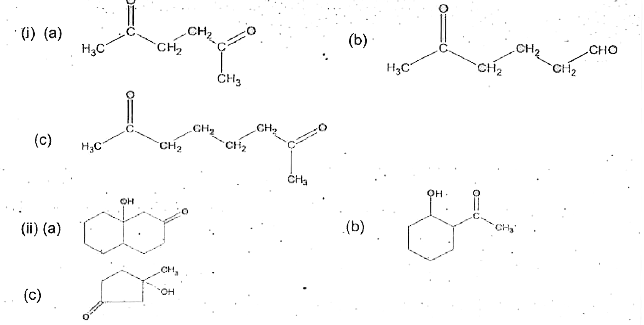
|
|
| 12. |
i) What is 'Tyndall effect'? ii) In the coagulation of negative sol, arrange the following ions in ascending orderof their flocculating power. Ba^(2+), Na^(+), Al^(3+) |
|
Answer» SOLUTION :i) SCATTERING of light by COLLOIDAL particles. ii) `NA^(+) lt Ba^(2+) lt Al^(3+)` |
|
| 13. |
(i) What is the two dimensional coordination number of a molecule in square close packed layer? (ii) Derive the integrated rate law for a first order reaction? |
Answer» Solution :(i) Square close packing : When the spheres of the second row are placed EXACTLY above those of the first row. This way the spheres are aligned horizontally as well as vertically. The ARRANGEMENT is AAA type. Coordination number is 4. 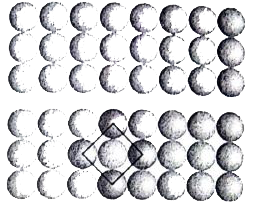 (ii) A reaction whose rate depends on the reactant CONCENTRATION raised to the first power is called a first order reaction. First order reaction is `A to` product Rate law can be expressed as, Rate `=k[A]^(1)` Where, k is the first order rate constant `(-d[A])/(DT)=k[A]^(1) rArr (-d[A])/([A])=k.dt "" ...(1)` Integrate the above equation (1) between the limits of time t = 0 and time equal to t, while the concentration varies from initial concentration `[A_(0)]` to [A] at the later time. `int_(A_(0))^(A) (-d[A])/([A])=k int_(0)^(t) dt` `-In[A]_(A_(0))^(A)=k(t)_(0)^(t)` `-In[A]-(-In[A_(0)])=k(t-0) rArr -In[A]+In[A_(0)]=kt` `In(([A_(0)])/([A]))=kt "" ...(2)` This equation (2) is in natural logarithm. To convert it into usual logarithm with base 10, we have to multiply the TERM by 2.303 `2.303 log(([A_(0)])/([A]))=kt rArr k=(2.303)/(t)log(([A_(0)])/([A]))""...(3)` |
|
| 14. |
(i) What is the total number of voids in cubic close-packed lattice? (ii) Metallic gold (Au) crystallises in face-centred cubic lattice. What is the number of unit cells in 2.0g of gold? [Au = 197] or, (i) What is a p-type semiconductor? (ii) A cubic crystal is made up of elements A and B. B is located at the corners of the unit cell and A is at the body-centre. What will be the probable formula of the compound? |
|
Answer» Solution :(i) In CUBIC close-packed lattice, the total number of voids equals to 12 per unit cell. (II) 197 G Au contains `6.022xx10^(23)` atoms. `THEREFORE" "2.0g` Au contains, `(2xx6.022xx10^(23))/197=6.144xx10^(21)` atoms In fcc lattice, there are 4 atoms per unit cell. `therefore6.114xx10^(21)` atoms consist `(6.114xx10^(21))/4=1.528xx10^(21)` unit cells. Therefore, `2.0`g Au consists `1.528xx10^(21)` unit cells of fcc lattice. (ii) B atoms are located at the corners of cubic unit cell. Therefore, number of B atom per unit cell = `8xx1/8=1` A atoms are located at the body-centre. Therefore, number of A atoms per unit cell = 1 Thus, the formula of the COMPOUND wil be AB. |
|
| 15. |
(i) What is the major product obtained when two moles of ethyl magnesium bromide is treated with methyl benzoate followed by acid hydrolysis. (ii) What are essential and non-essential amino acids? Give one example of each type. |
Answer» SOLUTION : 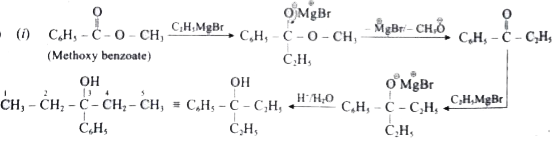 (ii) Essential AMINO acids: Amino acids which are not synthesised by the human body are CALLED essential amino acids. Example: Valine, Leucine. Non-essential amino acids: Amino acids which are synthesised by human body are called non-essential amino acids. Example: GLYCINE, ASPARTIC acid, etc. |
|
| 16. |
What is the role of aspartame in the food industry? |
|
Answer» Solution :The ROLE of aspartame in the food industry is i) It is USED as artificial sweetner/sweetning AGENT. |
|
| 17. |
(i) What is the difference between homogenous and heterogenouscatalysis ? (ii) What are emulsions ? What are their differenttypes ? Give one example of each type. |
|
Answer» |
|
| 18. |
(i) What is metamerism ? Give the structure and IUPAC name of metamers of 2-methoxy propane (ii) Explain the following reactions. 1. CH_(3)-CH_(2)OH overset("acidified")underset(Na_(2)Cr_(2)O_(7))to ? 2. CH_(3)-underset(OH)underset(|)(CH)-CH_(3) underset(Na_(2)Cr_(2)O_(7))overset("acidified")to ? 3. CH_(3)-CH_(2)-CH_(2)OH overset("PCC")to ? |
|
Answer» Solution :Metamerism: It is a special type of isomerism in which molecules with same formula, same functional group, but different only in the nature of the alkyl group attached to oxygen. 1. `CH_(3)-OVERSET(CH_(3))overset(|)(O)-CH-CH_(3)""-=2-"methoxy propane"` 2. `CH_(3)-CH_(2)-O-CH_(2)-CH_(3)""-="Ethoxy ethane"` 3. `CH_(3)-O-CH_(2)-CH_(2)-CH_(3)""-=1-"methoxy propane"` Ethoxy ethane and 1 -methoxy propane are metamers of 2-methoxy propane. (ii) 1. `CH_(3)-underset("ethanol")(CH_(2)-OH)overset("acidified "Na_(2)Cr_(2)O_(7))underset((O))to underset("ethanal")(CH_(3)-CHO)overset("acidified "Na_(2)Cr_(2)O_(7))underset((O))to underset("ethanoicacid")(CH_(3)-COOH)` 2. `underset("Propan-2-ol")(CH_(3)-underset(H)underset(|)(CH)-CH_(3))overset("acidified "Na_(2)Cr_(2)O_(7))underset((O))to underset("Propanal")(CH_(3)-underset(O)underset(||)(C)-CH_(3))overset("acidified "Na_(2)Cr_(2)O_(7))underset((O))to underset("ETHANOIC acid")(CH_(3)-underset(O)underset(||)(C)-OH)` 3. `underset("Propan-1-ol")(CH_(3)-CH_(2)-CH_(2))-OH overset("PCC")tounderset("Propanal")(CH_(3)-CH_(2))-CHO` |
|
| 19. |
(i) What is meant by the term "coordination number"? What is the coordination number of atoms in a bcc structure ? (ii) Rate constant k of a reaction varies with temperature T according to the following Arrhenius equation log K = "log A" (E_(a))/(2.303 R) ((1)/(T)) Where E_(a) is the activation energy. When a graph is plotted for log k Vs (1)/(T) a straight line with a slope of -4000 K is obtained. Calculate the activation energy. |
|
Answer» Solution :(i) 1. Let us consider the reaction between sodium hydroxide and acetic ACID to GIVE sodium acetate and water. `NaOH_((aq)) + CH_(3)COOH_((aq)) harr CH_(3)COONa_((aq)) + H_(2)O_((l))` 2. Coordination number of atoms in a bcc structure is 8 (ii) `log k = log A - (E_(a))/(2.303 R) ((1)/(T))` y = c + mx `m = - (E_(a))/(2.303 R)` `E_(a) = - 2.303 Rm` `E_(a) =- 2.303 xx 8.314 JK^(-1) MOL^(-1) xx (-4000 K)` `E_(a) = 76,589 J mol^(-1)` `E_(a) = 76.589 "kJ mol"^(-1)` |
|
| 20. |
(i) What is meant by the term 'coordination number' ? (ii) What is the coordination number of atoms : (a) in a cubic close-packed structure ? (b) in a body-centred cubic structure ? |
|
Answer» Solution :(i) The co-ordination number of atoms, ions or molecules in a crystalline solid is the number of the constituent PARTICLES PRESENT in the immediate SURROUNDINGS of the PARTICLE under consideration. (ii) (a) 12 (b) 8 |
|
| 21. |
(i) What is meant by the term 'coordination number ? (ii) What is the coordination number of atoms : (a) in a cubic close-packed structure ? (b) in a body-centred cubic structure ? |
|
Answer» Solution :(i) Coordination number of an atom is the number of ATOMS which are in immediate neighbourhood of that atom in the solid. In case of ionic solids, we CONSIDER the number of oppositely charged ions which are immediate NEIGHBOURS of a particular ion. (ii) Coordination number in : (a) CCP structure = 12 (b) bcc structure = 8. |
|
| 22. |
(i) What is meant by the term 'coordination number'? (ii) What is the coordination number of atom: (a) in a cubic close-packed structure (b) in a body-centred cubic structure? |
| Answer» Solution :(ii) (a) Coordination NUMBER of an atom in a CCP structure is 12, (b) in a BCC structure, coordination number is 8. | |
| 23. |
(i) What is buffer solution? Give an example for an acidic buffer and a basic buffer. (ii) The value of K_(sp) of two sparingy soluble salts Ni(OH)_(2) and AgCN are 2.0 times 10^(-15) " and "6 times 10^(-17) respectively. Which salt is more soluble? Explain. |
|
Answer» Solution :(i) 1. Buffer is a solution which consists of a mixture of weak ACID and its conjugate base (or) or a weak base and its conjugate acid. 2. This buffer solution RESISTS drastic changes in its pH upon addition of a small quantities of acids (or) bases and this ability is called buffer action. 3. Acidic buffer solution : Solution CONTAINING acetic acid and sodium acetate. BASIC buffer solution : Solution containing `NH_(4)O" and " NH_(4)Cl`. (ii) `AgCN iff Ag^(+)+CN^(-)` `K_(sp)=[Ag^(+)][CN^(-)]=6 times 10^(-17)` `Ni(OH)_(2) iff Ni^(2+)+2OH^(-)` `K_(sp)=[Ni^(2+)][OH^(-)]^(2)=2 times 10^(-15)` Let `[Ag^(+)]=S_(1), " then "[CN^(-)]=S_(1)` Let `[Ni^(2+)]=S_(2), " then "[OH^(-)]=2S_(2)` `S^(2)""_(1)=6 times 10^(-17), S_(1)=7.8 times 10^(-9)` `(S_(2))(2S_(2))^(2)=10^(-15), S_(2)=0.58 times 10^(-4)` `Ni(OH)_(2)` is more soluble than AgCN. |
|
| 24. |
i) What is denaturation of protein? ii) Give an example of acidic amino acid. |
|
Answer» Solution :i) The loss of physical and biological ACTIVITY of proteins without affecting the CHEMICAL COMPOSITION by the action of CERTAIN denaturing agents like heat, acid, alkali....etc. is CALLED as denaturation of proteins. ii) Aspartic acid. |
|
| 25. |
(i) What is Clemmensen reduction? Explain it. (ii) Write the structure of the major product of the aldol condensation of benzaldehyde with acetone. |
|
Answer» Solution :(i) Aldehyde and ketones when heated with zinc amalgam and concentrated hydrochloric ACID give hydrocarbons. This reaction is known as Clemmensen REDUCTION. `underset("Acetaldehyde")(CH_(3)-underset(O)underset(||)C-H+4[H]) underset("Conc HCl")overset(Zn+Hg) to underset("Ethane")(CH_(3)-CH_(3)+H_(2)O)` (ii) Aldol condensation of BENZALDEHYDE with acetone: STEP 1: 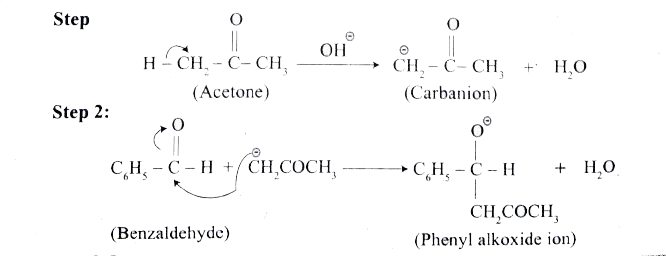 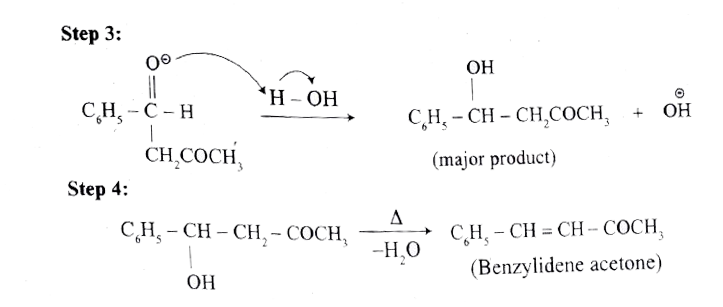 Step 4: `C_(6)H_(5)-underset(OH)underset(|)(CH)-CH_(2)_COCH_(3) underset(-H_(2)O) overset(Delta)to underset(("Benzylidene acetone"))(C_(6)H_(5)-CH=CH-COCH_(3))` |
|
| 26. |
(i) What is an elementary reaction ? Give the differences between order and molecularity of a reaction. (ii) In a first order reaction A to products, 60% of the given sample of A decomposes in 40 min. what is the half life of the reaction ? |
|
Answer» Solution :(i) Elementary REACTION: Each and every single step in a reaction mechanism is called an elementary reaction. DIFFERENCES between order and molecularity : 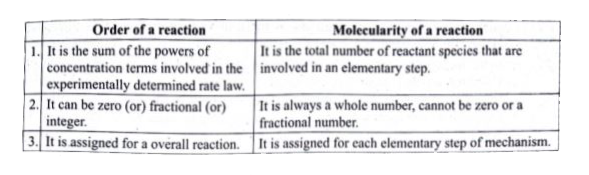 (ii) SOL. `k=(2.303)/(t)log""(a)/(a-x)` `k=(2.303)/(40" min")log""(100)/((100-60))iff k=(2.303)/(40)log((100)/(40))` `k=0.0575(0.3979)iff k=0.02287" min"^(-1)` `t_((1)/(2))=30.31" min"`. |
|
| 27. |
(i) What is actinide contraction?(ii) Which is the common oxidation state exhibited by actinides? |
|
Answer» SOLUTION :(i) The steady decrease in ATOMIC SIZE of the actinides with increases in the atomic number. (ii) `+3` |
|
| 28. |
(i) What happens when potassium chlorate is heated in presence of MnO_(2), write the equation for the reactions also.(ii) Draw the structure of sulphuric acid. |
|
Answer» Solution :(i) Potassium chlorate heated with `MnO_(2)` at 623 K to give potassium chloride and oxygen. `2KClO_(3)OVERSET(MnO_(2))UNDERSET(Delta)RARR 2KCl+3O_(2)` (ii) 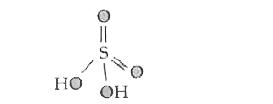
|
|
| 29. |
(i) What happens when m-cresol is treated with acidic solution of sodium dichromate? (ii) Formic acid is more stronger than acetic acid. Justify this statement. |
Answer» Solution :(i) When m-cresol is treated with ACIDICSOLUTION of sodium DICHROMATE it gives 4-hydroxy benzoic acid. 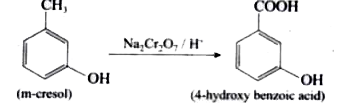 The electron releasing groups (+I groups) increase the relative charge on the carboxylate ion and destabilise it and hence the loss of protonbecomes difficult. `+I` groups are `CH_(3), -C_(2)H_(5), -C_(3)H_(7)` `underset("Formic acid")(H-overset(overset(O)(||))(C)-OH)>underset("ACETIC acid")(CH_(3)-overset(overset(O)(||))(C)-OH)>underset("Propionic acid")(CH_(3)-CH_(2)-COOH)` |
|
| 30. |
(i) What class of drug is Ranitidine ? (ii) If water contains dissolved Ca^(2+) ions, out of soaps and synthetic detergents, which will you use for cleaning clothes ? (iii) Which of the following is an antiseptic ? 0.2% phenol, 1% phenol |
|
Answer» SOLUTION :(i) Ranitidine is an antihistamine. (ii) We shall USE synthetic detergent for cleaning CLOTHES if the water contains `Ca^(2+)` ions. This is because `Ca^(2+ )` ions REACT with soap to FORM scum. (iii) `0.2%` phenol solution is an antiseptic. |
|
| 31. |
(i) What happens when H_2S is passed into potassium dichromate in acidic medium ? Give the equation. (ii) What is the composition of chromite ore ? |
|
Answer» Solution :(i) `H_2S` gets OXIDIZED to sulphur `Cr_2O_(7)^(2-) + 14H + 6E to 2Cr^(+3) + 7H_2O` `3H_2S to 6H^(+) + 3S + 6e^(-) ` (II) `FeCr_2O_4`. |
|
| 32. |
(i) What class of drug is Ranitidine? (ii) If water contains dissolved Ca^(2+) ions, out of soaps and synthetic detergents, which will you use for cleaning clothes? (iii) Which of the following is an antisepctic? 0.2% phenol, 1% phenol. |
|
Answer» Solution :(i) It is an ANTACID. (ii) In this case we use synthetic DETERGENTS because it give FOAM with hard water. (III) 0.2% solution of PHENOL acts as antiseptic. |
|
| 33. |
(i) What class of drug is ranitidine ? (ii) If water contains dissolved Ca^(2+) ions, out of soaps and synthetic detergents, which will you use for cleaning clothes ? (iii) Which of the following is an antiseptic? 0.2% phenol, 1% phenol. |
|
Answer» Solution :(i) It is an antacid and helps in REMOVING acidity of stomach. (ii) As the water contain `Ca^(2+)` ions, therefore it is hard water. Hence synthetic detergents are preferred over the SOAPS for cleaning the clothes because calcium salts of detergents are soluble in water while calcium salts of soap are INSOLUBLE. As a result, lot of soap is wasted. (iii) 0.2% solution of phenol is used as an antiseptic where as 1% solution of phenol acts as a disinfectant. |
|
| 34. |
(i) What are tranquililzers? .(ii)Name the first popular artificial sweetening agent . |
|
Answer» SOLUTION :i) Tranquilizers are the chemical compounds USED for the treatment of STRESS and SEVERE mental DISEASE. ii) Saccharin |
|
| 35. |
(i) What are the biological importance of proteins? (ii) Name one substance which can act as both analgesic and antipyretic. |
|
Answer» Solution :(i) Proteins are the functional units of living THINGS play vital role in all biological processes * All biochemical reactions occur in the living systems are catalysed by the catalytic proteins called enzymes. * Proteins such as KERATIN, collagen acts as structural BACK bones. * Proteins are used for transporting molecules (Haemoglobin), organelles (Kinesins) in the cell and control the movement of molecules in and out of the cells (Transporters). * Antibodies help the body to fight various diseases. * Proteins are used as messengers to coordinate many functions. Insulin & glucagon controls the glucose level in the blood. * Proteins act as receptors that detect presence of certain signal molecules and activate the PROPER response. * Proteins are also used to store metals such as iron (Ferritin) ETC. (ii) Aspirin (acetylsalicylic acid) is a chemical substance which lowers body temperature (to normal) and also reduces body pain. Therefore it acts as both antipyretic and analgesic. |
|
| 36. |
(i) What are the uses of nitrobenzene ? (ii) Write a note on formation of -helix. |
|
Answer» Solution :(i) 1. Nitro benzene is used to produce LUBRICATING oils in motors and machinery. 2. It is used in the manufacture of dyes, drugs, pesticides, synthelic rubber, aniline and explosives like TNT, TNB. (ii) 1. In the `alpha`-helix sub-structure, the aminoacids are arranged in a right handed helical (spiral) structure and are stabilised by the hydrogen bond between the carbonyl oxygen one aminoacid (`n^(th)` residue) with amino hydrogen of the fifth residue (n + `4^(th)` residue). 2. The side chains of the residues protrude outside of th helix. Each turn of an `alpha`-helix contains about 3.6 residues and is about 5.4 `Å` LONG. 3. The amino acid proline produces a line in the helical structure and often called as a helical BREAKER due to its rigid cyclic structure. 4. Many fibrous proteins such as `alpha`-Keratin in hair, nails, WOOL, skin and myosin in muscles have `alpha`-helix structure. Stretching PROPERTY of human hair is dure to the helical structure of `alpha`-keratin in hair. 5. Structure of `alpha`-helix. 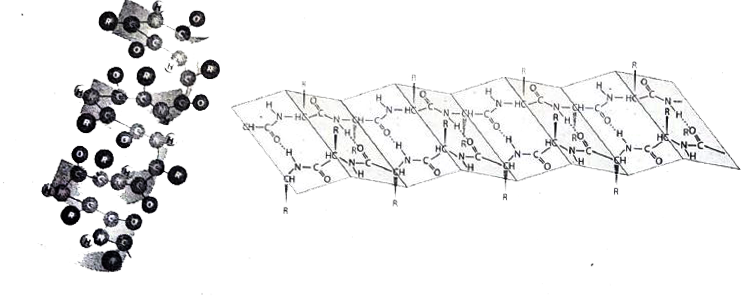
|
|
| 37. |
(i) What are non - essential amino acids ? (ii) Write zwitterionic structure of"glycine " |
|
Answer» Solution :Amino ACIDS which the body can synthesize are called non-esential amino acids. For example, glycine,a cysteni,etc, Therfore they MAY not be PRESENT in DIET. (ii) `NH3- CH3-COO-` |
|
| 38. |
(i) What are lyophilic and lyophobic sols ? Give one example of each type. Why are hydrophobic sols easily coagulated ? (ii) What is meant by catalyst poison ? |
|
Answer» Solution :(i) Lyophilic SOLS : Colloidal sols directly formed by mixing substances like gums, gelatin, starch, rubber, etc. with a suitable liquid (The dispersion medium) are lyophilic sols. An important characteristic of these sols is that if the dispersion medium is separated from the dispersed phase (say by evaporation) the sol can be reconstituted by simply remixin with the dispersion medium. That is why these sols are also called REVERSIBLE sols. These sols are quite stable and cannot be easily coagulated. Lyophobic sols : These colloidal sols can only be prepared by some special methods. These sols are readily precipitated on the addition of small amount of electrolytes, by heating or by shaking and hence are not stable. Hydrophobic sols are water hating. They are formed by indirect method. These sols are irreversible sols. These sols are readily precipitated by the addition of small amount of electrolytes, by heating or by shaking and hence are not stable. (II) 1. The substanes when added to a cataysed reaction decreases or completely destroys the activity of a catalyst are often known as catalytic posions. 2. In the reaction `2SO_(2) + O_(2) RARR 2SO_(3)` with Pt catalyst, the catalyst posison is `AS_(2)O_(3)`. |
|
| 39. |
(i) What are interstial compounds?(ii) Transition metals show good catalytic property. Give any two reasons. |
|
Answer» Solution :(i)The compounds in WHHICH small atoms like H,Cor N are trapped into the empty space of crystal lattiee of metals. (ii)(a) VARIABLE oxidation states (b) Large surface area (C) FORMATION of INTERMEDIATE compounds. |
|
| 40. |
(i) What are interhalogen compounds ? (ii) Explainthe preparation of KMnO_(4) |
|
Answer» Solution :(i) Eachhalogen combineswith otherhalogensto forma series of compounds known as interhalogencompounds . Ex :CIF, BrF, `CIF_(3) , BrF_(5) , IF_(7)` (II) Potassiumpermanganate is preparedfrom pyrolusite` (MnO_(2))`ore. The preparationinvolvesthe followingsteps (i) Conversion of ` MnO_(2)`to potassiummanganate: Powderedore is fusedwith KOHin the presence of airor oxidisingagentslike` KNO_(3) or KCIO_(3)` . A greencoloured potassium manganate is formed . ` 2MnO_(2) + 2KOH+ O_(2) tounderset(" potassiummanganate (Green)") (K_(2)MnO_(4) + 2H_(2)O)` (ii)Oxidiation of potassiummanganate to potassiumpermanganate : Potassiummanganate thusobtainedcan beoxidisedin TWOWAYS , eitherby chemicaloxidationor electrolyticoxidation . |
|
| 41. |
Transition elements shows catalytic property. Give two reason. |
|
Answer» Solution :(i) Are those COMPOUNDS FORMED when small atoms like H,C or N are trapped inside the crystal lattice of the metal. (ii) 1. Tendency to EXHIBIT variable (multiple) oxidation state (valencies) 2. Presence of vacant d-orbitals. 3. The presence of defects in their crystal lattice. 4. Tendency to form reaction INTERMEDIATES with reactants. 5. They provide large surface area with free valencies. |
|
| 42. |
(i) What are disinfectants ? Give an example. (ii) Give two examples of macromolecules that are chosen as drug target. (iii) What are anionic detergent ? Give an example. |
|
Answer» Solution :(i) Disinfectants are the chemicals which KILL or prevent the growth of MICOORGANISMS. For EXAMPLE : 1% solution of phenol. (iii) Anionic detergents are sodium salts of sulphonated LONG chain alcohols or hydrocarbons. In anionic detergents, the anionic part of the molecule is involved in the cleansing action. Example : Sodium lauryl sulphate, sodium dodecylbenzene sulphonate. (any one) |
|
| 43. |
(i) What are anionic detergents? (ii) What is the role of saccharin in food? |
|
Answer» Solution :(1) Sodium salts of sulphonated long chain alcohols or HYDROCARBONS. (ii) ARTIFICIAL SWEETENING AGENT. |
|
| 44. |
I. Transitionmetaloxidesare formedby thereactionof transitionmetalswithmolecularoxygenat hightemperature. II. The oxidationnumberof metalin metaloxidesrangesfrom +2to + 7 III. Firstmemberof 3dserieselementsformionicmetaloxides. IVHigheroxidesare basicin nature. |
|
Answer» I , and II only |
|
| 45. |
I. Transitionmetal ionsare smallandhighlycharged. II. Transitionmetalionshave lowenergy orbitalsacceptsan electron pair. III. Metalliccarbidesare chemicallyinert . IV . Loweroxidesareacidicin nature . |
|
Answer» I , II and III only |
|
| 46. |
I. Transitionelementsdonothave tendencyto formcorrdinationcompounds II. Transition metalionsare highly charged . III. Transitionmetalionshavevacantlow energyorbitals IV .Transitionmetalhydridesare usedas powerful reducingagents . |
|
Answer» I , II and III only |
|
| 47. |
(i) Total number of tractions on fractional distillation of I, II and III.(ii) Optical active compounds. (iii) Relation between I and II.(iv) Relation between I and II. |
|
Answer» (ii) I, II and III all are optically ACTIVE (ii) I and II are pair of enantiomers (iv) I and III are optical diastereomer. 1 |
|
| 48. |
(i) The resistance of a conductivity cell containing 0.001 M KCl solution at 298 K is 1500 Omega. What is the cell constant, if the conductivity of 0.001 M KCl solution at 298 K is 0.146 xx 10^(-3) S cm^(-1)? (ii) Predict the products of electrolysis in the followingA solution of H_2SO_(4)with platinum electrodes. |
|
Answer» SOLUTION : (i) Cell constant = Conductivity (or specific conductivity) x Resistance `=0.146 xx 10^(-3) S cm^(-1) xx 1500 Omega = 0.219 cm^(-1)` (ii) At cathode: `2H^(+) (AQ) + 2e^(-) to H_(2)(G)` At anode: `2OH^(-)(aq) to O_(2)(g) + 2H^(+) (aq) + 4e^(-)` Thus, `H_(2)`is evolved at the cathode and `O_(2)`at the anode. |
|
| 49. |
(i) The rate constant for a first order reaction is 1.54 times 10^(-3)s^(-1). Calculate its half life time. (ii) Explain about protective action of colloid. |
|
Answer» Solution :(i) We know that. `t_(1//2)=0.693//k` `t_(1//2)=0.693//1.54 times 10^(-3)s^(-1)=450s` (ii) 1. Lyophobic sols are PRECIPITATED readily even with small amount of electrolytes. But they are stabilised by the ADDITION of small amount of lyophillic colloid. 2. A small amount of gelatine sol is added to gold sol to protect gold sol. 3. Gold number is a measure of PROTECTING power of a colloid. Gold number is defined asthe number of milligrams of hydrophillic colloid that will just prevent the PRECIPITATION of 10 ml of gold sol on the addition of 1ml of 10% NaCl solution. Smaller the gold number, greater the PROTECTIVE power. |
|
| 50. |
(i) The radioactive isotope ""_(27)^(60)Co which is used in treatment of cancer can be mad by (n.p) reaction. What's the target nucleus for this reaction (A) ""_(28)^(59)Ni (B) ""_(27)^(59)Co (C )""_(28)^(60)Ni (D) ""_(27)^(60)Co (ii) What is the product P in the nuclear reaction ""_(92)^(235)U+_(0)^(1)n to ""_(27)^(60)Kr+3(""_(0)^(1)n) |
|
Answer» Solution :`(i) ""_(28)^(60)NI+_(0)^(1)N to _(27)^(60)CO+_(1)^(1)H` `(ii)` Let symbol of element is `""_(z)^(m)P` `92=Z+36` `:.Z=56` `235+1=M+92+3` `:.M=141` Thus element `P` will be `""_(56)^(14)Ba` |
|