

Saved Bookmarks
This section includes 7 InterviewSolutions, each offering curated multiple-choice questions to sharpen your Current Affairs knowledge and support exam preparation. Choose a topic below to get started.
| 1. |
I_2can exist in the oxidation states |
| Answer» Answer :D | |
| 2. |
I_(2) can be obtained from KI solution by the action of |
|
Answer» `CI_(2)` |
|
| 3. |
I_(2) andF_(2) are added to asolution containing 1M each of I^(-) and F^(-). What reaction will take place? Given that the reduction potential of I_(2) and F_(2) are 0.54 volt and 2.87 volts respectively. |
| Answer» Solution :`F_(2)+2I^(-)to2F^(-)+I_(2)` because for this reaction EMF will be +ve. | |
| 4. |
I^(131) is unsed to study the activity of thyroid gland. |
|
Answer» |
|
| 5. |
I. ZnO+CtoZn+COuparrow II. PbO+CtoPb+COuparrow III. Cr_(2)O_(3)+2AIto AI_(2)O_(3)+2Cr IV. P_(4)O_(10)+2Crto2CrO_(5)+P_(4)uparrow V. AI_(2)O_(3) + 2CrtoCr_(2)O_(3)+2AIOut of the above non-feasible reaction (s) is (are): |
| Answer» Answer :A | |
| 6. |
(i)10 g of lead on heating gave 10.78 g of litharge, PbO. (ii) 9.775 g of red lead (Pb_(3)O_(4)) yielded on strong heating 9.545 g of litharge. (iii) 4.87 g of lead peroxide (PbO_(2)) gave on heating 4.545 g of litharge. Show that these results illustrate the law of multiple proportions. |
|
Answer» Solution :(i) 10 G of lead give litharage `(PBO)=10.78g` `therefore"Oxygen PRESENT"=10.78-10=0.78g` `therefore"1 g of lead combines with oxygen"=(0.78)/(10)g=0.078g` (ii) 10.78 g of LITHARGE contain Pb = 10 g `therefore "9.775 g of lithrage will contain "Pb=(10)/(10.78)xx9.545g=8.854g` Thus, 9.775 g of red lead `(Pb_(3)O_(3))` contain `Pb=8.854 g` `therefore"Oxygen present"=9.775-8.854g=0.92g` `rArr"8.854 g of lead combine with oxygen"=0.92 g` `"1 g of lead combines with oxygen "=(0.92)/(8.854)=0.104g` (iii) 10.78 g of litharge contain Pb = 10 g `therefore"4.545 g of litharge contain Pb"=(10)/(10.78)xx4.545g=4.216g` Thus, 4.87 of lead PEROXIDE `(PbO_(2))` contains `Pb=4.216g` `therefore"Oxygen present"=4.87-4.216=0.654g` `rArr"4.216 g of Pb combine with oxygen "=0.654g` `"1 g of Pb combines with oxygen "=(0.654)/(4.216)=0.155g` `therefore` Ratio of masses of oxygen which combine with fixed mass (1 g) of Pb are in the ratio `0.078:0.104:0.155=1:1.33:1.99=3:4:6.` which is a simple whole number ratio. |
|
| 7. |
(i) You are provided with two test tubes containing an aqueous solution of carbonateand sulphite respectively. How will you identify them? (ii) A colourless salt on heating, forms a white sublimate on the cooler sides of the lost tube. The gas evolved is colourless and has a pungent smell. It givos donse white fumes when a rod dipped in conc. HCl is brought near the mouth of the fest tube. Identify the basic radical present in the salt. |
|
Answer» Solution :(i)On addition of `KnMO_4` to sulphite SALT, decolourization is observed `2MnO_(4)+5SO_(3)^(2-)+6Hto2Mn^(2+)+5SO_(4)^(2-)+3H_(2)O` Carbonate salt solutiondoes not react hence, there will be no decolourization (Acidified `Cr_2O_(7)^(2-)` may also be used instead of acidified `MnO_(4)` solution). (ii) The Formation of a white sublimate and the evoltion of a colorless pungent smelling GAS indicate the PRESENCE of ammounium Ion in the salt. `NH_(4)^(+)toNH_(3)+H` `NH_3+conc.HCIto NH_4Cl`(white sublimate compound) |
|
| 8. |
I. ZnO + C to Zn + CO uarr II. PbO + C to Pb + CO uarr III. Cr_(2)O_(3) + 2Al to Al_(2)O_(3) + 2Cr IV. P_(4)O_(10) + 2Crto 2CrO_(5) + P_(4) uarr V. Al_(2)O_(3) + 2Cr to Cr_(2)O_(3) + 2Al Out of the above non-feasible is (are): |
| Answer» Answer :A | |
| 9. |
{:((i) XeF_(4),(a)sp^(3)),((ii)XeOF_(2),(b)sp^(3)d^(2)),((iii)XeO_(3),(c)sp^(3)d^(3)),((iv)XeF_(6),(d)sp^(3)d):} |
| Answer» SOLUTION :(i) B (II) d (iii) a (IV) c | |
| 10. |
(i) Write the type of magnetism observed when the magnetic moments are oppositely aligned and cancel out each other. (ii) Which stoichiometric defect does not change the density of the crystal ? |
|
Answer» SOLUTION :(i) ANTI ferromagnetism. (ii) FRENKEL defect. |
|
| 11. |
(i) Write the type of magnetism observed when the magnetic moments are aligned in parallel and anti-parallel directions in unequal numbers. (ii) Which stoichiometric defect decreases the density of the crystal ? |
|
Answer» SOLUTION :(i) FERRIMAGNETISM. (II) SCHOTTKY DEFECT. |
|
| 12. |
(i) Write the structure of major alkene formed by beta-elimination of 2, 2, 3-trimethyl-3- bromopentane with sodium ethoxide in ethanol. (ii) Which one of the compounds in the following pairs is chiral ? (iii) Identify (A) and (B) in the following : OR How can you convert the following ? (i) But-1-ene to 1-iodobutane (ii) Benzene to acetophenone (iii) Ethanol to propanenitrile |
|
Answer» Solution :(i) `CH_(3) -CH=overset(overset(CH_3)|)C-overset(overset(CH_3)|)C-underset(underset(CH_3)|)CH_3` (II) 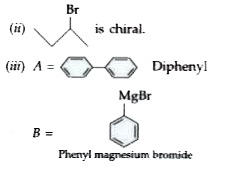 OR (i) But-1-ene to 1-iodobutane `CH_(3) -underset("But-1-ene")(CH_(2)) -CH=CH_(2) overset("HBr")underset("Peroxide")(to)CH_(3) - CH_(2) -CH_(2) -CH_(2)Br overset("nal")(to)underset("1-Iodobutane")(CH_(3) CH_(2) CH_(2) CH_(2) I) ` (ii) Benzene to acetophenone  (iii) ETHANOL to propanenitrile `underset("Ethanol")(CH_(3) CH_(2) OH) overset(PCI_(3)) (to)CH_(3) CH_(2) CI overset("KCN")(to) underset("Propanenitrile")(CH_(3) CH_(2) CN )` |
|
| 13. |
(i) Write the two chemical equations to show theinter conversion of chromates & dichromates in aqueous solution. (ii) Complete the equation: 5C_2O_4^(2-) + 2MnO_(4)^(-) + 16H^(+). |
|
Answer» SOLUTION :(i) `2CrO_(4)^(2-) + 2H^(+) rarr Cr_(2)O_(7)^(2-) + H_(2)O` `Cr_(2)O_(7)^(2-) + 2OH^(-) rarr 2CrO_(4)^(2-) + H_(2)O` `5C_(2)O_(4)^(2-) + 2MnO_(4)^(-) + 16H^(+) rarr 2MN^(2+) + 8H_(2)O + 10CO_(2)` |
|
| 14. |
(i) Write the structure of alpha-D(+) glucopyranose. (ii) What happens when fructose is treated with sodium amalgam and water ? |
|
Answer» |
|
| 15. |
(i) Write the structure and mention basicity of hypo phosphorous acid.(ii) Which gas is liberated when zinc reacts with dil. HNO_(3)? |
Answer» SOLUTION :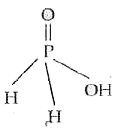 BASICITY = 1 (II) Nitrous oxide Or `N_(2)O` |
|
| 16. |
(i) Write the structural difference between starch and cellulose. (ii) What type of linkage is present in Nucleic acids ? (iii) Give one example each for fibrous protein and globular protein. |
|
Answer» Solution :(i) Starch CONSISTS of two parts amylose and amylopectin. Amylosein a polymerof `alpha` - D- glucoseunitsheld by`C_(1)- C_(4)`glycosidiclinkage . Amylopectin is a polymer of `alpha`- D - glucose unitsheld be `C_(1) - C_(4)` glycosidiclinkage andbrancing OCCURS by `C_(1) - C_(6)` glycosidiclinkages. Cellulose in a polymer of `beta` - D- glucose unitsheld by `C_(1)`of oneunit and `C_(4)` of next unit. (ii) Linkagein nucleicacids isphosphodiester linkage. (iii) EXAMPLEOF fibrousprotein : Kertain. Exampleof globularprotein: Albumin . |
|
| 17. |
(i) Write the reason for the anomalous behaviour of Nitrogen. (ii) Mn^(2+) is more stable than Mn^(4+).Why ? |
|
Answer» SOLUTION :(i) 1, Due to its small size, high electro negativity, high ionisation enthalpy enthalpy and absence of d-orbitals. 2. `N_(2)` hasa unique ability to form `p pi-p pi` multiple bond whereas the HEAVIER members of this group (15) do not form `p pi-p pi` bond, because their atomic orbitals are so large and diffused that they cannot have effective overlapping. 3. Nitrogen EXISTS a diatomic molecule with triple bond between the two atoms whereas otherelements form singlebond inthe elementalstate. 4. N cannot form `d pi-p pi`bonddue to the absence of d-orbitals whereas other elements can. (II) The relative stability of different oxidation statesof 3d metals iscorrelatedwith theextra stability of half-filled and fully filledelectronic configurations. Example: `Mn^(2+)(3d^(5))` is more stable than `Mn^(4+)(3d^(3))` |
|
| 18. |
(i) Write the name of two monosaccharides obtained on hydrolysis of lactose sugar. (ii) Why vitamin C cannot be stored in our body? (iii) What is the difference between a nucleoside and nucleotide ? |
|
Answer» Solution :(i) `beta - D`- glucoseand `beta - D ` - glucoseare obtainedon the hydrolysisof lactosesugar. (II) Vitamin C is WATER soluble. Therefore it is excreted out from the body and HENCE cannot be stored. (III) In nuleotide ,PHOSPHATE group is attachedto thenucleoside . 
|
|
| 19. |
(i) Write the products formed in the reaction of concentrated nitric acid with zinc. (ii) d-block elements readily form complexes. Give reason. |
|
Answer» Solution :(i) Zinc with Conc. `HNO_(3): 4Zn+10HNO_(3) to underset(("Zinc nitrate"))(4Zn(NO_(3))_(2))+underset(("Ammonium nitrate"))(NH_(4)NO_(3))+3H_(2)O` (ii) 1. Transition elements (d-block elements ) have a tendency to form coordination compounds (complexes) with a species that has an ability to donate an electron pair to form a coordinate covalent bond. 2. Transition metal ions are small and highly charged and they have vacant low energy ORBITALS to accept an electron pair donated by other groups. Due to these properties, transition METALS form large number of complexes. 3. Examples: `[Fe(CN)_(6)]^(4-), [Co(NH_(3))_(6)]^(3+)` |
|
| 20. |
(i) Write the important structural and functional differences between DNA and RNA. (ii) Write the hydrolysis products of sucrose. |
|
Answer» Solution :`{:("DNARNA",),("Double helical","Single helical"),("2 - Deoxyribose sugar","Ribose sugar"),("uracil absent","Thymine absent"),("property of replication","Do not replicant"),("Controls protein synthesis","Helps in protein synthesis"):}` `UNDERSET("Sucrose")(C_(12)H_(22)O_(11)+H_(2)Ooverset("invertase")rarr underset("glucose")(C_(6)H_(12)O_(6))+underset("FRUCTOSE")(C_(6)H_(12)O_(6))` |
|
| 21. |
(i) Write the IUPAC names for the following complexes. 1. Na_(2)[Ni(EDTA)] ""2. [Co(en)_(3)]_(2)(SO_(4))_(3) (ii) What is meant by piezo electricity? |
|
Answer» Solution :(i) 1. `Na_(2)[Ni(EDTA)]=` Sodium Ethylenediamineteraacetatonickelate (II) (or) Sodium 2,2.,2..,2...-(ethane-1,2-diyldinitrilo) tetraacetatonickelate(II) 2. `[Co(EN)_(3)]_(2)(SO_(4))_(3)=` TRIS(ethylenediamine)cobalt(III) sulphate (ii) Piezo electricity is the appearance of an electrical potential across the sides of a crystal. When you subject it to mechanical STRESS. The word piezo electricity means electricity resulting from pressure and latent heat. Even the inverse is possible which is known as inverse piezo electric effect. |
|
| 22. |
(i) Write the formulation for the galvantic cell in which the reaction Cu(s)+2Ag^+ (aq) toCu^(2+) (aq)+2Ag(s) Takes place . Identify the cathode and anode reactions in it. (ii) Write Nernst eq. and calculate the emf of the following cell. Sn(s)//Sn^(2+)(0.04m)||H^+(0.02M)|H_2(g)|H(s) |
|
Answer» Solution :(i) `CU(s) to Cu^(2+) (aq)+2e^-` (anode) `2Ag^(+) (aq)+2e^(-) to2Ag(s)` (At CATHODE) `overlineunderline (Cu(s)+2Ag^(+) (aq) to Cu^(2+) (aq) +2Ag (s))` Cu is acting as anode while Ag is acting as cathode. (II) `Sn(s) to Sn^(2+) (aq)+2e^-` `2H^+ (aq)+2e^(-) to H_2(g)` `OVERLINE underline(Sn(s)+2H^+ (aq)to Sn^(2+) (aq) +H_2(g))` Nernst equation `E_(cell)=E_(cell)^@-0.0591/2log""([Sn^(2+)])/([H^+]^2)` `=(E_(H^+//H_2)^@-E_(Sn^(2+)//Sn)^@)-0.0591/2log""0.04/(0.02)^2` `=[0-(0.14)]-0.0591/2log""4/100 TIMES 100/2 times 100/2` `=+0.14V-0.0591=0.0809 V` |
|
| 23. |
Write the general electronic configuration of tripositive lanthanoid ion. |
| Answer» Solution :i) General electronic CONFIGURATION of tripositive LANTHANOID ion `4F^(n)` where n=1 to 14. | |
| 24. |
(i) Write the cis and trans isometric structures of [Fe(NH_(3))_(2) (CN)_(4)]. (ii) What is the co-ordination number of Fe in [FeCl_(2)(en)_(2)]Cl? |
Answer» Solution :(i) `[Fe(CN_(3))_(2)(CN)_(4)]^(-)`   (ii) Co-ordination NUMBER of Fein`[FeCl_(2)(en)_(2)]Cl ` is 6. |
|
| 25. |
Write the cis and trans isomeric structures of [Fe(NH_(3))_(2)(CN)_(4)]^(-). |
Answer» SOLUTION :(i) 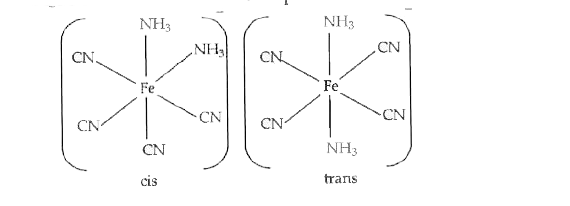 (II) SIX (or ) 6. |
|
| 26. |
(i) Write the chemical equation for the preparation of soap. (ii) Write notes on (a) Toilet soap (b) Medicinal soap |
Answer» Solution :(i)  (ii) (a) Toilet soap : Toilet soaps are prepared by using better grades of fats and oils and care is taken to REMOVE excess ALKALI. Colour and perfumes are added to make them more attractive. (b) Medicinal soap : Substances of medicinal value are added while preparing the soap. In some soaps, deodorants are added. Shaving soaps CONTAIN glycerol to PREVENT rapid drying. |
|
| 27. |
(i) Write structures of different isomeric amines corresponding to the molecular formula, C_(4)H_(11). (ii) Write IUPAC names of all the isomers. (iii) What type of isomerism is exhibited by different pairs of amines? |
|
Answer» Solution :(I, ii) primary amines, (a) `underset("Butanamine")(CH_(3)CH_(2)CH_(2)CH_(2)NH_(2))` (b) `underset("Butan-2-amine")(CH_(3)CH_(2)-underset(NH_(2))underset(|)(C)H-CH_(3))` (c) `underset("2-Methylpropanamine")(overset(3)(C)-overset(CH_(3))overset(|)(.^(2)C)H-overset(1)(C)H_(2))-NH_(2)` (d) `underset("2-Methylpropan-2-amine")(CH_(3)-underset(CH_(3))underset(|)overset(CH_(3))overset(|)(C)-NH_(2))` Secondary amines: (e) `underset("N-Methylpropanamine")(CH_(3)CH_(2)CH_(2)-NH-CH_(3))` (f) `underset("N-Methylpropan-2-amine")(overset(3)(C)H_(3)-overset(.^(1)CH_(3))overset(|)(.^(2)C)H-NH-CH_(3))` (g) `underset("N-Ethylthanamine")(CH_(3)-CH_(2)-NH-CH_(2)CH_(3))` Tertiary amines: (h) `underset("N,N-Dimethylethanamine")(CH_(3)-overset(CH_(3))overset(|)(N)-CH_(2)CH_(3))` (III) Position ISOMERS: (a) and (b), (e) and (f) Chain isomers: (a) and (c), (a) and (d), (b) and (c), (b) and (d). Metamers: (e) and (g), (f) and (g). (iv) Functional isomers: All `1^(@)` amines are functional isomers of `2^(@) and 3^(@)` amines and vice-versa. |
|
| 28. |
(i) Write the balanced reaction for obtaining XeO_(3) and XeOF_(4) from XeF_(6). (ii) XeF_(2) reacts with water. (iii) XeF_(6) reacts with water. |
|
Answer» Solution :(i) `XeF_(6)+3H_(2)Orarr underset("(COMPLETE HYDROLYSIS)")(XeO_(3)+6HF)` `XeF_(6)+H_(2)Orarr underset("(PARTIAL hydrolysis)")(XeOF_(4)+2HF)` (ii) `2XeF_(2)+2H_(2)Orarr 2Xe +4HF+O_(2)` (III) `XeF_(6)+2H_(2)Orarr XeO_(2)F_(2)+4HF` |
|
| 29. |
(i) Write structures of different isomeric amines corresponding to the molecular formula, C_(4)H_(11)N. (ii) Write IUPAC names of all the isomers. (iii) What type of isomerism is exhibited by different pairs of amines ? |
|
Answer» SOLUTION :Different primary, secondary and tertiary amines with MOLECULAR FORMULA `C_(4)H_(11)N` along with IUPAC names are given below : Primary amines : (a) `underset("Butanamine")(CH_(3)CH_(2)CH_(2)CH_(2)NH_(2))"(b) "underset("Butan-2-amine")(CH_(3)CH_(2)-underset(underset(NH_(2))(|))(CH)-CH_(3))` (c) `underset("2-Methylpropanamine")(overset(3)(C)H_(3)-overset(overset(CH_(3))(|))(overset(2)(C)H)-overset(1)CH_(2)-NH_(2))"(d)"underset("2-Methylpropan-2-amine")(CH_(3)-underset(underset(CH_(3))(|))overset(overset(CH_(3))(|))(C)-NH_(2))` Secondary amines : (e) `underset("N-Methylpropanamine")(CH_(3)CH_(2)CH_(2)-NH-CH_(3))"(f) "underset("N-Methylpropan-2-amine")(overset(3)(C)H_(3)-overset(overset(CH_(3))(|))(overset(2)(C)H)-NH-CH_(3))` (g) `underset("N-Ethylethanamine")(CH_(3)-CH_(2)-NH-CH_(2)CH_(3))` Tertiary amines : (h) `underset("N, N-Dimethylethanamine")(CH_(3)-overset(overset(CH_(3))(|))(N)-CH_(2)CH_(3))` Following types of isomerism are EXHIBITED by different pairs of amines : Chain isomers : (a) and (c), (a) and (d), (b) and (c), (b) and (d). Position isomers : (a) and (b), (e) and (f). Functional isomers : All `1^(@)` amines are functional isomers of `2^(@)" and "3^(@)` amines and vice-versa. Metamers : (e) and (g), (f) and (g). |
|
| 30. |
(i) writeequationsfor thepreparation ofn- heptane (a)n- Butyl bromide( B)Ethyl bromide ( C)i- Butane ,(d) 2- butane (ii) whichof thefollowing reagents will reactwithethane ? (a) Aqueous Ko ,(b)Alkaline KMnO_(4), ( C) Brominein presenceof light ,( D)Nitric acidat 723 K. (iii) writethe struturaland IUPAC namesfor all the dibromo derivatives of propane . ( iv)writethestructuralformula and IUPAC namesfor allthe trichlorodevivaties of propane,( v)startingwithbromoethaneandbromomethane, prepanepropaneusingthe Corey -Housesythesis(vi)prepanen- hexaneformi- bromopropaneusingthecorey -House synthesis. (vii)prepane2- deutero propanefrom isopropyl bromide . |
Answer» SOLUTION :
|
|
| 31. |
(i) Write down the order of energy of eclipsed and staggered conformation for ethane molecule. (ii) The nimbers of possible conformation for a single bond are (a) 1 (b) 2 (c) 6 (d) infinte |
|
Answer» Solution :(i) Energy ORDER - slaggered `LT` ECLIPSED. (II) (d) infinite |
|
| 32. |
(i) With reference to structural variability and chemical reactivity, write the differences between lanthanoids and actinoids. (ii) Name a member of the lanthanoid series which is well known to exhibit + 4 oxidation states. (iii) Complete the following equation: MnO_4^(-) + 8H^(+) + 5e^(-) to (iv) Out of Mn^(3+) and Cr^(3+), which is more paramagnetic and why? (Atomic nos.: Mn = 25, Cr = 24) |
Answer» SOLUTION :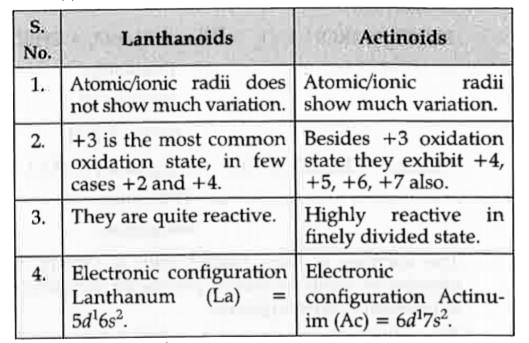 (ii) Cerium `(CE^(4+))` (III) `MnO_4^(-) +8H^(+) +5e^(-) to Mn^(2+) + 4H_2O` (iv) `Mn^(3+)` is more paramgnetic. Because `Mn^(3+)` has 4 UNPAIRED electrons `(3d^4)` therefore more paramagnetic whereas `Cr^(3+)` has 3 unpaired electrons `(3d^5). ` |
|
| 33. |
(i) Wirte machanism of hydration of ethene to yield ethanol. (ii) Write note on Williamson Ether synthesis. |
|
Answer» Solution :(i) MECHANISM of hydration of ethene : `H_(2)SO_(4)hArr H^(+)+HSO_(4)^(-)` `CH_(2)=CH_(2)+H^(+)rarr CH_(3)-overset(o+)CH_(2)` (ii) Williamson.s Ether synthesis : It is the REACTION of alhyl halide with sodium alkoxide/sodium phenoxide to FORM ether. `CH_(3)I+C_(2)H_(5)O^(-)Na^(+)rarr NaI+underset("Ethyl methyl ether")(NaI+CH_(3)-O-C_(2)H_(5))` |
|
| 34. |
(i) Why tetrahedral complexes do not exhibit geometrical isomerism. (ii) Explain about the importance and application of coordination complexes. |
|
Answer» Solution :(i) In tetrahedral geometry `*` All the four ligands are adjacent or equidistant to ONE another. `*` The RELATIVE positions of donor atoms of ligands attached to the central metal atom are same with respect to each other. `*` It has plane of symmetry Therefore, tetrahedral complexes do not exhibit geometrical isomerism.  (ii) 1. Phthalo blue - a bright blue pigment is a complex of copper (II) ion and it is used in printing ink and packaging industry. 2. Purification of Nickel by Mond.s process involves formation of `[Ni(CO)_(4)]` which yields 99.5% pure on decomposition. 3. EDTA is used as a chelating ligand for the separation of lanthanides, in softening of hard water and also in removing lead poisoning. 4. Coordination complexes are used in the extraction of SILVER and gold from their ores by forming soluble cyano complex. These cyano complexes are reduced by zinc to yield metals. This process is called Mac - Arthur Forrestcyanide process. 5. Some metal ions are estimated more accurately by complex formation. For eg., `Ni^(2+)` present in Nickel chloride solution is estimated accurately forming an insoluble complex called `[Ni(DMG)_(2)]`. 6. Many of the complexes are used as catalyst in organic and inorganic reactions. For e.g., (i) Wilkinson.s Catalyst - `[(PPh_(3))_(3)Rh" "Cl]` is used for hydrogenation of alkenes. (ii) Ziegler - Natta Catalyst `[TiCl_(4)+Al(C_(2)H_(5))_(3)]` is used in the polymerisation of ethene. 7. In photography, when the developed film is washed with sodium thio SULPHATE solution (hypo), the negative film GETS fixed. Undecomposed AgBr formsasoluble complex called sodium dithio sulphate argentate (I) which can be removed easily by washing the film with water. `""AgBr+2Na_(2)S_(2)O_(3) rarr Na_(3)[Ag(S_(2)O_(3))_(2)]+2NaBr` |
|
| 35. |
(i) Why ranitidine is a better antacid than magnesium hydroxide ? (ii) What is bakelite? How is it prepared? Give its uses. |
|
Answer» Solution :(i) To treat acidity, weak base such as magnesium hydroxide is used. But this weak base MAKE the stomach alkaline and trigger the production of much acid. This treatment only relieves the symptoms and does not control the cause. But ranitine stimulate the secretion of HCl by activating the receptor in the stomach WALL which binds the receptor and inactivate them. So ranitine is a better antacid than magnesium hydroxide. (II) 1. Bakelite is a thermo setting plastic. It is prepared from the MONOMERS such as phenol and formaldehyde. The condensation polymerisation take place in the presence of acid or base catalyst. 2. Phenol reacts with METHANAL to form ortho or para hydroxyl methyl phenols which on further reaction with phenol gives linear polymer called novolac. Novolac on further healing with formaldehyde undergoes cross linkages to form bakelite. 3. 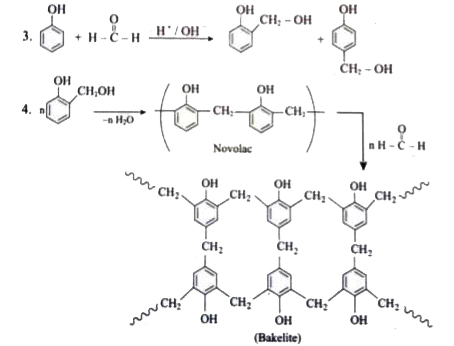 Novolac is used in paints . Soft bakelites are used in making glue for binding laminated wooden planks and in varnishes . Hard bakelites are used to prepare combs, pens. |
|
| 36. |
(i) Why should antidepressant drugs not be taken without consulting a doctor ? (ii) Give two examples of artificial sweeteners. |
|
Answer» Solution :(i) Antidepressant drugs should not be taken because there are specific drugs for specific problems. The drugs WORK on DIFFERENT RECEPTORS. (ii) TWO artificial sweeteners are : (a) Aspartame (b) Sucrolose. |
|
| 37. |
(i) Why lambda_(m)^(@) for CH_(3)COOH cannot be determined experimentally? (ii) Write about the classification of organic nitro compounds. |
|
Answer» Solution :(i) Molar conductivity of weak electrolytes keeps on increasing with dilution and does not become CONSTANT EVEN at very large dilution. (ii) 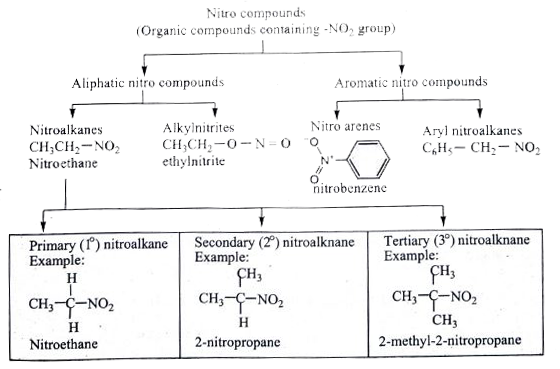
|
|
| 38. |
(i) Why are aquatic species more comfortable in cold water than in warm water ? (ii) What happens when we place the blood cell in saline water solution (hypertonic solution) ? Give reasons. |
| Answer» SOLUTION : (i) Solubility of a gas in water decreases with rise of temperature. Less OXYGEN is available toaquatic SPECIES in water. (ii) Blood CELLS SHRINK because concentration is more in saline water than in blood cells. | |
| 39. |
{:("(i) White phosphorous","(a) Volcanic eruptions"),("(ii) Red phosphorous","(b) Yellow phosphorous"),("(iii) Phosphine","(c )Match boxes"),("(iv) "SO_(2),"(d) smoke screen"):} |
| Answer» SOLUTION :(i) b (II) C (III) d (iv) a | |
| 40. |
(i) Which one of the following is a polysaccharide : starch, maltose, fructose, glucose (ii) Write one difference between alpha-helix and beta-pleated sheet structures of protein. (iii) Write the name of the disease caused by the deficiency of vitamin B_(12). |
|
Answer» Solution :(i) Starch is a polysaccharide. (ii) `alpha`-hellix: Polypeptide-chcin forms all possible H-bonds by twisting into a right handed helical STRUCTURE with -NH group of each amino acid residue. Hydrogen bonded to the `gt c = 0` group of an adjacent TURN of helix. `beta`-structure : All peptide chain are stretched out to nearly extension and then LAID SIDE by side which are held TOGETHER by intermolecular Hydrogen bond. (iii) Pernicious anaemia and scurvy. |
|
| 41. |
(i) Which one of the following is a polysaccharide : starch, maltose, fructose, glucose . (ii) Write one difference between a-helix and B-pleated sheet structure of protein. (iii) Write the name of the disease caused by the deficiency of vitamin B_(12). |
|
Answer» Solution :(i) STRACH ispolysaccharide . (ii) In `alpha` -helix STRUCTURE, a polypeptide chain forms all possible hydrogen bonds by twisting into a right handed screw with the -NH group of each amino acid residue hydrogen bonded to `>C= O` of an adjacent turn of the helix. In B-structure, all peptide chains are stretched out to nearly maximum extension and then laid side by side which are held TOGETHER by intermolecular hydrogen bonds. This structure resembles the PLEATED folds of drapery. (iii) Deficiency of vitamin `B_(12)` causes pernicious anaemia (RBC deficient in haemoglobin). |
|
| 42. |
(i) Which one of the following is a disaccharide : starch, maltose, fructose, glucose ? (ii) What is the difference between fibrous protein and globular protein ? (iii) Write the name of vitamin whose deficiency causes bone deformities in children ? |
|
Answer» Solution :(i) Maltose is a disaccharide. (ii) When POLYPEPTIDE chains run PARALLEL and are held together by hydrogen and DISULPHIDE bonds, fibrous proteins are OBTAINED. These proteins are insoluble in water. For example, hair, wool and silk. When chain of polypeptides coil around to give a spherical shape, globular proteins are obtained. These are soluble in water. Insulin and albumins are the examples of this kind of proteins. (iii) Deficiency of vitamin D causes bone DEFORMITIES in children. |
|
| 43. |
(i) Which one of the following is a monosaccharide : starch, maltose, fructose, cellulose. (ii) What is the difference between acidic amino acids and basic amino acids ? (iii) Write the name of the vitamin whose deficiency causes bleeding of gums. |
|
Answer» Solution :(i) Fructose is a MONOSACCHARIDE. (ii) If the NUMBER of carboxyl groups is more than the number of amino groups, the amino acid obtained is ACIDIC. If the number of amino groups is more than the number of carboxyl groups, the amino acid obtained is basic. (III) DEFICIENCY of vitamin C causes bleeding of gums. |
|
| 44. |
(i) Which of the following biomolecule is insoluble in water ? Justify. Insulin, Haemoglobin, Keratin. (ii) Draw the Haworth structure for alpha-D-Glucopyranose. (iii) Write chemical reaction to show that glucose contains aldehyde as carbonyl group. |
|
Answer» Solution :(i) Keratin is insoluble in water because it is a fibrous protein. In such proteins polypeptide chains RUN PARALLEL and are held together by hydrogen and disulphide bonds. (ii) Structure of `alpha`-D-Glucopyranose is given as under:  (iii) GLUCOSE REACTS with hydroxylamine to form an oxime. This shows that glucose contains a carbonyl group. Glucose gets oxidised to six-carbon carboxylic ACID, gluconic acid on treatment with a mild oxidising agent like bromine water. This shows that carbonyl group present is an aldehydic group. 
|
|
| 45. |
(i) Which is highest frequency photon that can be emitted from hydrogen atom? What is wavelength of this photon? (ii) Calclate the longest wavelength transition in the Pashen series of He^(+). (iii) Calculate the ratio of the wavelength of first and the ultimate line of Balmer sereis of Li^(2+)? |
|
Answer» Solution :(i) Highest frequency photon is emitted when electron comes from INFINITY to 1ST energy level. `E=-(13.6z^(2))/(1^(2))=-13.6eV` or `13.6xx1.6xx10^(-19)` Joule `=2.76xx10^(-18)` Joule `E=hv` `:.v=E/h=(2.176xx10^(-18)J)/(6.626xx10^(-34)Js)=0.328xx10^(18)Hz` `v=c/(LAMDA):.lamda=(3xx10^(80))/(0.328xx10^(16)Js)=9.146xx10^(-8)m` (iii) `barv=R_(H)xxZ^(2)[1/(n_(1)^(2))-1/(n_(2)^(2))]` For He Z=2, For Paschen series `n_(1)=3` For longest wavelength `n_(2)=4` `1/(lamda)=109678xx(2)^(2)xx[1/(3^(2))-1/(4^(2))]=109678xx4xx[1/9-1/16]=109678xx4xx7/144` `lamda=4689Å` (iii) WAVE number of first line of Balmer, `barv_(1)=RZ^(2)[1/(2^(2))-1/(3^(2))]=(5xx9r)/36=(5R)/4` Wavelength of first line of Balmer `=4/(5R)` Wave number of ultimate line ofBalmer `barv_(2)=RZ^(2)[1/(2^(2))-1/(OO)]=(9R)/4` `:.` Wavelength of ultimate of Balmer `=4/(9R)` `:.` Ratio `=9/5` |
|
| 46. |
(i) Which is stronger reducing agent Cr^(2+) or Fe^(2+) ? (ii) Explain about the oxidation state of Lanthanoids. |
|
Answer» |
|
| 47. |
Which is the strongest acid among the hydrogen halides? Give one reason [X=F,Cl,Br,I] |
|
Answer» SOLUTION :(i) `HI` BOND dissociation energy of HI is LEAST. (ii) 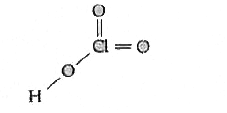
|
|
| 48. |
(i) Which is a stronger reducing agent Cr^(2+) or Fe^(2+) and why ? (ii) Explain why Cu^(+) ion is not stable in aqueous solution ? (iii) Explain why Ce^(4+) is a stronger oxidizing agent. |
|
Answer» Solution :(i) `Cr^(2+)` is a stronger reducing agent than `Fe^(2+)` because `Cr^(2+) rarr Cr^(3+) + e^(-)` results in CHANGE of configuration from `d^(4)` to more stable `d^(3) ( t_(2g)^(3))` than from `d^(6)` to `d^(5)` in case of the change `Fe^(2+) rarr Fe^(3+) + e^(-)` . (ii) This is because `Cu^(+)` ion in aqueous solution undergoes disproportionation to give more stable `Cu^(2+)` and Cu. (iii) This is because`CE^(4+)` TENDS to change to `Ce^(3+)` as `+3` oxidation state is more stable. |
|
| 49. |
(i) When 2.56 g of sulphur was dissolved in 100 g of CS_(2), the freezing point lowered by 0.383 K . Calculate the formula of sulphur (S_(x))(K_(f)" for "CS_(2)="3.83 K kg mol"^(-1)), (Atomic mass of sulphur = "32 g mol"^(-1)). |
| Answer» Solution :(i) `S_(8)`, SIMILAR to SOLVED problem 6, | |
| 50. |
I. When phosphine is heated with air, it burns to give meta phosphoric acid. II. Nitrogen is used for the manufacture of ammonia. III. Phosphine is weakly basic and forms phosphonium salts with acids. IV. Phosphine forms coordination compound with Lewis base. |
|
Answer» I and III only |
|