Saved Bookmarks
This section includes 7 InterviewSolutions, each offering curated multiple-choice questions to sharpen your Current Affairs knowledge and support exam preparation. Choose a topic below to get started.
| 1. |
Identify a reagent from the following list which can easily distinguish between 1-butyne and 2-butyne. |
|
Answer» BROMINE , `C Cl_4` `UNDERSET"butyne-1"(2CH_3-CH_2-C)-=CH+Cu_2Cl_2+2NH_4OH to underset"red ppt."(2CH_3-CH_2)-C-=C.Cu darr +2NH_4Cl +2H_2O` `CH_3-C-=C-CH_3+Cu_2Cl_2+2NH_4OH to ` No reaction |
|
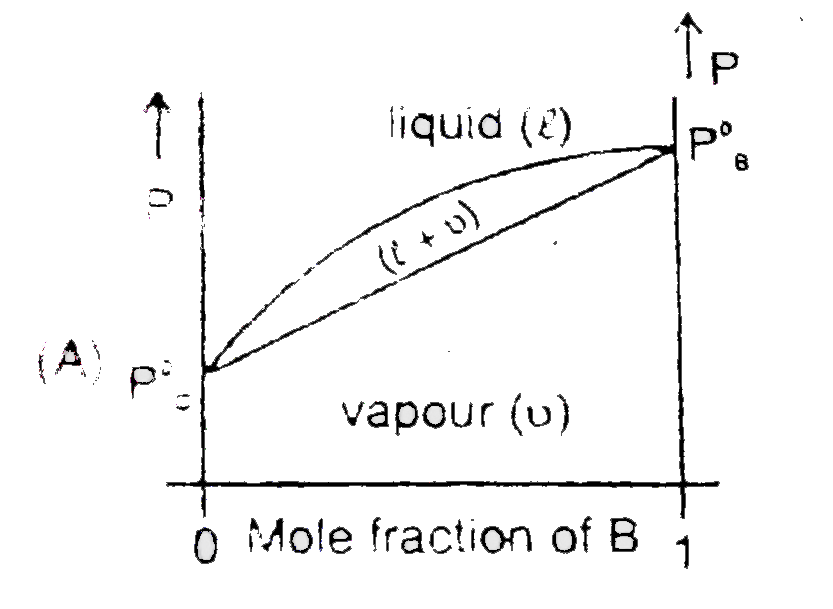
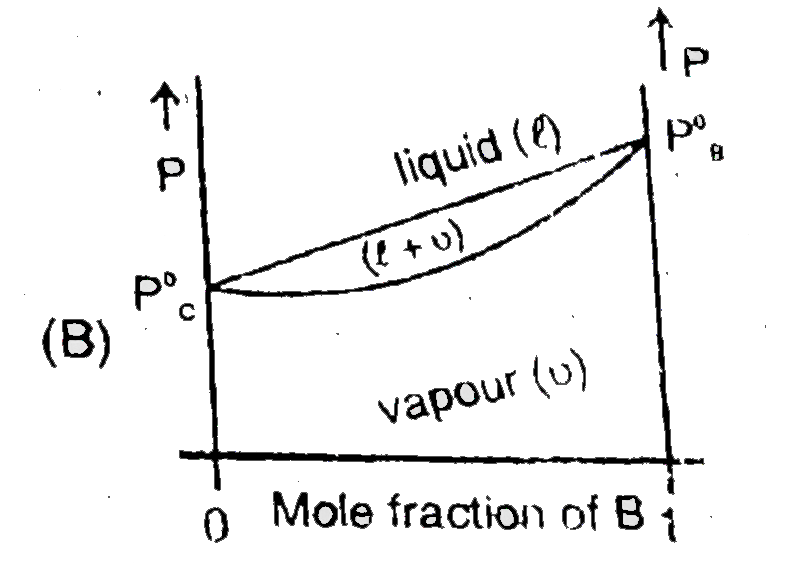
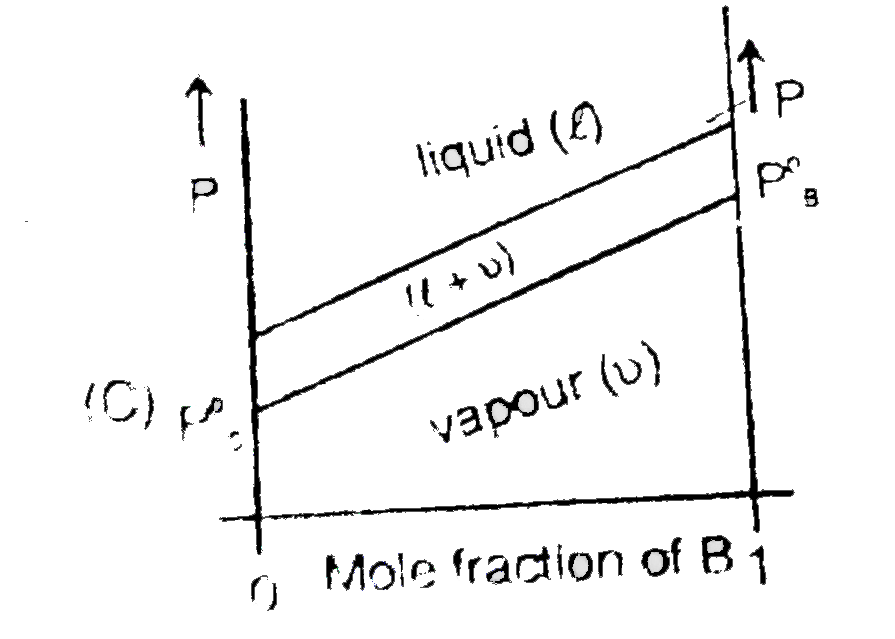
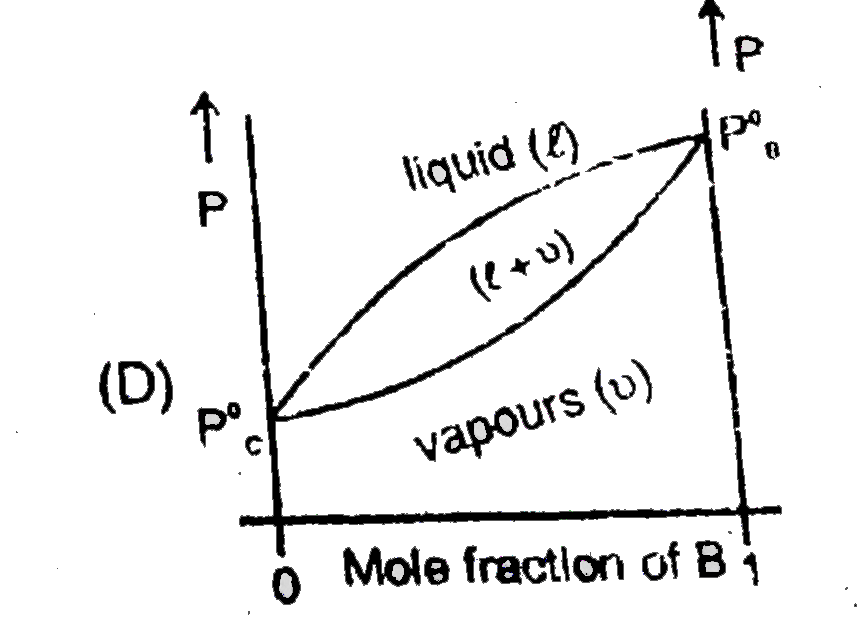
| 2. |
Idenfity, which of the following molecuels does not have 'R' configuration? |
|
Answer»
|
|
| 3. |
Idenfify reactions that correctly match with their products: |
|
Answer»
(B) More SUBSTITUTED producted (C) LESS substituted product (D) More substituted product |
|
| 4. |
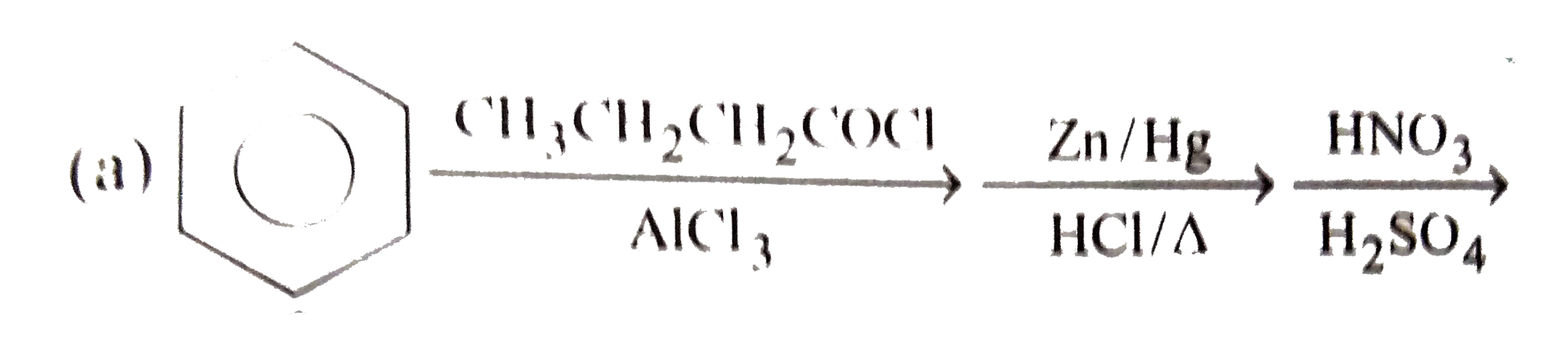
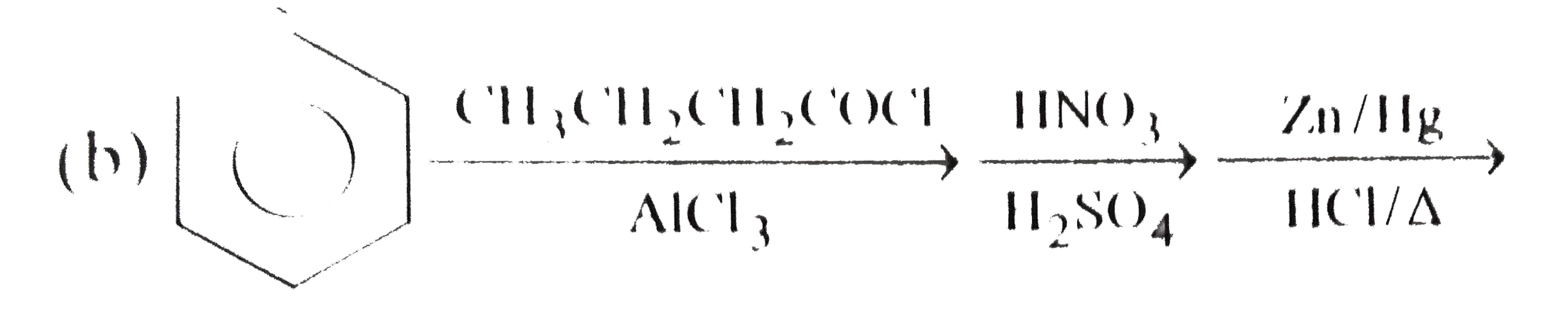
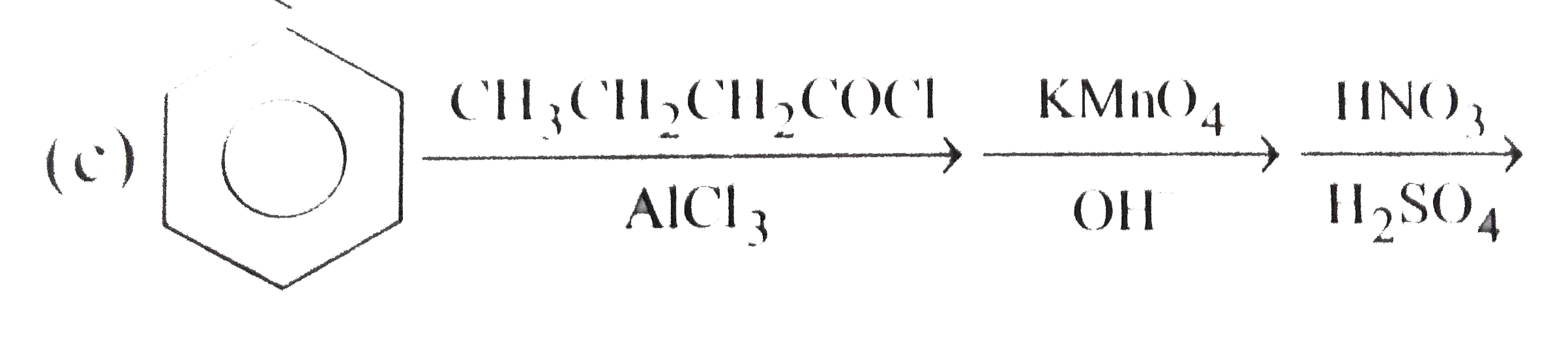
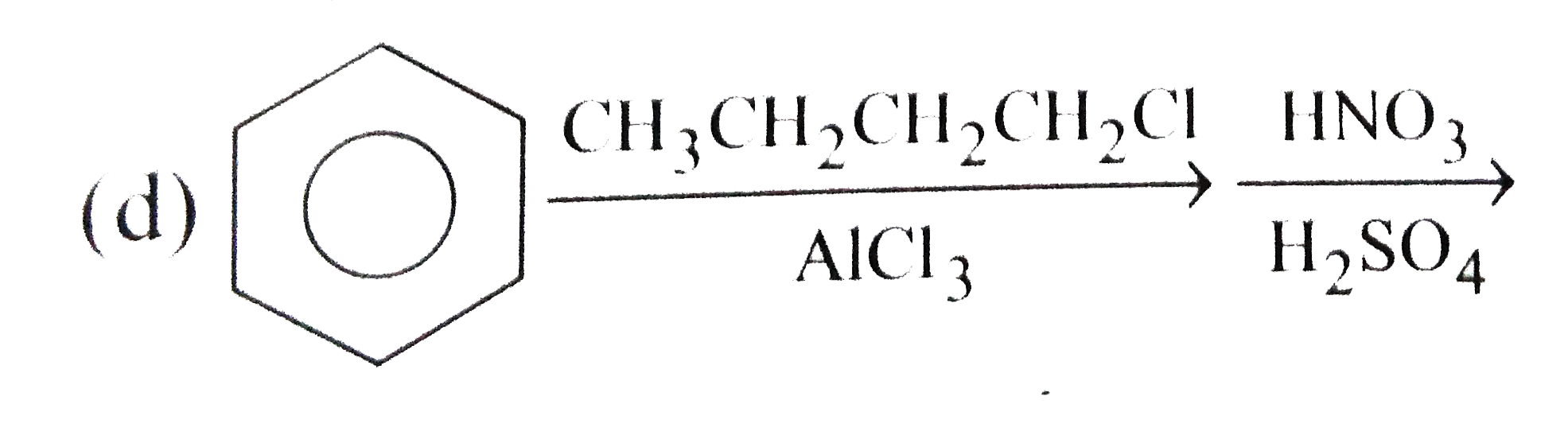
Idendify the correct method for the synthesis of the compound shown below from the following alternatives ? |
|
Answer»
|
|
| 5. |
Ideal Solution at Fixed Temperature Consider two liquids 'B' and 'C' that form an ideal solution We hold the temperature fixed at some value T that is above the freezing point of 'B' and 'C' We shall plo the system's pressure P against x_B,The overall mole fraction of B in the system : x_B=(n_(B_"total"))/(n_"total")=(n_B^l+n_B^v)/(n_B^v+n_C^l+n_C^v+n_B^l) Where n_B^l and n_B^v are the number of moles of B in the liquid and vapor phases, respectively, For a closed system x_B is fixed, although n_B^l and n_B^v may very. Let the system be enclosed in a cylinder fitted with a piston and immersed in a constant temperature bath To see what the P-versus - x_B phase diagram looks like let us initially set the external pressure on the piston high enough for the system to be entirely liquid (point A in figure ) As the pressure is lowered below that at A.the system eventually reaches a pressure where the liquid just begins to vaporizes (point D).At point D, the liquid has composition x_B^l where x_B^l at D is equal to the overall mole fraction x_B since only an infinitesimal amount of liquid has vapourized.What is the composition of the first vapour that comes off ? Raoult's law, P_B=x_B^vP_B^0 relates the vapour-phase mole fractions to the liquid composition as follows : x_B^v=(x_B^lP_B^0)/P and x_C^v=(x_C^lP_C^0)/P...(1) Where P_B^0 and P_C^0 are the vapour pressure of pure 'B' and pure 'C' at T where the system's pressure P equals the sum P_B+P_C of the parial pressures, where x_B^l=(n_B^l)/((n_B^l+n_C^l)) , and the vapour is assumed ideal. x_B^v/x_C^v=(x_B^lP_B^.)/(x_C^lP_C^.) ideal solution ...(2) Let B be the more volatile component meaning that P_B^0 gtP_C^0 Above equaion then show that x_B^v//x_C^v gt x_B^l//x_C^l .The vapour above an ideal solution is richer than the liquid in the more volatile component.Equations (1) and (2) apply at any pressure where liquid vapour equilibrium exists, not just at point D. Now let us isothermally lower the pressure below pointD,causing more liquid to vaporize . Eventually , we reach point F in figure. where the last drop of liquid vaporizes.Below F, we have only vapour . For any point on the line between D and F liquid and vapour phases coexist in equilibrium . Two liquids A and B have the same molecular weight and form an ideal solution.The solution has a vapour pressure of 700 Torrs at 80^@C.It is distilled till 2/3^(rd) of the solution (2//3^(rd) moles out of total moles) is collected as condensate.The composition of the condensate is x_A^'=0.75 and that of the residue is x_A^('')=0.30 If the vapour pressure of the residue at 80^@Cis 600 Torrs, find the original composition of the liquid ? |
|
Answer» `X_A=0.5` we have`700=X_AP_A^@+X_BP_B^@`...(1) `600=X_AP_A^@+X_BP_B^@`...(2) and `x=1/3(x+y)xx3/10+2/3(x+y)xx3/4` So, on SOLVING `X_A=x/(x+y)=0.6` |
|
| 6. |
Idebtify the product. HCHO overset (CH_3MgX) underset (H_2O) rarr ----- |
|
Answer» `CH_3OH` |
|
| 7. |
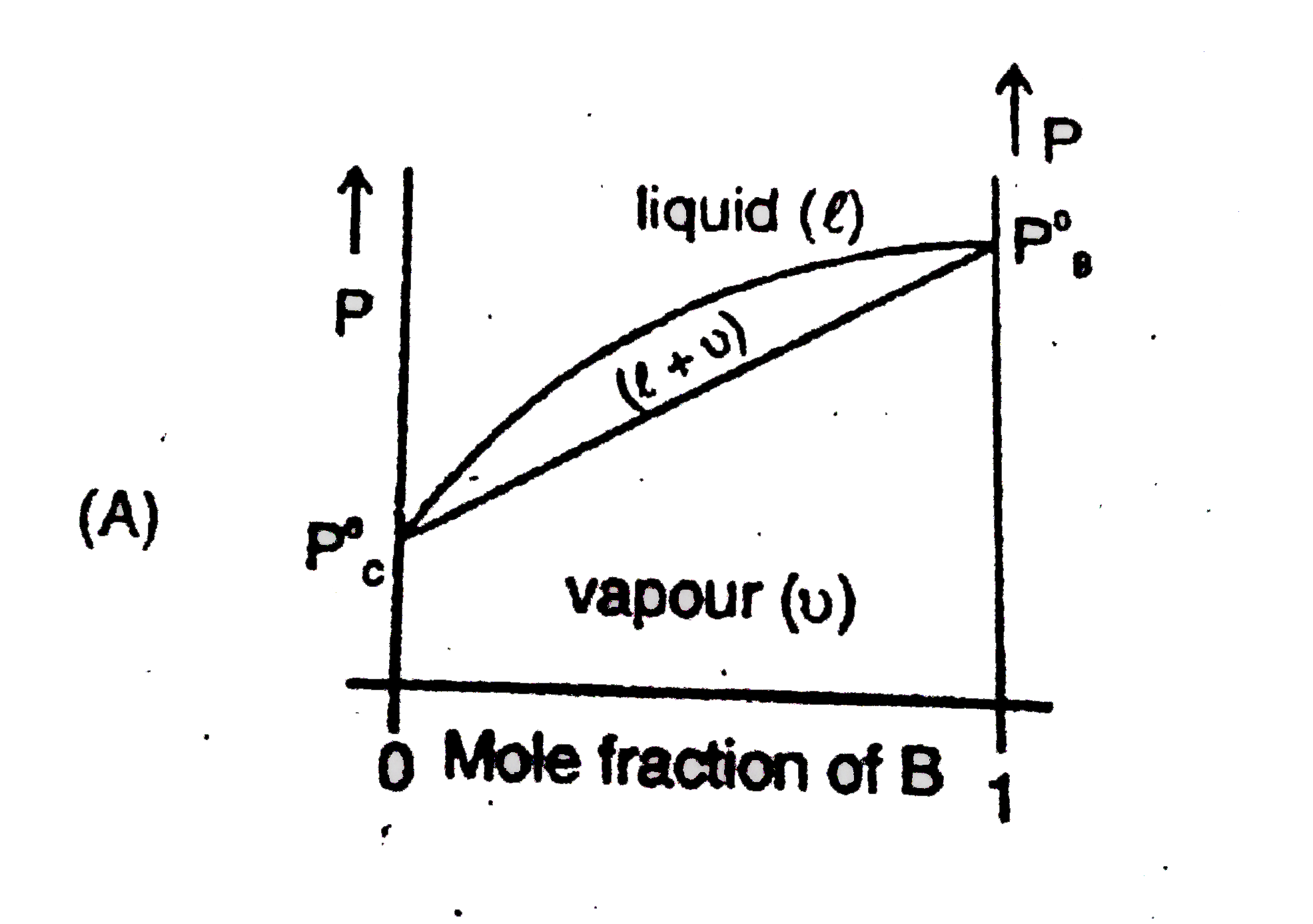
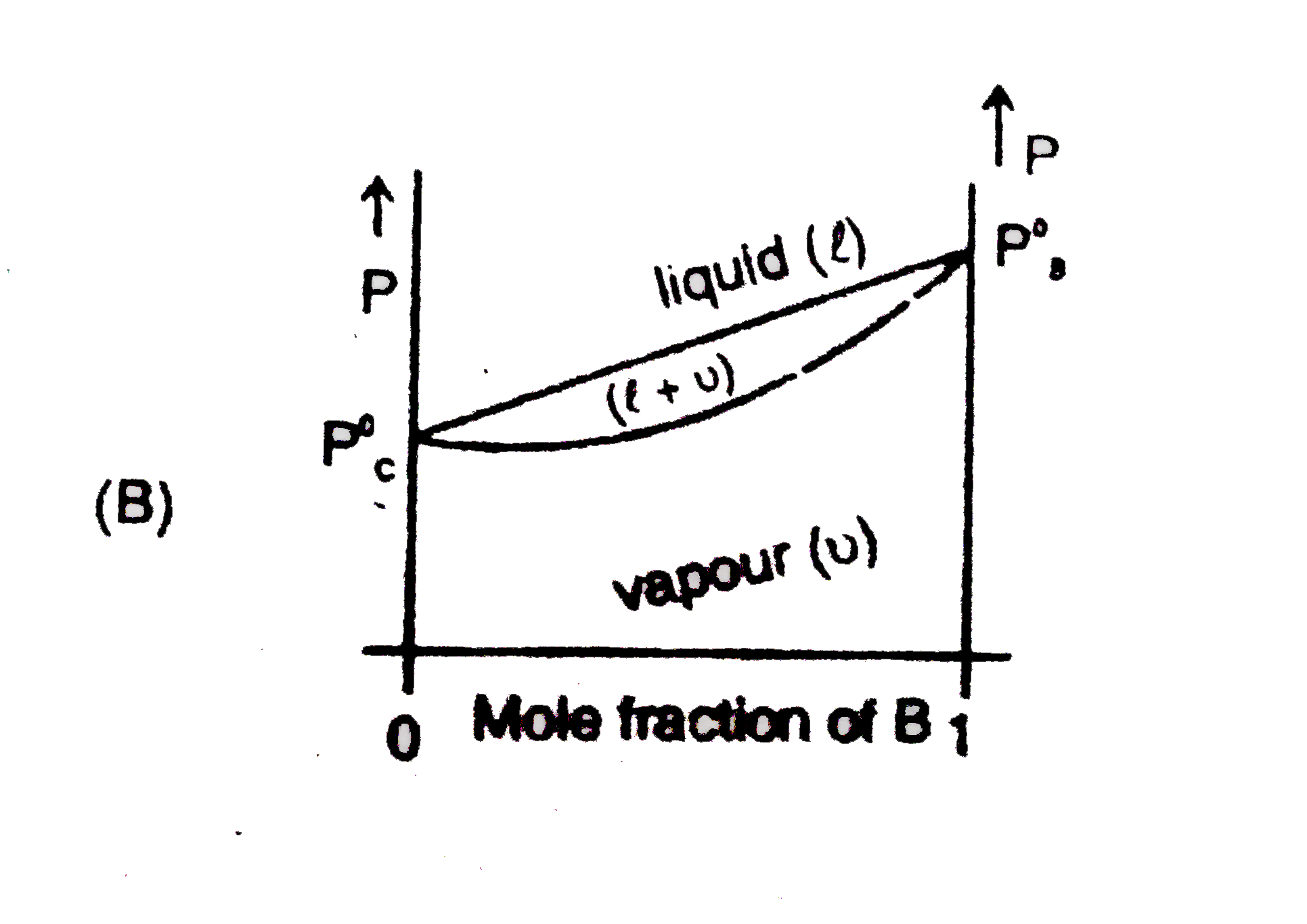
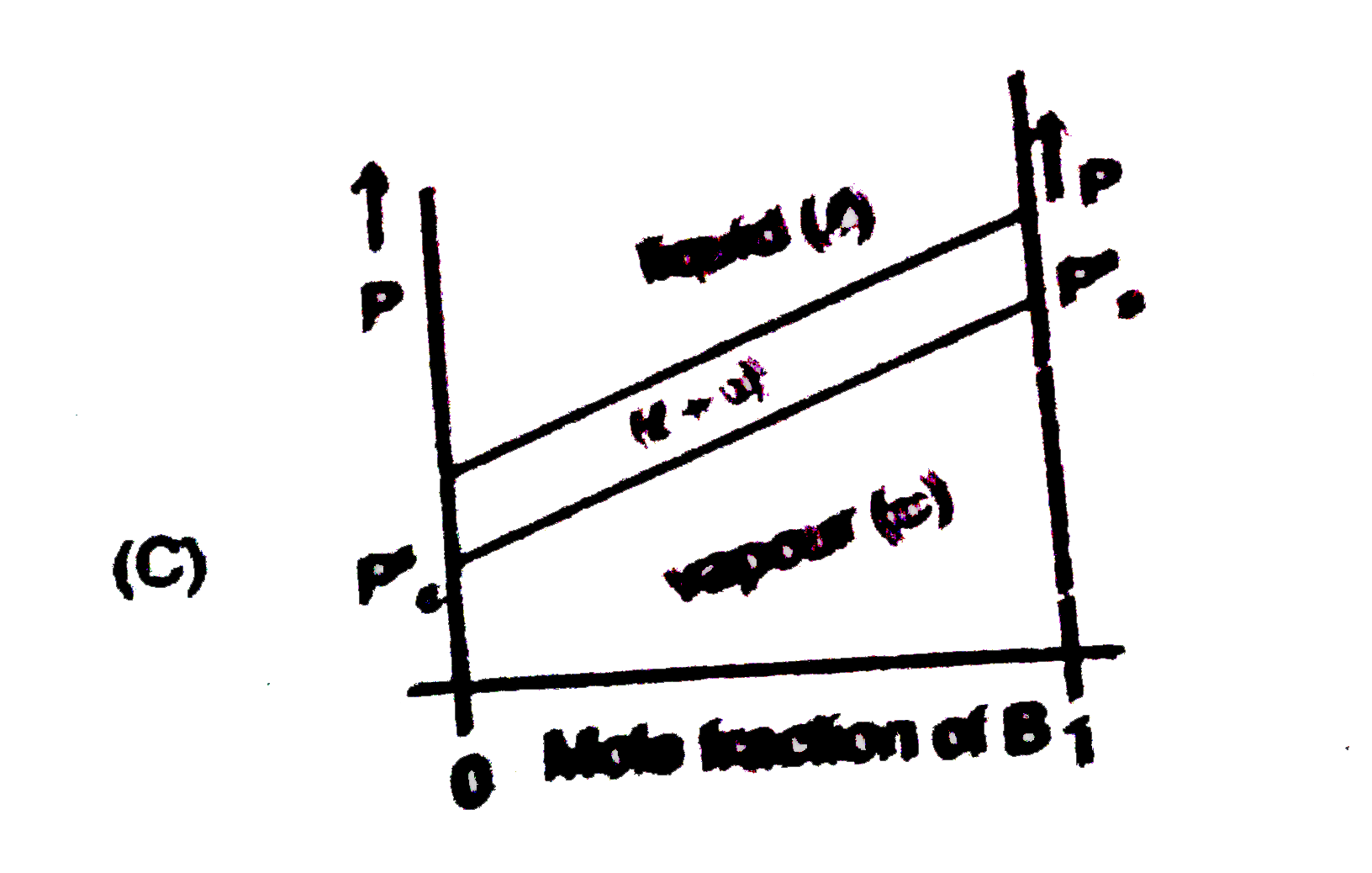
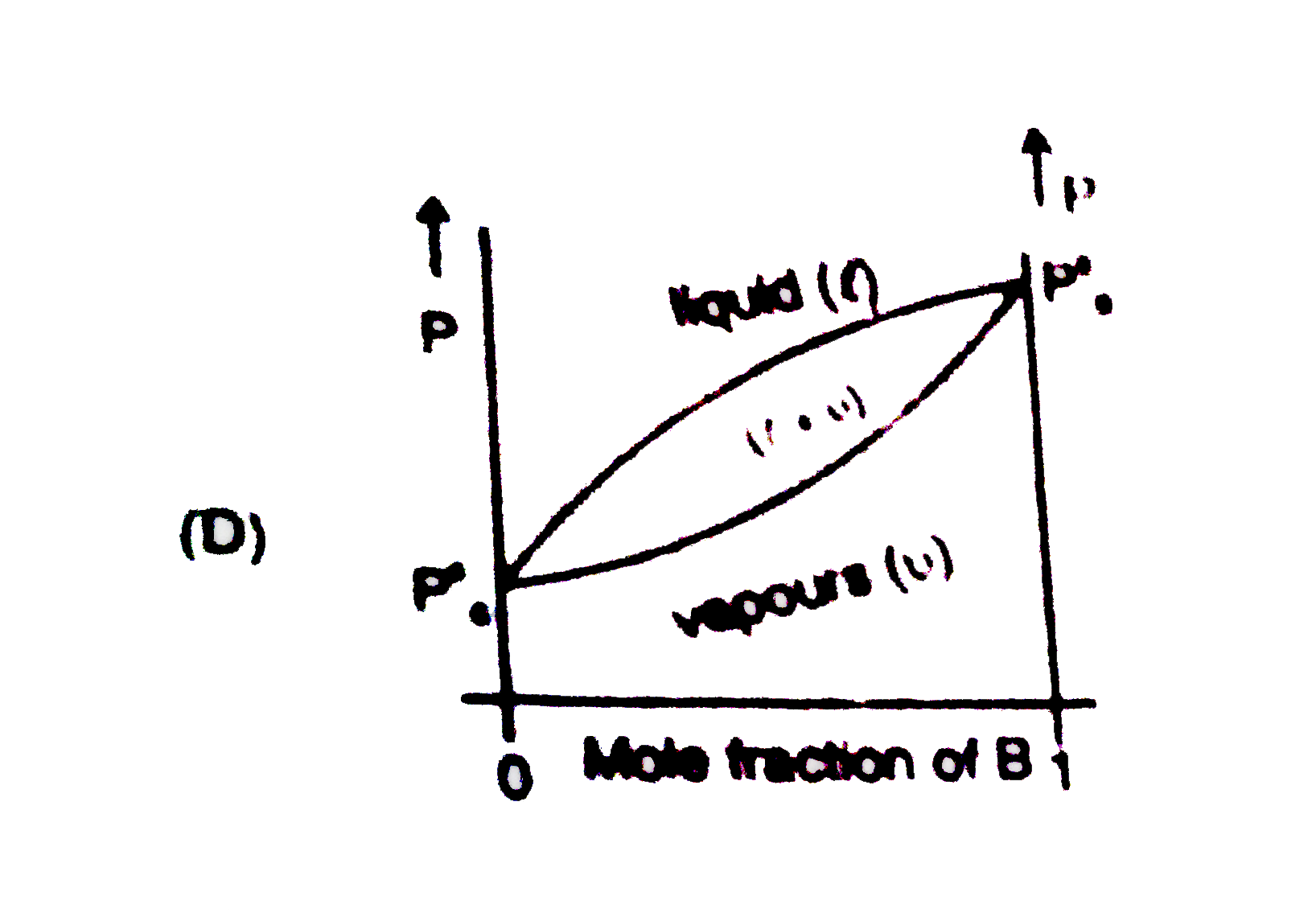
Ideal Solution at Fixed Temperature Consider two liquids 'B' and 'C' that form an ideal solution We hold the temperature fixed at some value T that is above the freezing point of 'B' and 'C' We shall plo the system's pressure P against x_B,The overall mole fraction of B in the system : x_B=(n_(B_"total"))/(n_"total")=(n_B^l+n_B^v)/(n_B^v+n_C^l+n_C^v+n_B^l) Where n_B^l and n_B^v are the number of moles of B in the liquid and vapor phases, respectively, For a closed system x_B is fixed, although n_B^l and n_B^v may very. Let the system be enclosed in a cylinder fitted with a piston and immersed in a constant temperature bath To see what the P-versus - x_B phase diagram looks like let us initially set the external pressure on the piston high enough for the system to be entirely liquid (point A in figure ) As the pressure is lowered below that at A.the system eventually reaches a pressure where the liquid just begins to vaporizes (point D).At point D, the liquid has composition x_B^l where x_B^l at D is equal to the overall mole fraction x_B since only an infinitesimal amount of liquid has vapourized.What is the composition of the first vapour that comes off ? Raoult's law, P_B=x_B^vP_B^0 relates the vapour-phase mole fractions to the liquid composition as follows : x_B^v=(x_B^lP_B^0)/P and x_C^v=(x_C^lP_C^0)/P...(1) Where P_B^0 and P_C^0 are the vapour pressure of pure 'B' and pure 'C' at T where the system's pressure P equals the sum P_B+P_C of the parial pressures, where x_B^l=(n_B^l)/((n_B^l+n_C^l)) , and the vapour is assumed ideal. x_B^v/x_C^v=(x_B^lP_B^.)/(x_C^lP_C^.) ideal solution ...(2) Let B be the more volatile component meaning that P_B^0 gtP_C^0 Above equaion then show that x_B^v//x_C^v gt x_B^l//x_C^l .The vapour above an ideal solution is richer than the liquid in the more volatile component.Equations (1) and (2) apply at any pressure where liquid vapour equilibrium exists, not just at point D. Now let us isothermally lower the pressure below pointD,causing more liquid to vaporize . Eventually , we reach point F in figure. where the last drop of liquid vaporizes.Below F, we have only vapour . For any point on the line between D and F liquid and vapour phases coexist in equilibrium . If the above process is repeated for all other composition of mixture of C and B If all the points where vapours start converting into liquid are connectted and all the points where vapours get completely converted into liquid are connected then obtained graph will look like : |
|
Answer»
`P=X_B^lP_B^@+X_C^lP_C^0` `=X_C^lP_B^0+(1-X_B^l)P_C^0` `=P_C^0+(P_B^@+P_C^@)X_B^l=P_C^@+(P_B^@-P_C^@)X_B` The second curve will not be a straight line having equation `P=(P_B^@-P_C^@)/(X_B^l(P_C^@-P_B^@)+P_B^@)` |
|
| 8. |
IDEAL SOLUTION AT FIXED TEMPERATURE Consider two liquids 'B' and 'C' that form an ideal solution. We hold the temperature fixed at some value T that is above the freezing points of 'B' and 'C' .We shall plot the system's pressure P against x_B,the overall mole fraction of B in the system : x_B=(n_(B,"total"))/n_("total")=(n_(B)^l+n_B^v)/(n_(B)^v+n_C^l+n_(C)^v+n_B^l) Where n_B^l and n_B^v are the number of moles of B in the liquid and vapour phases, respectively.For a closed system x_B is fixed, although n_B^l and n_B^vmay vary. Let the system be enclosed in a cylinder fitted with a piston and immersed in a constant-temperature bath. To see what the P-versus-x_B phase diagram looks like, let us initially set the external pressure on the piston high enough for the system to be entirely liquid (point A in figure) As the pressure is lowered below that at A, the system eventually reaches a pressure where the liquid just begins to vaporizes (point D).At point D, the liquid has composition x_B^l and x_B^l at D is equal to the overall mole fraction x_B since only an infinitesimal amount of liquid has vapourized. What is the composition of the first vapour that comes off ? Raoult's law, P_B=x_B^vP_B^0 related the vapour-phase mole fractions to the liquid composition as follows : x_B^v=(x_B^lP_B^0)/P and x_C^v=(x_C^lP_C^0)/P ...(1) Where P_b^0 and P_C^0 are the vapour pressure of pure 'B' and pure 'C' at T.where the system's pressure equals the sum P_B+P_C of the partial pressure, where x_B^l=n_B^l/((n_B^l+n_C^l)), and the vapor is assumed ideal. x_B^v/x_C^v=(x_B^lP_B^.)/(x_C^lP_C^.) ideal solution ...(2) Let B be the more volatile component, meaning that P_B^0gtP_C^(0).Above equation then shows that x_B^v//x_C^vgtx_B^l//x_C^l.The vapor above an ideal solution is richer than the the liquid in the more volatile component.Equations (1) and (2) apply at any pressure below point D.causing more liquid to vaporize.Eventually, we reach point F in figure.where the last drop of liquid vapourizes.Below, F we have only vapor.For any point on the line between D and F liquid and vapor coexist in equilibrium. Two liquids A and B form a non ideal solution which obey the equation P_T=P_A^@+3(P_B^@-P_A^@)x_B+2(P_A^@-P_B^@)x_B^2 When equimolar mixture of A and B is distilled find the composition (by mole) when this mixture will have a single boiling point .(P_B^@gtP_A^@) where P_A^@ and P_B^@ are vapour pressure of pure A and B respectively X_B=mole fraction of B in liquid phase : |
|
Answer» `3:1` `implies 3(P_B^@-P_A^@)-4(P_B^@-P_A^@)x_B=0` `x_B=3/4 " " x_A=1/4` `THEREFORE x_A/x_B=n_A/n_B` =1:3 |
|
| 9. |
IDEAL SOLUTION AT FIXED TEMPERATURE Consider two liquids 'B' and 'C' that form an ideal solution. We hold the temperature fixed at some value T that is above the freezing points of 'B' and 'C' .We shall plot the system's pressure P against x_B,the overall mole fraction of B in the system : x_B=(n_(B,"total"))/n_("total")=(n_(B)^l+n_B^v)/(n_(B)^v+n_C^l+n_(C)^v+n_B^l) Where n_B^l and n_B^v are the number of moles of B in the liquid and vapour phases, respectively.For a closed system x_B is fixed, although n_B^l and n_B^vmay vary. Let the system be enclosed in a cylinder fitted with a piston and immersed in a constant-temperature bath. To see what the P-versus-x_B phase diagram looks like, let us initially set the external pressure on the piston high enough for the system to be entirely liquid (point A in figure) As the pressure is lowered below that at A, the system eventually reaches a pressure where the liquid just begins to vaporizes (point D).At point D, the liquid has composition x_B^l and x_B^l at D is equal to the overall mole fraction x_B since only an infinitesimal amount of liquid has vapourized. What is the composition of the first vapour that comes off ? Raoult's law, P_B=x_B^vP_B^0 related the vapour-phase mole fractions to the liquid composition as follows : x_B^v=(x_B^lP_B^0)/P and x_C^v=(x_C^lP_C^0)/P ...(1) Where P_b^0 and P_C^0 are the vapour pressure of pure 'B' and pure 'C' at T.where the system's pressure equals the sum P_B+P_C of the partial pressure, where x_B^l=n_B^l/((n_B^l+n_C^l)), and the vapor is assumed ideal. x_B^v/x_C^v=(x_B^lP_B^.)/(x_C^lP_C^.) ideal solution ...(2) Let B be the more volatile component, meaning that P_B^0gtP_C^(0).Above equation then shows that x_B^v//x_C^vgtx_B^l//x_C^l.The vapor above an ideal solution is richer than the the liquid in the more volatile component.Equations (1) and (2) apply at any pressure below point D.causing more liquid to vaporize.Eventually, we reach point F in figure.where the last drop of liquid vapourizes.Below, F we have only vapor.For any point on the line between D and F liquid and vapor coexist in equilibrium. If the above process is repeated for all other compositions of mixture of C and B.if all the points where vapours start converting into liquid are connected than obtained graph will look like. |
|
Answer»
`P=X_B^lP_B^@+X_C^lP_C^@` `=X_B^lP_B^@+(1-x_B^l)P_C^@` `=P_C^@+(P_B^@-P_C^@)X_B^l=P_C^@+(P_B^@-P_C^@)X_B` The second curve will not be a straight line having equation `P=(P_B^@-P_C^@)/(X_B^l(P_C^@-P_B^@)+P_B^@)` |
|
| 10. |
IDEAL SOLUTION AT FIXED TEMPERATURE Consider two liquids 'B' and 'C' that form an ideal solution. We hold the temperature fixed at some value T that is above the freezing points of 'B' and 'C' .We shall plot the system's pressure P against x_B,the overall mole fraction of B in the system : x_B=(n_(B,"total"))/n_("total")=(n_(B)^l+n_B^v)/(n_(B)^v+n_C^l+n_(C)^v+n_B^l) Where n_B^l and n_B^v are the number of moles of B in the liquid and vapour phases, respectively.For a closed system x_B is fixed, although n_B^l and n_B^vmay vary. Let the system be enclosed in a cylinder fitted with a piston and immersed in a constant-temperature bath. To see what the P-versus-x_B phase diagram looks like, let us initially set the external pressure on the piston high enough for the system to be entirely liquid (point A in figure) As the pressure is lowered below that at A, the system eventually reaches a pressure where the liquid just begins to vaporizes (point D).At point D, the liquid has composition x_B^l and x_B^l at D is equal to the overall mole fraction x_B since only an infinitesimal amount of liquid has vapourized. What is the composition of the first vapour that comes off ? Raoult's law, P_B=x_B^vP_B^0 related the vapour-phase mole fractions to the liquid composition as follows : x_B^v=(x_B^lP_B^0)/P and x_C^v=(x_C^lP_C^0)/P ...(1) Where P_b^0 and P_C^0 are the vapour pressure of pure 'B' and pure 'C' at T.where the system's pressure equals the sum P_B+P_C of the partial pressure, where x_B^l=n_B^l/((n_B^l+n_C^l)), and the vapor is assumed ideal. x_B^v/x_C^v=(x_B^lP_B^.)/(x_C^lP_C^.) ideal solution ...(2) Let B be the more volatile component, meaning that P_B^0gtP_C^(0).Above equation then shows that x_B^v//x_C^vgtx_B^l//x_C^l.The vapor above an ideal solution is richer than the the liquid in the more volatile component.Equations (1) and (2) apply at any pressure below point D.causing more liquid to vaporize.Eventually, we reach point F in figure.where the last drop of liquid vapourizes.Below, F we have only vapor.For any point on the line between D and F liquid and vapor coexist in equilibrium. The equation of the curve obtained by connecting all those points where the vapours of above mixture (all mixtures of different composition are taken ) just start forming will be |
|
Answer» <P>`P=P_C^@+(P_B^@-P_C^@)X'_B` |
|
| 11. |
Ideal mixture of two miscible liquids A and B is placed in a cylinder containing piston. Piston is pulled out isothermally so that volume of liquid decreases but that of vapours increases. When negligibly small amount of liquid was left, the mole fraction of A in vapour phsae is 0.4. If P_(A)^(circ) = 0.4 atm and P_(B)^(circ) = 1.2 atm at the experimental temperature, calculate the total pressure at which the liquid is almost evaporated. |
|
Answer» |
|
| 12. |
Ideal gas equation is represented as PV=nRT. Gases present in universe were fond ideal in the Boyle's temperature range only and deviated more from ideal gas behavior at high pressure and low temperature. The deviation are explained in term of compressibility factor z. For ideal behavior Z=(PV)/(nRT)=1. the main cause to show deviavtion were due to wrong assumptions made about forces oif attractions (which becomes significant at high pressure ) and volume V occupied by molecules in PV=nRT is supposed to be volume of gas or the volume of container in which gas is placed by assuming that gaseous molecules do not have appreciable volume. Actually volume of the gas is that volume in which each molecule of gas can move freely. If volume occupied by gaseous molecule is not negligible, then the term V would be replaced by the ideal volume which by available for free motion of each molecule of gas in 1 mole gas. V_("actual")= volume of container -volume occupied by molecules =v-b Where b represent the excluded volume occupied by molecules present in one mole of gas. Similarly for n mole gas V_("actual")=v-nb As the pressure approaching zero i.e. at very low pressure. The curves plotted between compressibility factor Z and P for n mole of gases have the following characteristics. (I) The intercept on y-axis leads to a value of unity (II) The intercept on y axis leads to a value of 'n' (III) The curves posses same slope for different gases at same temperature (IV) The curves posses different slopes for different gases at same temperature. (V) The curves posses same slope for a gas at different temperature |
|
Answer» <P>I,IV,V |
|
| 13. |
ICl_(3) exist as dimer I_(2) Cl_(6) . In this molecule regarding this dimerization number of correct statements is // are |
|
Answer» All atoms are in the same plane with two CHLORINE bridges  All atoms are in the same plane with two chlorine bridges |
|
| 15. |
(i)Chlorobenzene and (ii) benzene hexachloride are obtained from benzene by the reaction of chlorine, in the presence of |
|
Answer» (i)DIRECT sunlight and (ii) anhydrous `AlCl_3` 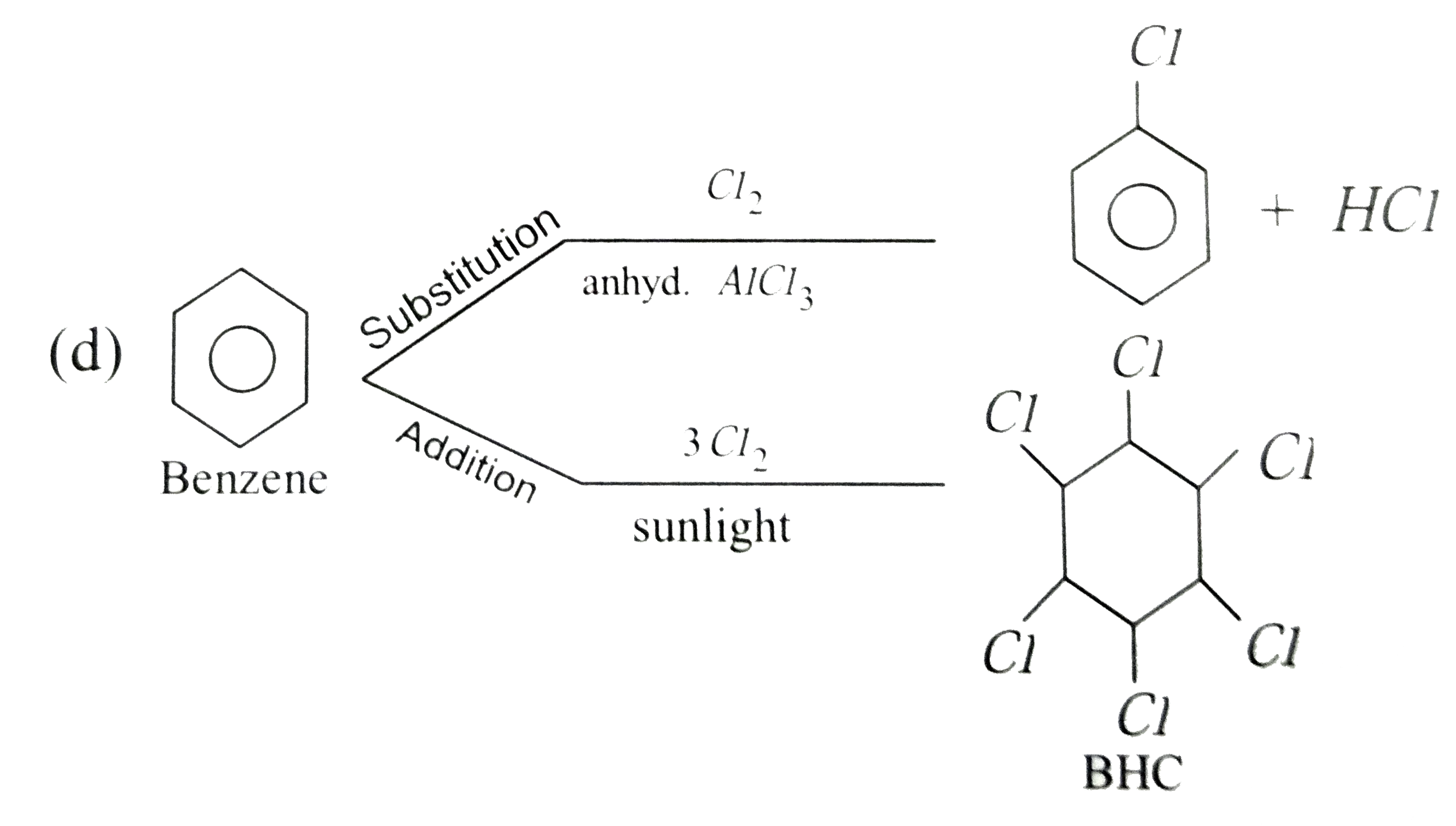
|
|
| 19. |
Icehasthreedimensionalcrystalstructurein which_______of totalvolumeisunoccupied |
|
Answer» ONE half |
|
| 20. |
Ice cold hydrochloric acid is added to dimethyl ether. The product formed is |
|
Answer» Dimethoxy METHANE |
|
| 21. |
(i)Can we use soaps and detergents to check the hardness of water ? (ii)What structural unit makesdetergents non-biodegradable ? (iii)What are invert soaps ? Give one examples |
| Answer» SOLUTION :Soaps get precipitated as INSOLUBLE calcium and magnesium soaps in hard water but DETERGENTS do not Therefore, soaps but not synthetic detergents can be used to CHECK the hardness of water. | |
| 22. |
Hydrolysis of CCl_4 is not possible but SiCl_4 is easily hydrolysed. |
|
Answer» Carbon cannot EXPAND its octet but SILICON can expand |
|
| 23. |
Ibuprofen is a |
|
Answer» Propionic ACID DERIVATIVE |
|
| 24. |
Ibuprofen is commonly used as |
|
Answer» antipyretic |
|
| 25. |
Ibuprofen tablets sold in the market contain |
|
Answer» only S-enantiomer |
|
| 26. |
IC l_(3)conducts electricity because on electrolysis it ionises as : |
|
Answer» `2IC l_(3)hArr I^(+)+IC l_(5)^(-)` |
|
| 27. |
Ibuprofen , crocin and disprin are widely used medicines. Can you name active chemotherapeutic agent used in each of these medicines ? |
| Answer» SOLUTION :Ibuprofen : 2-(4-Isobutylphenyl) propanoic acid , CROCIN , Paracetamol , Disprin , Acetysalicyclic acid | |
| 28. |
Ibuprofen contains |
|
Answer» Only S - enantiomer |
|
| 29. |
(i)Boron +O_(2)overset(700^(@)Cto (X)(ii)(X)+C(carbon) + Cl_(2)to (Y)+CO (ill) (Y)+LiAH_(4)to(2)+LICI +AICI_(3) (iv) (Z)+NH_(3)to(A)overset(Hesat)to(B) (v) (Z) +NaHto(D)QCompound (B) is: |
| Answer» Answer :A::B | |
| 30. |
IBr_(7) cannot exist but IF_(7) exist. This fact can be explained on the basic of |
|
Answer» Electro-vitres |
|
| 31. |
(i)Boron +O_(2)overset(700^(@)Cto (X)(ii)(X)+C(carbon) + Cl_(2)to (Y)+CO (ill) (Y)+LiAH_(4)to(2)+LICI +AICI_(3) (iv) (Z)+NH_(3)to(A)overset(Hesat)to(B) (v) (Z) +NaHto(D)QCompound (Z) is: |
|
Answer» an ionic compound |
|
| 32. |
(i)Boron +O_(2)overset(700^(@)Cto (X)(ii)(X)+C(carbon) + Cl_(2)to (Y)+CO (ill) (Y)+LiAH_(4)to(2)+LICI +AICI_(3) (iv) (Z)+NH_(3)to(A)overset(Hesat)to(B) (v) (Z) +NaHto(D)QCompound (x) and (Y) are: |
|
Answer» `(X) = BO_(2)`, `(Y) = BCI_(2)` |
|
| 33. |
(i)"Borax"""(a)Na_(2)B_(4)O_(7) (ii)"Prismatic form"""(b)Na_(2)B_(4)O_(7).5H_(2)O (iii)"Jeweller"""(c)Na_(2)B_(4)O_(7).10H_(2)O (iv)"Borax glass"""(x)[B_(4)O_(5)(OH)_(4)]^(2-) |
|
Answer» |
|
| 34. |
i.(A)underset(Delta)overset(NaOH)rarr(B)(g) overset(HCI)rarr While fumes. ii. After (B) is expelled completely, resultant alkline solution againgives gas (B) onheating with zine iii.(A) overset(Delta)rarr N_(2)O +H_(2)O What is the formula of white fumes? |
|
Answer» `NH_(4)NO_(3)` `NH_(4)NO_(3) overset(Delta) to N_(2) O + 2H_(2)O` i. `NH_(4)NO_(3) + NaOH overset(Delta) to NaNO_(3) `+ `overset(NH_(3))UNDERSET((B)) + H_(2)O` `NH_(3) + HCI rarr overset(NH_(4)CI)underset("white famus") + H_(2)O` iii`2NaOH + Zn overset(Delta to Na_(2)ZnO_(2) + 2H` `NaNO_(3) + KH overset(Delta)to NaOH + overset(NH_(3))underset((B)) + 2H_(2)O` `(NH_(2)` gas in obtain due to reeduction of `NO_(3)^(Theta))` |
|
| 35. |
(i)"Boron"""(a)"Optical" (ii)"Borax"""(a)"Neutron absorber" (iii)"Boric acid"""©"Welding torches"(iv)"Diborane"""(d)"Eye lotion" |
|
Answer» |
|
| 36. |
i.(A)underset(Delta)overset(NaOH)rarr(B)(g) overset(HCI)rarr While fumes. ii. After (B) is expelled completely, resultant alkline solution againgives gas (B) onheating with zine iii.(A) overset(Delta)rarr N_(2)O +H_(2)O Identify B |
|
Answer» `SO_(2)` `NH_(4)NO_(3) overset(Delta) to N_(2) O + 2H_(2)O` i. `NH_(4)NO_(3) + NAOH overset(Delta) to NaNO_(3) `+ `overset(NH_(3))underset((B)) + H_(2)O` `NH_(3) + HCI rarr overset(NH_(4)CI)underset("white famus") + H_(2)O` iii`2NaOH + Zn overset(Delta to Na_(2)ZnO_(2) + 2H` `NaNO_(3) + KH overset(Delta)to NaOH + overset(NH_(3))underset((B)) + 2H_(2)O` `(NH_(2)` gas in obtain due to reeduction of `NO_(3)^(Theta))` |
|
| 37. |
i.(A) overset(Delta)toglassy traparent beat (B) on platinum wire (B) + CuSO_(4) rarrcoloured bead(C ) ii underset((D))((A))+conc. H_(2)SO_(4)+CH_(3)CH_(2)OH overset("ignite")rarr green flame iv.Aqueous solution (A) is alkline Identify D. |
|
Answer» `(CH_(3))_(3)BO_(3)` `RARR(A)` is borax `(Na_(2)B_(4)O_(7).10H_(2)O)` `Na_(2)B_(4)O_(3)10H_(2)O OVERSET(Delta) to (NaBO_(2) + B_(2)O_(3))/((B) "Glassy bead") + 10H_(2)O` `B_(2)O_(3) + CuSO_(4) overset(Delta)to underset("Coloured bead(C))(Cu(BO_(2))_(2) +SO_(3)uarr` ii `Na_(2)B_(4)O_(3) + H_(2)SO_(4) + 5H_(2)O rarr NA_(2)SO_(4) + 2H_(3)BO_(3)` `H_(#)BO_(3) +3C_(2)H_(5)OH rarr underset("Green flame" (on ignition")(D))((C_(2)H_(5))_(3)BO_(3)+3H_(2)O)` `Na_(2)B_(4)O_(7)+5H_(2)O rarr underset("Weak acid")(2H_(3)BO_(3))+2Na[B(OH)_(4)]` `Na[B(OH)_(4)]` reacts with acid `(HCI)` hence AQUEOUS solution of (A) is alkaline. |
|
| 38. |
(i).An inorganic compound (A) is formed on passing a gas (B) through a concentrated liquor containing sodium sulphide and sodium sulphite. (ii) On adding (A) into a dilute solution of silver nitrate, a white precipitate appears which quickly changes into a black coloured compound (C). (iii) On adding two or three drops of ferric chloride into an excess of solution of (A), a violet coloured compound (D) is formed. But this colour disappears quickly. (iv) On adding a solution of (A) into the solution of cupric chloride, a white precipitate is first formed which dissolves on adding excess of (A) forming a compound (E). Identify (A) to (E) and give chemical equations for the reactions at steps (i) to (iv). |
|
Answer» Solution :Let us summarize the given facts. (i) `Na_(2)SO_(3)+Na_(2)S+Gas(B)toA` (ii) `A+ AgNO_(3)toWhite ppt.tounderset(BLACK)(C)` (iii) `A+FeCl_(3)tounderset("Violet")(D)toDisappears` (iv) `A+CuCl_(2)White ppt.overset(excess of A)to ppt.underset(E)(dissolves)` The given set of reactions indicate that the compound is sodium thiosulphate which can be formed from equation (i) when the gas (B) is either `SO_(2)` or `l_(2)` and thus the various reactions can be written as below: (i) `Na_(2)SO_(3)+2Na_(2)S+underset(B)(3SO_(2))tounderset(A)(3Na_(2)S_(2)O_(2))` or `Na_(2)SO_(3)+Na_(2)S+underset(B)(I_(2))tounderset(A)(Na_(2)S_(2)O_(3))+2Nal` (ii) `Na_(2)S_(2)O_(3)+2AgNO_(3)tounderset(White ppt.)(Ag_(2)S_(2)O_(3))darr+2NaNO_(3)` `underset(C(Black))(Ag_(2)S_(2)O_(3)+H_(2)Odarr)+H_(2)SO_(4)` (iii) `underset((A))(3Na_(2)S_(2)O_(3))2FeCl_(3)tounderset("D(Violet)")(Fe_(2)(S_(2)O_(3)))+6NaCl` `2Fe^(3+)+2S_(2)O_(3)^(2-)to2Fe^(2+)+underset("Coloueless")(S_(4)O_(3)^(2-))` (iv) `underset((A))(2Na_(2)S_(2)O_(3))+2CuCl_(2)to2CuCI+Na_(2)S_(4)O_(6)+2NaCl` `2CuCl+Na_(2)S_(2)O_(3)tounderset(White)(Cu_(2)S_(2)O_(3))darr+2NaClxx3` `3Cu_(2)S_(2)O_(3)+2Na_(2)S_(2)O_(3)tounderset("Soluble complex(E)")(Na_(4)[Cu_(6)(S_(2)O_(3))_(9)]` |
|
| 39. |
i.(A)underset(Delta)overset(NaOH)rarr(B)(g) overset(HCI)rarr While fumes. ii. After (B) is expelled completely, resultant alkline solution againgives gas (B) onheating with zine iii.(A) overset(Delta)rarr N_(2)O +H_(2)O Identify A |
|
Answer» `NH_(4)NO_(2)` `NH_(4)NO_(3) overset(Delta) to N_(2) O + 2H_(2)O` i. `NH_(4)NO_(3) + NaOH overset(Delta) to NaNO_(3) `+ `overset(NH_(3))underset((B)) + H_(2)O` `NH_(3) + HCI rarr overset(NH_(4)CI)underset("white famus") + H_(2)O` iii`2NaOH + ZN overset(Delta to Na_(2)ZnO_(2) + 2H` `NaNO_(3) + KH overset(Delta)to NaOH + overset(NH_(3))underset((B)) + 2H_(2)O` `(NH_(2)` gas in obtain due to reeduction of `NO_(3)^(Theta))` |
|
| 40. |
(i)A powdered substance (A) on treatment with fusion mixture (Na_2CO_3+KNO_3) gives a green coloured compound (B). (ii)The solution of (B) in boiling water on acidification with dilute H_2SO_4 gives a pink coloured compound ( C). (iii)The aqueous solution of (A) on treatment with excess of NaOH and Bromine water gives a compound (D) (iv)A solution of (D) in conc. HNO_3 on treatment with PbO_2at boiling temperature produced a compound (E) which was of the same colour at that of (C ). Sum of oxidation number of central atom of A,B,C,D & E is: |
|
Answer» (II)`3MnO_4^(2-)+4H^(+)tooverset(2MnO_4^-)((C) )+MnO_2+2H_2O` (III)`underset((A))(MN^(2+))+2OH^(-)toMn(OH)_2darr`(white) `Mn(OH)_2darr + Br_2 +2NAOH underset((D))(MnO_2)DARR`(black)+2NaBr+`2H_2O` (iv)`5PbO_2 +2 underset((A))(Mn^(2+))+4H^(+)tounderset((E))(2MnO_4^(-))+5Pb^(2+)+2H_2O` |
|
| 41. |
i.(A) overset(Delta)toglassy traparent beat (B) on platinum wire (B) + CuSO_(4) rarrcoloured bead(C ) ii underset((D))((A))+conc. H_(2)SO_(4)+CH_(3)CH_(2)OH overset("ignite")rarr green flame iv.Aqueous solution (A) is alkline Identify (B) . |
|
Answer» `NaPO_(3)` `rArr(A)` is borax `(Na_(2)B_(4)O_(7).10H_(2)O)` `Na_(2)B_(4)O_(3)10H_(2)O overset(Delta) to (NaBO_(2) + B_(2)O_(3))/((B) "Glassy bead") + 10H_(2)O` `B_(2)O_(3) + CuSO_(4) overset(Delta)to UNDERSET("COLOURED bead(C))(Cu(BO_(2))_(2) +SO_(3)uarr` ii `Na_(2)B_(4)O_(3) + H_(2)SO_(4) + 5H_(2)O rarr NA_(2)SO_(4) + 2H_(3)BO_(3)` `H_(#)BO_(3) +3C_(2)H_(5)OH rarr underset("GREEN flame" (on ignition")(D))((C_(2)H_(5))_(3)BO_(3)+3H_(2)O)` `Na_(2)B_(4)O_(7)+5H_(2)O rarr underset("Weak acid")(2H_(3)BO_(3))+2Na[B(OH)_(4)]` `Na[B(OH)_(4)]` reacts with acid `(HCI)` hence aqueous solution of (A) is alkaline. |
|
| 42. |
i.(A) overset(Delta)toglassy traparent beat (B) on platinum wire (B) + CuSO_(4) rarrcoloured bead(C ) ii underset((D))((A))+conc. H_(2)SO_(4)+CH_(3)CH_(2)OH overset("ignite")rarr green flame iv.Aqueous solution (A) is alkline Identify AC. |
|
Answer» `Cu_(3)(PO_(4))_(2)` `rArr(A)` is borax `(Na_(2)B_(4)O_(7).10H_(2)O)` `Na_(2)B_(4)O_(3)10H_(2)O overset(Delta) to (NaBO_(2) + B_(2)O_(3))/((B) "Glassy bead") + 10H_(2)O` `B_(2)O_(3) + CuSO_(4) overset(Delta)to underset("Coloured bead(C))(Cu(BO_(2))_(2) +SO_(3)uarr` ii `Na_(2)B_(4)O_(3) + H_(2)SO_(4) + 5H_(2)O rarr NA_(2)SO_(4) + 2H_(3)BO_(3)` `H_(#)BO_(3) +3C_(2)H_(5)OH rarr underset("Green flame" (on ignition")(D))((C_(2)H_(5))_(3)BO_(3)+3H_(2)O)` `Na_(2)B_(4)O_(7)+5H_(2)O rarr underset("Weak acid")(2H_(3)BO_(3))+2Na[B(OH)_(4)]` `Na[B(OH)_(4)]` reacts with acid `(HCI)` hence aqueous solution of (A) is alkaline. |
|
| 43. |
i.(A) overset(Delta)toglassy traparent beat (B) on platinum wire (B) + CuSO_(4) rarrcoloured bead(C ) ii underset((D))((A))+conc. H_(2)SO_(4)+CH_(3)CH_(2)OH overset("ignite")rarr green flame iv.Aqueous solution (A) is alkline Identify A . |
|
Answer» `NaNH_(4)HPO_(4).4H_(2)O` `rArr(A)` is borax `(Na_(2)B_(4)O_(7).10H_(2)O)` `Na_(2)B_(4)O_(3)10H_(2)O OVERSET(Delta) to (NaBO_(2) + B_(2)O_(3))/((B) "Glassy bead") + 10H_(2)O` `B_(2)O_(3) + CuSO_(4) overset(Delta)to UNDERSET("Coloured bead(C))(Cu(BO_(2))_(2) +SO_(3)uarr` ii `Na_(2)B_(4)O_(3) + H_(2)SO_(4) + 5H_(2)O rarr NA_(2)SO_(4) + 2H_(3)BO_(3)` `H_(#)BO_(3) +3C_(2)H_(5)OH rarr underset("Green flame" (on ignition")(D))((C_(2)H_(5))_(3)BO_(3)+3H_(2)O)` `Na_(2)B_(4)O_(7)+5H_(2)O rarr underset("Weak acid")(2H_(3)BO_(3))+2Na[B(OH)_(4)]` `Na[B(OH)_(4)]` reacts with acid `(HCI)` hence aqueous solution of (A) is alkaline. |
|
| 44. |
IA group elements react violently with water and the solution becomes |
|
Answer» Basic |
|
| 45. |
(i)A black coloured compound (B) is formed on passing H_(2)S through the solution of a compound (A) in NH_(4)OH (ii)(B) on treatment with HCl and potassium chlorate or aquaregia gives (A) (iii)(A) on treatment with KCN gives a buff/reddish-brown coloured precipitate which dissolves in excess of this reagent forming a compound ( C). (iv)The compound ( C) is changed into a compound (D) when its aqueous solution is boiled in air. (v)The solution of (A) was treated with excess of NaHCO_(3) & then with bromine water. On cooling & shaking for some time, a green colour of compound (E) is formed.No change is observed on heating. Identify (A) to (E) and give chemical equations. |
|
Answer» (ii)`CoS darr + HNO_(3)+ 3HCl to Co^(2+) +S darr + NOCL uarr + 2Cl^(-) + 2H_(2)O` (III)`Co^(2+) + 2CN^(-) to Co(CN)_(3) darr` (reddish-brown) `Co(CN)_(2) darr + 4CN^(-) to 4[Co(CN)_(6)]^(4-)`(brown solution) (iv)`4[Co(CN)_(6)]^(4-) + H_(2)O + O_(2) to 4[Co(CN)_(6)]^(3-)` (yellow solution)+`4OH^(-)` (v)`Co^(2+) + 6HCO_(3)^(-) to [Co(CO_(3))_(3)]^(4-) + 3H_(2)O + 3CO_(2)` `[Co(CO_(3))_(3)]^(4-) overset([O])to[Co(CO_(3))_(3)]^(3-)` (green solution) |
|
| 46. |
I_(2)(s) | I^(-) (0.1M) half cell is connected to a H^(+)(aq)| H_2("1 bar ") | Pthalf cell and e.m.f is found to be 0.7714 V . IfE_(I_2|I^(-))^(@) = 0.535 V, find the pH of H^(+) | H_2 half - cell . |
|
Answer» ` E=E^(@) - (0.0591)/(n) log Q ,0.7714 = (0.535 -0) - (0.0591)/(1) log(H^(oplus))(I^(-))` `-((0.07714 - 0.535)/(0.0591))log(H^(oplus)) (0.1) , log(H^(oplus))(0.1)=-((0.2364)/(0.0591))=(4)` ` (H^(oplus))(0.1) = 10^(-4) , (H^(oplus)) = (10^(-4))/(0.1) = 10^(-3) , P^(H) =3 ` |
|
| 48. |
I_2 on rubbing with liquor NH_3 forms with explosion: |
|
Answer» `NH_4I` |
|