Saved Bookmarks
This section includes 7 InterviewSolutions, each offering curated multiple-choice questions to sharpen your Current Affairs knowledge and support exam preparation. Choose a topic below to get started.
| 1. |
Hydrogen bond is strongest in |
|
Answer» `S-H---O` |
|
| 2. |
Hydrogen atom: The electronic ground state of hydrogen atom contains one electron in the first orbit. If sufficient energy is provided, this electron can be promoted to higher energy levels. The electronic energy of a hydrogen-like species (any atom//ions with nuclear charge Z and one electron) can be given as E_(n)=-(R_(H)Z^(2))/(n^(2)) where R_(H)= "Rydberg constant," n= "principal quantum number" Total energy required to remove two electrons from He is : |
|
Answer» |
|
| 4. |
Hydrogen bomb is based on the phenomenon of |
|
Answer» Nuclear fission `._(1)H^(2) + ._(1)H^(3) RARR ._(2)He^(4) + ._(0)^(1)n +` ENERGY |
|
| 5. |
Hydrogen atom: The electronic ground state of hydrogen atom contains one electron in the first orbit. If sufficient energy is provided, this electron can be promoted to higher energy levels. The electronic energy of a hydrogen-like species (any atom//ions with nuclear charge Z and one electron) can be given as E_(n)=-(R_(H)Z^(2))/(n^(2)) where R_(H)= "Rydberg constant," n= "principal quantum number" Calculate the following : (a) the kinetic energy (in eV) of an electron in the ground state of hydrogen atom. (b) the potential energy (in eV) of an electron in the ground state of hydrogen atom. |
|
Answer» `K.E. =+13.6 eV"" RARR ""P.E. =-27.2 eV` |
|
| 6. |
Hydrogen atom: The electronic ground state of hydrogen atom contains one electron in the first orbit. If sufficient energy is provided, this electron can be promoted to higher energy levels. The electronic energy of a hydrogen-like species (any atom//ions with nuclear charge Z and one electron) can be given as E_(n)=-(R_(H)Z^(2))/(n^(2)) where R_(H)= "Rydberg constant," n= "principal quantum number" The ratio of energy of an electron in the ground state Be^(3-) ion to that of ground state H atom is: The kinetic and potential energies of an electron in the H atoms are given as K.E. =e^(2)/(4 pi epsilon_(0)2r) and P.E.=-1/(4pi epsilon_(0)) e^(2)/r |
| Answer» ANSWER :`16` | |
| 7. |
Hydrogen atoms is a particular excited state 'n', when all returned to ground state, 6 different photons are emitted.Which of the followingis/are incorrect . |
|
Answer» out of 6 different PHOTONS only2 photons have speed equal to that of visible light So, `(n(n-1))/2=6, n=4` excited state is `3^(rd)` or n=4 photon having highest energy will ge `4to1` So, its energy will be `=13.6(1/1^2-1/4^2)=13.6xx15/16=12.75` when it is incident on plate having work function 8 eV then KE=12.75-8=4.75 KE will be equal to this VALUE or may be less if electron is inner electron.So OPTION (B) is correct.Option (A) is incorrect because all photon have equal velocitywhich is `3xx10^8m//s` ( C),(D) also incorrect because number of nodes in `n^(th)` & `(n-1)^(th)` shall are 6(Radial node) & 3 (Angular node) RESPECTIVELY. |
|
| 8. |
Hydrogen atom: The electronic ground state of hydrogen atom contains one electron in the first orbit. If sufficient energy is provided, this electron can be promoted to higher energy levels. The electronic energy of a hydrogen-like species (any atom//ions with nuclear charge Z and one electron) can be given as E_(n)=-(R_(H)Z^(2))/(n^(2)) where R_(H)= "Rydberg constant," n= "principal quantum number" A gaseous excited hydrogen-like species with nuclear charge Z can emit radiations of six different photon energies. (a) The principal quantum number of the excited state is : (b) It was observed that when this excited species emits photons of energy=2.64 eV when it comes to next lower energy state. Calculate the nuclear charge of the species. The least energy required to remove an electron from a species is know as the ionization energy (I.E.) of the species. The experimental I.E. of He atom is 24.58 eV. |
| Answer» ANSWER :(a) `4` (b) `2` | |
| 9. |
Hydrogen atom: The electronic ground state of hydrogen atom contains one electron in the first orbit. If sufficient energy is provided, this electron can be promoted to higher energy levels. The electronic energy of a hydrogen-like species (any atom//ions with nuclear charge Z and one electron) can be given as E_(n)=-(R_(H)Z^(2))/(n^(2)) where R_(H)= "Rydberg constant," n= "principal quantum number" What is the principal quantum number, n' of the orbit of Be^(3) that has the same Bohr radius as that of ground state hydrogen atom ? |
|
Answer» |
|
| 10. |
Hydrogen atom: The electronic ground state of hydrogen atom contains one electron in the first orbit. If sufficient energy is provided, this electron can be promoted to higher energy levels. The electronic energy of a hydrogen-like species (any atom//ions with nuclear charge Z and one electron) can be given as E_(n)=-(R_(H)Z^(2))/(n^(2)) where R_(H)= "Rydberg constant," n= "principal quantum number" The energy required to promote the ground state electron of H-atom to the first excited state is: When an electron returns from a higher energy level to a lower energy level, energy is given out in the form of UV//Visible radiation. |
|
Answer» |
|
| 11. |
Hydrogen atom: The electronic ground state of hydrogen atom contains one electron in the first orbit. If sufficient energy is provided, this electron can be promoted to higher energy levels. The electronic energy of a hydrogen-like species (any atom//ions with nuclear charge Z and one electron) can be given as E_(n)=-(R_(H)Z^(2))/(n^(2)) where R_(H)= "Rydberg constant," n= "principal quantum number" Calculate the wavelength of light (nm) for the electronic transition of H-atom from the first excited state to ground state. In the model of hydrogen like atom put forward by Niels Bohr (1913) the electron orbits around the central nucleus. the bohr radius of n^(th) orbit of a hydrogen-like species is given by r= k n^(2)/Z "" where, k is constant |
|
Answer» |
|
| 12. |
Hydrogen atom: The electronic ground state of hydrogen atom contains one electron in the first orbit. If sufficient energy is provided, this electron can be promoted to higher energy levels. The electronic energy of a hydrogen-like species (any atom//ions with nuclear charge Z and one electron) can be given as E_(n)=-(R_(H)Z^(2))/(n^(2)) where R_(H)= "Rydberg constant," n= "principal quantum number" The energy in Joule of an electron in the second orbit of H- atom is: |
|
Answer» |
|
| 13. |
Hydrogen Atom and Hydrogen Molecule The observed wavelengths in the line spectrum of hydrogen atom were first expressed in terms of a series by johann Jakob Balmer, a Swiss teacher. Balmer's empirical empirical formula is 1/lambda=R_(H)(1/2^(2)-1/n^(2)),"" N=3, 4, 5 R_(H)=(Me e^(4))/(8 epsilon_(0)^(2)h^(3) c)=109. 678 cm^(-1) Here, R_(H) is the Rydberg Constant, m_(e) is the mass of electron. Niels Bohr derived this expression theoretically in 1913. The formula is easily generalized to any one electron atom//ion. H^(-) is a two-electron atomic system. Assuming that the Bohr energy formula is valid for each electron with nuclear charge Z replaced by Z_(eff') calculate Z_(eff) for H^(-). |
|
Answer» |
|
| 14. |
Hydrogen Atom and Hydrogen Molecule The observed wavelengths in the line spectrum of hydrogen atom were first expressed in terms of a series by johann Jakob Balmer, a Swiss teacher. Balmer's empirical empirical formula is 1/lambda=R_(H)(1/2^(2)-1/n^(2)),"" N=3, 4, 5 R_(H)=(Me e^(4))/(8 epsilon_(0)^(2)h^(3) c)=109. 678 cm^(-1) Here, R_(H) is the Rydberg Constant, m_(e) is the mass of electron. Niels Bohr derived this expression theoretically in 1913. The formula is easily generalized to any one electron atom//ion. From the given data, calculate the energy change for the process H^(-) rarr H+e^(-) |
|
Answer» |
|
| 15. |
Hydrogen atom electron is excited to n = 4 state , in the spectrum of emitted radiation , number of lines in the ultravoilet and visible regions are respectively :- |
|
Answer» 3 , 1 |
|
| 16. |
Hydrogen Atom and Hydrogen Molecule The observed wavelengths in the line spectrum of hydrogen atom were first expressed in terms of a series by johann Jakob Balmer, a Swiss teacher. Balmer's empirical empirical formula is 1/lambda=R_(H)(1/2^(2)-1/n^(2)),"" N=3, 4, 5 R_(H)=(Me e^(4))/(8 epsilon_(0)^(2)h^(3) c)=109. 678 cm^(-1) Here, R_(H) is the Rydberg Constant, m_(e) is the mass of electron. Niels Bohr derived this expression theoretically in 1913. The formula is easily generalized to any one electron atom//ion. Put appropriate channel labels (i) or (ii) in the boxes below |
|
Answer» |
|
| 17. |
Hydrogen Atom and Hydrogen Molecule The observed wavelengths in the line spectrum of hydrogen atom were first expressed in terms of a series by johann Jakob Balmer, a Swiss teacher. Balmer's empirical empirical formula is 1/lambda=R_(H)(1/2^(2)-1/n^(2)),"" N=3, 4, 5 R_(H)=(Me e^(4))/(8 epsilon_(0)^(2)h^(3) c)=109. 678 cm^(-1) Here, R_(H) is the Rydberg Constant, m_(e) is the mass of electron. Niels Bohr derived this expression theoretically in 1913. The formula is easily generalized to any one electron atom//ion. Determine the values of the dissociation energies (D_(e) "in" eV) of the H_(2) molecule corresponding to channel (i) |
|
Answer» Channel (i) : `17.6 eV` |
|
| 18. |
Hydrogen Atom and Hydrogen Molecule The observed wavelengths in the line spectrum of hydrogen atom were first expressed in terms of a series by johann Jakob Balmer, a Swiss teacher. Balmer's empirical empirical formula is 1/lambda=R_(H)(1/2^(2)-1/n^(2)),"" N=3, 4, 5 R_(H)=(Me e^(4))/(8 epsilon_(0)^(2)h^(3) c)=109. 678 cm^(-1) Here, R_(H) is the Rydberg Constant, m_(e) is the mass of electron. Niels Bohr derived this expression theoretically in 1913. The formula is easily generalized to any one electron atom//ion. Consider a spherical shell of radius a_(0) and thickness 0.001 a_(0). Estimate the probability of finding the electron in this shell. Volume of a spherical shell of inner radius r and small thickness Deltar equals 4pir_(2) Deltar. The H_(2) molecule can dissociate through two different channels: (i) H_(2) rarr H+H (two separate hydrogen atoms) (ii) H_(2) rarr H^(+)+H^(-) (a proton and a hydride ion) The graph of energy (E) vs internuclear distance (R) for H_(2) is shown schematically in the figure. The atomic and molecular energies are given in the same scale. |
|
Answer» |
|
| 19. |
Hydrogen Atom and Hydrogen Molecule The observed wavelengths in the line spectrum of hydrogen atom were first expressed in terms of a series by johann Jakob Balmer, a Swiss teacher. Balmer's empirical empirical formula is 1/lambda=R_(H)(1/2^(2)-1/n^(2)),"" N=3, 4, 5 R_(H)=(Me e^(4))/(8 epsilon_(0)^(2)h^(3) c)=109. 678 cm^(-1) Here, R_(H) is the Rydberg Constant, m_(e) is the mass of electron. Niels Bohr derived this expression theoretically in 1913. The formula is easily generalized to any one electron atom//ion. Determine the loest energy and the radius of the Bohr orbit of the muonic hydrogen atom. Ignore the motion of the nucleus in your calculation. The radius of the Bohr orbit of a hydrogen atom ("called the Bohr radius", a_(0)=(epsilon_(0)h^(2))/(m_(e)e^(2)prod) "is" 0.53 Å) The classical picture of an ''orbit'' in Bohr's theory has now been replaced by the quantum mechanical nation of an 'orbital'. The orbital psi 1 sigma 1s (r) for the ground state of a hydrogen atom is given by psi 1 s (r)=1/sqrt(proda_(0)^(3)) e^(r/a_(0)) where r is the distance of the electron from the nucleus and a_(0) is the Bohr radius. |
|
Answer» RADIUS of the first BOHR orbit `=0.53//207=2.6xx10^(-3) Å` |
|
| 20. |
Hydrogen Atom and Hydrogen Molecule The observed wavelengths in the line spectrum of hydrogen atom were first expressed in terms of a series by johann Jakob Balmer, a Swiss teacher. Balmer's empirical empirical formula is 1/lambda=R_(H)(1/2^(2)-1/n^(2)),"" N=3, 4, 5 R_(H)=(Me e^(4))/(8 epsilon_(0)^(2)h^(3) c)=109. 678 cm^(-1) Here, R_(H) is the Rydberg Constant, m_(e) is the mass of electron. Niels Bohr derived this expression theoretically in 1913. The formula is easily generalized to any one electron atom//ion. A formula analogous to Balmer's formula applies to the series of spectral lines which arise from transition from higher energy levels to the lowest energy level of hydrogen atom. Write this formula and use it to determine the ground state energy of a hydrogen atom in eV. A 'muonic hydrogen atom' is like a hydrogen atom in which the electron is replaced by a heavier particle, the muon. The mass of a muon is about 207 times the mass of an electron, while its charge is the same as that of an electron. A muon has a very short lifetime, but we ignore its ubstable nature here. |
|
Answer» `E=-hcR_(H)=-13.6 EV` |
|
| 21. |
Hydrogen as a fuel has many advantages like |
|
Answer» high efficiency |
|
| 22. |
Hydrogen and oxygen are combined in the ratio 1:16 by mass in hydrogen peroxide. Calcualte the percentage of hydrogen and oxygen in hydrogen peroxide. |
|
Answer» SOLUTION :17 parts of HYDROGEN peroxide CONTAIN hydrogen =1 part 100 parts of hydrogen peroxide contain hydrogen. `=(1)/(17)xx100=5.88` % of OXYGEN =(100-5.88)=94.12 |
|
| 23. |
Hydrogen and deuterium differ in |
|
Answer» Reactivity with oxygen |
|
| 24. |
Hydrogenand deuterium differ in: |
|
Answer» Reactivity with oxygen |
|
| 25. |
Hydrogen adsorbed on reacting with palladium is known as: |
|
Answer» ATOMIC H |
|
| 26. |
Hydrofluoric acid is a weak acid. Molar conductivity of 0.02 M HF solution at 25^(@)C is 176.2Omega^(-1)cm^(2)mol^(-1). If its Lamda^(@)m=405Omega^(-1)cm^(2)mol^(-1), then find out its equilibrium constant at given concentration. |
|
Answer» `6.7xx10^(-4)M` `=(176.2Omega^(-1)cm^(2)"mole"^(-1))/(405.2Omega^(-1)cm^(2)"mole"^(-1))=0.435` `K_(a)=([H^(+)][F^(-1)])/([HF])=(Calpha^(2))/(1-alpha)` `=((0.002M)(0.435)^(2))/(1-0.435)` `=6.70xx10^(-4)M`. |
|
| 27. |
Hydrofluoric acid isnot preserved in glass bottles because |
|
Answer» It reacts with the VISIBLE part of light |
|
| 28. |
Hydrochloric acid at 25^(@)C is |
|
Answer» IONIC and liquid |
|
| 29. |
Hydrocarbons are obtained by electrolysis of |
|
Answer» POTASSIUM acetate |
|
| 30. |
Hydrocarbons are formed when aldehydes and ketones are reacted with amalgamated zinc and conc. HCl. The reaction is called |
|
Answer» Cannizzaroreaction |
|
| 31. |
Hydrocarbons A and B both possess a significant dipolel, even though each is composed of only C-C and C-H bonds. Explain why the dipole arises in each compound. Use resonance structures to illustrate the direction of the dipole. Which ring is more electron rich in each compound? |
|
Answer» |
|
| 32. |
Hydrocarbon reacts with metal by displacing the H atom is: |
|
Answer» `CH_4` |
|
| 33. |
Hydrocarbon reacting with metal by diplacing the H atom is |
|
Answer» `C_2H_2` |
|
| 34. |
Hydrocarbon contianing following bond is most reactive |
|
Answer» `C-=C` |
|
| 35. |
Hydrocarbon (CH_3)_3CH undergoes reaction with Br_2 and CI_2 in the presence of sunlight, if the reaction with Cl is highly reactive and that with Br is highly selective so no.of possible products respectively is (are) |
|
Answer» 2,2 |
|
| 36. |
Hydrocarbon C_6H_6 decolourise Br_2 water and give ppt. with ammoniacal AgNO_3. Hydrocarbon can be |
|
Answer» 1,3,5-cyclohexatriene |
|
| 37. |
Hydrocarbon and acid hydration will yield the same product in case is |
|
Answer»
|
|
| 38. |
Hydrocarbon (A) reacts with bromine by substitution to form an alkyl bromide which by Wurtz reaction is converted gaseous hydrocarbon less than four carbon atoms. (A) is |
|
Answer» `CH_(4)` |
|
| 39. |
Hydrocarbon (A) (C=87.2%) on hydrogenation forms (B) (C=84.1%). Ozonolysis of (A) forms acetic acid, acetone and pyruvic acid CH_(3)-overset(O)overset(||)C-COOH. What are (A) and (B) ? |
Answer» Solution :PERCENTAGE COMPOSITION shows that (A) and (B) has empirial FORMULA (A) `C_(4)H_(7)` and (B) `C_(4)H_(9)` 
|
|
| 40. |
Hydrocarbon (A) reacts with bromine by substitution to form an alkyl bromide which by Wurtz reaction is convert to agaseous hydrocarbon containingless than four carbon atoms. A is- |
|
Answer» `CH_4` |
|
| 41. |
Hydrocarbon (A) C_(6)H_(10) on treatment with H_(2)/Ni, H_(2)//Lindlar's catalyst or Na//liq. NH_(3) forms three different reduction products (B), (C), (D) respectively. (A) does not form any salt with ammonical AgNO_(3) solution, but (E) forms salt on heating with NaNH_(2) in an inert solvent. Compound (E) reacts with CH_(3)l to give (F). Compound (D) on oxidative ozonolysis gives n-butanoic acid along with other product. If (E) is reaxted with acelaldehyde followed by acidification, product is |
| Answer» SOLUTION :N//A | |
| 42. |
Hydroboration oxidation of propene produces |
|
Answer»
|
|
| 43. |
Hydroboration yields an ……………………product. |
| Answer» SOLUTION :Anti-Markownikoff.s | |
| 45. |
Hydroboration-oxidation of alkenes gives |
|
Answer» alkanes |
|
| 46. |
Hydroboration oxidation of 4-methyl butane would give |
|
Answer» 4 methyloctanol 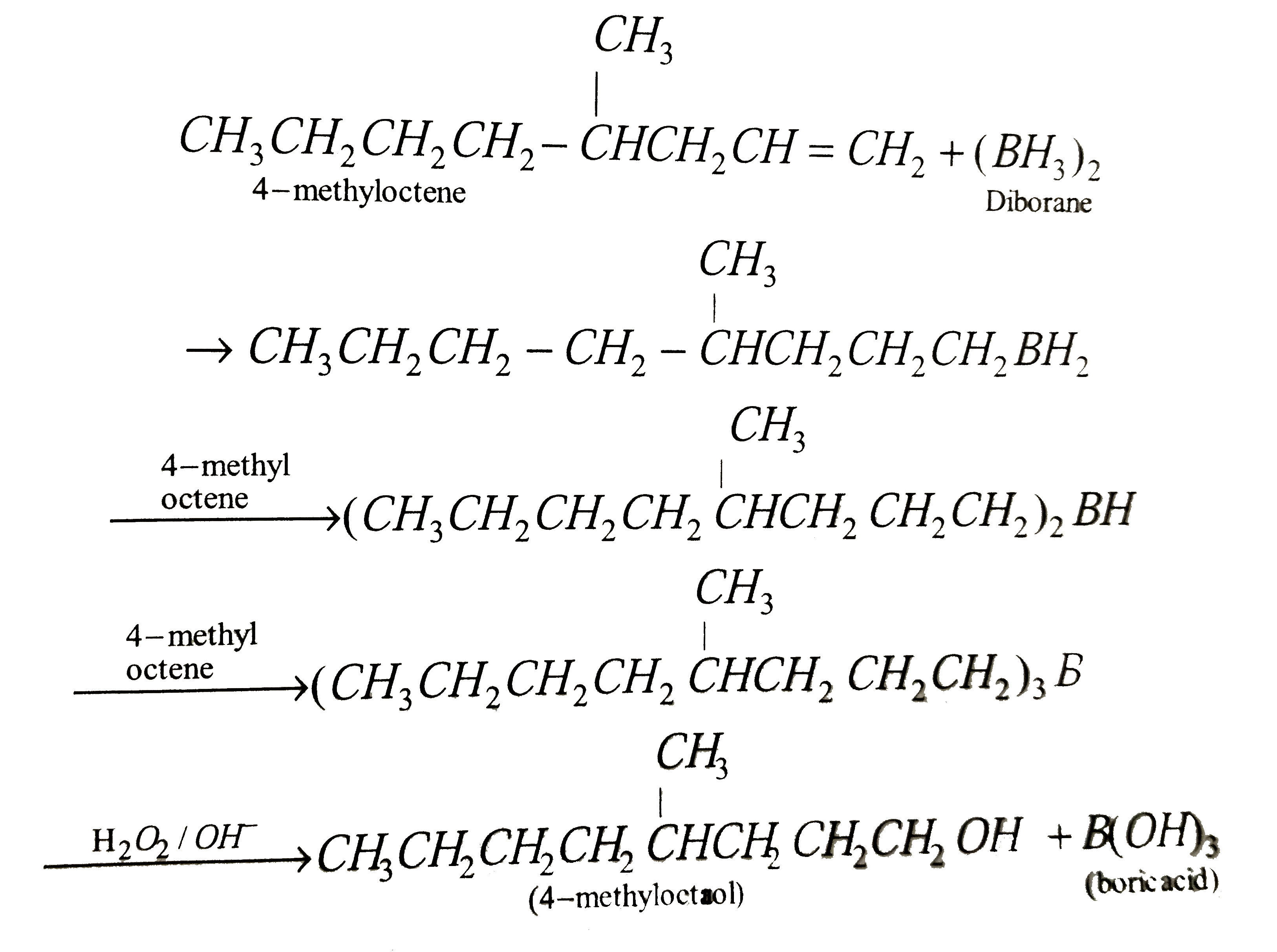 The overall result of the above reaction, appears to be anti-Markownkoff's addition of WATER (hydration) to a double BOND (Hydroboration oxidation ) |
|
| 47. |
Hydroboration oxidation of 3-methyl but-1-enegives |
|
Answer» 3-methylbutan-2-ol |
|
| 48. |
Hydroboration - oxidation method is used for the preparation of |
|
Answer» ethers. |
|
| 49. |
Hydrobenzene is formed when nitrobenzene is reduced with |
|
Answer» `ZN//HCl` |
|
| 50. |
Hydroazobenzene on treatement with H_(2)SO_(4) gives |
|
Answer» Azobenzene  
|
|