

Saved Bookmarks
This section includes 7 InterviewSolutions, each offering curated multiple-choice questions to sharpen your Current Affairs knowledge and support exam preparation. Choose a topic below to get started.
| 1. |
How would you determine the reduction potential of Zn//Zn^(2+)(aq)? |
Answer» Solution :(i) CONSIDER the zinc electrode dipped in zinc sulphate solution using SHE 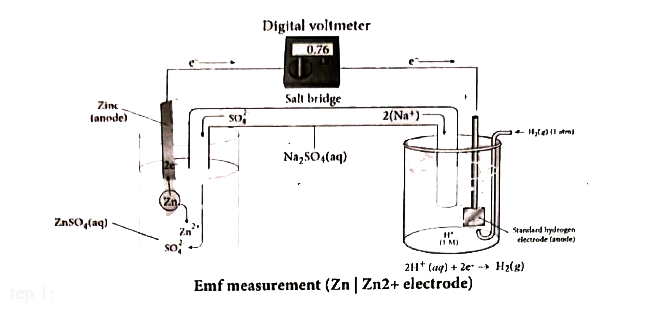 (ii) Step 1 : The following GALVANIC cell is constructed using SHE `Zn_((s))|Zn_((aq.1M))^(2+)||H_((aq.1M))^(+)|H_(2(G, 1 atm))|Pt_((s))` (iii) Step 2: The emf of the above galvanic cell is measured using a voltmeter. In this case the measured emf of the above galvanic cell is 0.76 V . (iv) Calculation: We know that, `E_("cell")^(@) = (E_("ox")^@)_(Zn//Zn^(2+)) + (E_("red")^(@))_(SHE)` `:. E_("cell")^(@) = 0.76 + 0V` `= 0.76 V` The oxidation potential corresponds to the below mentioned HALF cell reaction which takes place at the cathode. `Zn to Zn^(2+) + 2e^(-)` (oxidation) (v) The emf of the reverse reaction will GIVE the reduction potential `Zn^(2+) + 2e^(-) to Zn "" (E_("cell")^@)_(Zn^(2+)|Zn) = - 0.76V` |
|
| 2. |
How would you determine the standard electrode potential of the system (Mg^(2+) )/ Mg? |
| Answer» Solution :We have to set up a half cell in which MAGNESIUM WIRE is dipped in 1 M magnesium sulphate solution. Couple this electrode which STANDARD hydrogen electrode and measure the EMF of the cell so formed. SINCE the SINGLE electrode potential of SHE is zero, the measure EMF will be the standard single electrode potential of `Mg^2+(aq)/Mg` system. Since oxidation occurs at the magnesium electrode, its standard electrode potential will have negative sign | |
| 3. |
How would you determine the standard electrode potential of the system Mg^(2+) Mg? |
|
Answer» Solution :A CELL consisting of `Mg | MgSO_(4)` (1 M) as ONE electrode (by dipping a magnesium wire in 1 M `MgSO_4` solution) and standard hydrogen electrode Pt, `H_(2)` (1 atm) | `H^(+)` (1 M)as the second electrode is set up and emf of the cell and the DIRECTION of deflection in voltmeter are noted. The direction of deflection shows that electrons flow from magnesium electrode to hydrogen electrode, i.e., oxidation takes place on magnesium electrode and reduction on hydrogen electrode. The cell may be represented as follows : `Mg | Mg^(2+) (1 M) || H^(+) (1 M) | H_(2)`, (1 atm), Pt or `E_("cell")^(@) = E_(H^(+)//1//2H_(2)) -E_(Mg^(2+)//Mg)^(@)` Put `E_(H^(+)//1//2H_(2)O) =0` Hence, `E_(Mg^(2+)//Mg)^(@) =-E_("cell")^(@)` |
|
| 4. |
How would you determine the standard electrode potential of Mg^(2+)|Mg? |
|
Answer» Solution :We will SET up a cell consisting of `Mg|MgSO_(4)(1M)` as one electrode (by dipping a magnesium wire in 1M `MgSO_(4)` solution) and standard hydrogen electrode Pt, `H_(1)` (1 atm) `H^(+)|(1M)` as the second electrode and measure the EMF of the cell and also note the DIRECTION of deflection in the voltmeter. the direction of deflection shows that electronsf low from magnesium electrode to hydrogen electrode, i.e., oxidation TAKES PLACE on magnesium electrode and reduction on hydrogen electrode. Hence, the cell may be represented as: `Mg|Mg^(2+)(1M)||H^(+)(1M)|H_(2),(1atm),Pt` `E_(cell)^(@)=E_(H^(+),1//2H_(2))^(@)-E_(Mg^(2+),Mg)^(@)` put `E_(H^(+),1//2H_(2))^(@)=0` Hence, `E_(Mg^(2+),Mg)^(@)=-E_(cell)^(@)`. |
|
| 5. |
How would you convert the given compounds into benzene ? Ethyne |
Answer» SOLUTION :
|
|
| 6. |
How would you convert prop-1-yne to propanone? |
Answer» SOLUTION :PROP - 1- lyne on hydrolysis with `HgSO_4` and `H_2SO_4`gives propanone as PRODUCT. 
|
|
| 7. |
How would you convert propanenitrile to propanamine? |
|
Answer» Solution :PROPANENITRILE on reduction with LIALH4 GIVES PROPANAMINE. ` underset("Propanenitrile")(CH_3CH_2 CN +4 [H] ) overset(LiAIH_4)tounderset("1-Propanamine")(CH_3 CH_2 CH_2NH_2)` |
|
| 8. |
How would you convert Nitroethane to ethanamine? |
| Answer» SOLUTION :`UNDERSET("Nitro ETHANE")(CH_(3)-CH_(2)NO_(2))underset(6[H])overset(3H_(2)//Ni)(to)underset("Ethanamine")(CH_(3)-CH_(2))NH_(2)+2H_(2)O` | |
| 9. |
How will you convert methanamine into ethanamine? |
|
Answer» SOLUTION :`CH_3NH_2 + HNO_2 RARR CH_3OHoverset(PCl_5)rarr` `CH_3Clrarroverset(KCN)CH_3C EQUIV overset(Na/C_2H_5OH)underset(4[H])rarr `CH_3CH_2NH_2` |
|
| 10. |
How would you convert ethylene glycol into ethene? |
Answer» SOLUTION :
|
|
| 11. |
How would you convert : (i) Aniline to nitrobenzene , (ii) Aniline to iodobenzene ? |
|
Answer» Solution :`(i) C_(6)H_(5)NH_(2)OVERSET(NaNO_(2)+HCI)underset(273K)(rarr)C_(6)H_(5)N_(2)+CI^(-) overset((i)HBF_(4))underset((ii)NaNO_(2)//CuDelta)(rarr)C_(6)H_(5)NO_(2)` (ii) `C_(6)H_(5)NH_(2)overset(NaNO_(2)+HCI)underset(273K)(rarr)C_(6)H_(5)N_(2)+CI^(-)overset(KI)(rarr)C_(6)H_(5)I` |
|
| 12. |
How would you convert ethanol to ethene? (i) Phenol to benzoquinone (ii) Propanone to 2-methylpropan-2-ol (iii) Propene to propan-2-ol |
Answer» Solution :(i) PHENOL to benzoquinone :  (iii) Propene to PROPAN -2- OL : `underset("Propene")(CH_(3)-CH=CH_(2)) overset(H_(2)O, H^(+))rarr underset("Propan-2-ol")(CH_(3)-overset(OH)overset("|")"CH"-CH_(3))` |
|
| 13. |
How would you convert Acetaldoxime into Nitroethane? |
|
Answer» SOLUTION :OXIDATION of acetaldoxime and with trifluoro peroxy ACETIC acid gives nitroethane. `underset("Acetaldoxime")(CH_(3)-CH=NOH )underset([O])overset(CF_(3)COOOH)(to) underset("Nitroethane")(CH_(3)-CH_(2)NO_(2))` |
|
| 14. |
How would you convert chlorobenzene to aniline? |
|
Answer» SOLUTION :When CHLOROBENZENE is heated with alcoholic ammonia, aniline is obtained. `underset("chloro benzene")(C_(6)H_(5)-Cl) underset(Cu_(2)"O"//200^(@)C)overset(NH_(3))(to) underset("Aniline")(C_(6)H_(5)NH_(2))+HCl` |
|
| 15. |
How would you calculate the order of the reaction 2NO_((g))+O_(2(g))rarr2NO_(2(g)) by an experiment ? (or) prove that 2NO+O_2rarr2NO_2 is a third order reaction. |
|
Answer» Solution :`2NO_((g))+O_(2(g))rarr2NO_(2(g))` Series of EXPERIMENTS are conducted by keeping the CONCENTRATION of one of the reactants as constant and changing the concentration of the others.  Rate `=k[NO]^m[O_2]^n` For experiment 1, the rate law is `"Rate"_1= k [NO]^m[O_2]^n""...(1)` `19.26xx10^(-2)=k[1.3]^m[1.1]^n` For experiment 2 `"Rate"_2= k [NO]^m[O_2]^n""...(2)` `38.40xx10^(-2)=k[1.3]^m[2.2]^n` For experiment 3 `"Rate"_3= k [NO]^m[O_2]^n""...(3)` `76.8xx10^(-2)=k[1.3]^m[2.2]^n` `((2))/((1))IMPLIES(38.40xx10^(-2))/(19.26xx10^(-2))=(k[1.3]^m[2.2]^n)/(k[1.3]^m[1.1]^n)` `2=((2.2)/(1.1))^n` `2=2^nimpliesn =1 ` Therefore the reaction is FIRST order respect to `O_2` `((3))/((2))implies(76.8xx10^(-2))/(19.26xx10^(-2))=(k[2.6]^m[1.1]^n)/(k[1.3]^m[1.1]^n)` `4=((2.6)/(1.3))^n` `4 =2^m implies m = 2` Therefore the reaction is second order with respect to NO The rate law is `"Rate "_1 =k[NO]^2[O_2]^1` The overall order of the reaction = 2+1=3 |
|
| 16. |
How would you calculate the solubility of sparingly soluble salt using Kohlrausch's law? |
|
Answer» Solution :(i) SUBSTANCES like `AgCl, PbSO_4` are sparingly soluble in water. The solubility PRODUCT can be determined using conductivity experiments. (ii) Let us CONSIDER AgCl as an example `AgCl_((s)) (iii) Let the concetration of `[Ag^+]` be `.C.` mol `L^(-1)` If `[Ag^+] = C`, then `[Cl^-]`is also equal to C mol `L^(-1)` `:. K_(sp) = C.C` `K_(sp) = C^2` (iv) The relationship between molar conductance and equivalent conductance is `Lambda_@ = (K xx 10^(-3))/(C (mol L^(-1))) (or ) C = (k xx 10^(-3))/(Lambda^@)` Substitute the concentration value in the relation `K_(sp) = C^2` `K_(sp) = [(k xx 10^(-3))/(Lambda^@)]^(2)`. |
|
| 17. |
How would you calculate crystal field stabilization energy (CBSE) for [Fe(H_(2)O_(6)]^(3+). |
Answer» SOLUTION :Complex : `[Fe(H_(2)O)_(6)]^(3+)` 
|
|
| 18. |
How would you bring the following conversions? (i) Ethylamine to ethyl alcohol. (i) Acetic acid to methylamine. (iii) Propionamide to ethylamine. (iv) Ethyl chloride to n-propylamine (in 2 steps). (v) Ethyl amine to ethyl isocyanide. (vi) Ethyl alcohol to methylamine. (vii) Acetic acid to ethylamine. (viii) Ethylamine to methylamine. (ix) Methylamine to ethylamine. (x) Ethylamine from CH3 OH (3 steps). (xi) n-Butylamine from propene (3 steps). (xii) Isopropylamine from acetone. (xii) Acetic acid into dimethylamine. |
Answer» SOLUTION :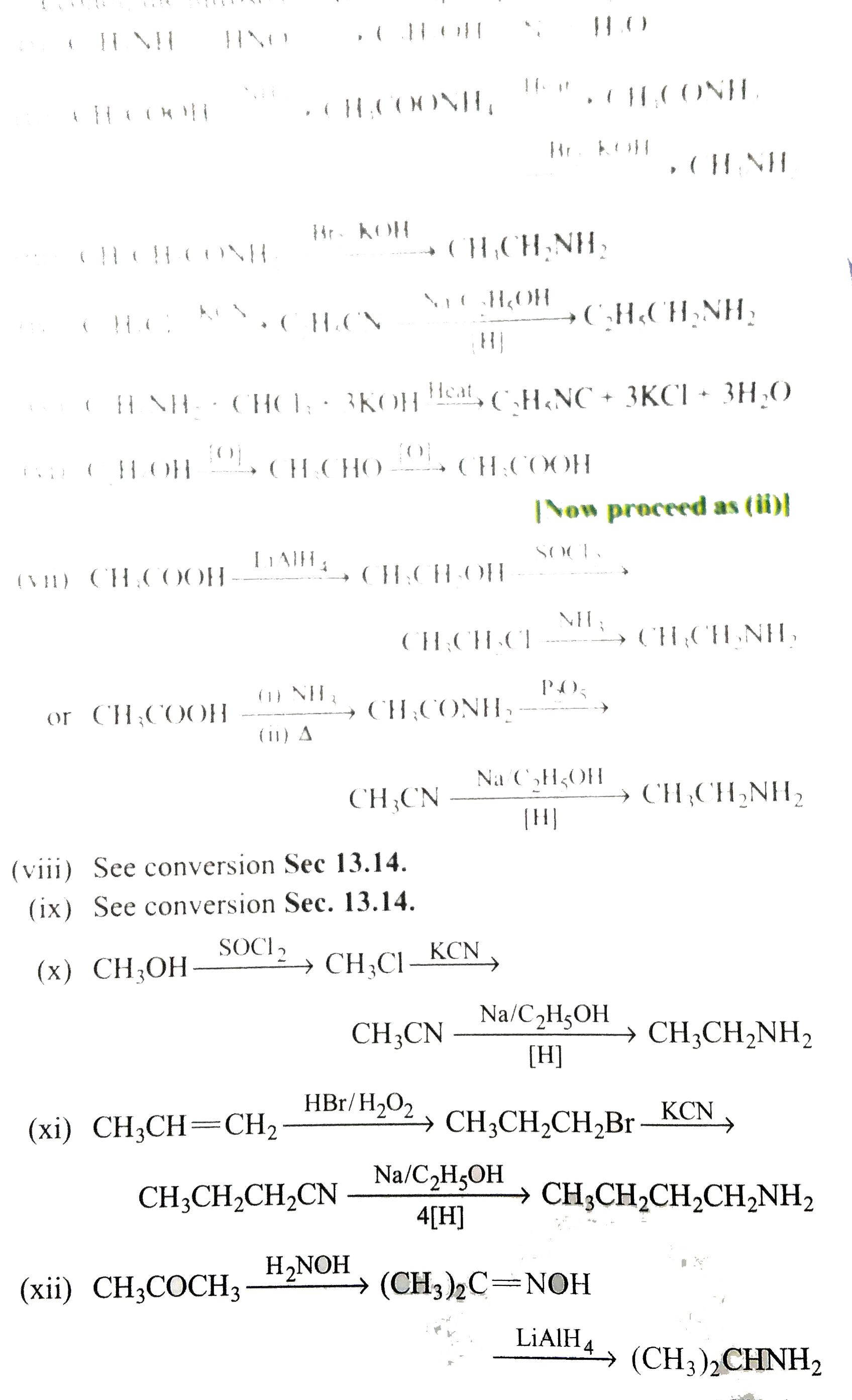 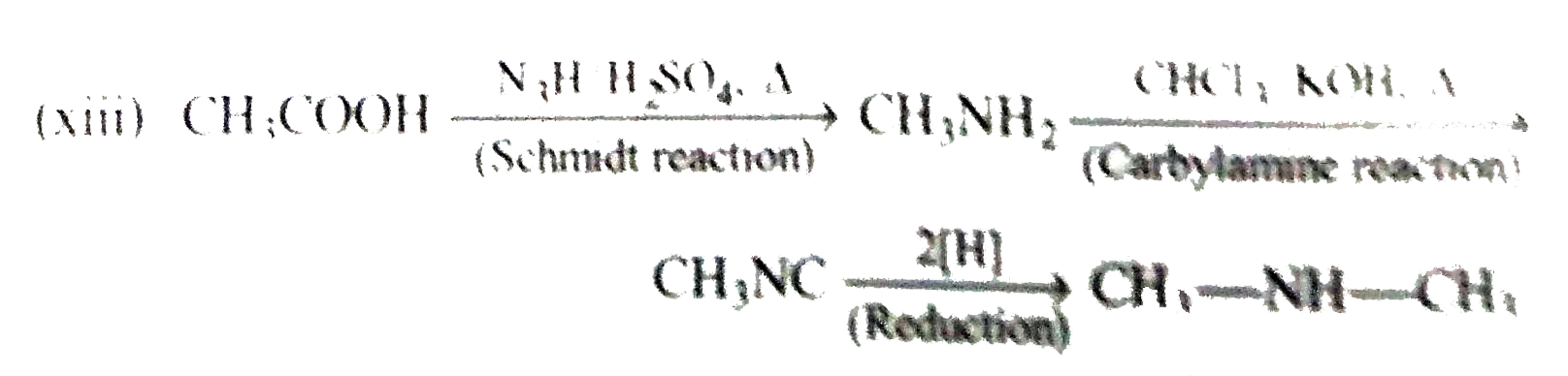
|
|
| 19. |
How would you bring about the following conversions : (i) Propanal to butanone ? (ii) Benzaldehyde to benzophenone ? (iii) Benzoyl chloride to benzonitrile ? |
Answer» Solution : The following steps are INVOLVED in the conversions :  (III) `underset("Benzoyl chloride")(C_(6)H_(5)COCl) overset(NH_(3))underset("Heat")to underset("BENZAMIDE")(C_(6)H_(5)COONH_(2)) overset(P_(2)O_(5))underset("heat")to underset("Benzonitrile")(C_(6)H_(5)C -=N)` |
|
| 20. |
How would you bring about the following conversions ? (i) Ethanal to 2-hydroxy-3-butenoic acid (ii) 2-methyl propanal to (iii) 2-butanone from ethyl alcohol (iv) 3-hexanon from n-propyl alcohol |
Answer» SOLUTION :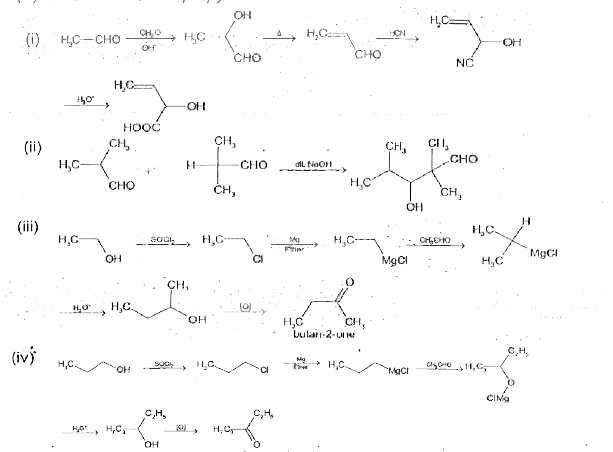
|
|
| 21. |
How would you bringaboutthe followingconversions ?(i) Propionicacidto ethylamine . (ii) Ethyl bromide to succinic acid . (ii) Acetic acid to acetadehyde . |
Answer» SOLUTION :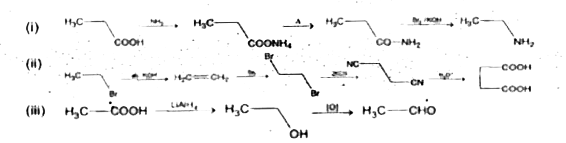
|
|
| 22. |
How would you achieve the following conversions: (i) Nitrobenzene to aniline (ii) An alkyl halidde to a quarternary ammonim salt. (iii) Aniline to benzonitrile. |
Answer» Solution : 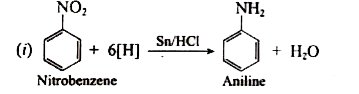 (ii) `UNDERSET("Chloroethane")(C_(2)H_(5)Cl)+NH_(3)tounderset("Ethanamine")(C_(2)H_(5)NH_(2))overset(C_(2)H_(5)Cl)(to) underset(N-"Ethylethanamine")((C_(2)H_(5))_(2)NH)overset(C_(2)H_(5)Cl)(to)` `underset("N,N-Diethyl ethanamine")((C_(2)H_(5))_(3)N)overset(C_(2)H_(5)Cl)(to)underset("TETRAETHYL Ammonium chloride")((C_(2)H_(5))_(4)N^(+)C^(-))` 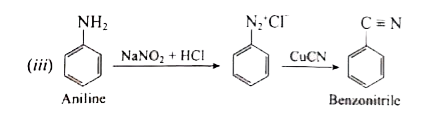
|
|
| 23. |
How would you account for the irregular variation of ionizationenthalpies ( first and second) in first series of the transition elements ? |
|
Answer» Solution :Irregular variation of FIRST ionization enthalpy . On movingfrom left to right along the first transiotn series,at effective nuclear charge increases, it is expected in general that the first ionization enthapy should show an increasing trend. However, the trend is irregular because removal of the electorn alters the relative energies of 4ss and 3d orbitals. thus, there is a reorganisation energy accompanying ionization. This results into the release of exchange energy which increases as the number of electrons increases in the `d^(n)` CONFIGURATION and also from the transference of s-electrons ito d-orbitals. Cr has low first ionization energy because loss of one electron GIVES stable ELECTRONIC configuratin`(3D^(5))` . ZN has very high ionization energy because electronhas to be removed from 4s orbital of the stalbe configuration `( 3d^(10) 4s^(2))`. Irregularities of second ionization enthalpy. After the loss of one electron, the removal of scond electron becomes difficult, Cr and Cu show much highervalues because the second electron has to be removed from the stable configurations of `Cr^(+) ( 3d^(5))` and `Cu^(+) ( 3d^(10))` |
|
| 24. |
How would you account for the irregular variation of ionisation enthalpies (first and second) in the first series of transition elements? |
| Answer» Solution :The removal of one ELECTRON from the METAL atom alters the relative energies of 4s and 3d orbitals. there will be a reorganisation of energy.after ionisation. It is not found to be REGULAR for 3d elements. It is mainly due to the varying degree of STABILITY ofilifferent 3d configuration. For example, .if ions formed by ionisation has `d^0,d^5ord^10` .configuration, the ionisation enthalpy will be LOWER than expected, | |
| 25. |
How would you account for the irregular variation of ionisation enthalpies (first and second) in the first series of the transition elements? |
|
Answer» Solution :First ionisation enthalpy : As we move from left to right, it is EXPECTED in general that the first ionisation enthalpy should show an increasing trend. However, the trend is irregular because removal of the electron alters the relative energies of 4s and 3d orbitals. THUS, there is a reorgani-sation energy accompanying ionisation. This results into the release of exchange energy which increases as the number of electrons increases in the d-orbitals and also from the transference of s-electrons into d-orbitals. CR has low first ionisation energy because loss of one electron gives stable electronic configuration `(3d^(5))`. Zn has very high ionisation energy because electron is removed from 4s orbital of the stable configuration `(3d^(10)4s^(2))`. Half-filled and fully filled configurations are more stable than others. Second ionisation enthalpy : After the loss of one electron, the removel of second electron becomes MUCH more difficult. HENCE, second ionisation enthalpies are much higher and in general increase from left to right. However, Cr and Cu show much higher values because the second electron has to be removed from the stable configurations of `Cr^(+)(3d^(5))` and `Cu^(+)(3d^(10))`. |
|
| 26. |
How would you account for the irregular variation of ionisation enthalpies (first and second) in the first series of the transition elements ? |
|
Answer» Solution :First ionisation enthalpy : On moving from left to right along the first transition series, the first ionisation enthalpy `(IE_(1))` is expected to increase. In practice the TREND is irregular, because removal of one electron alters the relative energies of 4s and 3d orbitals. So the UNIPOSITIVE ions have `3d^(n)` configuration (instead of `3d^(n)4s^(1)`) with no 4s - electron. Thus there is a reorganisation energy accompanying ionisation with the transference of 4s electrons into 3d - orbitals. Cr and Cu has relatively LOW first ionisatio enthalpy, because loss of one electron gives stable electronic configurations `3d^(5)` and `3d^(10)`, respectively. Zn has very HIGH ionisation enthalpy because one 4s electron is to be removed from stable configuration `3d^(10)4s^(2)`. Second ionisation enthalpy : Second ionisation enthalpies are much higher because removal of second electron from positively CHARGED species becomes difficult. In general, 2nd ionisation enthalpy increases from left to right. However, Cr and Cu have much higher values because 2nd electron is to be removed from the stable configuration of `Cr^(+)(3d^(5))` and `Cu^(+(3d^(10))`. The value for Zn is sufficiently low because the ionisation involves attainment of stable electronic configuration `(3d^(10)4s^(1)to 3d^(10)4s^(0))`. |
|
| 27. |
How would you account for the increasing oxidising power in the series VO_(2)^(+) lt Cr_(2)O_(7)^(2-) lt MnO_(4)^(-) ? |
| Answer» Solution :This is DUE to the INCREASING STABILITY of the LOWER species to which they are reduced. | |
| 28. |
How would you account for the following: XeF_2 is a linear molecule without a bend. |
Answer» Solution :` XeF_2`, in fact is a trigonal bipyramidal molecule, with three equitorial positions being occupied by lone pair of electrons and two FLUORINE ATOMS occupying axial position. This is to REDUCE the REPULSIONS between the lone pairs and bond pairs. The STRUCTURE is given below : 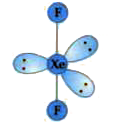
|
|
| 29. |
How would you account for the following ? The value of electron gain enthalpy with negative sign for sulphur is higher than that for oxygen. |
|
Answer» Solution :Because of COMPACT nature of oxygen atom, it has lower value of electron GAIN enthalpy than sulphur. In other WORDS, sulphur has higher value of electron gain enthalpy than oo oxygen. A smaller atom OFFERS greater repulsion to the added electron. |
|
| 30. |
How would you account for the following ? The electron gain enthalpy with negative sign is less for oxygen than that of sulphur. |
|
Answer» (ii) Hence the incoming ELETRONS are not accepted with the same ease as in case of SULPHUR as it has relatively large size. |
|
| 31. |
How would you account for the following: The N-O bondin NO_2^(-) is shorter than the N-O bond in NO_3^(-). |
| Answer» SOLUTION :One of the bonds in `NO_2^(-)` is N=O, while the bonds in `NO_3^(-)` are N-O bonds. A DOUBLE bond is always SHORTER than the SINGLE bond. | |
| 32. |
How would you account for the following: The electron gain enthalpy with negative sign for fluorine is less than that for chlorine, still fluorine is a stronger oxidising agent than chlorine. |
|
Answer» Solution :Fluorine is upper in the Group 17 than Cl. Therefore F is a more ELECTRONEGATIVE and hence stronger oxidising agent than CHLORINE. But the ELECTRON gain enthalpy with negative sign for fluorine is less than that for chlorine. This is because fluorine ATOM being smaller cannot accommodate more electrons easily due to inter-electronic repulsions. Hence less energy is released with `F_2` |
|
| 33. |
How would you account for the following? (i) Transition metals exhibits variable oxidation state. (ii) Zr(Z=40) and Hf(Z=72) have almost identical radii. (iii) Transition metals and their compounds act as catalyst. OR Complete the following chemical equation: (i)Cr_(2)O_(7)^(2-)+6Fe^(2+)+14H^(+)rarr (ii) CrO_(4)^(2-)+2H^(+)rarr (iii) 2MnO_(4)^(2-)+5C_(2)O_(4)^(2-)+16H^(+)rarr |
|
Answer» |
|
| 34. |
How would you account for the following: Sulphur in vapour state exhibits paramagnetism. |
|
Answer» Solution :In the VAPOUR state sulphur exists as `S_2` and not as `S_8`. The electronic configuration of S is : `3s^2 3p^(2) x 3p^1 y 3p^(1) Z ` There are 2 unpaired ELECTRONS in antibonding `pi**` ORBITALS due to which it is paramagnetic. |
|
| 35. |
How would you account for the following ? NF_3 is an exothermic compound but NCI, is endothermic compound. |
| Answer» SOLUTION : HEAT is evolved when N and F react to form `NF_3`. However heat is absorbed when N and Cl react to form `NCl_3`. | |
| 36. |
How would you account for the following:NCI_3 is an endothermic compound while NF_3 is an exothermic one. |
| Answer» SOLUTION :HEAT is ABSORBED when `NCl_3` is FORMED from `N_2 and Cl_2`. Heat is EVOLVED when `NF_3` is formed from `N_2 and F_2.` | |
| 37. |
How would you account for the following? (i) The highest oxidation state of a transition metal is usually exhibited in its oxide. (ii) The oxidising power of the following three oxo ions in the series follows the order : VO_(2)^(+)ltCr_(2)O_(7)^(2-)ltMnO_(4)^(-) |
|
Answer» Solution :(i) Because OXYGEN HA small size and high ELECTRO negaitivity .Hence they can oxidize the metal to the highest oxidation state (ii) See Q 29 (b) (i) SET I (O.D)-2010 |
|
| 38. |
How would you account for the following ? (i) The atomic radii of the metals of the third (5d) series of transition elements are virtually the same as those of the corresponding members of the second (4d) series. (ii) The E^(@) value for the Mn^(3+)//Mn^(2+) couple is much more positive than that for Cr^(3+)//Cr^(2+) couple or Fe^(3+)//Fe^(2+) couple. (iii) The highest oxidation state of a metal is exhibited in its oxide or fluoride. |
|
Answer» Solution :(i) This is due to intervention of 4f ORBITALS which must be filled before the 5d series of elements BEGIN. The filling of 4f before 5d results in a regular decrease in atomic radii called lanthanoid contraction, which compensates for the expected increase in atomic size with increasing atomic NUMBER. The net result is that second and third d series exhibit similar radii. (ii) More positive `E^(@)` value for `Mn^(3+)//Mn^(2+)` is due to particularly stable `Mn^(2+)(d^(5))` (half-filled) configuration. Low value for Fe is due to extrastability of `Fe^(3+)(d^(5))` and therefore lower stability of `Fe^(2+)`. Similarly `E^(@)` value for `Cr^(3+)//Cr^(2+)` is lower because of lower stability of `Cr^(2+)`. (iii) This is because oxygen and fluorine are most electronegative elements. They have the maximum capacity to WITHDRAW electrons from the metals to ENABLE them to exhibit the maximum oxidation state. |
|
| 39. |
How would you account for the following : (i) The electron gain enthalpy with negative sign is less for oxygen than that for sulphur. (ii) Phosphorus shows greater tendency for catenation than nitrogen. (iii) Fluorine never acts as the central atom in polyatomic interhalogen compounds. |
|
Answer» Solution :(i) Electron gain enthalpy with NEGATIVE sign is less for OXYGEN than for sulphur because of small size of oxygen atom, when an electron is added interelectronic repulsion increases hence, addition of electron in sulphur is favoured. (ii) Phosphorus SHOWS greater TENDENCY for catenation than nitrogen because of high bond enthalpy values. The `P - P` single bond STRENGTH greater than `N - N` single bond strength. (iii) Fluorine never acts as the central atom in polyatomic interhalogen compounds because of its high electronegativity and high ionisation energy. |
|
| 40. |
How would you account for the following: (i) The atomic radii of the metals of the third (5d) series of transition elements are virtually the same as those of the corresponding members of the second (4d) series. (ii) The E^0 value for the Mn^(3+)//Mn^(2+) couple is much more positive than that for Cr^(3+)//Cr^(2+)couple or Fe^(3+)//Fe^(2+)couple. |
|
Answer» Solution :(i) Due to lanthanoid contraction OR its MEANING, (ii) Due to STABLE half-filled `3d^5` CONFIGURATION of `MN^(2+)// "high " 3^(rd)` ionisation enthalpy of Mn. |
|
| 41. |
How would you account for the following: (i) Sulphur hexafluoride is less reactive than sulphur tetrafluoride. (ii) Of the noble gases only xenon forms known chemical compounds. |
|
Answer» Solution : (i) `SF_6` is more stable DUE to LESS repulsion in `SF_6` as compared to `SF_4` (II) It is due to large atomic SIZE and high polarisability of Xenon. Xenon has comparatively smallionisation ENTHALPY. |
|
| 42. |
How would you account for the following ? (i) Of the d^(4) species , Cr^(2+) is strongly reducting while manganese (III) is strongely oxidizing. (ii) Cobalt (III) is stable in aqueous solution but in the presence of complexingreagents , it is easily oxidized. (iii) The d^(1) configuration is very unstable in ions. |
|
Answer» Solution :(i) Refer to page (ii) CO(III)has GREATER tendency to form coordination complexes than Co(II). Hence, in the PRESENCE of ligands, C(II) changes to Co(III) , i.e., is easily oxidized. (iii) The IONS with `d^(1)` configuration have the tendency to losethe only electron present in d-subshell to acquire stable `d^(0)` configuration .Hence, they are unstable and undergo oxidationor disproportionation. |
|
| 43. |
How would you account for the following : (i) Phenols are much acidic than alcohols. (ii) The boiling points of ethers are much lower than those of alcohols of comparable molecular measses. |
Answer» SOLUTION :(i) It is because PHENOXIDE ion is more stable than alkoxide ion, on account of resonance  (ii) It is because ALCOHOLS are associated due to INTERMOLECULAR hydrogen bonding whereas ethers are not. `-H-underset(R)underset(|)O"- - - -"H-underset(R)underset(|)O"- - - -"H-underset(R)underset(|)O"- - - -"` |
|
| 44. |
How would you account for the following: (i) Of the d^(4) species, Cr^(2+) is strongly reducing while manganese (III) is strongly oxidising. (ii) Cobalt (II) is stable in aqueous solution but in the presence of complexing reagents it is easily oxidised. (iii) The d^(1) configuration is very unstable in ions |
|
Answer» Solution :(i) Since `Cr^(2+)` is reducing its configuration CHANGES to `d^(3)" from " d^(4).d^(3)` configuration is half filled `t_(2g)` which is stable in aqueous solution. `Mn^(3+)` is oxidizing, its configuration changes to `d^(5)` from `d^(4).d^(5)` is EXTRA stable as it is half-filled. (ii) Co(II) gets oxidized to Co(III) easily because in presence of strong field ligands, teh electrons get paired up forming diamagnetic octahedral complexes. These complexes are highly stable due to high CFSE. (iii) `d^(1)` configuration is highly unstable because after losing one `E^(-)`, the stable configuration `(d^(0))` is attained or such species will UNDERGO disproportionation reaction. For example. `{:(3MnO_(4)^(2-),+,4H^(+),rarr,2MnO_(4)^(-),+,MnO_(2),+,2H_(2)O),((+6),,,,(+7),,(+4),,),((d^(1)),,,,(d^(0)),,,,):}` |
|
| 45. |
How would you Account for the following: (i) Of the d^4 species, Cr^(2+) is strongly reducing while manganese (III) is strongly oxidising, (ii) Cobalt (II) is stable in aqueous solution but in the presence of complexing reagents, it is easily oxidised. (iii) The d^1 configuration is very unstable in ions. |
|
Answer» Solution :(i) `E^0` vlaue for `Cr^(3+)//Cr^(2+)` is negative (-0.41 V) whereas `E^0` value for `Mn^(3+)//Mn^(2+)` is positive(+1.57V). Thus, `Cr^(2+)` ions can easily undergo oxidation to give `Cr^(3+)` ions and, therefore, acts as strong reducing agent. On the other hand, `Mn^(3+)` can easily undergo reduction to give `Mn^(2+)` and hence act as oxidising agent (ii) Co (III) has greater tendency to form co-ordination complexes than Co (II). Thus, in the PRESENCE of ligands, Co (II) changes to Co (III). i.e., is easily oxidised (iii) The ions with `d^1` configuration have the tendency to lose the only ELECTRON present in d-subshell to acquire stable `d^0` configuration. Therefore, they are UNSTABLE and undergo oxidation or DISPROPORTION. |
|
| 46. |
How would you account for the following : (i) Of the d^(4) species, Cr^(2+) is strongly reducing while manganese (III) is strongly oxidising ? (ii) Cobalt (II) is stable in aqueous solution but in the presence of complexing reagents, it is easily oxidised ? (iii) The d^(1) configuration is very unstable in ions. |
|
Answer» Solution :(i) `E^(@)`value for `CR^(3+)//Cr^(2+)` is negative `(-0.41" V")`, whereas `E^(@)` value for `Mn^(3+)//Mn^(2+)` is positive `(+1.57" V")`. Hence, `Cr^(2+)` ions can easily undergo oxidation to give `Cr^(3+)` ions and, therefore, acts as strong REDUCING agent. On the other hand, `Mn^(3+)` can easily undergo reduction to give `Mn^(2+)` and hence acts as oxidising agent. (ii) CO (III) has greater tendency to form coordination complexes than Co (II). Hence, in the presence of ligands, Co (II) changes to Co (III), i.e., is easily oxidised. (iii) The ions with `d^(1)` configuration have the tendency to lose the only electron present in d-subshell too acquire stable `d^(0)` configuration. Hence, they are unstable and undergo oxidation or disproportionation. |
|
| 47. |
How would you account for the following. (i). Of the d^4 species. Cr^(2+) is strongly reducing while manganese (III) is strongly oxidising. (ii). Cobalt (II) is stable in aqueous solution but in the presence of complexing reagents it is easily oxidised. (iii). The d^1 configuration is very unstable in ions. |
|
Answer» Solution :(i). `E^(ɵ)` value for `((Cr^(3+))/(Cr^(2+)))` is negative `(-0.41V)` whereas `E^(ɵ)` value for `((Mn^(3+))/(Mn^(2+)))` is positive `(+1.57V)`. Hence `Cr^(2+)` ions can easily undergo oxidation to GIVE `Cr^(3+)` ions and THEREFORE, act as STRONG reducing agent whereas `Mn^(2+)` can easilyundergo reduction to give `Mn^(2+)` and hence act as oxidising agent. (ii). `Co^(3+)` has greater tendecny to form coordination complexes than `Co^(2+)`. Hence in the presence of ligands `Co^(2+)` changes to `Co^(3+)` i.e., is easily oxidised. (iii) The ions with `d^1` configuration have the tendency to lose the only ELECTRON present in d-subshell to acquire stable `d^0` configuration. Hence, they are UNSTABLE and undergo oxidation or disproportionation. |
|
| 48. |
How would you account for the following ? (i) Many of the transition elements are known to form interstitial compounds. (ii) The metallic radii of the third (5d) series of transition metals are virtually the same as those of the correponding group members of the second (4d) series. (iii) Lanthanoids from primarily +3 ions, while the actinoids usuallyhave higher oxidation states in their compounds , +4 or even +6 being typical. |
|
Answer» Solution :Many of the transition elementare known to FORM interstial compounds. Transition elements form intensitial compounds as they are capable of entrapping small atoms like H,C or N in the interstitial sites in their crystalLattice. (ii) The metallicradii of the third (5d) series of the transitionmetals are virtuallythe same as those of the corresponding GROUP memebers of the second (4d) series. This is due to filling 4f orbitals which have poor shielding effect or due to lanthanoid CONTRACTION. (iii) This is attributed to the fact that5f, 6d and 7S levels are of comparable energies in case of actionoids. Hence all these three subshells can participate on bonding. |
|
| 49. |
How would you account for the following ? (i) Many of the transition elements are known to form interstitial compound ? (ii) The metallic radii of third (5d) series of transition metals are virtually the same as those of the corresponding group member of second (4d) series. (iii) Lanthanoids form primarily +3 ions while the actinoids usually have higher oxidation state in their compounds, +4 or even +6 being typical. |
|
Answer» Solution :(i)N/A (ii) N/A (iii) In the elements belonging to Actionids series 5f, 6d and 7S orbitals have comparable enegies and the electrons present in these orbitals can TAKE part in the bond FORMATION to SHOW higher OXIDATION states. |
|
| 50. |
How would you account for the following ? (i) Many of the transition elements are known to form interstitial compounds. (ii) The metallic radii of the third (5d) series of transition metals are virtually the same as those of the corresponding group members of the second (4d) series (iii) Lanthanoids from primarily +3 ions, while the actinoids +1 usually have higher oxidation state in their compounds ,+4 or even +6beingtypical. |
|
Answer» |
|