

Saved Bookmarks
This section includes 7 InterviewSolutions, each offering curated multiple-choice questions to sharpen your Current Affairs knowledge and support exam preparation. Choose a topic below to get started.
| 1. |
How would you account for the following ? (i) Hydrogen fluoride is much less volatile than hydrogen chloride. (ii) Interhalogen compounds are strong oxidising agents. |
| Answer» SOLUTION :(i) It is because HF molecules are ASSOCIATED due to INTERMOLECULAR H-bonding while HCI is not. (II) It is due to low bond dissociation energy compared to halogens which is due to less effective overlapping. | |
| 2. |
How would you account for the following : (i) Among lanthanoids,Ln(III) compounds are predominant. However,occasionally in solution or in solid compound,+2 and +4 ions are also obtained. (ii) The E_(M^(2)//M)^(@) for copper is positive (0.34 V) copper is the only metal in the first series of transition elements showing this behaviour. (iii) The metallic radii of the third (5d) series of transition metals are nearly the same as those of the corresponding member of the second series. |
|
Answer» |
|
| 3. |
How would you account for the following : (i) H_(2)S is more acidic than H_(2)O ? (ii) The N - O bond in NO_(2)^(-) is shorter than the N - O bond inNO_(3)^(-). (iii) Both O_(2) and F_(2) stabilize high oxidation states but the ability of oxygen to stabilize the higher oxidation state exceeds that of fluorine. |
|
Answer» SOLUTION :(i) Because bond dissociation enthalpy of `H - S` bond is LOWER that of `H - O` bond. Oxygen is more ELECTRONEGATIVE than S. (ii) In the resonance STRUCTURE of these two species, in `NO_(2)^(-),2` Bonds are sharing a double bond while in `NO_(3)^(-),3` bonds are sharing a double bond which means that bond in `NO_(2)^(-)`will be shorter than in `NO_(3)^(-)`. OR In `NO_(2)^(-)` bond order is 1.5 while in `NO_(3)^(-)`, bond order is 1.33 because of the tendency of form multiple bonds with metal. (iii) `O_(2) and F_(2)` both stabilize higher oxidation states of metals but `O_(2)` exceeds `F_(2)` in doing so because fluorine is highly electronegative and smaller in SIZE in comparison to oxygen. |
|
| 4. |
How would you account for the following: (i) Cr^(2+) is reducing in nature while with the same d-orbital configuration (d^(4))Mn^(3+) is an oxidising agent. (ii) In a transition series of metals, the metal which exhibits the greatest number of oxidation states occurs in the middle of the series. |
|
Answer» Solution :(i) `Cr^(2+)` has d-orbital configuration `3d^(4)`. It attains a more stable configuration `3d^(3)` by DONATING an electron. Thus, it is REDUCING in nature. On the other hand, `MN^(3+)` has d-orbital configuration as `3d^(4)`. It attains a more stable `3d^(5)` configuration by gaining one electron. Thus, it ACTS as an oxidising agent. (ii) In a transition series of metals, the metal which exhibits the greatest number of oxidation state occurs in the MIDDLE of the series. This can be understood from the outer electronic configuration of the metals of the transition series. For example, in the first row transition metals, from Sc to Zn, the number of electrons in the d-orbital increases from 1 to 10. Thus from the first element to the middle element, there will be 1 to 5 unpaired electrons all of which are capable of bonding. From the middle to the last element, pairing of electrons will start and the number of unpaired electrons capable of bonding will decrease. Thus, it is in the middle of series that the metal exhibits greatest number of oxidation states. |
|
| 5. |
How would you account for the following: (i) Cr^(2+) is reducing in nature while with the same d-orbital configuration (d^4) Mn^(3+) is an oxidising agent. (ii) In a transition series of metals, the metal which exhibits the greatest number of oxidation state occurs in the middle of the series. |
|
Answer» Solution :(i) `Cr^(2+)` is REDUCTION as its configuration CHANGES from `d^(5)` to `d^(3)`, the latter having half filled `t_(2g)` level whereas oxidation of MN from `Mn^(2+)` to `Mn^(3+)` results in half filled do configuration, which is more stable. (ii) In a transition metals series the oxidation state first increases and then decreases, At the middle it is maximum due to GREATER number of unpaired electron in (n-1)d and ns-orbitals. |
|
| 6. |
How would you account for the following: (i) Among lanthanoids, Ln (III) compounds are predominant. However, occasionally in solutions or in solid compounds, +2 and +4 ions are also obtained. (ii) The E_(M^(2+)//M)^(@) for copper is positive (0.34 V). Copper is the only metal in the first series of transition elements showing this behaviour. (iii) The metallic radii of the third (5d) series of transition metals are nearly the same as those of the corresponding members of the second series. |
|
Answer» Solution :(i) Ln (III) compounds are predominant. However, occasionally +2 and +4 ions in solutions or in solid compounds are also obtained. This irregularity arises from the stability of empty, half-filled and fully filled f subshells. THUS, the formation of Ce (IV) is favoured by its noble gas configuration `(f^(U))`. (ii) `E_(M^(2+)//M)^(@)` for copper is positive (0.34 V). This is due to high atomisation enthalpy and low hydration enthalpy. The high energy to transform Cu (s) to `Cu^(2+)` is not balanced by its hydration enthalpy. (iii) The radii of the THIRD (5d) series are virtually the same as those of corresponding members of the second series. This phenomenon is associated with the intervention of the 4f orbitals which must be filled before the 5d series of elements begin. The FILLING of 4f orbitals before 5d orbitals results in a regular decrease in atomic radii. This is called lanthanoid contraction which compensates for the expected increase in atomic size with increasing atomic NUMBER. |
|
| 7. |
How would you account for the following:H_2Sis more acidic than HP_2O. |
| Answer» SOLUTION :`H_2S` is more acidic than `H_2O`. This can be EXPLAINED in terms of their BOND energies. Bond energy of H - O bond is more than that of H - S bond. It is more DIFFICULT to break H - O bond to liberate `H^(+)` IONS. | |
| 8. |
How would you account for the following: Enthalpy of dissociation for F_2 is much less than that for Cl_. |
| Answer» Solution : It is DUE to the reason that interelectronic repulsion between valence ELECTRONS of F ATOMS is more than those between CL atoms. | |
| 9. |
How would you account for the following : (i) Aldehydes are more reactive than ketones towards nucleophiles. (ii) The boiling points of aldehydes and ketones are lower than those of corresponding acids. (iii) Aldehydes and ketones undergo a number of addition reactions. |
Answer» Solution :(i)  There are two reasons : (a) `+I-`effect of the alkyl group reduces the charge on carbonyl carbon more in the case of ketone than aldehyde. The nucleophile (which carries negative charge or LONE pair of electrons) has LESS tendency to attach to the ketone. In other words, two alkyl groups reduce the nucleophilicity of the carbonyl group to a greater extent. (b) The nucleophile faces more difficulty to attach to the ketone due to steric hindrance of two alkyl groups in comparison to aldehyde where there is one alkyl group. (ii) Aldehydes and ketones are polar molecules. They get associated only due to weak dipole-dipole interactions. Corresponding acids get associated due to intermolecular hydrogen bonding, which are comparatively of stronger nature. They usually FORM the dimer as shown below :  THEREFORE, boiling points of aldehydes and ketones are lower than those of corresponding carboxylic acids. (iii) In the addition reactions of aldehydes and ketones, the nucleophile attacks the carbonyl carbon atom, which has a slight positive charge due to more electronegative oxygen:  This is because of the positive charge on carbon that nucleophilic addition reactions with HCN, `NaHSO_3`, Grignard REAGENT, alcohol, ammonia and its derivatives take place. |
|
| 10. |
How would you account for the following ? ClF_3 molecule has a T-shaped structure and not a trigonal planar one. |
Answer» Solution :The central atom Cl has seven electrons in the VALENCE shell. Three of these form electron PAIR bonds with three fluorine atoms leaving behind four electrons. Thus there are three bond pairs and two lone pairs. According to VSEPR THEORY, these will occupy the corners of a trigonal bipyramid. The two lone pairs will occupy the equatorial POSITIONS to MINIMISE lone pair - lone pair and bond pair - lone pair repulsions which are greater than bond pair - bond pair repulsions. The shape of `ClF_3` is that of a bent T. 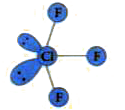
|
|
| 11. |
How would you account for the following: Among lanthanoids, Ln(III) compounds are predominant. However, occasionally in solution or in solid compounds, +2 and +4 ions are also obtained. |
| Answer» Solution :Lanthanoid METALS show +2 and +4 OXIDATION states in solution or in solid compounds to attain extra STABLE `f^0` and `f^7` and `f^(14)`configurations. For example, Eu and `Y_b` exhibit +2 oxidation states DUE to extra STABILITY of half-filled and completely filled 4f-subshell respectively. Ce and Tb exhibit + 4 oxidation states due to the extra stability of empty and half-filled 4f-subshell respectively. | |
| 12. |
How would you account for the following: Both O_2 and F_2 stabilise high oxidation states but the ability of oxygen to stabilise the higher oxidation state exceeds that of fluorine. |
| Answer» Solution :The ABILITY of oxygen to stabilise these high oxidation states EXCEEDS that of fluorine. The highest Mn fluoride is `MnF_4`, whereas the highest oxide is `Mn_2O_7`. The ability of oxygen to FORM multiple bonds to METALS explains its SUPERIORITY. | |
| 13. |
How would you account for the following ? Among lanthanoids, Ln (III) compounds are predominant . However, occasionally in solutions or in the solid compounds , +2 and +4ions are alos obtained. |
| Answer» Solution :`+2` and `+4` oxidationstates are shown BYTHOSE ELEMENTS which by losing 2 or 4 ELECTRONS acquire a stable configureation of `f^(0), f^(7) ` or `f^(14)` , e.g., `Eu^(2+)` is `[XE] 4f^(7), Yb^(2+)` is `[Xe4f^(14) , Ce^(4+) ` is `[Xe]4f^(0)` and `Tb^(4+)` is `[Xe]4f^(7)` | |
| 14. |
How would you account for the following : (i) Among lanthanoids , Ln(III) compounds are predominant , However, occasionally in solutions or in solid compounds, +2 and +4 ions are also obtained . (ii) The E_(M2+//M)^(@)for copper is positive (0.34V ) . Copper is the only metal in the first series of transition elements showing this behaviour . (iii) The metallic radii of the third (5d) series of transition metals are nearly the same as those of the corresponding members of the second series . |
| Answer» Solution :Lanthanoid metals show +2 and +4 oxidation states in solution or in SOLID compounds to ATTAIN extra stable `f^0` and `f^7` and `f^(14)`configurations. For EXAMPLE, EU and `Y_b` exhibit +2 oxidation states due to extra stability of half-filled and completely filled 4f-subshell respectively. CE and Tb exhibit + 4 oxidation states due to the extra stability of empty and half-filled 4f-subshell respectively. | |
| 15. |
How would you account for the following: (a) of the d^(4) species, Cr^(2+) is strongly reducing while Mn^(3+) is strongly oxidizing, (b) Co^(2+) is stable in aqueous solution but in the presence of complexing reagents it is easily oxidised. (c) The d^(1) configuration is very unstable in ions. |
|
Answer» Solution :(a) The most common oxidation state of Cr is + 3, it has a tendency to change + 2 oxidation state to +3 after removing ONE ELECTRON. `Cr^(2+)` is a strong reducing agent. On the other hand, `d^(4)` configuration of `Mn^(3+)` has a strong tendency to change to `d^(5)` configuration of Mn (II), which is more stable due to PRESENCE of half filled d-orbital, thus Mn(III) is a strong oxidising agent. (B) Electronic configuration of Co (III) 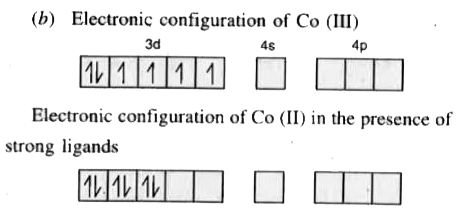 Co (III) complexes are more stable than Co (II) because in Co (III) has `d^(6)` electronic configuration. In the presence of strong ligands four unpaired electrons gel paired up and thus forms diamagnetic complexes. This arrangements has very large crystal field stabilization energy. Due to this reason Co (II) changes to Co (III) in the presence of strong ligands. (c) c) `d^(1)` configuration is very unstable in ions because after losing one more electron it will become stable, |
|
| 16. |
How would you account for the following: (i) Among lanthanoids, Ln (III) compounds are predominant. However, occasionally in solutions or in solid compounds, +2 and +4 ions are also obtained. (ii) The E_(M^(2+)//M)^(0) for copper is positive (0.34 V). Copper is the only metal in the first series of transition elements showing this behaviour. (iii) The metallic radii of the third (5d) series of transition metals are nearly the same as those of the corresponding members of the second series. |
|
Answer» Solution :Yes, the above fact is CORRECT Actually, in lanthanoids, the oxidation states of +2 and +4 only by those elements which can gain a stable configuration of `F^(0) , f^(7) or f^(14)` loosing 2 or 4 electrons Ex : `Eu^(+2)` has configuration `[Xe]_(54) f^(7), CE^(+4)` has configuration `[Xe]_(54)f^(0), Y_(b + 2)` has a configuration `[Xe]_(54) F^(14)` etc. These stable configuration may be achieved in aqueous solution, because in aq, state the Lu-atom forms hydroxide with water and as they have the tendency to make stable configuration like. `f^(0), f^(7) or f^(14)` they find `H^(+)` ions easily AVAILABLE in water and so they loose their additional electrons to get stabilized. Actually in aqueous solution Ln-atom are surrounded by nine water molecules and their co-ordination no. is 8 So it becomes easier to get protons in the solution. |
|
| 17. |
How would you account for the fact that the transition metals and their compounds are found to be good catalysts in many processes ? |
|
Answer» Solution :According to activated complex theory ( intermediate compound formation theory ), DUE to variable oxidationstates, transition metal combines with THEREACTANT `//`s to forma an intermediate ( an UNSTABLE species ) called activated complex whichi finally decomposes to form the products regenerating the catalyst. `underset("Reactant")(A) + underset("catalyst")(C) rarr underset("(Intermediate)")underset("Activated complex")([AC]) rarr underset("Product")(B) + underset("Catalyst")(C)` The REACTION proceeds through a new path with lower activation energy and hence is faster. According to adsorption theory, transition metal provides a large surface are with free valencies on which the reactants are adsorbed. As a result , the concentration of the reactants on the surface increases and hence the rate increases. |
|
| 18. |
How would you account for the fact that actinoids exhibit a larger number of oxidation states than the corresponting lanthanoids ? |
| Answer» Solution :ACTINOIDS show a larger number of oxidation states because the energy gap between 5f, 6d and 7s subhsells is very small and hence all the electrons PRESENT in these SUBSHELLS can participatein bonding whereas LANTHANOIDS show a limited number of oxidation states because the energy gap between 4F and 5d subshells is large and all the electrons in these subshells cannot participate in bonding. | |
| 19. |
How would you accont for the following? Lanthanoids form primarily + 3 ions, while the actinoids usually have higher oxidation states in their compounds, + 4 or even +6 being typical. |
| Answer» Solution :Lantranoids MOSTLY exhibit + 3 oxidation state in their compounds. Actinoids also normally show + 3 oxidation states. HOWEVER, their 5D, 6d and 7s ENERGY levels have compareable energies. As a result, they exhibit variable oxidation states due to the participation in bonding of all these three SUBSHELLS. | |
| 20. |
How would you accomplish the following synthesis ? |
|
Answer» 1. `HNO_(3),H_(2)SO_(4)` 2. NAOH 3. HONO, ice bath 4. `Cu_(2)O,H_(2)O` 5. NAH 6. MeBr 7. `H_(2)`, catalyst 
|
|
| 21. |
How woud you obtain phenol from benzene? |
Answer» SOLUTION : 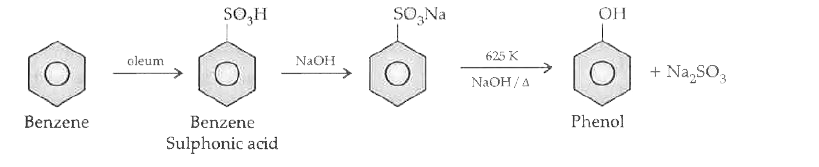
|
|
| 22. |
How will your identify 'cis' and trans' 2-butene by cyclization method? |
Answer» Solution :cis' and 'trans' ISOMERS FORM DIFFERENT epoxide with paracid. 
|
|
| 23. |
How would convert the following: (i) Phenol to benzoquinone (ii) Propanone to 2-methyl propan -2-ol (iii) Propene to propan -2-ol |
Answer» Solution : 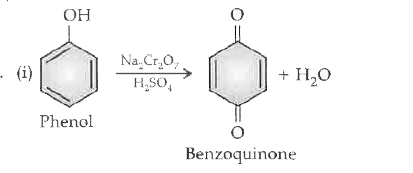 (II) `CH_(3)-underset(("Acetone"))underset(O)underset(||)(C)-CH_(3)underset(H_(2)O)overset(CH_(3)MgX)(to)underset((2-"methyl propan-2-ol"))underset(OH)underset(|)overset(CH_(3))overset(|)(C)-CH_(3)` (iii) `CH_(3)-underset(("Propene"))(CH)=CH_(2)+HOH to HC_(3) - underset(("Propan-2-ol"))underset(OH)underset(|)(CH)-CH_(3)` |
|
| 24. |
How will your convert : (i) Propionic acid to acetic acid (ii) Acetylene to acetic acid (iii) Formic acid to oxalic acid (iv) Malonic acid to acetic acid ? (v) Benzoic acid to benzophenone. (vi) Acetic acid to acetonitrile. (vii) Methyl bromide to acetic acid (viii) Methyl bromide to acetic acid (ix) Acetophenone to benzoic acid (x) Acetic acid to ethane. |
|
Answer» |
|
| 25. |
How will you test the presence of primary amine? |
|
Answer» Solution :By carbyl amine test. `RNH_(2) + CHCI_(3) + 3KOH rightarrow R - NC + 3KCI +3H_(2)O` |
|
| 26. |
How will you test pure chloroform? |
|
Answer» Solution :CHLOROFORM is oxidised by air in PRESENCE of light to form poisonous gas phosgene and HCl as shown in previous Q. When aq. `AgNO_(3)` solution is ADDED to the above solution, a white ppt. of AgCl is formed. `COCl_(2)+H_(2)Oto CO_(2)+2HCl` `HCl+AgNO_(3)to underset("White ppt.")(AgCl)+HNO_(3)` The formation of white ppt. confirms that chloroform is impure. if, however, no white ppt. is formed, it confirms that chloroform is pure. |
|
| 27. |
How will you synthesize? (i) Acetyl chloride from methyl chloride. (ii) Acetamide from ethyl alcohol. (iii) Methylamine from acetyl chloride. (iv) Acetamide from acetone. (v) Acetic anhydride from acetic acid. (vi) Ethyl acetate from ethyl bromide. (vii) Ethyl acetate from acetic acid. (viii) tert-Butyl ethanoate from acetic acid. (ix) Pantan-3-one from ethyl propanoate. (x) Acetone from ethyl acetate |
Answer» SOLUTION :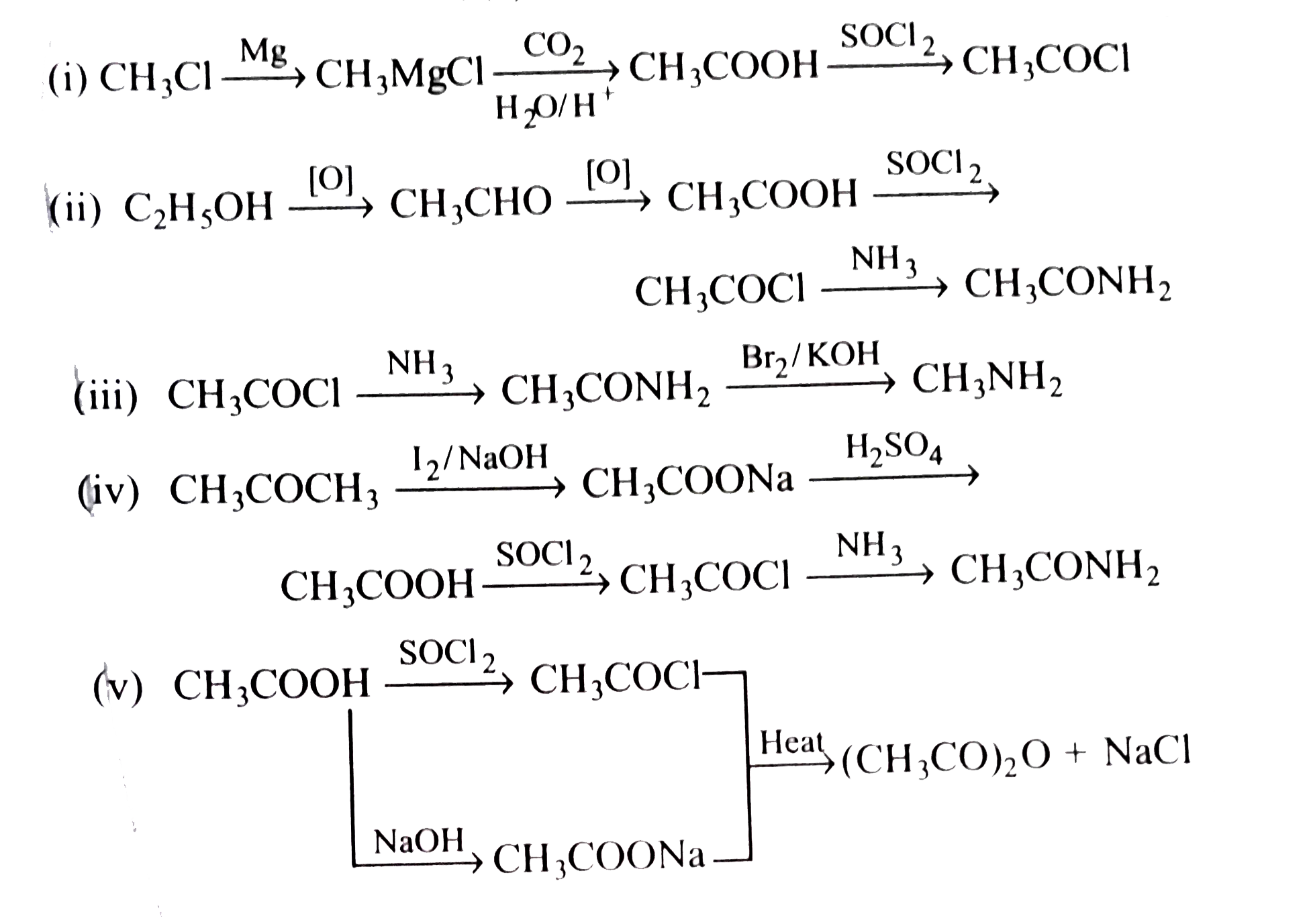 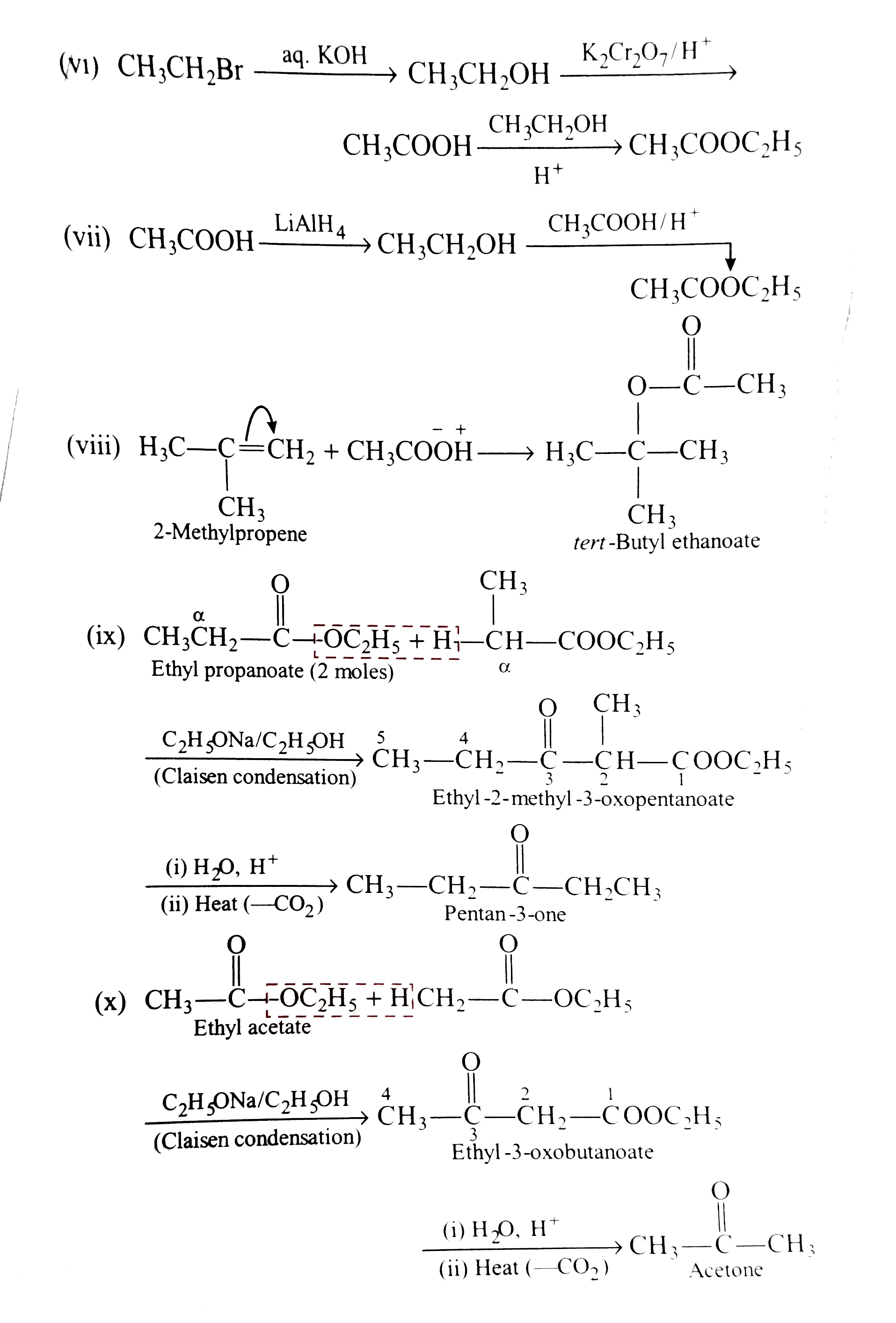
|
|
| 28. |
How will you synthesise? (i) Acetic acid from methyl iodide (ii) Iodoform irom acetic acid, (iii) Acetic acid from propionic acid. (iv) Glycine from acetic acid (v) Butylamine from propionic acid. (vi) Ethylamine from propionic acid. (vii) alpha-Hydroxy propionic acid from acetaldehyde (viii) Acetamide from acetone. (ix) Acetaldehyde from acetic acid (x) Methyl cyanide from acetic acid. (xi) Crotonic acid from acetaldehyde. (xi) Pyruvic acid from ethyl bromide (xiit) Succinic acid from ethyl bromide (xiv) Oxalic acid from methyl alcohol. (xv) B-Hydroxy propionic acid from ethylene oxide. (xvi) Tartaric acid from ethylene. (xvii) Malonic acid from acetic acid. (xviii) Lactic acid from acetic acid. (xix) 2-Phenylethanoic acid from benzene. (xx) p-Carboxyphenylacetic acid from p chlorotoluene (xxi) m-Fluorobenzoic acid from benzoic acid (xxii) o-Bromobenzoic acid from toluene. (xxiii) Aniline from benzoic acid. (xxiv) Salicylic acidfrom benzene. (xxv) Cinnamic acid from benzene. (xxvi) p-Met ylbenzoic acid from toluene. (xxxvii) p-Hydroxy benzoic acid from toluene. (xxviii) Benzoic acid from aniline. (xxix) Aniline from benzoic acid. (xxx) Phthalimide from phthalic acid. |
Answer» SOLUTION : 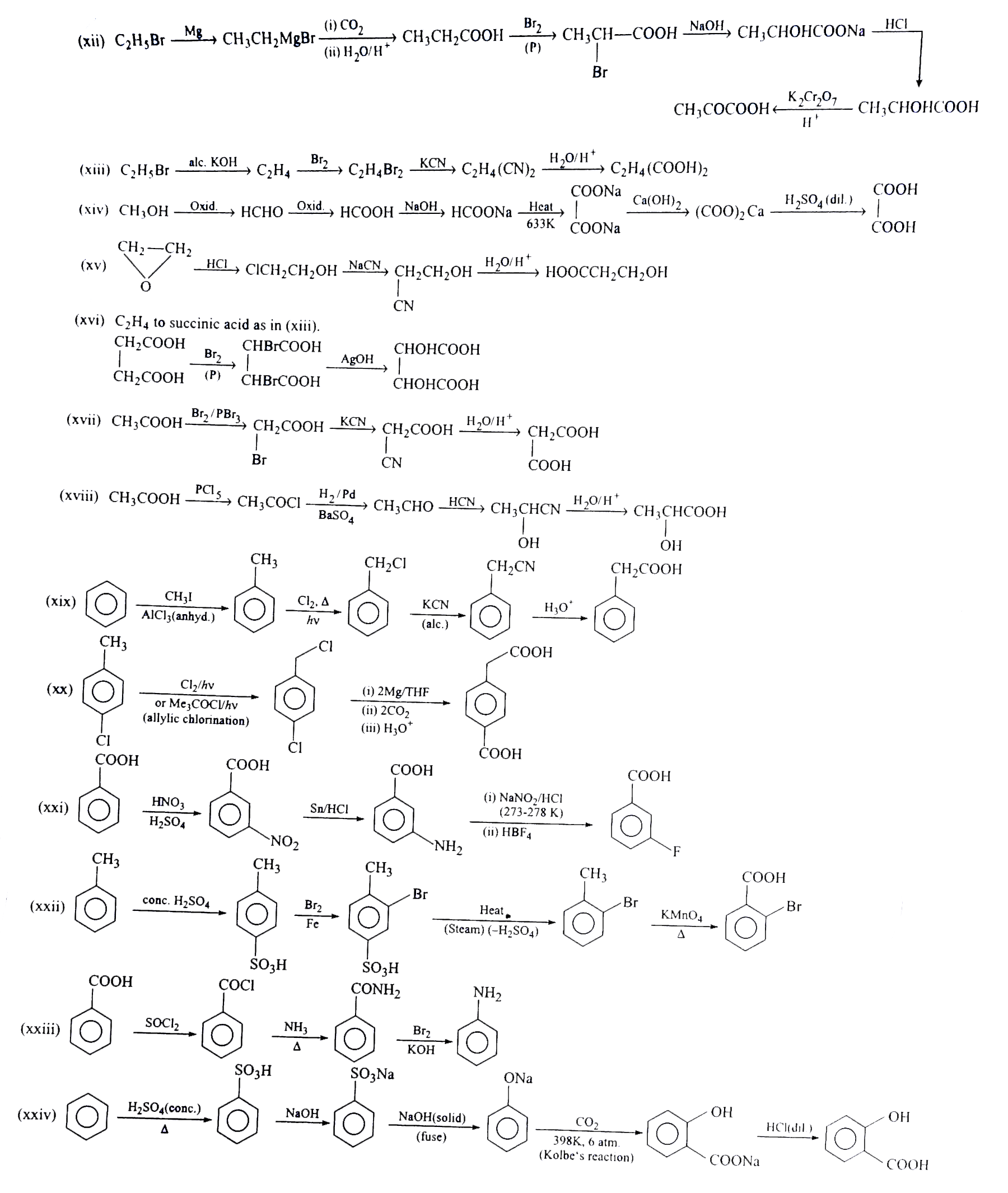 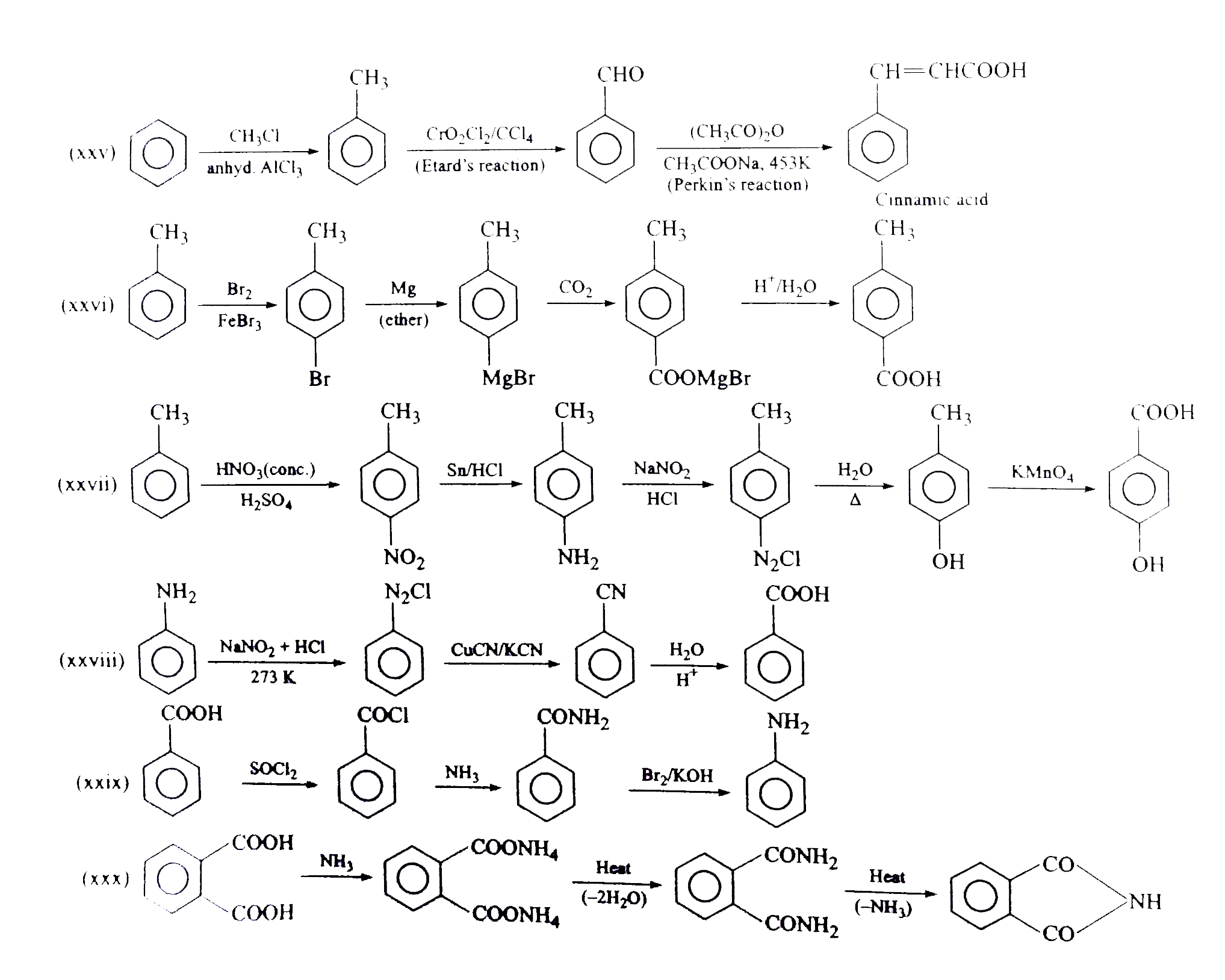
|
|
| 29. |
How will you synthesise salicylic acid from phenol? |
|
Answer» Solution :Two METHODS are available: (i) By Kolbe's reaction. (ii) By Reimer-tiemann reaction. Phenol is HEATED with carbon tetrachloride in presence of aq. NaOH at 34)K and the product so OBTAINED on hydrolysis with dil. HCL GIVES salicylic acid. |
|
| 30. |
How will you synthesize Alanine from acetylene? |
Answer» SOLUTION :
|
|
| 31. |
How will you synthesise ? (i)Acetamidefrom acetone. (ii) lodoform formacetic acid . (iii) Malonicacidfromaceticacid . (iv) Crotonicacidfromacetaldehyde . |
|
Answer» Solution :(i) `CH_(3)COCH_(3) overset(I_(2)//NaOH)to CH_(3)COONa overset(H^(+))to CH_(3)COOH overset(NH_(2))to CH_(3)COONH_(4) overset(DELTA)to CH_(3)CONH_(2)` (ii)`CH_(3)COOH overset(CA(OH)_(2)) to (CH_(3) COO)_(2)Ca overset(Delta) to CH_(3)COCH_(3) overset(NaOH//l_(2))to CHl_(3)` (iii) 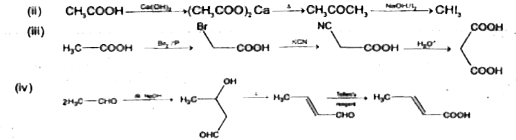
|
|
| 32. |
How will you synthesise, benzylamine from aniline ? |
| Answer» Solution :`UNDERSET("diazonium CHLORIDE")("Aniline")overset(NaNO_(2))underset(HCl, 0^(@)C) rarr "Benzene"overset(CuCN)rarr "cyano benzene" overset(LiAlH_(4)) rarr "Benzyl amine"` | |
| 33. |
How will you synthesise acetone from acetaldehyde ? |
| Answer» Solution :`underset("acetaldehyde")(CH_(3)-OVERSET(O)overset(||)C-H) overset(CH_(3)MGI) rarr underset("alcohol")underset("ISOPROPYL")(CH_(3)-overset(OH)overset("|")"CH"-CH_(3))overset(K_(2)Cr_(2)O_(7))underset(H_(2)SO_(4))rarr underset("acetone")(CH_(3)-overset(O)overset(||)C-CH_(3))` | |
| 34. |
How will you synthesis? ltbrlt a) Vinyl chloride from acetylene b) But-1-yne form acetylene c) But-2-one from acetylene d) Butan-2-one from acetylene e) Chloroprene from acetylene f) Propane from isopropyl alcohol g) 2,3-Dimethylbutane from propene h) n-Hexane from propene i) Cyclohexene from cyclohexane j) Vinyl acetate from ethyl alcohol k) Cyclohea-1,3-diene from cyclohexene l) Buta-1,3-diene from butane. m) 3-Ethylpent-1-yne from pent-1-yne |
|
Answer» Solution :a) `HC-=CH overset(2HCl)CH_(3)CHCl_(2)overset(KOH(alc))UNDERSET(Delta)to H_(2)C=CHCl` b) `HC-=CH overset(NaNH_(3))toHC-=Cnaoverset(CH_(3)CH_(2)Br)to HC-=C-CH_(2)CH_(3)` c) `CH_(3)-C-=Choverset(NaNH_(2))to CH_(3)-C-=Na overset(BrCH_(3))toCH_(3)-C-=C-CH_(3)` d) `HC-=CH overset(NaNH_(2))to HC-=CNa overset(CH_(3)CH_(2)Br)to HC-=underset("But-1-yne")(CCH_(2)CH_(3))overset(H_(2)SO_(4).H_(2)O)underset(HgSO_(4), Delta)to CH_(3)-overset(O)overset(||)C-CH_(2)CH_(3)` e) `2HC-=CHoverset(Cu_(2)Cl_(2))underset(NH_(4)Cl)to H_(2)C=underset("Vinyl acetylene")CH-C-=CH overset(HCl)to H_(2)C=underset("Chloroprene")CH-overset(Cl)overset(|)C=CH_(2)` f)  g)  h) `CH_(3)CH=CH_(2)overset(HBR)underset("Peroxide")CH_(3)CH_(2)CH_(2)Br overset((Na)//"ether")underset("Wurtz reactions")CH_(3)(CH_(2))_(4)CH_(3)]` i)     
|
|
| 35. |
How will you synthesise ? (a) Isopropyl bromide from n-propyl bromide. (b) n-propyl bromide from isopropyl bromide. (C) Propionic acid from ethyl bromide. (d) 1- Bromopropane from 1-chloropropane. (e) Ethylene glycol from ethyl chloride. (f) Chloroform from ethyl alcohol. (g) Iodoform from acetylene. (h) vinyl bromide from ethyl alcohol. (i) Allyl chloride from propane. (j) Methyl iodide from methane. (k) o- Bromobenzoic acid from toluene. (I) o-Chlorotoluene from toluene. |
|
Answer» Solution :`(a) CH_(3)CH_(2)CH_(2)BR OVERSET(alc. KOH)underset(Delta)(to) CH_(3)CH=CH_(2) overset(HBr)(to) CH_(3)CHBrCH_(3)` `(b) CH_(3)CHBrCH_(3) overset(alc.KOH)underset(Delta)(to)CH_(3)CH =CH_(2) overset(HBr)underset("peroxide")(to)` `CH_(3) CH_(2)CH_(2)Br` ` (C) C_(2)H_(5)Br overset(KCN)(to)C_(2)H_(5)CN overset(H_(2)O)(to) C_(2)H_(5)COOH` `(d) CH_(3)CH_(2)CH_(2)CI overset(alc.KOH)underset(Delta)(to) CH_(3)CH=CH_(2)overset(HBr)underset("peroxide")(to)` `CH_(3)CH_(2)CH_(2)Br` `(e) CH_(3)CH_(2)CI overset(alc.KOH)underset(Delta)(to) H_(2)C=CH_(2) overset("Alkaline")underset(KMnO_(4))(to)` `CH_(2)OH -CH_(2)OH` `(f) C_(2)H_(5)OH +CaOCI_(2) ("Bleaching powder")` `[CaOCI_(2) +HOH to CI_(2) +Ca(OH)_(2)]` `C_(2)H_(5)OH overset(CI_(2))underset([O])(to) CH_(3)CHO overset(CI_(2))(to) C CI_(3)CHO overset(Ca(OH)_(2))(to)` `CHCI_(3)+(HCOO)_(2)Ca` `(g) HC-=CH overset(H_(2)SO_(4))underset(HgSO_(4))(to) CH_(3)CHO overset(I_(2))underset(NaOH)(to) CHI_(3) +HCOONa` `(h) C_(2)H_(5)OH overset(H_(2)SO_(4))underset(Delta)(to) H_(2)C=CH_(2) overset(Br_(2))underset(C CI_(4))(to) CH_(2)Br -CH_(2)Br` `overset(alc.KOH)underset(Delta)(to) CH_(2)=CHBr` `(i) CH_(3)CH_(2)CH_(3)overset(CI_(2))underset(UV)(to) CH_(3)CH_(2)CH_(2)CI+CH_(3)CHCICIH_(3)` `overset(alc.KOH)underset(Delta)(to) CH_(3)CH=CH_(2)overset(CI_(2))underset(773K)(to) CICH_(2)CH=CH_(2)` `(j) CH_(4)overset(CI_(2))underset(UV)(to)CH_(3)CI overset(Nal)underset(Acetone)(to) CH_(3) I` 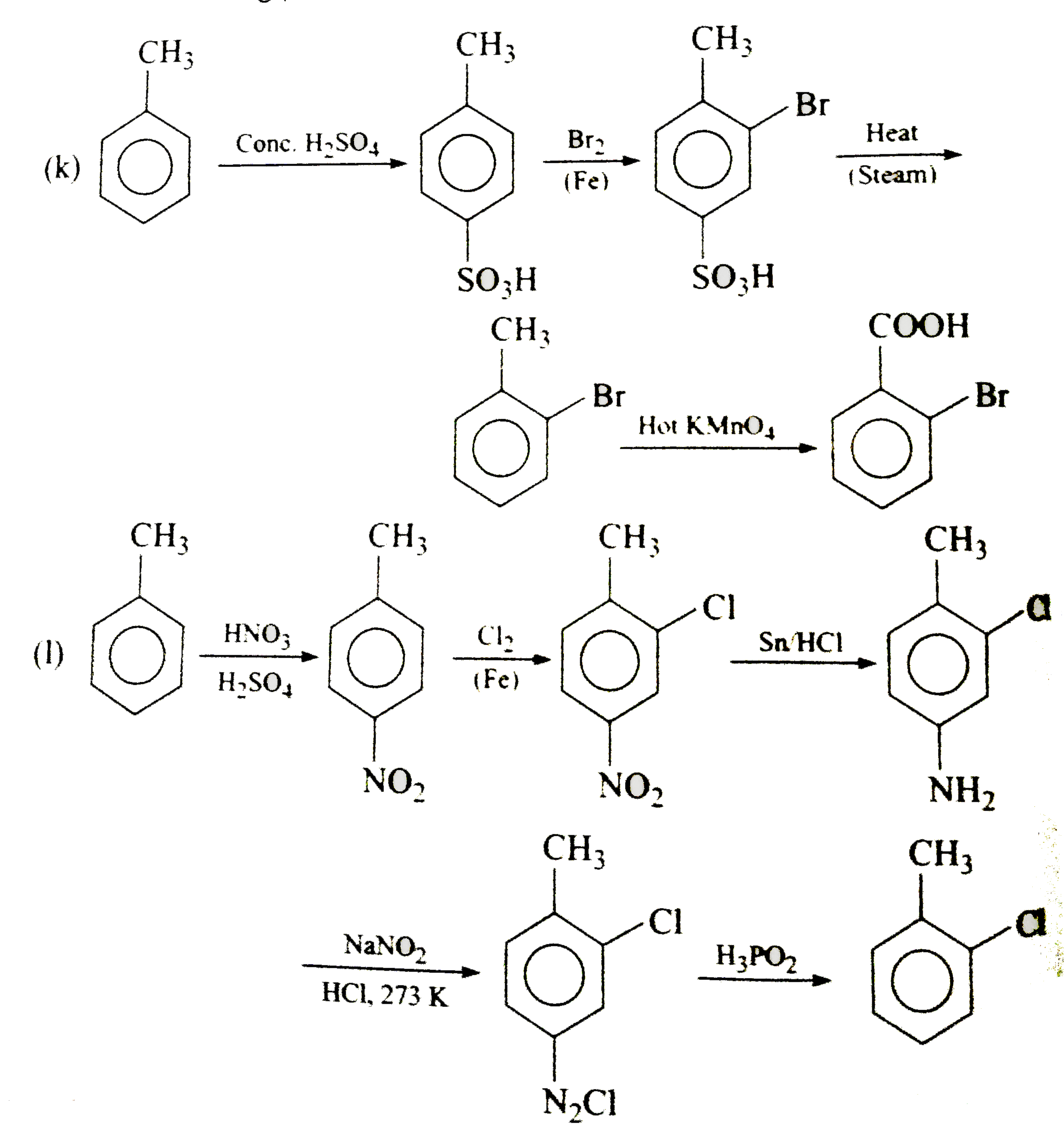
|
|
| 36. |
How will you synthesise acetaldehyde from formaldehyde ? |
| Answer» Solution :`UNDERSET("FORMALDEHYDE")(H-overset(O)overset(||)C-H)overset(CH_(3)MGBR) underset(H_(2)O //H^(+))RARR underset("ethyl alcohol")(CH_(3)CH_(2)OH) overset(K_(2)Cr_(2)O_(7))underset(H_(2)SO_(4))rarr underset("acetaldehyde")(CH_(3)CHO)` | |
| 37. |
How will you separate the following mixtures? (a) Sulphur, potassium nitrate and charcoal (b) Sand, common salt, iron filings and naphthalene (c) Powdered glass, ammonium chloride and potassium chloride. |
|
Answer» Solution :(a) (i) sulphur is soluble in carbon disulphide (ii) POTASSIUM nitrate is soluble in water (iii) Charcoal is insoluble in carbon disulphide as well as in water.  (B) (i) Iron filings are separated by a magnet (ii) Naphthalene sublimes on heating (iii) Sand is insoluble in water. (c) (i) AMMONIUM chloride sublimes on heating (ii) Potassium chloride is soluble in water (iii) Powdered glass is insoluble in water. |
|
| 38. |
How will you separate benzyl alcohol (neutral) and phenol (acidic) from their mixed solution in ether by extraction using an appropriate chemical reagent? |
| Answer» Solution :SEE ANSWER of Q . No. 38. USE NAOH INSTEAD of `NaHCO_(3)`. | |
| 39. |
How will you separate a solution (miscible) of benzene +CHCl_(3). |
|
Answer» Sublimation fr FRACTIONALDISTILLATION involves repeated distillations and condensation, in a fractionating column. As a result of distillation and condensation at eachpoint of the fractionatingcolumn, the vapoursrising up become RICHER in more volatile component. thus, the low boiling liquid distils FIRST while the higher boiling liquid distils AFTERWARDS. |
|
| 40. |
How will you separate a solution (miscible) of benzene + CHCl_(3)? |
|
Answer» Sublimation |
|
| 41. |
How will you separate a mixture of two gases ? |
|
Answer» FRACTIONAL distillation TECHNIQUE |
|
| 42. |
How will you convert: Benzene to N,N-dimethyl aniline? |
Answer» SOLUTION :ANILINE formed in step (i) is treated with `CH_3Br` in 1:2 molar RATIO
|
|
| 43. |
How will you remove the excess of NH_(4)Cl before adding (NH_(4))_(2)CO_(3) for the precipitation of group? |
|
Answer» Solution :`NH_(4)Cl` is removed by treating the filtrate from group IV with Conc. `HNO_(3)` on HEATING to DRYNESS, ammonium chloride is decomposed according to the following equations: `NH_(4)Cl+HNO_(3)toNO_(4)NO_(3)+HCl` `NH_(4)NO_(3)toN_(2)O+2H_(2)O` |
|
| 44. |
How will you purify amines having non-basic impurities? |
| Answer» SOLUTION :By USING HCL and ETHER | |
| 45. |
How willyouprovethe presence of aldheyde group in glucose ? |
Answer» SOLUTION :(i) Glucoseis oxidisedto gluconicacid withammoniacl SILVERNITRATE (Tollen.s reagent ) and alkalinecoppersulphate(Felhing.ssolution). Tollen.s regentis reduced to metallicsilverand FEHLING .s solution to CUPROUS oxide (red prepiciate). These reactinos confirm thepresence of an aldehye groupin GLUCOSE .  
|
|
| 46. |
How will you prove the selective nature of adsorption ? |
| Answer» Solution :Activated charcoal ADSORBS chlorine in preference to nitrogen and oxygen from the MIXTURE of gases. Similarly, animal charcoal only adsorbs COLOURING MATTER from the solution of impure sugar. These examples show that ADSORPTION is of selective nature. | |
| 47. |
How will you prove the presence of aldehyde group in glucose ? |
Answer» Solution :(i) GLUCOSE is oxidised to gluconic acid with AMMONIACAL silver nitrate (Tollen.s reagent) and alkaline COPPER sulphate (Fehling.s solution). Tollen.s reagent is reduced to METALLIC silver and Fehling.s solution to cuprous oxide (red precipitate). These reactions confirm the presence of an aldehye group in glucose. 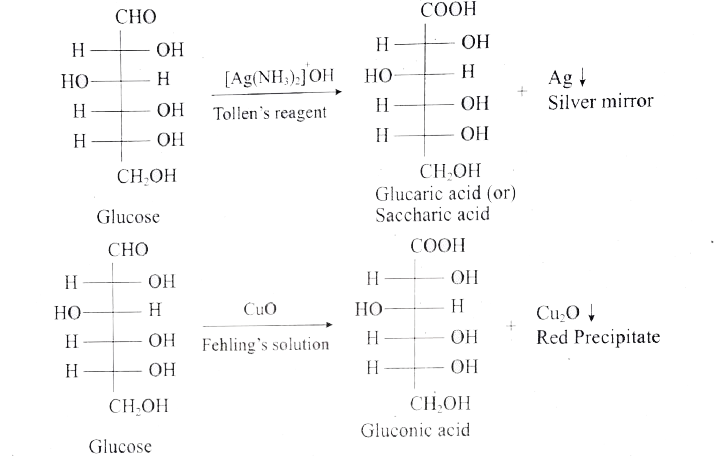
|
|
| 48. |
How will you prepared the following compounds form benzene? You may use any inorganic reagent and any organic reagent having not more than one carbona atom. (i) Methyl benzoate, (ii) m-Nitrobenzoic acid (iii) p-Nitrobenzoic acid and, (iv) Phenylacetic acid (v) p-Nitrobenzaldehyde |
Answer» SOLUTION :(i). 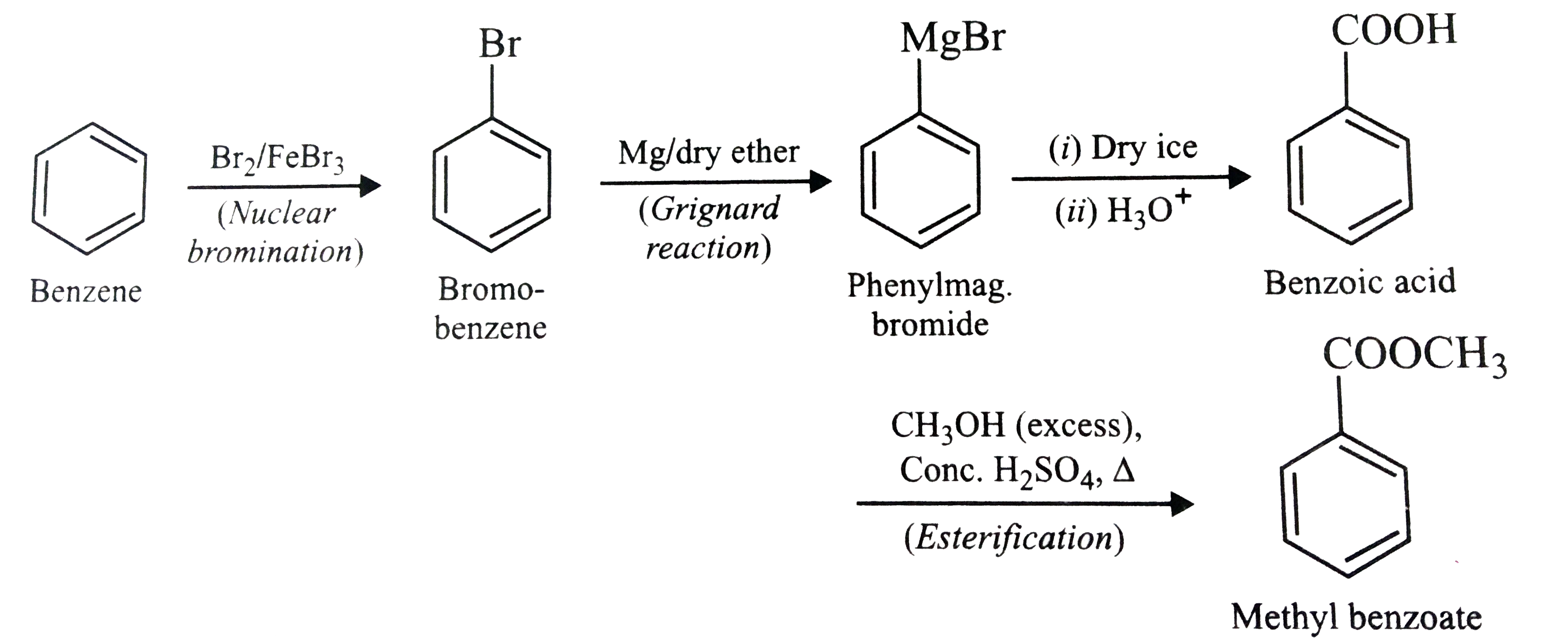 (II). 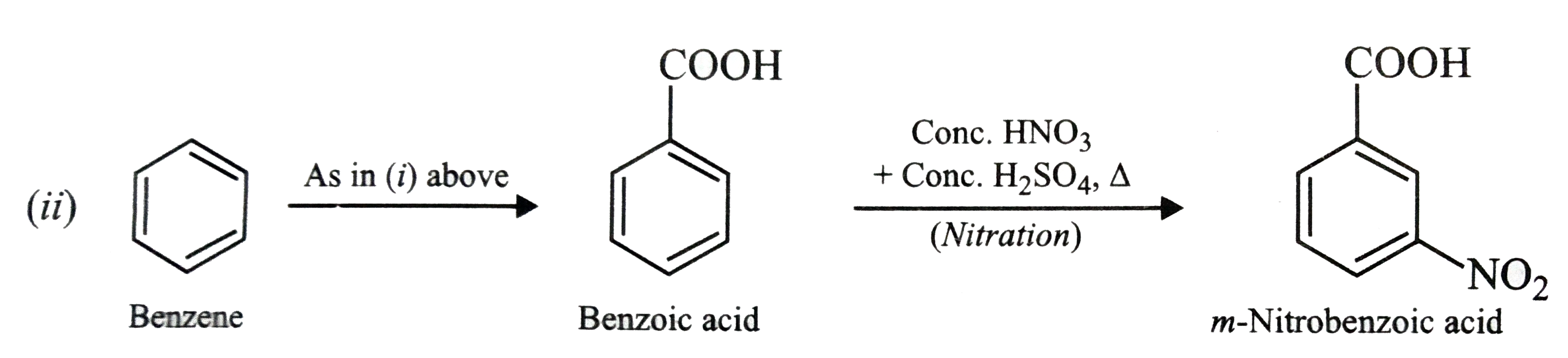 (III). 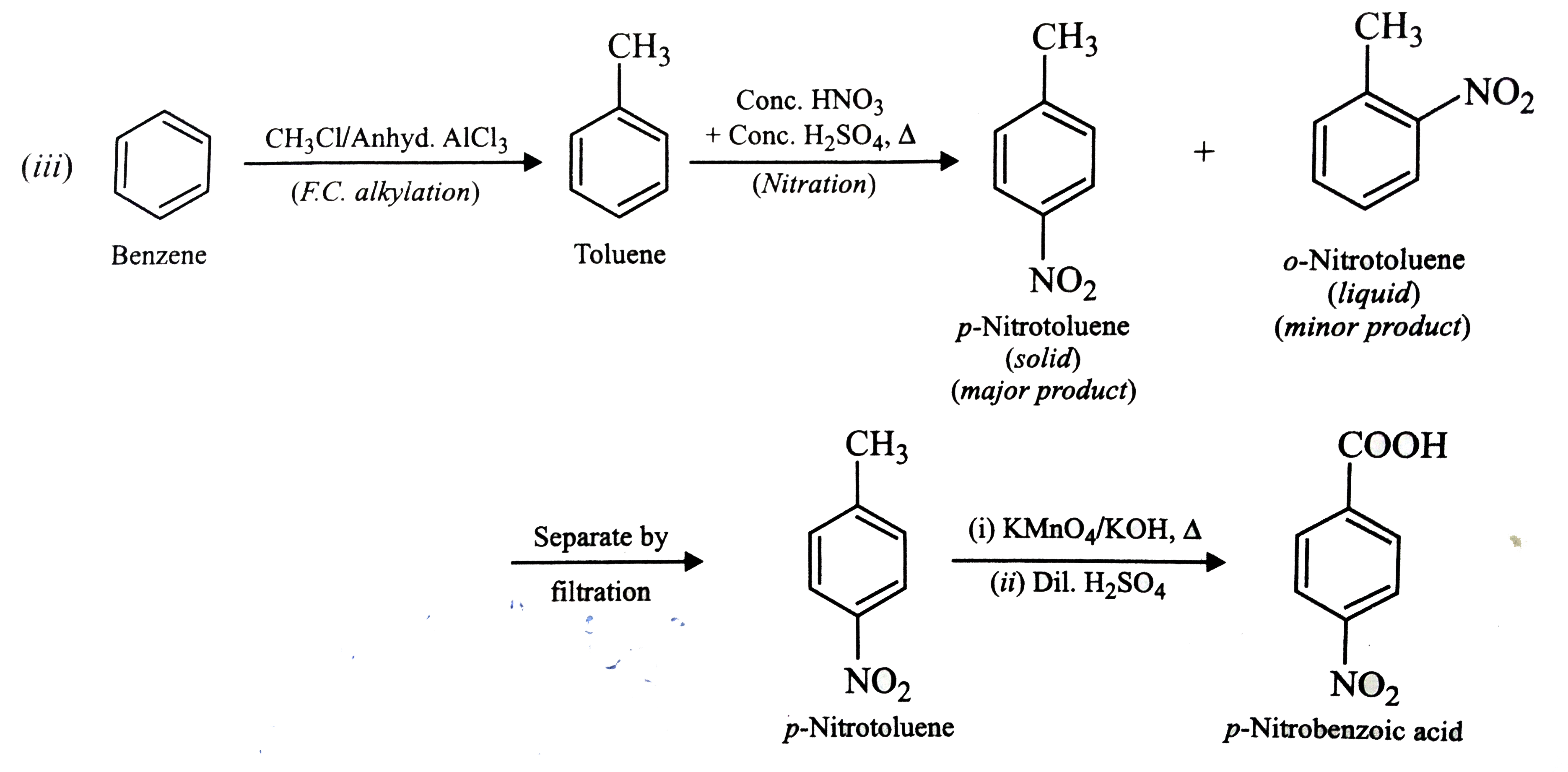 (IV). 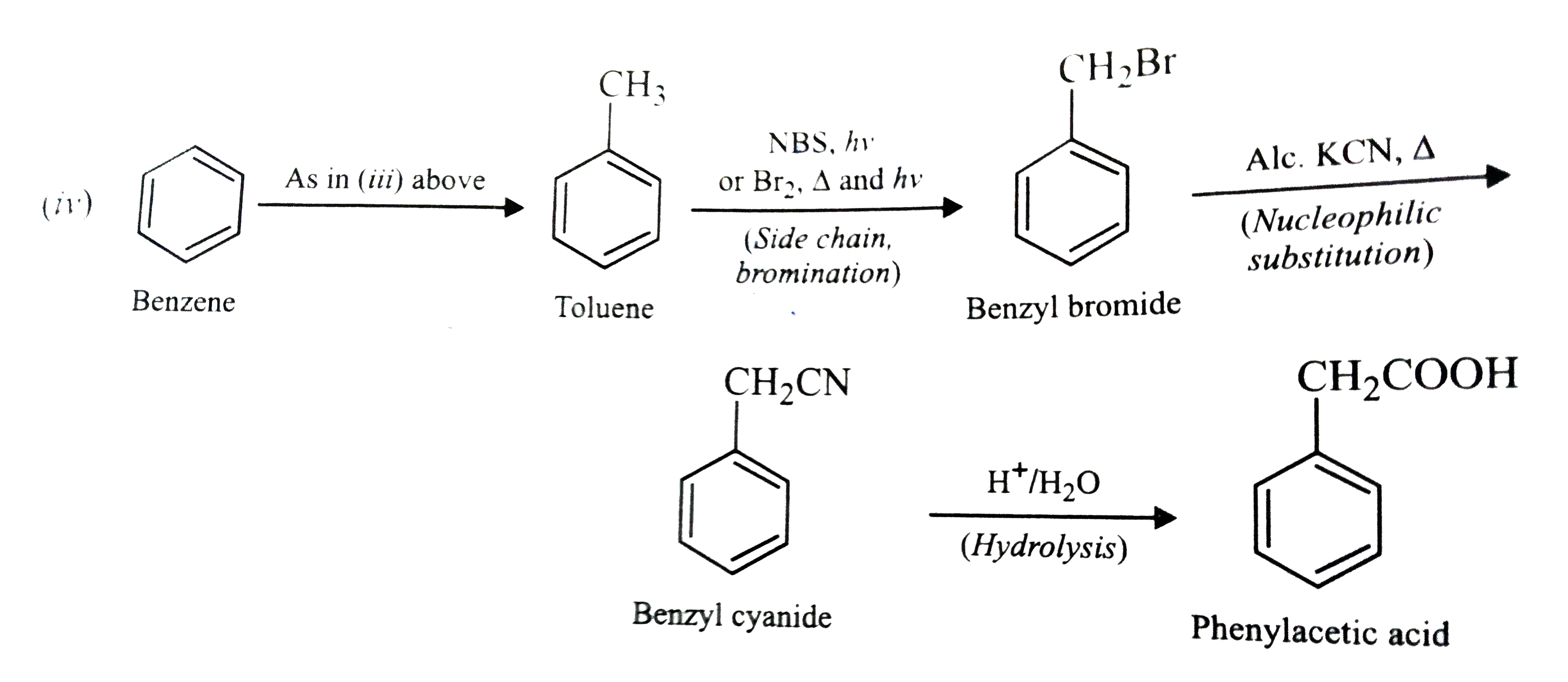 (V). 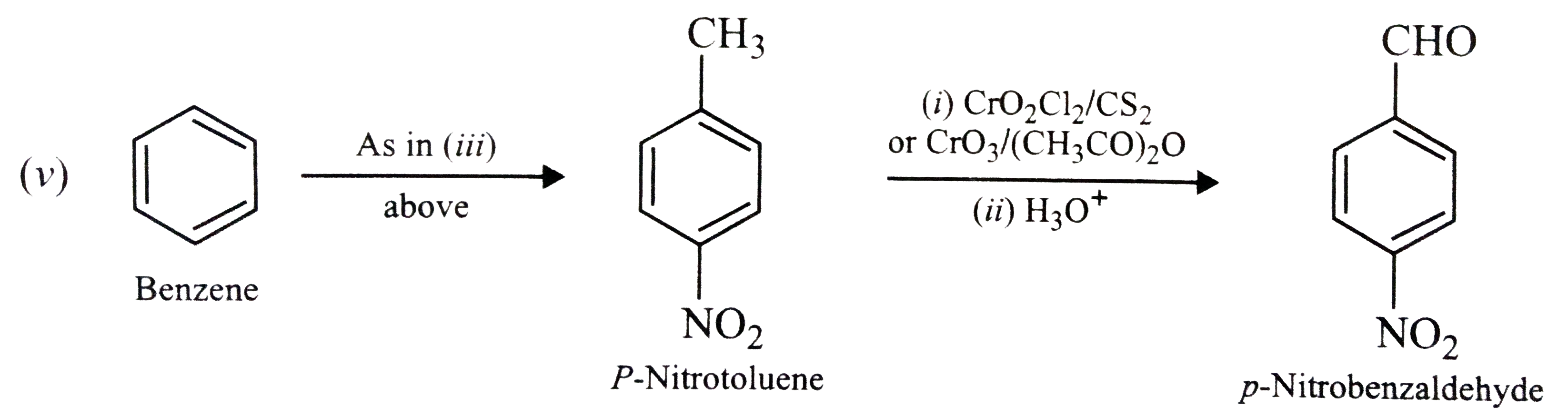
|
|
| 49. |
How will you prepare Xenon fluoride? |
|
Answer» Solution :XENON fluoides are prepare by direct REACTION of xenon and fluorine under different conditions as shown below. `Xe+F_(2)overset(NI)underset(400^(@)C)rarr XeF_(2)` `Xe+2F_(2)overset("Ni/acetone")underset(400^(@)C)rarr XeF_(4)` `Xe+3F_(2)overset(Ni//200atm)underset(400^(@)C)rarr XeF_(6)` |
|
| 50. |
How will you prepare the following compounds from benzene ? You may use any inorganic reagent and any organic reagent having not more than one carbon atom. (i) Methyl benzoate (ii) m - Nitrobenzoic acid (iii) p - Nitrobenzoic acid (iv) Phenylacetic acid (v) p - Nitrobenzaldehyde. |
Answer» SOLUTION : 
|
|