

Saved Bookmarks
This section includes 7 InterviewSolutions, each offering curated multiple-choice questions to sharpen your Current Affairs knowledge and support exam preparation. Choose a topic below to get started.
| 1. |
How would you synthesis 4-methoxyphenol form bromobenzene in NOT more than five step ? State clearly the reagents used in each step and show the structure of intermediate compounds in your synthetic scheme. |
Answer» SOLUTION :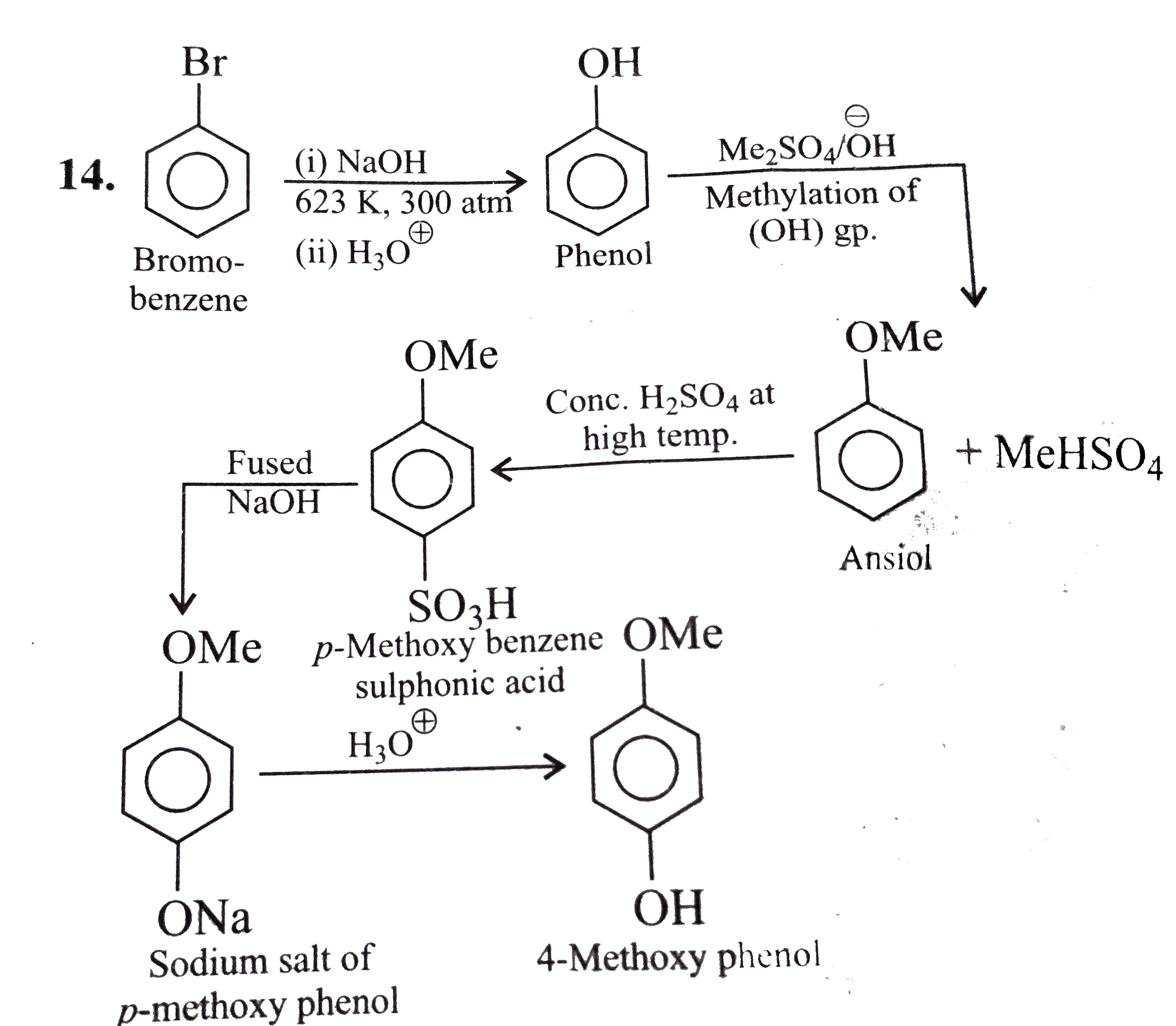
|
|
| 2. |
How would you provethe strutcureof glucoe? (OR) Elucidate the strcture of glucose . |
|
Answer» Solution :(i) Elemental analysis and molecular weightdetermination shown thatthe molecularformulaof GLUCOSEIS `C_(6) H_(12)O_(6)`. (ii) On reductionwithConc.HI and red P at 373K, glucose gives a mixtureof h - hexaneand 2 -iodohexaneindicatingthat thesixcarbon atomsare BONDED linearly . Glucose  (iii)Glucosereacts withhydroxylamin to fromoximeandwith HCNto fromcyanohydrin. These reactions indicate thepresence ofcarboyl groupin glucose .  (iv) Glucose getsoxidised to gluconic acidwithbromine waterwith bromine water suggests that thecarbonylgroup is an aldehyde GROUP and itoccupiesone endof the carbonchain.When glucose is oxidised byconc. `HNO_(3)`glucaricacidis formedand itsuggest that theotherend id occupied bya primary alcoholi.  (v) Glucoseis oxidised to gluconicacid withammonicalsilvernitrate (Tolle.s reagent ) andalkaline coppersulphate(Fehling.s solution) . Thesereactions furtherconfirmthe presence of an aldehydegroup.  (vi) Glucose from penta acetat withacetic anhydridesuggestingthe presenceof fivealcohol groups.  (vii) Glucose is a stablecompound anddoesnot undergodehydration easily . It indicates that not more thanone hydroxylgroupis bonded to singlecarbon atom . Thusthe fivehydroxylgroups areattached to fivedifferent carbonatomsand the sixth carbonis analdehydegroup. (vii) Glucoseisstablecompoundand doesnot undergodehydration easily. Thusthe fivehydroxylgroups areattachedto fivedifferentcarbon atoms and thesixthcarbon is analdehyde group. (viii) The EXACT specialarragementof -OH groups was given byEmil Fischer as follows :  (ix)D (+ ) glucose has Dconfigurationnad it is dextrorotatory . |
|
| 3. |
How would you produce Ethane nitrile form the following compounds? (i) Acetamide (ii) Ammonium acetate (iii) Acetaldoxime |
|
Answer» Solution :(i) `underset("Acetamide")(CH_(3)CONH_(2))underset(-H_(2)O)overset(P_(2)O_(5))(to)underset("Ethane nitrile")(CH_(3)CN)` (ii) `underset("Ammonium acetate")(CH_(3)COONH_(4))underset(-H_(2)O)overset(P_(2)O_(5))(to) underset("Ethane nitrile")(CH_(3)CN)+2H_(2)O` (iii) `underset("ACETALDOXIME")(CH_(3)-CH=NOH)underset(-H_(2)O)overset(P_(2)O_(5))(to)underset("Ethane nitrile")(CH_(3)CN)` |
|
| 4. |
How would you prepare the following?(i) Sodium thiosulphate from sodium carbonate (ii) Sodium carbonate from sodium chloride(iii) Microcosmic salt from disodium hydrogen phosphate |
|
Answer» Solution : (i) SODIUM carbonate is first converted into sodium sulphite by passing sulphur dioxide `Na_(2)CO_(3) +SO_(2)to Na_(2)SO_(3)+CO_(2)` The solution of `Na_(2)SO_(3)` is then boiled with sulphur for TWO hours. `Na_(2)SO_(3)+StoNa_(2)S_(2)O_(3)` (ii) The conversion is made by Solvay process `CO_(2)+NH_(3)+H_(2)OtoNH_(4)HCO_(3)` `NH_(4)HCO_(3)+NaClto NaHCO_(3)+NH_(4)CI` `2NaHCO_(3)toNa_(2)CO_(3)+H_(2)O+CO_(2)` (iii) It is prepared by DISSOLVING NH4Cl in disodium HYDROGEN phosphate in molecular proportion in hot water. `NH_(4)CI+Na_(2)HPO_(4)toNaNH_(4)HPO_(4)+NaCI` |
|
| 5. |
How would you prepare the following compounds by Friedel Crafts acylation?(i) Acetophenone(ii) Benzophenone |
Answer» SOLUTION :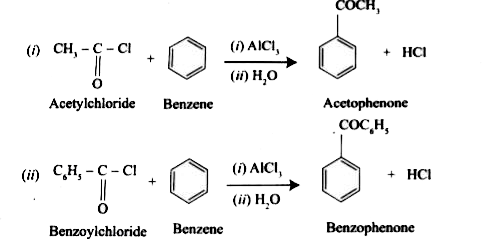
|
|
| 6. |
How would you prepare the followind compound by carbylamines reaction. (i) Methyl isocyanide (ii) Phenyl isocyanide |
|
Answer» Solution :(i) `underset("METHYL amine")(CH_(3)NH_(2))+CHCl_(3)+3KOH tounderset("Methyl isocyanide")(CH_(3)-N-=C)+3KCl+H_(2)O` (ii) `underset("Aniline")(C_(6)H_(5)NH_(2))+CHCl_(3)+3KOHtounderset("Phenyl isocyanide")(C_(6)H_(5)-N-=C+3KCl+2H_(2)O` |
|
| 7. |
How would you prepare tetraboric acid from boric acid? |
| Answer» Solution :`4H_(3)BO_(3) overset(160^(@)C)toH_(2)B_(4)O_(7)+H_(2)O` | |
| 8. |
How would you prepare p-nitro aniline from aniline? |
Answer» SOLUTION :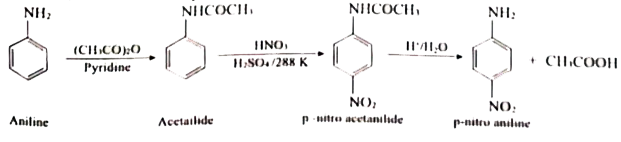
|
|
| 9. |
How would you prepare p-bromo aniline from aniline? |
Answer» SOLUTION :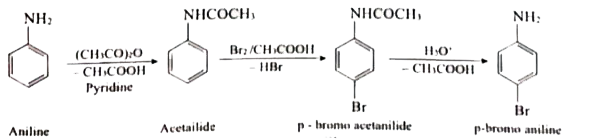
|
|
| 10. |
How would you prepare : (i) C_(6)H_(5)NH_(2) from C_(6)H_(5)NO_(2) (ii) CH_(3)NH_(2) from C_(2)H_(5)NH_(2) (iii) C_(2)H_(5)NH_(2) from CH_(3)NH_(2) |
Answer» Solution :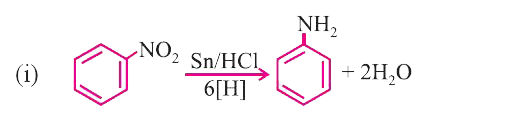 (II) `C_(2)H_(5)NH_(2) overset(HNO_(2)) to C_(2)H_(5)OH overset ("O") underset(K_(2)Cr_(2)O_(7)//H_(2)SO_(4))to CH_(3)COOH overset(NH_(3)) toCH_(3)COONH_(4) overset(DELTA) underset(-H_(2)O) toCH_(3)CONH_(2) overset (Br_(2)//KOH) to CH_(3)NH_(2)` (iii) `CH_(3)NH_(2) overset (HNO_(2)) to CH_(3)OH overset(SOCI_(2)) to CH_(3)CI overset ("KCN") to CH_(3)CN overset("[H]") to CH_(3)CH_(2)NH_(2)` |
|
| 11. |
How would you prepare Nylon - 2 - Nylon - 6 polymers? |
|
Answer» SOLUTION :Nylon - 2 - Nylon 6 is a co polymer which CONTAINS polyamide linkages. It is OBTAINED by the condensation polymerisation of monomers glycine and E-aminocaproic acid . `underset("Glycine")(nH_2N- CH_2-COOH) + underset("Aminocaproic acid ")(nH_2N -(CH_2 )_5 --COOH) to underset("Nylon-2-nylon-6")([--HN-CH_2-underset(O)underset(||)C-NH-(CH_2 )--underset(O)underset(||)C--]_(n) + (2n-1)H_2O` |
|
| 12. |
How would you prepare Nylon -2- Nylon -6- polymers? |
|
Answer» Solution :Nylon - 2 - Nylon 6 is a CO polymer which contains polyamide linkages. It is obtained by the condensation polymerisation of monomers glycine and E - amino caproic acid. `underset("Glycine")(nH_(2)N-CH_(2)-COOH)+underset("Aminocaproic acid")(nH_(2)N-(CH_(2))_(5)-COOH)RARR underset("Nylon -2 - nylon -6")(-[HN-CH_(2)-underset(O)underset(||)C-NH-(CH_(2))_(5)-underset(O)underset(||)C]_(n)-)+(2n-1)H_(2)O` |
|
| 13. |
How would you prepare nitro ethane from the following compounds? (i) CH_(3)-CH_(2)Br (ii) CH_(3)-CH_(3) |
|
Answer» Solution :(i) `underset("Ethyl bromide")(CH_(3)-CH_(2)Br)+KNO_(2) underset(S_(N^(2)))overset("Ethanol"// Delta)(to) underset("Nitro ethane")(CH_(3)-CH_(2)NO_(2))+KBr` (ii) `underset("Ethane")(CH_(3)-CH_(3))+Conc. HNO_(3)overset(675K)(to)underset("Nitroethane"(73%))overset(CH_(3)-CH_(2)NO_(2))+underset("Nitromethane"(27%))(CH_(3)NO_(2))` |
|
| 14. |
How would you prepare ferric hydroxide sol by hydrolysis method? |
|
Answer» SOLUTION :`FE(OH)_3` SOL can be prepared by the hydrolysis of `FeCl_3` `FeCl_3 + 3H_2O to Fe(OH)_3 "(sol)" + 3HCL` |
|
| 15. |
How would you prepare colloids of noble metals ? |
|
Answer» |
|
| 16. |
How would you prepare colloids of ink and graphite? (OR) Explain about mechanical dispersion method. |
|
Answer» SOLUTION :(i) Using a colloid mill, the solid is GROUND to colloidal dimension. The colloid mill consists of two metal plates rotating in OPPOSITE directions at very high speed of nearly 7000 revolution per minute. (ii) The colloidal particles of required colloidal size is obtained by ADJUSTING the distance between the two plates. (iii) By this method, colloidal SOLUTIONS of ink and graphite andprepared. 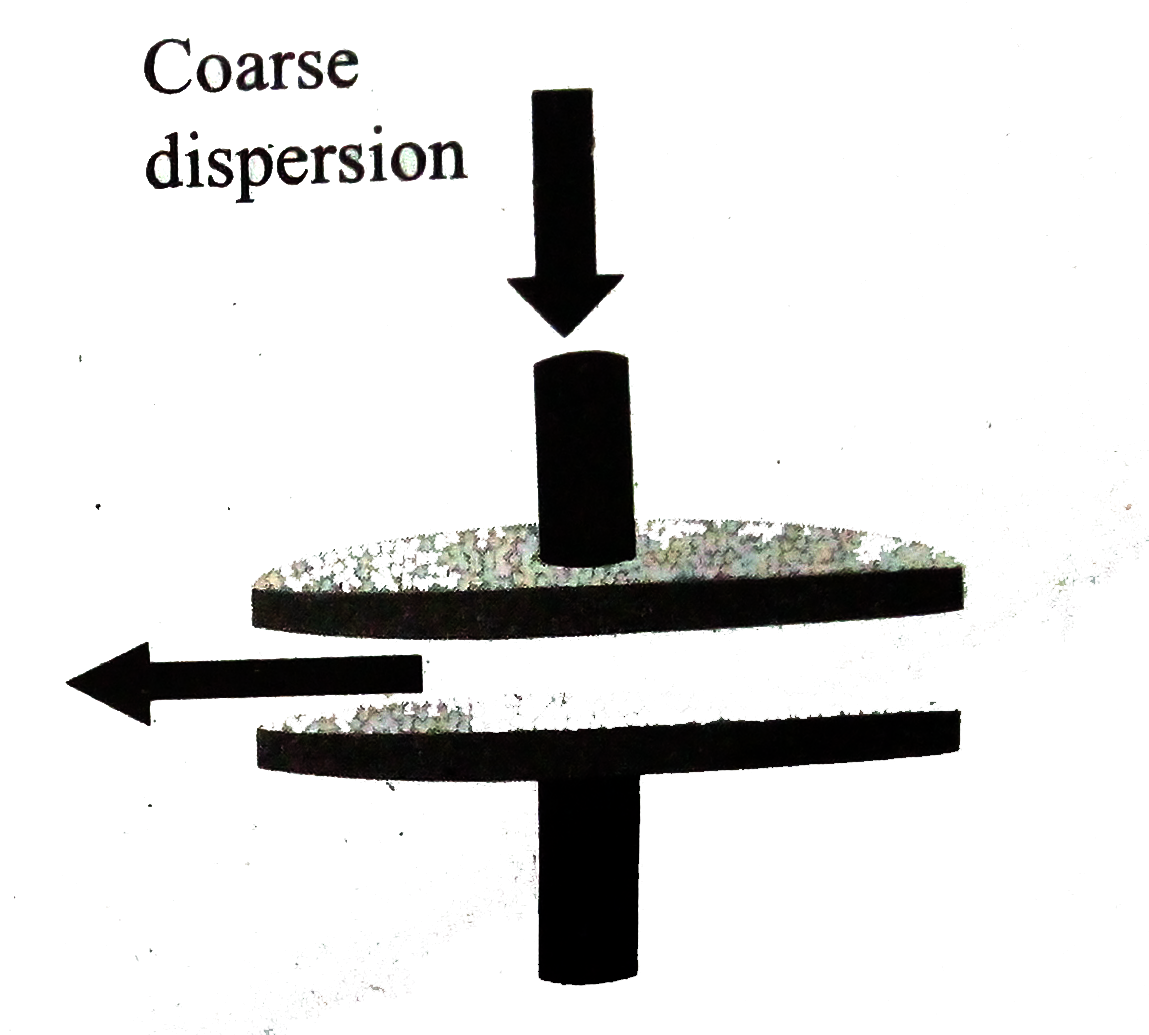
|
|
| 17. |
How would you prepare colloid by the exchange of solvent method? |
|
Answer» <P> SOLUTION :(i) COLLOIDAL solution of few substances like phosphorous or SULPHUR is obtained by the solutions in alcohol and pouring them into water.(II) As they are insoluble in water, they form colloidal solution. Pin alcohol + water`to P_("sol")` |
|
| 18. |
How would you prepare Buna - S ? Give its use. |
Answer» Solution :Buna - S is prepared by the polymerisation of buta - 1,3 - diene and styrene in the RATIO of 3:1 in the PRESENCE of SODIUM  Uses:- It is used in MAKING pneumatic tires in shoe heels and SOLES, and in gaskets. |
|
| 19. |
How would you prepare acetic acid from the following compounds. (i) Ethyl alcohol (ii) Methyl cyanide (iii) Ethyl acetate |
|
Answer» Solution :`(i) underset("ethyl alcohol")(CH_3CH_2OH) underset((O))overset(H^(+)//K_2Cr_2O_7)(to) underset("acetaldehyde")(CH_3CHO) underset((O))(to) underset("acetic acid")(CH_3COOH)` `(ii) underset("methyl CYANIDE ")(CH_3 - C -= N + 2H_2O) overset(H^(+))(to) underset("acetic acid ")(CH_3COOH) + NH_3 DARR ` `(III) underset("ethyl acetate ")(CH_3- undersetoverset(||)(O)(C ) - OC_2H_5OH)+ H_2O overset(H^(+)(to) underset("acetic acid")(CH_3COOH) + underset("ethanol")(C_2H_5OH)` |
|
| 20. |
How would you prepare boric anhydride from boric acid? |
| Answer» Solution :`2H_(2)BO_(3) OVERSET("Red hot")toB_(2)O_(3)+3H_(2)O` | |
| 21. |
How would you obtain the following : (i) Benzoquinone from phenol. (ii) 2-Methylpropan-2-ol from methylmagnesium bromide. (iii) Propan-2-ol from propene. |
|
Answer» SOLUTION :(i) Benzoquinone from phenol : Oxidation of phenol with chromic acid produces a congugated DIKETONE known as benzoquinone.  (ii) 2-Methylpropan-2-ol from methylmagnesium bromide : `underset("Acetone")(CH_(3)-overset(CH_(3))overset("|")"C "=O)+underset("bromide")underset("Methylmagnesium")(CH_(3)MgBr)rarr underset("(ADDITION compound)")(CH_(3)-underset(CH_(3))underset("|")overset(CH_(3))overset("|")"C "-OMgBr overset(H_(2)O)rarr underset("2-Methylpropan-2-ol")(CH_(3)-overset(CH_(3))overset("|")underset(CH_(3))underset("|")"C "-OH)+MG(OH)Br` (iii) Propan-2-ol from propene : This conversion can be accomblished as under : `underset("Propene")(CH_(3)-CH=CH_(2)+HI) rarr underset("2-Iodopropane")(CH_(3)-overset(I)overset(|)CH-CH_(3))` `underset("2-Iodopropane")(CH_(3)-overset(I)overset(|)CH-CH_(3)) overset(NaOH)rarr underset("Propan-2-ol")(CH_(3)-overset(OH)overset("|")"CH"-CH_(3))` |
|
| 22. |
How would you prepare acetaldeyde from acetyl cholride. Name the reaction. |
|
Answer» SOLUTION :`CH_3-CO-Cl+H_2overset(pd//BaSO_4)toCH_3-CHO+HCl` ROSENMUND REACTION |
|
| 23. |
How would you otain (i) Picric acid (2, 4, 6 - trinitrophenol) from phenol, (ii) 2 - Methylpropene from 2 - methylpropanol? |
Answer» Solution :(i) Phenol on TREATMENT with conc. Nitric acid gives 2, 4, 6 - trinitrophenol also CALLED PICRIC acid.  (ii) 2 - Methylpropene from 2- Methylpropanol `underset("2-Methylpropanol")(CH_(3)-overset(CH_(3))overset("|")"CH"-CH_(2)OH)overset(H_(2)SO_(3))underset(443K)rarr underset("2-Methylpropene")(CH_(3)-overset(CH_(3))overset("|")"C "=CH_(2))` |
|
| 24. |
How would you preparate ethyl amine from acetamide? |
| Answer» Solution :`underset("ACETAMIDE")(CH_3-undersetoverset(||)(O)(C ) - NH_2) + 4[H] overset(LiAlH_4)(to) underset("ETHYLAMINE")(CH_3-CH_2NH_2 ) + H_2O ` | |
| 25. |
How would you obtain the following : (a) But-2-enal from ethanal(b) Butanoic acid from butanol (c ) Benzoic acid from ethylbenzene |
|
Answer» SOLUTION :(a) But-2-enal from ETHANAL `underset("Ethanal")(CH_(3) CHO ) overset(NaOH )(rarr) ( CH_(3))underset(OH ) underset( |)(CH) - CH_(2) CHO underset( - H_(2) O ) overset( Delta) ( rarr) underset("But-2-enal")(CH_(3) CH = CHCHO)` (b) Butanoic ACID from butanol `:` `underset("Butanol")(CH_(3) CH_(2)CH_(2) CH_(2)-OH) overset( KMnO_(4))(rarr) underset("Butanoic acid")(CH_(3)CH_(2)CH_(2)COOH)` (c ) Benzoic acid from ethylbenzene `:` 
|
|
| 26. |
How would you obtain picric acid from phenol? |
Answer» SOLUTION :Phenol on REACTING with CONS. `HNO_(3)` gives PICRIC acid. 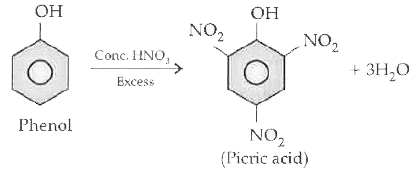
|
|
| 27. |
How would you obtain (i) Picric acid (2,4,6-trinitrophenol)from phenol, (ii) 2-Methyl propene from 2-methyl propanol |
Answer» SOLUTION :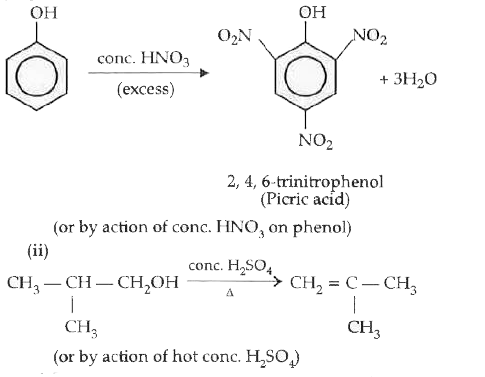
|
|
| 28. |
How would you obtain ethan-1,2-diol from ethanol? |
| Answer» Solution :`underset("ETHANOL")underset(CH_(2)OH)overset(CH_(3))(|)underset(443-443K)overset("Conc."H_(2)SO_(4))(to)underset("Ethylene")underset(CH_(2))overset(CH_(2))(||)overset("COLD DIL." KMnO_(4))(to)underset("ethan-1,2-diol")underset(CH_(2)OH)overset(CH_(2)OH)(|)` | |
| 29. |
How would you obtain chloroform from acetone? |
Answer» SOLUTION :When ACETONE is treated with CHLORINE and alkali, CHLOROFORM is formed. 
|
|
| 30. |
How would you obtain Benzoic acid from aniline? |
Answer» SOLUTION :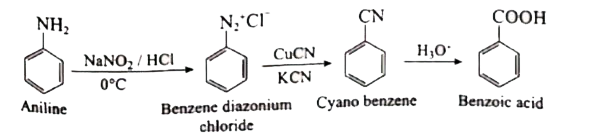
|
|
| 31. |
How would you obtain (a) But-2-enal from ethanal,(b) Butanoic acid from butanol,(c ) Benzoic acid from ethylbenzene ? |
|
Answer» SOLUTION :(a) But-2-enal from ethanal `:` `UNDERSET("Ethanal")(2CH_(3) CHO ) OVERSET("dil. NaOH" )( rarr) CH_(3)underset( OH)underset(|)(C) HCH_(2) CHOoverset( Delta )( rarr) CH_(3) - underset( "But-2-enal")(CH-CHCHO)` (b) Butanoic acid from butanol `:` `underset("Butanol")(CH_(3) CH_(2) CH_(2) CH_(2) OH) underset([O])overset( KMnO_(4))(rarr)underset("Butanoic acid ")(CH_(3) CH_(2) CH_(2) COOH ) ` (c ) Benzoic acid from ethylbenzene `:` 
|
|
| 32. |
How would you obtain a sol of Agl, the particles of which migrate toward cathode under the electric field |
|
Answer» By adding little excess of `Kl` to `AgNO_(3)` solution |
|
| 33. |
How would you measure the conductivity of ionic solutions? |
|
Answer» Solution :(i) The conductivity of an electrolytic solution is determined by using a wheatstone bridge arrangement in which one resistance is is replaced by a conductivity cell filled with the electrolytic solution of UNKNOWN conductivity. (ii) In the measurement of specific resistance of a metallic wire, a DC power supply is used. Here AC is used for this measurement to prevent electrolysis. Because DC CURRENT through the conductivity cell leads to the electrolysis of the solution taken in the cell. (iii) A wheatstone bridge is consitituted using known resistance P,Q, a variable resistance S and conductivity cell. An AC source (550 Hz to 5 KHz) is connected between the junctions A and C. A suitable detector is connected between the junction B and D. (iv) The variable resistance S is adjusted until the bridge is balanced and in this conditions, there is not current flow through the dectector. (v) Under balanced condition `P//Q = R//S` `:. R = P//Q xx S "" ...........(1)` The resistance of the electrolytic solution (R ) is calculated from the known resistance values, P,Q and measured S value using the equation (1). (vi) Specific conductance (or) conductivity of an electrolyte can be calculated from the resistance value (R ) using the following expression `k = 1/R [l/A]` (vii) The value of cell CONSTANT `l/A` is USUALLY provided by the cell manufacturer. Alternatively the cell constant may be determined using KCl solution whose concentration and specific conductance are known. 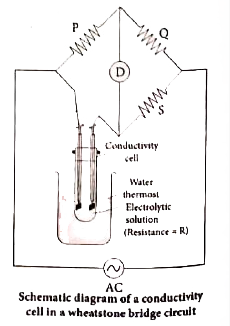
|
|
| 34. |
How would you measure the conductivity of ionic solutions ? |
|
Answer» Solution :The conductivity of an ELECTROLYTIC solution is determined by using a wheatstone bridge arrangement in which one resistance is REPLACED by a conductivity CELL filled with the electrolytic solution of unknown conductivity. In the measurement of specific resistance of a metallic wire, a DC power supply is used. Here AC is used for this measurement to prevent electrolysis. Because DC current through the conductivity cell leads to the electrolysis of the solution taken in the cell. A wheatstone bridge is constituted using known RESISTANCES P,Q, a variable resistance S and conductivity cell. An AC source (550 Hz to 5 KHz) is connected between the junctions A and C. A suitable detector is connected between the junctions B and D. The variable resistance S is adjusted until the bridge is balanced and in this conditions, there is no current flow through the detector. 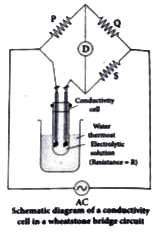 Under balanced condition `P//Q=R//S` `R=P//QxxS""...............................(1)` The resistance of the electrolytic solution (R) is calculated from the known resistance values P, Q and the measured S value using the equation (1). Specific conductance (or) conductivity of an electrolyte can be calculated from the resistance value (R) using the following expression `K=(1)/(R)[(l)/(A)]` The value of cell constant `(l)/(A)` is usually provided by the cell manufacturer. Alternatively the cell constant may be determined using KCl solution whose concentration and specific conductance are known. |
|
| 35. |
How would you measure CBSE for [Fe(CN)_(6)]^(3-). |
Answer» Solution :COMPLEX : `[Fe(CN)_(6)]^(3-)` 
|
|
| 36. |
How would you manufacture benzaldehyde from toluene? |
Answer» SOLUTION : This is the COMMERCIAL METHOD for the MANUFACTURE of BENZALDEHYDE. |
|
| 37. |
How would you get recemicmixtureof 1,2 butane siol from cis 2-butane? CH_(3)CH=CHCH_(3)underset((ii)B)overset((i)A)rarrCH_(3)-underset(OH)underset(|)CH-overset(OH)overset(|)CH-CH_(3) A and B are : |
|
Answer» <P>`A=KMnO_(4)//OH^(-),B=H_(2)` |
|
| 38. |
How would you get oxime from acetaldehyde ? Give equation ? |
| Answer» SOLUTION :When ACETALDEHYDE REACTS with hydroxylamine, oxime is FORMED | |
| 39. |
How would you justify that the relative lowering in vapour pressure is a colligative property ? |
|
Answer» Solution :According to Raoult.s law , " the relative LOWERING of vapoure PRESSURE `((po-ps)/(po))` is equal to the MOLE fraction of the solute `(X_1 (n_1)/(n_1 + n_2))` `IMPLIES(po-ps)/(po)=X_1`.From the above equation it is clear that relative lowering of vapour pressure DEPENDS upon the concentration or number of molecules of solute present in the solution. |
|
| 40. |
How would you get oxime from aldehyde ? |
| Answer» Solution :When ACETALDEHYDE REACTS with HYDROXYLAMINE, OXIME is formed | |
| 41. |
How would you get iodo benzene form benzene diazonium chloride. |
| Answer» Solution :`UNDERSET("BENZENE diazonium chloride")(C_(6)H_(5)N_(2)""^(+)Cl^(-))+Kitounderset("Iodobenzene")(C_(6)H_(5)I)+N_(2)uarr+KCl` | |
| 42. |
How would you get Benzyl alcohol from Benzoic acid. |
| Answer» Solution :`UNDERSET("Benzoic ACID")(C_6H_5COOH)underset(H_2O)overset(LiAlH_4)to underset("BENZYL ALCOHOL")(C_6H_5CH_2OH)` | |
| 43. |
How would you expect the bond strength to change in the series C_(2) to C_(2)^(-) to C_(2)^(2-)? |
|
Answer» GETS stronger than weaker `B.O=(4-0)/(2)=2` `C_(2)^(-)rarr(sigma_(1s))^(2)(sigma_(1s)^(**))^(2)(sigma_(2s))^(2)(sigma_(2s)^(**))^(2)(pi_(2p_(x)))^(2)(pi_(2p_(y)))^(2)(sigma_(2p_(z)))^(1)` `B.O=(5-0)/(2)=2.5` `C_(2)^(2-)rarr(sigma_(1s))^(2)(sigma_(1s)^(**))^(2)(sigma_(2s))^(2)(sigma_(2s)^(**))^(2)(pi_(2p_(x)))^(2)(pi_(2p_(y)))^(2)(sigma_(2p_(z)))^(2)` `B.O=(6-0)/(2)=3` As BOND order is increasing it implies bond strength is increasing. |
|
| 44. |
How would you do the following conversions in not more than two steps? (a) Propanone to Propene (b) Propanal to Butanone ( c) Ethanol to 3-Hydroxybutanal (d) Benzaldehyde to Benzophenone (e) Benzaldehyde to alpha-Hydroxyphenylacetic acid (f) Benzaldehyde to 3-Phenylpropan-1-ol |
|
Answer» Solution :(a) `CH_(3)COCH_(3)overset(LiAlH_(4))toCH_(3)overset(OH)overset(|)CH-CH_(3)overset(H^(+),453K)toCH_(3)CH=CH_(2)` (b) `CH_(3)CH_(2)CHOoverset(CH_(3)MGBR)underset(H_(3)O^(+))toCH_(3)-CH_(2)-overset(OH)overset(|)CH-CH_(3)overset(K_(2)Cr_(2)O_(7)//H^(+))toCH_(3)CH_(2)overset(O)overset(||)C-CH_(3)` ( c) `CH_(3)CH_(2)OHoverset([O])tounderset("2 MOLES")(CH_(3)CHO)overset(OH^(-))underset("ALDOL condensation")toCH_(3)-overset(OH)overset(|)CH-CH_(2)CHO` 
|
|
| 45. |
How would you distinguish natural honey from artificial honey? |
|
Answer» Solution :(i) Natural honey is a colloidal sol. It is distinguished from artificial one by adding ammonia cal `AgNO_(3)` (ii) In the case of natural honey, a metallic silver is produced assumes a reddish yellow colour due to the TRACES of albumin or ETHEREAL oil which acts as a protective COLLOID. (iii) In case of artificial honey, a dark yellow (or) greenish yellow PRECIPITATE is formed. |
|
| 46. |
How would you distinguish between (i) methyl alcohol and ethyl alcohol (ii) benzyl alcohol phenol, (iii) ethyl alcohol and benzyl alcohol? |
Answer» Solution :(i) METHYL ALCOHOL and Ethyl alcohol  (II)  (III) 
|
|
| 47. |
How would you distinguish between: (a) solutions of acetic acid, fornmic acid and ethanol (b) calcium formate and calcium acetate? (c) maleic acid and fumaric acid? (d) acetic acid and acetone? (e) acetic acid and acrylic acid? (f) tartaric acid and citric acid? (g) Benzoic acid and cinnamic acid? |
|
Answer» Solution :(a) Both FORMIC and acetic acid solutions will give effervescences with `NaHCO_(3)`. Formic acid reduces Fehling's solution and Tollens reagent while acetic acid do not give these tests. Ethanol neither reacts with `NaHCO_(3)` nor with Fehling's solution and Tollen's reagent. (b) Calcium formate on HEATING forms a gas with pungent smell. Calcium acetate on heating forms vapours of pleasant odour c) Maleic acid on heating gives maleic anhydride. No anhydride is formed by fumaric acid. d) Acetic acid reacts with `NaHCO_(3)` to give effervescence. Acetone gives iodoform test and yellow crystalline compound with 2,4-dinitrophenylhydrazine. (e) Acrylic acid decolourises bromine water in `"CC"I_(4)` and purple colour of dilute `KMnO_(4)` solution. These tests are not given by acetic acid (f) Tartaric acid with Tollens reagent gives silver miror. Citric acid does not give this test. (G) Cinnamic acid being unsaturated compound decolourises bromine water in `"CC"I_(4)`. Benzoic acid does not give this test. Further benzoic acid gives a buff coloured (pale dull yellow) precipitate with neutral ferric CHLORIDE solution |
|
| 48. |
How would you distinguish between? (a) Ethylamine and diethylamine or primary amine and secondary amine. (b) Ethylamine and acetamide. (c) Diethylamine and triethylamine. (d) Nitro ethane and ethyl nitrite. (e) Aniline and ethylamine. (f) Nitrobenzene and aniline. (g) Aniline and N-methylaniline |
|
Answer» Solution : (a) Ethylamine (primary amine) gives carbylamine test. It gives a foul odour when heated with chloroform and alcoholic KOH. Diethylamine (secondary amine) does not give this test. (b) Acetamide when heated with NaOH, gives a smell of ammonia, ethylamine does not EVOLVE NH3. Ethylamine givescarbylamine reaction while acetamide does not give this test. (c) Diethylamine reacts with nitrous acid to form N-nitrosoamine which is water INSOLUBLE yellow oil while triethylamine reacts with nitrous acid to form soluble nitrite salt. There is no visible sign of reaction. Diethylamine reacts with benzene sulphonyl chloride and forms a solid insoluble in alkali. Tertiary amine (triethyl amine) does not react with benzene sulphonyl chloride. (d) Ethyl nitrite on hydrolysis forms `C_(2)H_(5)OH` while nitroethane does not undergo hydrolysis. (e) Aniline reacts with nitrous acid (from `NaNO_(2), + HCl`) at 273-278K to form a diazonium salt which gives a red dye with alkaline solution of B-naphthol while ethylamine reacts with nitrous acid to produce nitrogen gas (seen as bubbles). (f) (a) NITROBENZENE on reduction gives aniline which exhibits dye test. b) Nitrobenzene gives Baker-Mulliken's test. On treatmentwith Zn `"dust"//NH_(4)CL,-NO_(2)` group is reduced to hydroxylamine which on warming with Tollen's reagent reduce to metallic silver. (c) Aniline gives azo dye test. (d) Aniline gives carbylamine test (a very unpleasant smell). (g) Aniline gives azo dye test. N-methylaniline forms nitrosoamine (yellow oily liquid) on treatmetn with nitrous acid, which is stable at room temperature. However on reacion with HCl in ether and alcohol, the nitroso(-NO) gorup migrates to para-postition. |
|
| 49. |
How would you differentiate betweenS_(N)1 " and " S_(N)2 mechanisms of substitution reactions ? Give one example of each. |
|
Answer» Solution :There are TWO different ways in which the substitution reactions of alkyl halides take place. (a) Substitution nucleophilic unimolecular `S_(N)1` : The reaction between tert. butyl chloride and hydroxide ion yields tert-butyl hydroxide and follows first order kinetics `(S_(N)1)` i.e., rate of the reaction depends upon one concentration terms i.e. tert. butyl chloride. The reaction occurs in two steps: `(CH_(3))_(3)C Cl to (CH_(3))_(3)C^(+) + Cl^(-) ` (First step ) Slop step `(CH_(3))_(3)C Cl + OH^(-) to (CH_(3))_(3)COH ` Fast step (b)Substitution nucleophilic bimolecular `S_(N)2` : The reaction between `CH_(3)Cl`and hydroxide ion to yield METHANOL and chloride ion follows a second order kinetics i.e., the rate of reaction depends upon the concentration of both terms. `CH_(3)Cl + OH^(-) overset(S_(N)2) to underset("Intermediate")([HO * * * * CH_(3)* * * * Cl^(-)]^(-)) to CH_(3)OH + CL^(-)` In the first step, `CH_(3)Cl " and " OH^(-)`react to FORM the intermediate compound. This is the slow step. In the second step, which is fast, the intermediate decomposes to yield the PRODUCTS. |
|
| 50. |
How would you determine the standard electrode potential of the system Mg^(2+) | Mg ? |
|
Answer» Solution :* The standard electrode potential of `Mg^(2+)|Mg` can be measured with RESPECT to the standard hydrogen electrode, represented by `Pt_((S)),H_(2(g))(1atm)|H_((AQ))^(+)(1M)`. * A cell, consisting of `Mg|MgSO_(4(aq))1M` as the anode and the standard hydrogen electrode as the cathode is set up. `Mg|Mg_((aq))^(2+)(1M)||H_((aq))^(+)(1M)|H_(2(g))(1" bar")|Pt_((S))` * Then, the emf of the cell is measured and this measured emf is the standard hydrogen electrode as the cathode is set up. `Mg|Mg_((aq))^(2+)(1M)||H_((aq))^(+)(1M)|H_(2(g))(1" bar")|Pt_((S))` * Then, the emf of the cell is measured and this measured emf is the standard electrode potential of the magnesium electrode. `E^(Theta)=E_(R)^(Theta)-E_(L)^(Theta)` * Here, `E^(Theta)` for the standard hydrogen electrode is ZERO. THEREFORE, `E^(Theta)=0-E_(L=E_(L)^(Theta))^(Theta)` |
|