

Saved Bookmarks
This section includes 7 InterviewSolutions, each offering curated multiple-choice questions to sharpen your Current Affairs knowledge and support exam preparation. Choose a topic below to get started.
| 1. |
How arep-nitroaniline compunds obtained from aniline ? |
Answer» Solution :p-nitroaniline : ACETANILIDE on TREATMENT with nitric acid in the PRESENCEOF sulphuric acid gives p-nitroacetanilide which on acidic hydrolysis gives p-nitroaniline as MAJOR product. 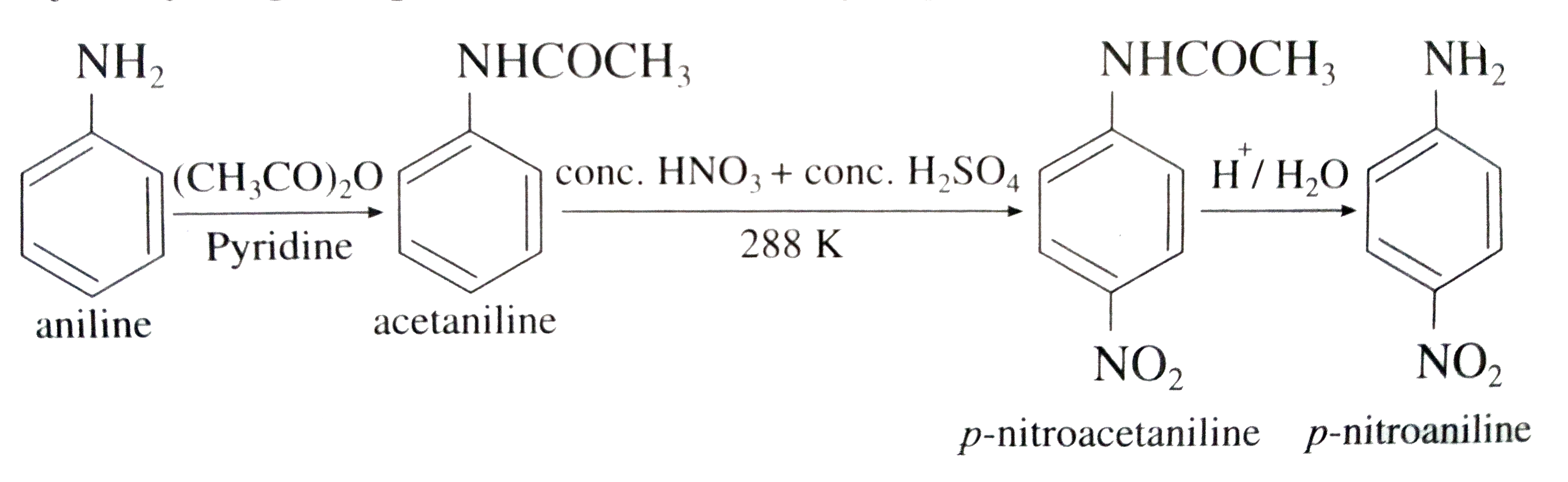
|
|
| 2. |
How are p-amino benzene compounds obtained from aniline ? |
Answer» SOLUTION :p-amino benzene : Aniline on TREATMENT with COLD sulphuric acid froms anilinium hydrogen sulphate which on HEATING with sulphuric acid at 453-473 K gives p-aminobenzene sulphonic acid (sulphanilic acid) as major product. 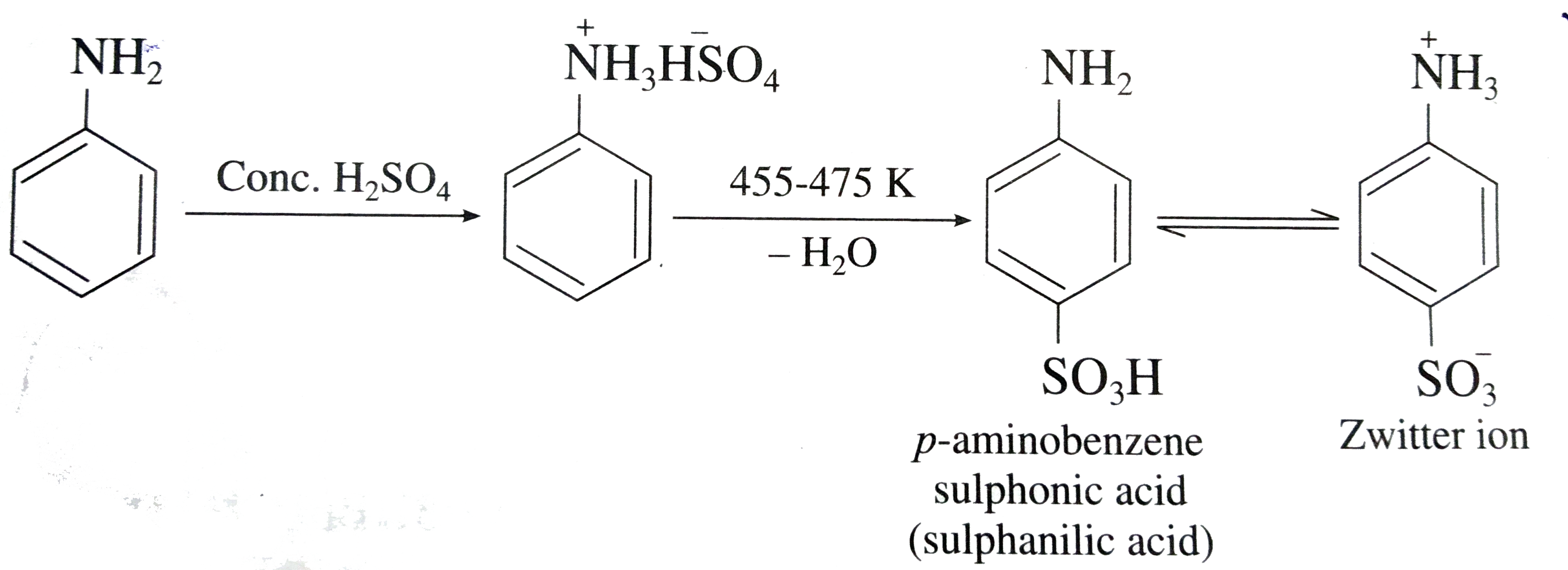 Sulphanilic acid exists as a salt, called Zwitter ion (Ion has positiveas well as negative charge within same molecular STRUCTURE). |
|
| 3. |
How arep-bromo aniline compounds obtained from aniline ? |
Answer» Solution :p-bromo aniline : When aniline is treated with ACETIC anhydride, acetanilide is OBTAINED. Acetanilide is then treated with bromine in acetic acid to give p-bromo acetanilide which on acid or alkaline HYDROLYSIS gives p-bromo aniline.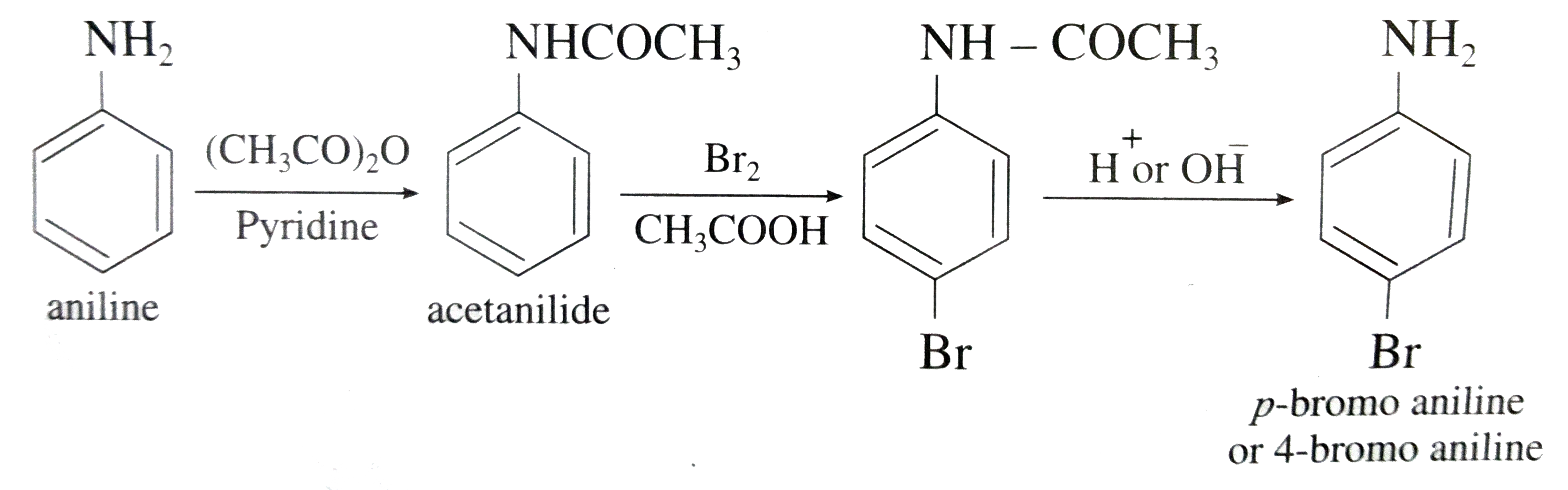
|
|
| 4. |
How are octahedral complexes with high spin and low spin states formed ? What is the condition of their formation ? |
|
Answer» Solution :There are three `t_(2g)` orbitals with lower energy and two `e_(g)` orbitals with higher energy. Three electrons with parallel spins can first enter into the lower energy three `t_(2g)` orbitals, i.E., for COMPLEXES with `d^(1), d^(2)` and `d^(3)` ion. For `d^(4), d^(5), d^(6)` etc. ions, the electrons can either into `t_(2g)` orbitals and pair up or they MAY enter into `e_(g)` orbitals. The former gives rise to low spin complex while the latter gives rise to high spin complex. If cystal field splitting energy (difference of energy between `t_(2g)` and `e_(g)` orbitals) is large, low spin state is more stable and if it is small, high spin state is more stable. |
|
| 5. |
How are nucleosides, nucleotides and nucleic acids related? |
| Answer» SOLUTION :NUCLEOSIDES joined to PHOSPHATE group form nucleotides. The POLYMERS of nucleotides are NUCLEIC acids. | |
| 6. |
How are NO and NO_(2) formed in the atmosphere ? |
| Answer» Solution :NO is formed DUE ot reaction between `N_(2)` and `O_(2)` during lightning or COMBUSTION of fossils FUELS. It is further oxidized to `NO_(2)`. | |
| 7. |
How are nitro alkanes prepared for the following methane |
|
Answer» Solution :GASEOUS mixture of methane and nitric acid passed through a red hot metal tube to give nitromethane. `{:(CH_(4(g))+HNO_(3(g))underset(" Red hot SI tube ")overset(675 K)(to)CH_3-NO_2+H_2O),(" MathaneNitro methane "):}` Except methane, other alkanes (upto n-hexane) give a mixture of NITROALKANES due to C-C cleavage. The individual nitro alkanes can be separated by FRACTIONAL distillation. 
|
|
| 8. |
How are nitro alkanes prepared for the following alkyl bromides |
|
Answer» SOLUTION :ALKYL bromides (or) iodides on heating with ethanolic solution of POTASSIUM nitrite GIVES nitroethane. `{:(CH_3CH_2-Br+KNO_2underset(SN_2)overset(" ethanol""/"triangle)(to)CH_3CH_2-NO_2+KBr),(" Ethyl bromideNitroethane "):}` The reaction follows `SN_2` MECHANISM. |
|
| 9. |
How are metals used as semiconductors refined ? What is the principle of the method used like germinum, silicon etc.? |
| Answer» Solution :GE, Si, B, In ETC. are REFINED by Zone refining METHOD. The method is BASED on principle that impurities are more soluble in molten state of the metal than in the solid state. | |
| 10. |
How are metalsusedassemiconductorsrefined ? Whatistheprinciple ofthe method used ? |
| Answer» Solution :Themetalssuchas GERMANIUM,silicon , GALLIUM, ETC. WHICHARE usedassemiconductors are purifiedbyzonerefiningwhich isbasedupontheprinciplethat impuritiesaremore SOLUBLEIN themeltthaninthesolidstate ofmetals. | |
| 11. |
How are metal carbonyls classified depending on the number of metal atoms? |
|
Answer» Solution :The structures of the binuclear metal carbonyls involve either metal-metal bonds or bridging CO groups , or both .The carbonyl ligands that are attached to only ONE metal atom are referred to as terminal carbonyl groups. Whereas those attached to two metal ATOMS simultaneously are CALLED bridging carbonyls. Depending upon the structures metal carbonyls are classified as follows. Non -bridged metal carbonyls: These metal carbonyls do not contain any bridging carbonyl ligands .They may be of two types (i) Non-bridged metal carbonyls which contain only terminal carbonyls . Examples: `[Ni(CO)_4], [Fe(CO)_5]and [Cr(CO)_6]` Non-bridgedmetal carbonyls which contains terminal carbonyls as well as metal-Metal bonds ,For examples The structure of ` Mn_2(CO)_(10) ` actually involve only a metal -metal bond so the formula is more correctly represented as ` (CO)_5 Mn-Mn(CO)_5`Other examples of this TYPE are ` T_(C_2) )CO)_(10 ) ` and `Re_2(CO)_(10 ) ` ` (##SUR_CHE_XII_V01_C05_E12_011_S01.png" width="80%"> |
|
| 12. |
How arematerialsclassifiedbasedon theirmagneticproperties? |
|
Answer» Solution :On the basisof magneticpropertiesmateriescan bebroadlyclassified as (a)Paramagneticmaterials ( b)diamagneticmaterials besides these there arefeeromagneticandantiferromagneticmaterials. (i) Materials with noelementarlymagneticdipolesare diamagneticin other r words aspeceswithall pairedelectrons exhibitsdiamagnetism. (ii) Thiskind of materials are repelledby the magneticfieldbacuaseteh PRESENCEOF externalmagneticfileda MAGNETICINDUCTION is introducedto the materialwhichgeneratesweakmagneticfieldthatopposethe appliesfield . (III) Paramagneticsolidshavingunpairedelectronspossesmagneticdipoleswhichare isolatedfrom one another . (iv ) In theabsenceof externalmagneticfieldthedipoles are arranged at random andhence the solidshowsno netmagnetism . (V ) BUTIN the presenceof magneticfield the dipolesar alignedparallelto thedirectionof the appliedfieldadn therfore they areattracted byan externalmagnetic field. (v i)Ferromagneticmaterials havedomainstructureand ineach domainthe magneticdiples are arranged. |
|
| 13. |
How are lipids classified? |
|
Answer» Solution : Lipids are classified into two CATAGORIES : (1) complex and (2) simple lipids. (1) Complex lipids : They are the esters of long chain fatty acids. It can be hydrolysed. Complex lipids includes triglycerides, GLYCOLIPIDS. phospholipids and waxes. (1) Triglycerides are triesters of glycerol with higher fatty acids. 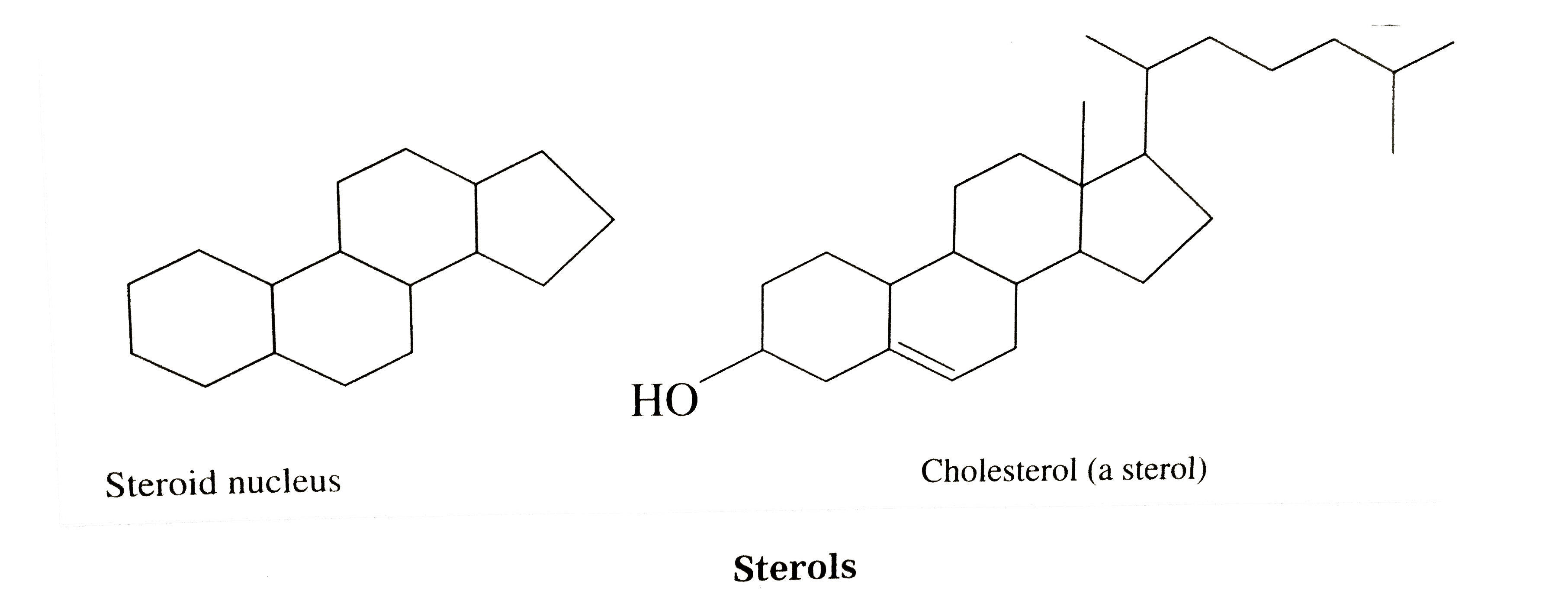 ats and oils are mixtures of triacyl glycerols. `R_(1) R_(2) and R_(3)` may same or different and may be saturated or unsaturated. (2) Glycolipids : When lipids are associated with sugars, It forineglycolipids. The simplest animal glycolipids are cerebrosides. In plant glycolipids, the sugar group is commonly galactose. (3) In phospholipids, two of the hydroxyl groups in glycerol are esterified by fatty acids and one by phosphate group. (4) Waxes are mainly esters of long chain carboxylic acids with long chain alcohols, usually they are secreted by plants and animals. (2) Simple lipids : These lipids have ester LINKAGES and cannot be hydrolysed. These include steroids, terpenes and prostaglandins. (1) Steroids are derived from cyclopentanoperhydrophenanthrene, which has nucleus of four rings.  (2) Sterols exist as free sterols or esters of fatty acids. Animal sterols include cholesterol and lanosterol. (3) Terpenes are unsaturated hydrocarbons. Terpenoids, which are derivatives of terpenes include geraniol, menthol and vitamin A. (4) Prostaglandins are group of `C_(20)` lipids. It contains FIVE members ring with two long side chains. It is detected in MANY body tissues. |
|
| 14. |
How are lipids classified ? |
| Answer» SOLUTION :Lipids can be CLASSIFIED as SIMPLE lipids, COMPOUNDS lipids and derived lipids. | |
| 15. |
How are ketones classified ? (feb. '16) |
|
Answer» Solution :Ketones are classified into two types : (1) Simple or SYMMETRICAL ketones and (2) Mixed or UNSYMMETRICAL ketones. (1) Simple or symmetrical ketone : The ketone in which the carbonyl carbon is ttached to two identical alkyl GROUPS is called a simple or symmetrical ketone.e.g.,`{:(CH_(3)-overset(O)overset("||")C-CH_(3)""C_(2)H_(5)-overset(O)overset("||")C-C_(2)H_(5)),("AcetoneDiethyl ketone"):}` (2) Mixed or unsymmetrical ketone : The ketone in which the carbonyl carbon is ATTACHED to two different alkyl group is called a mixed or unsymmetrical ketone. e.g., `{:(CH_(3)-overset(O)overset("||")C-C_(2)H_(5)""C_(3)H_(7)-overset(O)overset("||")C-C_(2)H_(5)),("Ethyl methyl ketoneEthyl n-propyl ketone"):}` |
|
| 16. |
How are isopropyl bromide and n-propyl bromide obtained from propene ? |
|
Answer» Solution :(i) `CH_(3)-CH= CH_(2)+HBr overset("Markownikoff.s rule")to underset("ISOPROPYL bromide")(CH_(3)-underset(CH_(3))underset(|)CH-CH_(3))` (II) `CH_(3)-CH=CH_(2)+HBr overset("Organic Peroxide")to underset("n-Propyl bromide")(CH_(3)-CH_(2)-CH_(2)-Br)` |
|
| 17. |
How are interhalogen compounds formed? What general composition can be assigned to them. |
|
Answer» SOLUTION :Halogens REACT with each other to form a number of compounds called interhalogen compounds. Their general formula is `XX_(n)` where X is a less electronegative HALOGEN while X' is a more electronegative halogen and n is its number. Depending upon the oxiation state of halogen X (i.e., +1, +3, +5 and +7), these are divided into four types : XX', `XX'_(3), XX'_(5) and XX'_(7)`. |
|
| 18. |
How are inorganic salts classified ? |
|
Answer» Solution :Inorganic salts are classified as follows: (i) Simple salts: NaCl, KCl, etc. (ii) DOUBLE salt : `K_2 SO_4 . Al_2 (SO_4)_3. 24 H_2 O` (potash ALUM), `FeSO_4. (NH_4)_2 . SO_4. 6H_2 O ` (Mohr.s salt) (iii) Complex salts : `K_4 [Fe(CN)_6 , K_3 [Fe(CN)_6]`. |
|
| 19. |
How are gold number and protective power of colloid related? |
| Answer» SOLUTION :They are INVERSELY RELATED. | |
| 20. |
How are following polymer obtained ? Write the names and structures of monomers and structure of respective polymer : Buna-N |
Answer» SOLUTION :Buna-N : By ADDITION POLYMERISATION. 
|
|
| 21. |
How are following polymer obtained ? Write the names and structures of monomers and structure of respective polymer : PHBV |
Answer» SOLUTION :PHBV : By CONDENSATION POLYMERISATION. 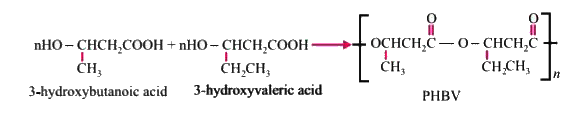
|
|
| 22. |
How are following polymer obtained ? Write the names and structures of monomers and structure of respective polymer : Glyptal |
Answer» SOLUTION :GLYPTAL : By CONDENSATION POLYMERISATION. 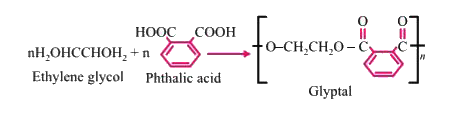
|
|
| 23. |
How are following polymer obtained ? Write the names and structures of monomers and structure of respective polymer : Nylon-6 |
Answer» SOLUTION :Nylon-6 : By CONDENSATION POLYMERISATION. 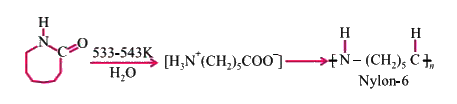
|
|
| 24. |
How are following polymer obtained ? Write the names and structures of monomers and structure of respective polymer : Dacron |
Answer» SOLUTION : DACRON : By CONDENSATION POLYMERISATION. 
|
|
| 25. |
How are following formed? (i) Cinnamic acid form benzaldehyde. (ii) Acetyl chloride from acetic acid. |
|
Answer» Solution :(i) (II) `CH_(3)COOH+PCl_(5)toCH_(3)COCl+POCl_(3)+HCL` |
|
| 26. |
How are following conversions done ? |
|
Answer» <BR>Conversions are described as under : (ii) 1- Chloropropane to 1 - Propanol (iii) 2- Methyl-1- pentene to 2 -Mehtyl -2- pentanol (iv) Phenol to Phenyl ethanoate. 
|
|
| 27. |
How are following compounds obtained from alkenes: C_(2)H_(5)Br |
|
Answer» Solution :Ethene on REACTION with hydrogen bromide FORMS `C_(2)H_(5)Br`. `underset("ethene")(H_(2)C)=CH_(2)+HBr to underset("Bromoethane")(CH_(3)-CH_(2)-Br)` |
|
| 28. |
How are emulsions useful in digestion ? |
| Answer» Solution :In the DIGESTION of fats in intestines emulsionsa are used. The fat in the intestine form SOAP with alkali of the intesines. This CONVERTS the remaining fat into emulsion and stabilises this emulsion. | |
| 29. |
How are electro chemical cells classified? Explain. |
|
Answer» Solution :Electrochemical cells are mainly classified into the following TWO types. (i) GALVANIC Cell (Voltaic cell) : It is a DEVICE in which a spontaneous CHEMICAL reaction generates an electric current i.e., it converts chemical energy into electrical energy. It is commonly known as a battery. (ii) Electrolytic cell : It is a device in which an electric current from an external SOURCE drives a nonspontaneous reaction i.e., it converts electrical energy into chemical energy. |
|
| 30. |
How are disaccharides classified? . Give example. |
|
Answer» Solution :(i) DISACCHARIDES linked through `C_(1)` of the first to `C_(4)`or `C_(6)` of the second component are called reducing sugar. Eg: LACTOSE. (ii) Disaccharides linked through the glycosidic carbon atoms of each component `C_(1)`of glucose to `C_(2)` of fructose are NON- reducing disaccharides. Eg: Sucrose. |
|
| 31. |
How are colloids classified on the basis of nature of interaction between dispersed phase and dispersion medium ? Describe the important characteristics of each class. Which of these sols need stabilizing agents for preservation ? |
| Answer» | |
| 32. |
How are dihalogen derivatives classified ? Give examples . |
|
Answer» Solution :The dihalogen DERIVATIVES are classified according to the POSITIONS of two halogen atoms in the compound as follows : (1) VICINAL dihalides : In these dihalogen derivatives of alkanes , two halogen atoms are bonded to two adjacent (vicinal) carbon atoms . Example : Ethylene , dichloride , `{:(CH_(2)-CH_(2)),(|""|),(Cl""Cl):}` (2) Geminal dihalides : In these dihalogen derivatives of alkanes , both the halogen atoms are bonded to the same carbon atom. Example: Ethylidence dichloride, `CH_(3)-CHCl_(2)`. |
|
| 33. |
How are colloidal solution of ink and graphite prepared? |
| Answer» Solution :(i) Using a colloid mill, the solid is ground to colloidal dimension. (ii) The colloid mill consists of TWO metal plates rotating in opposite direction at very high speed of nearly 7000 revolution / minute. (iii) The colloidal PARTICLES of required colloidal size is obtained by adjusting the distance between two plates. (iv) By this method, colloidal SOLUTIONS of INK and graphite are prepared. | |
| 34. |
How are carboxylic acids prepared from nitriles ? |
|
Answer» Solution :ALKYL Nitriles UPON acid/base hydrolysis gets hydrolysed to amides which upon heating further get hydrolysed to carboxylic acids. `underset("Alkane nitrile")(R-CN)+H_(2)O overset(H^(+))RARR underset("AMIDE")(RCONH_(2))+H_(2)O underset(Delta)rarr underset("Carboxylic acid")(RCOOH)+NH_(3)` |
|
| 35. |
How are carboxylic acid prepared from Grigoard reagent? |
Answer» SOLUTION :Carbon dioxide gas is bubbled through ethereal solution ofGrignard reagent to GIVE an addition COMPOUND which on HYDROLYSIS GIVES carboxylic acid. 
|
|
| 36. |
How are carbohydrates stored in the animal body ? |
| Answer» SOLUTION :Glucose is STORED as glycogen in the liver and muscles of HUMAN body. | |
| 37. |
How are carbohydrates classified ? |
|
Answer» Solution :On the basis of their hydrolysis products , carbohydrates are classified as : (1) Simple carbohydrates and (2) COMPLES carbohydrates. (1) Simple carbohydrates : The simple carbohydrates cannot hydrolsed further to simpler compounds . They are the basic units of all carbohydrates , and are called monosaccharides . They are sugars which are crystalline , water soluble and have sweet taste. Examples : glucose , fructose , ribose. Monosaccharides are further classified as aldoses, containing an aldehyde group and ketoses , containing keto group . DEPENDING upon number of carbon atoms and the functional groups , monosaccharides are further classified as triose , tetrose ,, pentose , hexose etc. (2) Complex carbohydrates : The complex carbohydrates are further classified as (A) Oligosaccharides and (B) Polysaccharides. (a) Oligosaccharides : An oligosaccharide is a carbohydrates (sugar) which on hydrolysis gives two to ten monosaccharide units. Depending on the number of monosaccharides produced on hydrolysis , oligosaccharides are further classified as : (1) Disaccharides `( C_(12)H_(22)O_(11) )` : Sucrose `overset("Hydrolysis")to ` Glucose + Fructose Maltose `overset("Hydrolysis")to ` Glucose +Glucose Lactose `overset("Hydrolysis")to` Glucose + Galactose (2) Trisaccharides `(C_(18)H_(32)O_(16))` : RAFFINOSE `overset("Hydrolysis")to ` Glucose + Fructose + Galactose (3) Tetrasaccharides `(C_(24)H_(42)O_(21))`: Stachyose `overset("Hydrolysis")to` Glucose + Fructose + Galactose + Galactose Oligosaccharide is homogenous . In this , each molecule of oligosaccharide contains the same number of monosaccharide units joines together in the same order as very other molecule of the same oligosaccharide. (b) Polysaccharides : These are carbohydrates which on hydrolysis give a large number of monosaccharides. Polysaccharides are tasteless , amorphous , insoluble in water. They are long chain, naturally occuring polymers of carbohydrates. E.g., cellulose, starch , glycogen. |
|
| 38. |
How are biopolymers more beneficial than synthetic polymers? |
| Answer» Solution :Durability of SYNTHETIC polymers is advantageous, however it presents a serious waste disposable problem. In renewal of the disposable problem, biodegradable polymers are USEFUL to us. Biopolymers are safe in use. They disintegrate by themselves in biological system during a certain period of time by enzymatic hydrolysis and to some extent by OXIDATION and hence, are biodegradable. As a result, they do not cause any pollution. | |
| 39. |
How are associated colloids different from multimolecular and macromolecular colloids ? |
|
Answer» SOLUTION :ASSOCIATED colloids are formed by electrolytes so that they are dissociated into ions and these ions associate together to form ionic micelles WHOSE size lies in the colloidal range, e.g. soaps. Multimolecular colloids - formed by the aggregation of a large number of SIMPLE molecules. Macromolecular colloids - DUE to large size of the molecules themselves. |
|
| 40. |
How are associated colloids different from multimolecular and macromolecular colloids? |
|
Answer» Solution :SUBSTANCE which an FORM aggregates at .Critical nicee concentration" and "kraft temperature" are KNOWN as associated colloids. Examples are soaps and SYNTHETIC detergets. |
|
| 41. |
How are antiseptics different from disinfectants ? How does an antibiotic different from these two ? Give one example of each of them. |
|
Answer» Solution :Antiseptics may kill or stop the growth of MICROBES and safe for living TISSUES, where an disinfectants kill microbes but not safe for living tissues. While antibiotic are produced by micro-ORGANISM, can inhibit the growth of other micro- organism. Example : ANTISEPTIC : 0.2% phenol, Disinfectant : 1% phenol, Antibiotic : Penicillin |
|
| 42. |
How are antiseptics different from disinfectants ? Give one example of each of them. |
|
Answer» Solution :ANTISEPTICS are CHEMICALS which prevent the growth of microorganisms without affecting living TISSUES. For example, furcine, soframicene, `0.2%` solution of phenol. Disinfectants are chemicals which KILL microorganisms in TOILETS, sewage line, etc. They are harmful to living tissues. For example, `1%` solution of phenol. |
|
| 43. |
How are anti-bonding molecular orbitals formed ? |
| Answer» Solution :Anti-bonding molecular orbitals are formed when two waves (of 2 ATOMIC orbitals) in opposite PHASE INTERACT i.e., by the subtractive INTERACTION of waves. | |
| 44. |
How are amines classified ? |
|
Answer» Solution :Amines are classified on the bass of the NUMBER of hydrogen atoms of ammonia that are replaced by alkyl group . Amines are classified as PRIMARY `(1^(@))` , SECONDARY `(2^(@))` and tertiary `(3^(@))` . (1) Primary amines `(1^(@) "amines")` : The amines in which only one hydrogen atom of ammonia is replaced by an alkyl or aryl group are called primary `(1^(@))`amines. Example : `CH_(3)-NH_(2)` methylamine. (2) Secondary amines `(2^(@)" amines" )` : The amines in which two hydrogem atoms of ammonia are replaced by two , same or different alkyl or aryl groups are called secondary `(2^(@))` amines. Example : `C_(2)H_(5)-NH-CH_(3)` ethylmethylamine. (3) Tertiary amines `(3^(@) "amines")` : The amines in which all the three hydrogen atom of ammonia are replaced by three same or different alkyl or aryl groups are called tertiary `(3^(@))` amines. Example :`CH_(3)-overset(CH_(3))overset(|)N-CH_(3)` trimethylamine Secondary and tertiary are further classified as (1) Simple/symmetrical amines (2) Mixed/or unsymmetrical amines. (3) Simple /symmetrical amines: In simple amines same alkyl group are attached to the nitrogen , e.g, `C_(2)H_(5)-NH-C_(2)H_(5)` Diethylamine `CH_(3)-UNDERSET(CH_(3))underset(|)N-CH_(3)`Trimethylamine (2) Mixed or unsymmetrical amines : In mixed amines different alkyl gropus are attached to the nitrogen. `C_(2)H_(5)-overset(CH_(3))-overset(|)N-C_(2)H_(5)` Diethyl methylamine `CH_(3)-NH_C_(2)H_(5)` Ethyl methylamine |
|
| 45. |
How are alpha-halo carboxylic acids obtained from carboxyliv acids? OR Explain Hell-Vohlard-Zelinsky(HVZ) reaction. |
|
Answer» Solution :carboxylicacid reacts with chlorine or bromine, in the presence of small amount of red phosphorus to form`alpha`-halocarboxylic acid. The reaction is calledHell-Vohlard-Zelinsky reaction. The importance of the reaction is that only `alpha`-HYDROGEN is substituted. `R-overset(alpha)underset(underset(H)(|))(C)H -COOH overset(1.X_(2)//"red P")underset(2.H_(2)O)(rarr)R-underset(underset(X)(|))(C)H - COOH + HX` When phenyl acetic acid is treated with bromine and red Phosphorus, 2- Brom -2 - phenyl acetic acid is obtained. 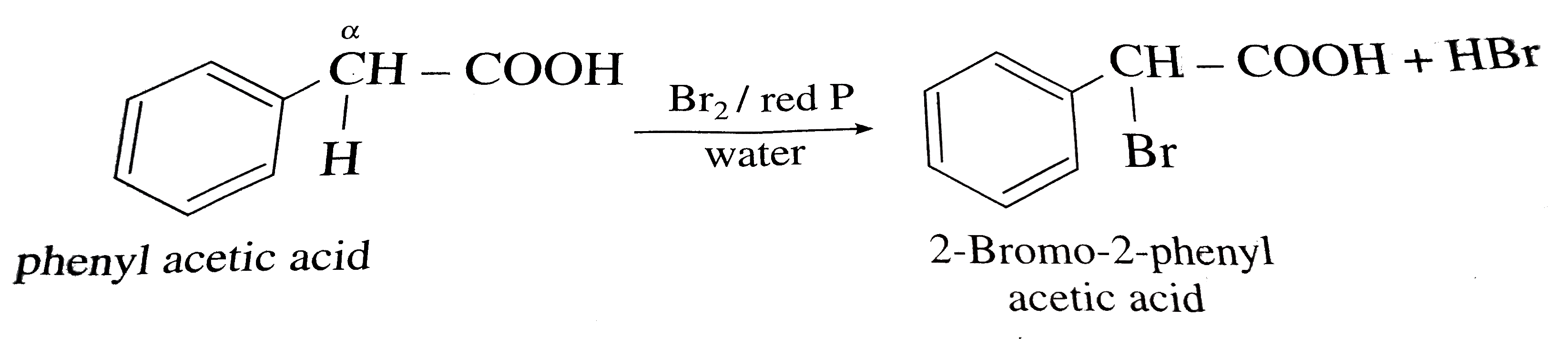 When acetic is treated with EXCESS of bromine and red phosphorus, TRIBROMO acetic acid is obtained. `CH_(3)-COOHoverset(Br_(2)//"red P")underset(-HBr)(rarr)BrCH_(2)-COOH overset(Br_(2)//"red P")underset(-HBr)(rarr) Br_(2) CH-COOH` `overset(Br_(2)//"red P")underset(-HBr)(rarr) Br_(3) C-COOH` tribromo acetic acid When propionic acid is treated with excess of bromine and red phosphorus 2,2- dibromo propionic acid is obtained. `underset(underset("Propionic acid")())(CH_(3)-)CH_(2)-COOHoverset(Br_(2)//"red P")underset(-HBr)(rarr)CH_(3)_ underset(underset(Br)(|))(C)H-COOH` ` overset(Br_(2)//"red P")underset(-HBr)(rarr)CH_(3)-overset(overset(Br)(|))underset(underset(Br)(|))(C)-COOH` 2,2 dibromopropionic acid |
|
| 46. |
How are alkyl halides (or monohalogen derivatives ) classified ? |
|
Answer» Solution :Alkyl halides are classified as follows:(1) PRIMARY (`1^(@)`) alkyl halide : It is an alkyl halide in which one halogen atom is BONDED to a primary`(1^(@)`)carbon atom , which is attached to only one other carbon atom . E.g. `CH_(3)-OVERSET(1^(@))CH_(2)-Cl`(ethyl chloride) (2) : Secondary `(2^(@))` alkyl halide : It is an alkyl halide in which one hlogen atom is bonded to a secondary `(2^(@))` carbon, which is attached to TWO other carbon atoms.E.g. `CH_(3)-underset(Br)underset(|)overset(2^(@))CH-CH_(3)` (isopropyl BROMIDE) (3): Tertiary `(3^(@))`alkyl halide : It is an alkyl halide in which one halogen atom is bonded to a tertiary `(3^(@))` carbon atom which is attached to three other carbon atoms. E.g. `CH_(3)-""^(3^(@))underset(CH_(3))underset(|)overset(CH_(3))overset(|)C-Br` tert -butyl bromide |
|
| 47. |
How are aldehydes distinguished from ketones using Tollen's and Fehling's reagents ? Give complete chemical reactions. |
|
Answer» SOLUTION :Aldehydes are more easily oxidised than ketones. They show the FOLLOWING two reactions which are not shown by ketones : (i) They reduce Fehling.s solution (alkaline solution of COPPER sulphate containing some sodium potassium tartrate) to form red precipitate of cuprous oxide : `CuSO_(4)+2NaOH to Cu(OH)_(2)+Na_(2)SO_(4)` `Cu(OH)_(2) underset("tartrate")overset("Sod.")to CuO + H_(2)O` `CH_(3)CHO+2CuO to CH_(3)COOH+underset("Red ppt.")(Cu_(2)O)` (ii) They reduce ammoniacal silver nitrate solution (Tollen.s reagent) to form silver which is obtained as a silver MIRROR. `AgNO_(3)+3NH_(4)OH to [Ag(NH_(3))_(2)]^(+)OH^(-)+NH_(4)NO_(3)+H_(2)O` `CH_(3)CHO+[Ag(NH_(3))_(2)]^(+)OH^(-) to CH_(3)COOH+underset(underset("mirror")("Silver"))(2Ag)+4NH_(3)+H_(2)O` The above two reactions are given by aldehydes but not by ketones. Therefore, these can be used to distinguish aldehydes and ketones. |
|
| 48. |
How are aldehydes distinguished from ketones using Tollens and Fehling.s reagent ? |
|
Answer» Solution :Unlike to ketones ALDEHYDE reduces Tollen.s reagent to silver MIRROR. Aldehydes reduce Fehling.s solution to red ppt. of cuprous salt WHEREAS ketones do not react with Fehling.s solution |
|
| 49. |
How are active metals extracted from their cations ? |
| Answer» SOLUTION :Active metals are stable as CATIONS. These cations can not be reduced by the USE of CHEMICAL reagent metals are extracted by the electrolysis of their fused SALTS. | |
| 50. |
How are (a) I-nitropropane and (b) 2-nitropropane prepared from suitable oxime? |
|
Answer» Solution :1-Nitropropane : `underset("Propyldoxime")(CH_(3) CH_(2) - OVERSET(H)overset(|)(C )) = N -overset("ACID") overset("Trifluoracetic")(to)` 2-Nitropropane: `underset({:("ISO propyldxime"),(("acetoxime")):}(CH_(3)- overset(CH_(3))overset(|)(CH) - N = OH) overset("Trifluoriacetic acid")(to)` `CH_(3) - overset(CH_(3))overset(|)(C ) = overset(O)overset(|)(N) - OH hArr CH_(3) - underset(H)underset(|)overset(CH_(3))overset(|)(C ) - overset(N)overset(|)= O` |
|