

Saved Bookmarks
This section includes 7 InterviewSolutions, each offering curated multiple-choice questions to sharpen your Current Affairs knowledge and support exam preparation. Choose a topic below to get started.
| 1. |
How are the following conversions carried out? (i) Propene topropan-2-ol (ii) Benzyl chloride toBenzyl alcohol (iii) Ethylmagnesium chloride toPropan-1-ol (iv) Methylmagnesium bromide to2-Methylpropan-2-ol. |
Answer» SOLUTION :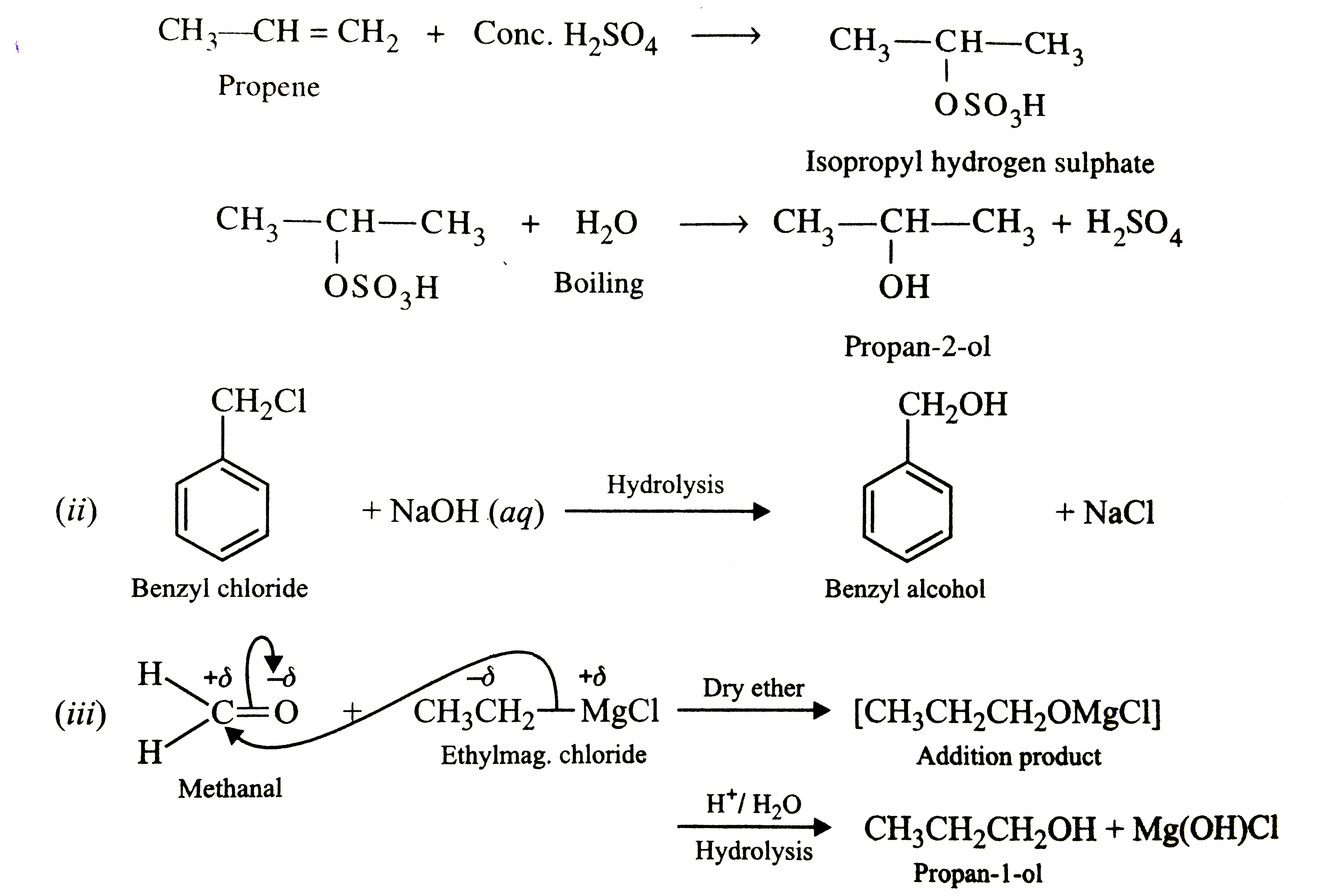 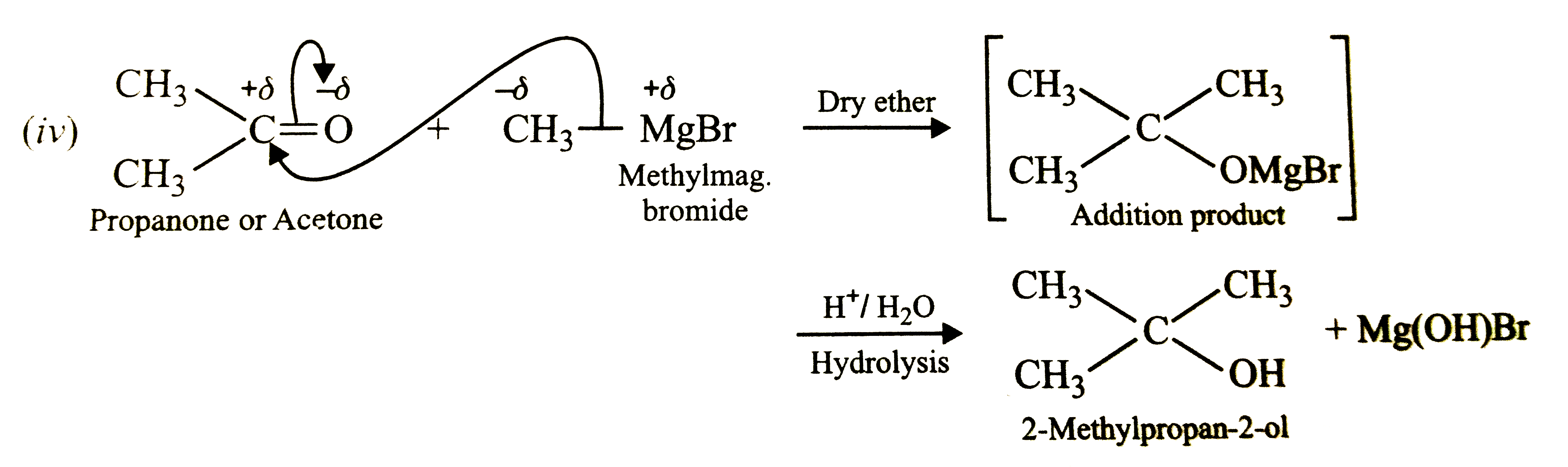
|
|
| 2. |
How are the following conversions carried out? (i) Propene to propan-2-ol (ii) Phenol to salicylaldehyde |
|
Answer» Solution :(i) Propene to PROPAN -2- OL : `underset("Propene")(CH_(3)-CH=CH_(2))+H_(2)Ooverset(H_(2)SO_(4))rarr underset("Propan -2- ol")(CH_(3)-underset(OH)underset("|")"CH"-CH_(3))` (ii) PHENOL to salicylaldehyde : 
|
|
| 3. |
How are the following conversions carried out? (i) Phenol to Toluene (ii) Ethanol to 1, 1 - dichlroethane. |
Answer» Solution :The conversions are carried out as under :  (ii) Ethanol to 1, 1 - dichloroethane : `underset("Ethanol")(CH_(3)CH_(2)OH)overset(Cu)underset(573K)RARR underset("Ethanal")(CH_(3)-overset(O)overset(||)C-H)overset(PCl_(5))rarr underset("1, 1 - Dichloroethane")(CH_(3)CHCl_(2))` |
|
| 4. |
How are the following conversions carried out? (i) Ethanol to 1,2-Ethanediol (ii) Phenol to Acetophenone |
Answer» Solution :(i)`underset("Ethanol")(CH_(3)CH_(2)OH)underset(443K)OVERSET(conc. H_(2)SO_(4))(to)CH_(2)=CH_(2)+H_(2)O+[O]underset(KMnO_(4))overset("Cold alkaline")(to)underset(1,2-"Ethanediol")underset(CH_(2)OH)underset(|)(CH_(2)OH)` 
|
|
| 5. |
How are the following conversions carried out ? (i) Benzyl chloride to benzyl alcohol, (ii) Methyl magnesium bromide to 2-methylpropan-2-ol. |
|
Answer» Solution :(i)Benzyl CHLORIDE to benzyl ALCOHOL `underset("Benzyl chloride ") (C_(6)H_(5)CH_(2)Cl) underset(-KCL) overset(aq.KOH) to underset("Benzyl alcohol ") (C_(6)H_(5)CH_(2)OH) ` (ii)Methyl magnesium bromide to 2-methylpropan-2-ol `underset("Propanone")(CH_(3) - underset(CH_(3)) underset(|) overset(O) overset(||)C ) + underset("bromide") underset("magnesium") underset("Maethyl")(CH_(3)MgBr) to CH_(3) "" CH_(3) - underset(CH_(3))underset(|) overset(OMgBr) overset(|) C - CH_(3)overset(H_(2)O) to underset("2-Methylpropan -2-ol") CH_(3) - underset(CH_(3)) underset(|) overset(OH) overset(|) C - CH_(3) ` |
|
| 6. |
How are the following conversions carried out? (i) Benzyl chloride to benzyl alcohol (ii) Methyl magnesium bromide to 2-Methylpropan-2-ol |
Answer» SOLUTION :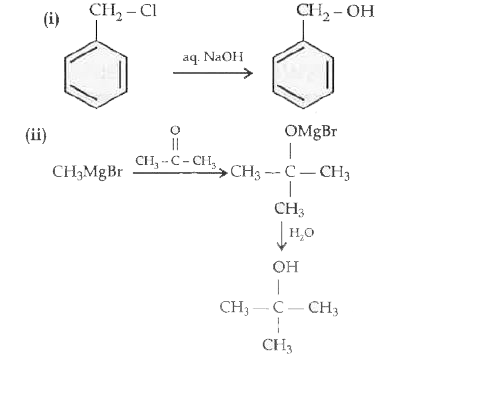
|
|
| 7. |
How are the following conversions carried out? Benzyl chloride to Benzyl alcohol. |
Answer» SOLUTION :
|
|
| 8. |
How are the following conversions carried out? Ethyl magnesium chloride to Propan-1-ol. |
Answer» SOLUTION :
|
|
| 9. |
How are the following conversions carried out ? (a) Benzyl chloride to benzyl alcohol (b) Ethyl magnesium bromide to propan -1- ol |
Answer» Solution :(a) BENZYL chloride to benzyl alcohol :  (b) Ethyl MAGNESIUM bromide to PROPANE -1- OL : 
|
|
| 10. |
How are the following conversions carried out ? (i) benzaldehyde from Toluene, (ii) acetophenone from benzene, and (iii) benzoin from benzaldehyde. |
|
Answer» Solution : Benzaldehyde from toluene : Side CHAIN CHLORINATION of toluene GIVES BENZAL chloride, which on hydrolysis gives benzaldehyde. 
|
|
| 11. |
How are the following conversions carried out ? 2-methylbutan-1ol-2methylbutanoic acid Pheylethene into Benzoic acid (3) Benzoic acid into metanitrobenzoic acid What is the action of Benzene sulphonyl chloride on primary, secondary and tertiary amines? Write two uses of formaldehyde. |
|
Answer» Solution :(1) 2-methylbutan-1-ol into 2-methylbutanoic acid `CH_(3) CH_(2) CH_(2) (CH_(3)) CH_(2) OH overset([O])(to) CH_(3) CH_(2) CH_(2) (CH_(3)) COOH` (2) PHENYL ethene into Benzoic acid 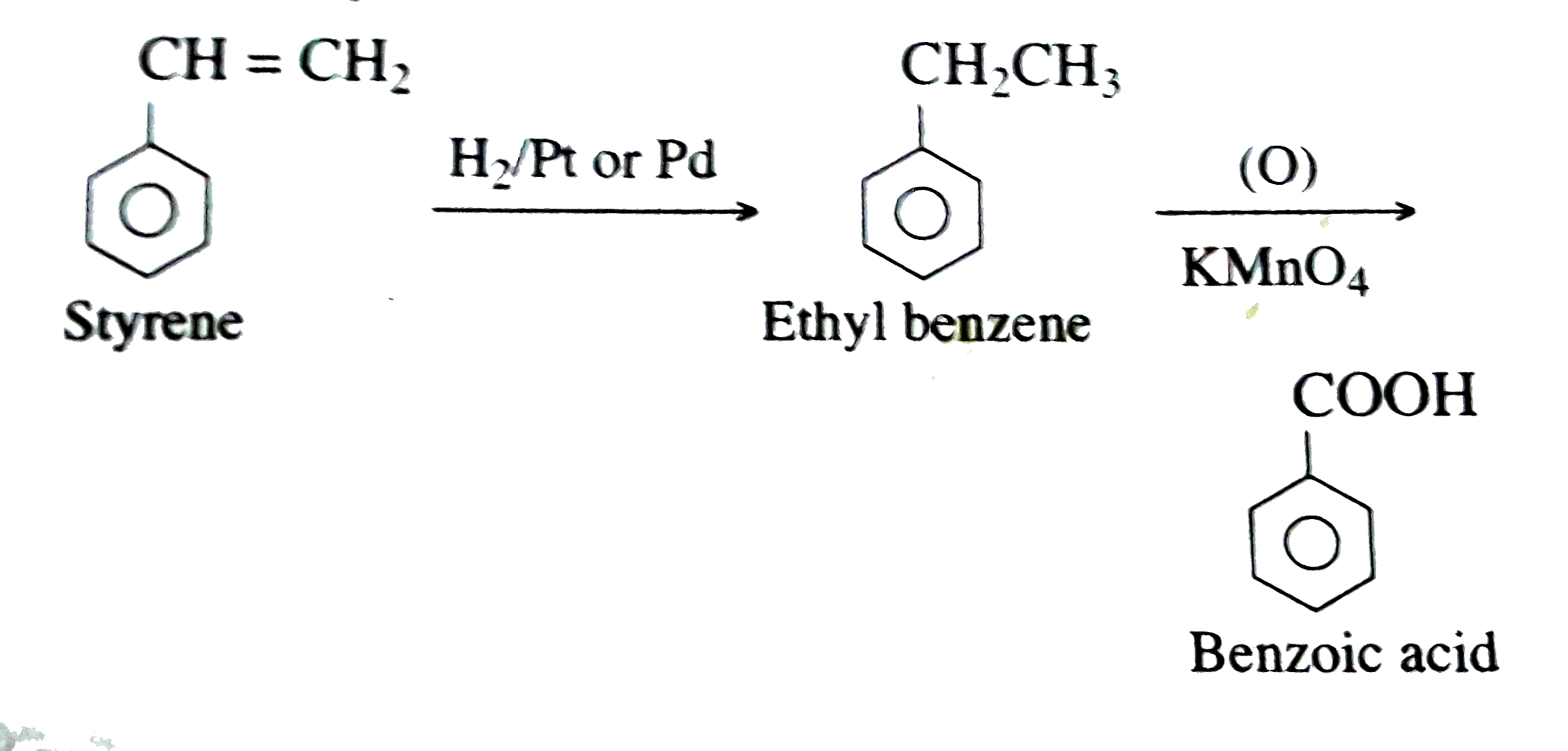 (3) Benzoic acid into metanitrobenzoic acid. 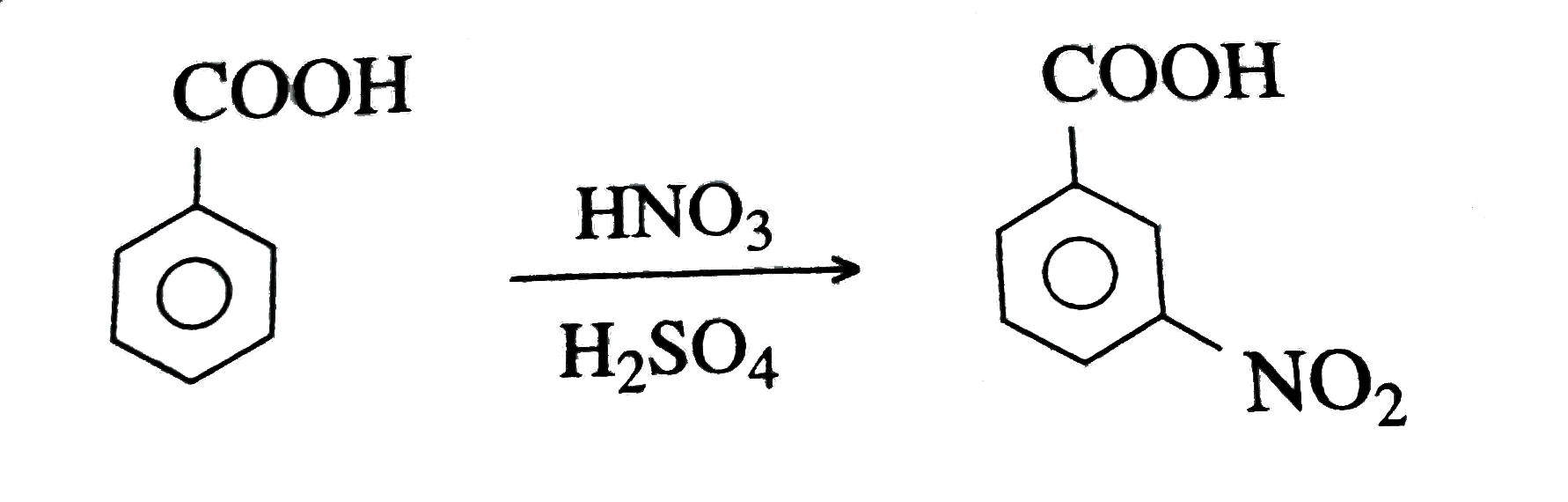 Benzene sulphonyl chloride is Hinsberg's REAGENT. It reacts with all the amines differently to form sulphonamide which can be used to distinguish between primary, SECONDARY and tertiary amines. Primary aminues react with benzenesulhonyl chloride formaing N-alkyl benzene sulphonamide. It is simply acid base type of reactions. Amine has lone pair of electrons on N, so it acts as base and attacks the electrophilic centre of the reagent that is S atom. Attack of `NH_(2)` helps in removal of `CI^(-)` and the product is sulphonamide. The primary amine sulphonamide is soluble in alkali. 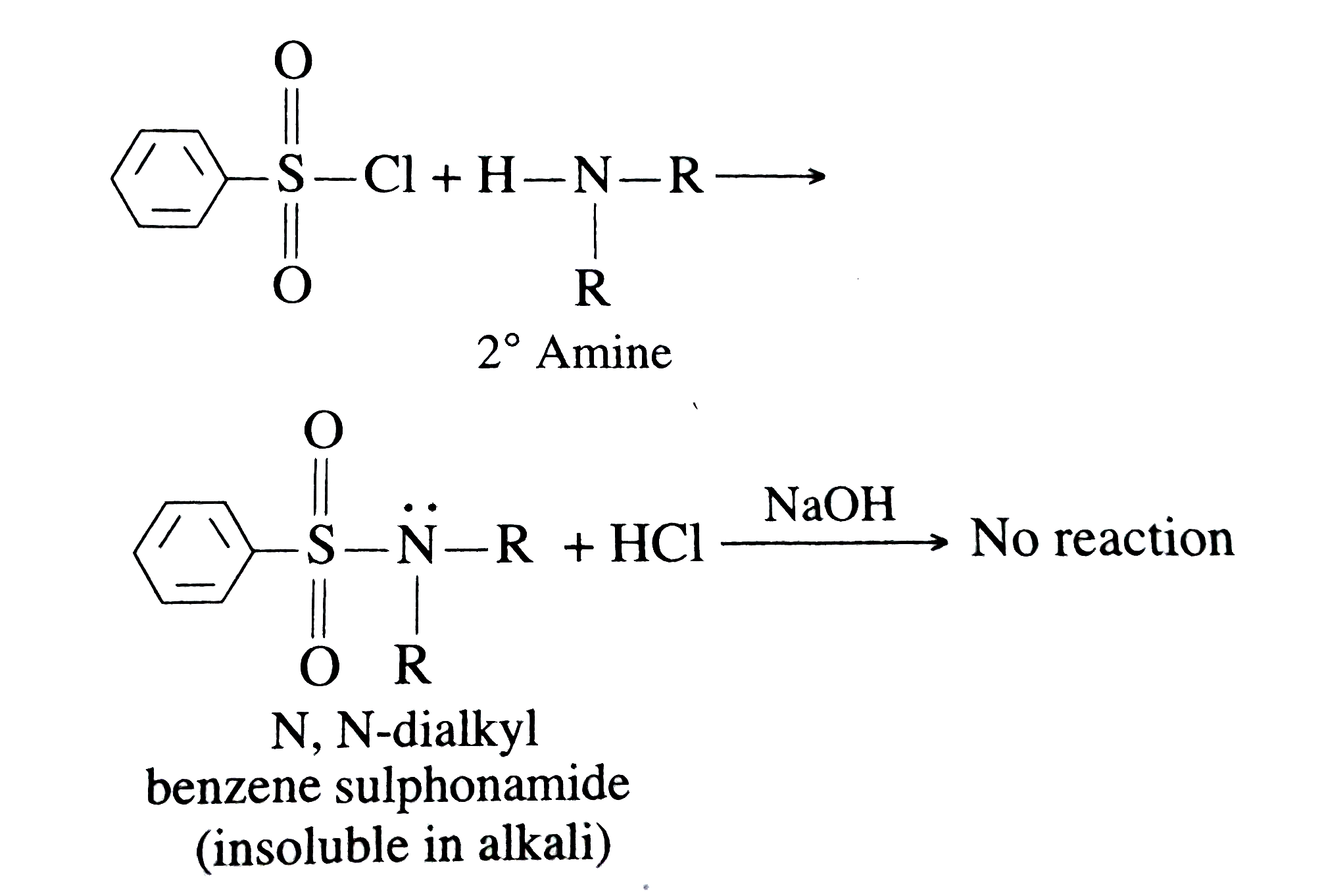 Secondary amines reacts with Benzenesulphonyl chloride FORMING N, N-dialkyl benzene sulphoanmide which is insoluble in alkali.  Tertiary amines do not react with benzenesulphonyl chloride Formaldehyde is regularly used in the chemical medical industries and it has preservative and sterilizing properties. It is also used to treat various types of building materials and in the creation of foam insulation and some types of fabrics. |
|
| 12. |
How are the following conversions archieved? (iii) Benzene to Benzaldehyde |
|
Answer» `(##ANE_PKE_CHE_XII_C12_E02_049_S01##)` |
|
| 13. |
How are the following conversions archieved? (ii) Acetic acid (CH_3COOH) to chloro acetic acid (CH_2Cl-COOH) |
|
Answer» `CH_3COOHunderset(Cl_2)overset (red-P)rarrCH_2Cl-COOH` [HVZ reaction] |
|
| 14. |
How are the following conversions achieved? (ii) (##ANE_PKE_CHE_XII_C12_E02_058_Q01.png" width="80%"> |
|
Answer» |
|
| 15. |
How are the following conversions archieved? (i) Benzoyl chloride [C_6H_5COCl] to benzaldehyde (C_6H_5-CHO) |
|
Answer» |
|
| 16. |
How are the following conversions achieved? (i) CH_3-CN rarr CH_3-COOH |
|
Answer» |
|
| 17. |
How are the following conversion carried out: (i) Propene to propan-2-ol (ii) Ethyl magnesium chloride to propan-1-ol |
|
Answer» Solution :(i) Propene to propan-2-ol: `underset("Propene")(CH_(3)CH)=CH_(2)+H_(2)Ooverset(H^(+))(hArr)CH_(3)-underset("Propan-2-ol")underset(OH)underset(|)(CH)-CH_(3)` (II) Ethyl MAGNESIUM CHLORIDE to propan -1-ol: `CH_(2)H_(5)MgCl+HCHOtoC_(2)H_(5)CH_(2)OMgCloverset(H_(2)O)(to)CH_(3)CH_(2)CH_(2)OH+Mg(OH)Cl` |
|
| 18. |
How are the following compounds obtained from benzene diazonium chloride? Phenol. |
Answer» Solution :Replacement by -OH : When the AQUEOUS solution is BOILED, phenol is obtained.  This is an example of `SN_1` REACTION in which `C_6H_5N_2Cl` initially gives `C_6H_5^(+)` and water is the NUCLEOPHILE. |
|
| 19. |
How are the following compounds obtained from calcium salts of fatty acids: (1) Formaldehyde (2) Acetaldehyde (3) Acetone? |
Answer» Solution :(1)l Formaldehyde: When calcium formate is strongly heated under dry conditions (dry DISTILLATION), formaldehyde (methanal) is obtained. 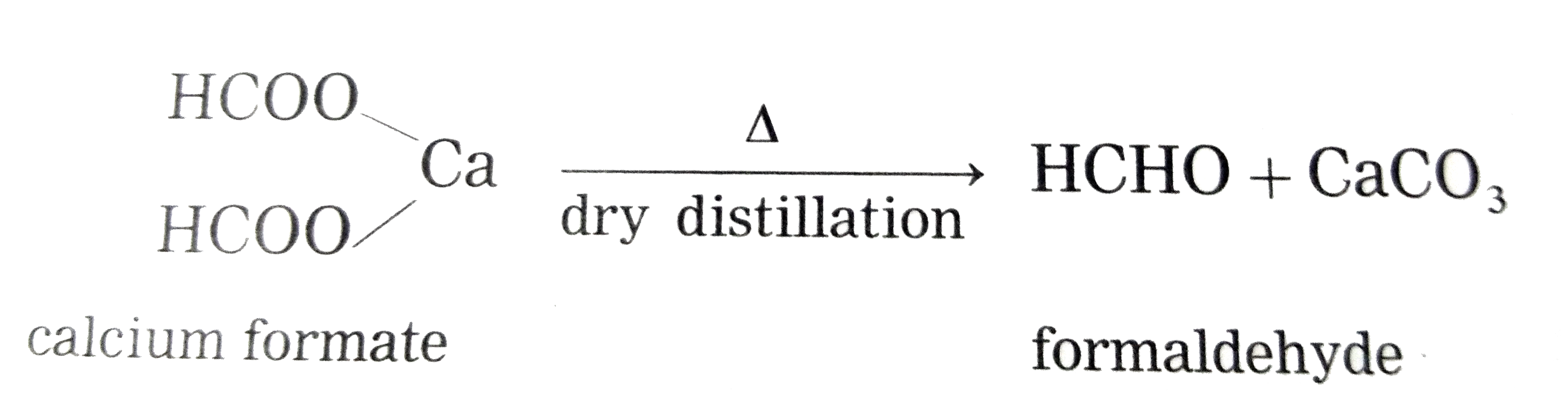 ` underset("dry distillation")overset(DELTA)(to) underset("formaldehyde")(HCHO+CaCO_(3))` ` underset("dry distillation")overset(DELTA)(to) underset("formaldehyde")(HCHO+CaCO_(3))` (2) Acetaldehyde: When calcium acetate (calcium ethanoate) is heated with calcium formate (calcium methanoate) under dry condition, acetaldehyde (ethanal) is obtained.  `underset("dry distillastion")(Delta)(to) underset("acetaldehyde")(2LCH_(3)CHO+)2CaCO_(3)` `underset("dry distillastion")(Delta)(to) underset("acetaldehyde")(2LCH_(3)CHO+)2CaCO_(3)` (3) Acetone: When calcium acetate (calcium ethanoate) is strongly heated under dry condition, acetone (PROPANONE) is obtained.  `underset("dry distillation")overset("heat")(to)underset("acetone")(CH_(3)COCH_(3))+CaCO_(3)` `underset("dry distillation")overset("heat")(to)underset("acetone")(CH_(3)COCH_(3))+CaCO_(3)`
|
|
| 20. |
How are the following compounds related ? |
|
Answer» Diastereomers 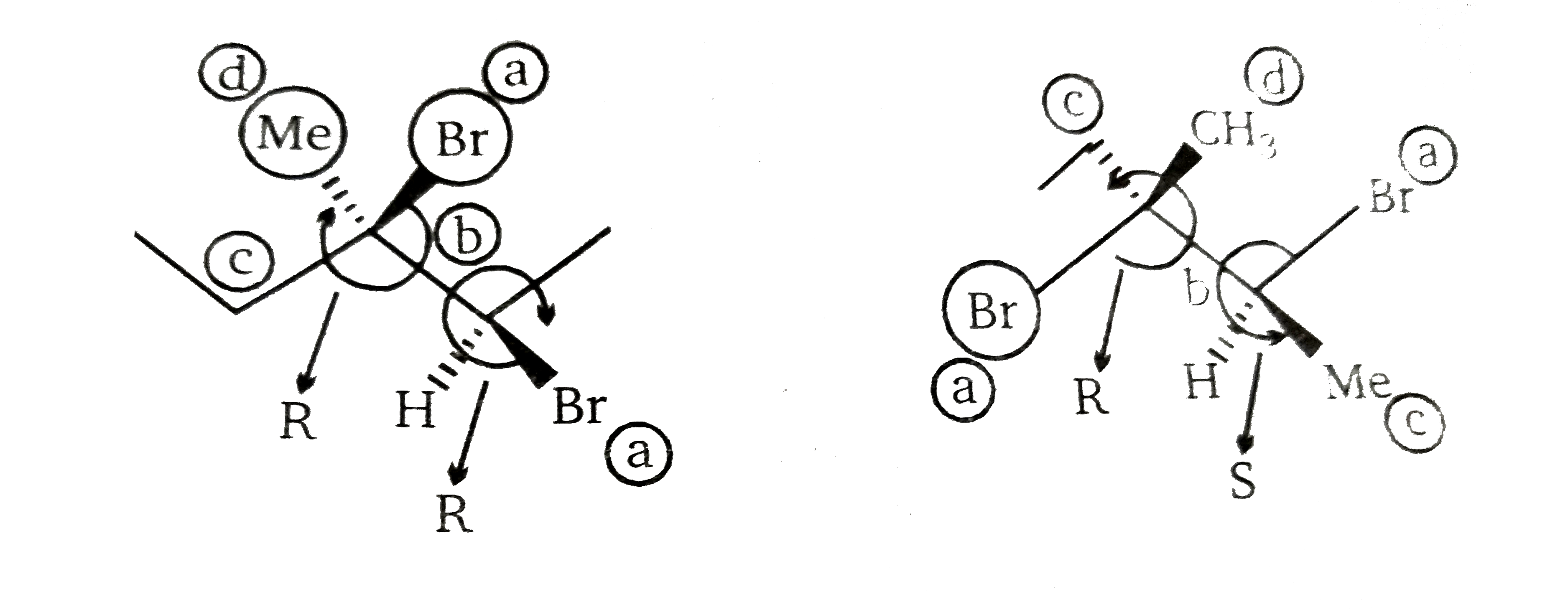
|
|
| 21. |
How are the following compounds obtained from benzene diazonium chloride? Ester. |
Answer» Solution :Replacement of RO- (or) RCOO- groups : SIMILARLY `-N_2Cl` can be replaced acyloxy group by BOILING with CARBOXYLIC ACIDS. 
|
|
| 22. |
How are the following compounds obtained from benzene diazonium chloride ? (i) phenol, (ii) ester, (iii) p-hydroxy azo benzene. |
|
Answer» Solution :Diazonium coupling reaction : Diazonium salt reacts with aromatic amine and PHENOLS to give azo compounds of the general FORMULA. `Ar-N=N-Ar` This reaction is known as Coupling reaction since all these compounds are intensely coloured and USED as dyes, thousands of azo dyes have been SYNTHESISED by this procedure. 
|
|
| 23. |
How are the following compounds are prepared by the dry distillation of calcium salt of carboxylic acids?(i) Methanal (ii) Ethanal |
Answer» SOLUTION :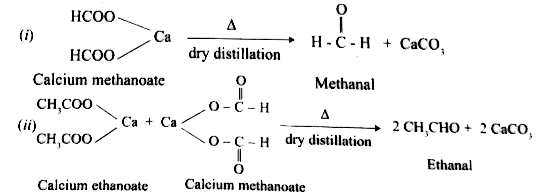
|
|
| 24. |
How are the following colloids different from each other in respect of dispersion medium and dispersed phase ? Give one example of each type. (i) An aerosol (ii) A hydrosol (iii) An emulsion |
|
Answer» SOLUTION :(i) An aerosol : It is a colloidal SYSTEM in which the dispersion medium is a gas. The dispersed PHASE could be solid or LIQUID. An example of solid in gas is smoke while an example of liquid in gas is fog or mist. (ii) A hydrosol : It is a colloidal system in which the dispersion medium is water. An example of hydrosol is muddy water. (iii) An emulsion : An emulsion is a colloidal solution of a liquid in another liquid i.e., both the dispersed phase and the dispersion medium are liquids. Milk is an example of emulsion in which the fat is dispersed phase and water is dispersion medium. |
|
| 25. |
How are the following colloids different from each other in respect of dispersion medium and dispersed phase ? Give one example of each. (i) An aerosol (ii) A hydrosol (iii) An emulsion. |
|
Answer» Solution :(i) An aerosol is a colloidal dispersion of a liquid in a gas. For EXAMPLE, fog. (ii) A HYDROSOL is a colloidal solution of a solid in water as the dispersion medium. For example, starch solution. (iii) An EMULSION is a colloidal system with dispersed phase as well as dispersion medium as liquids. For example, OIL in water. |
|
| 26. |
How are the following colloids different from each other in respect of dispersion medium and dispersed phase ? Give one example of each type. (i) An aerosol (ii) A hydrosol (iii) An emulsion. |
| Answer» | |
| 27. |
How are the following colloids different from each other in respect of dispersion medium and dispersed medium ? Give one example of each type. (a) An aerosol(b) A hydrosol(c) An emulsion |
| Answer» SOLUTION :`{:("D.P.","D.M.","Example"),((a)"Solid/liquid","Gas","Smoke"",""dust"",""Frog"",""cloud"),((B)"Solid","WATER","Muddy water"),((c)"Liquid","Liquid","MILK"",""HAIR cream"):}` | |
| 28. |
How are the cells systemically represented ? Given examples. |
|
Answer» |
|
| 29. |
How are teflon and nylon-6 synthesised ? Identify the type of polymerization on the basis of chain-growth and step-growth polymerization. |
| Answer» SOLUTION :TEFLON (chain-growth): nylon-6 (step-growth) | |
| 30. |
How are teflon and nylon-6 synthesised ? Identify the type of polymerization on the basis of chain growth and step growth polymerization. |
| Answer» SOLUTION :TEFLON (chain-growth): nylon-6 (step-growth) | |
| 31. |
How are synthetic detergents better than soaps? |
| Answer» Solution :Synthetic detergents are BETTER than soaps because soap can only be used with soft WATER while synthetic detergent can be used with both soft and HARD water. | |
| 32. |
How are syntetic detergents better than soaps ? |
| Answer» | |
| 33. |
How are synthetic detergents better than soaps ? |
| Answer» Solution :Synthetic detergents can be used in hard water as well in acidic solution. For EXAMPLE, in the case of ANIONIC detergents sulphonic acids and their CALCIUM and magnesium salts are soluble in water. But the fatty acids and their calcium and magnesium salts in case of soaps are insoluble producing SCUMS which hinders the cleansing action. | |
| 34. |
How are sugar classified based on reducing nature of carbohydrates ? |
|
Answer» |
|
| 35. |
How are substitutional solids obtained? |
| Answer» Solution :Substitutional SOLIDS are obtained when some atoms, ions or MOLECULES of ONE solid occupying the lattice site are replaced by atoms, ions or molecules of ANOTHER solid haviang similar nature and nearly same size. | |
| 36. |
How are specific and equivalent conductances related? |
|
Answer» Solution :`lambda_(c)=kappa TIMES V` `lambda_(c)=(kappa times 10^(-3))/C" mho".m^(2)(gm.equir)^(-1)` |
|
| 37. |
How are SO_(2) Cl_(2).SO_(3) and SO_(2) obtained from sulphuric acid ? |
|
Answer» Solution :`SO_(2)Cl_(2)` is formed from `H_(2)SO_(4)` by treating with excess of phosphorus pentachloride `H_(2)SO_(4) + 2PCl_(5) rarr SO_(2)Cl_(2) + 2HCL + 2POCl_(3)` `SO_(3)` is OBTAINED from sulphuric ACID by dehydration with phosphorus pentachloride `2H_(2)SO_(4) + P_(4)O_(10) rarr 4HPO_(3) + 2SO_(3)` `SO_(2)` is obtained from conc. `H_(2)SO_(4)`, when heated with copper METAL. `2H_(2)SO_(4) ("conc.") + CU rarr CUSO_(4) + 2H_(2)O + 2SO_(2)` |
|
| 38. |
How are SO_(2)Cl_(2) and SO_(2) obtained from sulphuric acid ? |
|
Answer» Solution :`SO_(2)Cl_(2)` is FORMED from `H_(2)SO_(4)` by treating with excess of phosphorus PENTACHLORIDE. `H_(2)SO_(4)+2PCl_(5)rarrSO_(2)Cl_(2)+2HCl+2POCl_(3)` `SO_(2)` is OBTAINED from `H_(2)SO_(4)` when heated with copper METAL. `2H_(2)SO_(4)+Cu rarr CuSO_(4)+2H_(2)O+2SO_(2)` |
|
| 39. |
How are silicates classified ? Give an example for each type of silicate. |
|
Answer» Solution :Silicates are classified into various types based on the way in which the tetrahedral units, `[SiO_(4)]^(4-)` are linked together. (i) Ortho silicates (Neso silicates): The simplest silicates which contain discrete `[SiO_(4)]^(4-)` tetrahedral units are called ortho silicates or neso silicates. Examples : Phenacite - `Be_(2)SiO_(4)` (`Be^(2+)` ions are tetrahedrally surrounded by `O^(2-)` ions) (ii) Pyro silicate (or) SORO silicates): Silicates which contain `[Si_(2)O_(7)]^(6-)` ions are called pyro silicates (or) Soro silicates. Example : Thortveitite - `Sc_(2)Si_(2)O_(7)` (iii) Cyclic silicates (or Ring silicates) : Silicates which contain `(SiO_(3))_(n)^(2n-)` ions which are formed by linking three or more tetrahedral `SiO_(4)^(4-)` units cyclically are called cyclic silicates. Example : Beryl `[Be_(3)Al_(2)(SiO_(3))_(6)]` (an aluminosilicate with each aluminium is surrounded by 6 oxygen atoms octahedrally) (iv) Inosilicates : Silicates which contain .n. number of silicate units liked by sharing two or more oxygen atoms are called inosilicates. Example : They are further classified as chain silicates and double chain silicates. (v) Chain silicates (or pyroxenes) : These silicates contain `[(SiO_(3))_(n)]^(2n-)` ions formed by linking .n. number of tetrahedral `[SiO_(4)]^(4-)` units linearly. Each silicate unit shares two of its oxygen atoms with other units. Example : Spodumene - `LiAl(SiO_(3))_(2)`. (vi) Double chain silicates (or amphiboles): These silicates contains `[Si_(4)O_(11)]_(n)^(6n-)` ions. In these silicates there are two different types of tetrahedra : (a) Those sharing 3 vertices (b) those sharing only 2 vertices. Examples : Asbestos : These are fibrous and non-combustible silicates. (vii) Sheet or phyllo silicates : Silicates which contain `(Si_(2)O_(5))_(n)^(2n-)` are called sheet or phyllo silicates. In these, Each `[SiO_(4)]^(4-)` tetrahedron unit shares three oxygen atoms with others and thus by forming two dimensional sheets. Example : Tale, MICA ETC. (viii) Three dimensional silicates (or tecto silicates) : Silicates in which all the oxygen atoms of `[SiO_(4)]^(4-)` tetrahedra are shared with other tetrahedra to form three-dimensional network are called three dimensional or tecto silicates. Examples : Quartz. |
|
| 40. |
How are simple and mixed ethers prepared using diazomethane. |
Answer» Solution :dimethyl ether is the only SIMPLE ether which can be prepared by the action of diazomethane on methanol in presence of tetrafluoroboric acid (`HBF_(4))` 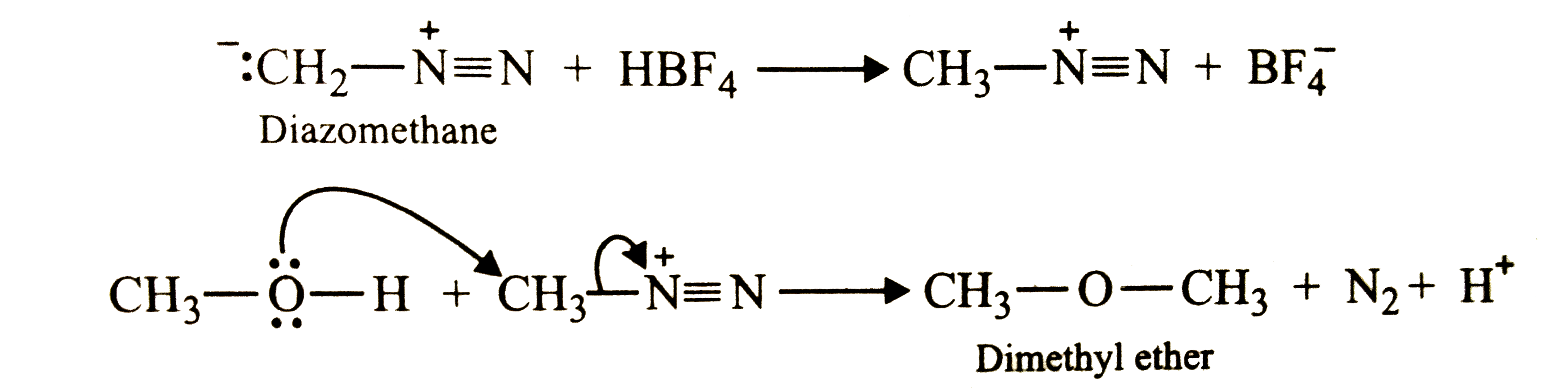 Reaction of alcohols, other than methanol, with `CH_(2)N_(2)` in presence `HBF_(4)` gives mixed ethers. `underset("Ethanol")(CH_(3)CH_(2)OH)+:overset(-)(C)H_(2)-overset(+)(N)-=N overset(HBF_(3)) underset("ETHYL methyl ether")(CH_(3)CH_(2)-O-CH_(3))+N_(2)` |
|
| 41. |
How are receptor proteins located in the cell membrane? |
| Answer» SOLUTION :Receptor PROTEINS are embedded in the cell membrane in such a way that their small part possessing active SITE projects out of the SURFACE of the membrane and OPENS on the outside region of the cell membrane. | |
| 42. |
How are receptor proteins located in the cell membrane ? |
| Answer» Solution :Receptor proteins are embedded in the cell membrane in such a way that their SMALL PART possessing active site projects out of the SURFACE of the membrane and OPENS on the outside region of the cell membrane. | |
| 43. |
How are proteins classified ? |
|
Answer» Solution :Proteins are classified into the following three types: (a) Simple proteins : The proteins which on hydrolysisgive only `ALPHA`-AMINO acids are called simple proteins , e.g. albumin , globulin. Simple proteins are further classified as follows: (i) Globular proteins : These proteins are spherical in shape and are soluble in water, e.g. albumin, CAESIN of milk. (ii) Fibrous proteins : These proteins have fibre-like structure and are insoluble in water , e.g. fibroin, keratin of hair, feathers, horns . (b) Conjugated proteins : The proteins which on hydrolysis give `alpha`-amino acids and some non-protein compound , are called conjugated proteins. The non-protein group present in these proteins is called prosthetic group. The prosthetic group MAY be a carbohydrate , a fat, a nucleic acid or phosphoric acid. (c) Derived proteins : The proteins which are FORMED by the treatment of some chemicals or heat on natural proteins are called derived proteins. Polypeptides orpeptones are derived proteins . |
|
| 44. |
How are propan -I- amine and propan -2 - amine prepared from oxime ? |
Answer» Solution :On REDUCTION of oxine with sodium and ethanol propan - 1- amine is obtained .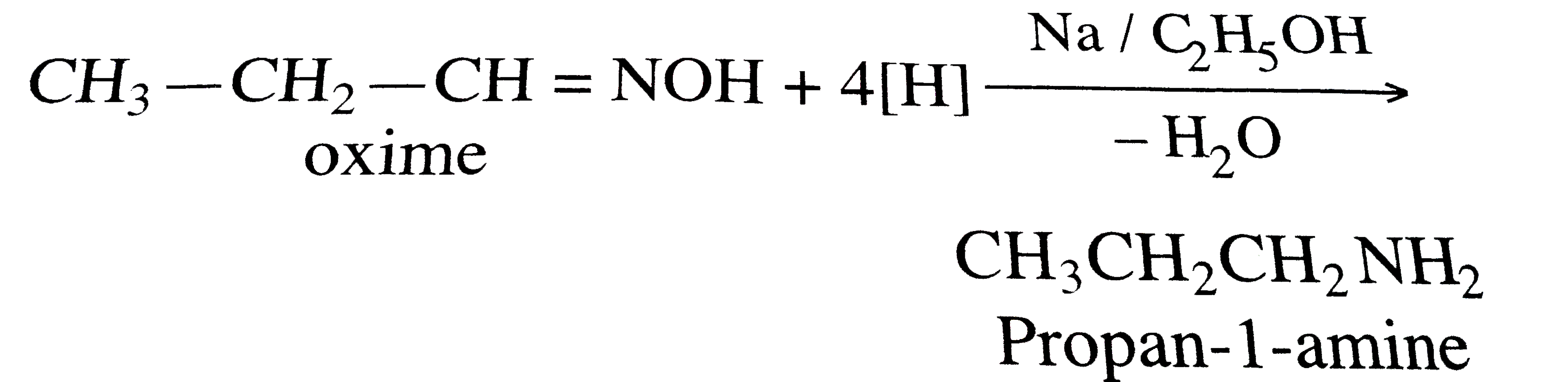 On reduction of acetoxine with sodium and ethanol propan -2- amine is obtained: On reduction of acetoxine with sodium and ethanol propan -2- amine is obtained: 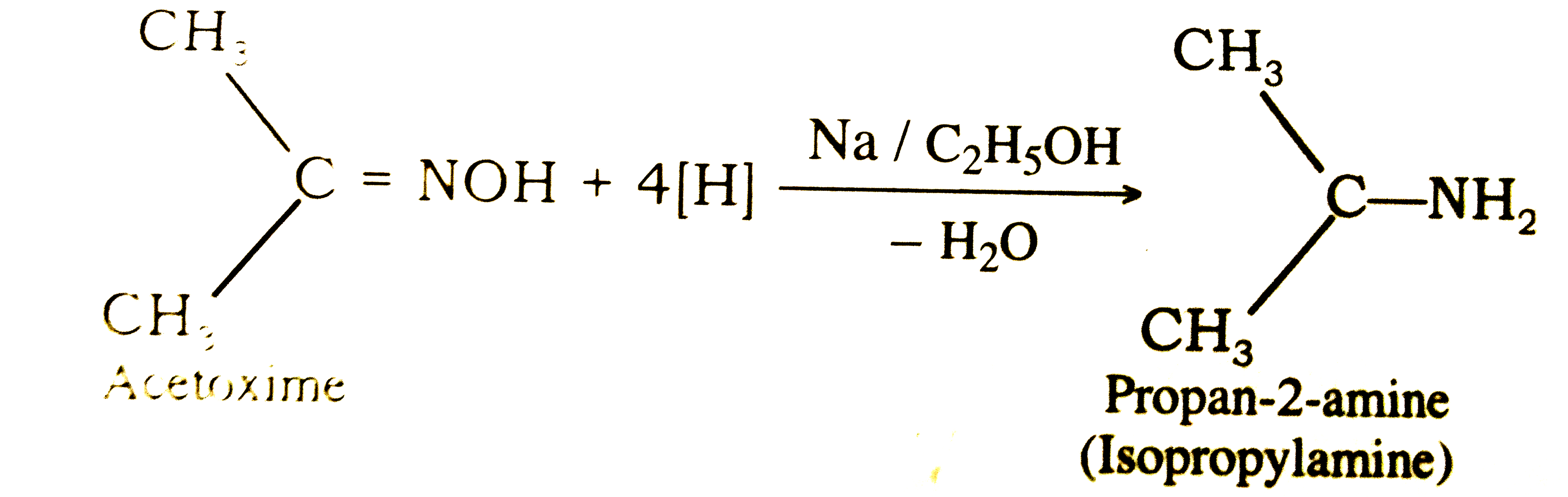
|
|
| 45. |
How are polymers classified on the basis of structures? |
| Answer» Solution :LINEAR polymers, BRANCHED chain polymers and CROSS linked polymers | |
| 46. |
How are polymers classified on the basis of structure ? |
|
Answer» SOLUTION :On the basis of structure, the polymers are classified as follows : (i) Linear polymers such as HIGH density polythene (HDP), polyvinyl chloride, NYLONS , polyester , etc. (ii) Branched polymers such as low density polythene (LDP), amylopectin , glycogen , etc. (iii) Cross - linked polymers such as baklite, melmac (MELAMINE -formadlehyde polmyer), etc. |
|
| 47. |
How are polymers classified on the basis of intermolecular forces of attraction ? |
|
Answer» Solution :The classification of polymers on the basis of inter-MOLECULAR forces of atraction such as van der Waal.s forces and hydrogen bonding etc. can be done in the following way : (i) Elastomers . Such of polymers have weakest inter-molecular forces between the polymer chains. As a result of this stretching of chains can take place . However , there are a few cross-links also between the chains due to which the chains regain their original position when the stretching force is withdrawn. (ii) Fibres . Such of polymers have the strongest inter-molecular forces such as hydrogen bonds and dipole-dipole interactions. As a result of this, fibres have high tensile strength and ELASTICITY. 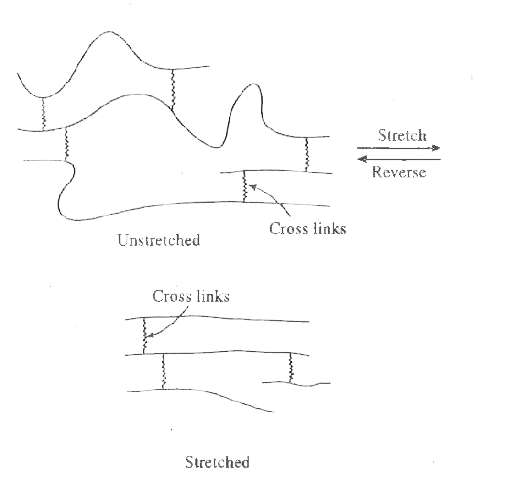 The molecules of fibres are long, thin and thread-like and can be woven into fabrics. Nylon-66 and terylene are EXAMPLES the magnitude of inter-molecular forces is intermediate between those in elastomers and fibres. These are no cross links between the polymer chains. As a result , thermoplastics are not very rigit and can be moulded into different shapes. Polythene , polypropylene and polystyrene are some examples of thermoplastics. (IV) Thermosetting polymers . Such polymers have relatively low molecular masses which get highly cross-linked on heating . This gives rise to a hard, infusible NAD insoluble three dimensional network soild. Bakelite and melamine are examples of thermosetting polymers. |
|
| 48. |
How are polymers classified on the basis of forces operating between their molecules? To which of these classes does nylon-6,6 belong? |
|
Answer» Solution :(i) Elastomers: The polymer chains are held together by weak intermolecular forces. Example - BUNA - S, Buna - N, Neoprene. (ii) Fibres: They have STRONG forces of attraction. Example - Polymides, (Nylon 6,6), polyesters. (iii) Thermoplastics: They are long chain molecules capable of repeatedly softening on heating and hardening on cooling. Example - Polythene, POLYSTYRENE. (iv) Thermosetting PLASTICS: They do not BECOME soft on heating and cannot be remoulded. Example - Bakelite, Nylon - 6,6, belong to fibres. |
|
| 49. |
How are polymers classified on the basis of mode of polymerisation ? Explain with examples. |
|
Answer» Solution :Addition polymers : Are formed by REPEATED addition of a large number of same or different monomers possessing DOUBLE or triple bonds. E.g., Polythene. `underset("Ethene")(nH_2C = CH_2) to underset("Polythene")((-H_2C - CH_2-)_n)` Condensation polymers : Are formed by repeated condensation reaction between TWO bifunctional or trifunctional monomer units usually with the elimination of small molecules like WATER, alcohol, ammonia, etc. E.g., Nylon-6, 6. `nHOOC(CH_2)_4COOH + nH_2N (CH_2)_6NH_2 to (underset("Nylon 6,6")(-overset(O)overset(||)C-(CH_2)_4overset(O)overset(||)C-overset(H)overset(|)N-(CH_2)_6overset(H)overset(|)N-))_n+(2n-1)H_2O` |
|
| 50. |
How are polymers classified categorieson thebasis of intermolecularforces ? |
|
Answer» Solution :There are fourtypes of POLYMERS on the basis of intermolecular forces : (i)Thermoplastic : They becomessofton HEATING, Theydoe not have cross linkage . Polytheneand polypropene are exampleof ths type of polymers(ii) Themosetting polymers : Theyhavestrongintermolecularforce of ATTRACTION . Bakeliteand melamine - formadehyded resin are examples of thiscategory. (iii)ELASTOMERS: Theyhave weak intermolecular forces of attraction . for example , Naturalrubberand Neoprene . (iv) Fibres : They are thread - likematerials WHICHARE crystallinein nature . They have strongNylon , 6,6 belong to fibres. |
|