Saved Bookmarks
This section includes 7 InterviewSolutions, each offering curated multiple-choice questions to sharpen your Current Affairs knowledge and support exam preparation. Choose a topic below to get started.
| 1. |
How are 1-nitropropane, 2-nitropropane and 2-methyl-2- nitropropane are distinguished from each other using nitrous acid ? |
|
Answer» Solution :Primary, SECONDARY and tertiary nitroalkanes are distinguished on the BASIS of their REACTION with freshly prepared nitrous `(HNO_(2))` -a mixture of sodium nitrite and hydrochloric acid. `NaNO_(2)+HCl to NaNO_(2)+HNO_(2)` Primary nitroalkanes react with nitrous acid to from blue coloured nitroso - nitroalkanes (acid from) which dissolve in NaOH to given RED solutions. 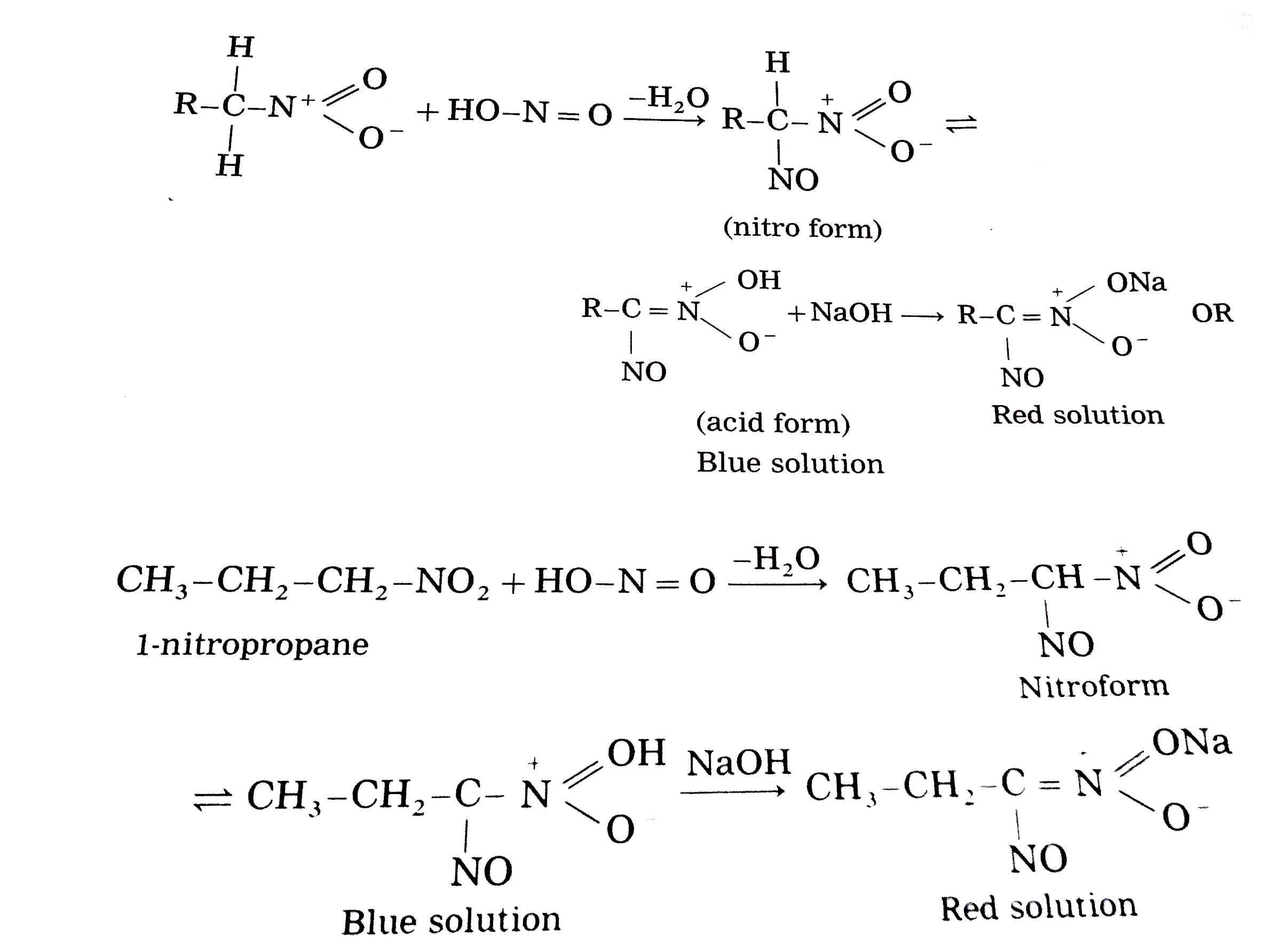 Secondary nitroalkanes reach with nitrous acid to from blue coloured nitroso - nitroalkanes. As nitroso-nitroalkane do not have `alpha`- HYDROGEN atom hence are insoluble in NaOH. 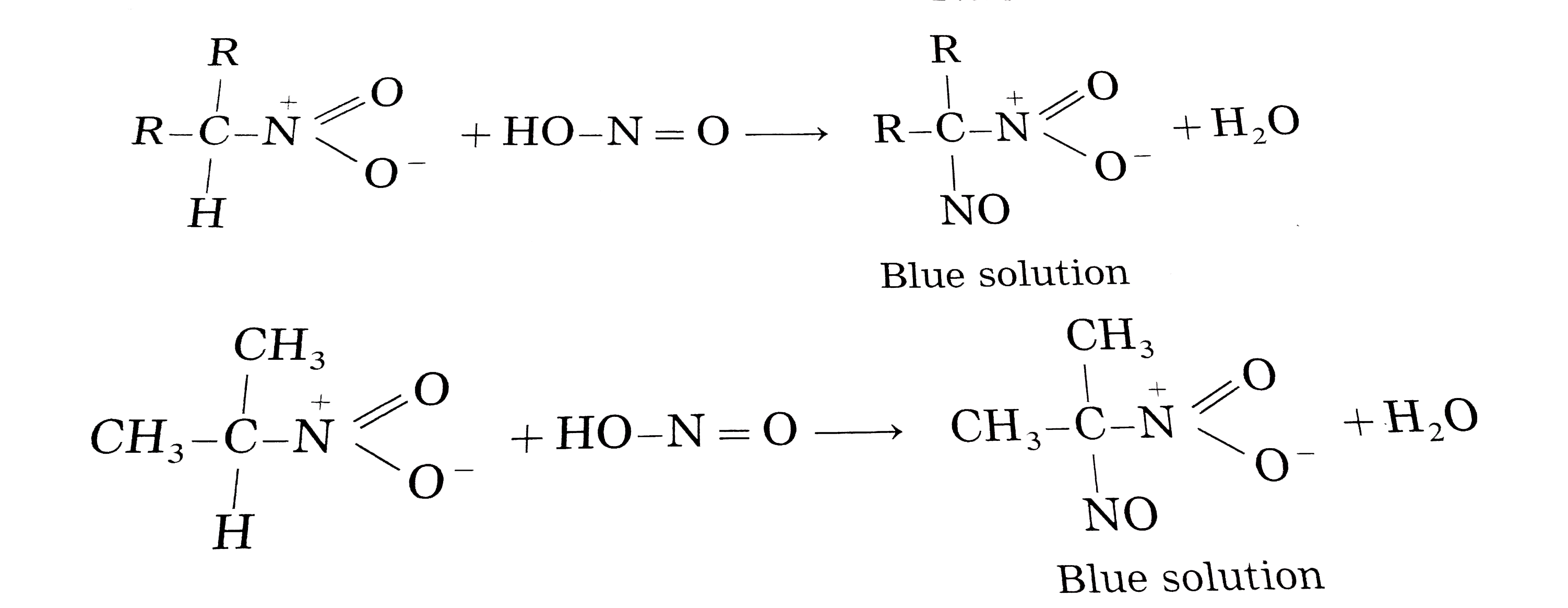 Tertiary nitroalkanes (2-methy1-2-nitropropane) do not react with nitrous acid since they do not contrain `alpha`-hydrogen atom. |
|
| 2. |
How are 2, 4, 6- tribromo aniline compounds obtained from aniline ? |
Answer» SOLUTION :2,4,6-tribromo ANILINE : When aniline is TREATED with BROMINE WATER, 2,4,6-tribromo aniline is obtained.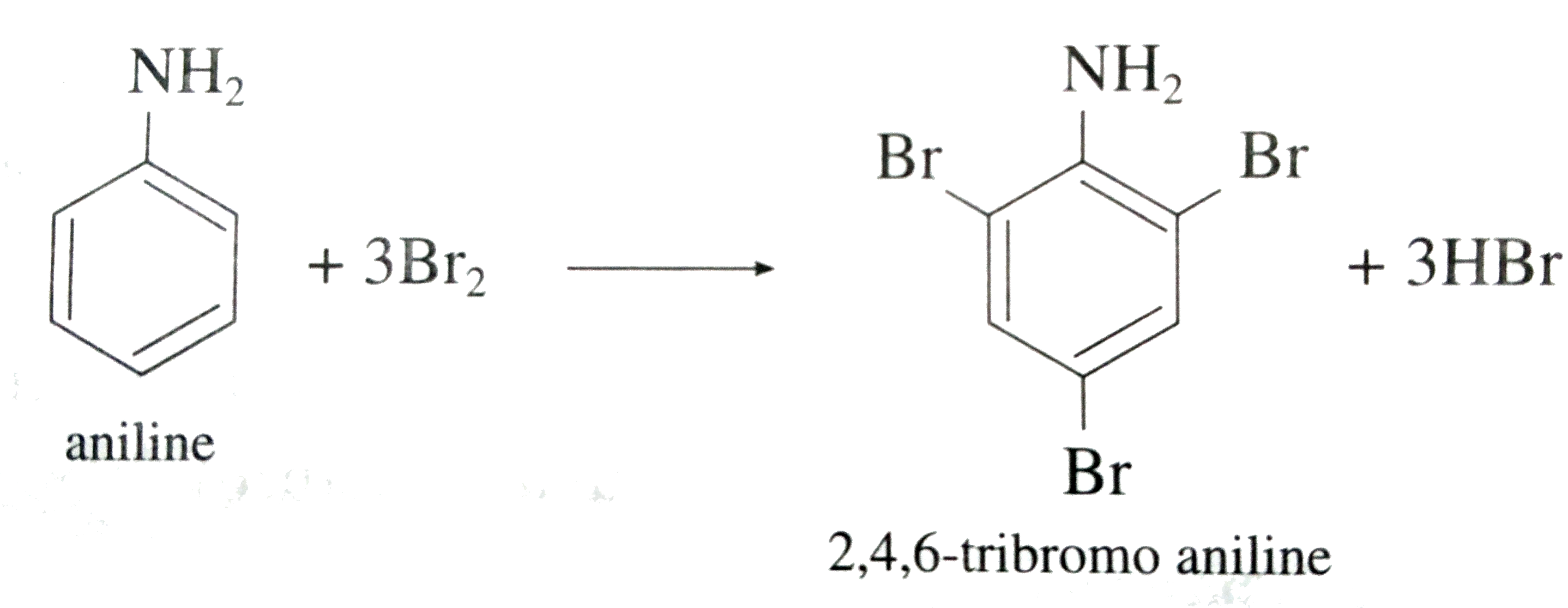
|
|
| 3. |
How are (1) butanone (2) Pentan-3-one obtained using (i) alcohol and (ii) geminal dihalide? |
|
Answer» Solution :(1) Using alcohol: (1) Butan-2-ol on CONTROLLED oxidation with `K_(2)Cr_(2)O_(7)` and dillute `H_(2)SO_(4)` forms butanone. `CH_(3)-UNDERSET("Butan-2-ol") overset(OH)overset(|)(CH)-CH_(2)-CH_(3)+[O]underset("dil". H_(2)SO_(4))overset(K_(2)Cr_(2)O_(7))(to CH_(3)- underset("Butanone")overset(O)overset(||)(CO-CH_(2)-CH_(3)+H_(2)O` (2) Pentan-3-ol on oxidation with `K_(2)Cr_(2)O_(7)` and dilute `H_(2)SO_(4)` forms Pentan-3-one. (2) Using geminal dihalide: (1) When 2, 2-Dichlorobutane is hydrolysed by boiling with aqueous KOH, Butanone is OBTAINED. 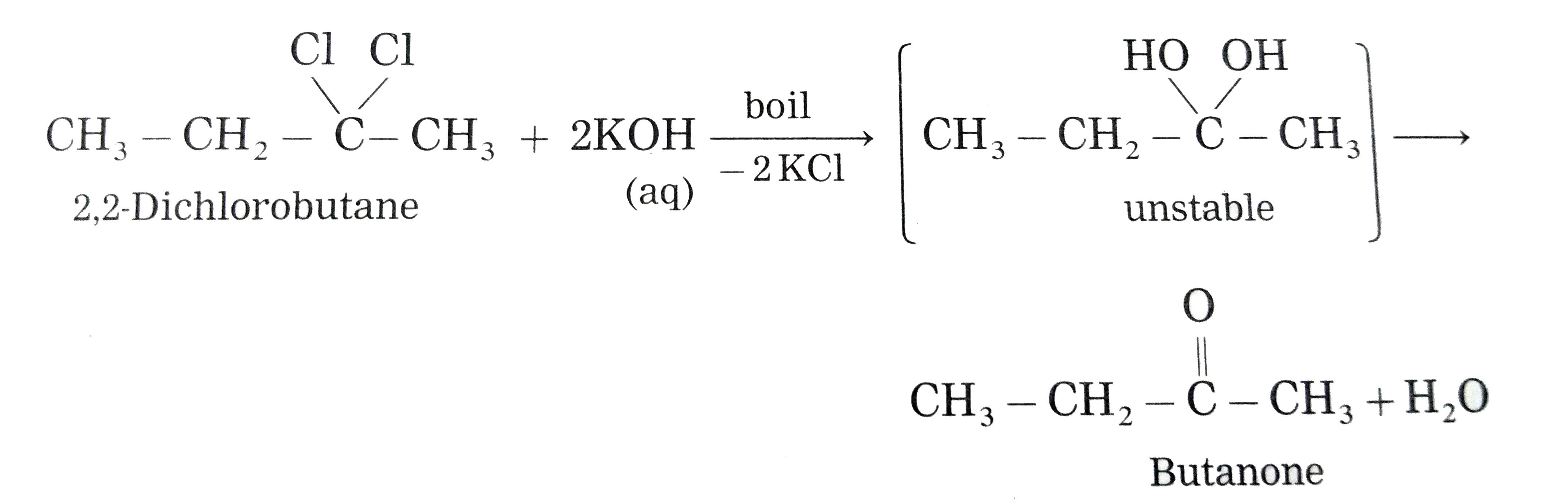 `CH_(3) - CH_(2)- underset("Butanone")overset(O)overset(||)(C)-CH_(3)+H_(2)O` (2) When 3,3-dichloropentane is hydrolysed by boiling with aqeous `KOH`, Pentan-3-one is obtained. 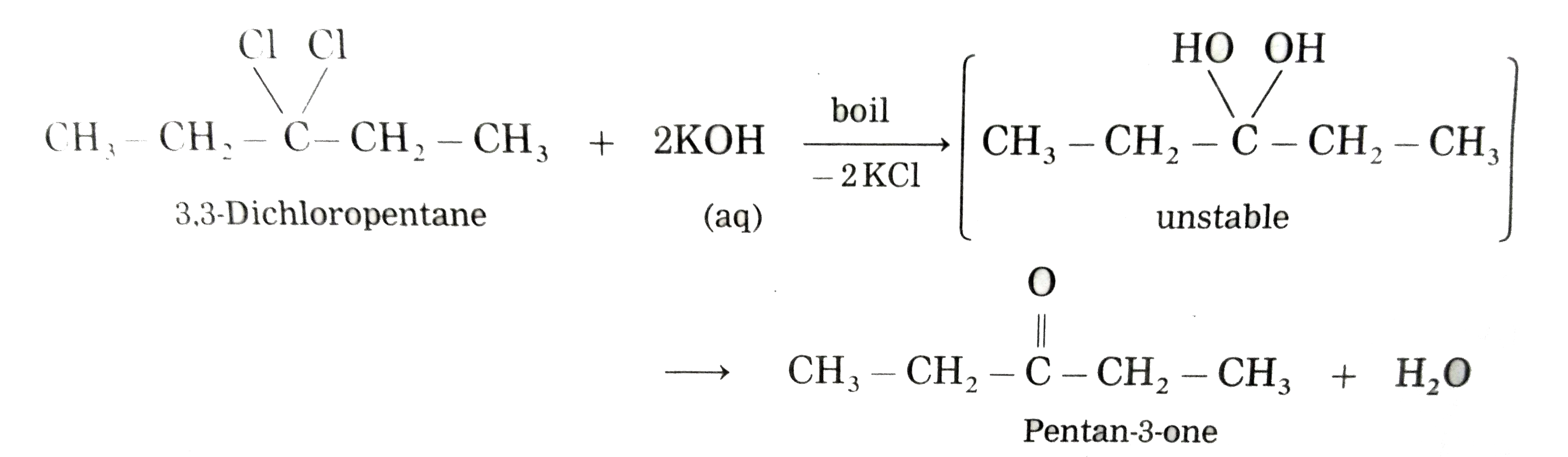 `implies CH_(3)-CH_(2)-underset("Pentan-3-one")overset(O) overset(||)(C-CH_(2))-CH_(3)+H_(2)O` |
|
| 4. |
How anisole reacts with bromine in ethanoic acid? write the chemical equation for the reaction. |
Answer» SOLUTION :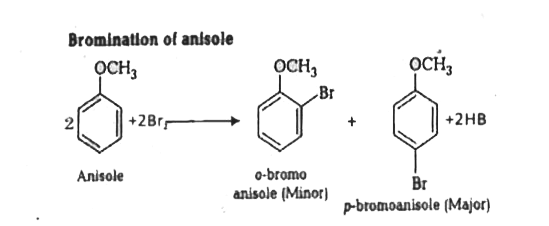
|
|
| 5. |
How anisole reacts with acetyl chloride [CH_(3)COCl] in the presence of anhydrous AlCl_(3)? Write the chemical equation for the reaction. |
Answer» SOLUTION :
|
|
| 6. |
How an electrochemical cell is represented by cell notation ? |
Answer» Solution :An ELECTROCHEMICAL cell can be represented as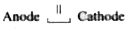 Salt bridge e.g. DANIELL cell (Zn-Cu cell) can be represented as `Zn|Zn^(2+)(C_(1)M)||CU^(2+)(C_(2)M)|Cu` |
|
| 7. |
How aniline is prepared by Hoffmann bromamide degradation reaction? Giveequation. |
| Answer» SOLUTION :`UNDERSET("BENZAMID")(C_6H_5 - CONH_2 ) + Br_2 + 4NaOHunderset("ANILINE")to C_6H_5 - N_2 + Na_CO_3 + 2NaBr + 2H_2O` | |
| 8. |
How amorapure boron of law purity is obtained from borax? |
|
Answer» |
|
| 9. |
How alloys are formed in d-block elements? |
|
Answer» Solution :(i) An alloy is formed by blending a metal with one or more other elements. The elements may be metals or non-metals or both. (II) The bulk metal is named as solvent, and the other elements in smaller portion is called solute. (III) According to Hume-Rothery rule to form an alloy, the difference between the atomic radii of the solvent and solute is less than 15%. Both the solvent and solute MUST have the same crystal structure and valence and their electro negativity difference must be CLOSE to zero. (iv) Since their atomic sizes are similar and one metal atom can be easily replaced by another metal atom from its crystal lattice to form an alloy. The alloys are hard and have high melting points. Examples: Gold - copper alloy. |
|
| 10. |
How alkanes are prepared from alkyl halide ? |
|
Answer» Solution :Alkenes are prepared from alkyl HALIDES by DEHYDROGENATION REACTION in PRESENCE of alcoholic potash solution. `R-CH_2-CH_2-X overset(Alcoholic)underset(KOH)rarr R-CH=CH_2 +KX + H_2O` `underset(CH_3-CH_2-Cl overset(alcoholic)underset(KOH)rarrunderset(ETHYLENE)(CH_2=CH_2)+KCl+H_2O` |
|
| 11. |
How acetone reacts with the following reagents?(i) NH_2OH (ii) NH_2-NH_2 (iii) C_6H_5NH - NH_2 |
Answer» SOLUTION :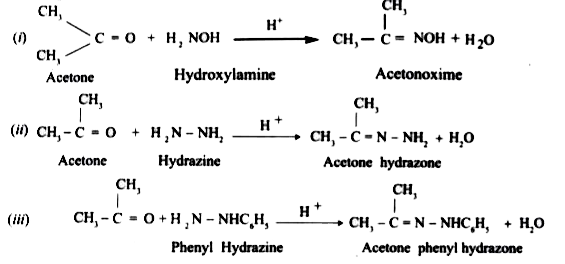
|
|
| 12. |
How acetylene is converted to ethyl alcohol ? |
|
Answer» Solution :Acetylenc on HYDRATION gives ACETALDEHYDE, which on REDUCTION gives ETHANOL. `CH = CH + H_2O underset(H_2SO_4)overset(HgSO_4)(rarr) CH_3-CHO overset(LiAIH_4)(rarr) C_2H_5OH`. |
|
| 14. |
How a mixture of nitrobenzene and aniline can be separated? |
| Answer» Solution :The mixture is treated with dil HCl. Only aniline dissolves. It is then shaken with ether. NITROBENZENE goes into ether LAYER. It is separated. Nitrobenzene is obtained by EVAPORATING ether. The aqueous layer, on NEUTRALISATION with NaOH GIVES aniline. It is also shaken with ether separately and ether is collected. Aniline is obtained by evaporating ether. | |
| 15. |
overset(H_(2)O^(+))underset(Delta)rarr[B] |
|
Answer»
|
|
| 16. |
How 2-butanol can be obtained from ethanol? |
Answer» SOLUTION :
|
|
| 17. |
Household gaseous fuel (LPG) mainly contains |
|
Answer» A) `CH_(4)` |
|
| 18. |
Hot copper turnings can be used as an 'oxygen getter' for inert gas supplies by slowly passing the gas over the turnings at 600 K: 2Cu(s) + 1/2 O_2(g) iff Cu_2 O(s) , K_p = 7.5 xx 10^10How many molecules of O_2are left in one litre of a gas supply after equilibrium has been reached? |
| Answer» SOLUTION :`2.17~~1` | |
| 19. |
Hot cone. H_2SO_4 acts as moderately strong oxidising agent. It oxidises both metals and non-metals. Which of the following element is oxidised by cone. H_2SO_4 into two gaseous products ? |
|
Answer» Cu |
|
| 20. |
Hot concentrated sulphuric acid is a moderately strong oxidizing agent. Which of the following reactions does not show oxidizing behaviour ? |
|
Answer» `CaF_(2) +H_(2)SO_(4) to CaSO_(4) +2HF` |
|
| 21. |
Hot concentrated sulphuric acid is a moderately strong oxidising agent. Which of the following reactions does not show oxidising behaviour ? |
|
Answer» `Cu + 2 H_(2)SO_(4) rarr CuSO_(4) + SO_(2) + 2H_(2) O` (a stronger acid displaces a weaker acid from its salts). |
|
| 22. |
Hot concentrated H_(2)SO_(4) ismoderately strong oxidising agent which of the following reactions does not show oxidising behaviour ? |
|
Answer» `Cu+2H_(2)SO_(4)rarrCuSO_(4)+SO_(2)+2H_(2)O` |
|
| 23. |
Hot conc. H_2SO_4 acts as strong oxidising agent which of the following element is oxidising by conc. H_2SO_4 into two gaseous products ? |
| Answer» ANSWER :A | |
| 24. |
Hot conc. H_2SO_4 acts as moderately strong oxidising agent. It oxidises both metals and non-metals. Which of the following elements is oxidised by conc. H_2SO_4 into two gaseous products ? |
|
Answer» Cu `underset("(CONC.)")(C + 2H_2SO_4) overset(DELTA) rarr CO_2 + 2SO_2 + 2H_2O` |
|
| 25. |
Hot conc. H_(2)SO_(4) acts as moderately strong oxidising agent. It oxidises both metals and nonmetals. Which of the following element is oxidised by conc. H_(2)SO_(4) into two gasous products ? |
| Answer» Solution :`CO_(2) and SO_(2), i.e., C + 2H_(2)SO_(4) overset(Delta)(rarr) CO_(2) + 2SO_(2) + 2H_(2)O` | |
| 26. |
Hot cone. H_(2)SO_(4) acts as moderately strong oxidising agent. It oxidises both metals and non-metals. Which of the following elements is oxidised by cone. H_(2)SO_(4) into two gaseous products? |
|
Answer» Cu `underset("(CONC.)")(C + 2H_2SO_4) OVERSET(Delta) RARR CO_2 + 2SO_2 + 2H_2O` |
|
| 27. |
Hot carbon reacts with steam to produce an equimolar rnixture of CO(g) andH_2(g)known as water gas. What is the energy released as water gas is used as fuel?CO(g) +1/2O_2(g) to CO_2(g) , Delta H = -282.985kJH_2(g) + 1/2 O_2(g) to H_2O(g), Delta H = -241.818 kJ |
| Answer» SOLUTION :`-524.802 KJ` | |
| 28. |
Hot conc. H_(2)SO_(4) acts as moderatelystrong oxidising agent. It oxidises both metal and non-metals. Element which gets oxidised by conc. H_(2)SO_(4) into two gaseous products is |
| Answer» Solution :`C+2H_(2)SO_(4) to CO_(2)+2SO_(2)+2H_(2)O` | |
| 29. |
Hot and conc.HNO_3 react with carbon to from: |
|
Answer» `CO_2` |
|
| 30. |
Hot and conc. Nitric acid when reacts with copper, the gas obtained is |
|
Answer» `N_(2)` |
|
| 33. |
Hormones which regulate metabolism of lipids, carbohydrates and protein is |
|
Answer» epinephrine |
|
| 34. |
Hormones which control the development and maintenance of pregnancy is |
|
Answer» estrone |
|
| 36. |
Hormones that help in the conversion of glucose to glycogen.is |
|
Answer» cortisone |
|
| 37. |
Hormones function as : |
|
Answer» CHEMICAL MESSENGERS |
|
| 38. |
Hormones are secreted by ductless glands of human body. Iodine containing hormone is |
|
Answer» Adrenoline |
|
| 39. |
Hormones are |
|
Answer» steroid |
|
| 40. |
Hormone secretion in mammals is under the control to ............ |
| Answer» SOLUTION :ENDOCRINE GLANDS | |
| 41. |
Hormones are secreted by ductless glands of human body. Iodine-containing hormone is |
|
Answer» insulin |
|
| 42. |
Hormann'shypobromitereaction isaffordsa method of |
|
Answer» perparationof `1^(@)`ALCOHOL |
|
| 43. |
Hormone produced in the ovary is Testosterone.(True/False) |
|
Answer» |
|
| 44. |
Hoop's process of purification of aluminium involves formation of layers during electrolysis. This is because [True/False (T = True, F= False)] (i) the three layers have same densities but different materials (ii) the three layers have different densities (iii) the upper layer is of pure aluminium which acts as a cathode (iv) the bottom layer is of impure a aluminium which acts as an anode and middle layer consists of NaF, BaF_(2) and AlF_(3) |
|
Answer» FTTF |
|
| 45. |
Hoope's process is used in the refining of |
|
Answer» Al |
|
| 46. |
Hoop's process is used in the extraction of |
|
Answer» Zn |
|
| 47. |
Hoope's process is used in the refining of : |
|
Answer» Au |
|