

Saved Bookmarks
This section includes 7 InterviewSolutions, each offering curated multiple-choice questions to sharpen your Current Affairs knowledge and support exam preparation. Choose a topic below to get started.
| 1. |
Here each question contains statements given in two columns which have to be matched. Statements in Column I are labelled as A, B, C and D whereas the statements in Column II are labelled as p, q, r and s. The answers to these questions are to be appropriately bubbled as illustrated below in the following example. If the correct matches are A-p, A-s, B-q, B-r, C-p, C-q and D-p, their correctly labelled 4 xx 4 matrix should look like : |
|
Answer» |
|
| 2. |
Here each question contains statements given in two columns which have to be matched. statements in Column I are labelled as A,B,C and D whereas the statements in Column II are labelled as p,q,r and s. the answer to these questions are to be appropriatly bubbled as illustrated in the following example if the correct matches are A-p , A-s, B-q, B-r , C-p , C-q and C-p their correctly labelled 4 x 4 matrix should look like the following {:(,"Column I",,"Column II",),((A),pK_(b) " of " X^(-)(K_(b)" of "HX=10^(-6)),,(p)6.9,),((B),pH " of " 10^(-2)M HCl,,(q)8.0, ),((C ) ,pH " of " 10^(-2)M "acetic acid solution " (K_(a) " of aceticacid " =1.0 xx 10^(-5)),,(r ) 3.3,),((D),"pH of a solution obtained by mixing equal volumes of solution of pH =3 and pH =5 log 2 = 0.3010, log 3=0.4771 log 4=0.6020 , log 5=0.6990",,(s ) 3.4,):} |
|
Answer» |
|
| 3. |
Here each question contains statements given in two columns which have to be matched. statements in Column I are labelled as A,B,C and D whereas the statements in Column II are labelled as p,q,r and s. the answer to these questions are to be appropriatly bubbled as illustrated in the following example if the correct matches are A-p , A-s, B-q, B-r , C-p , C-q and C-p their correctly labelled 4 x 4 matrix should look like the following {:(,"Column I",,"Column II",),((A),"Degree of dissociation",,(p) ("No. of molecules dissociated")/("No. of molecules taken"),),((B),"Oswald's dilution law",,(q)alpha=sqrt(K xxC),),((C ),"Catalyst",,(r ) [H_(3)O]^(+)[OH^(-)],),((D), "Ionic product of water ",,(s) "Helps in attaining equilibrium in appropriate time",):} |
|
Answer» |
|
| 4. |
Here, each question contains statements given in two columns which have to be matched. Statements in column I are labelled as A,B, C, and D whereas in column II are labelled as p,q,r and s. The answers to these questions are to be appropriately bubbled as illustrated in the following example. If the correct matches are A-p, A-s, B-q, B-r, C-p, C-q and D-p, then correctly labelled 4 xx 4 matrix looks like {:(,"Column-I",,"Column-II"),("(A)",H_(2)S,p.,"Oxidising as well as reducing agent"),("(B)",SO_(2),q.,"reducing agent"),("(C)",P_(4),r.,"zero oxidation state"),("(D)",6OH^(-)+3Br_(2)rarr5Br^(-)+BrO_(3)^(-)+3H_(2)O,s.,"This proportionation in alkaline medium"):} |
|
Answer» |
|
| 5. |
Here, each question contains statements given in two columns which have to be matched. Statements in column I are labelled as A,B, C, and D whereas in column II are labelled as p,q,r and s. The answers to these questions are to be appropriately bubbled as illustrated in the following example. If the correct matches are A-p, A-s, B-q, B-r, C-p, C-q and D-p, then correctly labelled 4 xx 4 matrix looks like {:(,"Column-I",,"Column-II"),("A.",CuSO_(4)+ZnrarrCu+ZnSO_(4),p.,"Non-metal displacement reaction"),("B.",2KClO_(3)rarrKCl+3O_(2),q.,"Disproportionation reaction"),("C.",3Cl_(2)+6KOHrarr5Cl^(-)+ClO_(3)^(-)+3H_(2)O,r.,"Decomposition reaction"),("D.",Cl_(2)+2KClrarr2KCl+I_(2),s.,"Redox reaction"):} |
|
Answer» |
|
| 6. |
Here, each question contains statements given in two columns which have to be matched. Statements in column I are labelled as A,B, C, and D whereas in column II are labelled as p,q,r and s. The answers to these questions are to be appropriately bubbled as illustrated in the following example. If the correct matches are A-p, A-s, B-q, B-r, C-p, C-q and D-p, then correctly labelled 4 xx 4 matrix looks like {:(,"Column-I",,"Column-II"),("(A)","I",p.,"zero oxidation state"),("(B)","KMnO"_(4),q.,"Reducing agent"),("(C)","H"_(2)"O"_(2),r.,"Oxidizing agent"),("(D)","M(CO)"_(4),s.,"Oxidizing as well as reducing agent"):} |
|
Answer» |
|
| 7. |
Here each question contains statements given in two columns which have to be matched. Statement in Column I are labelled as A,B, C are D whereas statements in column II are labelled as p,q,r and s. the answers to these questions are to be appropriately bubbled as illustrated in the following example. If the correct matches are A-p, A-s, B-q, B-r, C-p, C-q and D-p then the correctly labelled 4 xx 4 matrix look like. {:(Column I,Column II),((A)"Elevation in boiling point",(p)"Colligative property"),((B)"Osmotic pressure",(q)"Cryoscopic constant"),((C)"Relative lowering in vapour pressure",(r)"Berkely-Hartley method"),((D)"Depression in freezing point",(s)"Ostwald and Walker method"):} |
|
Answer» |
|
| 8. |
Here each question contains statements given in two columns which have to be matched. Statement in Column I are labelled as A,B, C are D whereas statements in column II are labelled as p,q,r and s. the answers to these questions are to be appropriately bubbled as illustrated in the following example. If the correct matches are A-p, A-s, B-q, B-r, C-p, C-q and D-p then the correctly labelled 4 xx 4 matrix look like. {:(Column I,Column II),((A)"Molality",(p)"Elevation on boiling point"),((B)"Molarity",(q)"Volume of solution"),((C)"Normality",(r)"Wt of solvent"),((D)"Mole fraction",(s)"Moles of solute"):} |
|
Answer» |
|
| 9. |
Here each question contains statements given in two column which have to be matched. Statements in column I are labelled as A,B ,C and D where as the statements in column II are labelled p,q,r and s. the answer to these question are to be appropriately bubbled as illustrated in the following example. If the correct matches should like the following |
|
Answer» `PCl_(3)+3H_(2)O overset(Delta)to underset("Tribasic non reducing acid")(H_(3)PO_(3))+3HCl` `2NO_(2)+H_(2)Oto underset("Reducing agent")(HNO_(2))+HN^(+5)O_(3)` `4HNO_(3)+P_(4)O_(10) overset(Delta)to2overset(+5)(N)_(2)O_(5)+4H overset(+%)(P)O_(3)` or `3NO_(2)+H_(2)O to underset("Reducing agent")(NO) +2HN^(+5)O_(3)` |
|
| 10. |
Here each question contains statements given in two column which have to be matched. Statements in column I are labelled as A,B ,C and D where as the statements in column II are labelled p,q,r and s. the answer to these question are to be appropriately bubbled as illustrated in the following example. If the correct matches should like the following |
|
Answer» |
|
| 11. |
Here each question constains statements given in two columns which have to be matched. Statement in column I are labelled as A, B, C and D whereas statements in column II are labelled as p, q, r and s. The answers to these questions have to be appropriately bubbled as illustrated. If the correct matches are A-p, A-s, B-q, B-r, Cp-, C-q and D-p, then correctly labelled 4 xx 4 matrix should look like following: |
|
Answer» |
|
| 12. |
Here each question contain statements given in two columns which have to be matched. Statements in column I are labelled as A. B, C and D where as the statements in the column II are labelled as p, q, r and s. The answers to these questions are to be appropriately bubbled as illustrated below. If the correct matches are A-p, A-s, Bq, B-r, C-p, C-q and D-s. Then correctly labelled 4xx4 matrix should look like the following |
|
Answer» |
|
| 13. |
HCl contains 97.26% chlorine, phosphine contains 91.1% phosphorus, Applying the suitable law of chemical combination . Calculate how much quantity of phosphorus will combine with 10.65g of chlorine =97.26parts. |
|
Answer» Solution :In HCl, chlorine =97.26parts and hydrogen =2.74parts So, 2.74 PARTS of hydrogen COMBINE with chlorine =97.26 parts 1 part of hydrogen combines with chlorine. `=(97.26)/(2.74)` parts `=35.5` parts In phosphorus phosphorus =91.1 parts and hydrogen =8.9 parts 1 part of hydrogen combines with phosphorus `=(91.1)/(8.9)=10.24` parts According to law of RECIPROCAL PROPORTIONS, when phosphorus and chlorine will react, they should combine in the ratio of `19.24:35.5` by MASS. So, 35.5 g of chlorine combine with phosphorus=10.24g ltbr. 10.65g of chlorine will combine with phosphorus `=(10.24)/(35.5)xx10.65g=3.072g` |
|
| 14. |
Herbicides are used to kill weeds the commonherbicide is |
|
Answer» D.D.T |
|
| 16. |
Heptane and octane form an ideal solution at 373 K. The vapour pressures of the pure liquidsat this temperature are 105.2 kPa and 46.8 kPa, respectively. If the solution contains 25 g of heptane and 28.5 g of octane, calculate (i) vapour pressure exerted by heptane (ii) vapour pressure exerted by solution (iii) mole fraction of octane in the vapour phase. |
|
Answer» Solution :Heptane and octane form ideal solution Mass of heptane= 25 g Mol. mass of heptane ` = (7 XX 12) + (16 xx 1) = 84 + 16 = 100` Mass of octane= 28.5 g mol. mass of octane` = (8 xx 12) + (1XX 18) = 96 + 18 = 114` Number of moles of heptane `(n_1) =25/100 = 0.25` Number of moles of octane `(n_2 ) = (28.5)/(114) = 0.25` Mole fraction of heptane = `(n_1)/(n_1 + n_2) = (0.25)/(0.25 + 0.25) = (0.25)/(0.50) = 0.5` Mole fraction of octane = 1 - 0.5 = 0.5. (i) Vapour pressure EXERTED by heptane = 0.5 x 105.2 = 52.6 kPa (ii) Vapour pressure exerted by octane = 0.5 x 46.8 = 23.4 kPa Vapour pressure exerted by solution (heptane + octane) = 52.6 + 23.4 = 76 kPa (iii) Mole fraction of uctane in the vapour phase =Vapour pressure of octane/Vapour pressure of solution `= (23.4)/(76) = 0.3078` |
|
| 17. |
Heptane and octane form an ideal solution. At 373 K, the vapour pressure of the two liquid components are 105.2 kPa and 46.8 kPa respectively. What will be the vapour pressure of a mixture of 26.0 g of heptane and 25 g of octane ? |
|
Answer» Solution :Vapour pressure of heptane `(p_(1)^(0))=105.2` kPa We know that, Molar mass of heptane `(C_(7)H_(16))` `= 7xx12+16xx1` `= 100 g mol^(-1)` Therefore, Number of moles of heptane `= (26)/(100)=0.26` mol Molar mass of octane `(C_(3)H_(18))` `= 8xx12+18xx1` = 114 g `mol^(-1)` Therefore, Number of moles of octane `= (35)/(114)=0.31` mol Mole fractionn of heptane, `x_(1)` `= (0.26)/(0.26+0.31)` = 0.456 And, mole FRACTION of oxtane, `x_(2)` `= 1-0.456` = 0.544 Now, PARTIAL pressure of heptane, `p_(1)=x_(1)p_(1)^(0)` `= 0.456xx105.2` = 47.97 kPa Partial pressure of octane, `p_(2)=x_(2)p_(2)^(0)` `= 0.544xx46.8` = 25.46 kPa Hence, vapour pressure of solution, `p_("total")=p_(1)+p_(2)` `= 47.97+25.46` = 73.43 kPa |
|
| 18. |
Heptane and octane form ideal solution. AT 373 K, the vapour pressure of the two liquid components are 105.2 kPa and 46.8 kPA respectively. What will be the vapour pressure of a mixture of 26.0 g of heptane and 35.0 g of octane ? |
|
Answer» <P> Solution :`"Molar mass of HEPTANE "(C_(7)H_(16))="100 g mol"^(-1)" ,Molar mass of octane "(C_(8)H_(18))="114 g mol"^(-1)``"26.0 g heptane"=("26.0 g")/("100 g mol"^(-1))="0.26 mol ,35.0 g octane"=("35.0 g")/("114 g mol"^(-1))="0.31 mol"` `"x (heptane)"=("0.26 g")/(0.26+0.31)=0.456" ,x (octane)"=1-0.456=0.544` `"p (heptane)" = 0.456 xx105.2" kPa = 47.97 kPA,p (octane)"=0.544xx46.8" kPa = 25.46 kPa"` `P_("Total")=47.97+25.46="73.43 kPa."` |
|
| 19. |
Heptane and octane form an ideal solution. At 373 K, the vapour pressures of the two liquidcomponents are 105.2 kPa and 46.8 kPa, respectively. What will be the vapour pressure of amixture of 26.0 g of heptane and 35 g of octane ? |
|
Answer» SOLUTION :Molar MASS of heptane `(C_7H_16)= 100 g "MOL"^(-1)` Molar mass of octane `(C_8H_18) = 114 g "mol"^(-1)` Number of moles in 26.0 g heptane = `(26.0)/(100 g "mol"^(-1)) = 0.26 `mol Number of moles in 35.0 g octane = `(35.0)/(114 g "mol"^(-1) ) = 0.31 `mol Mole fraction of heptane ` = (0.26)/(0.26 + 0.31) = 0.456` Mole fraction of octane = 1 - 0.456 = 0.544 Partial pressure of heptane = 0.456 x 105.2 kPa = 47.97 kPa Partial pressure of octane = 0.544 x 46.8 kPa = 25.46 kPa Total pressure = 47.97 + 25.46 = 73.43 kPa. |
|
| 20. |
HCI react with corn starch to produced |
|
Answer» Fructose |
|
| 21. |
Heptane and octane form an ideal solution. At 373 K, the vapour pressure of the two liquid components are 105.2 kPa and 46.8 kPa respectively, what will be the vapour pressure of a mixture of 26.0 g of heptane and 35 g of octane ? |
|
Answer» 7.308 kPa `P_("octane")^(@)=46.8kPa` `P_("Total")=P_("Heptane")^(@)X_("Heptane")+P_("Octane")^(@)X_("Octane")` `=105.2xx(((26)/(100))/((26)/(100)+(35)/(114)))+46.8xx(((35)/(114))/((26)/(100)+(35)/(114)))` `=73.08` kPa |
|
| 22. |
HCI is a strong acid since |
|
Answer» It can be EASILY oxidised |
|
| 23. |
Hensenclever's process is a method for the manufacture of: |
| Answer» Answer :D | |
| 24. |
HCHOoverset(50%NaOH)toI+J |
| Answer» SOLUTION :`IimpliesCH_3OH" "JimpliesHCOONa` | |
| 25. |
Henry's law is not valid when |
|
Answer» Temperature is high |
|
| 26. |
HCHO with conc. Alkali forms two compounds. The change in oxidation number would be |
|
Answer» (0 to -2) in both the COMPOUNDS |
|
| 27. |
HCHO overset(CH_(3)MgBr)rarrA overset(H_(2)O)rarr B underset(H^(+))overset(K_(2)Cr_(2)O_(7))rarrC. What is the product 'C'? |
| Answer» SOLUTION :`CH_(3)COOH` | |
| 28. |
HCHO+CH_(3)-underset(O)underset(||)(C)-CH_(3)underset(NaOH)overset("dil")tounderset("4-hydroxy butan-2-one")(HO-CH_(3)-CH_(2)-underset(O)underset(||)(C)-CH_(3)) is an example of ________ reaction. |
|
Answer» Claisen Schmidt |
|
| 29. |
Henry's law constants for aqueous solution of CO, O_(2), CO_(2) and C_(2)H_(2) gases are respectively at 25^(@)C as 58xx10^(3), 43xx10^(3), 1.61xx10^(3) and 1.34xx10^(3). The solubility of these gases decreases in the order |
|
Answer» `CO gt O_(2)gt CO_(2)gt C_(2)H_(2)` `THEREFORE` Order of `K_(H) : CO gt O_(2)gt CO_(2)gt C_(2)H_(2)` `therefore` Order of solubility : `C_(2)H_(2)gt CO_(2)gt O_(2)gt CO` |
|
| 30. |
Henry's law constant of ofygen is 1.4xx10^(-3) mol lit ^(-1). Atm^(-1) at 298 K. How much of oxygen in dissolved in 100 ml at 298 K when the partical pressure of oxygen is 0.5 atm ? |
|
Answer» `1.4` g GIVEN `k _(H) =1.4 xx10^(-3)` ` p_(O_(2)) =0.5 or` `po_(2) =K _(H) xx xo _(2)` `therefore x o _(2) =(0.5)/(1.4 xx10^(-3))` No. of moles, `n =m/M` `0.7 xx10^(-4) = (m)/( 32)` `m =22.4 xx10^(-4) g = 2.24 MG ` |
|
| 31. |
HCHO and CH_(3)-overset(O)overset(||)C-overset(O)overset(||)C-H are the products obtained on ozonolysis of a monomer (A) of a polymer. (a) Give the structure of (A) (b) Draw the all "cls" form of a polymer of a monomer (A) |
|
Answer» |
|
| 32. |
Henry's law constant for the molality of methane in benzene at 298 K is 4.27xx10^(5) mm Hg. Calculate the solubility of methane in benzene at 298 K under 760 mm Hg. |
|
Answer» SOLUTION :Here, `""K_(H)=4.27xx10^(5)" mm,"p=760 mm` `"APPLYING Henry's LAW,"p=K_(H)x," we have "x=(p)/(K_(H))=("760 mm")/(4.27xx10^(5)" mm")=1.78xx10^(-3)` i.e., mole fraction of methane in benzene `=1.78xx10^(-3)`. |
|
| 33. |
HCHO and HCOOh are distinguished treating with |
|
Answer» Tollen.s REAGENT |
|
| 34. |
HCHO and HCOOH are detected by |
| Answer» Answer :A | |
| 35. |
Henry's law constant for the molality of methane in benzene of 298 K is 4.27 xx 10^(5) mm Hg. Calculate the solubility of methane in benzene of 298 K under 760 mm Hg. |
|
Answer» SOLUTION :`K_(H) = 4.27 XX 10^(5)` 1 Hg P = 762 mm of Hg Henry.s law`P = K_(H) xx x_(CH_(4)) ` `x_(CH_(4)) = (P)/(K_(H)) = (760 "mm Hg")/(4.27 xx 10^(5) mm "Hg")` ` = 1.78 xx 10^(-3)` mole fraction of methane in benzene , `x_(CH_(4)) = 1.78 xx 10^(-3)` . |
|
| 36. |
HCHO " and " CH_(3) CHOdiffer from each other towards |
|
Answer» SCHIFF's reagent |
|
| 37. |
Henry's law constant for the molality of methane in benzene at 298 K is 4.27xx10^(5). Calculate the solubility of methane in benzene at 298 K under 760 mm Hg. |
|
Answer» Solution :Here, p = 760 mm Hg `K_(H)=4.27xx10^(5)` mm Hg According to Henry.s law, `p=K_(H).x` `x=(p)/(K_(H))` `= (760 " mm Hg")/(4.27xx10^(5)" mm Hg")` `=1.77.99xx10^(-5)` `= 1.78xx10^(-5)` (approximately) Hence, the MOLE FRACTION of methane in benzene is `1.78xx10^(-5)`. |
|
| 38. |
HC-=CH underset((1 eq))overset(NaNH_(2))rarr "" underset((ii)H_(2 O))overset((i) H_(3)C-overset(O)overset(||)(C)-H)rarr"" overset(Al_(2)O_(3)//Delta)rarr"" overset(HCL=l(1 eq))rarr "" overset(polymerization)rarrFinal product is: |
|
Answer» `(-CH_(2)-underset(H)underset(|)(C)=overset(H)overset(|)(C)-CH_(2)-)_(n)` 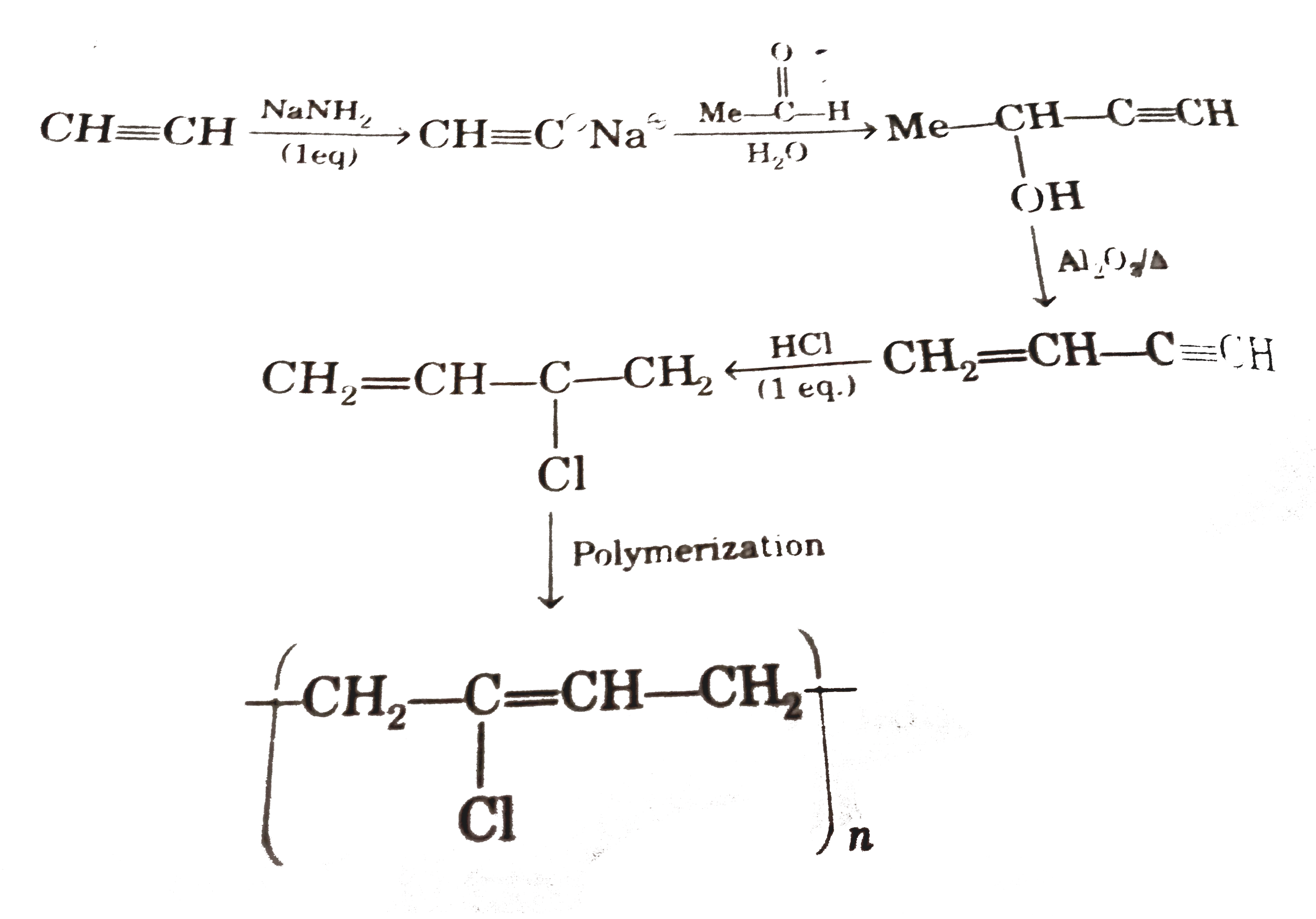
|
|
| 39. |
Henry's law constant K of CO_(2) in water at 25^(@) C is 3 xx 10^(-2) mol/L atm^(-1). Calculation the mass of CO_(2) present in 100 L of soft drink bottled with a partial pressure of CO_(2) of 4 atm at the same temperatrue. |
| Answer» ANSWER :D | |
| 40. |
HBr reacts with CH_2 = CH - OCH_3under anhydrous conditions at 25^@Cto give |
|
Answer» `H_3C - CHBR - OCH_3` |
|
| 41. |
Henry's law constant for the molality of methane in benzene at 298 K is 4.27 xx10^5 mm Hg. Calculate the solubility of methane in benzene at 298 K under 760 mm Hg. |
|
Answer» <P> Solution :`K_H = 4.27 xx 10^5 MM, p = 760 mm`Applying Henry.s law `p = K_H x " or " x = (p)/(K_H)` Substituting the VALUES, we have ` x=(760mm)/(4.27 xx 10^5 mm) =- 1.78 xx 10^(-3) ` i.e., MOLE fraction of methane in benzene = `1.78 xx 10^(-3)` |
|
| 42. |
Henry's law constant for CO_(2) in water is 1.67xx108 Pa at 298 K. Calculate the quantity of CO_(2) in 500 mL of soda water when packed under 2.5 atm CO_(2) presure at 298 K. |
|
Answer» Solution :It is given that : `K_(H)=1.67xx10^(8)Pa` `p_(CO_(2))=2.5 ATM = 2.5xx1.01325xx10^(5)Pa` `= 2.533125xx10^(5)Pa` According to Henry.s law : `p_(CO_(2))=K_(H).chi` `chi=(p_(CO_(2)))/(K_(H))=(2.533125xx10^(5))/(1.67xx10^(8))=0.00152` `chi =(n_(CO_(2)))/(n_(CO_(2))+n_(H_(2)O))=(n_(CO_(2)))/(n_(H_(2)O))` `nCO_(2)` is neglected as COMPARED to `nH_(2)O` [since],in 500 mL of soda water, the volume of water = 500 mL [Neglecting the AMOUNT of soda present] We can write : Mole of water `= (500)/(18)=2.78` MOL `chi=(n_(CO_(2)))/(n_(H_(2)O))=(n_(CO_(2)))/(27.78)=0.00152` `n_(CO_(2))=0.042 mol` Hence, quantity of `CO_(2)` in 500 mL of soda water `= (0.042xx44)G` = 1.848 g. |
|
| 43. |
Henry's law constant for CO_(2) in water is 1.67xx10^(8) Pa at 298 K. Calculate the quantity of CO_(2) in 500 mL of soda water when packed under 2.5 atm CO_(2) pressure at 298 K. |
|
Answer» SOLUTION :`K_(H)=1.67xx10^(8)"Pa,"p_(CO_(2))="2.5 atm"=2.5xx101325Pa` `"Applying Henry's law, "p_(CO_(2))=K_(H)xx x_(CO_(2))` `therefore""x_(CO_(2))=(p_(CO_(2)))/(K_(H))=(2.5xx101325Pa)/(1.67xx10^(8)Pa)=1.517xx10^(-3),"i.e.,"(n_(CO_(2)))/(n_(H_(2)O)+n_(CO_(2)))~=(n_(CO_(2)))/(n_(H_(2)O))=1.517xx10^(-3)` `"For 500 mL of SODA water, water present "~="500 mL = 500 G "=(500)/(18)="27.78 moles"` i.e.,` n_(H_(2)O)="27.78 moles"` `therefore (n_(CO_(2)))/(27.78)=1.517xx10^(-3)or n_(CO_(2))=42.14xx10^(-3)" mole = 42.14 m mol "=42.14xx10^(-3)xx44g=1.854g.` |
|
| 44. |
Henry's law constant for CO_2 in water is 1.67 xx 10^8 Pa at 298 K. Calculate the quantity of CO_2 in 500 mL of soda water when packed under 2.5 atm CO_2pressure at 298 K. |
|
Answer» Solution :`K_H = 1.67 xx 10^8 Pa, P_(CO_2)` = 2.5 ATM = `2.5 xx 101325 Pa` APPLYING Henry.s law, `P_(CO_2) = K_H xx x_(CO_2) " or " x_(CO_2) = (P_(CO_2))/(K_H)` Substituting the values, we get ` x_(CO_2) = (2.5 xx 101325 Pa)/(1.67 xx 10^8 Pa) = 1.517 xx 10^(-3)` `(n_(CO_2))/(n_(H_2O) + n_(CO_2)) = (n_(CO_2))/(n_(H_2O))= 1.517 xx 10^(-3)` For 500 mL of soda water, water present ` = 500/18 = 27.78 `moles i.e., `n_(H_2O) = 27.78` moles ` therefore (n_(CO_2))/(27.78) = 1.517 xx 10^(-3)` `n_(CO_2)= 27.78 xx 1.517 xx 10^(-3) `mole = `42.14 xx 10^(-3) xx 44 g = 1.854 g ` |
|
| 45. |
Henry'slawconstan for thesolubilityof methane in benzene is 4.27 xx 10^(-5) mm^(-1) Hgmol dm^(-3) at constant temperature.Calculate thesolubilityof methane at760 mm Hg pressureat sametemperature . |
|
Answer» `=4.27 xx 10^(-5) MM^(-1) Hg"mol" dm^(-3)` Pressure ofthe gas = P = 760 mm Hg `K= 4.27xx 10^(-5) mm^(-1) "mol" dm^(-3)` `=3245 xx 10^(-5) xx 760 atm^(-1) "mol" dm^(-3)` `=3.245 xx 10^(-2)atm^(-1)"mol" dm^(-3)` `P= 760 mm = (760)/(760)atm= 1 atm` By Henry's,law `S= K xx P = 3.245 xx 10^(-2) atm^(-1) "mol" dm^(-3) xx 1 atm ` `=3.245 xx 10^(-2)"mol" dm^(-1)` |
|
| 47. |
Henderson's equation is pH = pK_(a) + log.(["salt"])/(["acid"]). If the acid gets half neutralized the value of pH will be : [pK_(a) = 4.30] |
|
Answer» 4.3 `pH = 4.3 + log .((1)/(2))/((1)/(2)) = 4.3 + log 1, pH = 4.3 + 0 = 4.3`. |
|
| 48. |
HBr molecule has internuclear distance of 1.27xx10^(-10)m. The electronic charge is 4.8xx10^(10) esu. Observed dipole moment is 1.03 D. find % ionic character of the bond. |
|
Answer» Solution :% lonic CHARACTER `=(mu_(("observed")))/(mu_(("THEO")))xx100` `=(1.3xx100)/(1.27xx10^(-8)xx4.8xx10^(-18))=(1.03)/(6.096)xx100=16.80` |
|