

Saved Bookmarks
This section includes 7 InterviewSolutions, each offering curated multiple-choice questions to sharpen your Current Affairs knowledge and support exam preparation. Choose a topic below to get started.
| 1. |
Half life period of a reaction is directly proportional to initial concentration of the reactant. What is the order of this reaction? |
|
Answer» SOLUTION :Half LIFE of the zero order REACTION is directly proportional to INITIAL concentration of the reactant. `t_(1//2)=([R]_(0))/(2K)""rArr""t_(1//2)alpha[R]_(0)` The order of the reaction is zero order. |
|
| 2. |
Half-life period of a zero order reaction is |
|
Answer» PROPORTIONAL to INITIAL CONCENTRATIONS of REACTANTS |
|
| 3. |
Half-life period of a radioactive element is 100 seconds. Calculate the disintegration constant and average life period. How much time will it take for 90% decay? |
|
Answer» Solution :`t^(1//2)=100 SEC` average LIFE period `tau=(1)/(lambda)=(1)/(0.00693)=1.44 sec^(-1)` `=(2.303)/(0.00693) LOG (100)/(10)` `=(2.303)/(0.00693) log 10=332.3 sec` |
|
| 4. |
Half life period of a radio active element is 1500 years. Find the value of disintegration constant interms of second. |
|
Answer» SOLUTION :`LAMBDA=(0.693)/(t^(1//2)) =(0.693)/(1500 yrs)` `=(0.693)/(1500xx365xx24xx60xx60 sec)` `=0.1465 xx10^(-10) sec^(-1)` |
|
| 5. |
Half life period of a first-order reaction is 1386 seconds . The specific rate constant of the reaction is |
|
Answer» `5. 0 xx 10^(-3) s^(-1)` |
|
| 6. |
Half-life period of a first order reaction is |
|
Answer» directly proportional to initial concentration a. |
|
| 7. |
Half-life period of a first - order reaction is 1386 seconds. The specific rate constant of the reaction is |
|
Answer» `5.0xx10^(-2)s^(-1)` |
|
| 8. |
Half life period of a first order reaction is 10min. Starting with initial concentration 12 M. The rate after 20 min is |
|
Answer» `0.0693 xx3 MIN^(-1)` =0.0693 `min^(-1)` `t= (2.303)/(k) "LOG" ([R]_(0))/([R])` `20 = (2.303)/(0.0693)"log" (12)/([R])` or `"log"(12)/([R]) = 0.601` `(12)/([R])` = Antilog (0.601)=4 . or `[R] =(12)/(4) =3` RATE after 20 min Rate =`k[R]^(1)` `=0.0693xx3` M `min^(-1)` |
|
| 9. |
Half life ofreaction is found to be inversely proportional to the cube of its initial concentration.The order of reaction is |
|
Answer» 2 |
|
| 10. |
Half-life of radius is 1580 yr. Its average life will be |
|
Answer» `2.5 xx 10^(3) YR` `1.44 xx 1580 = 2275.2 = 2.275 xx 10^(3) yr` |
|
| 11. |
Half life period is independent of initial concentration of reactant for |
|
Answer» FIRST order REACTION |
|
| 12. |
Half-life of a reaction is found to be inversely proportional to the cube of its initial concentration. The order of reaction is |
|
Answer» 2 |
|
| 13. |
Half - life of polonium is of |
|
Answer» 138 days |
|
| 14. |
half life of a radioactive substance which disintegrates by 75% in 60 minutes will be |
|
Answer» SOLUTION :75% of the substance disintegrates into two half lives. `:.` 2 half - lives = 60 min `:. t_(1//2) = 30` min. |
|
| 15. |
Half-life of a reaction is found to be inversely proportional to the cube of initial concentration. The order of reaction is |
|
Answer» 5 `t_(1//2)=(K)/(a^(n-1))` a is the initial concentration of reactant. `t_(1//2)prop(1)/(a^(3))""thereforet_(1//2)=(K)/(a^(3))` `(K)/(a^(n-1))=(K)/(a^(3))impliesa^(3)=a^(n-1)` `impliesn-1=3impliesn=4`. `therefore`The order of the reaction is 4. |
|
| 16. |
Half-life of a radioactive substance is 120 days. After 480 days, 4 g will be reduced to |
|
Answer» 2 |
|
| 17. |
Half-life of a radioactive element is 100 yr. The time in which it disintegrates to 50% of its mass, will be |
| Answer» Solution :`t = 100` YEARS | |
| 18. |
Half-life of a radioactive disintegration (A rarr B) having rate constant 231 s^(-1) is |
|
Answer» `3.0 XX 10^(-2) s` |
|
| 19. |
Half-life of a first order reaction is 5xx10^(4)s. What percentage of the initial reactant will react in 2 hours? Calculate. |
|
Answer» Solution :`k=(0.693)/(t_(1//2)) and k=(2.303)/(t)"log"([R]_(0))/([R])` From these two EQUATIONS, we have `(0.693)/(t_(1//2))=(2.303)/(t)"log"([R]_(0))/([R])` Substituting the VALUES, wehave `(0.693)/(5XX10^(4))=(2.303)/(7200)"log"([R]_(0))/([R])` or `"log" ([R]_(0))/([R])=(0.693xx7200)/(5xx10^(4)xx2.303)=(4989.6)/(11.515xx10^(4))=0.0433` or `([R]_(0))/([R])=1.105 or ([R])/([R]_(0))=(1)/(1.105)` PERCENTAGE `=(1)/(1.105)xx100=90.49%` |
|
| 20. |
Half life of a first order reaction completes in 5 minutes. What persent of reactant reacts after 40 minutes ? |
|
Answer» Solution :`t_(½) = 15 min` `K = (0.693)/(t_(½))` `= (0.693)/(15)` `K = 0.0462 min^(-1)` For first order REACTION, `K = (2.303)/(t) log_(10)((a)/(a-x))` `a = 100 K =0.0462 min^(-1), x = ? T = 40 min` `0.0462 = (2.303)/(40) log_(10)((100)/(a-x))` `log_(10)((100)/(a-x)) = 0.8024` `(100)/(a-x)` antilog (0.8024) `a-x = (100)/(6.345)` `a-x = 15.76` `x = 100 - 15.76` `x = 100 - 15.76` `:. x = 84.24%` |
|
| 21. |
Half life of a certain zero order reaction, A rightarrow P is 2 hour when the initial concentration of the reactant, 'A' is 4 mol L^(-1). The time required for its concentration to change from 0.40 to 0.20 mol L^(-1) is |
|
Answer» 0.75 min |
|
| 22. |
Half-lifeof ""^(210)Pb is 22 years. 2gram of lead is allowed decay for 11 years. (a) How much lead is left?and (b) Whatis the percentage decay ? |
|
Answer» Solution :Radioactive decay follows FIRST ORDER kinetics Number of half - lives `"(n)"=("Total - TIME")/("Half - life")=(11y)/(22y)=1/2=0.5`. (a) AMOUNT of lead left undecayed `=("Amount of lead taken")/(2^(n))=(2)/(sqrt(2))=1.414g` (b) Amount of lead decayed = Amount taken - left amount `=2-1.414=0.586g` Percentage pf lead decayed `=(0.586xx100)/(2)=29.3%`. |
|
| 23. |
Half-life is the time in which 50% of radioactive element disintegrates. Carbon -14 disintegrates 50% in 5770 years. Find the half-life of carbon -14 |
| Answer» Solution :`t_(1//2) = 5770` years | |
| 24. |
Half-cell reactions are given below : Mn^(2+)+2e^(-) to Mn,E_(0)=-1.18V 2(Mn^(3+)+e^(-) to Mn^(2+)),E_(0)=+1.51V then what is E_(0) for 3Mn^(2+) to Mn+2Mn^(3+) ? |
|
Answer» `-0.33V`, no REACTION `underset(+3)(3MN^(2+)) to underset(0)(M)n+underset(+3)(2MN)^(3+)` So, half OXIDATION : `2Mn^(2+) to 2Mn^(3+)+2e^(-)("Anode")` `UNDERLINE("and half reduction : "Mn^(2+)+2e^(-) to Mn" (Cathode)")` Total reaction : `3Mn^(2+) to Mn+2Mn^(3+)` So `E_("reaction")^(@)=E_("reduction")^(@)("Cathode")-E_("red")^(@)("Anode")` `=E_(Mn^(2+)|Mn)^(@)-E_(Mn^(3+)|Mn^(2+))^(@)` `=(-1.18-1.51)` `=-2.69V` `E_("Reaction")^(@) lt 0` so no reaction is possible and here, `E_(("Reaction"))^(@)=-2.68V=-2.69V`. |
|
| 25. |
Half-life for radioactive C^(14) is 5760 years. In how many years 200 mg of C^(14) sample will be reduced to 25 mg |
|
Answer» 11520 years n = 3, NUMBER of half lives = 3 so time required `= 3xx 5760 = 17280 yr` |
|
| 26. |
Half life for radioactive ""^(14)C is years. In how many years, 200 mg of ""^(14)C sample will be reduced to 25 mg ? |
|
Answer» 23040 years |
|
| 27. |
Hair shampoos belong to which class of synthetic detergent ? |
Answer» Solution :Hair shampoos are made up of cationic detergents. These are quartenary AMMONIUM SALTS of amineswith acetates, chloride or bromidesas anions e.g., cetyltrimethyl ammonium BROMIDE. 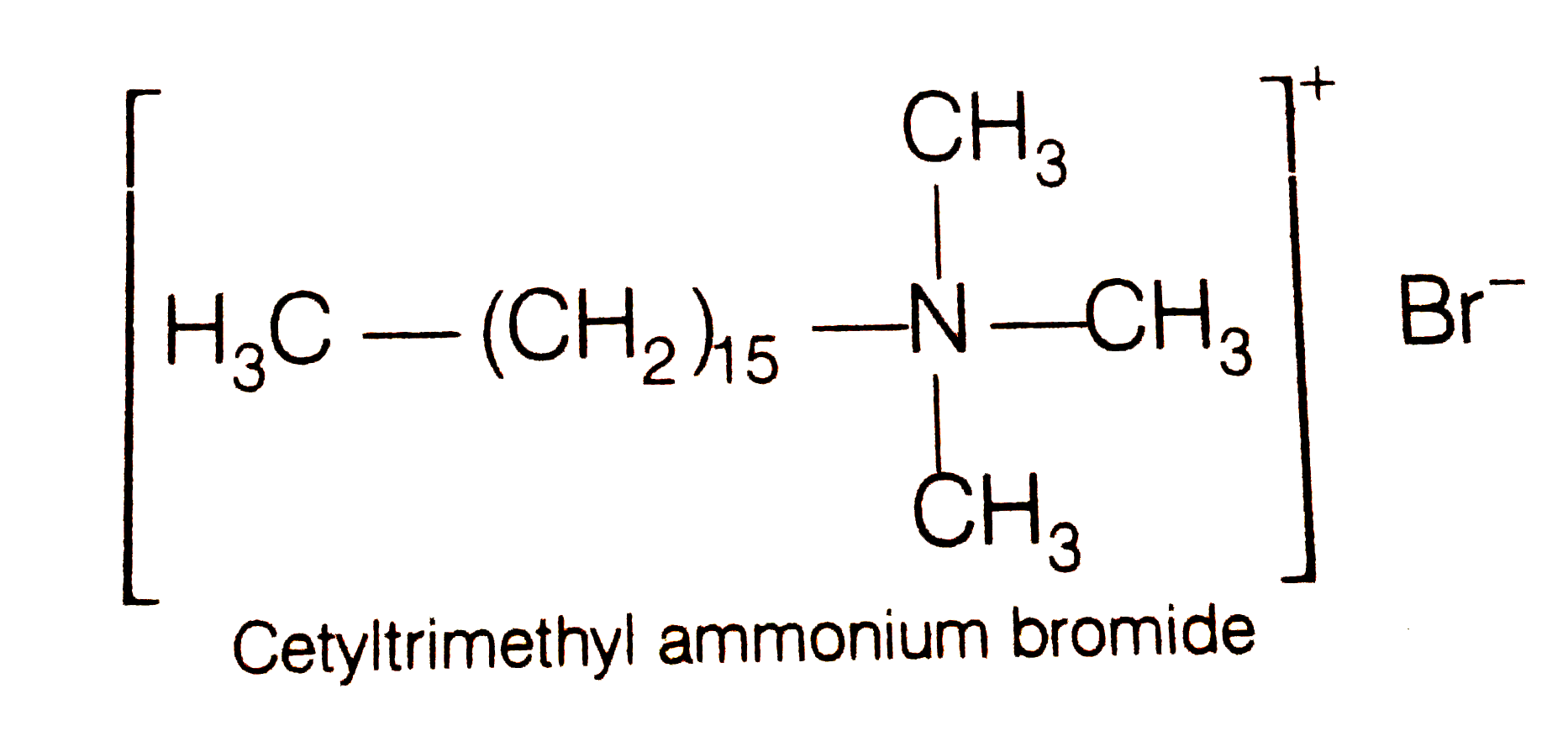
|
|
| 28. |
Hair shampoos belong to which class of detergents ? |
| Answer» SOLUTION :CATIONIC DETERGENTS. | |
| 30. |
Hair dyes contain |
|
Answer» COPPER sulphate |
|
| 31. |
Hair cream is .................. |
|
Answer» SOLUTION :Emulsion dispersedphase Dispersionmedium - LIQUID |
|
| 33. |
Hair cream is |
|
Answer» gel DISPERSION MEDIUM - liquid |
|
| 36. |
Haemophilia is a disease caused by deficiency of: |
|
Answer» RBCs |
|
| 38. |
Human haemoglobin is made up of |
|
Answer» 4 HAEME units and one globular protein |
|
| 39. |
haemoglobin (Hb) binded with oxygen and give oxy-haemoglobin (HbO_(2)). This process is partially regulated by the concentration of H_(3)O^(+) annd dissolved CO_(2) in blood as HbO_(2)+H_(3)O^(+)+CO_(2)hArr H^(+)-Hb-CO_(2)+O_(2)+H_(2)O If there is production of Lactic acid and CO_(2) in an muscle exercise then |
|
Answer» More `O_(2)` is release |
|
| 40. |
Haemoglobinin the example of |
|
Answer» SIMPLE protein |
|
| 41. |
Haemoglobin is …….. |
|
Answer» an ENZYME |
|
| 42. |
Haemoglobin is………………… |
|
Answer» an ENZYME |
|
| 43. |
Haemoglobin contains 0.334% of Fe by weight. The molecular weight of haemoglobin is approximately 67200. The number of Fe atoms present in one molecule of haemoglobin is |
|
Answer» 1 |
|
| 45. |
Haemoglobin contains 0.33% of iron by weight. The molecular weight of haemoglobin is approximately 67200. The number of iron atoms (at. wt. of Fe = 56) present in one molecule of haemoglobin is |
|
Answer» 6 `=222U = 222/56 = 4` atoms. |
|
| 46. |
Haemoglobin contains 0.33% of iron by weight . The mol. Wt. of haemoglobin is approx.67200. The no of iron atoms (at.wt. of Fe = 56) present in one molecule of haemoglobin are : |
|
Answer» 1 |
|
| 47. |
Haemoglobin contains 0.25% iron by mass . The molecular mass of haemoglobin is 89600 then the number of iron atoms per molecule of haemoglobin(Atomic mass of fe = 56) |
|
Answer» |
|
| 48. |
Haemoglobin contains 0.25% iron by mass. The molecular mass of haemoglobin is 89600. calculate the number of iron atoms per molecule of haemoglobin. |
|
Answer» |
|
| 49. |
Haemoglobin contains 0.33% of iron by weight. The molecular mass of haemoglobin is about 67200. The number of iron atoms (at. mass of Fe=56) present in one molecule of haemoglobin is: |
|
Answer» 6 ` = (67200)/(6.022 XX 10^23)` Mass of IRON ` = (67200)/(6.022 xx 10^23) xx (0.33)/(100)` `= 3.682 xx 10^(-22) g ` 56 g of iron contains `6.02 xx 10^23` atoms ` 3.682 xx 10^(-22) g ` of iron contains ` = (6.02 xx 10^23)/(56) xx 3.682 xx 10^(-22)` = 4 atoms |
|