Saved Bookmarks
This section includes 7 InterviewSolutions, each offering curated multiple-choice questions to sharpen your Current Affairs knowledge and support exam preparation. Choose a topic below to get started.
| 1. |
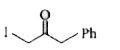
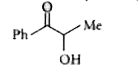
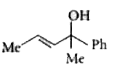
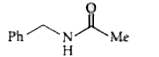
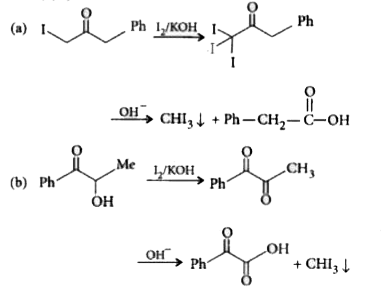
Haloform reaction with l_(2) and KOH will be responded by |
|
Answer»
|
|
| 3. |
Haloform reaction is used for preparing |
|
Answer» `CH_(2)Cl_(2)` |
|
| 4. |
Haloform reaction is not given by |
|
Answer» `CH_(3)COCH_(3)` |
|
| 5. |
Haloform reaction cannot be used to prepare |
|
Answer» `CHF_(3)` |
|
| 6. |
Haloform reaction does not take place with : |
|
Answer» Methanol |
|
| 7. |
Haloform reaction does not take place with |
|
Answer» acetone |
|
| 8. |
Haloform are trihalogen derivatives of |
|
Answer» methane |
|
| 9. |
Halobenzene is treated with Na in ethereal medium to form |
|
Answer» o-Dihalobenzene |
|
| 10. |
Haloarenes undergo nucleophilic and eletrophilic subsitution reactions.Write one example for nucleophilic subsititution reaction of chlorobenzene. |
Answer» SOLUTION :
|
|
| 11. |
Haloarenes undergo nucleophilic and eletrophilic subsitution reactions. write two examples for ambident nucleophiles |
| Answer» SOLUTION :`CN^- , NO_2^-` | |
| 12. |
Haloarenes are less reactive than haloalkanes, why? |
|
Answer» SOLUTION :This is due to the following reasons: (i) Haloarene involves resonance. eg. CONSIDER chloro berizene. It has 5 resonating STRUCTURES.  Haloalkane has only one STRUCTURE eg. `CH_(3)-Cl`. `:.` Haloarenes are more stable. (ii) `"In Haloarene" = overset(sp^(2))overset(|)C-X` bond is lens polar than in haloalkanes. (iii) In haloarene  bond length is less than in haloalkanes bond length is less than in haloalkanes
|
|
| 13. |
Haloarenes show mostly |
|
Answer» ELECTROPHILIC addition |
|
| 14. |
Haloarenes are less reactive than haloalkanes and haloalkenes. Explain. |
|
Answer» Solution :The ELECTRON pair on chlorine is involved in a RESONANCE with `pi` - electrons of a ring. As a result, the C - Cl BOND assumes partial doubled bond character which becomes difficult to break. THUS, reactivity DECREASES. 
|
|
| 15. |
Haloalkanes undergo beta-elimination reaction in presence of alcoholic potassium hydroxide. Which is the major product obtained by the beta-elimination of 2-bromopentane. |
| Answer» SOLUTION :Pent-2-ene | |
| 16. |
Haloalkanes undergo beta-elimination reaction in presence of alcoholic potassium hydroxide. Name the rule , which leads to the product in the above elimination reaction. |
| Answer» SOLUTION :ZAITSEV's RULE | |
| 17. |
Haloalkanes react with KCN to form alkyl cyanides as main product while AgCN forms isocyanides as the chief product. Explain. |
| Answer» Solution :KCN is predominantly IONIC and provides cyanide ions in solution. Although both carbon and nitrogen atoms are in a position to donate electron pairs, the attack TAKES place mainly through carbon atom and not through nitrogen atom since C - C BOND is more STABLE than C - N bond. However, AgCN is mainly covalent in NATURE and nitrogen is free to donate electron pair forming isocyanide as the main product. | |
| 18. |
Haloakanes react with KCN to form alkyl cyanides as main product while AgCN forms isocyanides as the chief product . Explain . |
| Answer» Solution :KCN is mainly ionic compound and provides CYANIDE ions in solution. THOUGH each CARBON and nitrogen carry a lone pair of electrons, the lone pair on carbon is more reactive. The carbonium ion, `R^(+)`, preferentially combines with the carbon ATOM of the cyanide GROUP and forms alkyl cyanide. On the other hand, AgCN is mainly a covalent compound and only nitrogen has the lone pair of electrons. Thus, carbonium ion attacks through nitrogen and there by forms an alkyl isocyanide | |
| 19. |
Haloalkanes contain halogen atom(s) attached to the sp^(3)hybridised carbon atom of an alkyl group. Identify haloalkene from the following compounds. |
|
Answer» Only (II) |
|
| 20. |
Haloalkanes dissolve easily in organic solvents, why? |
| Answer» SOLUTION :Haloalkanes dissolve easily in organic solvents of low poarity such a petroleum ether, benzene, diethyl ether, chloroform, CARBON tetrachloride, ETC. because the NEW forces of attraction set up been haloalkane and solvent molecules are of the same strength as the forces of attraction being BROKEN, i.e., existing between haloalkane-haloalkane and solvent-solvent molecules. | |
| 21. |
Haloalkanes contain halogen atom(s) attached to the sp^(3) hybridised carbon atom of an alkyl group. Identify haloalkane from following compounds. |
|
Answer» 2-Bromopentane (D) Trichloromethane 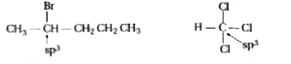
|
|
| 22. |
Haloalkanes can easily be prepared from alcohols while aryl halides cannot be prepared from phenol. Explain. |
Answer» Solution :Alcohols being weak bases easily GET protonated in presence of strong acids like HCl, HBR or HI to form the corresponding protonated alcohols. Due to the presence of +ve charge on the oxygen atom, C-O bond in protonated alcohols becomes weak and hence can be easily cleaved by `Cl^(-),Br^(-)` or `I^(-)` ion to form the corresponding alkyl halide.  In contrast, phenols are much weaker bases than alcohols due to delocalization of the lone pair of ELECTRONS of the oxygen atom over the benzene ring. As a result phenols are not suficiently protonated. further, due to RESONANCE, C-O bond inn phenols has some double bond CHARACTER and hence cannot be easily cleaved by the nucleophiles, such as `Cl^(-),Br^(-)` or `I^(-)` ion to form to corresponding aryl halide. 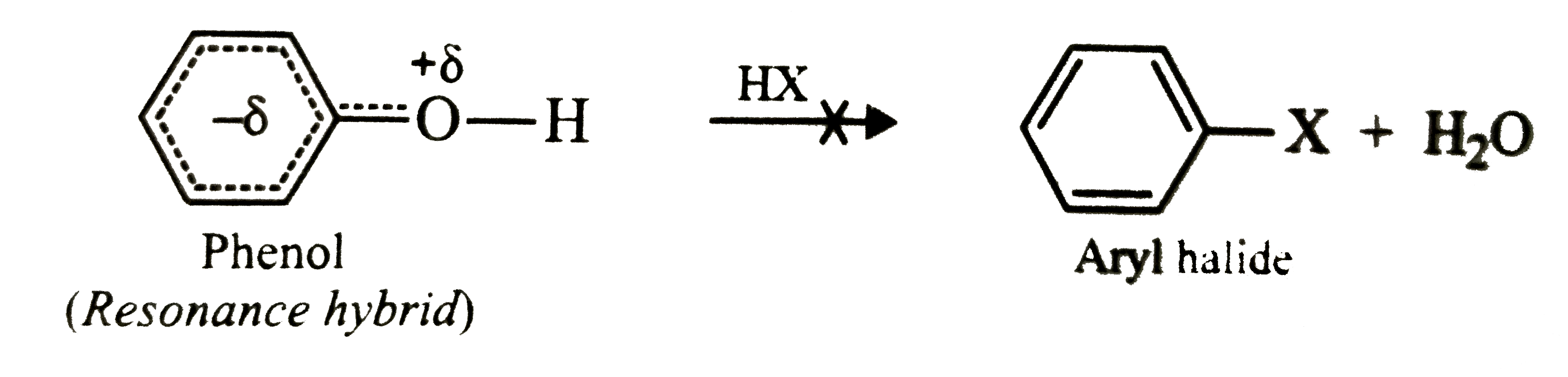
|
|
| 23. |
Why haloalkanes are more reactive than haloarenes towards nuclophilic subsition reaction ? |
| Answer» | |
| 24. |
Haloalkanes and haloarenes react with metals to give hydrocarbons from which hydrocarbons are obtained easily.Identify the product |
Answer» SOLUTION :
|
|
| 25. |
Identify A, B,in the following : |
Answer» SOLUTION :
|
|
| 26. |
Haloalkanes and haloarenes react with metals to give hydrocarbons from which hydrocarbons are obtained easily identify the product and name the reaction. |
Answer» SOLUTION :
|
|
| 27. |
Haloalkane in the presence of alcoholic KOH undergoes |
|
Answer» ELIMINATION |
|
| 28. |
Halo alkane are easily prepared from alcohols while aryl halides cannot be prepared from pehnol.- Justify. |
|
Answer» Solution :(i) ALCOHOLS are weakly basic in nature so easily in presence of strong acids. (ii) DUE to the presence of +ve charge on the oxygen atom, C-O in protonated alcohols became weak hence easily cleaved by halideions to FORM alkyl halides. (III) Where as phenols are much weaker bases due to delocalisation of the lone pair of ELECTRONS on the oxygen atom due to resonance and so are not easily protonated. (iv) The C-O bond in phenols has some double bond character, hence not easily cleaved by halide ions to form respectively aryl halides. |
|
| 29. |
Halo arenes undergo Wurtz- Fitting reaction . Write the formula of A and B in the above reaction. |
| Answer» SOLUTION :A: `C_6H_5N_2Cl`B: `C_6H_5Cl` | |
| 30. |
Halo peridol, clozapine, alprazolam, aspirin, diazepam. |
| Answer» SOLUTION : Aspirin. It is an ANALGESIC and ANTIPYRETIC whereas others are ANAESTHETICS. | |
| 31. |
Halo arenes are less reactive towards nucleophilic substitution reaction than halo alkanes. Give reason. |
Answer» SOLUTION :In halo alkanes, the halogen atom is attached to the carbon atom. As the halogen atom is more electronegative than carbon, the bond between carbon and halogen is POLAR in character.  DUE to the presence of partial positive charge on C-atom, the nucleophiles can attack on electron deficient carbon there by resulting in the displacement of weaker nucleophile, thus reaction of alkyl halide are nucleophilic substitution reaction. `R, X^(-) +Z to R : Z+X^(-) ("Halide ion")` Where as in halo arenes e.g.  halogen atom attached to benzene RING releases electrons towards benzene ring (+m effect) then by the ortho and PARA regions become site of attack for nucleophiles than the electrophiles. 
|
|
| 32. |
Halo alkane in the presence of alcoholic KOH undergoes |
|
Answer» ELIMINATION 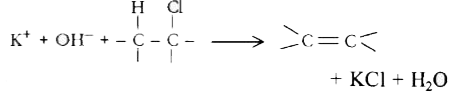
|
|
| 33. |
Hall's process is used for purification of _________. |
|
Answer» WHITE bauxite |
|
| 34. |
Halide which does not get hydrolysed by sodium hydroxide. |
|
Answer» VINYL CHLORIDE |
|
| 35. |
Halides of alkaline earth elements generally form hydrates. This shows that the halides of these elements are: |
|
Answer» HYGROSCOPIC in nature |
|
| 36. |
Halide most readily hydrolyses is (SN_1) |
|
Answer» `C_6H_5CI` |
|
| 37. |
Half the period of a first order reaction is 1386 seconds . The specific rate constant of the reaction is : |
|
Answer» `0.5xx10^(-2) s^(-1)` or `k = (0.693)/(t_(1//2))` `= (0.693)/(1386) = 0.5 xx10^(-3) s^(-1)` |
|
| 38. |
Half-life (t_(1//2)) and completion time (T) of the above reaction (Ato2B) are : |
|
Answer» 500 MIN, 750 min |
|
| 39. |
The product of half life (t_(1//2)) and the square of initial concentration of the reactant is constant. Then the order of reaction is |
|
Answer» zero |
|
| 40. |
Half lives of first order anda zero order reaction are same . Then the ratio of the initial rates of the first order reaction to that of the zero order reaction is |
|
Answer» `(1)/(0.693)` `t_(1//2)` for first order = `(0.693)/(K')` Rate = Initial rate , when `[A_(0)] = 1` So , `(1)/(2k) = (0.693)/(k')` or `(k')/(k) = 2 xx 0.693`. |
|
| 41. |
Halflife(t_(1/2)) of firstorderreaction is |
|
Answer» dependentof concentration |
|
| 42. |
Half lives for first order and zero reactions are the same. The ratio of initial first order reaction is: |
|
Answer» `1/0.693` `t_(1//2) = [A]_(0)/(2k)` For first order reaction `t_(1//2)= 0.693/k` Rate= Initial rate when `[A]_(0) = 1` `THEREFORE 1/(2k) = 0.693/k^(')` `k^(')/k= 2xx 0.693` |
|
| 43. |
Halflifeperiod of first order reaction A rarr productis 6.93 h what is the valueof rate constant ? |
|
Answer» 1.596 `H^(-1)` `t_(1//2)=(0.693)/(k)` where k= RATE constant `therefore 6.93 h=(0.693)/(k) rarr k=(0.693)/(6.93h)` `k=0.1 h^(-1)` |
|
| 44. |
Half life period ............. reaction is directly proportional to initial concentration of the reactant . |
| Answer» SOLUTION :ZERO ORDER | |
| 45. |
half life period of second order reaction is…… |
|
Answer» PROPORTIONAL to the INITIAL CONCENTRATION of reactants |
|
| 46. |
Half life periods for a reaction at initial concentration of 0.1 M and 0.01 M are 5 and 50 minutes respectively. Then the order of reaction is |
| Answer» Answer :C | |
| 47. |
Half life period of zero order reaction is ........... proportional to initial concentration of the reactant. |
| Answer» SOLUTION :DIRECTLY | |
| 48. |
Half life period of a radioactive substance is 1600 minutes . What fraction of the substance will remain after 6400 minutes : |
|
Answer» `1//16` 
|
|
| 49. |
Half life period of a reaction is found to be inversely proportional to the cube of its initial concentration . The order of the reaction is ........... |
|
Answer» 2 |
|
| 50. |
Half life period of a zero order reaction is |
|
Answer» proportional to initial CONCENTRATION of reactants |
|