

Saved Bookmarks
This section includes 7 InterviewSolutions, each offering curated multiple-choice questions to sharpen your Current Affairs knowledge and support exam preparation. Choose a topic below to get started.
| 1. |
Haemoglobin, a complex containing iron is a constituent of blood. The oxidation state of iron in the complex is |
| Answer» ANSWER :B | |
| 2. |
Haematite is reduced in a blastfurnance by |
|
Answer» CO `3Fe_(2)O_(3) +CO overset(300-400^(@)C)to 2Fe_(3)O_(4)+CO_(2)` `Fe_(3)O_(4) +4CO overset(500-600^(@)C)to 3FeO+4CO+(1)/(4)O_(2)` `FeO+CO overset(700^(@)C)to Fe+CO_(2) ` |
|
| 7. |
Haematite, an ore ofiron, firstconcentratedand thencalcined. Thecalcinedore isthen heated in ablastfurnace inpresence ofcoke thelimestone and atthesame timea blastof hot air(pre heated to1000 K ) isintroduced intothe furnace throughtuyeres.Two products(X) and(Y) are obtained. Now answer thefollowingquestions. (a) Whatmethodis used forconcentrationof haematite ore? (b) Whathappensduringcalcination ? (c )Identiythe twoproductsand mention their uses. |
|
Answer» Solution :(a) Sincehaematite`(Fe_2O _ 3 ) `isanoxideore, it isconcentrated bygravityseparationprocess in which the crushedore iswashed in astreamof waterwhen lighersand and clayparticlesare washed awaywhilethe heavierore particlessettledown. (b) Duringcalcination, theimpuritiesof sulphur, phosphorus andarsenicescape as theirvolatile oxides. ` S_8 +8 O_ 2 to8 SO _ 2uparrow, P _ 4+5 O _ 2 toP _ 4O _(10) uparrow ,2 As+5 O _ 2toAs_ 2O_5uparrow ` (c)The variousreactionstakingplacein theblastfurnace are : `CaCO_ 3` decomposes to formCaOand`CO_ 2`. The CaO thus formed actsas aflux andcombines withsilica(present as an IMPURITY ) to formfusiblecalcium silicateslag (N). ` underset("Limestone")(CaCO_3) (s)overset(1123K)toCaO(s) +CO_ 2 (g)` `CaO(s)+SiO_ 2tounderset("Calciumsilicate (slag)") underset (N) (CaSiO_ 3 ) ` Calciumsilicateslag is usedas a buildingmaterialsuchascement. `C (s)+CO_ 2(g) to2CO(g) ` Both COandcokereduce`Fe_2 O _ 3`toFemetal(X). `Fe_2O_ 3 (s) +CO(g) overset (773 -873 K )to2Fe O (s) +CO _ 2(g) ` ` FeO (s)+C(s)overset( gt 1073K )tounderset ("Iron metal (M)")(Fe(s//l)) +CO(g) ` `Fe_ 2O_ 3(s)+3 C (s) overset ( 1073K ) tounderset("Iron metal (M)")( 2 Fe (s//l)) +3 CO(g) ` The ironthusobtainedfromthefurnacecontainsabout 4% carbonand manyimpurities(e.g., S, P, Si, MN) insmaller amount. This is calledpig iron and iscast intoavariety of shapes. |
|
| 8. |
Haberprocessis usedfortheproduction ofwhich ofthe following ? |
|
Answer» ` NH_ 3 ` `N _ 2(g )+3 H _2 (g ) hArr2 NH_ 3( g ) ` |
|
| 10. |
HA is a weak acid. The pH of 0.1 M HA solution is 2. What is the degree of dissociation (alpha) of HA |
|
Answer» 0.5 For weak acid, `[H^(+)] = alpha. C` or, `0.01 = alpha xx 0.1 rArr alpha = 0.1`. |
|
| 11. |
H_(5)IO_(6) is a |
|
Answer» STRONG REDUCING agent |
|
| 12. |
H_3PO_4 is tribasic acid and oneof its salts is NaH_2PO_4..What volume of 1 M NaOH should be added to 12 g NaH_2PO_4 (mol.wt.120) to exactly convert it into Na_3po_4. |
|
Answer» 100ml |
|
| 13. |
H_(3)PO_(4) is a tribasic acid and one of its salts of NaH_(2)PO_(4). What volume of 1 M NaOH should be added to 12 g NaH_(2)PO_(4) (molecular mass = 120 g/mole) to exactly convert it into Na_(3)PO_(4) |
| Answer» Answer :B | |
| 14. |
H_3PO_4 consist of |
|
Answer» <P>two P-OH bonds and 2 P=O bonds |
|
| 15. |
H_(3)PO_(3) is diprotic (or dibasic). Why ? Or What is the basicity of H_(3)PO_(3) and why ? |
Answer» Solution :Its structure is  Since it CONTAINS only TWO ionizable H-atoms which are present as OH GROUPS, it BEHAVES as a dibasic ACID. |
|
| 16. |
H_(3)PO_(3) is diprotic (or dibasic). Why? |
Answer» SOLUTION :Its structure is 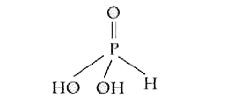 Since it contain only two ionizable H - ATOMS which are present as OH GROUPS, it behaves as a dibasic acid. |
|
| 17. |
H_3PO_3+HNO_3+(NH_4)_2MoO_4to Oxidation number of Mo in product is x. Cr_2O_7^(2-)+H^(+)+NaCl to Oxidation state of Cr in product is y. SCN^(-)+MnO_2toNumber of pi bonds in sulphur containing product is z. Find x+y+z |
|
Answer» y=+6 `CrO_2Cl_2` z=4 `ZtoN^(@)C-S-S-C^(@)N` |
|
| 19. |
H_(3)PO_(3) disproportionates to |
|
Answer» `H_(3)PO_(4) and PH_(3)` |
|
| 20. |
H_(3)PO_(2) overset(140^(@)) rarrA overset(220^(@)C) toB overset(320^(@)C)rarrC. Compound ( C) is : |
|
Answer» `H_(2)PO_(3)` |
|
| 21. |
H_(3)PO_(2) is the formula for one of the phosphorus acids. Its name and basicity are respectively |
|
Answer» PHOSPHOROUS acid and TWO |
|
| 23. |
H_3PO_2 has the name and basicity respectively: |
|
Answer» PHOSPHORUS ACID and two |
|
| 24. |
H_(3)CNH_(2)overset((CH_(2))_(2)O)to(A). What is (A) |
|
Answer»

|
|
| 25. |
[H_(3)C(CH_(2))_(15)-overset(CH_(3))overset("|")underset(CH_(3))underset("|")"N "-CH_(3)]^(+)Br^(-) the given structure is for |
|
Answer» Cetyltrimethyl ammonium BROMIDE |
|
| 26. |
H_3C-undersetunderset(CH_3)|CH-overset+CH=CH_2+HBr to A A (Predominantly ) is |
|
Answer» `CH_3-undersetunderset(BR)|CH-undersetunderset(CH_3)|CH-CH_3` 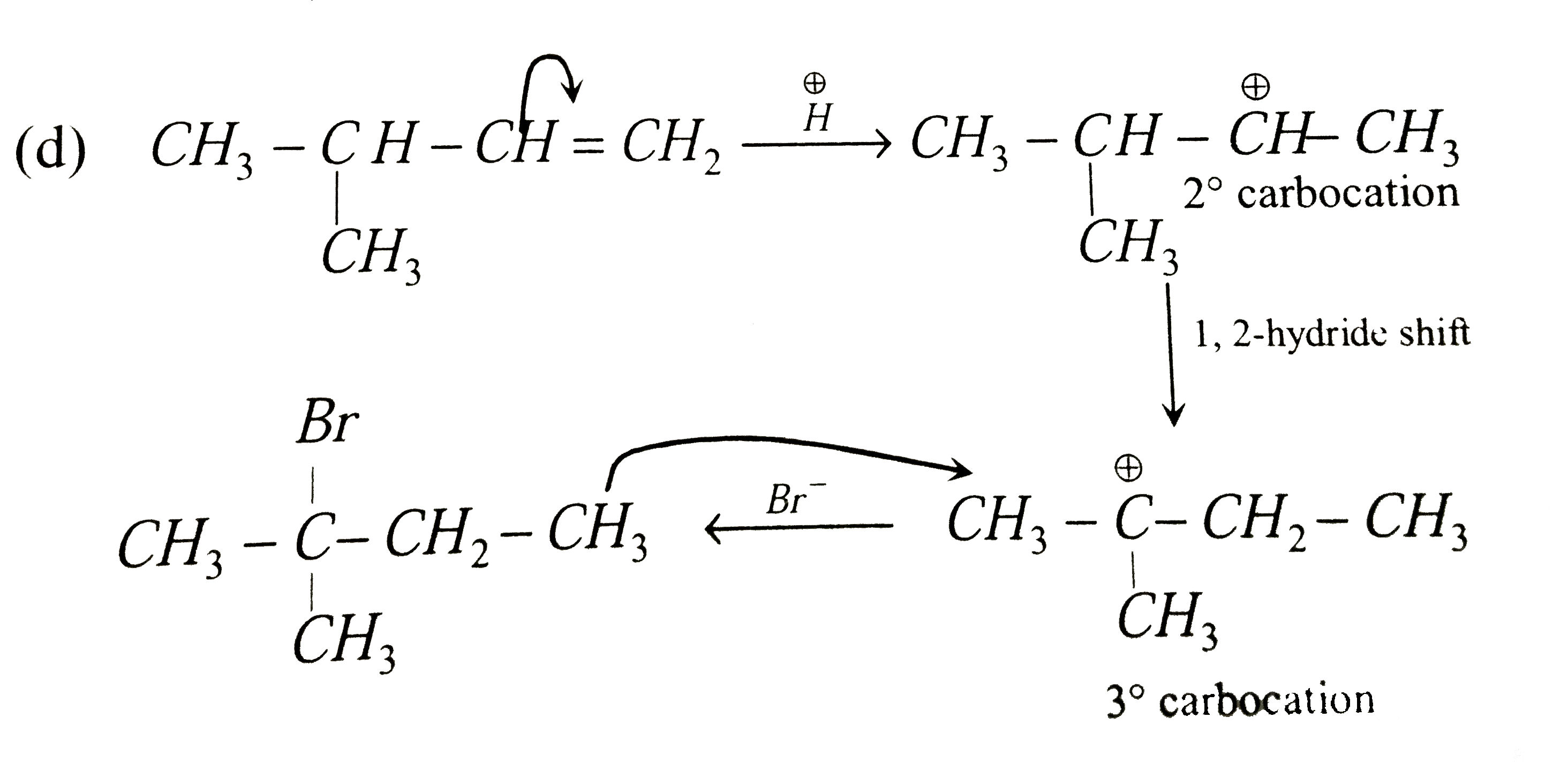
|
|
| 27. |
H_(3)C-underset(CH_(3))underset(|)(C)H-CH=CH_(2)+HBr to A A (predominantly) is |
|
Answer» `CH_(3)-UNDERSET(Br)underset(|)(C)H-underset(CH_(3))underset(|)(C)H-CH_(3)` 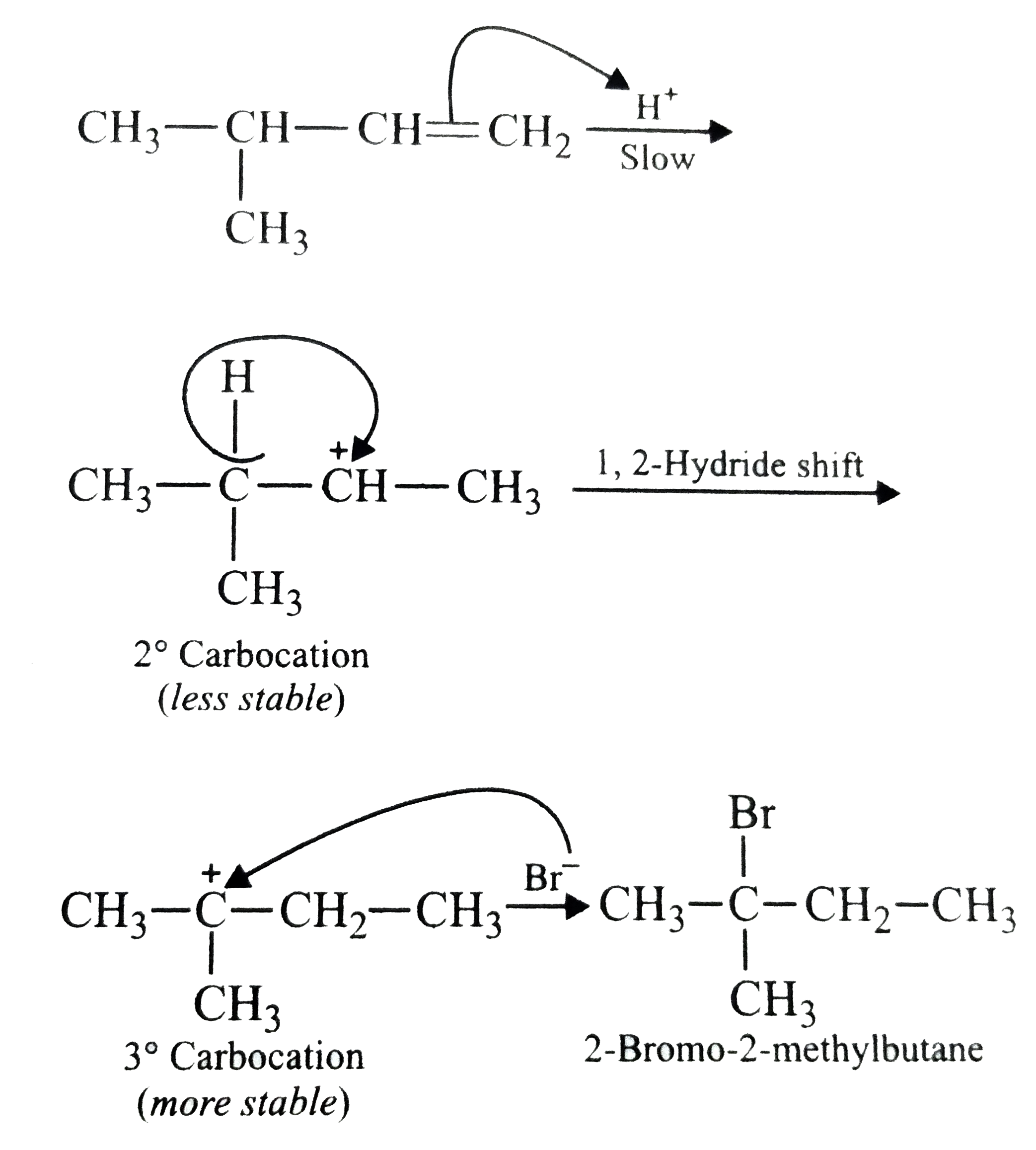 THUS, option (d) is correct. |
|
| 28. |
H_(3)C underset(CH_(3))underset(|) overset(CH_(3)) overset(|) (--) overset(C_(2)H_(5))overset(|)CH-underset(CH_(3))underset(|)(CH)-OH underset(/_\) overset(H^(o+))toP Product mixture, the product's mixture contains |
|
Answer» `H_(3)C-underset(CH_(3))underset(|)(CH)-underset(OH)underset(|)(CH)-overset(CH_(3)) overset(|)(CH)-C_(2)H_(50` 
|
|
| 29. |
H_(3)C-underset(CH_(3))underset("|")(CH)-CH=CH_(2)+HBrrarrA A (predominantly) is : |
|
Answer» `CH_(3)-underset(CH_(3))underset(|)overset(Br)overset(|)(C)-CH_(2)CH_(3)` |
|
| 30. |
H_(3)C-underset(CH_(3))underset("|")("C ")H-CH=CH_(2)overset(HBr)rarr |
|
Answer» `CH_(3)-UNDERSET(CH_(3))underset("|")("C ")H-underset("BR ")underset("| ")("C ")H-CH_(3)` |
|
| 31. |
H_(3)C-underset(CH_(3)) underset(|)overset(CH_(3)) overset(|)(C)-overset(O)overset(||)(C)-CH_(3) underset((ii)"hydrolysis"//H_(3)O^(+))overset((i)F_(3)C-overset(O)overset(||)(C)-O-overset(18)(O)-H)to Products. Which of the following option is/are correct? |
|
Answer» `(CH_(3))_(3)C-OVERSET(18)(OH)` 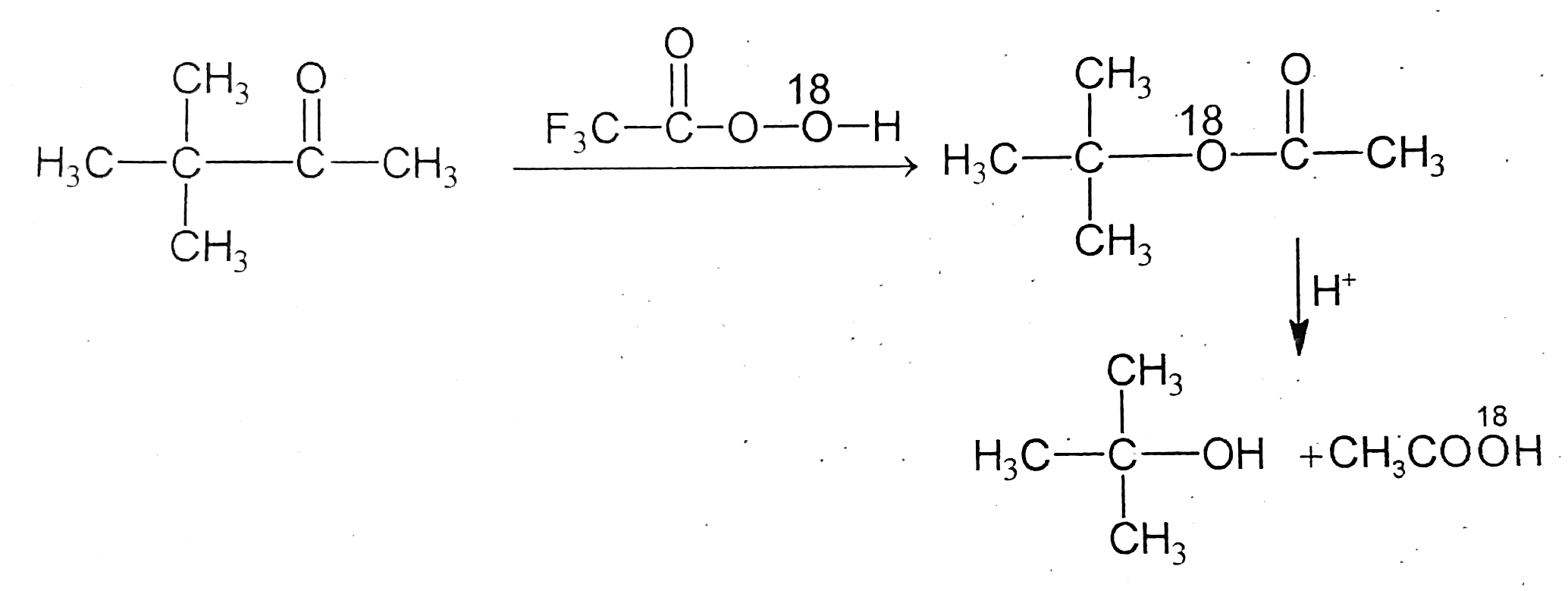
|
|
| 32. |
H_(3)C-overset(O)overset("||")C-OH+C_(2)H_(5)overset(18)(OH)overset(conc. H_(2)SO_(4))rarr(X) H_(3)C-overset(O)overset("||")C-OH+(CH_(3))_(3)C-overset(18)(OH)overset(conc. H_(2)SO_(4))rarr(Y) In the above reaction (X) and (Y) are respectively: |
|
Answer» `CH_(3)-overset(O)overset("||")C-overset(18)(O)-C_(2)H_(5) and CH_(3)-overset(O)overset("||")C-O-overset(CH_(3))overset(|)underset(CH_(3))underset(|)C-CH_(3)` |
|
| 33. |
H_(3)C-overset(O)overset("||")C-O-underset(Ph)underset(|)C=CH_(2)+H_(2)O overset(NaOH)underset(H_(3)^(oplus)O)rarrX+Y X and Y are: |
|
Answer» `X " is "CH_(3)-OVERSET(O)overset("||")C-O-CH_(2)-Ph` |
|
| 34. |
H_(3)C - overset(O)overset(||)(C) - COOH underset((ii) H_(2)//Pd)overset((i) NH_(3)) rarr (A). Identify (A) |
|
Answer» `CH_(3)CONH_(2)` |
|
| 35. |
H_(3)C-CH_(2)-overset(CH_(3))overset(|)CH-underset(O)underset(||)C-NH_(2)overset(Br_(2)+KOH)underset(Delta)toA overset(1.CH_(3)"I(excess)")underset(2.AgOH,Delta)toB. |
|
Answer» `CH_(3)-CH_(2)-CH=CH_(2)` |
|
| 36. |
H_(3)C-CH_(3)overset("Pysolysis")rarrAoverset(1000-200atm)underset("RCOOOCOR")rarrB. Aoverset("ziegler-natta")underset("catalyst")rarrC Here B and C are respectively |
| Answer» Answer :A | |
| 37. |
H_3BO_3 IS _____ acid ? |
|
Answer» MONOBASIC |
|
| 38. |
H_3BO_3 accepts hydroxide ion from water as shown below H_3BO_3(aq)+H_2O(l) leftrightarrow B(OH)_4^(-) + H^+ Predict the nature of H_3BO_3 using lewis concept. |
|
Answer» Solution :Boric acid is also calledas hydrogen BORATE or orthoboric acid . It is a weak MONO basic LEWIS acid of BORON and it is written as `B(OH)_3`. It accepts hydroxyl `(OH^-)` ion from water.It does not dissociate to give hydronium `(H_3O^+)` ion rather forms metaborate ion and this ion in turn give `H_3O^+` ion. `B(OH)_3+H_2O leftrightarrow [B(OH)_4]^-+ H_3O^+` HENCE it is considered as weak acid. |
|
| 39. |
H_(3)BO_(3) is : |
|
Answer» MONOBASIC and WEAK Lewis ACID. |
|
| 40. |
H_(3)BO_(3) acceptshydroxideionfromwatershownbelow, H_(3) BO_(3) (aq) + H_(2)O(l) -> B(OH)_(4)^(-)+ H^(+) Predictthe natureof H_(3)BO_(3) usingLewisconcept. |
|
Answer» Solution :Boricacidis alsocalledas hydrogenborateor orthoboricacid . ITIS aweakmonobasicLewisacidof borronandwrittenas `B(OH)_(4)` . Itacceptshydroxy`(OH^(-))` ION fromwater. Itdoesnotdissociateto givehydronium`H_(3) O^(+)` ion ratherformsionand thisions inturmgive`H_(3)O^(+)` ions `B(OH)_(3)+ H_(2)O= (B(OH)_(4))^(-)= H_(3)O^(+)` Henceit isconsideredas weakacid. |
|
| 41. |
H_3 C CH_2 CO_2 H underset(Delta)overset(NH_3)to X underset(Delta)overset(-OH)toY. What are X and Y ? |
|
Answer» `{:("" X,""Y),(H_3C CH_2 CONH_2,H_3C CH_2CH_2 CO_2 H):}` |
|
| 42. |
H_3 PO_3 has ……non ionisable P-H bonds |
|
Answer» NONE 
|
|
| 43. |
H_(3) C - CH = CH - CH_(2) - underset(NH_(2))underset(|)(CH) - CH_(2) - COOH The IUPAC name of the above compound is |
|
Answer» 5-Amino-hex-2-en carboxylic ACID |
|
| 44. |
CH_3- CH_2-overset(O ) overset(|| ) C - underset(CH_3) underset(|) overset(CH_3) overset(|) C- CH_3overset(PhCO_2 H)toA , Awill be |
|
Answer»

|
|
| 45. |
H_3 BO_3 accepts hydroxide ion from water as shown below H_3 BO_3(aq)+H_2 O (I) B(OH)_(4)^(-)+H^+ Predict the nature of H_3 BO_3 using Lewis concept. |
Answer» SOLUTION :
|
|
| 47. |
H_(2)SO_(4), reacts with PCl_(5) to give |
|
Answer» thionyl chloride |
|
| 48. |
Sulphuric acid reacts with PCl_5 to give |
|
Answer» Thionyl chloride `HO-SO_2-OH+2PCl_5 to Cl-SO_2 -Cl + 2POCl_3 + 2HCL` |
|
| 49. |
H_2SO_4 reacts with sugar and act as: |
|
Answer» A DEHYDRATING agent |
|


