

Saved Bookmarks
This section includes 7 InterviewSolutions, each offering curated multiple-choice questions to sharpen your Current Affairs knowledge and support exam preparation. Choose a topic below to get started.
| 1. |
Give the significance of a 'lattice point. |
| Answer» Solution :The location of the constituent PARTICLES of a solid is CALLED LATTICE point. The constituent particles could be an atom, MOLECULE or ion. | |
| 2. |
Give the significance of (+) sign in the name D-(+)-glucose. |
| Answer» SOLUTION :(+)SIGN INDICATES dextro-rotatory NATURE of GLUCOSE. | |
| 3. |
Give the schematicrepresentation of linear polymers, branchedchain polymer and crossintermolecular forces of elastomersand fibres. |
Answer» SOLUTION :
|
|
| 4. |
Glucosegivessilvermirrorwith Tollen's reagent . It showsthe presence of ………. . |
|
Answer» an ACIDIC GROUP |
|
| 5. |
Give the ring-chain tautomers of 4-ketopentanoic acid (Laevulic acid): |
Answer» SOLUTION :
|
|
| 6. |
Glucose gives silver mirror with ammoniacal nitrate because it has |
|
Answer» aldehyde group |
|
| 7. |
Give the resonating structures of NO_(2)and N_(2)O_(5) |
Answer» SOLUTION : 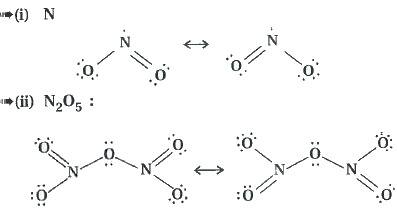
|
|
| 8. |
Glucose gives test with : |
|
Answer» TOLLEN's reagent |
|
| 9. |
Glucose gives silver mirror test with Tollen's reagent.It shows the presence of |
|
Answer» an ACID group |
|
| 10. |
Give the resonating structures of NO_(2) and N_(2)O_(5). |
Answer» SOLUTION :RESONATING structures of `NO_(2)` 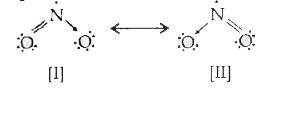 Reasonating STRUCTURE of `N_(2)O_(5)` 
|
|
| 11. |
Glucose gives positive test with |
|
Answer» FEHLING's solution |
|
| 12. |
Give the resonating structures of NO_2and N_2O_5 |
Answer» SOLUTION :
|
|
| 13. |
Glucose gives silver mirror test with Tollen's reagent. It shows the presence of |
|
Answer» CARBOXYLIC GROUP |
|
| 14. |
Give the resonating structures of NO_2 and N_2O_5 . |
Answer» SOLUTION :RESONATING STRUCTURES of `NO_2` are : 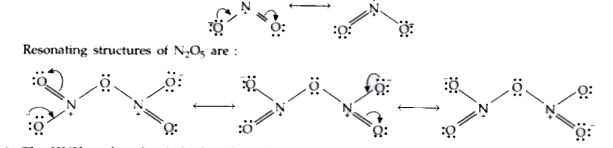
|
|
| 15. |
Give the resonance structure of carboxylate anion. |
Answer» SOLUTION :
|
|
| 16. |
Glucose gives many reactions of aldehyde because: |
|
Answer» It is hydrolysed to acetaldehyde |
|
| 17. |
Give the relationship between the following paris of compounds. |
|
Answer» |
|
| 18. |
Glucose gives many reactions of aldehyde, because |
|
Answer» It is hydrolysed to acetaldehyde |
|
| 19. |
Give the relationship between the equivalent weight and molecular weight of KMnO_(4) in ( a) acidic (b) alkaline and (c ) neutral media. |
| Answer» Solution :(a) `E = M //5` (b) In STRONGLY ALKALINE medium, `E= M` . In WEAKLY alkaline medium `E= M//3`(c ) `E = M//3`. Refer to page. | |
| 20. |
Glucose + Fructose+ Monnose underset("(Excess)")overset(PhNHNH_(2))rarr How many osazone ? |
|
Answer» |
|
| 21. |
Glucose, fructose, galactose, mannose, sucrose. |
| Answer» SOLUTION :SUCROSE. It is a DISACCHARIDE WHEREAS other are MONOSACCHARIDES. | |
| 22. |
Give the relationship between molar conducitivity and specific conductivity. |
|
Answer» SOLUTION :`wedge_(m)=kappaxx(1000)/(M)`, where `KAPPA` is specific conductivity in S `cm^(-1)` and M is the MOLAR concentration in mol `L^(-1)`, `wedge_(m)` is in S `cm^(2)mol^(-1)` or `wedge_(m)=(kappa)/(M)` where `kappa` is S `m^(-1)`, M is in mol `m^(-3),wedge_(m)` is in S `m^(2)mol^(-1)`. |
|
| 23. |
Glucose froms an oxime but glucose pentaacetate does not. Explain. |
| Answer» SOLUTION :Glucose reacts with `NH_2OH` VIA the OPEN chain form which has the free `-CH=O` group to form glucose oxime. Glucose pentaacetate , on the otherhand , cannot be CONVERTED into the open chain form because its anomeric hydroxyl group (i.e., `C_1-OH`) is acetylated and HENCE does not form the oxime. | |
| 24. |
Give the relationship between equivalent and molar conductance of a givne solution? |
| Answer» Solution :`wedge_(m)=KAPPA=(1000)/("MOLARITY") and wedge_(EQ)=kappaxx(1000)/("Normality")therefore(wedge_(m))/(wedge_(eq))=kappaxx("Normality")/("Molarity")` | |
| 25. |
Glucose reacts with acetic anhydride in the pressence of pyridine to give |
|
Answer» di ACETATE |
|
| 26. |
Give the relation between solublity of gas in liquid and Henry's constant. |
| Answer» Solution :Higher the VALUE of `K_(H)` at a given PRESSURE the lower is the solubility of the gas in the liquid. | |
| 27. |
Explain the reduction of nitro methane in different medium. |
|
Answer» SOLUTION :Nitro METHANE on REDUCTION with `Zn"/"NH_4Cl` (nuetral medium reduction) will give ethyl hydroxylamine as product. `{:(CH_3NO_2+4[H]overset(Zn"/"NH_4Cl)(to)CH_3NHOH+H_2O),("Methyl hydroxylamine "):}`. |
|
| 28. |
Glucose forms many derivatives. The derivative which will help to prove the furanose structure is: |
|
Answer» OSAZONE |
|
| 29. |
Give the reason which prompted Bartlett to prepare first noble gas compound. |
| Answer» SOLUTION :Bartlett observed that ionisation enthalpies of Xe and `O_2` are similar. After the PREPARATION of `O_2^(+)PtF_6^(-)` was reported, `O_2^(+) PtF_6^(-)` was reported , he thought `Xe^(+) PtF_6^(-)` compound could be PREPARED (Xe in PLACE of `O_2`). | |
| 30. |
Glucose forms many derivatives. The derivative which will help to prove the furanose structure is |
|
Answer» Acetyl |
|
| 31. |
Give the reduction of nitromethane in (a) acid medium, (b) neutral medium. |
|
Answer» Solution :NITRO METHANE on REDUCTION with `Sn"/"HCl` (ACID medium reduction) produce methylamine as product. `{:(CH_3NO_2+6[H]overset(Sn"/"HCl)(to)CH_3-NH_2+2H_2O),(" Nitro methaneMethylamine "):}`. |
|
| 32. |
Glucose form hemiacetal between CHO group and -OH group on |
|
Answer» C-2 |
|
| 33. |
Give the reason for the formation of a light yellow or white ppt. in the group II even if it may not be because of some metal ion. |
|
Answer» Solution :Yellow or WHITE PPT. is formed due to the oxidation of `H_(2)S` GAS by some oxidising agents to sulphur which FLOATS on the surface `BaSO_(3)+2HCl+2H_(2)StoBaCl_(2)+3H_(2)O+underset(("yellow"))(3S)` `2NaNO_(2)+H_(2)S+2HClto2NO+2NaCl+2H_(2)O+underset(("yellow"))(S)` `2FeCl_(3)+H_(2)Sto2FeCl_(2)+2HCl+underset(("Yellow"))(S)` |
|
| 34. |
Give the reason for the bleaching action of Cl_(2) |
|
Answer» Solution :In presencee of moisture or in aqueous solution, `Cl_(2)` libertes NASCENT oxygen. `Cl_(2) + H_(2)O rarr 2 HCl underset("Nascent oxygen")([O])` This nascent oxygen BRINGS about the oxidation of coloured substances PRESENT in vegetable and organic matter to colourless substances. Coloured SUBSTANCE + O `rarr` Colourless substance Thus, the bleaching action of `Cl_(2)` is due to oxidation. Since the bleaching effect of `Cl_(2)` is permanent, it is used to bleach cotton and textiles and WOOD pulp for manufacture of paper and rayon. |
|
| 35. |
Glucose does not reacts with |
| Answer» Solution :`NaHSO_(3)` | |
| 36. |
Glucose fails to react with A) NaHSO_(3) B) Schiff’s reagent C) PhNHNH_(2) D) Br_(2).H_(2)O |
|
Answer» A,B |
|
| 37. |
Give the reason for the bleaching property of chlorine. |
| Answer» Solution :In aqueous solution or in presence of moisture, chlorine liberates nascent oxygen `Cl_2+H_2Oto2HCl+[O]` This nascent oxygen brings about oxidation of coloured SUBSTANCES PRESENT in vegetable and organic MATTER to COLOURLESS substances. | |
| 38. |
Give the reason for bleaching action of Cl_2. |
|
Answer» Solution :`Cl_2` in presence of moisture produces NASCENT hydrogen which is RESPONSIBLE for bleaching PROPERTY. `Cl_(2) + H_(2)O to underset(HCl + [O])(HOCl) + HCl` Coloured matter `+ [O] to` Colourless |
|
| 39. |
Give the reason for bleaching action of Cl_(2). (with reaction) |
| Answer» Solution :`{:(Cl_(2)+H_(2)OrarrHCl+HOCl),("HOCl"RARR HCl+[O]),(barul(""Cl_(2)+H_(2)Orarr2HCl+[O]" " )"NASCENT OXYGEN"),("Wet coloured material "+[O]rarr"colourless"):}` | |
| 40. |
Glucose does not give violet colour with |
|
Answer» `NaHSO_(3)` |
|
| 41. |
Give the reason for bleaching action of Cl_2 |
|
Answer» Solution :In PRESENCE of moisture or in aqueous solution, `Cl_2` liberates nascent oxygen. `Cl_2 + H_2O to 2HCl + UNDERSET("Nascent oxygen")([O])` This nascent oxygen brings about the oxidation of coloured substances PRESENT in vegetable and organic matter to convert them to colourless substances. Coloured SUBSTANCE + O ` to` Colourless substance Thus, the bleaching action of `Cl_2` is due to oxidation. |
|
| 42. |
Glucose does not give2,4- DNPtest , Schiff's test or does not give sodium bisulphite adduct. Give reacsons. Or Despire having an aldehyde group, glucose not give 2,4-DNP test ? What does this indicate ? |
| Answer» Solution :Although the open chain structure of glucose does contains an aldehyde group , yetit does not give certain characteristic reactions of the `-CHO` group. Fro example, it neither with2,4-dinitrophenylhydrazine to form a 2,4-DNP derivative nor it gives Schiff's test not it REACTS with a concentrated solution of sodium bisulphite to give sodium bisulphate adduct. (The reason being that glucose actually exists in the CYCLIC hemiacetal form with only a small amount `(LT 0.05 %)` of the open chain form. Since the concentration of therefore , formation of 2,4-DNP derivative or `NaHSO_3` adduct or observation of Schiff's test cannot disturb the equilibrium to regenerate more of the open chain form from the cyclic hemiacetal form and hence does not give these TESTS. | |
| 43. |
Give the reactions of nitrous acid with primary secondary and tertiary amines.. (b) Name the products with chemical reactions when the following compounds are hydrolysed: (i) CH_(3)CJH_(2)CN woth dil. HCl (ii) CH_(3)CN with alkaline H_(2)O_(2) (iii) C_(2)H_(5)NC with di. HCl (iv) C_(2)H_(5)NO_(2) with dil. HCl (c ) Explain the formation of the mixture of (i) PhCH_(2)CHO and (ii) PhCOMePh(CHOH)CH_(2)NH_(2) (A) is treated with nitrous acid (d) How nitrobenzene is identified by using Mulliken-Baker test? |
Answer» SOLUTION :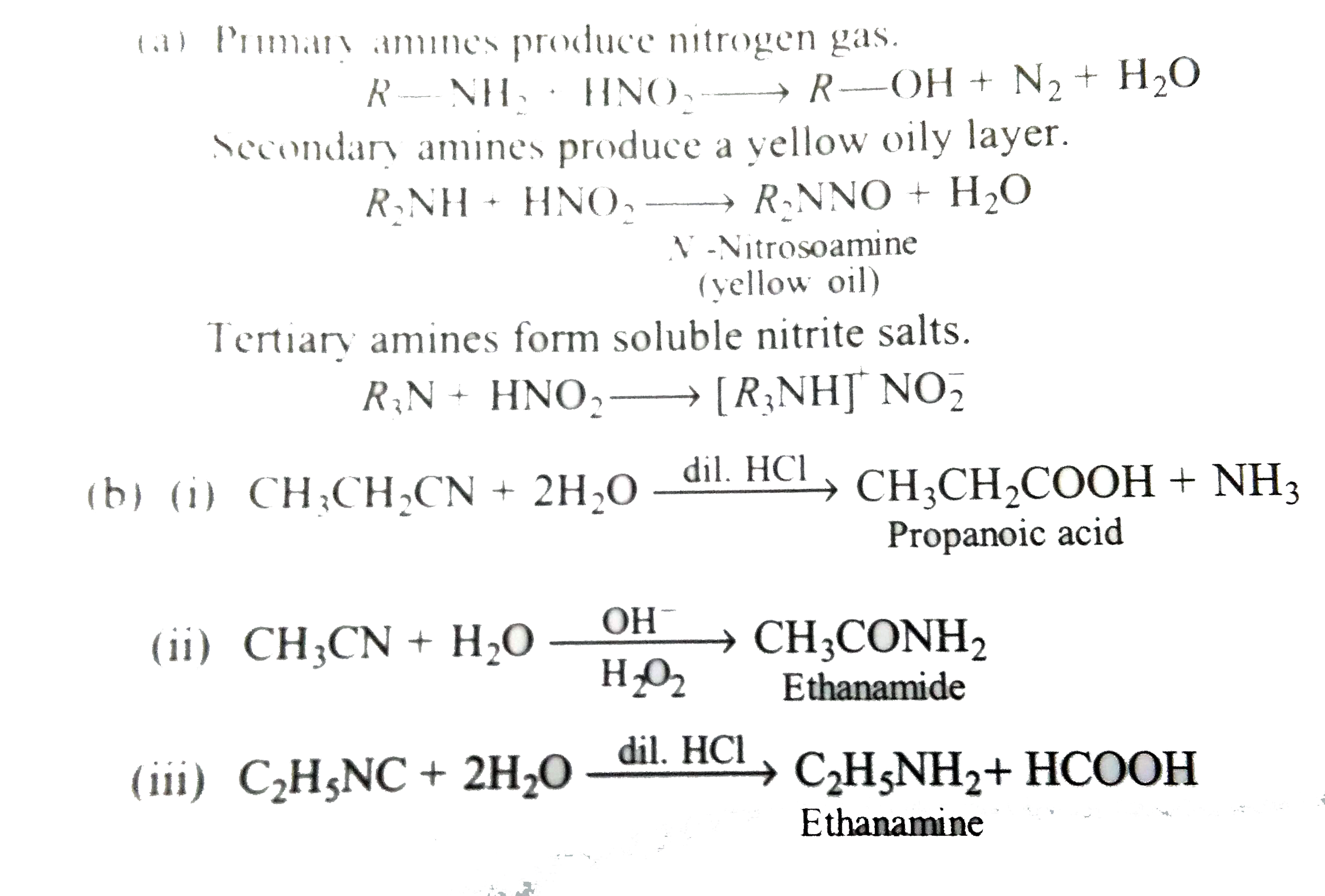 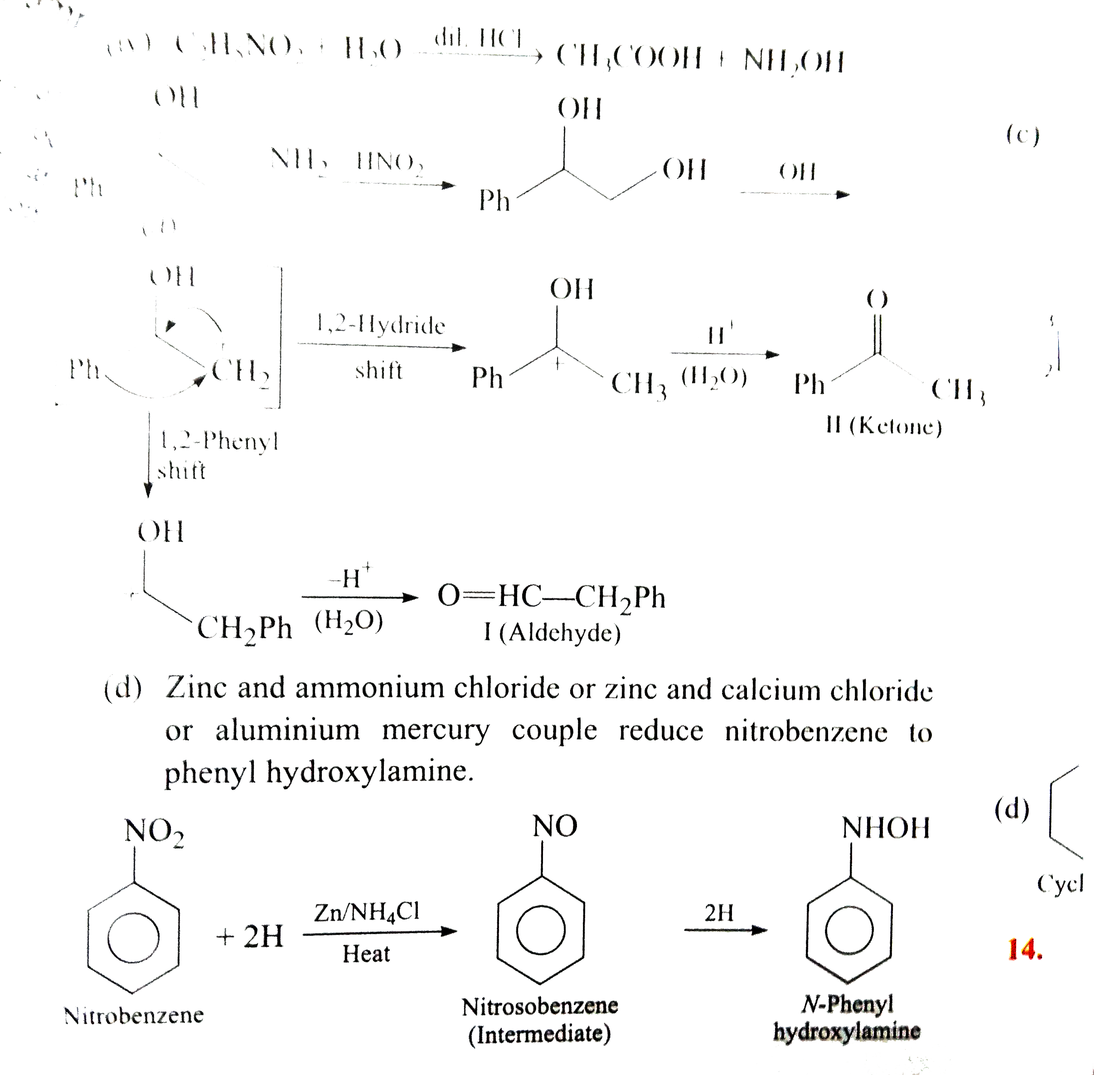 
|
|
| 44. |
Glucose does not react with |
|
Answer» `Br_2//H_2O` |
|
| 45. |
Give the reason for bleaching action of Cl_(2). |
|
Answer» (ii) In aqueous solution, `Cl_(2)` liberates nascent oxygen which brings about the oxidation of coloured substances present in vegetables and organic matter to colourless substances. `Cl_(2)+H_(2)O rarr 2HCl+[O]` Coloured substance `+ [O] rarr` colurless substance. |
|
| 46. |
Glucose dissolves in water to give a neutral solution. What information do you get from this with regard to the structure of glucose? |
|
Answer» Solution :This INDICATES that the glucose molecule does not CONTAIN a carboxyl group. `-overset(O)overset(||)"C"-H` |
|
| 47. |
Give the reagents in the following reactions: |
|
Answer» Solution :(a) `1. Br_(2)+FE,2. Sn+HCl, overset(Θ)H` `3. HNO_(2),0-5^(@)C,4. CUBR` (b) `1. Sn+HCl,2.Ac_(2)O` `3. HNO_(3)+H_(2)SO_(4) ,4. overset(Θ)(O)H` `5. Br_(2)+Fe,6. HNO_(2),0-5^(@)C` `7. CuBr,8. Sn+HCl:overset(Θ)(O)H` `9.HNO_(2),0-5^(@)C,10 H_(3)PO_(2)` (c) `1. Br_(2)+Fe, 2. overset(Θ)(O) H` `3.HNO_(2),0-5^(@)C,4. CuBr` (d) `1. Br_(2)+Fe,2. Sn+HCl:overset(Θ)(O)H` `3. HNO_(2),0-5^(@)C,4.H_(3)PO_(2)` (E) `1.Sn+HCl,2. Ac_(2)O` `3.Br_(2)+Fe,4. overset(Θ)(O)H` `5.HNO_(2),0-5^(@)C,6. CuBr` f. `1.Br_(2)+Fe,2.HNO_(2),0-5^(@)C` `3.H_(3)PO_(2)` |
|
| 48. |
Give the reactions of alcohols with phosphorus halides. |
|
Answer» Solution :`to` Alcohols react with PHOSPHORUS halides such as `PCI_(5), PCI_(3), Pl_(3)` etc. to form corresponding alkyl halides. Phosphorus tribromides and phosphorus tri-iodides are prepared in situ during the REACTION by ACTION of phosphorus on bromine and iodine. `3R - OH + P_(3)(X = Br, I) to 3R – X + H_(3)PO_(3)` `R - OH + PCl_(5) to R - Cl + POCI_(3) + HCI` |
|
| 49. |
Glucose contains in addition to aldehyde group |
|
Answer» ONE secondary OH and FOUR primary OH GROUPS 
|
|
| 50. |
Give the reaction prodcuts when acetophenon, acetaldehyde and cyclohexane undergo reaction with diazomethane. |
|
Answer» Solution :The products of the GIVEN reactions are as FOLLOWS : `Ph= overset(O) overset(||)(C)-CH_(3) overset(CH_(2)N_(2)) to Ph-CH_(2)- overset(O) overset(||)(C)-CH_(3)` `CH_(3)overset(O)overset(||)(C)-H overset(CH_(2)N_(2))toH_(2)C-overset(O) overset(||)(C)-CH_(3)` 
|
|